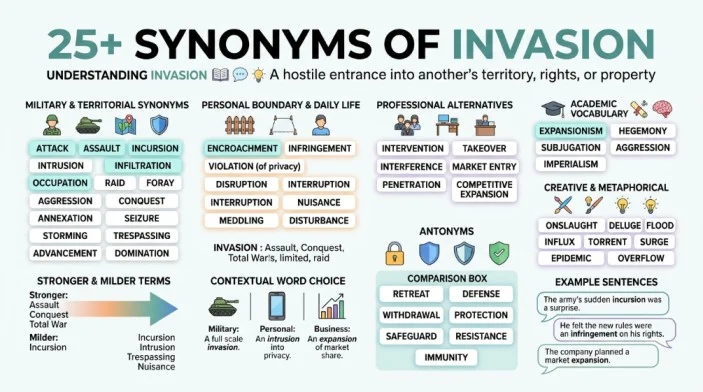
When writing an essay, news report, history assignment, or professional article, repeating the word invasion can make your writing feel limited. Finding the right synonym of invasion can make a major difference because words such as incursion, infiltration, intrusion, and occupation describe different aspects of unwanted entry or aggressive expansion.
The best alternative depends on what you actually mean. A military event may call for incursion or offensive, while an unwanted entry into someone’s privacy is better described as an intrusion. In biological writing, infestation, spread, or colonization may be more accurate. Choosing the right word improves clarity, tone, accuracy, and overall communication.
What Are the Best Synonyms of “Invasion”?
A strong synonym of invasion depends on context. Incursion works well for a limited military entry, intrusion for unwanted entry or interference, infiltration for entering gradually or secretly, and occupation for control of territory. In academic and formal writing, encroachment, aggression, and offensive can provide more precise alternatives.
Meaning, Tone, and Context
Simple Definition
Invasion generally refers to entering a place, area, territory, or sphere without permission, often with the intention of taking control, causing harm, spreading influence, or occupying space.
The word is most strongly associated with military action, especially when an army enters another country or territory. However, English also uses invasion in nonmilitary contexts, such as an invasion of privacy, an invasion of insects, or an invasion of a particular market.
Part of Speech
Invasion is a noun.
The related verb is invade, which means to enter a place or area forcefully, without permission, or in large numbers.
Overall Tone
The tone of invasion is usually negative because it suggests unwanted, aggressive, excessive, or unauthorized entry.
The emotional strength can vary depending on context. A military invasion usually carries very strong negative associations, while an expression such as “an invasion of tourists” may be figurative and somewhat less serious.
Formality Level
Invasion is a neutral to formal word. It is appropriate in:
- Academic writing
- Historical writing
- News reporting
- Political discussions
- Military discussions
- Professional analysis
- Everyday conversation
Its meaning is usually clear, but a more specific synonym can make formal writing more precise.
Common Uses
Native English speakers commonly use invasion in expressions involving:
- Military invasion
- Foreign invasion
- Invasion of territory
- Invasion of privacy
- Invasion of personal space
- Invasion of a country
- Invasion of an ecosystem
- Insect invasion
- Alien species invasion
- Market invasion
- Media invasion
Word Forms
| Word | Part of Speech | Example |
|---|---|---|
| Invasion | Noun | The invasion changed the region’s history. |
| Invade | Verb | The army attempted to invade the territory. |
| Invaded | Past tense verb | The country was invaded during the conflict. |
| Invading | Present participle | Invading forces approached the border. |
| Invader | Noun | The invaders entered the city. |
| Invasive | Adjective | The species is considered invasive. |
When and How to Use “Invasion”
Use invasion when you need to communicate forceful, unwanted, unauthorized, or extensive entry into a place, territory, system, or personal sphere.
The word is especially useful when the event involves aggression, control, or a significant breach of boundaries.
Professional Context
“The company viewed the competitor’s rapid expansion as an invasion of its traditional market.”
Here, invasion is figurative. It suggests aggressive expansion rather than literal military action.
Academic Context
“The invasion of the region resulted in major political and social changes.”
This wording is suitable for historical or political analysis.
Workplace Context
“Employees considered the constant monitoring of private messages an invasion of privacy.”
Here, the word describes an unacceptable breach of personal boundaries.
Personal Context
“I felt that taking photos without asking was an invasion of my privacy.”
The phrase clearly communicates that a personal boundary was crossed.
Email Context
The proposed policy could be viewed as an invasion of employee privacy.”
This wording is appropriate for a formal workplace concern.
Resume Context
Because invasion is rarely suitable as a resume keyword, it should normally be replaced with a more precise professional term such as market expansion, competitive entry, or territorial expansion, depending on the situation.
Social Media Context
“The sudden invasion of spam comments made the discussion difficult to follow.”
In this example, invasion is figurative and describes a large amount of unwanted content.
Best Synonyms of “Invasion”
No synonym is identical to invasion in every context. The word can describe military action, unauthorized entry, gradual penetration, territorial expansion, biological spread, or a violation of personal boundaries.
Professional Writing: Encroachment
Encroachment is useful when something gradually extends into an area where it does not belong.
Example:
“The report examines the continued encroachment of development into protected land.”
It is especially useful for environmental, legal, political, and business discussions.
Academic Writing: Incursion
Incursion is a strong choice when describing a limited or relatively brief entry into another territory.
Example:
“The army launched an incursion across the disputed border.”
It is more specific than the broad word invasion.
Business Communication: Expansion
When discussing companies entering new markets, expansion is usually more professional than invasion.
Example:
“The company’s international expansion has increased its market share.”
Casual Conversation: Intrusion
For unwanted entry into someone’s personal space or affairs, intrusion sounds natural.
Example:
“I considered the unexpected visit an intrusion.”
Emotional Writing: Violation
When the focus is on the harm caused by crossing someone’s boundaries, violation can be more emotionally powerful.
Example:
“She described the unauthorized recording as a serious violation of her privacy.”
Creative Writing: Infiltration
Infiltration creates a sense of gradual, secretive, or unnoticed entry.
Example:
“By midnight, the enemy’s infiltration of the fortress was complete.”
Resume Writing: Expansion
In professional documents, invasion is usually inappropriate when describing business growth. Expansion, market entry, or growth communicates the idea more positively and professionally.
Workplace Communication: Intrusion
When discussing boundaries, intrusion is generally more appropriate.
Example:
“Employees raised concerns about unnecessary intrusion into their personal communications.”
Stronger Meaning: Assault
Assault can communicate aggressive attack, although it does not always mean invasion or territorial occupation.
Example:
“The forces launched a coordinated assault on the city.”
Softer Meaning: Incursion
Incursion can be softer than invasion when describing a limited entry rather than a full-scale takeover.
Example:
“The border experienced a brief military incursion.”
When Not to Use “Invasion”
Although invasion is versatile, it can be too strong or too broad in some situations.
When the Entry Is Limited
If a military force enters an area briefly without attempting a large-scale takeover, invasion may exaggerate the event.
Less Precise:
“The troops carried out an invasion of the border area.”
Better:
“The troops carried out an incursion across the border.”
Why:
Incursion specifically suggests a limited entry.
When Something Enters Secretly
If the focus is on gradual or concealed entry, infiltration is more precise.
Less Precise:
“The group conducted an invasion of the organization.”
Better:
“The group carried out an infiltration of the organization.”
Why:
Infiltration emphasizes secret or gradual entry.
When Someone Crosses a Personal Boundary
For privacy or personal space, intrusion usually sounds more natural.
Less Precise:
“The question felt like an invasion.”
Better:
“The question felt like an intrusion.”
Why:
Intrusion directly communicates unwanted interference.
When Discussing Business Growth
Calling normal market growth an invasion can sound hostile or unnecessarily negative.
Less Precise:
“The company is planning an invasion of the European market.”
Better:
“The company is planning an expansion into the European market.”
Why:
Expansion is neutral and professional.
When Describing Gradual Environmental Spread
In environmental science, invasion may be useful, but a more specific term can clarify the process.
Less Precise:
“The invasion of the species increased rapidly.”
Better:
“The species’ spread increased rapidly.”
Why:
Spread focuses on distribution rather than the act of entering.
When You Mean Control After Entry
If the main idea is prolonged control of territory, occupation may be more accurate.
Less Precise:
“The invasion lasted for many years.”
Better:
“The occupation lasted for many years.”
Why:
Occupation focuses on control after territory has been taken.
Words Commonly Confused With “Invasion”
Incursion
Difference: An incursion usually refers to a limited entry into another territory or area.
When to Use It: Use it for a brief or restricted military entry.
Example:
“The border experienced another military incursion.”
Occupation
Difference: Occupation emphasizes control of a territory after entering it.
When to Use It: Use it when foreign forces maintain control over an area.
Example:
“The occupation continued for several years.”
Infiltration
Difference: Infiltration emphasizes secret, gradual, or unnoticed entry.
When to Use It: Use it for spies, groups, information, or forces entering discreetly.
Example:
“The security team detected an infiltration attempt.”
Intrusion
Difference: Intrusion focuses on unwanted interference or entry, often into someone’s private space.
When to Use It: Use it for privacy, personal boundaries, or unwanted involvement.
Example:
“The constant questions felt like an intrusion.”
Encroachment
Difference: Encroachment suggests gradual movement into territory, rights, space, or authority that belongs to someone else.
When to Use It: Use it for land, legal rights, environmental issues, or boundaries.
Example:
“The community opposed the encroachment of construction onto protected land.”
Offensive
Difference: An offensive is an organized military campaign designed to attack or achieve a strategic objective.
When to Use It: Use it when describing a planned military operation.
Example:
“The army began a major offensive at dawn.”
Best Synonyms of “Invasion” by Context
| Context | Best Synonym | Why It Works | Example |
|---|---|---|---|
| Formal writing | Incursion | Precise for limited entry | The incident was described as an incursion. |
| Academic writing | Incursion | Works well in historical analysis | The incursion changed regional relations. |
| Professional communication | Intrusion | Clear for unwanted interference | The policy raised concerns about intrusion. |
| Business emails | Expansion | Neutral for market entry | The company plans expansion overseas. |
| Resume writing | Expansion | Positive and professional | Led international market expansion. |
| Workplace communication | Intrusion | Appropriate for privacy issues | Employees opposed unnecessary intrusion. |
| Casual conversation | Intrusion | Natural for unwanted entry | His visit felt like an intrusion. |
| Everyday speaking | Intrusion | Common for personal boundaries | I don’t want to be an intrusion. |
| Creative writing | Infiltration | Creates suspense and secrecy | The infiltration began after dark. |
| Storytelling | Incursion | Works well for military events | The sudden incursion shocked the village. |
| Emotional writing | Violation | Emphasizes harm or boundary crossing | She viewed it as a violation of trust. |
| Strong emphasis | Assault | Communicates aggressive attack | The forces launched an assault. |
| Mild tone | Incursion | Can describe limited entry | A brief incursion occurred overnight. |
| Social media captions | Invasion | Familiar and expressive | An invasion of spam ruined the comments. |
| American English | Invasion | Standard and widely understood | The invasion changed the region. |
| British English | Invasion | Also standard and widely understood | The invasion was discussed in Parliament. |
How to Choose the Best Synonym of “Invasion”
The easiest way to choose the right alternative is to identify what aspect of invasion you want to emphasize.
Choose Based on Meaning
- If you mean a limited military entry, choose incursion.
- If you mean secret entry, choose infiltration.
- If you mean long-term territorial control, choose occupation.
- If you mean unwanted interference, choose intrusion.
- If you mean gradual movement into another area, choose encroachment.
- If you mean business growth into a new market, choose expansion.
Choose Based on Tone
- For neutral professional writing, choose expansion, entry, or encroachment, depending on meaning.
- For strong military language, assault, offensive, or aggression may work better.
- For personal situations, intrusion or violation can communicate the emotional dimension more clearly.
Choose Based on Audience
An academic reader may expect incursion, occupation, encroachment, or infiltration.
A business audience usually responds better to terms such as expansion, market entry, and competitive growth.
A general audience can usually understand invasion, intrusion, attack, and incursion without additional explanation.
Choose Based on Emotional Strength
- Use intrusion when you want to emphasize unwanted interference.
- Use violation when the boundary crossing causes a stronger sense of harm.
- Use attack or assault when aggressive action is central.
- Use incursion when you want a more restrained description of a limited entry.
Choose Based on Writing Purpose
- For a history essay, invasion, incursion, and occupation may all be useful, but each describes a different stage or type of military action.
- For a business report, expansion or market entry is usually better.
- For a privacy complaint, intrusion or violation is more precise.
- For environmental writing, spread, colonization, or establishment may be more appropriate depending on the biological process being described.
Real Life Examples of “Invasion”
School
Basic:
“The invasion changed the history of the country.”
More precise:
“The invasion changed the country’s political structure.”
College
Basic:
“The military invasion affected local communities.”
Improved:
“The military incursion had lasting effects on nearby communities.”
Workplace
Basic:
“Employees complained about an invasion of privacy.”
Improved:
“Employees complained about unnecessary intrusion into their private communications.”
Business
Basic:
“The company began an invasion of new markets.”
Improved:
“The company began an international expansion into new markets.”
Basic:
“The proposed software could lead to an invasion of employee privacy.”
Improved:
“The proposed software could create an unacceptable intrusion into employee privacy.”
Resume
Basic:
“Helped with the company’s invasion of international markets.”
Improved:
“Supported the company’s expansion into international markets.”
Conversation
Basic:
“Sorry, I don’t want to invade your privacy.”
Improved:
“Sorry, I don’t mean to intrude on your privacy.”
Storytelling
Basic:
“The invasion began before sunrise.”
Improved:
“The incursion began before sunrise, catching the defenders off guard.”
Blogging
Basic:
“The invasion of invasive species can damage ecosystems.”
Improved:
“The spread of invasive species can disrupt native ecosystems.”
Social Media
Basic:
“Our comments section was hit by an invasion of spam.”
Improved:
“Our comments section was overwhelmed by a flood of spam.”
25 Best Synonyms of “Invasion”
Not every alternative below is interchangeable with invasion in every sentence. Each one corresponds to a particular sense, such as military entry, unwanted interference, territorial expansion, or biological spread.
| Synonym | Simple Meaning | Best Used For | Example Sentence |
|---|---|---|---|
| Incursion | A limited entry into another area | Military or territorial contexts | The troops made a brief incursion across the border. |
| Intrusion | Unwanted entry or interference | Privacy and personal boundaries | The constant monitoring felt like an intrusion. |
| Infiltration | Secret or gradual entry | Military, security, organizations | The team detected an attempted infiltration. |
| Occupation | Control of a territory after entry | Military and historical contexts | The occupation lasted several years. |
| Encroachment | Gradual movement into another area | Land, rights, territory | Residents opposed the encroachment onto public land. |
| Assault | Aggressive attack | Military contexts | The soldiers prepared for an assault on the stronghold. |
| Attack | An attempt to harm or defeat | General military contexts | The sudden attack forced the troops to retreat. |
| Offensive | Organized military attack | Military strategy | The army launched a new offensive. |
| Aggression | Hostile or forceful behavior | Political and military writing | The government condemned the act of aggression. |
| Onslaught | A powerful or sustained attack | Strong descriptive writing | The city faced an onslaught of enemy forces. |
| Raid | A sudden, usually limited attack or entry | Military and security contexts | The unit conducted a nighttime raid. |
| Foray | A brief entry into an unfamiliar area or activity | Figurative and limited entry | The company’s first foray into the market was successful. |
| Inroad | Progress into another area or sphere | Figurative competition | The brand made major inroads into the market. |
| Irruption | Sudden entry or appearance | Formal and descriptive writing | The sudden irruption of troops caused panic. |
| Penetration | Entry into an area, group, or system | Security, business, markets | The company’s market penetration increased rapidly. |
| Ingress | The act of entering | Formal or technical contexts | The security system restricts unauthorized ingress. |
| Trespass | Entering property without permission | Legal and personal contexts | The sign warned visitors against trespass. |
| Violation | Breaking a boundary, right, or rule | Privacy and personal contexts | She regarded the disclosure as a violation of privacy. |
| Expansion | Growth into a new area | Business and markets | The company’s international expansion accelerated. |
| Spread | Movement across a wider area | Biological and figurative contexts | The rapid spread of the species concerned scientists. |
| Colonization | Establishment in a new area | Historical and biological contexts | The species’ colonization of the island changed the ecosystem. |
| Establishment | Becoming established in a new environment | Ecology and biology | The establishment of the species was difficult to reverse. |
| Proliferation | Rapid increase or spread | Biological, social, and abstract contexts | The proliferation of invasive plants threatened native species. |
| Flood | A large amount arriving suddenly | Figurative contexts | The website received a flood of unwanted messages. |
| Deluge | An overwhelming amount arriving | Figurative and expressive writing | The company faced a deluge of complaints. |
Synonyms of “Invasion” by Usage
Professional vs Personal Synonyms
Professional writing should favor precise and neutral alternatives.
- For business expansion, use expansion, market entry, or inroads rather than invasion.
- For privacy concerns, use intrusion or violation.
- For military analysis, use incursion, offensive, occupation, or assault according to the specific event.
Personal conversations can use invasion more flexibly, especially in expressions such as “invasion of privacy” or “invasion of personal space.”
Formal vs Conversational Synonyms
Formal writing often benefits from:
- Incursion
- Encroachment
- Infiltration
- Occupation
- Aggression
- Ingress
- Penetration
Everyday conversation is more likely to use:
- Invasion
- Intrusion
- Attack
- Spread
- Flood
Technical or formal vocabulary should be used only when it improves precision. A complicated synonym is not automatically a better synonym.
Academic Synonyms
Academic writing benefits from terms that identify the exact process being discussed.
Incursion is useful for limited military entry.
Occupation focuses on territorial control.
Encroachment works for gradual expansion into another area.
Infiltration describes secret or gradual entry.
Colonization can describe establishment in a new territory, especially in historical or biological discussions, although its meaning is broader and context dependent.
Proliferation is useful when discussing rapid increase or spread rather than physical invasion itself.
Professional and Business Synonyms
Business writers should usually avoid describing normal market growth as an invasion unless they intentionally want a competitive or aggressive tone.
- Use expansion for entering new markets.
- Use market penetration for increasing presence within a market.
- Use inroads for making progress in a competitive market.
- Use competitive entry when discussing a new competitor.
- Use growth when the focus is simply on increased business activity.
Creative and Literary Synonyms
Creative writing can use stronger alternatives to create atmosphere.
Onslaught suggests overwhelming force.
Infiltration creates suspense because the entry is gradual or secret.
Irruption suggests a sudden appearance or entry.
Deluge can be used figuratively to describe an overwhelming amount.
Flood creates an image of something arriving in large numbers.
These words can make a scene more vivid without repeating invasion.
Slang or Modern Synonyms
There is no single widely accepted slang synonym that replaces invasion across contexts.
Informal expressions such as flood, swarm, or flooded with can work figuratively.
For example:
“The post was flooded with spam.”
This sounds natural in casual online communication. It would not be the best choice for a formal military or academic report.
Strongest to Mildest Synonyms
There is no universal intensity ranking because the synonyms emphasize different qualities. However, a practical scale can help when the main concern is force or severity.
Mild
- Entry
- Ingress
- Incursion
- Foray
These terms can describe entry without automatically suggesting total control.
Moderate
- Intrusion
- Infiltration
- Encroachment
- Penetration
These words emphasize unwanted entry, gradual movement, or boundary crossing.
Strong
- Attack
- Assault
- Offensive
- Aggression
- Occupation
These words carry stronger military or hostile associations.
Very Strong
- Onslaught
- Invasion
- Deluge
These can communicate overwhelming force, although their exact meaning depends heavily on context.
Emotional vs Neutral Synonyms
Emotional Synonyms
These alternatives create stronger feelings or imagery:
- Assault
- Onslaught
- Violation
- Aggression
- Deluge
- Flood
They are useful when the writer wants readers to feel the seriousness, hostility, or overwhelming nature of an event.
Neutral Synonyms
These alternatives are more descriptive and controlled:
- Incursion
- Entry
- Infiltration
- Occupation
- Expansion
- Penetration
- Encroachment
They work particularly well in academic, professional, and analytical writing.
Antonyms of “Invasion”
The exact opposite of invasion depends on the sense being discussed. The following words represent genuine opposing concepts such as protection, withdrawal, departure, exclusion, or peaceful boundaries.
| Antonym | Meaning | Example Sentence |
|---|---|---|
| Withdrawal | Moving away from an area | The army began its withdrawal from the region. |
| Retreat | Moving back from an opposing force | The troops ordered a retreat. |
| Departure | Leaving a place | Their departure ended the military presence. |
| Exit | Movement out of an area | The soldiers made a safe exit. |
| Evacuation | Organized removal from danger | The evacuation protected civilians. |
| Exclusion | Keeping someone or something out | The policy ensures the exclusion of unauthorized visitors. |
| Protection | Keeping someone or something safe | Strong borders provide protection from external threats. |
| Defense | Action taken to protect against attack | The country’s defense system was strengthened. |
| Security | Protection against danger or unauthorized access | The building has strict security measures. |
| Peace | A state without conflict | The agreement restored peace to the region. |
| Noninterference | Avoiding involvement in another area | The policy emphasized noninterference in domestic affairs. |
| Containment | Preventing movement or expansion | Officials focused on the containment of the outbreak. |
| Boundary | A limit separating areas | The river forms a natural boundary. |
| Respect | Recognition of another person’s rights or limits | Respect for privacy prevents unnecessary interference. |
| Repatriation | Returning people to their home country | The agreement included the repatriation of displaced citizens. |
Comparison: “Invasion” vs Similar Words
Invasion vs Incursion
Main Difference
Invasion generally suggests a larger or more consequential entry, while incursion often describes a limited entry into another territory.
Which Is Stronger?
Invasion usually sounds stronger.
Which Is More Formal?
Both are suitable for formal writing, but incursion can offer greater precision when the event is limited.
When to Use Each
Use invasion for major territorial entry. Use incursion for a smaller or shorter military entry.
Examples
Invasion:
“The invasion changed the country’s political history.”
Incursion:
“The border experienced a brief military incursion.”
Invasion vs Intrusion
Main Difference
Invasion often suggests forceful or large-scale entry, while intrusion focuses on unwanted interference or entry into someone’s space.
Which Is Stronger?
Invasion is generally stronger in military contexts.
Which Is More Formal?
Both are appropriate in formal writing.
When to Use Each
Use invasion for territory or large-scale entry. Use intrusion for privacy, personal space, or unwanted involvement.
Examples
Invasion:
“The invasion caused widespread destruction.”
Intrusion:
“The employee considered the monitoring an intrusion.”
Invasion vs Infiltration
Main Difference
Infiltration emphasizes gradual, secret, or unnoticed entry.
Which Is Stronger?
Invasion usually suggests greater force.
Which Is More Formal?
Both work in professional and academic writing.
When to Use Each
Use infiltration when secrecy or gradual entry matters.
Examples
Invasion:
“The invasion began at dawn.”
Infiltration:
“The infiltration occurred over several weeks.”
Invasion vs Occupation
Main Difference
Invasion describes entering territory, while occupation emphasizes continued control of that territory.
Which Is Stronger?
Neither is inherently stronger. They describe different stages.
Which Is More Formal?
Both are common in historical and political writing.
When to Use Each
Use invasion for the act of entering. Use occupation for the period of control afterward.
Examples
Invasion:
“The invasion began in the northern region.”
Occupation:
“The occupation lasted for years.”
Invasion vs Encroachment
Main Difference
Encroachment usually describes gradual expansion into another person’s territory, rights, or space.
Which Is Stronger?
Invasion generally sounds more forceful.
Which Is More Formal?
Encroachment is especially useful in legal, environmental, and academic writing.
When to Use Each
Use encroachment when gradual boundary crossing is important.
Examples
Invasion:
“The invasion involved a large military force.”
Encroachment:
“The development represented encroachment on protected land.”
Invasion vs Attack
Main Difference
An attack is an attempt to harm or defeat someone. An invasion specifically involves entering a place or territory, often with a broader objective.
Which Is Stronger?
The strength depends on context. An attack can be brief, while an invasion can involve sustained territorial entry.
Which Is More Formal?
Both are standard formal terms.
When to Use Each
Use attack when the act of aggression is the main focus. Use invasion when entering territory is central.
Examples
Invasion:
“The invasion crossed the national border.”
Attack:
“The attack damaged several military facilities.”
Common Phrases and Expressions with “Invasion”
Invasion of Privacy
Meaning: An unwanted act that interferes with someone’s private life or personal information.
Example:
“Sharing her private messages without permission was an invasion of privacy.”
Foreign Invasion
Meaning: Entry into a country by forces from another country.
Example:
“The region was prepared for the possibility of a foreign invasion.”
Military Invasion
Meaning: The entry of armed forces into another territory.
Example:
“The military invasion created a major humanitarian crisis.”
Invasion of Personal Space
Meaning: Entering or interfering with someone’s physical or personal boundaries.
Example:
“Standing so close to someone can feel like an invasion of personal space.”
Invasion of Territory
Meaning: Entering an area controlled or claimed by another group.
Example:
“The invasion of territory increased tensions between the two sides.”
Invasion of Privacy
Meaning: Interfering with someone’s private information, activities, or personal life.
Example:
“Employees questioned whether the new system amounted to an invasion of privacy.”
Invasion of Insects
Meaning: A large number of insects entering an area.
Example:
“The warm weather led to an invasion of insects.”
Invasion of the Body
Meaning: Entry of harmful organisms or substances into the body, especially in medical or biological contexts.
Example:
“The immune system responds to the invasion of harmful pathogens.”
Common Mistakes to Avoid
1. Treating Every Synonym as Identical
Incorrect:
“The company launched an occupation of the new market.”
Better:
“The company launched an expansion into the new market.”
Why:
Occupation is strongly associated with territorial control, while expansion naturally describes business growth.
2. Using “Invasion” When You Mean “Intrusion”
Incorrect:
“His personal question was an invasion into my private life.”
Better:
“His personal question was an intrusion into my private life.”
Why:
Intrusion is the more natural choice for unwanted interference in personal matters.
3. Using an Informal Alternative in Formal Writing
Incorrect:
“The country faced a huge attack from foreign forces.”
Better:
“The country faced a major military invasion.”
Why:
The revised version gives the historical or political event a more precise description.
4. Choosing an Overly Dramatic Synonym
Incorrect:
“The company made an onslaught into a new market.”
Better:
“The company expanded into a new market.”
Why:
Onslaught suggests a powerful attack. It is usually inappropriate for ordinary business growth.
5. Repeating “Invasion” Too Often
Incorrect:
“The invasion began after the invasion force crossed the border. The invasion continued as the invasion forces moved south.”
Better:
“The invasion began after military forces crossed the border. The offensive continued as troops moved south.”
Why:
Strategic variation improves readability while preserving meaning.
6. Using “Infiltration” When Entry Was Open and Forceful
Incorrect:
“The army openly crossed the border in a secret infiltration.”
Better:
“The army openly crossed the border in a military incursion.”
Why:
Infiltration implies secrecy or gradual entry, so it conflicts with an openly announced military movement.
7. Confusing “Invasion” With “Occupation”
Incorrect:
“The occupation began when the troops first crossed the border.”
Better:
“The invasion began when the troops first crossed the border, followed by an occupation.”
Why:
The invasion refers to entry, while occupation refers to subsequent control.
Frequently Asked Questions
1. What is a synonym of invasion?
A useful synonym of invasion is incursion, especially for a limited military entry. Other alternatives include intrusion, infiltration, occupation, encroachment, and assault, depending on the exact meaning and context.
2. What are the best formal synonyms of invasion?
The best formal alternatives include incursion, infiltration, occupation, encroachment, aggression, and offensive. Each describes a different aspect of entry, attack, territorial control, or gradual expansion.
3. What are common informal synonyms of invasion?
In everyday English, intrusion, attack, entry, flood, and spread can work depending on context. There is no single informal replacement because invasion has several distinct meanings.
4. What is another word for invasion in professional writing?
For professional writing, use expansion when discussing business growth, intrusion for privacy concerns, incursion for limited territorial entry, and encroachment for gradual boundary crossing.
5. What is the difference between invasion and incursion?
An invasion usually suggests a larger or more consequential entry into territory, while an incursion often refers to a limited or brief entry. Both can describe military movement across a border.
6. What is the opposite of invasion?
Depending on context, opposites of invasion include withdrawal, retreat, departure, exclusion, protection, defense, security, and peace. The best choice depends on whether the focus is movement, conflict, or boundaries.
Conclusion
Invasion describes forceful, unwanted, unauthorized, or extensive entry into a territory, space, system, or sphere. The best synonym depends on the specific meaning. Incursion is useful for limited military entry, infiltration emphasizes secret entry, occupation focuses on territorial control, intrusion works for personal boundaries, and expansion is more appropriate for business growth.
No synonym works perfectly in every situation. Strong writing comes from matching the word to the audience, purpose, tone, and exact relationship being described.
A useful vocabulary habit is to identify the main idea behind invasion before replacing it. Decide whether you mean entry, attack, control, secrecy, interference, spread, or expansion, then choose the word that communicates that idea most precisely. This approach makes the synonym of invasion you choose clearer and more natural.
Read More Related Articles:
- 25+ Synonyms of Existence | Meanings, Uses, Examples, and …
- Synonyms for Thus | Meaning, Examples, and Better Word …
- Meaning, Uses, Examples, and the Best Synonym of Complain