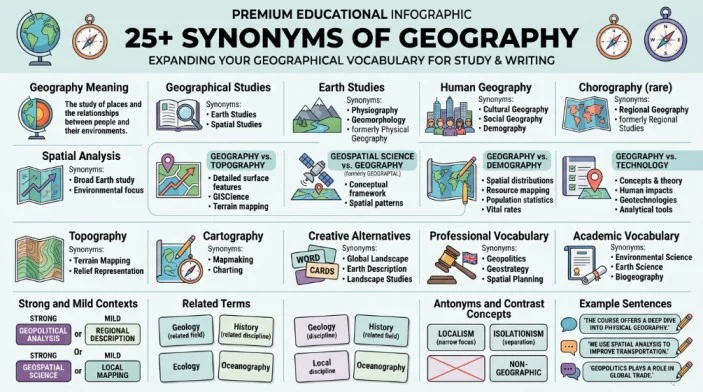
A student may write the word geography several times in an essay, while a teacher, blogger, or content writer may need a more precise term for a particular topic. Searching for synonyms of geography can help, but there is an important distinction: geography is the name of an academic field, so it does not have dozens of perfect one word synonyms.
The best alternative depends on what you mean. You might be discussing maps, Earth’s physical features, human populations, places, regions, or spatial relationships. Words such as geographical studies, spatial studies, physical geography, human geography, topography, and cartography can work in specific contexts, but they do not all mean exactly the same thing.
What Are the Best Synonyms of “Geography”?
Geography is the study of Earth’s places, physical features, people, environments, and spatial relationships. The closest alternatives include geographical studies, geographic science, and spatial studies, while topography, cartography, human geography, and physical geography are more specific terms. The best choice depends on the exact aspect of geography being discussed.
Meaning, Tone, and Context
Simple Definition
Geography is the field of study concerned with places on Earth and the relationships between people, environments, physical features, and locations.
It can involve natural features such as mountains, rivers, climates, and oceans, as well as human subjects such as populations, cities, migration, economies, and cultures.
Part of Speech
Geography is a noun.
It can refer to both an academic subject and the physical arrangement or characteristics of a particular place.
Overall Tone
The word geography is neutral. It does not normally express positive or negative emotion.
Formality Level
Geography is a neutral and standard term. It works naturally in academic writing, professional communication, textbooks, journalism, everyday conversation, and educational content.
Common Uses
Native English speakers use geography when discussing:
- Earth’s physical features
- Countries and regions
- Climate and environments
- Population distribution
- Cities and urban areas
- Migration
- Maps and locations
- Human societies and places
- Spatial relationships
- Regional differences
- Natural resources
- Political boundaries
Word Forms
| Form | Word |
|---|---|
| Noun | geography |
| Adjective | geographic, geographical |
| Adverb | geographically |
| Related noun | geographer |
| Related adjective | geographic |
| Related noun | geographical location |
The adjective geographic is especially common in American English, while geographical is also standard and widely used.
When and How to Use “Geography”
Use geography when you are referring to the broad field that examines places, environments, physical features, people, and spatial relationships.
Professional
“The company’s expansion strategy considers the geography of each target market.”
Academic
“Geography helps researchers understand the relationship between people and their environments.”
Workplace
“Our sales team studies the geography of different customer markets.”
Personal
“I’ve always enjoyed learning about the geography of different countries.”
“Please review the attached report on the geography of our target region.”
Resume
“Completed advanced coursework in geography, environmental studies, and regional planning.”
Social Media
“Learning about world geography makes travel even more fascinating.”
Best Synonyms of “Geography”
There is no single word that can replace geography in every context. This is because geography is a broad discipline, while many related terms describe only one part of the subject.
Professional Writing: Geographic Studies
Geographic studies is useful when referring broadly to research or academic work involving places, locations, environments, and spatial relationships.
Example:
“The organization uses geographic studies to support regional planning.”
Academic Writing: Geographical Science
Geographical science emphasizes geography as a systematic field of scientific study.
Example:
“Geographical science provides useful methods for analyzing environmental change.”
Business Communication: Spatial Analysis
Spatial analysis works well when discussing the relationship between locations, patterns, and data.
Example:
“The company used spatial analysis to identify promising retail locations.”
Casual Conversation: Geography
In casual speech, there is usually no need to replace geography. The word is already natural and clear.
Example:
“I’ve always liked geography.”
Emotional Writing: Sense of Place
Sense of place is useful when geography is being discussed through personal, cultural, or emotional connection to a location.
Example:
“The novel creates a powerful sense of place through its descriptions of the coastal landscape.”
Creative Writing: Landscape
Landscape can work when the focus is on the visible physical character of a place.
Example:
“The surrounding landscape was shaped by centuries of wind and rain.”
Resume Writing: Geographic Analysis
Geographic analysis is a strong professional term when describing analytical work involving location or spatial data.
Example:
“Conducted geographic analysis to identify underserved markets.”
Workplace Communication: Regional Analysis
Regional analysis works when geography is being considered at the level of a specific area or market.
Example:
“The team completed a regional analysis before opening the new office.”
Stronger or More Specific Meaning: Spatial Analysis
When you want to emphasize analytical relationships between locations, spatial analysis is more precise than simply saying geography.
Example:
“Spatial analysis revealed a strong relationship between transportation access and housing development.”
Softer or Broader Meaning: Place Studies
Place studies can provide a broader, interdisciplinary alternative when discussing the meaning, identity, culture, and characteristics of places.
Example:
“The course combines geography with place studies and cultural research.”
When Not to Use “Geography”
Although geography is broad and useful, it is not always the most precise choice.
When You Mean Maps
Less precise:
“I am studying geography to learn how maps are made.”
Better:
“I am studying cartography to learn how maps are designed and produced.”
Why:
Cartography specifically concerns map creation and representation.
When You Mean Earth’s Surface Features
Less precise:
“The geography of the mountain range is complex.”
Better:
“The topography of the mountain range is complex.”
Why:
Topography focuses on the shape and arrangement of land surfaces.
When You Mean People and Society
Less precise:
“The geography of migration is changing.”
Better:
“The human geography of migration is changing.”
Why:
Human geography specifically examines relationships between people, societies, and places.
When You Mean Natural Features
Less precise:
“The geography of the region includes several unusual landforms.”
Better:
“The physical geography of the region includes several unusual landforms.”
Why:
Physical geography focuses on natural features and processes.
When You Mean a Specific Area
Less precise:
“We studied the geography of the western states.”
Better:
“We conducted a regional analysis of the western states.”
Why:
Regional analysis emphasizes systematic examination of a particular area.
When You Mean Location Based Data
Less precise:
“The company needs geography to choose its next store.”
Better:
“The company needs geospatial analysis to choose its next store.”
Why:
Geospatial analysis is more precise when geographic data and location patterns are involved.
Words Commonly Confused With “Geography”
Topography
Difference: Topography describes the shape, elevation, and arrangement of physical land surfaces.
When to Use It: Use it when discussing terrain, slopes, elevations, valleys, hills, and other surface features.
Example:
“The region’s rugged topography makes transportation difficult.”
Cartography
Difference: Cartography focuses on the creation, design, interpretation, and presentation of maps.
When to Use It: Use it when maps are the central topic.
Example:
“Modern cartography uses digital tools to create detailed maps.”
Geology
Difference: Geology studies Earth’s materials, structure, history, and geological processes.
When to Use It: Use it when discussing rocks, minerals, tectonic activity, and Earth’s geological history.
Example:
“Geology explains how the area’s rock formations developed.”
Geology vs Geography
Geography is concerned with places, spatial relationships, environments, and human and physical patterns. Geology focuses more specifically on Earth’s materials, structure, and geological history.
Example:
“Geography examines where different landscapes occur, while geology examines how the underlying rocks formed.”
Demography
Difference: Demography focuses on human populations, including their size, structure, distribution, and change.
When to Use It: Use it when population statistics are the central concern.
Example:
“The city’s changing demography is affecting housing demand.”
Geospatial Science
Difference: Geospatial science focuses on collecting, analyzing, and interpreting information connected to locations on Earth.
When to Use It: Use it for GIS, satellite data, mapping technology, and location based analysis.
Example:
“Geospatial science supports emergency response and urban planning.”
Best Synonyms of “Geography” by Context
| Context | Best Synonym or Alternative | Why It Works | Example |
|---|---|---|---|
| Formal writing | Geographical studies | Refers broadly to academic geographic work | “The report draws on geographical studies.” |
| Academic writing | Geographical science | Presents geography as a systematic discipline | “Geographical science examines spatial patterns.” |
| Professional communication | Geographic analysis | Highlights practical analysis of locations | “The team performed geographic analysis.” |
| Business emails | Regional analysis | Works well for markets and territories | “The regional analysis is attached.” |
| Resume writing | Geographic analysis | Describes a useful professional skill | “Performed geographic analysis using location data.” |
| Workplace communication | Spatial analysis | Precise for location based patterns | “Spatial analysis identified the strongest market.” |
| Casual conversation | Geography | The original term sounds most natural | “I enjoy learning geography.” |
| Everyday speaking | Places and regions | Simple alternative when discussing locations | “The course covers places and regions.” |
| Creative writing | Landscape | Emphasizes physical appearance | “The landscape stretched toward the horizon.” |
| Storytelling | Sense of place | Adds cultural and emotional meaning | “The story has a strong sense of place.” |
| Emotional writing | Sense of place | Focuses on connection to location | “The poem creates a deep sense of place.” |
| Strong emphasis | Spatial analysis | More technical and specific | “Spatial analysis revealed a clear pattern.” |
| Mild tone | Geographic context | Gives broad contextual information | “The event makes more sense in its geographic context.” |
| Social media captions | Landscape | Short and visually descriptive | “The mountain landscape was unforgettable.” |
| American English | Geography | Standard and natural | “Geography was one of my favorite subjects.” |
| British English | Geography | Also standard in British English | “She studied geography at university.” |
How to Choose the Best Synonym of “Geography”
The most important rule is simple: do not replace geography merely to avoid repetition. Replace it when another term communicates the intended meaning more precisely.
If You Mean the Academic Subject
Use geography, geographical studies, or geographical science.
If You Mean Physical Land
Use topography, landscape, or physical geography, depending on the context.
If You Mean Maps
Use cartography or mapmaking.
If You Mean People and Places
Use human geography, population geography, or demography when population characteristics are the focus.
If You Mean Location Based Data
Use geospatial analysis, spatial analysis, or geographic analysis.
If You Mean a Specific Area
Use regional analysis, regional studies, or geographic context.
If You Mean Emotional Connection to a Place
Use sense of place.
Consider Your Audience
For a general audience, geography is usually the clearest option.
For specialists, terms such as spatial analysis, geospatial science, and regional analysis may communicate the intended concept more accurately.
Real Life Examples of “Geography”
School
Basic:
“Geography teaches students about countries, environments, and physical features.”
More precise:
“Physical geography helps students understand Earth’s natural systems.”
College
Basic:
“She decided to study geography in college.”
More precise:
“She decided to specialize in human geography and urban development.”
Workplace
Basic:
“The company’s geography affects its delivery network.”
More precise:
“The company’s geographic distribution affects its delivery network.”
Business
Basic:
“We considered the geography of the new market.”
More precise:
“We conducted a regional analysis before entering the new market.”
Basic:
“Please review the geography section of the report.”
More precise:
“Please review the geographic analysis section of the report.”
Resume
Basic:
“Experience with geography and mapping.”
More professional:
“Experience with geographic analysis, mapping, and location based data.”
Conversation
Basic:
“I’ve always enjoyed geography.”
Natural alternative:
“I’ve always enjoyed learning about different places and regions.”
Storytelling
Basic:
“The geography of the area shaped the story.”
More descriptive:
“The landscape and surrounding terrain shaped the story.”
Blogging
Basic:
“Geography can influence travel experiences.”
More specific:
“Regional geography can influence climate, transportation, and travel experiences.”
Social Media
Basic:
“Geography makes every destination more interesting.”
More creative:
“Every landscape tells a story about the place that shaped it.”
25 Best Synonyms and Contextual Alternatives for “Geography”
A linguistic note is necessary here: geography has relatively few true one word synonyms. Several terms below are specialized forms, broader alternatives, or closely related concepts rather than perfect replacements. They should be selected according to context rather than treated as interchangeable.
| Synonym or Alternative | Simple Meaning | Best Used For | Example Sentence |
|---|---|---|---|
| Geographical studies | Study of geographic subjects | Academic writing | “Her research focuses on geographical studies.” |
| Geographical science | Systematic study of geographic patterns | Academic research | “Geographical science examines spatial relationships.” |
| Geographic studies | Research about places and spatial patterns | Education | “The course introduces geographic studies.” |
| Spatial studies | Study of space and spatial relationships | Academic contexts | “Spatial studies can reveal patterns across regions.” |
| Geographic analysis | Analysis involving locations and geographic patterns | Professional work | “The company uses geographic analysis for planning.” |
| Spatial analysis | Analysis of relationships between locations | GIS and research | “Spatial analysis identified areas of rapid growth.” |
| Geospatial analysis | Analysis of location based information | Technology and business | “Geospatial analysis improved the delivery network.” |
| Geospatial science | Study and use of geographic information | Technical fields | “Geospatial science supports environmental monitoring.” |
| Regional studies | Study of particular geographic regions | Academia | “Regional studies can explain differences between neighboring areas.” |
| Regional analysis | Detailed examination of a region | Business and planning | “Regional analysis guided the expansion strategy.” |
| Physical geography | Study of natural Earth systems | Education | “Physical geography covers rivers, climates, and landforms.” |
| Human geography | Study of people and places | Social sciences | “Human geography explores migration and urbanization.” |
| Cultural geography | Study of culture and its relationship with place | Academic writing | “Cultural geography examines how traditions vary by region.” |
| Economic geography | Study of economic activity across places | Business and academia | “Economic geography examines where industries develop.” |
| Political geography | Study of political patterns and space | Government and academia | “Political geography examines borders and territories.” |
| Population geography | Study of population distribution across space | Demographic research | “Population geography examines settlement patterns.” |
| Environmental geography | Study of relationships between people and environments | Environmental studies | “Environmental geography examines human impacts on ecosystems.” |
| Topography | Shape and arrangement of land surfaces | Physical terrain | “The area’s topography makes construction difficult.” |
| Landscape | Visible physical character of a place | Creative and descriptive writing | “The desert landscape was striking.” |
| Cartography | Science and practice of mapmaking | Maps | “Cartography has changed with digital technology.” |
| Place studies | Interdisciplinary study of places | Cultural and academic contexts | “Place studies explores how communities experience locations.” |
| Sense of place | Emotional and cultural character of a location | Creative writing | “The novel captures a strong sense of place.” |
| Regional geography | Study of particular regions | Academic writing | “Regional geography compares the characteristics of different areas.” |
| Chorography | Detailed description or study of a particular region | Specialized academic use | “The historical work provides a chorography of the region.” |
| Earth studies | Broad study of Earth and its systems | General education | “The program combines geography with Earth studies.” |
Synonyms of “Geography” by Usage
Professional vs Personal Synonyms
In professional settings, choose terms that identify the exact geographic task being performed.
Professional: geographic analysis, spatial analysis, geospatial analysis, regional analysis.
Personal: geography, places, regions, landscapes.
For example, a resume should say “geospatial analysis” when the work involved location based data rather than simply saying “geography.”
Formal vs Conversational Synonyms
Formal writing can use geographical studies, geographical science, regional analysis, and spatial analysis when they accurately describe the subject.
In casual conversation, simply saying geography, places, or regions is usually more natural.
Academic Synonyms
Academic writing benefits from precision. Use:
- Geographical science
- Human geography
- Physical geography
- Cultural geography
- Economic geography
- Regional geography
- Spatial analysis
- Population geography
These terms identify specific areas of geographic inquiry instead of using the broad word geography for every idea.
Professional and Business Synonyms
For business contexts, the best choices include:
- Geographic analysis
- Geospatial analysis
- Regional analysis
- Spatial analysis
- Geographic distribution
- Geographic data
These terms are especially useful in market research, logistics, retail planning, real estate, transportation, and location based decision making.
Creative and Literary Synonyms
Creative writing often benefits from descriptive alternatives rather than technical vocabulary.
Use landscape, terrain, region, place, and sense of place when the goal is to create imagery or emotional atmosphere.
For example:
“The geography was beautiful” is factual but broad.
“The rugged landscape stretched beneath the fading evening light” creates a much stronger visual impression.
Slang or Modern Synonyms
There is no widely accepted slang synonym for geography.
In casual speech, people may simply say places, locations, or the area, but these are not true synonyms.
For example:
“I love learning about different places” sounds conversational, but it does not have exactly the same meaning as “I love geography.”
Strongest to Mildest Synonyms
Because geography is a field rather than an emotion or quality, it does not have a meaningful intensity scale in the same way words such as important or angry do.
A more useful scale is based on specificity.
| Level | Term | Focus |
|---|---|---|
| Broad | Geography | Places, people, environments, and spatial relationships |
| Broad | Geographical studies | Academic geographic study |
| Moderate | Regional studies | Particular regions |
| Specific | Physical geography | Natural systems |
| Specific | Human geography | People and places |
| More specific | Spatial analysis | Spatial patterns and relationships |
| Highly specific | Geospatial analysis | Location based data and analysis |
| Highly specific | Cartography | Maps and mapmaking |
The more specific term is not necessarily “stronger.” It simply communicates a narrower concept.
Emotional vs Neutral Synonyms
Emotional Alternatives
These terms can add feeling or personal meaning:
- Sense of place
- Landscape
- Homeland
- Place
- Cultural landscape
For example:
“The poem creates a strong sense of place.”
This expresses more than physical location. It suggests emotional, cultural, or personal meaning.
Neutral Alternatives
These terms are better for objective communication:
- Geography
- Geographic analysis
- Spatial analysis
- Regional analysis
- Geographical studies
- Physical geography
- Human geography
Use neutral terminology in academic papers, reports, professional documents, and technical writing.
Antonyms of “Geography”
Strictly speaking, geography does not have 15 genuine dictionary antonyms. It is the name of an academic discipline and a concept involving places and spatial relationships. Creating artificial opposites and calling them true antonyms would be linguistically misleading.
For comparison purposes, the following are contrast concepts, not exact antonyms:
| Contrast Concept | Meaning | Example Sentence |
|---|---|---|
| Nongeographic | Not related to geography | “The analysis focuses on nongeographic factors.” |
| Nonspatial | Not involving spatial relationships | “The study examines nonspatial variables.” |
| Placeless | Not connected to a particular place | “The design has a deliberately placeless quality.” |
| Location independent | Not dependent on geographic location | “The service is largely location independent.” |
| Abstract | Not tied to a physical place | “The concept is abstract rather than geographic.” |
| Universal | Applying broadly across places | “The principle is presented as universal.” |
| Global | Relating to the world as a whole | “The issue has global consequences.” |
| Theoretical | Concerned mainly with ideas | “The paper takes a theoretical approach.” |
| Conceptual | Based primarily on concepts | “The discussion remains conceptual.” |
| Virtual | Existing primarily in digital space | “The community operates in a virtual environment.” |
| Placelessness | Lack of distinctive connection to a location | “The architecture has been criticized for placelessness.” |
| Nonterritorial | Not organized around physical territory | “The organization has a nonterritorial structure.” |
| Location neutral | Not favoring a specific location | “The policy is location neutral.” |
| Universalized | Treated as applicable everywhere | “The model presents a universalized explanation.” |
| Decontextualized | Removed from its geographic or social context | “The data becomes misleading when decontextualized.” |
These terms should not be used as automatic replacements for geography. They describe concepts that contrast with geographic or place based thinking.
Comparison: “Geography” vs Similar Words
Geography vs Topography
Main Difference
Geography is a broad field covering physical and human relationships with places. Topography specifically describes the shape and elevation of land.
Which Is Stronger?
Neither is stronger. Topography is simply more specific.
Which Is More Formal?
Both are standard terms, but topography is more specialized.
When to Use Each
Use geography for the broad subject. Use topography when discussing terrain.
Examples
Geography:
“Geography examines how people and environments interact.”
Topography:
“The area’s topography includes steep hills and narrow valleys.”
Geography vs Cartography
Main Difference
Geography studies places and spatial relationships. Cartography focuses on creating and presenting maps.
Which Is Stronger?
Neither is stronger.
Which Is More Formal?
Both are formal and academic terms.
When to Use Each
Use cartography when maps are the main focus.
Examples
Geography:
“Geography helps students understand regional patterns.”
Cartography:
“Cartography involves designing accurate maps.”
Geography vs Geology
Main Difference
Geography studies places, environments, people, and spatial relationships. Geology studies Earth’s rocks, structure, materials, and geological history.
Which Is Stronger?
Neither.
Which Is More Formal?
Both are established academic disciplines.
When to Use Each
Use geology when discussing Earth’s physical structure and geological processes.
Examples
Geography:
“Geography examines the distribution of natural resources.”
Geology:
“Geology explains the formation of the region’s rock layers.”
Geography vs Demography
Main Difference
Geography has a broad spatial focus. Demography specifically studies human populations and their characteristics.
Which Is Stronger?
Neither. Demography is narrower.
Which Is More Formal?
Both are appropriate for academic and professional writing.
When to Use Each
Use demography when population size, age, fertility, mortality, or population change is central.
Examples
Geography:
“Geography examines where populations are distributed.”
Demography:
“Demography examines changes in population structure.”
Geography vs Landscape
Main Difference
Geography is a field of study. Landscape describes the visible physical features and character of a place.
Which Is Stronger?
Neither.
Which Is More Formal?
Geography is more academic. Landscape is common in both everyday and creative writing.
When to Use Each
Use landscape when describing scenery or physical surroundings.
Examples
Geography:
“The geography of the region affects agriculture.”
Landscape:
“The mountain landscape attracts thousands of visitors.”
Geography vs Geospatial Science
Main Difference
Geography is a broad discipline. Geospatial science focuses heavily on geographic information, spatial data, mapping technologies, and location based analysis.
Which Is Stronger?
Neither, but geospatial science is more specialized.
Which Is More Formal?
Both are suitable for academic and professional contexts.
When to Use Each
Use geospatial science when discussing GIS, satellite data, geographic information systems, and spatial technologies.
Examples
Geography:
“Geography explores relationships between people and places.”
Geospatial Science:
“Geospatial science uses location data to analyze environmental change.”
Common Phrases and Expressions with “Geography”
Geography of a Region
Meaning: The physical and human characteristics of a particular area.
Example:
“The geography of the region influences its economy and transportation.”
Physical Geography
Meaning: The branch of geography concerned with Earth’s natural features and processes.
Example:
“Students learn about rivers and climate in physical geography.”
Human Geography
Meaning: The study of people, societies, and their relationships with places.
Example:
“Human geography examines patterns of migration.”
World Geography
Meaning: The study of countries, regions, physical features, and global spatial patterns.
Example:
“World geography was one of her favorite subjects in school.”
Regional Geography
Meaning: The study of the characteristics and relationships within particular regions.
Example:
“The course focuses on regional geography in North America.”
Geographic Location
Meaning: The position of a person, place, or object on Earth.
Example:
“The store’s geographic location makes it convenient for customers.”
Geographic Distribution
Meaning: The way people, resources, or features are spread across an area.
Example:
“The report examines the geographic distribution of rainfall.”
Geographic Information
Meaning: Information connected to specific locations.
Example:
“The system stores geographic information about roads and properties.”
Common Mistakes to Avoid
1. Treating Every Related Term as a True Synonym
Incorrect
“Topography and geography always mean the same thing.”
Better
“Topography is one specific area related to physical geography.”
Why
Topography focuses on landforms and surface shape, while geography has a much broader meaning.
2. Using Geography When You Mean Cartography
Incorrect
“She specializes in geography and creates digital maps.”
Better
“She specializes in cartography and creates digital maps.”
Why
Cartography specifically concerns maps and their design.
3. Confusing Geography With Geology
Incorrect
“Geography studies the chemical composition of rocks.”
Better
“Geology studies the chemical composition and structure of rocks.”
Why
Rock composition belongs primarily to geology.
4. Using Technical Terms Without a Reason
Incorrect
“We used geospatial science to describe the location of the school.”
Better
“We recorded the geographic location of the school.”
Why
The technical term adds unnecessary complexity when a simple phrase communicates the idea clearly.
5. Using “Landscape” as a Complete Replacement
Incorrect
“The university offers a degree in landscape.”
Better
“The university offers a degree in geography.”
Why
Landscape describes a place or scenery. It is not the name of the broader academic discipline.
6. Using a Broad Term When a Specific One Is Needed
Incorrect
“The company conducted geography before opening the store.”
Better
“The company conducted geographic analysis before opening the store.”
Why
Geographic analysis clearly describes the professional activity being performed.
7. Assuming Geography Has Direct Antonyms
Incorrect
“Nongeographic is the direct antonym of geography.”
Better
“Geography has no standard direct antonym because it names an academic field and a way of studying spatial relationships.”
Why
Not every noun has a dictionary antonym.
Frequently Asked Questions
What are the best synonyms of “geography”?
The closest broad alternatives are geographical studies, geographical science, and geographic studies. More specialized alternatives include spatial studies, regional studies, and geospatial science, depending on the intended meaning.
What are the best formal synonyms of “geography”?
For formal or academic writing, use geographical studies, geographical science, geographic analysis, spatial analysis, or regional studies when those terms accurately describe your subject.
What are common informal synonyms of “geography”?
There are no widely accepted informal synonyms for geography. In casual conversation, people may say places, regions, locations, or landscapes, but each expression has a narrower meaning.
What is another word for “geography” in professional writing?
Professional alternatives include geographic analysis, spatial analysis, geospatial analysis, and regional analysis. The best choice depends on whether you are discussing geographic data, locations, markets, or regional patterns.
What is the difference between “geography” and “topography”?
Geography is the broad study of places, people, environments, and spatial relationships. Topography is narrower and focuses specifically on the shape, elevation, and arrangement of physical land surfaces.
What is the opposite of “geography”?
There is no standard direct opposite of geography. Terms such as nongeographic, nonspatial, and placeless can describe contrasting concepts, but they are not strict dictionary antonyms.
Conclusion
Geography is a broad academic and practical concept involving places, environments, people, physical features, and spatial relationships. Because it covers so many areas, it has relatively few exact synonyms. The best alternative depends on the specific idea you want to communicate.
For academic writing, geographical studies, geographical science, and specialized branches such as human geography or physical geography can provide greater precision. In professional contexts, geographic analysis, spatial analysis, and geospatial analysis may be more appropriate. For creative writing, landscape and sense of place can add imagery and emotional depth.
The key vocabulary skill is not replacing every occurrence of a word with another term. Instead, identify the exact meaning you want to express, then select the word that matches your audience, tone, and purpose. When looking for synonyms of geography, precision is more valuable than forced variety.
Read More Related Articles:
- 25+ Synonyms of Resume | Meanings, Uses, Examples, and …
- 25+ Synonyms of Bridge | Meanings, Uses, Examples, and …
- 25+ Synonyms of Sincerely | Meanings, Uses, Examples, and …