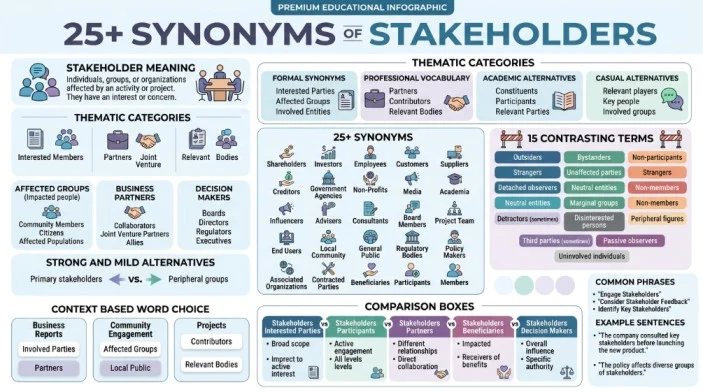
When writing a business email, project proposal, report, or presentation, repeating the word stakeholders can quickly make your writing feel predictable. The best synonyms of stakeholders help you describe the people, groups, organizations, or communities connected to a decision, project, or organization with greater precision.
The right alternative depends on the relationship involved. Interested parties is useful in formal communication, affected parties emphasizes who may experience an impact, and constituents works especially well when referring to people represented by an organization or public official. Choosing carefully improves clarity, tone, and professional credibility.
What Are the Best Synonyms of “Stakeholders”?
Stakeholders are people, groups, or organizations that have an interest in, influence on, or are affected by a project, decision, or organization. Useful alternatives include interested parties, affected parties, participants, partners, constituents, beneficiaries, and rights holders, depending on the specific relationship.
Meaning, Tone, and Context
Simple Definition
A stakeholder is a person, group, or organization that has an interest in something or may be affected by its decisions, activities, or results.
For example, a company’s stakeholders may include employees, customers, investors, suppliers, regulators, local communities, and business partners.
The exact group changes according to the situation. A school project, government policy, nonprofit program, and corporate merger can all have very different stakeholders.
Part of Speech
Stakeholder is primarily a noun.
The plural form is stakeholders.
Overall Tone
The word stakeholder has a neutral to professional tone. It is especially common in business, management, government, education, project planning, consulting, nonprofit work, and public policy.
It does not inherently express positive or negative emotion.
Formality Level
Stakeholder is generally neutral to formal. It works naturally in professional reports, presentations, academic writing, business emails, project documents, and organizational communication.
In casual conversation, simpler alternatives such as people involved or people affected may sound more natural.
Common Uses
Native English speakers commonly use stakeholder in phrases such as:
- Key stakeholders
- Project stakeholders
- Internal stakeholders
- External stakeholders
- Business stakeholders
- Community stakeholders
- Stakeholder engagement
- Stakeholder consultation
- Stakeholder expectations
- Stakeholder feedback
- Stakeholder interests
- Stakeholder communication
- Stakeholder management
- Stakeholder groups
Word Forms
| Form | Example |
|---|---|
| Noun | stakeholder |
| Plural noun | stakeholders |
| Related noun | stakeholder engagement |
| Related noun | stakeholder management |
| Related adjective | stakeholder focused |
The word does not have a common verb or adverb form that directly functions as a synonym for stakeholder.
When and How to Use “Stakeholders”
Use stakeholders when you need a broad term for people or groups that have an interest in, influence on, or are affected by an organization, project, policy, or decision.
Professional
“Project stakeholders will review the proposal before implementation.”
This is appropriate when several groups have an interest in a professional project.
Academic
“The researchers interviewed stakeholders involved in the education reform.”
Here, stakeholders can refer to teachers, students, administrators, policymakers, and other affected groups.
Workplace
“We should gather feedback from key stakeholders before changing the policy.”
The word works well when multiple groups have an interest in a workplace decision.
Personal
“The event was planned with the local community and other stakeholders in mind.”
This is slightly more formal than everyday conversation, but it works when discussing organized community interests.
“Please share the revised timeline with all relevant stakeholders.”
This is a natural professional email sentence.
Resume
“Coordinated communication among internal and external stakeholders.”
This phrasing is common in professional resumes because it summarizes relationship management responsibilities.
Social Media
“Great projects happen when stakeholders have a clear understanding of the shared goal.”
For social media, stakeholders is appropriate when the audience is professional or business focused.
Best Synonyms of “Stakeholders”
No alternative is identical to stakeholders in every situation. The best choice depends on whether you want to emphasize interest, impact, participation, representation, partnership, or responsibility.
Professional Writing: Interested Parties
Interested parties is one of the most useful formal alternatives because it broadly describes people or groups with an interest in a matter.
Example:
“The report was distributed to all interested parties.”
Use it when the specific nature of each group’s relationship does not need to be explained.
Academic Writing: Affected Parties
Affected parties works well when the focus is on people or groups who may experience the consequences of a policy, decision, or research outcome.
Example:
“The researchers consulted affected parties before finalizing the recommendations.”
It is more specific than stakeholders because it emphasizes impact.
Business Communication: Key Parties
Key parties can work when referring to the main people or organizations involved in a business matter.
Example:
“All key parties agreed to the revised terms.”
It is especially useful in negotiations and agreements.
Casual Conversation: People Involved
People involved is often more natural than stakeholders in everyday speech.
Example:
“We need to talk to the people involved before making a decision.”
It communicates the idea without corporate terminology.
Emotional Writing: Communities
When a decision affects a particular population, communities can be warmer and more human centered than stakeholders.
Example:
“The program was designed around the needs of local communities.”
Creative Writing: People Affected
People affected is useful when you want readers to focus on human consequences rather than organizational relationships.
Example:
“The new rule changed the lives of thousands of people affected by the decision.”
Resume Writing: Partners
Partners is useful when the people or organizations involved have a cooperative relationship with the writer or organization.
Example:
“Built strong relationships with strategic partners across multiple markets.”
Do not use partners if the groups merely have an interest in a project.
Workplace Communication: Relevant Parties
Relevant parties works well when you want to identify the people or groups whose input or approval matters.
Example:
“The updated policy will be reviewed by all relevant parties.”
Stronger Meaning: Decision Makers
Decision makers is more specific than stakeholders. It identifies people who have authority to make or approve decisions.
Example:
“The findings were presented directly to key decision makers.”
Softer Meaning: Interested Groups
Interested groups can sound less technical and less corporate than stakeholders.
Example:
“The organization invited interested groups to submit comments.”
When Not to Use “Stakeholders”
Although stakeholders is widely useful, it is not always the clearest choice. Sometimes the word is too broad, too corporate, or less precise than the relationship you actually mean.
When the People Are Specifically Affected
Less precise:
“We consulted stakeholders about the new policy.”
Better:
“We consulted affected residents about the new policy.”
The second version tells readers exactly who was involved and why.
When You Mean Decision Makers
Less precise:
“The stakeholders approved the proposal.”
Better:
“The decision makers approved the proposal.”
Not every stakeholder has authority to approve something.
When You Mean Business Partners
Less precise:
“We met with our stakeholders.”
Better:
“We met with our business partners.”
Use business partners when the relationship is cooperative and ongoing.
When You Mean Customers
Less precise:
“We surveyed stakeholders about the product.”
Better:
“We surveyed customers about the product.”
If customers are the actual group being surveyed, naming them directly is clearer.
When You Mean Employees
Less precise:
“Stakeholders expressed concerns about the policy.”
Better:
“Employees expressed concerns about the policy.”
Specific nouns usually communicate more information than broad organizational terminology.
When the Audience Is Casual
Less natural:
“We should ask the stakeholders what they think.”
More natural:
“We should ask the people involved what they think.”
In everyday conversation, stakeholders can sound unnecessarily corporate.
Words Commonly Confused With “Stakeholders”
Interested Parties
Difference:
Interested parties have an interest in a matter, but the term does not necessarily say they will be affected by it.
When to Use It:
Use it in formal documents when you want a broad, neutral expression.
Example:
“All interested parties were invited to review the proposal.”
Participants
Difference:
Participants actively take part in an activity, event, study, or process.
When to Use It:
Use it when participation is the main relationship.
Example:
“All participants completed the survey.”
A participant can be a stakeholder, but not every stakeholder actively participates.
Beneficiaries
Difference:
Beneficiaries are people or groups who receive benefits from a program, policy, service, or organization.
When to Use It:
Use it for nonprofit programs, grants, insurance, public services, and similar situations.
Example:
“The program served more than 500 beneficiaries.”
Partners
Difference:
Partners have a cooperative relationship with an organization or person.
When to Use It:
Use it for business relationships, collaborations, strategic alliances, and joint projects.
Example:
“Our partners helped expand the program.”
Decision Makers
Difference:
Decision makers have authority to make or approve decisions.
When to Use It:
Use it when authority and responsibility are central to the discussion.
Example:
“The decision makers approved the final proposal.”
Constituents
Difference:
Constituents are people represented by a political official, organization, or institution.
When to Use It:
Use it in government, politics, advocacy, and representative organizations.
Example:
“The representative met with constituents to discuss the proposed legislation.”
Best Synonyms of “Stakeholders” by Context
| Context | Best Synonym | Why It Works | Example |
|---|---|---|---|
| Formal writing | Interested parties | Broad and professional | “All interested parties received notice.” |
| Academic writing | Affected parties | Highlights impact | “Affected parties were interviewed.” |
| Professional communication | Relevant parties | Identifies people whose input matters | “Relevant parties reviewed the proposal.” |
| Business emails | Key parties | Concise and professional | “The key parties approved the timeline.” |
| Resume writing | Partners | Shows collaborative relationships | “Managed relationships with strategic partners.” |
| Workplace communication | People involved | Clear and accessible | “We consulted the people involved.” |
| Casual conversation | People involved | Sounds natural | “Let’s ask the people involved.” |
| Everyday speaking | People affected | Easy to understand | “We need to hear from people affected.” |
| Creative writing | Communities | More human centered | “Local communities opposed the change.” |
| Storytelling | People affected | Emphasizes human impact | “The decision changed the lives of people affected.” |
| Emotional writing | Communities | Creates a human focus | “The initiative supported vulnerable communities.” |
| Strong emphasis | Decision makers | Identifies authority | “Decision makers approved the plan.” |
| Mild tone | Interested groups | Less corporate | “Interested groups shared their views.” |
| Social media captions | People involved | Accessible to broad audiences | “The people involved made the event possible.” |
| American English | Stakeholders | Standard professional term | “Key stakeholders attended the meeting.” |
| British English | Stakeholders | Also standard professional usage | “The council consulted local stakeholders.” |
How to Choose the Best Synonym of “Stakeholders”
Choosing an alternative starts with identifying the relationship between the person or group and the subject.
If They Have an Interest
Choose interested parties or interested groups.
Example:
“All interested parties were notified of the change.”
If They Will Experience an Impact
Choose affected parties, affected groups, or people affected.
Example:
“The organization consulted affected residents.”
If They Actively Participate
Choose participants.
Example:
“Participants contributed ideas during the workshop.”
If They Receive Benefits
Choose beneficiaries.
Example:
“Beneficiaries received access to the new service.”
If They Work Cooperatively With You
Choose partners or collaborators.
Example:
“Our strategic partners supported the expansion.”
If They Have Authority
Choose decision makers, leaders, or authorities, depending on the context.
Example:
“The decision makers approved the final budget.”
If They Are Represented
Choose constituents or members, when appropriate.
Example:
“The official met with constituents before the vote.”
If You Need a Broad Professional Term
Keep stakeholders.
It is often the best choice when a project involves several different groups and you do not want to list every category.
Real Life Examples of “Stakeholders”
School
Original:
“The school consulted stakeholders about the new schedule.”
More specific:
“The school consulted teachers, parents, and students about the new schedule.”
The second version is better when identifying the actual groups adds useful information.
College
“The university invited affected students and faculty members to discuss the proposed changes.”
Here, affected explains why those groups were consulted.
Workplace
“Managers should communicate major policy changes to relevant stakeholders.”
This is appropriate for a professional setting.
Business
“The company met with key business partners before entering the new market.”
Business partners is more precise than stakeholders in this context.
“Please forward the revised document to all relevant stakeholders.”
This is a concise and natural business email sentence.
Resume
“Managed communication with internal and external stakeholders during major technology projects.”
This is useful on a resume because stakeholders efficiently covers multiple groups.
Conversation
“We should talk to the people affected before changing the plan.”
This sounds more natural in everyday speech than stakeholders.
Storytelling
“The decision makers never heard from the communities affected by the construction project.”
This version puts human impact at the center of the story.
Blogging
“A successful content strategy considers the needs of all major stakeholders.”
This works well for a professional business blog.
Social Media
“Strong organizations listen to the people they serve, not just the people who make decisions.”
This alternative sounds more accessible and audience focused.
25 Best Synonyms of “Stakeholders”
Because stakeholder is a broad relationship term, not every alternative can replace it in every sentence. The following 25 are context based alternatives that genuinely overlap with one or more major meanings of stakeholders.
| Synonym | Simple Meaning | Best Used For | Example Sentence |
|---|---|---|---|
| Interested parties | People or groups with an interest | Formal writing | “All interested parties received the report.” |
| Affected parties | People or groups experiencing an impact | Policies and projects | “Affected parties were invited to comment.” |
| Relevant parties | People whose involvement matters | Business communication | “The relevant parties approved the change.” |
| Interested groups | Groups concerned with an issue | Public communication | “Interested groups submitted feedback.” |
| Affected groups | Groups experiencing consequences | Policy discussions | “Affected groups requested additional support.” |
| Participants | People actively taking part | Events and studies | “Participants shared their experiences.” |
| Partners | People or organizations working together | Business | “Our partners supported the initiative.” |
| Business partners | Organizations with a business relationship | Corporate communication | “Business partners joined the meeting.” |
| Collaborators | People working together | Research and creative projects | “Collaborators contributed to the final design.” |
| Constituents | People represented by an official or organization | Government and advocacy | “The senator met with constituents.” |
| Beneficiaries | People receiving benefits | Nonprofits and programs | “Beneficiaries gained access to training.” |
| Customers | People buying or using products | Business | “Customers provided valuable feedback.” |
| Clients | People or organizations receiving professional services | Professional services | “Clients reviewed the proposed changes.” |
| Employees | People working for an organization | Workplace | “Employees supported the new policy.” |
| Investors | People or organizations providing capital | Finance and business | “Investors closely followed the company’s results.” |
| Shareholders | Owners of company shares | Corporate finance | “Shareholders voted on the proposal.” |
| Suppliers | Businesses providing goods or services | Supply chains | “Suppliers were notified about the new requirements.” |
| Residents | People living in a particular area | Community projects | “Local residents attended the hearing.” |
| Community members | People belonging to a local community | Public projects | “Community members raised concerns.” |
| Advocates | People publicly supporting a cause | Policy and social issues | “Advocates requested stronger protections.” |
| Representatives | People acting for others | Organizations and negotiations | “Representatives met to discuss the agreement.” |
| Decision makers | People with authority to decide | Management | “Decision makers reviewed the findings.” |
| Leaders | People responsible for directing others | Organizations | “Leaders discussed the project’s future.” |
| Rights holders | People or groups possessing recognized rights | Human rights and policy | “Rights holders participated in the consultation.” |
| People affected | Individuals experiencing an impact | General communication | “The proposal was discussed with people affected.” |
Synonyms of “Stakeholders” by Usage
Professional vs Personal Synonyms
In professional writing, stakeholders, interested parties, relevant parties, and decision makers are useful because they efficiently describe organizational relationships.
In personal communication, expressions such as people involved, people affected, and community members usually sound more natural.
For example:
Professional:
“The project team consulted key stakeholders.”
Personal:
“The team talked with the people affected.”
Both sentences communicate a similar idea, but the second sounds less corporate.
Formal vs Conversational Synonyms
For reports, essays, business documents, and presentations, consider:
- Interested parties
- Affected parties
- Relevant parties
- Constituents
- Representatives
For emails and casual communication, consider:
- People involved
- People affected
- Groups involved
- People we serve
Texting usually does not require stakeholders unless the conversation is specifically about business or organizational work.
Academic Synonyms
Academic writing benefits from specificity. Instead of using stakeholders for every group, identify the exact relationship whenever possible.
Affected parties works well when discussing policy consequences.
Participants is appropriate for research subjects or people actively involved in a study.
Beneficiaries works for people receiving benefits from a program.
Constituents is useful in political and public administration research.
Rights holders may be appropriate in research involving legal or human rights frameworks.
Example
Less precise:
“Stakeholders expressed concerns about the education policy.”
More precise:
“Teachers, parents, and affected students expressed concerns about the education policy.”
The second sentence gives readers information that the broad term does not provide.
Professional and Business Synonyms
Resumes
- Use stakeholders when your role involved managing relationships across several groups.
“Coordinated communication with internal and external stakeholders.”
- Use partners when collaboration was central to your role.
“Built relationships with strategic business partners.”
- Use clients when you worked directly with customers receiving professional services.
“Managed communications with enterprise clients.”
Interviews
Use stakeholders when discussing project coordination.
“I kept stakeholders informed throughout the implementation process.”
Use decision makers when discussing leadership approval.
“I presented the findings to senior decision makers.”
Meetings
Use relevant parties when only certain groups need to participate.
“The relevant parties will meet on Thursday.”
Presentations
Use key stakeholders when referring to the primary groups involved.
“The presentation addressed concerns raised by key stakeholders.”
Performance Reviews
Use internal stakeholders when describing cross department relationships.
“Developed effective relationships with internal stakeholders.”
Client Communication
Use clients, customers, or partners when those terms accurately describe the relationship.
Business Emails
Use relevant parties or stakeholders when you need a concise professional term.
“Please ensure all relevant parties are informed.”
Creative and Literary Synonyms
Creative writing often benefits from replacing corporate language with human centered terms.
Instead of:
“The stakeholders opposed the proposal.”
Consider:
“Local residents opposed the proposal.”
Or:
“The communities affected by the decision pushed back.”
These alternatives tell the reader who the people are and why they matter.
Storytelling
Use communities, residents, families, workers, or people affected when the human experience is central to the story.
Fiction
Specific nouns usually create stronger imagery than abstract business language.
Poetry
Words describing people, relationships, or communities can carry more emotional weight than stakeholders.
Descriptive Writing
Identify the actual people involved whenever possible.
Speeches
Audience friendly terms such as people we serve, our communities, and our partners can sound warmer than stakeholders.
Slang or Modern Synonyms
There is no widely accepted slang word that serves as a direct synonym for stakeholders.
Informal expressions such as the people involved, the people affected, or everyone involved are better choices when a casual tone is needed.
Avoid replacing stakeholders with forced slang in business writing. Natural clarity is more effective than trying to make professional vocabulary sound trendy.
Strongest to Mildest Synonyms
Unlike adjectives such as important, stakeholder synonyms are not naturally arranged on a simple emotional intensity scale. Their differences mainly involve specificity and relationship, not strength.
A useful practical scale is:
Broad:
Stakeholders, interested parties
More specific:
Relevant parties, interested groups
Impact focused:
Affected parties, affected groups, people affected
Participation focused:
Participants, collaborators
Relationship focused:
Partners, business partners
Authority focused:
Decision makers, leaders, representatives
The strongest choice is therefore the word that most accurately identifies the relationship.
Emotional vs Neutral Synonyms
Emotional or Human Centered Synonyms
These expressions can create a more personal tone:
- Communities
- Community members
- People affected
- People we serve
- Residents
- Families
Example:
“Local communities deserve a voice in the development process.”
This sounds more human than:
“Local stakeholders deserve a voice in the development process.”
Neutral Synonyms
These are useful for objective professional communication:
- Interested parties
- Relevant parties
- Stakeholders
- Participants
- Representatives
- Affected parties
Example:
“Relevant parties reviewed the proposal before implementation.”
Neutral language works particularly well in reports, contracts, presentations, and formal emails.
Antonyms of “Stakeholders”
There is no perfect lexical opposite of stakeholders because the word describes a relationship rather than a simple quality. However, when the intended meaning is people with an interest or connection, the following terms can describe people who lack that relationship.
| Antonym or Contrasting Term | Meaning | Example Sentence |
|---|---|---|
| Nonparticipants | People who do not take part | Nonparticipants were not included in the workshop. |
| Outsiders | People outside the relevant group | Outsiders were not involved in the decision. |
| Unaffiliated people | People without an organizational connection | Unaffiliated people did not receive access. |
| Uninvolved parties | People without a meaningful role | Uninvolved parties were not consulted. |
| Disinterested parties | Parties without an interest in the matter | Disinterested parties had no reason to intervene. |
| Unrelated parties | People with no relevant connection | Unrelated parties were excluded from the discussion. |
| Nonmembers | People who do not belong to a group | Nonmembers could not vote. |
| Nonbeneficiaries | People who do not receive program benefits | Nonbeneficiaries were outside the program’s target population. |
| Nonparticipants | People who do not actively participate | Nonparticipants observed the event from outside. |
| Unaffected people | People who experience no impact | Unaffected people were not required to complete the survey. |
| External observers | People watching without direct involvement | External observers monitored the process. |
| Bystanders | People present without active involvement | Bystanders watched the discussion. |
| Nonrepresentatives | People not acting for a particular group | Nonrepresentatives could not speak on the organization’s behalf. |
| Uninvolved individuals | People without a role in the matter | Uninvolved individuals were asked to leave the meeting. |
| General public | People considered broadly rather than as a defined stakeholder group | The information was released to the general public. |
Some of these are contextual contrasts rather than strict dictionary antonyms. Use them only when the intended meaning is lack of involvement, interest, representation, or impact.
Comparison: “Stakeholders” vs Similar Words
“Stakeholders” vs “Interested Parties”
Main Difference
Stakeholders can have an interest, influence, or potential impact. Interested parties focuses primarily on having an interest in the matter.
Which Is Stronger?
Neither is inherently stronger. Stakeholders is broader in organizational contexts.
Which Is More Formal?
Both are formal enough for professional writing.
When to Use Each
Use stakeholders for project and organizational relationships. Use interested parties when emphasizing who has an interest in an issue.
Examples
Stakeholders:
“Key stakeholders reviewed the project plan.”
Interested parties:
“All interested parties were notified of the hearing.”
“Stakeholders” vs “Participants”
Main Difference
Participants actively take part in something. Stakeholders may have an interest or be affected without participating.
Which Is Stronger?
Neither.
Which Is More Formal?
Both can be used in formal writing.
When to Use Each
Use participants for studies, events, workshops, and activities.
Examples
Stakeholders:
“Stakeholders reviewed the proposed policy.”
Participants:
“Participants completed the survey.”
“Stakeholders” vs “Beneficiaries”
Main Difference
Beneficiaries specifically receive a benefit.
Which Is Stronger?
Neither.
Which Is More Formal?
Both are common in professional and nonprofit contexts.
When to Use Each
Use beneficiaries when receiving a benefit is the defining relationship.
Examples
Stakeholders:
“The project’s stakeholders supported the expansion.”
Beneficiaries:
“The beneficiaries received free training.”
“Stakeholders” vs “Partners”
Main Difference
Partners have a cooperative relationship. Stakeholders do not necessarily cooperate with the organization.
Which Is Stronger?
Neither.
Which Is More Formal?
Both are appropriate in business writing.
When to Use Each
Use partners when collaboration or shared goals are central.
Examples
Stakeholders:
“The stakeholders raised concerns about the project.”
Partners:
“Our partners helped deliver the project.”
“Stakeholders” vs “Decision Makers”
Main Difference
Decision makers have authority to make decisions. Stakeholders may have no decision making power.
Which Is Stronger?
Decision makers is more specific about authority.
Which Is More Formal?
Both work well professionally.
When to Use Each
Use decision makers when approval or authority matters.
Examples
Stakeholders:
“The stakeholders provided feedback.”
Decision makers:
“The decision makers approved the proposal.”
“Stakeholders” vs “Constituents”
Main Difference
Constituents are people represented by an official, organization, or institution.
Which Is Stronger?
Neither.
Which Is More Formal?
Both are formal, but constituents is especially associated with government and representation.
When to Use Each
Use constituents when representation is the key relationship.
Examples
Stakeholders:
“The project’s stakeholders attended the consultation.”
Constituents:
“The representative met with constituents.”
Common Phrases and Expressions with “Stakeholders”
Key Stakeholders
Meaning:
The most influential or relevant groups connected to a project or decision.
Example:
“The project manager met with key stakeholders before the launch.”
Internal Stakeholders
Meaning:
People within an organization who have an interest in its activities or decisions.
Example:
“Internal stakeholders supported the proposed changes.”
External Stakeholders
Meaning:
People or groups outside an organization who have an interest in its activities.
Example:
“The company regularly communicates with external stakeholders.”
Stakeholder Engagement
Meaning:
The process of communicating and working with stakeholders.
Example:
“Effective stakeholder engagement helped identify concerns early.”
Stakeholder Feedback
Meaning:
Opinions, comments, or information provided by stakeholders.
Example:
“The team used stakeholder feedback to improve the proposal.”
Stakeholder Expectations
Meaning:
The outcomes or standards stakeholders expect.
Example:
“The manager discussed stakeholder expectations with the project team.”
Stakeholder Management
Meaning:
The process of identifying, communicating with, and managing relationships with stakeholders.
Example:
“Strong stakeholder management can improve project coordination.”
Stakeholder Interests
Meaning:
The concerns, goals, needs, or priorities stakeholders have.
Example:
“The policy should consider the interests of different stakeholders.”
Common Mistakes to Avoid
1. Treating Every Synonym as Identical
Incorrect:
“The beneficiaries approved the proposal.”
Better:
“The stakeholders approved the proposal.”
Why:
If the people have an interest in the project but do not necessarily receive benefits, stakeholders is more accurate.
2. Using “Stakeholders” When You Mean Customers
Incorrect:
“We surveyed stakeholders about their shopping experience.”
Better:
“We surveyed customers about their shopping experience.”
Why:
Customers identifies the exact group being surveyed.
3. Using “Partners” for Every Stakeholder
Incorrect:
“We need approval from our partners.”
Better:
“We need approval from the relevant stakeholders.”
Why:
Not every stakeholder has a partnership with the organization.
4. Using “Decision Makers” for Everyone
Incorrect:
“All stakeholders approved the decision.”
Better:
“The decision makers approved the decision.”
Why:
Stakeholders can provide feedback without having authority to approve anything.
5. Using Corporate Language in Casual Conversation
Incorrect:
“We need to consult all stakeholders before choosing a restaurant.”
Better:
“We should ask everyone involved before choosing a restaurant.”
Why:
The second version sounds more natural in an everyday situation.
6. Using a Broad Term When Specificity Matters
Incorrect:
“Stakeholders opposed the construction project.”
Better:
“Local residents opposed the construction project.”
Why:
The specific noun immediately tells readers who objected.
7. Confusing “Affected” With “Interested”
Incorrect:
“All interested parties will lose access to the service.”
Better:
“All affected parties will lose access to the service.”
Why:
Affected directly communicates the consequence.
Frequently Asked Questions
What is a synonym for stakeholders?
Common alternatives include interested parties, participants, groups, partners, and concerned parties.
What are stakeholders and their synonyms?
Stakeholders are people or groups affected by or interested in an organization, project, or decision. Synonyms include interested parties and participants.
What is another word for stakeholders?
Interested parties is a common and professional alternative to stakeholders.
What are the synonyms of stakeholders in education?
In education, alternatives include students, teachers, parents, administrators, staff, and community members, depending on the context.
What are other words for stakeholder?
Other words for stakeholder include participant, partner, contributor, member, investor, and interested party.
What is the meaning of stakeholders?
Stakeholders are individuals, groups, or organizations that have an interest in, influence over, or may be affected by a particular decision, project, or organization.
What are the best synonyms of “stakeholders”?
The best synonyms of stakeholders include interested parties, affected parties, relevant parties, participants, partners, beneficiaries, constituents, and people affected, depending on the relationship involved.
What are the best formal synonyms of “stakeholders”?
Strong formal alternatives include interested parties, relevant parties, affected parties, representatives, constituents, and rights holders. The best choice depends on whether interest, impact, representation, or legal rights is the focus.
What are common informal synonyms of “stakeholders”?
Common informal alternatives include people involved, people affected, people concerned, everyone involved, and the people we serve. These expressions usually sound more natural in conversations than corporate terminology.
What is another word for “stakeholders” in professional writing?
In professional writing, useful alternatives include interested parties, relevant parties, affected parties, partners, and decision makers. Choose the specific term that accurately describes the group’s relationship with the project or organization.
What is the difference between “stakeholders” and “interested parties”?
Stakeholders may have an interest, influence, or be affected by a decision, while interested parties primarily emphasizes having an interest. The terms overlap, but stakeholders is especially common in organizational and project contexts.
What is the opposite of “stakeholders”?
There is no single perfect opposite of stakeholders. Depending on context, contrasting terms include uninvolved parties, unaffiliated people, unaffected people, nonparticipants, and outsiders, meaning people without a relevant connection or role.
Conclusion
Stakeholders refers broadly to people, groups, or organizations with an interest in, influence on, or potential impact from a project, organization, or decision. The best synonyms of stakeholders depend on the relationship you want to describe.
Use interested parties for formal communication, affected parties when consequences matter, participants for active involvement, partners for cooperative relationships, beneficiaries for people receiving benefits, and decision makers when authority is the focus.
The most effective synonym is not necessarily the most sophisticated word. Choose the term that tells your reader exactly who the people are and why they matter. A useful vocabulary habit is to replace broad words with specific ones whenever the relationship is clear.
Read More Related Articles:
- 25+ Synonyms of Resume | Meanings, Uses, Examples, and …
- 25+ Synonyms of Bridge | Meanings, Uses, Examples, and …
- 25+ Synonyms of Sincerely | Meanings, Uses, Examples, and …











1 thought on “25+ Synonyms of Stakeholders | Meanings, Professional Alternatives & Smart Word Choices 2026”