Finding the right words can instantly improve your writing, making every sentence sound clearer and more natural. If you’re searching for synonyms of naive, you’re likely looking for alternatives that better match different tones, whether you’re writing an essay, story, email, or professional content. The right synonym helps express innocence, inexperience, or trust without repeating the same word.
This guide explores the most accurate synonyms of naive, explaining their meanings, usage, and subtle differences. You’ll discover formal, informal, and context-based alternatives with practical examples, helping you choose the perfect word for every situation while making your writing stronger, more engaging, and easier to understand.
What Are the Best Synonyms of “Naive”?
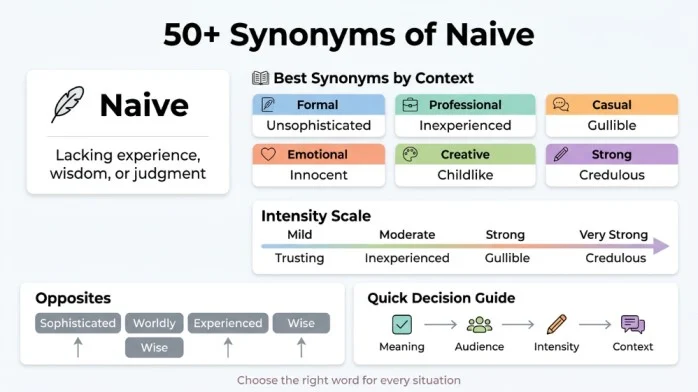
Naive describes someone who shows a lack of experience, wisdom, or judgment. The best synonyms include innocent, gullible, unsuspecting, trusting, inexperienced, childlike, credulous, and unsophisticated. Choose innocent for emotional writing, gullible for situations involving deception, unsuspecting for storytelling, inexperienced for professional contexts, and childlike for creative descriptions.
Meaning, Tone, and Context
Simple Definition
The word naive describes a person who lacks experience, wisdom, or judgment. It often refers to someone who is too trusting or believes things too easily.
Part of Speech
Naive is an adjective.
Overall Tone
The word usually has a neutral to slightly negative tone. It can suggest innocence or a lack of awareness.
Formality Level
Naive is considered neutral and appears in both formal and informal writing. It is commonly used in academic discussions, literary descriptions, everyday conversations, and psychological contexts.
Common Uses
Native English speakers commonly use naive when talking about:
- Naive people
- Naive beliefs
- Naive assumptions
- Naive questions
- Naive comments
- Naive behavior
- Naive expectations
- Naive trust
- Naive optimism
- Naive approach
Word Forms
| Word Form | Example |
|---|---|
| Adjective | naive |
| Noun | naivety / naivete |
| Adverb | naively |
| Opposite Form | sophisticated, worldly, experienced |
When and How to Use “Naive”
The word naive works well whenever you want to describe someone who lacks experience or is too trusting. However, choosing a more specific synonym can make your message clearer and more impactful.
Professional
“The intern’s naive approach to the project showed a lack of understanding of industry norms.”
Academic
“The study challenged the naive assumption that all participants would respond honestly.”
Workplace
“Her naive comments about the budget revealed her inexperience in financial planning.”
Personal
“I was naive to believe everything he told me without asking questions.”
“My naive suggestion was quickly corrected by more experienced team members.”
Resume
“While I may lack direct experience, I am not naive about the challenges of this role.”
Social Media
“Looking back, I realize how naive I was to trust so easily.”
Best Synonyms of Naive
The word naive is useful because it fits almost every type of writing, but no single synonym works perfectly in every situation. Some alternatives emphasize innocence, while others highlight gullibility, inexperience, or simplicity. Choosing the right synonym helps your writing sound more natural and precise.
Professional Writing: Inexperienced
Inexperienced is one of the strongest professional alternatives to naive. It focuses on lack of knowledge or practice rather than lack of intelligence.
Example:
“The new hire was inexperienced in managing large-scale projects.”
Why it works:
Business writing benefits from precise language, and inexperienced clearly communicates lack of practice without sounding judgmental.
Academic Writing: Unsophisticated
In essays, research papers, and reports, unsophisticated is often a better choice than naive because it highlights a lack of complexity or refinement.
Example:
“The researcher’s unsophisticated methodology was criticized by peers.”
Why it works:
It sounds objective, formal, and academically appropriate.
Business Communication: Green
Green is a professional yet informal alternative that describes someone new to a role or industry.
Example:
“Our green team members require additional training.”
Why it works:
It immediately communicates lack of experience without sounding harsh.
Casual Conversation: Gullible
For everyday speaking, gullible sounds natural and accurately describes someone easily deceived.
Example:
“Don’t be so gullible. That’s clearly a scam.”
Why it works:
Native English speakers frequently use gullible to describe someone who believes things too easily.
Emotional Writing: Innocent
When discussing personal experiences or describing someone’s character, innocent is usually more expressive than naive.
Example:
“Her innocent heart believed the best in everyone.”
Why it works:
It emphasizes purity and goodness instead of simply lacking experience.
Creative Writing: Childlike
Creative writing often benefits from descriptive vocabulary. Childlike helps create stronger imagery and emotional connection.
Example:
“His childlike wonder made even the simplest moments magical.”
Why it works:
It captures the reader’s attention and adds depth to storytelling.
Resume Writing: Eager
Recruiters frequently see the word eager because it positively frames inexperience as enthusiasm.
Example:
“Eager professional seeking opportunities to learn and grow.”
Why it works:
It sounds concise, professional, and achievement-focused.
Workplace Communication: Untrained
Untrained emphasizes that someone has not yet received necessary instruction.
Example:
“Untrained staff should not operate heavy machinery.”
Why it works:
It communicates necessity while maintaining a professional tone.
Stronger Meaning: Credulous
When you need stronger emphasis, credulous is one of the best replacements for naive.
Example:
“The credulous investor fell for the fraudulent scheme.”
Why it works:
It suggests excessive willingness to believe, often with negative consequences.
Softer Meaning: Trusting
Sometimes you want to recognize someone’s good nature without making them sound foolish.
Example:
“She has a naturally trusting personality.”
Why it works:
It gives balanced emphasis without exaggeration.
When Not to Use “Naive”
Although naive is versatile, it is not always the most effective word. In many situations, a more specific synonym communicates your message more clearly.
When It Sounds Too Judgment
Sometimes naive can sound insulting, especially in professional contexts.
Less Effective
“The intern’s naive questions were annoying.”
Better
“The intern’s thoughtful questions showed a desire to learn.”
Why
Thoughtful frames the behavior positively.
When Greater Precision Is Needed
If the situation requires specific description, naive may sound too general.
Less Effective
“He was naive about the risks.”
Better
“He was unaware of the potential consequences.”
Why
Unaware specifies what the person lacked.
In Academic Writing
Academic writing usually favors more precise vocabulary.
Less Effective
“The naive participants believed the instructions.”
Better
“The unsuspecting participants followed the instructions without question.”
Why
Unsuspecting is more objective and descriptive.
On a Resume
General wording often reduces the impact of your personal brand.
Less Effective
“I am not naive about the challenges.”
Better
“I am aware of the challenges and prepared to meet them.”
Why
Aware demonstrates knowledge and readiness.
In Creative Writing
Using naive repeatedly can make storytelling feel flat.
Less Effective
“The naive girl believed the stranger.”
Better
“The innocent girl trusted the stranger without hesitation.”
Why
Innocent creates stronger imagery and emotional depth.
When Expressing Personal Feelings
If you want to describe someone positively, choose a more expressive word.
Less Effective
“She is naive.”
Better
“She has a gentle, trusting nature.”
Why
Gentle and trusting communicate warmth and kindness.
Words Commonly Confused with “Naive”
| Word | Difference | When to Use It | Example |
|---|---|---|---|
| Innocent | Suggests purity and lack of guilt. | Emotional and personal writing. | “The innocent child smiled.” |
| Gullible | Easily deceived or tricked. | Situations involving deception. | “He is too gullible for scams.” |
| Unsuspecting | Not aware of danger or deception. | Storytelling and warnings. | “The unsuspecting victim was targeted.” |
| Trusting | Willing to trust others. | Describing personality positively. | “She is a trusting person.” |
| Inexperienced | Lacking knowledge or practice. | Professional and workplace contexts. | “The inexperienced worker needed training.” |
| Childlike | Having qualities of a child. | Creative and emotional writing. | “His childlike curiosity was endearing.” |
Best Synonyms of Naive by Context
| Context | Best Synonym | Why It Works | Example |
|---|---|---|---|
| Formal Writing | Unsophisticated | Sounds precise and professional. | “The unsophisticated analysis was flawed.” |
| Academic Writing | Credulous | Fits research and essays naturally. | “Credulous participants were easily influenced.” |
| Professional Communication | Inexperienced | Highlights lack of practice. | “Inexperienced staff require guidance.” |
| Business Emails | Green | Concise and professional. | “Our green team members are learning quickly.” |
| Resume Writing | Eager | Emphasizes enthusiasm. | “Eager learner with strong potential.” |
| Workplace Communication | Untrained | Stresses need for instruction. | “Untrained employees must complete orientation.” |
| Casual Conversation | Gullible | Sounds natural in daily speech. | “Don’t be so gullible!” |
| Everyday Speaking | Trusting | Common informal alternative. | “She is a trusting person.” |
| Creative Writing | Childlike | Adds vivid description. | “His childlike wonder was inspiring.” |
| Storytelling | Unsuspecting | Shows a turning point. | “The unsuspecting hero walked into danger.” |
| Emotional Writing | Innocent | Expresses purity and goodness. | “Her innocent heart was broken.” |
| Strong Emphasis | Credulous | Indicates excessive trust. | “His credulous nature was his downfall.” |
| Mild Tone | Trusting | Gives moderate emphasis. | “She has a trusting disposition.” |
| Social Media Captions | Naive | Sounds engaging and natural. | “I was so naive back then!” |
| American English | Gullible | Frequently used in conversation. | “That’s a gullible move.” |
| British English | Naive | Common in formal and everyday usage. | “His naive approach was criticized.” |
Synonyms of Naive by Usage
The word naive works in almost every situation, but choosing a more specific synonym makes your writing stronger and more natural. The sections below explain which alternatives fit different types of communication.
Professional vs Personal Synonyms
- Professional communication requires precise vocabulary, while personal conversations sound better with simpler, more relatable words.
Professional Synonyms
| Synonym | Best Used For | Why It Works |
|---|---|---|
| Inexperienced | Reports, policies | Shows lack of practice objectively. |
| Unsophisticated | Analysis, research | Indicates lack of refinement. |
| Green | Workplace communication | Professional yet informal. |
| Untrained | Safety, procedures | Stresses need for training. |
| Unaware | Risk assessment | Highlights lack of knowledge. |
Recommendation
Use inexperienced, unsophisticated, or untrained in resumes, business emails, presentations, and reports because they sound more precise than naive.
Personal Synonyms
| Synonym | Best Used For | Example |
|---|---|---|
| Gullible | Daily conversations | “He is so gullible.” |
| Trusting | Relationships | “She is naturally trusting.” |
| Innocent | Emotional writing | “Her innocence was beautiful.” |
| Childlike | Creative descriptions | “His childlike joy was contagious.” |
Recommendation
In conversations with friends and family, natural words like gullible and trusting often sound better than overly formal alternatives.
Formal vs Conversational Synonyms
Choosing the right level of formality helps your writing match the audience.
| Situation | Best Synonyms |
|---|---|
| Reports | Unsophisticated, Inexperienced |
| Essays | Credulous, Unaware |
| Business Writing | Inexperienced, Untrained |
| Presentations | Unsophisticated, Naive |
| Professional Emails | Inexperienced, Green |
| Casual Conversations | Gullible, Trusting |
| Text Messages | Gullible, Naive |
Example
Formal:
“The research participants were unsophisticated in their understanding of the topic.”
Conversational:
“Don’t be so gullible about what you see online.”
Academic Synonyms
Academic writing benefits from vocabulary that sounds precise and objective.
Credulous
Commonly used when discussing participants in research who are easily influenced.
Example
“Credulous participants were more likely to accept the misleading information.”
Unsophisticated
Best for describing methods, analyses, or understanding that lack complexity.
Example
“The unsophisticated research design produced unreliable results.”
Unaware
Ideal when describing subjects who lack knowledge about something.
Example
“Participants were unaware of the true purpose of the study.”
Inexperienced
Appropriate when referring to researchers or subjects with limited background.
Example
“Inexperienced researchers often overlook important variables.”
Gullible
Useful when discussing vulnerability to misinformation.
Example
“Gullible individuals are more susceptible to fake news.”
Recommendation
For essays and research papers, credulous, unsophisticated, and unaware usually sound stronger and more authoritative than naive.
Professional and Business Synonyms
Business communication often requires concise and specific language.
Inexperienced
Perfect for describing new employees or team members.
Example
“Inexperienced staff should be paired with mentors.”
Untrained
Highlights the need for instruction.
Example
“Untrained workers are not permitted to operate this equipment.”
Green
Describes someone new to an industry or role.
Example
“Our green interns bring fresh energy to the team.”
Unaware
Shows lack of knowledge about specific topics.
Example
“Some team members were unaware of the new policy.”
Eager
Positively frames inexperience as enthusiasm.
Example
“Eager candidates are often the most motivated to learn.”
Recommendation
Use these words in resumes, interviews, meetings, presentations, business emails, and client communication to sound more professional.
Creative and Literary Synonyms
Creative writing benefits from expressive vocabulary that creates emotion and imagery.
Childlike
Adds warmth and innocence to descriptions.
Example
“His childlike wonder made every day feel magical.”
Innocent
Expresses purity and goodness.
Example
“The innocent child trusted everyone she met.”
Unsuspecting
Creates tension and foreshadows danger.
Example
“The unsuspecting traveler walked into the trap.”
Gullible
Describes vulnerability in a relatable way.
Example
“His gullible nature made him the target of every prank.”
Trusting
Shows openness and kindness.
Example
“Her trusting heart was her greatest strength and weakness.”
These words make stories, speeches, and descriptive writing more engaging.
Slang or Modern Synonyms
There are very few true slang synonyms for naive, but native speakers often use casual expressions.
| Expression | Meaning | Appropriate For | Avoid In |
|---|---|---|---|
| Wet behind the ears | Inexperienced | Everyday conversations | Academic papers |
| Born yesterday | Naive and easily deceived | Friends, social media | Business reports |
| Green | New and inexperienced | Casual speech | Formal writing |
Example
Casual:
“He’s still wet behind the ears.”
Formal:
“He is still inexperienced in this field.”
Strongest to Mildest Synonyms
The following scale shows how different synonyms express different levels of naivety.
| Intensity | Synonyms |
|---|---|
| Mild | Trusting, Unaware |
| Moderate | Inexperienced, Unsophisticated |
| Strong | Gullible, Credulous |
| Very Strong | Naive, Childish |
Understanding the Scale
- Trusting simply shows willingness to trust.
- Unaware shows lack of knowledge about something.
- Inexperienced shows lack of practice or exposure.
- Unsophisticated shows lack of complexity or refinement.
- Gullible suggests being easily deceived.
- Credulous suggests excessive willingness to believe.
- Naive suggests a general lack of wisdom or judgment.
- Childish suggests immaturity and lack of grown-up understanding.
Emotional vs Neutral Synonyms
Some synonyms express feelings, while others simply communicate lack of experience.
Emotional Synonyms
| Synonym | Best Used For |
|---|---|
| Innocent | Personal experiences |
| Childlike | Creative descriptions |
| Trusting | Relationships |
| Unsuspecting | Storytelling |
These words add emotion and help readers connect with the message.
Neutral Synonyms
| Synonym | Best Used For |
|---|---|
| Inexperienced | Professional contexts |
| Unsophisticated | Academic writing |
| Unaware | Risk assessment |
| Untrained | Workplace communication |
Neutral words communicate information without adding unnecessary emotion.
Antonyms of Naive
| Antonym | Meaning | Example Sentence |
|---|---|---|
| Sophisticated | Having refined knowledge and experience | The sophisticated investor avoided the scam. |
| Worldly | Experienced in life | He is a worldly traveler who knows the risks. |
| Experienced | Having practical knowledge | The experienced manager handled the crisis well. |
| Cynical | Distrustful of others’ motives | Her cynical attitude made her hard to fool. |
| Wise | Having good judgment | The wise elder offered sound advice. |
| Savvy | Having practical knowledge | She is savvy about online scams. |
| Skeptical | Questioning and doubtful | The skeptical journalist verified every claim. |
| Knowledgeable | Having deep understanding | The knowledgeable expert identified the problem. |
| Street-smart | Having practical survival skills | The street-smart teenager avoided danger. |
| Shrewd | Showing clever judgment | The shrewd businessman negotiated a better deal. |
| Astute | Having sharp insight | Her astute observations impressed the team. |
| Perceptive | Quick to understand | The perceptive detective noticed the clue. |
| Realistic | Facing facts practically | She has a realistic view of the situation. |
| Mature | Fully developed in judgment | The mature student made responsible decisions. |
| Seasoned | Experienced and skilled | The seasoned professional guided the team. |
Comparison: “Naive” vs Similar Words
Although naive is a versatile word, several similar words carry different shades of meaning. Understanding these differences helps you choose the most accurate word for each situation.
Naive vs Innocent
Main Difference
Naive suggests a lack of wisdom or judgment. Innocent suggests purity and lack of guilt or wrongdoing.
Which Is Stronger?
Innocent is stronger in terms of moral purity, while naive is stronger in terms of judgment.
Which Is More Formal?
Both are suitable for formal writing, but innocent is more common in emotional contexts.
When to Use Each
Use naive for situations involving judgment or awareness.
Use innocent for situations involving morality or purity.
Examples
Naive:
“He was naive to trust his business partner.”
Innocent:
“The innocent child believed in magic.”
Naive vs Gullible
Main Difference
Naive suggests a general lack of experience or wisdom. Gullible specifically means easily deceived or tricked.
Which Is Stronger?
Gullible is stronger because it directly implies vulnerability to deception.
Which Is More Formal?
Naive is more formal and widely acceptable. Gullible is more casual.
When to Use Each
Use naive for general descriptions.
Use gullible when describing someone’s vulnerability to scams or lies.
Examples
Naive:
“She has naive beliefs about love.”
Gullible:
“He is so gullible that he believed the fake news.”
Naive vs Trusting
Main Difference
Naive suggests foolishness or lack of awareness. Trusting suggests a positive willingness to believe.
Which Is Stronger?
Trusting is positive and neutral. Naive is slightly negative.
Which Is More Formal?
Both fit professional writing, but trusting has a warmer tone.
When to Use Each
Choose trusting when describing someone’s positive nature.
Choose naive when suggesting that someone’s trust is misplaced.
Examples
Naive:
“His naive trust in strangers was dangerous.”
Trusting:
“She has a trusting and open heart.”
Naive vs Inexperienced
Main Difference
Inexperienced focuses on lack of practice or exposure. Naive focuses on lack of judgment or wisdom.
Which Is Stronger?
Neither is stronger. They emphasize different ideas.
Which Is More Formal?
Inexperienced is more formal and professional.
When to Use Each
Use inexperienced in professional contexts.
Use naive in personal or emotional contexts.
Examples
Naive:
“She made naive assumptions about the project.”
Inexperienced:
“The inexperienced intern needed guidance.”
Naive vs Unsophisticated
Main Difference
Unsophisticated means lacking refinement or complexity. Naive means lacking wisdom or judgment.
Which Is Stronger?
Unsophisticated sounds more objective and neutral.
Which Is More Formal?
Unsophisticated is more formal.
When to Use Each
Use unsophisticated for intellectual or cultural contexts.
Use naive for personal or emotional contexts.
Examples
Naive:
“He had naive ideas about how business works.”
Unsophisticated:
“The unsophisticated analysis was easily challenged.”
Naive vs Childlike
Main Difference
Childlike describes qualities of a child, like wonder or curiosity. Naive describes lack of judgment or awareness.
Which Is Stronger?
Childlike is positive and warm. Naive can be negative.
Which Is More Formal?
Childlike is more common in creative writing.
When to Use Each
Use childlike for positive descriptions.
Use naive for more critical descriptions.
Examples
Naive:
“Her naive behavior was inappropriate for her age.”
Childlike:
“His childlike curiosity made him a great learner.”
Common Phrases and Expressions with “Naive”
| Phrase | Meaning | Example Sentence |
|---|---|---|
| Naive belief | An unrealistic or overly trusting belief | “His naive belief in honesty was admirable but unrealistic.” |
| Naive assumption | An assumption made without enough knowledge | “That naive assumption caused the team to fail.” |
| Naive question | A question that reveals lack of knowledge | “The intern asked a naive question about the industry.” |
| Naive optimism | Unrealistic positive thinking | “Her naive optimism led her to ignore the risks.” |
| Naive trust | Trust given without good reason | “His naive trust in strangers was worrying.” |
| Naive approach | An approach lacking practical experience | “The naive approach to the problem was ineffective.” |
| Naive comment | A comment that reveals inexperience | “His naive comment made everyone uncomfortable.” |
| Naive view | A perspective lacking depth or understanding | “She holds a naive view of the world.” |
Common Mistakes to Avoid
1. Using “Naive” When “Innocent” Is More Appropriate
Incorrect
“The naive child was not guilty of the crime.”
Better
“The innocent child was not guilty of the crime.”
Why
Innocent refers to lack of guilt, not lack of experience.
2. Using “Naive” in Professional Writing Without Context
Incorrect
“The naive employee made mistakes.”
Better
“The inexperienced employee made mistakes that could have been avoided with proper training.”
Why
Inexperienced is more professional and specific.
3. Choosing an Overly Strong Synonym
Incorrect
“Her credulous nature made her accept the invitation.”
Better
“Her trusting nature made her accept the invitation.”
Why
Trusting is more positive and less judgmental.
4. Repeating “Naive” Too Often
Incorrect
“The naive student asked a naive question, and the naive teacher gave a naive answer.”
Better
“The new student asked a simple question, and the experienced teacher gave a thoughtful answer.”
Why
Using varied vocabulary improves readability and style.
5. Confusing “Naive” with “Childlike”
Incorrect
“Her naive wonder made her appreciate the small things.”
Better
“Her childlike wonder made her appreciate the small things.”
Why
Childlike emphasizes positive qualities, while naive can imply foolishness.
6. Using “Naive” When Describing Positives
Incorrect
“Her naive generosity touched everyone.”
Better
“Her generous spirit touched everyone.”
Why
Generous is more positive and less critical than naive.
7. Overusing “Naive” in Creative Writing
Incorrect
“The naive girl wandered into the naive town where naive people lived.”
Better
“The innocent girl wandered into the peaceful town where trusting people lived.”
Why
Varying vocabulary makes writing more engaging and descriptive.
Frequently Asked Questions
What are the best synonyms of “naive”?
The best synonyms of naive include innocent, gullible, unsuspecting, trusting, inexperienced, childlike, and unsophisticated. The right choice depends on your audience, tone, and writing purpose.
What are the best formal synonyms of “naive”?
Strong formal alternatives include unsophisticated, inexperienced, credulous, unseasoned, and green. These words work well in academic papers, reports, and business communication.
What are common informal synonyms of “naive”?
Common informal alternatives include gullible, trusting, simple, and wet behind the ears. These expressions sound natural in everyday conversations and social media posts.
What is another word for “naive” in professional writing?
In professional communication, excellent alternatives include inexperienced, untrained, green, and unsophisticated. These words make reports, emails, resumes, and presentations sound more precise and polished.
What is the difference between “naive” and “gullible”?
Naive is a general word that describes lack of experience or judgment. Gullible specifically means easily deceived or tricked. Gullible is more specific and often more negative than naive.
What is the opposite of “naive”?
The most common opposites include sophisticated, worldly, experienced, cynical, savvy, and skeptical. Each describes someone with knowledge, judgment, or awareness.
Conclusion
The word naive is useful when describing someone who lacks experience or judgment, but using it repeatedly can make your writing feel repetitive. Learning the best synonyms of naive helps you express your ideas with greater accuracy, stronger style, and better clarity.
You’re writing an essay, preparing a business presentation, updating your resume, or having a casual conversation, no single synonym fits every situation. Words like innocent, gullible, unsuspecting, trusting, inexperienced, and childlike each carry unique meanings and should be chosen based on your audience, tone, and purpose.
A simple way to improve your vocabulary is to pause before writing naive and ask yourself whether you want to emphasize innocence, gullibility, inexperience, or simplicity. Choosing the most appropriate synonym will make your writing more engaging, professional, and natural.
Read More Related Articles:
Synonyms for Creativity | Meaning, Examples, and Better …
Synonyms for Marginalized| Meaning, Examples, and Better …