A writer may use explicit several times in an essay, email, report, caption, or professional document and then realize that the word does not always express exactly what they mean. Sometimes they want to say something is clearly stated. In other situations, they mean detailed, graphic, direct, or completely unambiguous.
Finding the right synonym of explicit depends heavily on context. Words such as clear, specific, precise, and unambiguous work well when information is plainly stated, while graphic, detailed, or uncensored can describe content that presents sensitive or mature material openly. Choosing the right alternative improves accuracy, tone, and readability without changing the intended meaning.
What Are the Best Synonyms of “Explicit”?
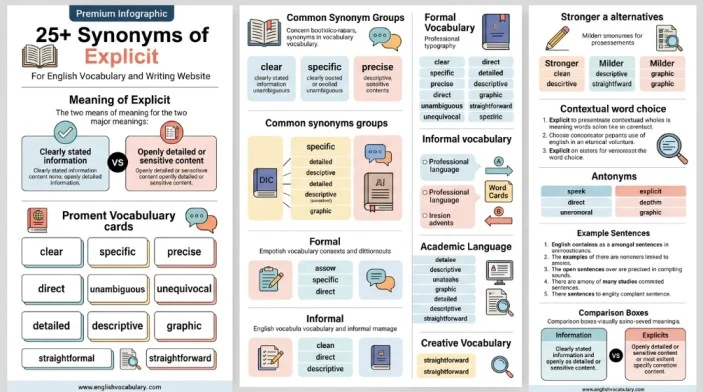
Explicit generally means clearly stated, directly expressed, or presented without leaving the meaning uncertain. The best synonyms include clear, specific, precise, direct, and unambiguous for ordinary writing. For detailed or sensitive content, graphic, detailed, and uncensored may be more accurate.
For formal writing, unequivocal, precise, and specific are strong choices. Academic writing often benefits from clear, explicitly stated, or unambiguous. Professional communication commonly uses direct, specific, and clearly defined, while creative or sensitive contexts may call for graphic, descriptive, or uncensored.
Meaning, Tone, and Context
Simple Definition
Explicit describes something that is expressed clearly and directly, leaving little or no room for uncertainty about its meaning.
The word can also describe content that presents sexual, violent, or otherwise sensitive details openly and in a graphic way. Because of these two major meanings, the best synonym depends on the sentence.
Part of Speech
Explicit is an adjective.
It normally describes a noun:
- explicit instructions
- explicit permission
- explicit language
- explicit details
- explicit criticism
- explicit content
- explicit reference
- explicit statement
Overall Tone
The tone of explicit is usually neutral, but it can become sensitive depending on the subject.
When describing instructions or communication, it often sounds professional and precise. When describing sexual or violent material, it can carry a sensitive or cautionary tone.
Formality Level
Explicit is a neutral to formal word. It works naturally in:
- Academic writing
- Business communication
- Legal writing
- Professional documents
- Technical instructions
- Everyday conversation
- Media discussions
- Content descriptions
It is not limited to formal English, which makes it a highly versatile word.
Common Uses
Native English speakers commonly use explicit when discussing information, instructions, permission, statements, references, rules, or content.
Examples include:
- “The manager gave explicit instructions.”
- “The contract contains explicit requirements.”
- “She gave explicit permission.”
- “The author makes an explicit reference to the event.”
- “The study provides explicit evidence.”
- “The website contains an explicit content warning.”
Two Main Meanings of “Explicit”
Understanding these two meanings is essential when choosing a synonym.
Meaning 1: Clearly expressed
Here, explicit means something is stated directly rather than merely suggested.
Example:
“The professor gave explicit instructions for the assignment.”
This means the instructions were clear and directly stated.
Meaning 2: Graphic or openly detailed
Here, explicit describes content that presents sensitive, sexual, violent, or otherwise mature details openly.
Example:
“The movie contains explicit scenes.”
In this sense, graphic, detailed, or uncensored may be more appropriate depending on the exact context.
Word Forms
| Form | Word |
|---|---|
| Adjective | explicit |
| Adverb | explicitly |
| Noun | explicitness |
| Common opposite | implicit |
The adverb explicitly means in a clear and direct manner.
Example:
“The policy explicitly prohibits unauthorized access.”
The noun explicitness refers to the quality of being clearly and directly expressed.
When and How to Use “Explicit”
Use explicit when the message is stated directly enough that readers do not need to infer the intended meaning. It is especially useful when clarity, precision, or directness matters.
Professional
“The supervisor provided explicit instructions for handling confidential documents.”
Here, explicit emphasizes that the instructions were clearly stated.
Academic
“The researchers made an explicit distinction between the two groups.”
This use highlights a distinction that was directly expressed rather than implied.
Workplace
“Employees received explicit guidance about the new attendance policy.”
The word works because the guidance was clearly communicated.
Personal
“She gave me explicit permission to share the information.”
This means permission was directly and clearly given.
“Please provide explicit confirmation before we proceed with the order.”
The word makes the request precise and removes uncertainty.
Resume
“Created explicit documentation for new employee procedures.”
This use can work when the documentation clearly defines processes, although detailed or clearly defined may sound more natural depending on the resume context.
Social Media
“The post includes an explicit warning about sensitive content.”
Here, explicit communicates that the warning clearly identifies the nature of the material.
Best Synonyms of “Explicit”
No synonym perfectly replaces explicit in every sentence. The most accurate choice depends on whether you mean clearly stated information, direct communication, detailed description, or sensitive content.
Professional Writing: Precise
Precise is excellent when the emphasis is on exact wording or clearly defined information.
“The report provides precise instructions for completing the procedure.”
It is especially useful when accuracy matters.
Academic Writing: Unambiguous
Unambiguous works well when you want to show that a statement has only one clear interpretation.
“The findings provide unambiguous evidence of the relationship.”
It has a formal, objective quality that suits academic writing.
Business Communication: Specific
Specific is often more natural than explicit when discussing requirements, expectations, requests, or details.
“Please provide specific instructions before the project begins.”
It tells the reader that the information should be concrete rather than general.
Casual Conversation: Clear
Clear is the most natural everyday alternative in many situations.
“She was very clear about what she wanted.”
It sounds simple and conversational.
Emotional Writing: Direct
Direct works when someone communicates feelings, opinions, or intentions openly.
“His direct response made his feelings obvious.”
It emphasizes straightforward communication.
Creative Writing: Descriptive
Descriptive is useful when explicitness comes from providing many details.
“The author uses descriptive language to create a vivid scene.”
It is better than explicit when the main idea is richness of description rather than directness.
Resume Writing: Specific
Specific is generally more useful on a resume than explicit because resumes benefit from concrete descriptions.
Instead of:
“Provided explicit project instructions.”
Consider:
“Provided specific project guidelines to support team performance.”
Workplace Communication: Clearly Defined
Clearly defined is useful for policies, expectations, roles, goals, and procedures.
“The team works according to clearly defined responsibilities.”
It sounds professional without being unnecessarily formal.
Stronger Meaning: Unequivocal
Unequivocal means completely clear and leaving no reasonable doubt.
“The company issued an unequivocal statement about its policy.”
This is stronger and more formal than ordinary explicit.
Softer Meaning: Clear
Clear can be a softer, more conversational alternative.
“The instructions were clear and easy to follow.”
It communicates clarity without the stronger formal emphasis of unequivocal.
When Not to Use “Explicit”
Although explicit is accurate in many situations, it can sometimes sound too general, too formal, or simply less natural than a more precise alternative.
When It Is Too General
Less effective:
“The teacher gave explicit information.”
Better:
“The teacher gave specific information about the assignment.”
Why:
The word specific tells readers more about the nature of the information.
When It Is Too Formal
Less natural in casual conversation:
“Please provide explicit confirmation.”
More natural:
“Please clearly confirm that.”
Why:
The second version sounds more conversational.
When It Is Too Vague
Less effective:
“The report contains explicit details.”
Better:
“The report contains detailed financial figures.”
Why:
Detailed identifies what kind of information is being emphasized.
When It Is Too Weak
Sometimes explicit does not communicate enough force.
Less effective:
“The policy gives an explicit warning.”
Better:
“The policy gives a clear and unequivocal warning.”
Why:
Unequivocal makes the strength of the message clearer.
When It Is Too Strong
If you simply mean understandable, explicit may unnecessarily emphasize directness.
Less effective:
“The instructions were explicit and easy to understand.”
Better:
“The instructions were clear and easy to understand.”
Why:
Clear communicates the intended idea naturally without adding extra emphasis.
When the Meaning Is Actually “Graphic”
Less effective:
“The film contains explicit descriptions of the accident.”
Better:
“The film contains graphic descriptions of the accident.”
Why:
If the emphasis is on disturbing or vivid detail, graphic is more precise.
When the Meaning Is Actually “Detailed”
Less effective:
“She gave explicit information about the process.”
Better:
“She gave detailed information about the process.”
Why:
Detailed emphasizes the amount and depth of information rather than its directness.
Words Commonly Confused With “Explicit”
| Word | Difference | When to Use It | Example |
|---|---|---|---|
| Implicit | Means suggested rather than directly stated. | Use when readers must infer the meaning. | “The criticism was implicit rather than direct.” |
| Specific | Focuses on exact details rather than general information. | Use for requirements, examples, or precise details. | “The manager gave specific instructions.” |
| Clear | Means easy to understand. | Use in everyday and professional communication. | “Her explanation was clear.” |
| Direct | Focuses on straightforward communication. | Use when someone says something openly. | “He gave a direct answer.” |
| Graphic | Focuses on vivid or disturbing detail. | Use for descriptions of violence, sex, injury, or other intense material. | “The article contains graphic descriptions.” |
| Detailed | Emphasizes the amount of information provided. | Use when something explains many aspects of a subject. | “The guide offers detailed instructions.” |
Best Synonyms of “Explicit” by Context
| Context | Best Synonym | Why It Works | Example |
|---|---|---|---|
| Formal writing | Unequivocal | Removes doubt and sounds authoritative. | “The statement was unequivocal.” |
| Academic writing | Unambiguous | Clearly communicates one interpretation. | “The evidence was unambiguous.” |
| Professional communication | Specific | Makes expectations concrete. | “Please provide specific requirements.” |
| Business emails | Clear | Sounds professional without unnecessary formality. | “Please provide clear instructions.” |
| Resume writing | Specific | Helps describe concrete skills and duties. | “Provided specific training materials.” |
| Workplace communication | Direct | Encourages straightforward communication. | “Her direct feedback was helpful.” |
| Casual conversation | Clear | Natural and easy to understand. | “He was clear about his plans.” |
| Everyday speaking | Straightforward | Sounds natural and uncomplicated. | “She gave a straightforward answer.” |
| Creative writing | Descriptive | Adds detail without focusing on directness. | “The descriptive passage created a vivid scene.” |
| Storytelling | Detailed | Provides depth and information. | “He gave a detailed account of the journey.” |
| Emotional writing | Direct | Expresses feelings openly. | “Her direct message showed how she felt.” |
| Strong emphasis | Unequivocal | Leaves virtually no room for doubt. | “The decision was unequivocal.” |
| Mild tone | Clear | Communicates meaning without sounding forceful. | “The message was clear.” |
| Social media captions | Direct | Keeps communication concise and understandable. | “The caption gives a direct explanation.” |
| American English | Clear | Common and natural across contexts. | “The policy is clear.” |
| British English | Clear | The same core alternatives apply. | “The instructions are clear.” |
How to Choose the Best Synonym of “Explicit”
Choosing an alternative becomes easier when you first identify what explicit means in your sentence.
If You Mean “Clearly Stated”
Choose:
Clear, direct, specific, or stated.
Example:
“The rules were clearly stated.”
If You Mean “Impossible to Misunderstand”
Choose:
Unambiguous, unequivocal, or unmistakable.
Example:
“The instructions were unambiguous.”
If You Mean “Detailed”
Choose:
Detailed, descriptive, or specific.
Example:
“The manual contains detailed instructions.”
If You Mean “Graphic”
Choose:
Graphic, vivid, or descriptive, depending on the content.
Example:
“The novel contains graphic descriptions of violence.”
If You Mean “Open and Direct”
Choose:
Direct, frank, forthright, or candid.
Example:
“She gave a frank explanation of the problem.”
Consider Your Audience
- For an academic audience, unambiguous, specific, and precise usually work well.
- For a workplace audience, clear, specific, and direct are often more natural.
- For casual conversation, clear and straightforward are usually better choices.
- For sensitive content, choose a synonym that accurately describes whether the material is graphic, detailed, or uncensored.
Consider Emotional Strength
- A sentence using clear usually sounds neutral.
- A sentence using direct can sound more assertive.
- A sentence using unequivocal sounds especially firm.
- A sentence using graphic shifts the meaning toward vivid or sensitive detail.
Consider the Writing Purpose
- If your goal is to explain information, choose clear or specific.
- If your goal is to emphasize certainty, choose unambiguous or unequivocal.
- If your goal is to describe content, choose detailed, descriptive, or graphic according to the subject.
Real Life Examples of “Explicit”
School
Original:
“The teacher gave explicit instructions for the project.”
Improved:
“The teacher gave specific instructions for the project.”
Why: Specific sounds natural when discussing assignment requirements.
College
Original:
“The professor made an explicit distinction between the theories.”
Improved:
“The professor made a clear distinction between the theories.”
Why: Clear works naturally while preserving the original meaning.
Workplace
Original:
“The manager gave explicit directions.”
Improved:
“The manager gave clear directions.”
Why: Clear is concise and natural in workplace communication.
Business
Original:
“The contract contains explicit requirements.”
Improved:
“The contract contains specific requirements.”
Why: Specific emphasizes concrete obligations.
Original:
“Please give me explicit instructions.”
Improved:
“Please provide clear instructions.”
Why: The revised version sounds professional and polite.
Resume
Original:
“Created explicit training materials for new employees.”
Improved:
“Created detailed training materials for new employees.”
Why: Detailed better describes substantial training content.
Conversation
Original:
“She was explicit about her plans.”
Improved:
“She was clear about her plans.”
Why: Clear is more natural in everyday speech.
Storytelling
Original:
“The author gave explicit details about the character’s childhood.”
Improved:
“The author provided detailed descriptions of the character’s childhood.”
Why: Detailed descriptions better captures the storytelling context.
Blogging
Original:
“The article gives explicit instructions for creating a budget.”
Improved:
“The article provides step by step instructions for creating a budget.”
Why: The revised wording tells readers exactly what kind of information the article contains.
Social Media
Original:
“The creator gave an explicit warning about the video.”
Improved:
“The creator gave a clear warning about the video’s sensitive content.”
Why: Clear is concise and natural for social media communication.
25 Best Synonyms of “Explicit”
The list below covers the two major meanings of explicit: clearly expressed information and openly detailed or graphic content. Some alternatives are stronger matches in particular contexts than others.
| Synonym | Simple Meaning | Best Used For | Example Sentence |
|---|---|---|---|
| Clear | Easy to understand | Everyday and professional communication | “The instructions were clear.” |
| Specific | Focused on exact details | Requirements and instructions | “Please provide specific examples.” |
| Precise | Exact and accurate | Academic and technical writing | “The report uses precise language.” |
| Unambiguous | Having only one clear meaning | Academic and formal writing | “The evidence was unambiguous.” |
| Unequivocal | Completely clear and firm | Formal statements | “She gave an unequivocal response.” |
| Direct | Straightforward and openly expressed | Conversation and workplace communication | “He gave a direct answer.” |
| Straightforward | Simple and easy to understand | Casual and professional writing | “Her explanation was straightforward.” |
| Plain | Expressed in simple, clear language | General communication | “The policy is written in plain language.” |
| Express | Clearly stated or directly given | Formal communication | “The contract requires express consent.” |
| Stated | Directly said or written | Formal and academic contexts | “The stated objective was to improve access.” |
| Overt | Open and not hidden | Actions, attitudes, and statements | “The organization faced overt criticism.” |
| Unmistakable | Impossible to mistake | Strong emphasis | “There was an unmistakable change in tone.” |
| Categorical | Complete and without qualification | Formal statements | “The company issued a categorical denial.” |
| Declarative | Expressed as a firm statement | Formal or linguistic contexts | “The report uses declarative language.” |
| Detailed | Containing many specific facts | Instructions and descriptions | “The guide provides detailed directions.” |
| Graphic | Vividly and intensely described | Sensitive or disturbing content | “The article contains graphic descriptions.” |
| Descriptive | Giving a rich account of details | Creative writing | “The novel uses descriptive language.” |
| Vivid | Producing a strong mental image | Creative and sensory writing | “The writer gives a vivid account of the event.” |
| Uncensored | Not edited to remove sensitive material | Media and content descriptions | “The documentary includes uncensored footage.” |
| Unfiltered | Presented without holding back | Opinions and personal communication | “She offered an unfiltered assessment.” |
| Frank | Open and honest | Personal and professional discussion | “He gave a frank explanation.” |
| Blunt | Very direct, sometimes without softness | Informal criticism | “Her blunt response surprised the team.” |
| Forthright | Open and direct | Professional and personal communication | “He was forthright about the challenges.” |
| Candid | Honest and openly expressed | Interviews and personal discussions | “She gave a candid account of the experience.” |
| Literal | Expressed according to the exact wording or meaning | Language and interpretation | “The statement has a literal meaning.” |
Synonyms of “Explicit” by Usage
Professional vs Personal Synonyms
Professional communication usually benefits from clarity without unnecessary emotional force. Specific, precise, clear, direct, and unequivocal are especially useful.
Examples:
“Please provide specific requirements.”
“The manager gave clear instructions.”
“The company issued an unequivocal statement.”
Personal communication can be more flexible. Direct, frank, candid, and straightforward can express openness without sounding excessively technical.
Example:
“I appreciate your candid feedback.”
Recommendation
Use specific when discussing details, clear when discussing understanding, direct when discussing communication, and unequivocal when emphasizing certainty.
Formal vs Conversational Synonyms
Formal writing often favors words that communicate precision.
| Situation | Strong Choice |
|---|---|
| Reports | Precise |
| Essays | Specific |
| Business writing | Clear |
| Presentations | Direct |
| Emails | Clear |
| Casual conversations | Straightforward |
| Texting | Clear |
| Personal discussions | Candid |
For example:
Formal:
“The agreement contains specific requirements.”
Conversational:
“The agreement is pretty clear about what we need to do.”
The second version is more relaxed while preserving the central meaning.
Academic Synonyms
Academic writing requires careful distinctions. The strongest alternatives to explicit depend on what the writer wants to communicate.
Unambiguous
Use this when a statement has one clear interpretation.
“The results provide unambiguous evidence.”
Precise
Use this when accuracy and exact wording matter.
“The researchers used precise terminology.”
Specific
Use this when referring to defined details.
“The study identifies specific factors affecting performance.”
Clearly Stated
Use this when the main concern is whether the author directly expressed an idea.
“The limitation was clearly stated in the conclusion.”
Unequivocal
Use this when the evidence or conclusion is especially firm.
“The authors reached an unequivocal conclusion.”
These choices help academic writing avoid vague statements while preserving an objective tone.
Professional and Business Synonyms
Resumes
Use specific, clear, and detailed when describing responsibilities.
Instead of:
“Provided explicit support to clients.”
Consider:
“Provided detailed support to clients throughout the implementation process.”
Interviews
Use direct, candid, or forthright when describing communication.
“I prefer to give direct feedback while remaining constructive.”
Meetings
Use clear and specific.
“The team needs specific objectives before the meeting.”
Presentations
Use precise and clear.
“The presentation provides a clear explanation of the proposed strategy.”
Performance Reviews
Use direct and specific.
“The manager gave specific feedback on areas for improvement.”
Client Communication
Use clear, direct, and specific.
“We need a clear description of the client’s requirements.”
Business Emails
Use clear or specific rather than forcing the word explicit into every sentence.
“Could you provide specific details about the requested changes?”
Creative and Literary Synonyms
Creative writing gives explicit several possible alternatives because the writer may want to emphasize detail, openness, or vivid imagery.
Descriptive
Best for language that gives readers many details.
“The descriptive passage brought the setting to life.”
Vivid
Best for language that creates a strong mental image.
“The author paints a vivid picture of the storm.”
Graphic
Best when the description is extremely detailed and potentially disturbing or sensitive.
“The novel contains graphic descriptions of violence.”
Detailed
Best when the writer provides substantial information without necessarily creating an emotional effect.
“The memoir gives a detailed account of her childhood.”
Forthright
Best when a character speaks openly and directly.
“The character is forthright about her fears.”
These alternatives allow writers to control the exact effect rather than relying on explicit as a broad description.
Slang or Modern Synonyms
There is no single true slang synonym for explicit that works across its meanings.
In casual English, people may use expressions such as straight up, totally clear, or spelled out, but these are context dependent and should not be treated as universal replacements.
Spelled Out
Meaning: Explained clearly and completely.
Acceptable in: Conversation, informal writing, workplace discussions.
Avoid in: Highly formal academic or legal writing unless the tone permits it.
Example:
“The manager spelled out exactly what the team needed to do.”
Straight Up
Meaning: Directly or honestly.
Acceptable in: Casual conversation and informal social media.
Avoid in: Academic papers, formal reports, and professional documents.
Example:
“She told me straight up that the plan would not work.”
These expressions are alternatives for particular uses of explicit, not complete synonyms.
Strongest to Mildest Synonyms
Because explicit has multiple meanings, there is no single universal intensity scale. The following scale focuses mainly on the meaning of clarity and directness.
| Intensity | Useful Alternatives |
|---|---|
| Mild | Clear, plain |
| Moderate | Specific, direct, straightforward |
| Strong | Precise, unambiguous, unmistakable |
| Very Strong | Unequivocal, categorical |
Mild
Clear communicates understandable information without adding force.
Moderate
Specific and direct add precision and openness.
Strong
Unambiguous and unmistakable suggest that confusion is difficult or impossible.
Very Strong
Unequivocal and categorical communicate firm certainty.
Emotional vs Neutral Synonyms
Emotional Synonyms
These words can carry more personal or interpersonal feeling.
- Frank
- Candid
- Blunt
- Forthright
- Unfiltered
Example:
“She gave a candid explanation of what had happened.”
These words are useful when the writer wants to emphasize openness or honesty.
Neutral Synonyms
These alternatives mainly communicate information.
- Clear
- Specific
- Precise
- Unambiguous
- Detailed
- Stated
- Direct
Example:
“The instructions were specific and easy to follow.”
Neutral vocabulary is generally safer for academic, technical, and professional writing.
Antonyms of “Explicit”
The strongest opposite of explicit is usually implicit, meaning something is suggested rather than directly stated. Because explicit also describes detailed or uncensored content, some antonyms apply to particular senses rather than every use.
| Antonym | Meaning | Example Sentence |
|---|---|---|
| Implicit | Suggested without being directly stated | “The criticism was implicit rather than direct.” |
| Implied | Communicated indirectly | “Her concern was implied by her response.” |
| Unstated | Not directly expressed | “The unstated assumption affected the decision.” |
| Indirect | Communicated without saying something plainly | “He gave an indirect answer.” |
| Vague | Lacking clear details | “The instructions were too vague to follow.” |
| Ambiguous | Open to more than one interpretation | “The wording was ambiguous.” |
| Unclear | Difficult to understand | “The policy remains unclear.” |
| Obscure | Difficult to understand or interpret | “The reference was obscure.” |
| Cryptic | Deliberately or unusually difficult to understand | “His cryptic message confused everyone.” |
| Allusive | Communicating through indirect reference | “The poem is highly allusive.” |
| Euphemistic | Using softer language instead of direct wording | “The report used euphemistic language.” |
| Censored | Edited to remove restricted or sensitive material | “The broadcast version was censored.” |
| Restrained | Limited in expression or detail | “The description was restrained rather than graphic.” |
| Suggestive | Hinting at something without stating it directly | “The wording was suggestive but not explicit.” |
| Veiled | Hidden or expressed indirectly | “The comment contained a veiled criticism.” |
Comparison: “Explicit” vs Similar Words
Explicit vs Implicit
Main Difference
Explicit means directly stated, while implicit means suggested without being directly stated.
Which Is Stronger?
Explicit is stronger in terms of clarity because the message is directly communicated.
Which Is More Formal?
Both are common in academic and professional writing.
When to Use Each
Use explicit when the writer clearly states the message.
Use implicit when readers must infer it.
Examples
Explicit:
“The policy explicitly prohibits outside employment.”
Implicit:
“The policy implicitly discourages outside employment.”
Explicit vs Clear
Main Difference
Clear means easy to understand. Explicit goes further by emphasizing that something has been directly stated.
Which Is Stronger?
Explicit usually carries more emphasis on direct expression.
Which Is More Formal?
Explicit is somewhat more formal, while clear is highly versatile.
When to Use Each
Use clear for everyday communication.
Use explicit when direct wording or absence of implication matters.
Examples
Explicit:
“The contract contains explicit restrictions.”
Clear:
“The contract contains clear restrictions.”
Explicit vs Specific
Main Difference
Specific focuses on exact details. Explicit focuses on direct expression.
Which Is Stronger?
Neither is universally stronger. They emphasize different qualities.
Which Is More Formal?
Both work well in professional and academic contexts.
When to Use Each
Use specific for exact requirements or details.
Use explicit when information is directly stated.
Examples
Explicit:
“The agreement gives explicit permission.”
Specific:
“The agreement lists specific conditions.”
Explicit vs Direct
Main Difference
Direct emphasizes straightforward communication. Explicit emphasizes information that is clearly and fully stated.
Which Is Stronger?
Explicit can be stronger when complete clarity is important.
Which Is More Formal?
Both are suitable for professional writing.
When to Use Each
Use direct when discussing communication style.
Use explicit when discussing the content of a statement.
Examples
Explicit:
“The instructions were explicit.”
Direct:
“She gave me a direct answer.”
Explicit vs Graphic
Main Difference
Explicit can describe content that is openly detailed, while graphic specifically emphasizes vivid, intense, or potentially disturbing detail.
Which Is Stronger?
Graphic can create a stronger sensory or emotional impression.
Which Is More Formal?
Both are used in media, journalism, and content descriptions.
When to Use Each
Use explicit for a broad content warning.
Use graphic when the material is vividly described or shown.
Examples
Explicit:
“The film contains explicit content.”
Graphic:
“The film contains graphic depictions of violence.”
Explicit vs Detailed
Main Difference
Detailed focuses on the amount and depth of information. Explicit focuses on directness or openness.
Which Is Stronger?
Neither is automatically stronger.
Which Is More Formal?
Both are appropriate in professional and academic writing.
When to Use Each
Use detailed when information contains many facts or explanations.
Use explicit when the information is directly expressed.
Examples
Explicit:
“The agreement contains explicit instructions.”
Detailed:
“The agreement contains detailed instructions.”
Common Phrases and Expressions with “Explicit”
Explicit Instructions
Meaning
Instructions that clearly explain what someone should do.
Example Sentence
“The supervisor gave explicit instructions for completing the safety procedure.”
Explicit Permission
Meaning
Permission that has been clearly and directly granted.
Example Sentence
“You need explicit permission before using the client’s photographs.”
Explicit Consent
Meaning
Consent that is clearly expressed rather than assumed.
Example Sentence
“The organization requires explicit consent before collecting certain information.”
Explicit Details
Meaning
Information presented clearly and specifically.
Example Sentence
“The report includes explicit details about the proposed changes.”
Explicit Statement
Meaning
A statement that directly communicates an idea.
Example Sentence
“The company made an explicit statement about its future plans.”
Explicit Reference
Meaning
A direct mention of a person, subject, idea, or event.
Example Sentence
“The article makes an explicit reference to the earlier study.”
Explicit Content
Meaning
Content that openly contains mature, sexual, violent, or otherwise sensitive material.
Example Sentence
“The platform added a warning for explicit content.”
Explicit Language
Meaning
Language that directly expresses something, or language containing graphic or offensive material depending on context.
Example Sentence
“The report avoids explicit language and uses neutral terminology.”
Common Mistakes to Avoid
Mistake 1: Treating “Explicit” and “Implicit” as Similar
Incorrect:
“The message was explicit, so readers had to guess what it meant.”
Better:
“The message was implicit, so readers had to infer what it meant.”
Why:
Explicit information is directly expressed. If readers must infer the meaning, implicit is the correct word.
Mistake 2: Using “Explicit” When You Mean “Specific”
Incorrect:
“Please give me explicit examples of the problem.”
Better:
“Please give me specific examples of the problem.”
Why:
Specific is more natural when asking for particular examples.
Mistake 3: Using “Graphic” as a Universal Replacement
Incorrect:
“The manager gave graphic instructions about the new policy.”
Better:
“The manager gave clear instructions about the new policy.”
Why:
Graphic suggests vivid or sensitive detail, so it is inappropriate for ordinary workplace instructions.
Mistake 4: Using Informal Language in Formal Writing
Incorrect:
“The professor spelled everything out for us.”
Better:
“The professor provided clear instructions.”
Why:
Spelled everything out is conversational. Clear instructions is more appropriate for academic writing.
Mistake 5: Confusing “Explicit” With “Detailed”
Incorrect:
“The manual is explicit because it contains 200 pages.”
Better:
“The manual is detailed because it contains extensive information.”
Why:
Length and detail do not automatically mean that information is explicit.
Mistake 6: Overusing Strong Words
Incorrect:
“The company’s unequivocal instructions were to bring a notebook.”
Better:
“The company’s clear instructions were to bring a notebook.”
Why:
Unequivocal adds unnecessary force to a simple instruction. Strong vocabulary works best when the situation genuinely requires it.
Mistake 7: Using “Explicit” When “Clear” Sounds More Natural
Incorrect:
“Can you be more explicit about what time we should arrive?”
Better:
“Can you be clearer about what time we should arrive?”
Why:
Both can be correct, but clearer is often more natural in everyday conversation.
Frequently Asked Questions
1. What are the best synonyms of “explicit”?
The best alternatives depend on meaning. Clear, specific, precise, direct, and unambiguous work for clearly stated information, while detailed, graphic, and uncensored may fit sensitive or highly descriptive content.
2. What are the best formal synonyms of “explicit”?
Strong formal alternatives include unambiguous, unequivocal, precise, specific, categorical, and clearly stated. Choose based on whether you want to emphasize clarity, certainty, exactness, or direct communication.
3. What are common informal synonyms of “explicit”?
In casual English, clear, straightforward, direct, and spelled out can replace explicit in suitable contexts. Clear is generally the safest and most natural everyday alternative.
4. What is another word for “explicit” in professional writing?
Specific, clear, precise, direct, and unambiguous are strong professional alternatives. Specific works especially well for requirements, while clear is useful for instructions and expectations.
5. What is the difference between “explicit” and “implicit”?
Explicit means directly stated or clearly expressed, while implicit means suggested without being directly stated. For example, an explicit instruction tells you exactly what to do, while an implicit message requires interpretation.
6. What is the opposite of “explicit”?
The most direct opposite is implicit, meaning suggested rather than directly expressed. Other opposites include implied, unstated, indirect, vague, and ambiguous, depending on the sentence.
Conclusion
Explicit usually means clearly and directly expressed, although it can also describe content that is openly detailed or graphic. The best alternative depends on the exact meaning you want to communicate.
For ordinary writing, clear, specific, precise, direct, and unambiguous are reliable choices. In formal contexts, unequivocal and categorical can add stronger emphasis. For detailed or sensitive material, detailed, graphic, descriptive, or uncensored may be more accurate.
The most effective synonym is not necessarily the strongest word. Consider your audience, purpose, tone, and intended meaning before replacing explicit. A useful vocabulary habit is to identify exactly what you mean first, then choose the word that expresses that meaning with the least ambiguity. This approach makes finding the right synonym of explicit much easier.
Read More Related Articles:
- Synonyms for Thus | Meaning, Examples, and Better Word …
- 25+ Synonyms of Generic: Meanings, Uses, Examples, and …
- Synonyms for Empty | Meaning, Examples, and Better Word …