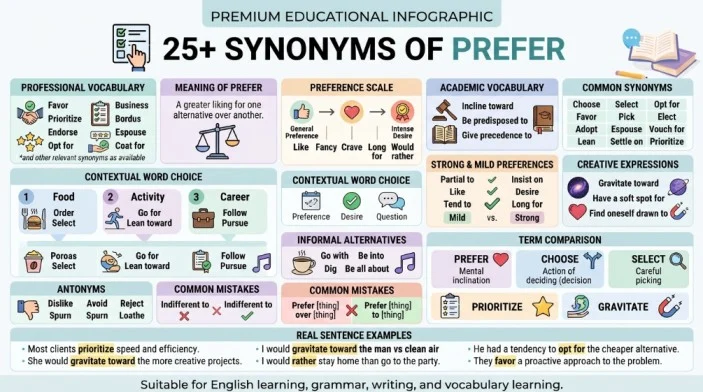
You may notice yourself using prefer repeatedly in emails, essays, captions, resumes, or everyday conversations. While the word is perfectly natural, repeating it can make your writing feel predictable. Learning the right synonym of prefer gives you more ways to express choice, personal taste, priority, and stronger liking.
The best alternative depends on what you actually mean. Favor can sound polished, choose focuses on selection, opt for works well in professional communication, and would rather is natural in casual speech. Understanding these differences helps you communicate your preference more clearly without choosing a synonym that changes the original meaning.
What Are the Best Synonyms of “Prefer”?
A useful synonym of prefer is favor, especially when expressing a general preference. Choose, select, and opt for focus more on making a choice, while would rather and like better sound natural in conversation. For professional writing, use favor, opt for, or prioritize when the context supports them.
Meaning, Tone, and Context
Simple Definition
Prefer means to like or choose one person, thing, activity, or option more than another. It describes a preference between alternatives.
For example:
“I prefer tea to coffee.”
This means the speaker likes tea more than coffee.
The word can also describe a choice based on practical reasons rather than personal enjoyment:
“The company prefers digital communication.”
Here, prefer expresses the company’s favored option.
Part of Speech
Prefer is a verb.
It normally describes an action or mental choice involving one option over another.
Overall Tone
The tone of prefer is generally neutral. It does not automatically express strong emotion, approval, or dislike.
For example:
“I prefer working in the morning.”
This simply communicates a personal preference.
Formality Level
Prefer is a neutral word that works in both formal and informal English.
It is appropriate for:
- Academic writing
- Business communication
- Professional emails
- Resumes
- Everyday conversation
- Personal writing
- Social media
Some alternatives, such as favor, prioritize, or elect, can sound more formal depending on context.
Common Uses
Native English speakers commonly use prefer when discussing:
- Food and drinks
- Hobbies
- Travel choices
- Work arrangements
- Communication methods
- Products and services
- Personal habits
- Business decisions
- Academic approaches
- Lifestyle choices
Examples include:
“I prefer tea to coffee.”
“She prefers working from home.”
“We prefer email communication.”
“He prefers the second option.”
Common Grammar Patterns
The most common structure is:
prefer A to B
“I prefer summer to winter.”
Another common structure is:
prefer doing something to doing something else
“I prefer walking to driving.”
You can also use:
prefer to do something rather than do something else
“I prefer to work early rather than stay late.”
Avoid replacing to with than in the basic prefer A to B structure.
Word Forms
| Form | Example |
|---|---|
| Verb | prefer |
| Noun | preference |
| Adjective | preferred |
| Adverb | preferably |
Examples:
“My preferred method is email.”
“She has a strong preference for quiet environments.”
“Please respond by email, preferably before Friday.”
When and How to Use “Prefer”
Use prefer when you want to show that one option is more desirable, suitable, or appealing than another.
The word is especially useful when the comparison matters.
Professional
“I prefer to review the proposal before the meeting.”
This communicates a professional preference without sounding demanding.
Academic
“Some researchers prefer qualitative methods when studying personal experiences.”
Here, prefer describes a methodological choice.
Workplace
“I prefer working in the morning when the office is quieter.”
The sentence expresses a personal work preference naturally.
Personal
“I prefer spending weekends with my family.”
This describes a personal choice or lifestyle preference.
“I would prefer to discuss the details by phone.”
This is polite and appropriate for professional communication.
Resume
“Preferred candidates should have strong communication skills.”
In this structure, preferred describes what an employer favors.
Social Media
“I prefer quiet weekends over crowded events.”
The wording is natural for expressing personal taste.
Best Synonyms of “Prefer”
No synonym is identical to prefer in every situation. Some alternatives describe the act of choosing, while others emphasize liking, priority, or a favored option.
Professional Writing: Favor
Favor is one of the closest alternatives when you want to express a preference in a polished or professional way.
“The company favors flexible work arrangements.”
It works particularly well when the subject is an organization, policy, strategy, or general tendency.
Academic Writing: Favor
Favor and prefer are both useful in academic writing, especially when comparing approaches, theories, or methods.
“The study favors a qualitative approach.”
Use favor when you want to emphasize support for one approach rather than simply personal preference.
Business Communication: Opt For
Opt for clearly communicates a deliberate choice.
“The team opted for a simpler solution.”
It is especially useful when someone has considered multiple possibilities and selected one.
Casual Conversation: Would Rather
Would rather is extremely natural when expressing a personal choice in everyday conversation.
“I’d rather stay home tonight.”
It often sounds more conversational than I prefer to stay home tonight.
Emotional Writing: Favor
When discussing affection or personal inclination, favor can work, although prefer is often more direct.
“She clearly favored one idea over the others.”
Creative Writing: Gravitate Toward
Gravitate toward suggests that someone naturally feels drawn to something.
“He always gravitated toward quiet places.”
It adds a more expressive quality than simply saying he preferred quiet places.
Resume Writing: Favor
In professional documents, favor can describe a preferred approach, but it should not be used simply to decorate resume statements.
“Favor data driven approaches to improve operational efficiency.”
Workplace Communication: Opt For
Opt for is concise and natural in workplace communication.
“We opted for a shorter meeting format.”
It communicates an actual decision rather than a general personal taste.
Stronger Meaning: Prioritize
Prioritize is stronger when the idea involves giving something greater attention or importance.
“The company prioritizes customer satisfaction.”
It is not always interchangeable with prefer because priority can involve importance rather than personal liking.
Softer Meaning: Lean Toward
Lean toward suggests a developing or tentative preference.
“I’m leaning toward the second proposal.”
This is useful when a final decision has not yet been made.
When Not to Use “Prefer”
Although prefer is versatile, another word can sometimes communicate your meaning more precisely.
When “Prefer” Sounds Too General
If you want to emphasize a deliberate decision, choose or select may be better.
Less Precise:
“We prefer the new design.”
Better:
“We chose the new design.”
The second sentence makes it clear that an actual decision was made.
When “Prefer” Sounds Too Vague
If you mean something receives greater attention or importance, use prioritize.
Less Precise:
“The company prefers customer safety.”
Better:
“The company prioritizes customer safety.”
The second version focuses on organizational priorities rather than simple preference.
When “Prefer” Is Too Formal for Casual Speech
In some everyday situations, would rather sounds more conversational.
Less Natural:
“I prefer to watch a movie tonight.”
More Conversational:
“I’d rather watch a movie tonight.”
Both are correct, but the second sounds more relaxed.
When “Prefer” Is Too Weak
If something is selected because it is required or necessary, prefer may understate the situation.
Weak:
“We prefer employees to wear protective equipment.”
Stronger:
“Employees are required to wear protective equipment.”
The issue is no longer preference. It is a requirement.
When “Prefer” Is Too Strong
In some contexts, you may only want to suggest a slight inclination.
Stronger:
“I prefer the first option.”
Softer:
“I’m leaning toward the first option.”
The second sentence leaves more room for another choice.
When a More Specific Word Is Available
If you mean personal enjoyment, like better may be clearer.
General:
“I prefer this restaurant.”
More Direct:
“I like this restaurant better.”
The second version sounds particularly natural in casual conversation.
Words Commonly Confused With “Prefer”
Favor
Difference: Favor means to show approval, support, or preference toward someone or something.
When to Use It: Use it when discussing policies, options, candidates, approaches, or general tendencies.
Example:
“The committee favors the proposed solution.”
Choose
Difference: Choose focuses on selecting one option from alternatives.
When to Use It: Use it when an actual decision is being made.
Example:
“She chose the blue dress.”
Select
Difference: Select usually sounds more deliberate or formal than choose.
When to Use It: Use it for formal decisions, applications, products, candidates, or carefully chosen options.
Example:
“The manager selected three candidates for interviews.”
Like
Difference: Like expresses enjoyment, approval, or positive feeling. Prefer specifically compares options or indicates one is favored over another.
When to Use It: Use like when no comparison is necessary.
Example:
“I like coffee.”
Prioritize
Difference: Prioritize means to give something greater importance or attention.
When to Use It: Use it for goals, responsibilities, tasks, and business objectives.
Example:
“We prioritize customer service.”
Opt For
Difference: Opt for means to choose one option, often after considering alternatives.
When to Use It: Use it when describing a deliberate decision.
Example:
“They opted for a smaller office.”
Best Synonyms of “Prefer” by Context
| Context | Best Synonym | Why It Works | Example |
|---|---|---|---|
| Formal writing | Favor | Sounds polished and objective. | “The report favors a cautious approach.” |
| Academic writing | Favor | Works well for comparing approaches. | “The researchers favor this method.” |
| Professional communication | Opt for | Clearly expresses a practical decision. | “We opted for a digital solution.” |
| Business emails | Favor | Appropriate for professional preferences. | “We favor the revised schedule.” |
| Resume writing | Favor | Can describe a professional approach. | “Favor efficient workflows.” |
| Workplace communication | Opt for | Natural for decisions. | “We opted for a shorter meeting.” |
| Casual conversation | Would rather | Sounds natural and conversational. | “I’d rather stay home.” |
| Everyday speaking | Like better | Simple and familiar. | “I like this one better.” |
| Creative writing | Gravitate toward | Adds a sense of natural attraction. | “She gravitated toward quiet corners.” |
| Storytelling | Lean toward | Shows an emerging preference. | “He leaned toward the safer choice.” |
| Emotional writing | Favor | Can express a personal inclination. | “She favored the idea because it felt right.” |
| Strong emphasis | Prioritize | Adds importance and urgency. | “We prioritize customer safety.” |
| Mild tone | Lean toward | Suggests an uncertain preference. | “I’m leaning toward the first option.” |
| Social media captions | Like better | Casual and accessible. | “I like the old version better.” |
| American English | Prefer | Neutral and widely natural. | “I prefer tea to coffee.” |
| British English | Prefer | Also standard and natural. | “I prefer tea to coffee.” |
How to Choose the Best Synonym of “Prefer”
The best synonym depends on what you are trying to communicate.
Choose Based on Meaning
If you mean like one thing more, use:
prefer, favor, like better
If you mean make a decision, use:
choose, select, opt for
If you mean give something greater importance, use:
prioritize
If you mean feel naturally drawn to something, use:
gravitate toward
If you mean have an uncertain preference, use:
lean toward
Choose Based on Tone
| Tone | Recommended Word |
|---|---|
| Neutral | Prefer |
| Professional | Favor |
| Deliberate | Select |
| Conversational | Would rather |
| Casual | Like better |
| Strategic | Prioritize |
| Tentative | Lean toward |
| Expressive | Gravitate toward |
Choose Based on Audience
- For an academic audience, favor, select, and opt for may work well.
- For a business audience, favor, opt for, and prioritize are useful choices.
For friends and family, would rather, like better, and go with usually sound more natural.
Choose Based on Emotional Strength
Prefer is generally neutral.
Favor can suggest approval.
Gravitate toward suggests natural attraction.
Prioritize adds importance.
Would rather often communicates a clear personal choice.
Choose Based on Writing Purpose
- For an essay:
“The researchers favor a qualitative approach.”
- For a business report:
“The company prioritized customer retention.”
For an email:
“We would prefer to meet on Thursday.”
- For casual conversation:
“I’d rather go tomorrow.”
For a story:
“She gravitated toward the quietest table.”
Choose the Most Natural Option
Do not replace prefer simply because another word sounds more advanced.
For example:
“I favor chocolate ice cream over vanilla.”
This is grammatically understandable, but in everyday American conversation:
“I prefer chocolate ice cream to vanilla.”
sounds more natural.
The goal is not to use the most sophisticated word. The goal is to use the word that communicates your meaning naturally.
Real Life Examples of “Prefer”
School
Original:
“Students prefer online resources.”
Improved:
“Many students favor online resources because they are easy to access.”
College
Original:
“I prefer studying in the library.”
Improved:
“I prefer studying in the library because it provides a quieter environment.”
Workplace
Original:
“Our team prefers the morning schedule.”
Improved:
“Our team favors the morning schedule because it supports better collaboration.”
Business
Original:
“The company prefers digital payments.”
Improved:
“The company has opted for digital payments to simplify transactions.”
Original:
“I prefer Thursday.”
Improved:
“I would prefer Thursday if that works for you.”
Resume
Original:
“I prefer organized workflows.”
Improved:
“I favor organized workflows that improve efficiency and accountability.”
Conversation
Original:
“I prefer staying home.”
Improved:
“I’d rather stay home tonight.”
Storytelling
Original:
“She preferred quiet places.”
Improved:
“She gravitated toward quiet places where she could think.”
Blogging
Original:
“Many readers prefer short articles.”
Improved:
“Many readers favor concise articles that deliver useful information quickly.”
Social Media
Original:
“I prefer the old design.”
Improved:
“I like the old design better.”
25 Best Synonyms of “Prefer”
| Synonym | Simple Meaning | Best Used For | Example Sentence |
|---|---|---|---|
| Favor | Like or support one option more | Formal and professional writing | “The board favors the revised proposal.” |
| Choose | Select one option | Everyday decisions | “I choose the window seat whenever possible.” |
| Select | Choose carefully | Formal situations | “The editor selected the strongest submission.” |
| Opt for | Decide on one option | Business and workplace writing | “We opted for a simpler design.” |
| Pick | Choose informally | Casual conversation | “I’ll pick the blue one.” |
| Would rather | Prefer one action or option | Everyday conversation | “I’d rather leave early.” |
| Like better | Prefer something in casual language | Informal speech | “I like this version better.” |
| Go with | Choose or accept an option | Casual and workplace communication | “Let’s go with the original plan.” |
| Lean toward | Have a slight preference | Uncertain decisions | “I’m leaning toward the second option.” |
| Incline toward | Have a tendency to favor | Formal writing | “The evidence inclines us toward caution.” |
| Gravitate toward | Feel naturally drawn to | Creative and descriptive writing | “She gravitated toward quiet spaces.” |
| Prioritize | Give greater importance to | Business and professional settings | “We prioritize customer satisfaction.” |
| Give precedence to | Treat one option as more important | Formal writing | “The policy gives precedence to safety.” |
| Have a preference for | Have a favored option | Formal and neutral writing | “She has a preference for flexible schedules.” |
| Show a preference for | Demonstrate a favored choice | Academic and analytical writing | “Participants showed a preference for digital tools.” |
| Favor over | Prefer one thing to another | Direct comparisons | “The team favored quality over speed.” |
| Settle on | Finally choose | Decisions after consideration | “They settled on a new location.” |
| Elect | Choose formally | Official or formal decisions | “The committee elected to postpone the vote.” |
| Rank higher | Consider more desirable | Evaluations and comparisons | “Users ranked reliability higher than price.” |
| Value more highly | Consider more worthwhile | Personal or professional judgment | “She values flexibility more highly than convenience.” |
| Go for | Choose or select | Informal communication | “I’d go for the larger size.” |
| Desire over | Want one option more | Formal or literary contexts | “He desired stability over recognition.” |
| Favorably regard | View one option more positively | Formal writing | “The committee regarded the proposal favorably.” |
| Be inclined toward | Tend to prefer | Formal and neutral writing | “She is inclined toward the second approach.” |
| Gravitate to | Naturally move toward a favored option | Creative and conversational writing | “Young readers often gravitate to relatable characters.” |
Synonyms of “Prefer” by Usage
Professional vs Personal Synonyms
Professional settings generally benefit from precise words such as favor, opt for, and prioritize.
“The company favors flexible scheduling.”
In personal conversation, would rather, like better, pick, and go with sound more natural.
“I’d rather go on Saturday.”
The distinction is not absolute. Prefer itself works comfortably in both settings.
Formal vs Conversational Synonyms
For reports and essays, consider:
- Favor
- Select
- Opt for
- Be inclined toward
- Give precedence to
- For presentations and business emails:
- Prefer
- Favor
- Opt for
- Prioritize
For casual conversation and texting:
- Would rather
- Like better
- Pick
- Go with
- Go for
Academic Synonyms
Academic writing often needs a distinction between preference and selection.
- Use favor when describing support for a theory, method, or interpretation.
“The researchers favor a mixed methods approach.”
Use select when participants or researchers actively choose something.
“Participants selected their preferred response.”
Use opt for when describing a deliberate methodological choice.
“The researchers opted for a longitudinal design.”
- Use prioritize when discussing what receives greater attention or importance.
“The study prioritizes long term outcomes.”
Professional and Business Synonyms
Resumes
Use favor carefully when describing professional approaches.
“Favor collaborative problem solving and efficient workflows.”
However, resumes are usually stronger when they focus on actions and results rather than preferences.
Interviews
Prefer and would rather can be useful when discussing work styles.
“I prefer collaborative environments because they encourage knowledge sharing.”
Meetings
Opt for is useful when describing decisions.
“We opted for a shorter meeting format.”
Presentations
Favor can communicate a recommendation.
“Our team favors a phased implementation.”
Performance Reviews
Prioritize is stronger when describing professional goals.
“I prioritize accuracy when handling client information.”
Client Communication
Prefer is polite and neutral.
“We would prefer to receive the documents by Friday.”
Business Emails
Would prefer can sound courteous when making a request.
“We would prefer to schedule the call for Tuesday.”
Creative and Literary Synonyms
Creative writing benefits from alternatives that reveal how a character feels or behaves.
Gravitate toward suggests natural attraction:
“She gravitated toward the books with worn covers.”
Lean toward suggests uncertainty:
“He leaned toward forgiveness but remained cautious.”
Favor can suggest a character’s recurring preference:
“The old captain favored simple meals and quiet evenings.”
Go for can create an informal, energetic voice:
“When in doubt, she always went for the boldest choice.”
Slang or Modern Synonyms
There is no single slang word that perfectly replaces prefer.
However, casual expressions such as go for, go with, pick, and I’d rather are common in modern everyday English.
Go for:
“I’d go for the black jacket.”
This is acceptable in casual speech, texting, social media, and relaxed workplace conversations.
It should generally be avoided in highly formal academic or legal writing.
Strongest to Mildest Synonyms
The intensity of preference depends heavily on context. Unlike words describing emotion, preference vocabulary does not always form a strict strength scale.
Mild
Lean toward
“I’m leaning toward the first option.”
This suggests that the decision is not final.
Mild to Moderate
Prefer
“I prefer the first option.”
This clearly communicates a preference without strong emotional force.
Moderate
Favor
“The committee favors the first proposal.”
This can suggest an established preference or support.
Strong
Prioritize
“We prioritize safety over convenience.”
This adds importance and practical commitment.
Very Strong
Give precedence to
“The policy gives precedence to public safety.”
This strongly emphasizes that one consideration takes priority over another.
Emotional vs Neutral Synonyms
Emotional Synonyms
These alternatives can add feeling or personal involvement:
- Gravitate toward
- Favor
- Like better
- Would rather
- Go for
Example:
“She gravitated toward the people who made her feel comfortable.”
Neutral Synonyms
These alternatives communicate preference with less emotional coloring:
- Prefer
- Choose
- Select
- Opt for
- Favor
- Prioritize
Example:
“The organization opted for a more efficient system.”
For academic and professional writing, neutral vocabulary is usually safer because it reduces unnecessary emotional interpretation.
Antonyms of “Prefer”
There is no perfect single antonym for prefer in every context. The opposite depends on whether you mean dislike, reject, avoid, deprioritize, or choose against something. The following words represent common contextual opposites.
| Antonym | Meaning | Example Sentence |
|---|---|---|
| Dislike | Have an unfavorable feeling toward | “She dislikes crowded restaurants.” |
| Reject | Refuse to accept or choose | “The committee rejected the proposal.” |
| Avoid | Stay away from something | “He avoids unnecessary meetings.” |
| Refuse | Decline to accept or do something | “She refused the alternative.” |
| Decline | Politely or formally say no | “The client declined the offer.” |
| Disfavor | Regard negatively or without approval | “The board disfavored the proposed policy.” |
| Shun | Deliberately avoid or reject | “The community shunned the outdated practice.” |
| Dismiss | Treat something as unworthy of consideration | “The manager dismissed the suggestion.” |
| Disregard | Give no attention or consideration | “The team disregarded the warning.” |
| Neglect | Fail to give proper attention | “The company neglected an important concern.” |
| Deprioritize | Give something less priority | “The team deprioritized the feature.” |
| Oppose | Act against or disagree with | “Several members opposed the proposal.” |
| Exclude | Leave something out of consideration | “The committee excluded the most expensive option.” |
| Abandon | Give up a choice, plan, or course | “They abandoned the original strategy.” |
| Overlook | Fail to notice or consider | “The reviewer overlooked a useful alternative.” |
Comparison: “Prefer” vs Similar Words
Prefer vs Choose
Main Difference
Prefer describes a favored option. Choose describes the act of selecting an option.
Which Is Stronger?
Neither is inherently stronger. They describe different ideas.
Which Is More Formal?
Both are neutral. Choose is extremely common in everyday English.
When to Use Each
Use prefer when explaining what you like more. Use choose when describing an actual decision.
Examples
Prefer:
“I prefer the blue design.”
Choose:
“I chose the blue design.”
Prefer vs Favor
Main Difference
Prefer usually describes one option being more desirable. Favor can describe preference, approval, or support.
Which Is Stronger?
Favor can sound slightly stronger because it may imply active support.
Which Is More Formal?
Favor often sounds more formal or institutional.
When to Use Each
Use prefer for personal choices. Use favor for policies, proposals, methods, or general preferences.
Examples
Prefer:
“I prefer working remotely.”
Favor:
“The company favors remote work.”
Prefer vs Select
Main Difference
Select emphasizes careful choice. Prefer emphasizes what someone likes or favors more.
Which Is Stronger?
Neither is inherently stronger.
Which Is More Formal?
Select is slightly more formal.
When to Use Each
Use select for deliberate or official choices.
Examples
Prefer:
“I prefer the first option.”
Select:
“The committee selected the first option.”
Prefer vs Like
Main Difference
Like expresses positive feelings. Prefer compares alternatives.
Which Is Stronger?
Neither is necessarily stronger.
Which Is More Formal?
Prefer is more suitable for formal writing.
When to Use Each
Use like when expressing general enjoyment. Use prefer when comparing options.
Examples
Prefer:
“I prefer tea to coffee.”
Like:
“I like tea.”
Prefer vs Prioritize
Main Difference
Prefer concerns choice or liking. Prioritize concerns importance and allocation of attention or resources.
Which Is Stronger?
Prioritize can imply a stronger practical commitment.
Which Is More Formal?
Both are common in professional writing.
When to Use Each
Use prioritize when something receives greater attention because it matters more.
Examples
Prefer:
“I prefer email communication.”
Prioritize:
“We prioritize urgent client requests.”
Prefer vs Opt For
Main Difference
Opt for emphasizes making a deliberate decision.
Which Is Stronger?
Neither is automatically stronger.
Which Is More Formal?
Both work in professional writing, although opt for often sounds more decision focused.
When to Use Each
Use opt for when someone chooses among alternatives.
Examples
Prefer:
“I prefer the smaller package.”
Opt for:
“We opted for the smaller package.”
Common Phrases and Expressions with “Prefer”
Prefer A to B
Meaning
This structure compares two things and shows that the first is more desirable.
Example Sentence
“I prefer tea to coffee.”
Prefer to Do Something
Meaning
Used when describing a preferred action.
Example Sentence
“I prefer to work early in the morning.”
Prefer Doing Something to Doing Something Else
Meaning
This compares two activities.
Example Sentence
“She prefers reading to watching television.”
Prefer to Do Something Rather Than Do Something Else
Meaning
Used to express one preferred action over another.
Example Sentence
“We prefer to meet online rather than travel to the office.”
Would Prefer
Meaning
A polite way to state a particular preference.
Example Sentence
“I would prefer to discuss this tomorrow.”
Preferred Method
Meaning
The method that someone favors over alternatives.
Example Sentence
“Email is my preferred method of communication.”
Preferred Option
Meaning
The choice someone considers most suitable or desirable.
Example Sentence
“The preferred option is to submit the form online.”
Preferable to
Meaning
Used to say that one option is more desirable than another.
Example Sentence
“Working from home may be preferable to a long commute.”
Common Mistakes to Avoid
1. Using “Than” Instead of “To”
Incorrect
“I prefer tea than coffee.”
Better
“I prefer tea to coffee.”
Why
The standard comparative structure is prefer A to B.
2. Confusing Preference With Selection
Incorrect
“I preferred the blue shirt yesterday, so I bought the red one.”
This may be logically possible, but the wording can confuse the reader.
Better
“I preferred the blue shirt, but I chose the red one.”
Why
Preferred communicates liking, while chose communicates the final decision.
3. Using an Informal Expression in Formal Writing
Incorrect
“The company went with a cheaper supplier.”
Better
“The company opted for a more cost effective supplier.”
Why
Went with is conversational. Opted for fits professional writing better.
4. Using “Prefer” When You Mean “Prioritize”
Incorrect
“The hospital prefers patient safety.”
Better
“The hospital prioritizes patient safety.”
Why
The second sentence communicates organizational priority rather than personal or comparative preference.
5. Choosing an Overly Strong Word
Incorrect
“I gravitate toward this font.”
This can sound unnecessarily expressive in a simple business message.
Better
“I prefer this font.”
Why
The neutral word communicates the idea clearly without adding unnecessary imagery.
6. Repeating “Prefer” Too Often
Incorrect
“I prefer this option. I prefer this schedule. I prefer this method.”
Better
“I favor this option, prefer the current schedule, and would rather use this method.”
Why
Careful variation can improve readability when each alternative accurately expresses the intended meaning.
7. Treating Every Synonym as Identical
Incorrect
“The company prefers customer safety.”
Better
“The company prioritizes customer safety.”
Why
Replacing a word mechanically can change its meaning. Good synonym use requires attention to context.
Frequently Asked Questions
1. What are the best synonyms of “prefer”?
The best synonyms of prefer include favor, choose, select, opt for, would rather, like better, lean toward, and prioritize. The best choice depends on whether you mean liking, choosing, or giving priority.
2. What are the best formal synonyms of “prefer”?
The best formal alternatives include favor, select, opt for, be inclined toward, give precedence to, and prioritize. Choose based on whether you mean preference, selection, tendency, or importance.
3. What are common informal synonyms of “prefer”?
Common informal alternatives include would rather, like better, pick, go with, and go for. These expressions are natural in conversations, texting, casual emails, and social media.
4. What is another word for “prefer” in professional writing?
Favor and opt for are strong professional alternatives to prefer. Prioritize can also work when the intended meaning involves giving greater attention or importance to a goal.
5. What is the difference between “prefer” and “choose”?
Prefer describes a favored option, while choose describes the act of selecting something. You can prefer one option but ultimately choose another because of cost, timing, availability, or other practical factors.
6. What is the opposite of “prefer”?
Common contextual opposites include dislike, reject, avoid, refuse, decline, and disfavor. The correct opposite depends on whether the original meaning involves liking, selecting, accepting, or giving priority to something.
Conclusion
Prefer means to like, favor, or consider one option more desirable than another. It is a neutral and highly versatile verb that works naturally in academic writing, professional communication, everyday conversation, and personal expression.
The best synonym of prefer depends on the intended meaning. Use favor for support or preference, choose and select for decisions, opt for for deliberate choices, would rather for casual speech, lean toward for tentative preferences, and prioritize when importance is involved.
No synonym works perfectly in every sentence. Before replacing prefer, consider your audience, tone, purpose, and exact meaning. A useful vocabulary habit is to identify whether you are expressing a preference, making a choice, showing support, or establishing a priority before selecting your alternative
Read More Related Articles:
25+ Synonyms, Meanings, Uses, Examples, and Best …
Meaning, Uses, Examples, and the Best Synonym of Complain
25+ Synonyms of Frequency | Meanings, Uses, Examples …











1 thought on “25+ Synonyms of Prefer | Meanings, Uses, Examples, and Best Alternatives in 2026”