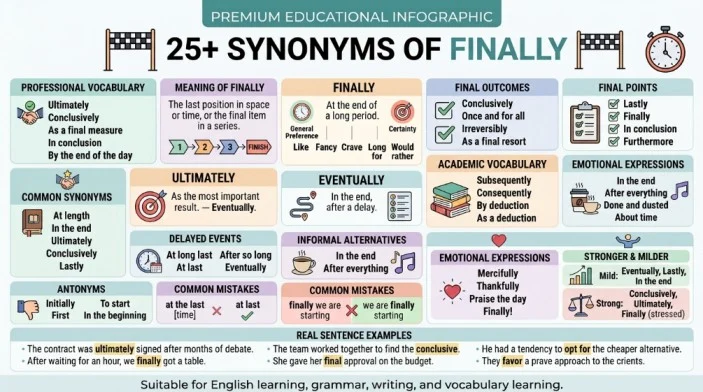
Synonyms of Finally can make your writing more precise, natural, and expressive. The word “finally” is useful, but repeating it can make sentences feel predictable. Depending on the context, you may need a word that highlights an ending, shows that something happened after a long wait, introduces a final point, or describes the result of a process. Words such as eventually, ultimately, at last, in conclusion, and lastly can serve similar purposes, but they do not always carry the same meaning or tone.
Choosing the right alternative requires more than finding a word with a similar dictionary definition. Context, grammar, tone, and sentence purpose all matter. Synonyms of Finally can range from casual expressions used in everyday conversation to formal alternatives suited to essays, reports, business writing, and professional communication. This guide explains these differences with clear meanings and practical examples so you can choose the most accurate word for your sentence.
What Are the Best Synonyms of “Finally”?
Finally usually means something happened at the end of a process, after a delay, or as the last point in a sequence. The best alternatives include eventually for delayed results, ultimately for final outcomes, at last for relief, lastly for final points, and in the end for conclusions.
Meaning, Tone, and Context
Simple Definition
Finally is used to show that something happens at the end of a period, process, sequence, or discussion. It can also show that an event occurred after waiting, difficulty, or delay.
Consider these examples:
“She finally arrived.”
Here, finally suggests that her arrival happened after waiting or expecting her.
“Finally, we need to discuss the budget.”
Here, finally introduces the last point in a sequence.
“The plan finally succeeded.”
In this sentence, finally suggests that success came after effort, difficulty, or delay.
Part of Speech
Finally is an adverb.
It commonly modifies verbs, clauses, and entire sentences.
Overall Tone
The tone of finally is generally neutral, but its emotional effect can change depending on context.
It can express:
- Relief: “We finally made it home.”
- Patience after delay: “The package finally arrived.”
- Sequence: “Finally, review your answers.”
- Conclusion: “Finally, the evidence supports the original theory.”
- Resolution: “They finally reached an agreement.”
Formality Level
Finally is a neutral word that works comfortably in formal, semi formal, and informal English.
It is appropriate for:
- Academic essays
- Business reports
- Professional emails
- Conversations
- Presentations
- Instructions
- Blog posts
- Storytelling
- Social media
Because it is so versatile, the main challenge is not whether finally is acceptable. The challenge is choosing a more precise alternative when the context requires one.
Common Uses
Native English speakers commonly use finally to describe:
- The last event in a sequence
- Something that happens after a long wait
- The result of a lengthy process
- The conclusion of an argument
- The final step in instructions
- The last point in a presentation
- A long awaited achievement
- A final stage of development
Word Forms
Finally is the adverb form related to final.
| Word | Part of Speech | Example |
|---|---|---|
| Final | Adjective | “This is the final decision.” |
| Finally | Adverb | “They finally agreed.” |
| Finality | Noun | “The decision gave the matter a sense of finality.” |
When and How to Use “Finally”
Use finally when you want to signal an ending, a final stage, or an event that happened after waiting or difficulty.
Professional
“After reviewing the proposals, the committee finally selected a supplier.”
Here, finally indicates that the selection came after a process of evaluation.
Academic
“Finally, the study considers how these findings may affect future research.”
Here, finally introduces the final point in an academic discussion.
Workplace
“We finally completed the software migration.”
This use suggests that the work took time or involved challenges.
Personal
“After months of planning, we finally moved into our new home.”
The word conveys a sense of completion after a long process.
“Finally, please remember to attach the signed document before submitting the form.”
Here, finally introduces the last instruction.
Resume
“Finally, coordinated the transition to a new customer management system.”
In a resume, however, finally may sound unnecessary. A stronger structure often removes it and begins directly with the accomplishment.
Social Media
“After years of practice, I finally performed on stage.”
This use naturally communicates excitement and relief after a long wait.
Best Synonyms of “Finally”
No single synonym works perfectly in every sentence. The best alternative depends on the specific meaning of finally, especially whether you are emphasizing delay, sequence, conclusion, or the result of a process.
Professional Writing: Ultimately
Ultimately works well when discussing the final result of a decision, process, or situation.
“The team ultimately decided to postpone the launch.”
It sounds polished and focuses on the final outcome rather than simply the passage of time.
Academic Writing: Ultimately
In academic writing, ultimately is useful when explaining the final conclusion or overall consequence of an argument.
“The evidence ultimately supports the proposed explanation.”
It often sounds more analytical than finally.
Business Communication: Eventually
Eventually is useful when an outcome occurs after a period of time, uncertainty, or difficulty.
“The two companies eventually reached an agreement.”
It emphasizes the passage of time.
Casual Conversation: At Last
At last sounds natural when something long awaited has happened.
“We are at last ready to leave.”
It can communicate relief, satisfaction, or impatience.
Emotional Writing: At Long Last
At long last strongly emphasizes that something has happened after a very long wait.
“At long last, she returned to the town where she had grown up.”
It carries more emotional weight than ordinary finally.
Creative Writing: In the End
In the end is effective when describing the final result of events in a story.
“In the end, he chose to follow his original dream.”
It works especially well when the outcome contrasts with earlier expectations.
Resume Writing: Ultimately
For a resume, ultimately can work when describing the final result of a responsibility or process.
“Ultimately improved customer retention by redesigning the onboarding process.”
However, most resume bullets are stronger when they begin with a specific action verb rather than ultimately.
Workplace Communication: Eventually
Use eventually when explaining that a task, agreement, or decision took time to complete.
“The project eventually returned to its original schedule.”
Stronger Meaning: At Long Last
At long last is stronger emotionally than finally because it clearly suggests prolonged waiting.
“At long last, the team celebrated its championship.”
Softer Meaning: Lastly
Lastly is a mild, orderly alternative when you simply want to introduce the final point in a list.
“Lastly, consider the long term costs.”
It does not usually communicate the emotional relief associated with finally.
When Not to Use “Finally”
When You Mean the Final Result
If you are discussing the ultimate consequence of a situation, ultimately may be more precise.
Less Precise:
“The company finally changed its strategy.”
Better:
“The company ultimately changed its strategy.”
Why:
Ultimately focuses more strongly on the eventual result or conclusion.
When You Mean a Long Wait
If you want to emphasize relief after a long delay, at last may communicate the feeling more naturally.
Less Expressive:
“She finally received the letter.”
More Expressive:
“She received the letter at last.”
Why:
At last can add a clear sense of relief or anticipation.
When You Are Listing Final Points
If you are simply introducing the last item, lastly may be clearer.
Less Precise:
“Finally, we need to review the budget.”
Better:
“Lastly, we need to review the budget.”
Why:
Lastly signals sequence without suggesting that the speaker has been waiting for the budget discussion.
When You Mean the Overall Outcome
Use in the end when describing what happened after all the events were considered.
Less Precise:
“Finally, they decided to stay.”
Better:
“In the end, they decided to stay.”
Why:
In the end highlights the final outcome of a situation.
When the Word Sounds Repetitive
Using finally repeatedly in the same paragraph can make your writing monotonous.
Repetitive:
“Finally, we reviewed the data. Finally, we contacted the client. we completed the report.”
Better:
“First, we reviewed the data. We then contacted the client. Ultimately, we completed the report.”
Why:
Varying transition words makes the sequence easier to follow.
When You Need to Show Sequence Clearly
In instructions or numbered explanations, lastly or to conclude may be clearer.
Less Precise:
“Finally, save the document.”
Better:
“Lastly, save the document.”
Why:
The second version clearly signals the final instruction.
Words Commonly Confused With “Finally”
| Word | Difference | When to Use It | Example |
|---|---|---|---|
| Eventually | Emphasizes something happening after time or delay. | Delayed outcomes. | “She eventually found a new apartment.” |
| Ultimately | Focuses on the final result or conclusion. | Decisions and outcomes. | “The proposal ultimately failed.” |
| Lastly | Introduces the final item in a sequence. | Lists and presentations. | “Lastly, check your spelling.” |
| At last | Often expresses relief after waiting. | Long awaited events. | “At last, the rain stopped.” |
| In the end | Refers to the final outcome after events unfold. | Stories and decisions. | “In the end, they chose the simpler option.” |
| Afterward | Means later, not necessarily at the end. | Events that follow another event. | “They went to dinner afterward.” |
Best Synonyms of “Finally” by Context
| Context | Best Synonym | Why It Works | Example |
|---|---|---|---|
| Formal writing | Ultimately | Clearly expresses a final outcome. | “The policy ultimately proved effective.” |
| Academic writing | Ultimately | Fits analytical conclusions. | “The evidence ultimately supports the hypothesis.” |
| Professional communication | Eventually | Emphasizes a result reached over time. | “The teams eventually agreed on a solution.” |
| Business emails | Lastly | Clearly introduces the final point. | “Lastly, please review the attached schedule.” |
| Resume writing | Ultimately | Can introduce a final result when needed. | “The initiative ultimately improved retention.” |
| Workplace communication | Eventually | Natural for delayed tasks or decisions. | “We eventually resolved the issue.” |
| Casual conversation | At last | Sounds natural and can express relief. | “At last, we’re finished.” |
| Everyday speaking | Finally | Simple and versatile. | “I finally found my keys.” |
| Creative writing | In the end | Works naturally for narrative outcomes. | “In the end, she followed her heart.” |
| Storytelling | At long last | Adds emotional emphasis to a long wait. | “At long last, the travelers reached home.” |
| Emotional writing | At last | Communicates relief and anticipation. | “At last, they were reunited.” |
| Strong emphasis | At long last | Strongly highlights prolonged waiting. | “At long last, justice was served.” |
| Mild tone | Lastly | Signals sequence without extra emotion. | “Lastly, review the final paragraph.” |
| Social media captions | Finally | Short, familiar, and conversational. | “Finally, vacation starts!” |
| American English | Finally | Common and natural across contexts. | “We finally made it.” |
| British English | Finally | Also standard and widely used. | “She finally arrived home.” |
How to Choose the Best Synonym of “Finally”
Choosing the right alternative becomes easier when you identify what finally means in your sentence.
If You Mean “After a Long Wait”
Choose at last, at long last, or eventually.
“The package finally arrived.”
Possible alternatives:
“The package arrived at last.”
“The package eventually arrived.”
The first emphasizes relief. The second focuses more neutrally on the passage of time.
If You Mean “The Final Result”
Choose ultimately or in the end.
“They finally agreed to the proposal.”
More precise alternatives:
“They ultimately agreed to the proposal.”
“In the end, they agreed to the proposal.”
If You Mean “The Last Item”
Choose lastly.
“Finally, we should discuss the budget.”
Better for a formal list:
“Lastly, we should discuss the budget.”
If You Want Emotional Relief
Choose at last or at long last.
“She finally saw her family again.”
More emotional:
“At long last, she saw her family again.”
If You Want Neutral Writing
Keep finally or use eventually, depending on the meaning.
Do not replace a familiar word simply to make your writing sound sophisticated. Precision is more valuable than unnecessary vocabulary variety.
Real Life Examples of “Finally”
School
Original:
“Finally, students should review their answers.”
Improved:
“Lastly, students should review their answers.”
Why: The sentence introduces the final instruction in a sequence.
College
Original:
“The researchers finally reached a conclusion.”
Improved:
“The researchers ultimately reached a conclusion.”
Why: Ultimately works well when emphasizing the conclusion of an academic process.
Workplace
Original:
“We finally solved the software problem.”
Improved:
“We eventually solved the software problem.”
Why: Eventually emphasizes that the solution came after time and effort.
Business
Original:
“The company finally entered the international market.”
Improved:
“The company ultimately entered the international market.”
Why: Ultimately highlights the final strategic outcome.
Original:
“Finally, please send the completed form.”
Improved:
“Lastly, please send the completed form.”
Why: Lastly clearly marks the final instruction.
Resume
Original:
“Finally, helped the company improve customer satisfaction.”
Improved:
“Ultimately contributed to a customer satisfaction improvement initiative.”
Why: Resume writing generally benefits from specific accomplishments rather than unnecessary transition words.
Conversation
Original:
“I finally got home.”
Natural alternative:
“I finally got home.”
Why: There is no need to replace finally simply for variety. It is already natural and conversational.
Storytelling
Original:
“Finally, the traveler reached the village.”
Improved:
“At long last, the traveler reached the village.”
Why: At long last adds emotional weight and emphasizes the journey.
Blogging
Original:
“Finally, we can compare the two approaches.”
Improved:
“Lastly, we can compare the two approaches.”
Why: Lastly works better when introducing the final section of an organized explanation.
Social Media
Original:
“Finally, my vacation has started!”
Alternative:
“At last, my vacation has started!”
Why: At last adds excitement and relief while remaining natural for social media.
25 Best Synonyms of “Finally”
Not all alternatives below work in exactly the same grammatical and contextual situations. Some express delayed completion, while others introduce the final point or describe an eventual outcome.
| Synonym | Simple Meaning | Best Used For | Example Sentence |
|---|---|---|---|
| Eventually | After some time | Delayed events | “She eventually found the answer.” |
| Ultimately | In the final result | Conclusions and outcomes | “The plan ultimately succeeded.” |
| At last | After waiting | Relief and completion | “At last, the guests arrived.” |
| Lastly | As the final item | Lists and instructions | “Lastly, check the figures.” |
| In the end | As the final outcome | Stories and decisions | “In the end, they stayed.” |
| At long last | After a very long wait | Emotional writing | “At long last, the project was complete.” |
| After all | Considering everything | Final reasoning | “After all, the decision was theirs.” |
| In conclusion | As a final statement | Essays and reports | “In conclusion, the evidence is convincing.” |
| To conclude | To bring something to an end | Speeches and writing | “To conclude, the proposal deserves support.” |
| Lastly of all | As the final point | Strong sequence emphasis | “Lastly of all, review the summary.” |
| To finish | As the closing action | Presentations and speech | “To finish, let’s review the main points.” |
| To wrap up | To finish something | Informal communication | “To wrap up, we need two more decisions.” |
| In the final analysis | After considering everything | Formal analysis | “In the final analysis, the strategy was effective.” |
| When all is said and done | After everything is considered | Conversational conclusions | “When all is said and done, family comes first.” |
| In due course | At the appropriate later time | Formal contexts | “The results will be published in due course.” |
| At the conclusion | At the ending point | Formal writing | “At the conclusion of the study, the researchers summarized the findings.” |
| In the final stages | Near the end of a process | Projects and processes | “The team is in the final stages of testing.” |
| In the closing stages | Near the end | Events and processes | “The agreement was reached in the closing stages.” |
| As a final point | Introducing the last idea | Presentations and essays | “As a final point, costs should be considered.” |
| As a final step | Introducing the last action | Instructions | “As a final step, save the file.” |
| At the finish | At the ending point | Specific physical or figurative endings | “They celebrated together at the finish.” |
| After a while | After some time | Casual situations | “After a while, he finally understood.” |
| In time | Eventually or before it is too late | General time reference | “In time, the process became easier.” |
| Sooner or later | Eventually | Expected future outcome | “Sooner or later, the truth will emerge.” |
| In the long run | Considering the eventual result | Long term outcomes | “In the long run, the investment may pay off.” |
Important Usage Note
Some entries in this table are contextual alternatives rather than interchangeable replacements in every sentence. For example, lastly is appropriate when introducing a final point, while ultimately is better when discussing a final result. Likewise, at long last carries more emotion than neutral finally.
Synonyms of “Finally” by Usage
Professional vs Personal Synonyms
Professional writing benefits from alternatives that clearly communicate sequence or outcome.
Use:
- Ultimately for final results
- Eventually for delayed outcomes
- Lastly for final points
- In conclusion for formal summaries
- As a final point for presentations
Personal communication can be more expressive.
Use:
- At last
- At long last
- In the end
- Finally
- After all
Formal vs Conversational Synonyms
For reports and essays, choose words that clearly show logical relationships.
Formal:
“Ultimately, the findings support the proposed model.”
Conversational:
“In the end, we decided to stay.”
For texting, finally and at last are usually more natural than formal expressions such as in the final analysis.
Academic Synonyms
Academic writing often needs a distinction between the final point and the final conclusion.
- Use lastly when introducing the last item:
“Lastly, the study examines the limitations of the research.”
- Use ultimately when explaining the final conclusion:
“The evidence ultimately supports the central argument.”
- Use in conclusion when formally closing an essay or discussion:
“In conclusion, the findings suggest that further research is needed.”
Professional and Business Synonyms
Resumes
Avoid unnecessary transition words when a direct action verb is stronger.
Instead of:
“Finally, managed the company’s largest account.”
Use:
“Managed the company’s largest account.”
Interviews
Ultimately works well when discussing the final result of a career decision.
“I ultimately chose this position because it offered stronger opportunities for growth.”
Meetings
Lastly works naturally when introducing the final agenda item.
“Lastly, let’s discuss next month’s schedule.”
Presentations
To conclude and in conclusion clearly signal the closing section.
“To conclude, our three priorities are quality, efficiency, and customer service.”
Performance Reviews
Ultimately can describe a final achievement.
“The changes ultimately improved team productivity.”
Client Communication
Eventually is useful when explaining a process that took longer than expected.
“We eventually identified the source of the issue.”
Business Emails
Lastly works well for a final request.
“Lastly, please confirm the delivery address.”
Creative and Literary Synonyms
Creative writing allows more emotional flexibility.
At long last suggests prolonged waiting:
“At long last, the old house came into view.”
In the end emphasizes the final outcome:
“In the end, the hero returned home.”
At last can express relief:
“At last, the door opened.”
Ultimately can emphasize a character’s final realization:
“Ultimately, she understood what she had been trying to avoid.”
These alternatives can make a narrative more expressive without changing its basic meaning.
Slang or Modern Synonyms
There is no single slang word that perfectly replaces finally.
In casual American English, speakers may use expressions such as:
“At last”
This is informal enough for everyday conversation and can express relief.
“About time”
This is not a direct synonym, but it can react to something that happened later than expected.
“About time you got here!”
It can sound humorous, impatient, or teasing, so it should be avoided in formal writing.
“To wrap up”
This is a modern conversational expression for ending a discussion.
“To wrap up, let’s review the schedule.”
It works in casual and workplace conversations but is less suitable for highly formal academic writing.
Strongest to Mildest Synonyms
The intensity of a synonym depends largely on whether it emphasizes delay, emotion, certainty, or simply sequence.
Mild
Lastly
Primarily indicates order without strong emotion.
“Lastly, review the final section.”
Mild to Moderate
Finally
Neutral and versatile.
“Finally, we reviewed the results.”
Moderate
Eventually
Emphasizes that something happened after time passed.
“They eventually reached an agreement.”
Moderate
Ultimately
Focuses on the final outcome.
“The proposal ultimately succeeded.”
Strong
At last
Often communicates relief or satisfaction.
“At last, the search was over.”
Very Strong Emotion
At long last
Strongly emphasizes prolonged waiting.
“At long last, the missing documents arrived.”
The strongest choice should not automatically be treated as the best choice. A neutral sentence often sounds more professional when it does not carry unnecessary emotional weight.
Emotional vs Neutral Synonyms
Emotional Synonyms
These expressions can communicate relief, satisfaction, anticipation, or emotional resolution.
- At last
- At long last
- In the end
- When all is said and done
Example:
“At long last, they were reunited.”
This sounds more emotional than:
“They were finally reunited.”
Neutral Synonyms
These alternatives communicate sequence or outcome without adding much emotion.
- Finally
- Eventually
- Ultimately
- Lastly
- In conclusion
- To conclude
Example:
“Lastly, the report discusses future research.”
This is neutral and appropriate for academic writing.
Antonyms of “Finally”
There are fewer exact antonyms for finally than there are synonyms because the word has several meanings. The clearest opposites are words and phrases that place an event at the beginning, before another event, or earlier in a sequence.
| Antonym | Meaning | Example Sentence |
|---|---|---|
| Initially | At the beginning | “Initially, the team rejected the proposal.” |
| At first | During the beginning stage | “At first, she disliked the idea.” |
| First | Before everything else | “First, gather all the required documents.” |
| First of all | As the first point | “First of all, we need to identify the problem.” |
| To begin with | At the starting point | “To begin with, the plan had several weaknesses.” |
| In the beginning | At the earliest stage | “In the beginning, the project had limited funding.” |
| At the outset | At the very beginning | “At the outset, the team established clear goals.” |
| Beforehand | Before an event | “Please prepare the documents beforehand.” |
| In advance | Before something happens | “We booked the tickets in advance.” |
| Previously | At an earlier time | “The company had previously used another system.” |
| Earlier | At a time before now or another event | “She had arrived earlier than expected.” |
| Before | At an earlier time | “I had seen the report before.” |
| Prior to that | Before the specified event | “Prior to that, the company had no international offices.” |
| Prematurely | Before the appropriate time | “The announcement was released prematurely.” |
| At the start | At the beginning | “At the start, everyone agreed with the plan.” |
These are contextual opposites rather than perfect one word antonyms in every use of finally. For example, initially is the clearest opposite when finally refers to the later stage of a process, while first is the natural contrast when finally introduces the last point in a sequence.
Comparison: “Finally” vs Similar Words
Finally vs Eventually
Main Difference
Finally can indicate the last point in a sequence or something that happened after waiting. Eventually primarily emphasizes that something happened after a period of time.
Which Is Stronger?
Neither is inherently stronger. Finally can carry more emotional relief, while eventually often sounds more neutral.
Which Is More Formal?
Both are neutral and suitable for professional writing.
When to Use Each
Use finally for endings, final points, and delayed events.
Use eventually when the passage of time is the main idea.
Examples
Finally:
“Finally, we reviewed the final proposal.”
Eventually:
“The team eventually found a solution.”
Finally vs Ultimately
Main Difference
Finally can describe sequence or delayed completion. Ultimately focuses on the final result or conclusion.
Which Is Stronger?
Ultimately can sound more analytical.
Which Is More Formal?
Ultimately is especially common in academic and professional writing.
When to Use Each
Use finally for final steps.
Use ultimately for conclusions and outcomes.
Examples
Finally:
“Finally, submit the completed form.”
Ultimately:
“The company ultimately changed its strategy.”
Finally vs Lastly
Main Difference
Finally can express delay, relief, or sequence. Lastly mainly introduces the final item in a list or discussion.
Which Is Stronger?
Finally can carry more emotional meaning.
Which Is More Formal?
Lastly can sound particularly organized in lists and presentations.
When to Use Each
Use lastly when simply introducing the final point.
Examples
Finally:
“I finally received the package.”
Lastly:
“Lastly, review the attached document.”
Finally vs At Last
Main Difference
Both can refer to something happening after waiting, but at last often adds a stronger sense of relief.
Which Is Stronger?
At last can sound more emotionally expressive.
Which Is More Formal?
Both are acceptable, although at last is especially natural in conversation and expressive writing.
When to Use Each
Use at last when you want to emphasize that waiting has ended.
Examples
Finally:
“We finally reached the hotel.”
At last:
“At last, we reached the hotel.”
Finally vs In the End
Main Difference
Finally often focuses on when something happens. In the end usually focuses on the final result of a situation.
Which Is Stronger?
Neither is universally stronger.
Which Is More Formal?
Both are widely used, but in the end is especially natural in narrative and conversational English.
When to Use Each
Use finally for timing.
Use in the end for outcomes.
Examples
Finally:
“She finally arrived.”
In the end:
“In the end, she decided to stay.”
Finally vs Afterward
Main Difference
Afterward means at a later time following another event. It does not necessarily mean at the very end.
Which Is Stronger?
Neither is stronger because they express different time relationships.
Which Is More Formal?
Both are neutral.
When to Use Each
Use afterward when something happens later, even if additional events follow.
Examples
Finally:
“Finally, the meeting ended.”
Afterward:
“Afterward, everyone went to lunch.”
Common Phrases and Expressions with “Finally”
Finally Arrive
Meaning: To reach a destination after waiting or traveling.
Example:
“We finally arrived at the airport.”
Finally Get
Meaning: To obtain something after waiting or trying.
Example:
“I finally got the approval I needed.”
Finally Finish
Meaning: To complete something after spending time on it.
Example:
“She finally finished her assignment.”
Finally Decide
Meaning: To make a decision after considering options.
Example:
“After several meetings, the board finally decided.”
Finally Realize
Meaning: To understand something after a period of time.
Example:
“He finally realized why the plan had failed.”
Finally Reach
Meaning: To arrive at a place, stage, decision, or agreement after a process.
Example:
“The two sides finally reached an agreement.”
Finally Get Around To
Meaning: To do something that has been delayed because other things took priority.
Example:
“I finally got around to cleaning my office.”
Finally Come to a Decision
Meaning: To make a final choice after consideration.
Example:
“The committee finally came to a decision.”
Common Mistakes to Avoid
1. Using “Finally” When You Mean “Eventually”
Incorrect:
“Eventually, this is the last point in the presentation.”
Better:
“Finally, this is the last point in the presentation.”
Why:
Finally works when introducing the last item. Eventually focuses on something happening after time has passed.
2. Using “Finally” for Every Final Idea
Incorrect:
“Finally, the introduction is complete. Finally, the research begins. Finally, the conclusion is written.”
Better:
“The introduction is complete. The research then begins. Finally, the conclusion is written.”
Why:
Using the word once at the appropriate transition makes the sequence easier to follow.
3. Confusing “Finally” With “Lastly”
Incorrect:
“I finally received the package after three weeks.”
Better:
“I finally received the package after three weeks.”
Why:
Lastly would not work here because the sentence describes delayed arrival, not the final item in a list.
4. Using “At Last” in Highly Neutral Reports
Less Appropriate:
“At last, the experiment produced a measurable result.”
Better:
“The experiment eventually produced a measurable result.”
Why:
At last can imply emotional relief. Eventually sounds more neutral and objective.
5. Choosing “Ultimately” for a Simple Final Step
Less Appropriate:
“Ultimately, click the Save button.”
Better:
“Finally, click the Save button.”
Why:
Ultimately focuses on an eventual result, while finally naturally introduces the last instruction.
6. Using “In the End” When You Mean the Last List Item
Less Appropriate:
“In the end, add your signature to the form.”
Better:
“Finally, add your signature to the form.”
Why:
In the end usually refers to a final outcome rather than a final instruction.
7. Using Formal Alternatives Just to Sound Sophisticated
Less Effective:
“In the final analysis, I finally found my keys.”
Better:
“I finally found my keys.”
Why:
Simple language is often stronger when the situation is simple. Good vocabulary means choosing the most accurate word, not the most complicated one.
Frequently Asked Questions
What is the best synonym for finally?
The best synonym depends on context. Eventually, ultimately, at last, and in the end are common choices.
What are common synonyms for finally?
Common synonyms for finally include eventually, ultimately, at last, in the end, and lastly.
What is another word for finally?
Eventually is a common another word for finally, especially when describing something that happens after a long period.
What does finally mean?
Finally can mean something happens at the end of a process or after a delay. It can also introduce the last point in a list or discussion.
Is eventually a synonym for finally?
Yes. Eventually can replace finally when referring to something that happens after some time, effort, or delay.
What does a thesaurus suggest for finally?
A finally thesaurus may list alternatives such as eventually, ultimately, lastly, at last, and in the end, depending on the context.
Is lastly the same as finally?
Not always. Lastly usually introduces the final item in a sequence, while finally can also describe an event that happens after a delay.
Which synonym for finally is best for formal writing?
Ultimately and eventually often work well in formal writing, but the best choice depends on the intended meaning.
What are the best synonyms of “finally”?
The best synonyms of finally depend on meaning. Use eventually for delayed events, ultimately for final outcomes, at last for relief, lastly for final points, and in the end for overall results.
What are the best formal synonyms of “finally”?
Strong formal alternatives include ultimately, lastly, in conclusion, to conclude, and in the final analysis. Choose based on whether you are describing a result, introducing a final point, or closing an argument.
What are common informal synonyms of “finally”?
Common conversational alternatives include at last, in the end, eventually, and at long last. At last is especially useful when expressing relief after waiting for something to happen.
What is another word for “finally” in professional writing?
Ultimately, eventually, and lastly are useful professional alternatives. Use ultimately for outcomes, eventually for delayed results, and lastly when introducing the final point in a business discussion.
What is the difference between “finally” and “eventually”?
Finally can indicate the last event or something that happened after waiting. Eventually mainly emphasizes that something happened after time passed, so it is especially useful when delay is central to the meaning.
What is the opposite of “finally”?
The clearest contextual opposites include initially, at first, first, to begin with, at the outset, and in the beginning. These expressions place an event at the beginning rather than the end.
Conclusion
Finally is a flexible adverb that can describe an ending, a final point, a delayed event, or a completed process. The best alternative depends on the exact meaning you want to communicate.
Use eventually when time and delay matter, ultimately for final outcomes, lastly for the final point in a sequence, at last for relief, and in the end for an overall result. In emotional or literary writing, at long last can add stronger feeling.
There is no single perfect synonym of finally for every sentence. Before replacing the word, identify your purpose, audience, tone, and intended meaning. A useful vocabulary habit is to ask whether you are emphasizing time, sequence, conclusion, or emotion, then choose the word that expresses that idea most precisely.
Read More Related Articles:
- 25+ Synonyms, Meanings, Uses, Examples, and Best …
- Meaning, Uses, Examples, and the Best Synonym of Complain
- 25+ Synonyms of Frequency | Meanings, Uses, Examples …










1 thought on “25+ Synonyms of Finally | Better Ways to Express Endings, Results & Last Moments in 2026”