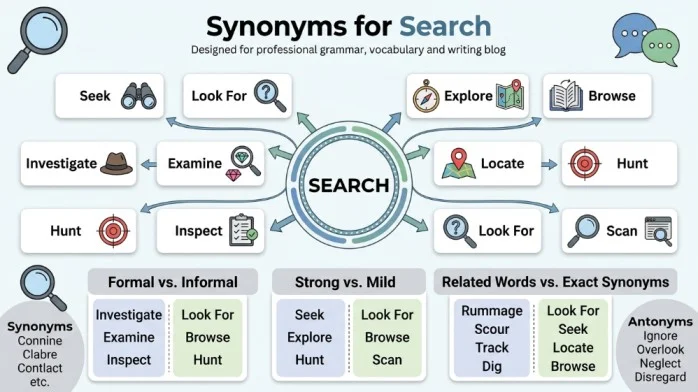
If you’re looking for synonyms for search, the best alternatives include seek, look for, explore, scan, examine, investigate, browse, and hunt. The right synonym depends on what you’re trying to express. Some words suggest a careful investigation, while others describe a casual attempt to find something. Choosing the correct word makes your writing clearer and more natural.
you’re writing an essay, email, blog post, or everyday message, understanding these subtle differences helps you communicate more effectively.
Best Synonyms for Search
The best synonyms for search are seek, look for, explore, and investigate. Other useful alternatives include browse, scan, inspect, examine, hunt, and locate. The most suitable choice depends on your purpose, tone, and the level of detail you want to convey.
What Does Search Mean?
Search means to try to find someone, something, or information by looking carefully or systematically.
It can describe a physical activity, such as searching a room for lost keys, or a digital activity, such as searching the internet for information.
Part of Speech
- Verb: to search
- Noun: a search
Examples
- We searched the house for the missing passport.
- She searched online for a reliable recipe.
In both examples, the goal is to find something that is not immediately visible or known.
Core Meaning of Search
At its core, search is about making an effort to discover or locate something.
Sometimes the process is quick and simple.
Other times, it requires patience, careful observation, or detailed investigation.
For example:
- A student searches for information before writing a report.
- A detective searches for evidence.
- A traveler searches for the best hotel.
- A customer searches for the lowest price.
Although these situations are different, they all involve looking for something with a specific purpose.
Grammar and Usage Notes
Part of Speech
Verb
- Search for information.
- Search the database.
- Search carefully.
Noun
- The search took several hours.
- Their search ended successfully.
Common Sentence Patterns
- search for something
- search someone
- search somewhere
- search carefully
- search online
- search thoroughly
Common Collocations
- search results
- search engine
- search history
- search party
- search warrant
- advanced search
- search function
- search process
When “Search” Sounds Natural
Use search when you want to describe an intentional effort to find something.
Examples:
- Search the website for product information.
- We searched every room.
- She searched the database.
When Another Synonym Works Better
Sometimes another word sounds more natural.
- Seek often fits formal writing.
- Browse suggests casual looking.
- Explore implies discovering possibilities.
- Investigate emphasizes careful examination.
- Scan suggests looking quickly.
- Examine focuses on close inspection.
Choosing the right alternative depends on your audience and the context.
Best Synonyms for Search
| Synonym | Meaning | Tone | Best Use Case | Example Sentence |
|---|---|---|---|---|
| Seek | Try to find | Formal | Professional writing | They seek new opportunities every year. |
| Look for | Try to find | Neutral | Everyday conversation | I’m looking for my wallet. |
| Explore | Discover possibilities | Positive | Research and learning | Students explored different solutions. |
| Investigate | Examine carefully | Formal | Reports and investigations | Police investigated the incident. |
| Browse | Look casually | Informal | Shopping and websites | She browsed several online stores. |
| Scan | Look quickly | Neutral | Reading or checking | He scanned the document for errors. |
| Examine | Inspect carefully | Formal | Academic and technical writing | Scientists examined the samples. |
| Inspect | Check closely | Formal | Safety and quality control | Workers inspected the equipment. |
| Hunt | Search energetically | Informal | Casual speech | We hunted for a parking space. |
| Locate | Find the position of | Professional | Business and technical writing | Engineers located the fault quickly. |
Common Synonyms for Search
Seek
Meaning: To try to find or obtain something.
Best context: Formal writing, literature, and professional communication.
Example: The company seeks talented engineers.
Look For
Meaning: To search in a simple, everyday way.
Best context: Daily conversation.
Example: I’m looking for my glasses.
Explore
Meaning: To investigate possibilities or discover new information.
Best context: Education, travel, research, and creative thinking.
Example: Let’s explore different ideas before deciding.
Browse
Meaning: To look through something casually.
Best context: Shopping, websites, books, and catalogs.
Example: She browsed the bookstore without buying anything.
Scan
Meaning: To look over something quickly for specific information.
Best context: Reading, proofreading, and reviewing documents.
Example: Please scan the report before the meeting.
Investigate
Meaning: To examine facts carefully to discover the truth.
Best context: Journalism, law, research, and science.
Example: Experts investigated the cause of the problem.
Examine
Meaning: To inspect something closely and carefully.
Best context: Academic, scientific, and professional writing.
Example: Doctors examined the patient thoroughly.
Hunt
Meaning: To search actively, often with determination.
Best context: Informal conversation.
Example: We hunted everywhere for the missing remote.
Locate
Meaning: To find the exact position of something.
Best context: Maps, technology, engineering, and business.
Example: Rescue teams quickly located the hikers.
Formal Synonyms for Search
Formal alternatives are useful in academic writing, business communication, legal documents, technical reports, and professional emails. These words often suggest a more careful or purposeful process than the everyday verb search.
Seek
Meaning: To try to find, obtain, or achieve something.
Best use: Academic papers, business writing, professional communication, and formal speeches.
Example: The organization seeks feedback from customers to improve its services.
Investigate
Meaning: To examine a situation carefully to discover facts or determine the cause of something.
Best use: Research, journalism, law enforcement, audits, and scientific studies.
Example: Scientists are investigating new ways to reduce energy consumption.
Examine
Meaning: To inspect or study something closely.
Best use: Academic writing, healthcare, science, and technical reports.
Example: Engineers examined the damaged bridge before reopening it.
Inspect
Meaning: To check something carefully for quality, safety, or compliance.
Best use: Manufacturing, construction, maintenance, and official inspections.
Example: The inspector checked every emergency exit before approving the building.
Explore
Meaning: To study a subject or consider several possibilities.
Best use: Research papers, education, strategic planning, and presentations.
Example: The report explores several methods for improving customer satisfaction.
Locate
Meaning: To determine the exact position of a person, place, object, or piece of information.
Best use: Technical documents, navigation, engineering, and business operations.
Example: The software quickly located the missing file.
Informal Synonyms for Search
These alternatives sound natural in everyday conversation, personal messages, and social media.
Look For
Meaning: To try to find something.
Best use: Daily conversations.
Example: I’m looking for my headphones.
Hunt For
Meaning: To search enthusiastically or with determination.
Best use: Casual speech.
Example: We spent an hour hunting for a good coffee shop.
Dig Around
Meaning: To search through things casually or informally.
Best use: Conversations with friends or family.
Example: I dug around my desk until I found the receipt.
Browse
Meaning: To look through something without a specific goal.
Best use: Shopping, websites, books, or streaming platforms.
Example: She browsed several online stores before making a purchase.
Scout Out
Meaning: To look for suitable places or opportunities.
Best use: Travel, events, and informal planning.
Example: We scouted out a few restaurants before dinner.
Strong Synonyms for Search
Some situations require words that express greater effort, urgency, or intensity. These stronger alternatives add emphasis but should be used only when the situation truly calls for them.
Investigate
Suggests a detailed and systematic search for facts.
Example: Detectives investigated every possible lead.
Comb Through
Implies searching every part of an area carefully.
Example: Volunteers combed through the forest looking for the missing hiker.
Probe
Suggests a deep or detailed investigation.
Example: The committee probed the causes of the financial losses.
Scrutinize
Means examining something with exceptional care.
Example: Editors scrutinized every paragraph before publication.
Pursue
Often refers to actively searching for an opportunity, goal, or objective over time.
Example: She pursued every opportunity to expand her business.
Tip: These words carry more intensity than search. Avoid using them if the situation is routine or casual.
Mild Synonyms for Search
Sometimes a softer word creates a more natural sentence.
Look Around
A relaxed way of searching.
Example: Feel free to look around the store.
Browse
Suggests casual exploration without urgency.
Example: He browsed the menu before ordering.
Check
Usually means looking briefly for confirmation.
Example: I’ll check my email after lunch.
Scan
Means looking quickly rather than carefully.
Example: She scanned the schedule for today’s events.
Glance Through
Suggests a very quick review.
Example: I glanced through the report before the meeting.
These words work well when the action doesn’t involve an intensive or lengthy search.
Synonyms for Search by Context
The best synonym depends on where and how you’re using it.
Everyday Conversation
For casual conversations, choose simple words that sound natural.
Recommended synonyms:
- look for
- hunt for
- check
- browse
- look around
Example: I’m looking for a nearby pharmacy.
Professional Writing
Business writing usually benefits from more precise language.
Recommended synonyms:
- seek
- locate
- identify
- examine
- investigate
Example: The team seeks innovative ways to improve customer service.
Academic Writing
Research papers and essays often require objective wording.
Recommended synonyms:
- investigate
- examine
- explore
- analyze
- study
Example: Researchers explored several possible explanations for the results.
Creative Writing
Creative writing benefits from descriptive language.
Recommended synonyms:
- hunt
- pursue
- wander in search of
- seek
- discover
Example: The traveler wandered the old streets searching for hidden treasures.
Marketing Copy
Marketing content should encourage curiosity and action.
Recommended synonyms:
- discover
- explore
- find
- uncover
- browse
Example: Explore our newest collection today.
Technical Writing
Technical documents require precision and clarity.
Recommended synonyms:
- locate
- identify
- inspect
- examine
- retrieve
Example: Locate the settings menu before updating the software.
Another Word for Search in a Sentence
Here are natural examples showing different alternatives in real situations.
- We looked for the missing keys before leaving the house.
- The researcher investigated several possible explanations.
- She browsed the clothing section for new arrivals.
- Engineers examined the machine after the shutdown.
- The team sought customer feedback before launching the product.
- Police searched the neighborhood for witnesses.
- Volunteers combed through the park during the cleanup.
- Students explored different career options.
- I checked my backpack one more time.
- Rescue workers quickly located the hikers.
- He scanned the article for key facts.
- The auditor inspected company records carefully.
- We hunted for a quiet place to study.
- Scientists probed the causes of the unusual results.
- She discovered an easier solution while exploring the database.
Search Synonyms Compared
| Word | Meaning | Tone | Intensity | Best Use Case |
|---|---|---|---|---|
| Search | Look carefully | Neutral | Medium | General use |
| Seek | Try to obtain or find | Formal | Medium | Business, academic writing |
| Look for | Try to find | Casual | Low | Everyday conversation |
| Browse | Look casually | Informal | Low | Shopping, websites |
| Explore | Discover possibilities | Positive | Medium | Learning, travel, research |
| Investigate | Examine carefully | Formal | High | Research, journalism, law |
| Examine | Inspect closely | Formal | High | Science, education |
| Inspect | Check carefully | Professional | High | Safety and quality control |
| Scan | Look quickly | Neutral | Low | Reading and reviewing |
| Locate | Find the exact position | Professional | Medium | Technology, navigation |
Key Differences
- Seek often refers to finding opportunities, knowledge, or solutions rather than physical objects.
- Browse suggests casual looking without a clear objective.
- Investigate implies collecting facts before reaching a conclusion.
- Examine focuses on close observation.
- Locate emphasizes successfully identifying the exact position of something.
- Scan means looking quickly instead of thoroughly.
Understanding these differences helps you choose words that match your intended meaning instead of treating every synonym as interchangeable.
Words Similar to Search
Some words belong to the same semantic field as search but are not exact synonyms. They share a related idea yet cannot replace search in every sentence.
| Word | Why It’s Related | Why It Isn’t Always a Synonym | Example |
|---|---|---|---|
| Discover | Means finding something, often unexpectedly | Focuses on the result rather than the act of searching | She discovered an old photo in the attic. |
| Find | Means successfully locating something | Describes the outcome instead of the process | I finally found my wallet. |
| Identify | Means recognizing or naming something | Often involves recognition rather than searching | The scientist identified the species. |
| Analyze | Means studying something in detail | Focuses on evaluation after information is gathered | We analyzed the survey results. |
| Research | Means collecting and studying information | A broader process that may include searching | He researched local history for his project. |
| Review | Means looking over something | Usually involves checking existing information | Please review the document before sending it. |
| Detect | Means noticing or discovering something | Often refers to identifying something hidden | The sensor detected movement. |
| Trace | Means following the path or origin of something | Emphasizes tracking rather than general searching | Police traced the phone call. |
These words are useful because they describe activities closely connected to searching, but each carries its own meaning and should be chosen carefully.
Antonyms of Search
Antonyms express the opposite idea of searching or looking for something.
| Antonym | Meaning | Example Sentence |
|---|---|---|
| Ignore | Pay no attention to something | He ignored the warning signs. |
| Overlook | Fail to notice | She overlooked an important detail. |
| Neglect | Fail to give proper attention | The company neglected customer feedback. |
| Miss | Fail to find or notice | I missed the correct exit on the highway. |
| Disregard | Intentionally pay no attention | They disregarded the instructions. |
| Avoid | Stay away from something | She avoided the crowded area. |
While these words are opposite in certain contexts, remember that the best antonym depends on how search is being used in a sentence.
How to Choose the Right Synonym for Search
A synonym should fit both the meaning and the situation. Keep these tips in mind before replacing search with another word.
Match the Context
Think about what is being searched.
- Use seek for opportunities or goals.
- Use locate for finding an exact place or object.
- Use browse for casual exploration.
- Use investigate for careful fact-finding.
Match the Tone
The tone should suit your audience.
- Professional writing benefits from words like seek, examine, and investigate.
- Everyday conversations usually sound better with look for, check, or browse.
Consider the Level of Intensity
Some words suggest much greater effort.
For example:
- Comb through implies an extremely careful search.
- Probe suggests a deep investigation.
- Look for sounds much lighter and more conversational.
Think About the Reader
Simple language is often the clearest choice. If your audience includes general readers, choose familiar words whenever possible.
Check Whether the Meaning Is Exact
Not every related word is a true synonym.
For example:
- Find refers to the successful result.
- Search describes the process.
- Discover often suggests an unexpected finding.
Using the wrong word can subtly change the meaning of your sentence.
Keep the Sentence Natural
Read your sentence aloud. If the replacement sounds awkward, choose another synonym that fits more naturally.
Common Mistakes When Using Synonyms for Search
Even experienced writers sometimes choose a synonym that doesn’t quite fit. Avoid these common mistakes.
Choosing the Wrong Tone
A highly formal word may sound unnatural in casual conversation.
Less natural:
I sought my phone before leaving.
More natural:
I looked for my phone before leaving.
Using a Word That’s Too Strong
Words such as probe or scrutinize suggest intense examination.
Avoid using them for simple everyday situations.
Using Informal Words in Professional Writing
Casual expressions like hunt around or dig around usually don’t belong in business reports or academic papers.
Instead, use locate, seek, or investigate when writing professionally.
Treating Related Words as Exact Synonyms
Words like discover, identify, and find have meanings that overlap with search, but they don’t always replace it.
Always consider whether you’re describing the process or the outcome.
Ignoring Context
The same synonym won’t fit every sentence.
For example:
- You browse a website.
- You investigate a crime.
- You seek employment.
- You locate a missing file.
Matching the word to the situation makes your writing more accurate and natural.
Quick Synonym List for Search
Common Synonyms
- seek
- look for
- explore
- browse
- examine
- investigate
- locate
- inspect
- scan
- hunt
Formal Synonyms
- seek
- investigate
- examine
- inspect
- locate
- explore
Informal Synonyms
- look for
- hunt for
- browse
- check
- dig around
- look around
Strong Synonyms
- investigate
- scrutinize
- probe
- comb through
- pursue
Mild Synonyms
- check
- browse
- glance through
- look around
- scan
Related Words
- discover
- find
- identify
- analyze
- research
- detect
- review
- trace
FAQs
What is the best synonym for search?
The best synonym depends on the context. For general situations, look for, seek, explore, and investigate are among the most useful alternatives.
What is another word for search?
Another word for search is “seek.” Other common options include look for, browse, scan, locate, and examine.
What is a formal synonym for search?
Seek is one of the best formal synonyms. Depending on the context, investigate, locate, inspect, and examine also work well.
What is an informal synonym for search?
Look for is the most common informal alternative. Other casual choices include hunt for, browse, check, and look around.
What is a stronger word for search?
Investigate, probe, scrutinize, and comb through suggest a more detailed or determined search than the general verb search.
What is a milder word for search?
Check, browse, look around, and scan describe lighter or less intensive forms of searching.
What words are similar to search?
Related words include find, discover, identify, research, analyze, review, and detect. These share a similar meaning but are not always direct replacements.
What is the opposite of search?
Common antonyms include ignore, overlook, neglect, disregard, and avoid, depending on the sentence.
How do I choose the right synonym for search?
Choose a synonym that matches the meaning, tone, formality, and level of intensity. Consider your audience and make sure the replacement sounds natural within the sentence
Conclusion
Understanding the best synonyms for search helps you communicate more precisely and naturally. While words such as seek, look for, explore, browse, investigate, locate, and examine share similar meanings, each one fits a different context, tone, or level of intensity.
Instead of replacing search automatically, think about what you want to express. A formal report may call for investigate or seek, while a casual conversation often sounds better with look for or browse. By choosing words that match your purpose and audience, your writing becomes clearer, more engaging, and more accurate.
Read More Related Articles:
Synonyms for Pros and Cons | Meaning, Examples, and Better …
Synonyms for Review | Meaning, Examples, and Better Word …











1 thought on “Synonyms for Search | Meaning, Examples, and Better Word Choices”