Finding the right alternative can make ordinary writing sound more precise, natural, and engaging. Synonyms of Shows can vary greatly depending on what “shows” means in a sentence. You might need a word that means demonstrates, reveals, displays, presents, or proves. Choosing the wrong alternative can change the meaning or make your sentence sound unnatural. That is why context matters more than simply replacing one word with another.
This guide explores Synonyms of Shows through clear meanings, practical examples, tone differences, and real-world usage. The alternatives are organized by context so you can choose words that fit academic writing, professional communication, everyday conversation, reports, presentations, and creative content. Each option should be judged by its exact meaning, grammatical role, and level of formality. This approach helps you write with greater accuracy while avoiding repetitive or awkward word choices in 2026.
What Are the Best Synonyms of “Shows”?
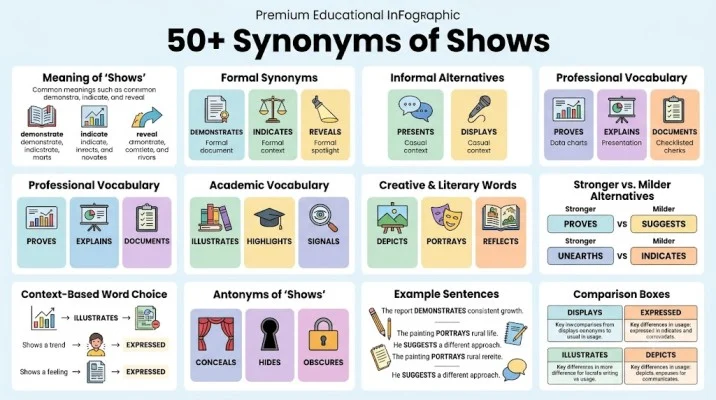
Shows can mean displays, demonstrates, reveals, indicates, explains, or presents something, depending on context. For formal and academic writing, use demonstrates, indicates, or illustrates. For professional communication, presents or displays often work well. Emotional or creative writing, reveals and expresses can add more meaning and depth.
Meaning, Tone, and Context
Simple Definition
The word shows has several meanings because it is a flexible English verb. It can describe making something visible, explaining an idea, providing evidence, expressing a feeling, or allowing someone to understand something.
For example:
“The chart shows an increase in sales.”
Here, shows means that the chart presents or indicates information.
In another sentence:
“She shows great patience.”
Here, shows means demonstrates or expresses a quality.
The exact synonym therefore depends on what the sentence is communicating.
Part of Speech
Shows is usually a verb.
It is the third person singular present form of show.
Examples include:
“The report shows strong growth.”
“He shows respect for his colleagues.”
The word show can also function as a noun, but shows as a plural noun has a different meaning, such as television programs, performances, or public events.
Overall Tone
The tone of shows is generally neutral.
It does not automatically express approval, criticism, emotion, or urgency. Its meaning comes primarily from the surrounding sentence.
For example:
“The evidence shows that the plan worked.”
This is neutral and factual.
“Her smile shows how happy she is.”
This has a warmer emotional tone because of the context.
Formality Level
Shows is a neutral word that works in both informal and formal communication.
It is perfectly acceptable in:
- Everyday conversation
- School assignments
- Academic writing
- Business reports
- Professional emails
- Presentations
- Social media
- Blog posts
- Creative writing
However, formal writing may sometimes benefit from a more precise alternative.
For example:
“The research shows a clear relationship.”
can become:
“The research demonstrates a clear relationship.”
The second version sounds more academic because demonstrates emphasizes evidence.
Common Uses
Native English speakers commonly use shows when talking about:
- Evidence
- Results
- Data
- Charts
- Feelings
- Behavior
- Skills
- Information
- Changes
- Relationships
- Examples
- Personal qualities
- Performances
- Visual displays
Examples:
“The survey shows strong customer satisfaction.”
“His behavior shows maturity.”
“The graph shows a decline in revenue.”
“She shows excellent leadership skills.”
Word Forms
| Word Form | Example |
|---|---|
| Verb | show |
| Third person singular | shows |
| Past tense | showed |
| Present participle | showing |
| Noun | show |
| Related noun | demonstration |
| Related adjective | shown |
The correct form depends on the grammatical structure of the sentence.
When and How to Use “Shows”
Use shows when you want to communicate that something makes information, evidence, qualities, feelings, or characteristics visible or understandable.
The word is especially useful when you do not need to specify exactly how something communicates its meaning.
Professional
“The latest report shows steady growth in customer engagement.”
Here, shows means that the report provides evidence of growth.
Academic
“The study shows a strong connection between sleep and concentration.”
In academic writing, the word is acceptable, although demonstrates or indicates may provide greater precision depending on the evidence.
Workplace
“Her performance shows that she is ready for additional responsibility.”
The word connects observable performance with a conclusion.
Personal
“His actions show how much he cares about his family.”
Here, shows communicates an emotional meaning.
“The attached document shows the changes made to the proposal.”
This is a clear and natural use in professional email writing.
Resume
“My experience shows my ability to manage multiple projects.”
A stronger resume version might be:
“My experience demonstrates my ability to manage multiple projects.”
The second version sounds more polished and evidence based.
Social Media
“This photo shows how much fun we had during the trip.”
For casual content, shows is natural and does not need to be replaced.
Best Synonyms of “Shows”
No synonym for shows works perfectly in every sentence. The correct choice depends on the meaning you want to express.
Professional Writing: Demonstrates
Demonstrates is one of the strongest alternatives for professional documents.
It suggests that something provides clear evidence or makes a quality visible.
“Her performance demonstrates strong leadership skills.”
This is especially effective in resumes, reports, evaluations, and presentations.
Academic Writing: Indicates
Indicates works well when evidence points toward a conclusion without necessarily proving it completely.
“The data indicates a gradual increase in demand.”
It sounds objective and is particularly useful when discussing research findings.
Business Communication: Presents
Presents is useful when something formally provides information to an audience.
“The report presents the company’s financial results.”
It works naturally in presentations, reports, meetings, and business writing.
Casual Conversation: Tells
In everyday conversation, tells can replace shows when something provides information.
“That tells us everything we need to know.”
It is conversational and natural, but it is usually less formal than demonstrates or indicates.
Emotional Writing: Reveals
Reveals works particularly well when an action, expression, or event makes hidden feelings visible.
“Her expression reveals how deeply she was affected.”
It creates more emotional depth than the neutral word shows.
Creative Writing: Reveals
In storytelling, reveals can create a sense of discovery.
“The final chapter reveals the truth behind the mysterious letter.”
It is particularly effective when information becomes known gradually.
Resume Writing: Demonstrates
Demonstrates is a strong resume choice because it connects experience with an ability or result.
“This experience demonstrates my ability to lead cross functional teams.”
Workplace Communication: Highlights
Highlights works well when you want to draw attention to a particular fact, result, or feature.
“The report highlights several areas for improvement.”
Stronger Meaning: Proves
Proves is much stronger than shows because it suggests that evidence establishes something as true.
“The results prove that the system can handle the increased workload.”
Use this carefully. If the evidence only suggests a conclusion, indicates or suggests may be more accurate.
Softer Meaning: Suggests
Suggests is useful when evidence points toward an idea without establishing it with certainty.
“The findings suggest that customer preferences are changing.”
This is often better than shows when the evidence is incomplete or open to interpretation.
When Not to Use “Shows”
Although shows is versatile, it can sometimes be too general. Replacing it with a more precise verb can make your sentence clearer.
When “Shows” Is Too General
Consider:
“The report shows the company’s progress.”
This is correct, but it does not explain how the report communicates that progress.
A more precise version is:
“The report documents the company’s progress.”
Documents emphasizes recorded evidence.
When “Shows” Is Too Vague
Consider:
“The evidence shows a problem.”
A more precise alternative could be:
“The evidence indicates a problem.”
This makes the relationship between evidence and conclusion clearer.
When “Shows” Is Too Weak
If something provides strong evidence, shows may not communicate enough certainty.
“The experiment shows that the treatment works.”
If the evidence genuinely establishes the conclusion, you could write:
“The experiment demonstrates that the treatment works.”
When “Shows” Is Too Strong
The opposite can also happen.
“The survey proves that every customer prefers the new design.”
If the survey does not establish the claim with certainty, suggests is safer:
“The survey suggests that many customers prefer the new design.”
When “Shows” Is Too Informal
In highly formal academic or technical writing, shows may sometimes sound less precise.
“The findings show a relationship between the variables.”
A more formal version is:
“The findings indicate a relationship between the variables.”
When “Shows” Is Repetitive
Repeatedly writing shows can make an essay or report monotonous.
Instead of:
“The chart shows sales growth. The graph shows customer activity. The table shows monthly results.”
Use:
“The chart illustrates sales growth. The graph indicates customer activity. The table presents monthly results.”
Each verb communicates a slightly different relationship with the information.
Words Commonly Confused With “Shows”
Demonstrates
Difference: Demonstrates usually implies clearer evidence or a visible example of a quality, skill, or result.
When to Use It: Use it when evidence supports a conclusion or when behavior clearly displays an ability.
Example:
“Her presentation demonstrates strong communication skills.”
Indicates
Difference: Indicates means that something points toward or provides evidence of a particular conclusion.
When to Use It: Use it frequently in research, reports, statistics, and analytical writing.
Example:
“The results indicate a steady increase in demand.”
Reveals
Difference: Reveals suggests that information was previously hidden, unknown, or not immediately obvious.
When to Use It: Use it for discoveries, secrets, emotions, or information becoming known.
Example:
“The interview reveals several problems within the organization.”
Displays
Difference: Displays emphasizes making something visible, especially information, images, products, or data.
When to Use It: Use it for screens, charts, products, exhibits, and visual presentations.
Example:
“The dashboard displays real time sales figures.”
Explains
Difference: Explains focuses on making an idea or process understandable rather than simply making it visible.
When to Use It: Use it when a person, example, document, or diagram helps someone understand something.
Example:
“The diagram explains how the system works.”
Suggests
Difference: Suggests is less definite than shows. It means the available information points toward a possible conclusion.
When to Use It: Use it when evidence is suggestive rather than conclusive.
Example:
“The evidence suggests that the policy needs revision.”
Best Synonyms of “Shows” by Context
| Context | Best Synonym | Why It Works | Example |
| Formal writing | Demonstrates | Sounds precise and evidence based | “The study demonstrates a clear pattern.” |
| Academic writing | Indicates | Communicates analytical evidence carefully | “The data indicates a change in behavior.” |
| Professional communication | Highlights | Draws attention to relevant information | “The report highlights key concerns.” |
| Business emails | Presents | Fits organized information sharing | “The document presents the updated figures.” |
| Resume writing | Demonstrates | Connects experience with ability | “The achievement demonstrates leadership.” |
| Workplace communication | Highlights | Focuses attention on important points | “The review highlights areas for improvement.” |
| Casual conversation | Tells | Sounds natural in everyday speech | “That tells me something important.” |
| Everyday speaking | Explains | Works when information becomes understandable | “This example explains the problem.” |
| Creative writing | Reveals | Adds discovery and suspense | “The letter reveals his secret.” |
| Storytelling | Uncovers | Suggests discovery of hidden information | “The investigation uncovers the truth.” |
| Emotional writing | Expresses | Communicates feelings or attitudes | “Her actions express genuine gratitude.” |
| Strong emphasis | Proves | Indicates very strong evidence | “The evidence proves the claim.” |
| Mild tone | Suggests | Avoids overstating certainty | “The results suggest a possible trend.” |
| Social media captions | Captures | Works well for images and moments | “This photo captures the joy of the day.” |
| American English | Shows | Natural and widely understood | “The chart shows steady growth.” |
| British English | Shows | Also natural and commonly used | “The report shows a similar pattern.” |
How to Choose the Best Synonym of “Shows”
The best synonym depends on the exact relationship between the subject and the information being communicated.
1. Consider the Meaning
First identify what shows means in your sentence.
- If something provides evidence, choose demonstrates, indicates, or suggests.
- If something makes information visible, choose displays or presents.
- If something makes a hidden fact known, choose reveals or uncovers.
- If something communicates emotion, choose expresses.
2. Consider the Tone
Ask whether your writing is casual, professional, academic, emotional, or creative.
- For academic writing:
“The evidence indicates…”
- For business writing:
“The report highlights…”
- For casual speech:
“That shows…”
- For creative writing:
“The scene reveals…”
3. Consider Your Audience
A school assignment may benefit from demonstrates or illustrates.
A client email may sound more natural with highlights or presents.
A social media caption usually does not need a complicated replacement.
4. Consider Emotional Strength
- Use shows for neutral communication.
- Use expresses when feelings are central.
- Use reveals when something hidden becomes visible.
- Use proves only when the evidence genuinely establishes the claim.
5. Consider Your Writing Purpose
- If you are analyzing evidence, choose indicates.
- If you are explaining a skill, choose demonstrates.
- If you are presenting information, choose presents.
- If you are emphasizing a point, choose highlights.
- If you are creating suspense, choose reveals.
6. Consider Formality
| Purpose | Recommended Word |
| Academic paper | Indicates |
| Research report | Demonstrates |
| Business report | Highlights |
| Resume | Demonstrates |
| Professional email | Presents |
| Casual conversation | Shows |
| Creative story | Reveals |
| Emotional message | Expresses |
7. Choose the Most Natural Word
Do not replace shows simply because another word sounds more advanced.
For example:
“The picture shows my family.”
This is already natural.
Changing it to:
“The picture demonstrates my family.”
would be incorrect because demonstrates does not fit the intended meaning.
A good synonym should improve accuracy, not merely make the sentence sound more sophisticated.
Real Life Examples of “Shows”
School
Original:
“The experiment shows how plants respond to light.”
Improved:
“The experiment demonstrates how plants respond to light.”
Why: Demonstrates works well when an experiment provides observable evidence.
College
Original:
“The research shows a connection between the two factors.”
Improved:
“The research indicates a connection between the two factors.”
Why: Indicates is useful when research points toward a relationship.
Workplace
Original:
“The report shows several problems with the current process.”
Improved:
“The report highlights several problems with the current process.”
Why: Highlights focuses attention on specific concerns.
Business
Original:
“The presentation shows our latest sales results.”
Improved:
“The presentation presents our latest sales results.”
Why: Presents fits formal delivery of organized information.
Original:
“The attached file shows the changes.”
Improved:
“The attached file outlines the changes.”
Why: Outlines is more specific when the document organizes and summarizes changes.
Resume
Original:
“My experience shows that I can lead a team.”
Improved:
“My experience demonstrates my ability to lead a team.”
Why: The improved version connects experience directly with a professional skill.
Conversation
Original:
“That shows how much she cares.”
Improved:
“That shows how much she cares.”
Why: In casual conversation, the original is already natural and does not need a more formal synonym.
Storytelling
Original:
“The final scene shows that he was telling the truth.”
Improved:
“The final scene reveals that he was telling the truth.”
Why: Reveals adds a sense of discovery.
Blogging
Original:
“The statistics show that readers prefer shorter articles.”
Improved:
“The statistics indicate that readers prefer shorter articles.”
Why: Indicate fits analytical writing and avoids overstating what statistics establish.
Social Media
Original:
“This picture shows how amazing the trip was.”
Improved:
“This picture captures how amazing the trip was.”
Why: Captures is more expressive and works naturally with photos and memories.
20 Best Synonyms of “Shows”
| Synonym | Simple Meaning | Best Used For | Example Sentence |
| Demonstrates | Makes something clear through evidence or action | Academic, professional | “The project demonstrates her leadership ability.” |
| Indicates | Points toward a fact or conclusion | Research, reports | “The data indicates a steady increase.” |
| Reveals | Makes hidden information known | Stories, emotions, discoveries | “The letter reveals the truth.” |
| Displays | Makes something visible | Screens, charts, products | “The monitor displays the latest results.” |
| Presents | Provides information to an audience | Business, presentations | “The report presents the annual results.” |
| Illustrates | Makes an idea clear through an example or image | Academic, educational | “The example illustrates the main concept.” |
| Highlights | Draws special attention to something | Business, reports | “The report highlights several concerns.” |
| Expresses | Communicates a feeling, thought, or attitude | Emotional writing | “Her smile expresses genuine happiness.” |
| Suggests | Points toward an idea without certainty | Research, analysis | “The evidence suggests a possible solution.” |
| Proves | Establishes something as true | Strong evidence | “The results prove the method is effective.” |
| Explains | Makes something understandable | Education, communication | “The diagram explains the process.” |
| Documents | Provides a record of something | Reports, history | “The report documents the company’s progress.” |
| Reflects | Represents or gives an impression of something | Analysis, personal writing | “The survey reflects changing customer preferences.” |
| Depicts | Represents something visually or descriptively | Art, literature | “The painting depicts a peaceful village.” |
| Portrays | Represents someone or something in a particular way | Literature, media | “The film portrays the character as ambitious.” |
| Uncovers | Discovers or brings hidden information to light | Investigations, journalism | “The investigation uncovers serious errors.” |
| Captures | Successfully represents a feeling, moment, or quality | Photography, creative writing | “The photograph captures the excitement of the event.” |
| Communicates | Conveys information or meaning | Business, writing | “The design communicates a sense of trust.” |
| Signals | Gives a sign that something exists or is happening | Analysis, business | “The decline signals a change in customer demand.” |
| Exhibits | Clearly displays a quality or behavior | Formal, academic | “The candidate exhibits strong analytical skills.” |
Synonyms of “Shows” by Usage
Professional vs Personal Synonyms
Professional writing often requires more specific verbs because readers need to understand exactly what the evidence or document communicates.
Strong professional choices include:
- Demonstrates
- Indicates
- Highlights
- Presents
- Documents
- Exhibits
- Communicates
For example:
“The results demonstrate strong improvement.”
In personal communication, simpler choices often sound more natural.
“Her actions show how much she cares.”
Using a formal synonym in every personal sentence can make your writing sound unnecessarily stiff.
Formal vs Conversational Synonyms
Reports
Use demonstrates, indicates, documents, or highlights.
Essays
Use demonstrates, illustrates, indicates, or suggests.
Business Writing
Use presents, highlights, demonstrates, or outlines.
Presentations
Use presents, displays, or illustrates.
Emails
Use shows, presents, outlines, or highlights, depending on the meaning.
Casual Conversations
Use shows, tells, or explains.
Texting
Simple forms such as shows and tells usually sound more natural than highly formal alternatives.
Academic Synonyms
Academic writing benefits from verbs that accurately describe the relationship between evidence and a conclusion.
Demonstrates
Use demonstrates when the evidence clearly establishes or displays a point.
“The experiment demonstrates the effect of temperature on bacterial growth.”
Indicates
Use indicates when the evidence points toward a conclusion.
“The findings indicate a relationship between exercise and concentration.”
Suggests
Use suggests when the evidence supports a possibility without establishing certainty.
“The results suggest that additional research may be necessary.”
Illustrates
Use illustrates when an example, figure, or case makes an idea easier to understand.
“This example illustrates the importance of accurate measurement.”
Reflects
Use reflects when data or behavior represents a broader condition.
“The survey reflects changing attitudes toward remote work.”
These choices are more useful than simply replacing shows with a more complicated word because each one communicates a different degree or type of evidence.
Professional and Business Synonyms
Resumes
Use demonstrates, exhibits, or reflects when describing abilities.
“Five years of project management experience demonstrates strong organizational skills.”
Interviews
Use demonstrates when connecting past experience to an ability.
“This experience demonstrates my ability to work under pressure.”
Meetings
Use highlights, presents, or indicates when discussing information.
“The latest report highlights three areas that need attention.”
Presentations
Use presents, displays, or illustrates.
“The next slide presents our quarterly performance.”
Performance Reviews
Use demonstrates, exhibits, or reflects.
“Her recent work demonstrates strong attention to detail.”
Client Communication
Use highlights, presents, or outlines.
“The proposal highlights the benefits of the new service.”
Business Emails
Use shows when simplicity is appropriate, but choose indicates, highlights, or outlines when greater precision is helpful.
Creative and Literary Synonyms
Creative writing gives you more freedom to choose words based on mood and imagery.
Reveals
Useful for secrets, discoveries, and character development.
“His silence reveals more than his words ever could.”
Uncovers
Useful for mysteries and investigations.
“The old diary uncovers a forgotten family secret.”
Portrays
Useful for describing how a character, place, or event is represented.
“The novel portrays the city as both beautiful and dangerous.”
Depicts
Useful for visual or descriptive representation.
“The painting depicts a quiet coastal village.”
Captures
Useful for emotions, memories, atmosphere, and moments.
“The photograph captures the warmth of the celebration.”
These alternatives can make storytelling more precise without unnecessarily making the language complicated.
Slang or Modern Synonyms
There is no single slang word that directly replaces shows in every situation.
Informal expressions such as puts on display, lays out, or lets you see may work in specific contexts, but they are phrases rather than universal synonyms.
Lets You See
This is casual and useful when something makes information or a situation understandable.
“The example lets you see how the process works.”
It is suitable for conversation and informal explanations, but it would usually be less appropriate in academic writing.
Lays Out
This means presenting information clearly and in an organized way.
“The report lays out the company’s plans for next year.”
It is common in conversational and semi formal communication.
Avoid these casual expressions in highly formal academic or technical writing when a more precise verb is available.
Strongest to Mildest Synonyms
The strength of a synonym depends on what shows means in the sentence. Some words express stronger certainty, while others simply communicate observation.
Mild
Suggests
This indicates possibility rather than certainty.
“The results suggest a change in consumer behavior.”
Mild to Moderate
Indicates
This suggests that evidence points toward a conclusion.
“The data indicates a gradual decline.”
Moderate
Shows
This is neutral and flexible.
“The graph shows a decline.”
Moderate to Strong
Demonstrates
This implies clearer evidence or a visible example.
“The experiment demonstrates the effect.”
Strong
Proves
This communicates a high degree of certainty.
“The evidence proves the claim.”
The important point is that proves should not replace shows automatically. Scientific, academic, and professional writing should never claim more certainty than the evidence supports.
Emotional vs Neutral Synonyms
Emotional Synonyms
These alternatives add feeling, discovery, or personal meaning.
- Reveals
- Expresses
- Captures
- Portrays
- Uncovers
Example:
“Her expression reveals how deeply she cares.”
This is more emotionally engaging than:
“Her expression shows how deeply she cares.”
Neutral Synonyms
These communicate information without adding much emotion.
- Shows
- Indicates
- Demonstrates
- Presents
- Displays
- Documents
- Highlights
Example:
“The chart indicates a decline in sales.”
Neutral vocabulary is generally preferable for reports, research, professional documents, and factual explanations.
Antonyms of “Shows”
Because shows has several meanings, its opposite depends on the intended sense. The following words represent genuine opposites in common contexts.
| Antonym | Meaning | Example Sentence |
| Hides | Keeps something from being seen | “He hides his feelings from everyone.” |
| Conceals | Deliberately keeps information secret | “The document conceals several important details.” |
| Covers | Places something over another thing so it cannot be seen | “The curtain covers the window.” |
| Masks | Hides the true nature of something | “His smile masks his disappointment.” |
| Suppresses | Prevents something from being expressed or revealed | “She suppresses her frustration at work.” |
| Obscures | Makes something difficult to see or understand | “The technical language obscures the main point.” |
| Withholds | Refuses to provide information | “The company withheld the details from the public.” |
| Misrepresents | Presents something inaccurately | “The advertisement misrepresents the product.” |
| Distorts | Changes something so it no longer represents reality accurately | “The image distorts the original proportions.” |
| Confuses | Makes something harder to understand | “The unclear explanation confuses the reader.” |
| Hinders | Makes understanding or progress more difficult | “The missing information hinders the investigation.” |
| Omits | Leaves information out | “The report omits several relevant details.” |
| Disguises | Makes something appear different from what it really is | “The clever design disguises the damaged surface.” |
| Denies | Refuses to acknowledge or accept something | “The company denies responsibility for the incident.” |
| Conceals | Keeps something hidden from others | “The witness concealed the relevant information.” |
Comparison: “Shows” vs Similar Words
Shows vs Demonstrates
Main Difference
Shows is broad and neutral. Demonstrates usually suggests that something provides clear evidence or visibly displays a quality, ability, or result.
Which Is Stronger?
Demonstrates is generally stronger because it suggests clearer evidence.
Which Is More Formal?
Demonstrates is more common in academic and professional writing.
When to Use Each
Use shows for general statements. Use demonstrates when evidence or ability needs emphasis.
Examples
Shows:
“The report shows strong growth.”
Demonstrates:
“The report demonstrates strong growth across all regions.”
Shows vs Indicates
Main Difference
Indicates focuses on evidence pointing toward a conclusion.
Which Is Stronger?
Shows can sound slightly more direct. Indicates is often more cautious.
Which Is More Formal?
Indicates is more common in academic and analytical writing.
When to Use Each
Use indicates when you want to avoid implying absolute certainty.
Examples
Shows:
“The data shows an increase.”
Indicates:
“The data indicates an increase.”
Shows vs Reveals
Main Difference
Reveals suggests that something previously hidden or unknown becomes known.
Which Is Stronger?
Reveals is more expressive and can carry emotional or dramatic force.
Which Is More Formal?
Both can be formal, but reveals is especially common in journalism, storytelling, and analysis.
When to Use Each
Use reveals for secrets, discoveries, hidden emotions, or newly discovered information.
Examples
Shows:
“The interview shows her concerns.”
Reveals:
“The interview reveals her deeper concerns.”
Shows vs Displays
Main Difference
Displays emphasizes making something physically or visually visible.
Which Is Stronger?
Neither is necessarily stronger.
Which Is More Formal?
Displays is common in technical, business, and descriptive writing.
When to Use Each
Use displays for screens, charts, products, images, and visible information.
Examples
Shows:
“The screen shows the results.”
Displays:
“The screen displays the results.”
Shows vs Suggests
Main Difference
Shows can sound more direct. Suggests communicates a possibility or interpretation.
Which Is Stronger?
Shows is generally stronger because suggests allows more uncertainty.
Which Is More Formal?
Suggests is especially useful in academic and analytical writing.
When to Use Each
Use suggests when the evidence does not justify a definite conclusion.
Examples
Shows:
“The evidence shows a pattern.”
Suggests:
“The evidence suggests a possible pattern.”
Shows vs Explains
Main Difference
Shows can simply make something visible or apparent. Explains specifically makes an idea, reason, or process understandable.
Which Is Stronger?
Neither is inherently stronger.
Which Is More Formal?
Both work across formal and informal contexts.
When to Use Each
Use explains when understanding is the main purpose.
Examples
Shows:
“The diagram shows the system.”
Explains:
“The diagram explains how the system works.”
Common Phrases and Expressions with “Shows”
Shows That
Meaning: Indicates or provides evidence of something.
Example:
“The evidence shows that customer satisfaction has improved.”
Shows How
Meaning: Demonstrates the way something happens or works.
Example:
“The tutorial shows how to create an effective presentation.”
Shows Signs Of
Meaning: Displays evidence or symptoms of something.
Example:
“The building shows signs of structural damage.”
Shows Interest In
Meaning: Demonstrates curiosity, attention, or enthusiasm.
Example:
“The student shows interest in environmental science.”
Shows Respect
Meaning: Demonstrates consideration or admiration.
Example:
“She always shows respect for her coworkers.”
Shows Up
Meaning: Arrives or appears somewhere.
Example:
“He showed up early for the interview.”
Shows Promise
Meaning: Demonstrates signs of future ability or success.
Example:
“The young athlete shows promise.”
Shows the Way
Meaning: Guides someone or demonstrates the correct route or method.
Example:
“The instructor shows the students the correct technique.”
Common Mistakes to Avoid
1. Choosing a Synonym Without Checking Its Exact Meaning
Incorrect:
“The painting demonstrates a beautiful sunset.”
Better:
“The painting depicts a beautiful sunset.”
Why:
Depicts means represents something visually. Demonstrates is generally used for evidence, behavior, abilities, or explanations.
2. Using “Proves” When the Evidence Only Suggests Something
Incorrect:
“The survey proves that everyone prefers the new design.”
Better:
“The survey suggests that many people prefer the new design.”
Why:
Proves communicates certainty. A survey may provide evidence without establishing an absolute conclusion.
3. Using Informal Language in Academic Writing
Incorrect:
“The graph tells us the economy is improving.”
Better:
“The graph indicates that the economy is improving.”
Why:
Indicates provides a more precise analytical tone.
4. Repeating “Shows” Too Often
Incorrect:
“The chart shows sales. The table shows costs. The report shows profits.”
Better:
“The chart illustrates sales. The table presents costs. The report documents profits.”
Why:
Using contextually appropriate verbs improves variety without sacrificing accuracy.
5. Using “Reveals” for Information That Was Never Hidden
Incorrect:
“The chart reveals the monthly sales figures.”
Better:
“The chart displays the monthly sales figures.”
Why:
Reveals suggests discovery or previously hidden information. Displays is more neutral for visible data.
6. Choosing a Stronger Word Just to Sound More Advanced
Incorrect:
“The photograph demonstrates the beauty of the landscape.”
Better:
“The photograph captures the beauty of the landscape.”
Why:
Captures naturally describes a photograph representing a mood, moment, or visual quality.
7. Confusing “Shows” With “Explains”
Incorrect:
“The chart explains the monthly sales figures.”
Better:
“The chart shows the monthly sales figures.”
Why:
A chart can display data, while explains is more appropriate when something clarifies how or why something happens.
Frequently Asked Questions
What is a synonym for shows?
Common synonyms include displays, reveals, demonstrates, presents, indicates, exhibits, and illustrates, depending on context.
What is another word for shows?
Another word for shows can be displays, reveals, proves, demonstrates, presents, or indicates.
What are some synonyms for shows?
Useful synonyms for shows include displays, demonstrates, reveals, exhibits, presents, illustrates, and indicates.
What are the synonyms of shows?
The synonyms of shows vary by meaning. For example, displays fits visual presentation, while demonstrates fits explaining or proving something.
What is a synonym for shows in writing?
Depending on the sentence, indicates, demonstrates, reveals, illustrates, or suggests can replace shows.
What are other words for shows?
Other words for shows include displays, exhibits, presents, reveals, demonstrates, indicates, and proves.
What does “shows syn” mean?
“Shows syn” is a shortened search phrase for “shows synonyms,” usually referring to alternative words for shows.
What are synonyms for which shows?
If you mean alternatives to the phrase “which shows,” options include “which demonstrates,” “which indicates,” “which reveals,” and “which illustrates.”
Conclusion
The word shows is flexible, natural, and useful, but its broad meaning means that another verb may sometimes communicate your idea more precisely. Demonstrates works well for evidence and professional skills, indicates suits analytical writing, displays fits visual information, and reveals adds depth to creative or emotional writing.
The best synonyms of shows are not interchangeable in every sentence. Before replacing the word, consider what you actually mean, who will read your writing, how formal the situation is, and how much certainty or emotion you want to communicate.
A useful vocabulary habit is to identify the exact job the verb is doing before choosing a synonym. Instead of searching for the most sophisticated word, choose the word that communicates your meaning most clearly and naturally.
Read More Related Articles:
- 50+ Synonyms of Love | Powerful Words to Express Every …
- Synonyms for Thus | Meaning, Examples, and Better Word …
- 50+ Synonyms of Nice | Meanings, Uses, Examples, and Best …