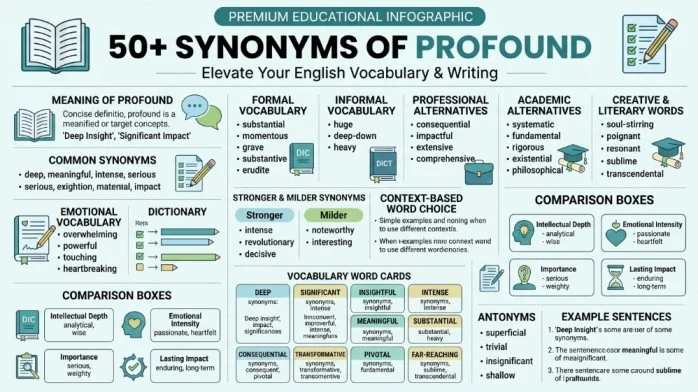
Some words carry more weight than others. Profound is one of them. It can describe a powerful idea, a meaningful experience, deep knowledge, or an effect that goes far beyond the surface. But using the same word repeatedly in essays, blogs, emails, captions, or professional writing can make your language feel predictable. Exploring synonyms of profound gives you more precise ways to express depth, significance, intensity, and intellectual importance.
Finding the right profound synonym is not simply about replacing one word with another. A writer may need another word for profound that sounds academic, emotional, formal, or conversational. Words such as deep, significant, meaningful, far reaching, and intense can work in different contexts, while profound alternative choices may change the exact tone of a sentence. This guide explains each option clearly, helping you choose the most natural synonym for profound and understand when terms like profoundly synonym, profoundly synonyms, profound synonyms, and synonyms for profound fit best.
What Are the Best Synonyms of “Profound”?
Profound describes something extremely deep, meaningful, intense, or intellectually significant. The best alternatives include deep for general use, significant for formal writing, insightful for ideas, intense for emotions, far reaching for effects, and transformative for experiences that produce major change.
Meaning, Tone, and Context
Simple Definition
Profound describes something that has great depth, importance, intensity, or intellectual meaning. It can refer to ideas that require serious thought, emotions that are deeply felt, changes that have lasting effects, or experiences that strongly influence a person.
For example, a profound insight is not simply an interesting observation. It is an idea that reveals something important or encourages deeper understanding.
A profound emotion is deeply felt and often powerful. A profound change is substantial and may have lasting consequences.
Part of Speech
Profound is an adjective.
It is normally placed before a noun:
She made a profound observation.
It can also appear after a linking verb:
The experience was profound.
Overall Tone
The tone of profound is generally serious, thoughtful, and positive or neutral.
It often suggests depth rather than simple importance. Depending on the context, it can describe intellectual depth, emotional intensity, spiritual significance, or major consequences.
Formality Level
Profound is a neutral to formal word. It is especially common in:
- Academic writing
- Essays
- Literary criticism
- Professional discussions
- Speeches
- Philosophy
- Psychology
- Personal reflection
- Journalism
- Creative writing
It can also appear in everyday conversation, although simpler alternatives such as deep or meaningful may sound more natural.
Common Uses
Native English speakers commonly use profound with nouns such as:
- Profound impact
- Profound effect
- Profound change
- Profound understanding
- Profound insight
- Profound knowledge
- Profound sadness
- Profound respect
- Profound difference
- Profound experience
- Profound realization
- Profound influence
- Profound truth
- Profound meaning
- Profound question
Word Forms
| Form | Word |
|---|---|
| Adjective | Profound |
| Noun | Profundity |
| Adverb | Profoundly |
Examples:
The lecture offered a profound perspective.
The experience affected her profoundly.
The book explores the profundity of human relationships.
When and How to Use “Profound”
Use profound when you want to communicate more than ordinary importance or depth. It works especially well when something causes serious thought, produces a powerful emotional response, or has a lasting influence.
Professional
The new policy could have a profound effect on employee productivity.
In professional writing, profound is strongest when discussing major consequences rather than routine improvements.
Academic
The study provides a profound insight into how social environments influence learning.
Here, the word suggests intellectual depth and meaningful understanding.
Workplace
Her leadership had a profound influence on the team’s culture.
This works when the influence was substantial and lasting.
Personal
Losing my childhood home had a profound emotional effect on me.
The word communicates deep personal significance.
Thank you for your message. Your advice had a profound impact on my decision.
This is appropriate when the advice genuinely changed the writer’s thinking or actions.
Resume
Developed a training program that had a profound impact on employee engagement.
For resumes, however, a more measurable term such as significant may sometimes be more credible.
Social Media
That conversation had a profound impact on the way I see success.
The word works well when a post is personal, reflective, or inspirational.
Best Synonyms of “Profound”
No synonym can replace profound perfectly in every sentence. The word can describe depth, emotional intensity, intellectual insight, importance, or lasting influence, so the best replacement depends on the specific meaning.
| Context | Best Synonym | Why It Works |
| Professional writing | Significant | Sounds precise and objective. |
| Academic writing | Insightful | Highlights intellectual understanding. |
| Business communication | Consequential | Emphasizes meaningful results or effects. |
| Casual conversation | Deep | Natural and widely understood. |
| Emotional writing | Intense | Clearly communicates strong feelings. |
| Creative writing | Poignant | Adds emotional depth and sensitivity. |
| Resume writing | Significant | Communicates measurable importance professionally. |
| Workplace communication | Substantial | Suggests a considerable effect or change. |
| Stronger meaning | Far reaching | Highlights effects that extend beyond the immediate situation. |
| Softer meaning | Meaningful | Communicates importance without sounding overly dramatic. |
Professional Writing: Significant
Significant is often a better choice than profound when you want an objective professional tone.
The initiative produced significant improvements in customer satisfaction.
It is especially useful when the importance can be demonstrated through results or evidence.
Academic Writing: Insightful
Use insightful when describing an observation, analysis, argument, or interpretation that shows unusual understanding.
The researcher offers an insightful analysis of social behavior.
It is more specific than simply calling an argument profound.
Business Communication: Consequential
Consequential emphasizes results and consequences.
The decision could have consequential effects on future operations.
This works well when the main idea is that something will produce important outcomes.
Casual Conversation: Deep
Deep is the most natural everyday alternative in many contexts.
We had a deep conversation about family and relationships.
Although less formal than profound, it sounds comfortable and natural in ordinary speech.
Emotional Writing: Intense
When profound describes a strong emotional experience, intense can be a clearer alternative.
She felt intense sadness after hearing the news.
Use it when emotional strength is more important than intellectual depth.
Creative Writing: Poignant
Poignant is useful for moments that create strong emotional responses, especially sadness, tenderness, or reflection.
The final scene was deeply poignant.
It adds emotional color that the more general word profound may not provide.
Resume Writing: Significant
Resume writing benefits from concise, measurable language.
Led a project that delivered significant cost savings.
This is generally stronger than using profound without explaining the actual result.
Workplace Communication: Substantial
Substantial suggests a considerable amount, effect, improvement, or change.
The department made substantial progress during the second quarter.
It sounds professional without creating unnecessary emotional intensity.
Stronger Meaning: Far Reaching
Far reaching emphasizes consequences that extend well beyond the immediate situation.
The decision could have far reaching consequences for the industry.
It is particularly useful for policies, discoveries, decisions, and social changes.
Softer Meaning: Meaningful
Meaningful is a gentler alternative that emphasizes personal or practical value.
The project was a meaningful experience for everyone involved.
It is less dramatic than profound and works well in personal communication.
When Not to Use “Profound”
Although profound is useful, it should not be used simply to make ordinary statements sound more impressive. The word suggests genuine depth, intensity, significance, or lasting influence.
When “Profound” Is Too General
If you can identify exactly what makes something important, a more specific word may communicate the idea better.
Less precise:
The report had a profound effect.
Better:
The report had a significant effect on the company’s strategy.
Why:
Significant communicates importance in a more objective professional way.
When “Profound” Is Too Vague
Calling something profound does not explain why it matters.
Less precise:
She shared a profound idea.
Better:
She shared an insightful idea about how technology affects attention.
Why:
Insightful tells the reader that the idea demonstrates understanding.
When “Profound” Sounds Too Formal
In casual conversation, deep may sound more natural.
Less natural:
We had a profound conversation last night.
More natural:
We had a deep conversation last night.
Why:
The second version fits everyday American speech more comfortably.
When “Profound” Sounds Too Weak
If you need to emphasize urgency or serious consequences, critical may be better.
Less effective:
Accurate information is profound to the project.
Better:
Accurate information is critical to the project.
Why:
Critical communicates necessity and importance more directly.
When “Profound” Sounds Too Strong
Not every useful observation is profound.
Overstated:
Her suggestion that we start earlier was profound.
Better:
Her suggestion that we start earlier was helpful.
Why:
The second sentence matches the relatively ordinary nature of the suggestion.
When a More Emotional Word Is Better
When the focus is a strong feeling, intense, heartfelt, or poignant may be more precise.
General:
He experienced profound sadness.
More emotionally direct:
He experienced intense sadness.
Why:
Intense directly emphasizes emotional strength.
Words Commonly Confused With “Profound”
Deep
Difference:
Deep is broader and more common. It can describe physical depth, ideas, emotions, relationships, or understanding.
When to Use It:
Use it when you want a natural, flexible alternative to profound.
Example:
They developed a deep understanding of the problem.
Significant
Difference:
Significant emphasizes importance, impact, or noticeable results rather than depth itself.
When to Use It:
Use it in academic, professional, and analytical writing.
Example:
The study found a significant difference between the two groups.
Intense
Difference:
Intense focuses on strength or degree, particularly with emotions, sensations, experiences, or activity.
When to Use It:
Use it when the main idea is emotional or sensory strength.
Example:
She felt intense relief after receiving the news.
Insightful
Difference:
Insightful describes something that demonstrates a clear and intelligent understanding of a subject.
When to Use It:
Use it for comments, observations, analysis, books, discussions, and ideas.
Example:
His insightful comments helped the team understand the problem.
Serious
Difference:
Serious can describe importance, concern, or consequences, but it does not necessarily suggest intellectual or emotional depth.
When to Use It:
Use it when discussing risks, problems, responsibilities, or situations requiring attention.
Example:
The company faces a serious financial challenge.
Meaningful
Difference:
Meaningful emphasizes personal value, purpose, or emotional significance.
When to Use It:
Use it for relationships, experiences, conversations, achievements, and personal reflections.
Example:
Volunteering became a meaningful part of her life.
Best Synonyms of “Profound” by Context
| Context | Best Synonym | Why It Works | Example |
| Formal writing | Significant | Clear and objective | The discovery had a significant impact. |
| Academic writing | Insightful | Highlights intellectual depth | The paper offers an insightful analysis. |
| Professional communication | Substantial | Indicates considerable effect | The team made substantial progress. |
| Business emails | Significant | Professional and measured | This change could have significant consequences. |
| Resume writing | Significant | Works well with measurable achievements | Delivered significant improvements in efficiency. |
| Workplace communication | Critical | Highlights priority or necessity | Clear communication is critical to success. |
| Casual conversation | Deep | Natural and familiar | We had a deep discussion. |
| Everyday speaking | Meaningful | Warm and accessible | It was a meaningful experience. |
| Creative writing | Poignant | Adds emotional depth | The ending was poignant. |
| Storytelling | Transformative | Highlights major personal change | The journey was transformative. |
| Emotional writing | Intense | Focuses on emotional strength | She felt intense grief. |
| Strong emphasis | Far reaching | Emphasizes broad consequences | The law could have far reaching effects. |
| Mild tone | Meaningful | Suggests value without exaggeration | The conversation was meaningful. |
| Social media captions | Deep | Sounds natural and expressive | A deep reminder to appreciate life. |
| American English | Deep | Common and natural | It was a deep realization. |
| British English | Deep | Also natural in British usage | The book explores deep social questions. |
How to Choose the Best Synonym of “Profound”
Choosing an alternative becomes easier when you first identify what profound means in your sentence.
If You Mean Intellectual Depth
Choose:
Insightful, perceptive, penetrating, philosophical
Example:
She offered a profound interpretation.
Better:
She offered an insightful interpretation.
If You Mean Emotional Strength
Choose:
Intense, heartfelt, poignant, deep
Example:
He experienced profound sadness.
Better:
He experienced intense sadness.
If You Mean Major Importance
Choose:
Significant, consequential, substantial, momentous
Example:
The decision had profound consequences.
Better:
The decision had far reaching consequences.
If You Mean Major Personal Change
Choose:
Transformative, life changing, meaningful
Example:
Traveling abroad was a profound experience.
Better:
Traveling abroad was a transformative experience.
If You Mean General Depth
Choose:
Deep
Example:
The book explores profound questions.
Better:
The book explores deep questions.
Consider Your Audience
Academic readers may expect significant, insightful, or substantial.
Business readers may respond better to critical, consequential, or significant.
Friends and social media audiences generally find deep, meaningful, or intense more natural.
Consider Emotional Strength
Do not automatically choose the strongest word available.
A meaningful conversation may be deep, while a traumatic experience may be profound or intense. Matching the intensity of the word to the situation makes your writing more credible.
Consider Formality
- For formal documents:
significant, substantial, consequential
- For everyday speech:
deep, meaningful, serious
- For creative writing:
poignant, transformative, profound
Consider Natural Usage
The best synonym is the one that sounds natural with the noun.
For example:
profound knowledge
can become:
deep knowledge
But:
profound impact
is often better rewritten as:
significant impact
The synonym should fit both the meaning and the words around it.
Real Life Examples of “Profound”
School
Original:
The book had a profound message about friendship.
Improved:
The book delivered a meaningful message about friendship.
Why it works:
Meaningful sounds natural for a school discussion about values and relationships.
College
Original:
The professor gave us a profound explanation of the theory.
Improved:
The professor gave us an insightful explanation of the theory.
Why it works:
Insightful emphasizes understanding and intellectual value.
Workplace
Original:
The new manager had a profound effect on team morale.
Improved:
The new manager had a significant effect on team morale.
Why it works:
Significant is more objective for workplace communication.
Business
Original:
The merger will have a profound effect on the company.
Improved:
The merger will have far reaching effects on the company.
Why it works:
Far reaching highlights consequences that extend beyond one immediate area.
Original:
Your advice had a profound impact on my decision.
Improved:
Your advice had a meaningful impact on my decision.
Why it works:
Meaningful sounds warm and personal without sounding overly dramatic.
Resume
Original:
Made a profound contribution to company growth.
Improved:
Made a significant contribution to company growth.
Why it works:
Significant is more conventional and professional for achievement statements.
Conversation
Original:
We had a profound discussion about life.
Improved:
We had a deep conversation about life.
Why it works:
Deep is more natural in casual American English.
Storytelling
Original:
The journey had a profound effect on her.
Improved:
The journey was transformative, changing how she viewed the world.
Why it works:
Transformative explains the nature of the effect rather than simply labeling it profound.
Blogging
Original:
This experience taught me a profound lesson.
Improved:
This experience taught me a meaningful lesson.
Why it works:
Meaningful works naturally in reflective blog writing.
Social Media
Original:
Sometimes a profound moment changes everything.
Improved:
Sometimes a transformative moment changes everything.
Why it works:
Transformative creates a clearer connection between the moment and the resulting change.
25 Best Synonyms of “Profound”
The following list includes alternatives that match different senses of profound, including depth, significance, emotional intensity, intellectual insight, and lasting influence.
| Synonym | Simple Meaning | Best Used For | Example Sentence |
| Deep | Having great depth or meaning | Everyday and creative writing | The book raises deep questions about identity. |
| Significant | Important or meaningful | Academic and professional writing | The research produced significant findings. |
| Insightful | Showing deep understanding | Ideas and analysis | Her insightful comments changed the discussion. |
| Intense | Extremely strong | Emotions and experiences | He felt intense gratitude after the ceremony. |
| Meaningful | Having personal value or purpose | Personal writing | It was a meaningful conversation. |
| Substantial | Considerable in amount or effect | Business and formal writing | The company made substantial progress. |
| Consequential | Producing important results | Decisions and policies | The ruling could have consequential effects. |
| Momentous | Extremely important | Major events and decisions | The election marked a momentous change. |
| Far reaching | Affecting many areas or future outcomes | Policies and discoveries | The discovery had far reaching implications. |
| Transformative | Producing major change | Experiences and developments | The program was transformative for many students. |
| Penetrating | Showing sharp understanding | Analysis and criticism | The author provides a penetrating analysis of power. |
| Perceptive | Showing strong awareness | People and observations | She made a perceptive observation about the situation. |
| Thought provoking | Encouraging serious thought | Books, speeches, ideas | The documentary raised thought provoking questions. |
| Philosophical | Concerned with deep questions | Ideas and discussions | They had a philosophical conversation about freedom. |
| Serious | Important or requiring attention | Problems and issues | The organization faces a serious challenge. |
| Strong | Powerful in effect or feeling | Emotions and opinions | He developed a strong connection with his mentor. |
| Heartfelt | Deeply sincere and emotional | Messages and expressions | She wrote a heartfelt letter to her parents. |
| Poignant | Deeply moving or emotionally affecting | Stories and memories | The film ended with a poignant scene. |
| Fundamental | Basic and essential | Academic concepts | Trust is fundamental to healthy relationships. |
| Pivotal | Extremely important to an outcome | Events and decisions | Her decision was pivotal to the team’s success. |
| Momentous | Of great importance or consequence | Historical events | It was a momentous occasion for the country. |
| Erudite | Showing extensive learning | Scholarly writing | The professor gave an erudite lecture on philosophy. |
| Learned | Having extensive knowledge | Formal descriptions of people | She is a learned scholar of literature. |
| Wise | Showing sound judgment and understanding | Advice and people | His wise advice helped me reconsider the decision. |
| Life changing | Producing major personal change | Experiences and events | Moving abroad was a life changing experience. |
Synonyms of “Profound” by Usage
Professional vs Personal Synonyms
Professional writing generally benefits from precise and objective alternatives.
Use:
- Significant
- Substantial
- Consequential
- Critical
- Pivotal
Example:
The policy had a significant effect on employee retention.
Personal writing can use warmer words.
Use:
- Deep
- Meaningful
- Heartfelt
- Intense
- Transformative
Example:
Her support was deeply meaningful to me.
Formal vs Conversational Synonyms
- For reports and essays, choose:
- Significant
- Substantial
- Consequential
- Fundamental
- Pivotal
- For presentations and professional emails:
- Significant
- Critical
- Meaningful
- Substantial
- For casual conversation:
- Deep
- Serious
- Strong
- Meaningful
- For texting:
- Deep
- Intense
- Huge
- Life changing
The more formal the setting, the more important it becomes to choose a word that communicates the exact type of depth or importance.
Academic Synonyms
Academic writing often requires vocabulary that distinguishes intellectual depth from simple emotional intensity.
Insightful works for analysis.
The article provides an insightful discussion of social inequality.
Significant works for important results.
The researchers found a significant relationship between the variables.
Fundamental works for core principles.
Language is fundamental to human communication.
Penetrating works for unusually sharp analysis.
The author presents a penetrating critique of the theory.
Consequential works for important effects.
The decision had consequential implications for future research.
Professional and Business Synonyms
Resumes
Use significant, substantial, or pivotal when describing measurable achievements.
Delivered significant improvements in customer retention.
Interviews
Use meaningful, significant, or transformative when discussing experiences.
The project was a transformative experience that improved my leadership skills.
Meetings
Use critical or key when identifying priorities.
Customer feedback is key to improving the product.
Presentations
Use significant, substantial, or far reaching.
The proposal could have far reaching benefits for the organization.
Performance Reviews
Use significant, substantial, or valuable.
She made a significant contribution to the team’s success.
Client Communication
Use meaningful, significant, or substantial.
We have made substantial progress toward resolving the issue.
Business Emails
Use critical when something requires immediate attention.
This information is critical to completing the next stage.
Creative and Literary Synonyms
Creative writing often benefits from alternatives that communicate emotional or intellectual depth more vividly.
Poignant works for emotionally moving scenes.
The character’s final words were poignant.
Transformative works for experiences that change a character.
The journey became a transformative chapter in her life.
Deep works naturally for thoughts, relationships, and questions.
Their friendship developed into a deep bond.
Heartfelt works for sincere emotional expression.
His heartfelt apology finally opened the door to forgiveness.
Thought provoking works for ideas that encourage reflection.
The novel presents a thought provoking view of human nature.
Slang or Modern Synonyms
There is no single true slang synonym for profound. However, informal expressions can communicate similar ideas depending on context.
Deep
Meaning: Very thoughtful, emotionally meaningful, or intellectually interesting.
Acceptable in: Conversations, social media, informal writing.
Avoid in: Highly formal academic or technical writing when greater precision is needed.
That was a deep conversation.
Life Changing
Meaning: So significant that it changes someone’s life or outlook.
Acceptable in: Social media, personal stories, casual conversation.
Avoid in: Formal reports unless the expression accurately describes the situation.
Studying abroad was a life changing experience.
A Big Deal
Meaning: Something considered very important.
Acceptable in: Casual speech and texting.
Avoid in: Academic essays, formal reports, and professional documents.
Getting that opportunity was a big deal for her.
Strongest to Mildest Synonyms
There is no universal ranking because profound can describe different types of depth. Still, the following scale can help when choosing a word for intensity.
| Level | Suitable Words | Typical Meaning |
| Mild | Meaningful, thoughtful | Worthwhile or reflective |
| Moderate | Deep, significant, substantial | Clearly important or deep |
| Strong | Intense, consequential, momentous | Powerful or highly significant |
| Very Strong | Profound, transformative, far reaching | Extremely deep or capable of lasting effects |
Use stronger vocabulary only when the situation genuinely deserves it. Overusing words such as profound, momentous, or transformative can make ordinary experiences sound exaggerated.
Emotional vs Neutral Synonyms
Emotional Synonyms
These alternatives add feeling to the sentence:
- Intense
- Heartfelt
- Poignant
- Deep
- Meaningful
- Transformative
Example:
Her speech was deeply poignant.
These words work well in personal essays, stories, speeches, social media posts, and reflective writing.
Neutral Synonyms
These alternatives communicate depth or importance without strong emotional language:
- Significant
- Substantial
- Consequential
- Fundamental
- Pivotal
- Insightful
Example:
The report identified several significant changes in consumer behavior.
Neutral vocabulary is usually preferable in professional and academic contexts.
Antonyms of “Profound”
Because profound has several meanings, its opposite depends on context. The following words represent genuine opposites across its major senses of depth, significance, intensity, and intellectual seriousness.
| Antonym | Meaning | Example Sentence |
| Superficial | Lacking depth | His analysis was superficial and ignored the main issue. |
| Shallow | Lacking intellectual or emotional depth | The discussion remained shallow throughout the meeting. |
| Trivial | Of little importance | They spent time arguing about a trivial detail. |
| Insignificant | Having little importance | The difference was insignificant. |
| Minor | Relatively unimportant or small | The project experienced only a minor delay. |
| Meaningless | Lacking meaning or purpose | Without context, the statement seemed meaningless. |
| Unimportant | Not important | The detail was unimportant to the final decision. |
| Frivolous | Lacking seriousness or purpose | The discussion became frivolous instead of productive. |
| Simplistic | Treating a complex matter too simply | The article offered a simplistic explanation. |
| Ordinary | Not unusual or remarkable | It seemed like an ordinary day. |
| Insipid | Lacking interest, energy, or depth | The speech felt insipid and repetitive. |
| Superficiality | Lack of depth | The critic complained about the film’s superficiality. |
| Unsubstantial | Lacking real weight or substance | The argument was unsubstantial and poorly supported. |
| Casual | Lacking seriousness in some contexts | His casual response surprised everyone. |
| Light | Not serious or emotionally heavy | They preferred a light conversation after dinner. |
Comparison: “Profound” vs Similar Words
Profound vs Deep
Main Difference
Both words can describe intellectual, emotional, or conceptual depth. Deep is more common and flexible, while profound usually carries stronger emphasis on seriousness or significance.
Which Is Stronger?
Profound often sounds stronger.
Which Is More Formal?
Profound is generally more formal than deep.
When to Use Each
Use deep for everyday conversation and broadly applicable descriptions. Use profound when the depth or significance is exceptional.
Examples
Profound:
The experience had a profound effect on her worldview.
Deep:
They developed a deep friendship.
Profound vs Significant
Main Difference
Significant emphasizes importance or measurable impact. Profound emphasizes exceptional depth, intensity, or significance.
Which Is Stronger?
Profound usually carries more expressive force.
Which Is More Formal?
Both are formal enough for professional and academic writing, but significant is especially common in analytical contexts.
When to Use Each
Use significant for research, statistics, business results, and measurable effects. Use profound for deeper intellectual, emotional, or personal effects.
Examples
Profound:
The experience had a profound emotional impact.
Significant:
The program produced significant improvements.
Profound vs Intense
Main Difference
Intense focuses on strength or degree. Profound focuses more on depth and significance.
Which Is Stronger?
The answer depends on context. Intense is stronger for immediate emotional or sensory force, while profound is stronger for depth.
Which Is More Formal?
Both can be used formally.
When to Use Each
Use intense for emotions, pain, activity, or sensations. Use profound for ideas, experiences, effects, and understanding.
Examples
Profound:
She gained a profound understanding of the issue.
Intense:
He experienced intense pain.
Profound vs Meaningful
Main Difference
Meaningful emphasizes personal value, purpose, or emotional significance. Profound suggests greater depth or intensity.
Which Is Stronger?
Profound generally sounds stronger.
Which Is More Formal?
Profound is more formal.
When to Use Each
Use meaningful for personal experiences, relationships, conversations, and achievements. Use profound for unusually deep effects or insights.
Examples
Profound:
The book changed her perspective in a profound way.
Meaningful:
The conversation was deeply meaningful to both of them.
Profound vs Insightful
Main Difference
Insightful specifically describes an idea or observation that demonstrates strong understanding. Profound has a wider range of meanings.
Which Is Stronger?
For intellectual analysis, profound may sound stronger, while insightful is more precise.
Which Is More Formal?
Both work well in academic and professional writing.
When to Use Each
Use insightful for comments, analysis, observations, and interpretations. Use profound when describing unusually deep ideas or effects.
Examples
Profound:
The philosopher raised a profound question about freedom.
Insightful:
She made an insightful observation about human behavior.
Profound vs Serious
Main Difference
Serious indicates importance, concern, or a lack of humor. Profound indicates depth or exceptional significance.
Which Is Stronger?
Neither is always stronger. They communicate different qualities.
Which Is More Formal?
Both are widely accepted in formal writing.
When to Use Each
Use serious for problems, risks, responsibilities, and concerns. Use profound for ideas, experiences, emotions, and effects with unusual depth.
Examples
Profound:
The book explores profound questions about identity.
Serious:
The company faces a serious financial problem.
Common Phrases and Expressions with “Profound”
Profound Impact
Meaning: A very strong or lasting effect on someone or something.
Example:
The invention had a profound impact on modern communication.
Profound Effect
Meaning: A deep or significant influence.
Example:
The experience had a profound effect on his career.
Profound Change
Meaning: A major change that significantly alters a person, organization, or situation.
Example:
The industry has undergone a profound change in recent years.
Profound Understanding
Meaning: Very deep knowledge or comprehension.
Example:
She has a profound understanding of human behavior.
Profound Insight
Meaning: A deeply meaningful or revealing understanding.
Example:
His book offers a profound insight into leadership.
Profound Difference
Meaning: A very large or meaningful distinction.
Example:
There is a profound difference between knowing facts and understanding them.
Profound Respect
Meaning: Very deep admiration or regard.
Example:
I have profound respect for people who dedicate their lives to public service.
Profound Sadness
Meaning: Extremely deep sadness.
Example:
She experienced profound sadness after the loss.
Common Mistakes to Avoid
1. Treating Every Synonym as Identical
Incorrect:
The research had a deep result.
Better:
The research had a significant result.
Why:
Deep does not naturally fit every noun. Significant is more appropriate for results and findings.
2. Using “Profound” for Ordinary Situations
Incorrect:
Choosing between two lunch options was a profound decision.
Better:
Choosing between two lunch options was a minor decision.
Why:
Profound suggests unusual depth or significance. Using it for ordinary choices sounds exaggerated.
3. Using “Deep” When You Mean Serious
Incorrect:
The company has a deep financial problem.
Better:
The company has a serious financial problem.
Why:
Serious is the natural choice when describing a major problem or risk.
4. Using Informal Language in Academic Writing
Incorrect:
The experiment had a really deep result.
Better:
The experiment produced a significant result.
Why:
Significant is more precise and appropriate for academic analysis.
5. Choosing “Intense” for Intellectual Depth
Incorrect:
The professor gave an intense explanation of the theory.
Better:
The professor gave an insightful explanation of the theory.
Why:
Intense describes strength, while insightful describes intellectual quality.
6. Overusing “Profound”
Incorrect:
Every lesson in the course was profound.
Better:
Several lessons were insightful, while one discussion was particularly profound.
Why:
Varying vocabulary prevents exaggeration and makes the strongest description more meaningful.
7. Using “Meaningful” When You Need Objective Importance
Incorrect:
The company recorded a meaningful increase in revenue.
Better:
The company recorded a significant increase in revenue.
Why:
Significant is more suitable for measurable business results.
Frequently Asked Questions
What is another word for profound?
Deep, meaningful, intense, significant, and insightful are common alternatives.
What is a synonym for profound?
Common synonyms for profound include deep, thoughtful, meaningful, and far-reaching.
What is a profoundly synonym?
Depending on context, profoundly can mean deeply, greatly, intensely, or extremely.
What are the synonyms of profound?
Useful synonyms include deep, intense, meaningful, significant, insightful, and far-reaching.
What is a profound alternative?
A strong alternative to profound is deep, though the best choice depends on the context.
What are profoundly synonyms?
Common alternatives for profoundly include deeply, greatly, intensely, and significantly.
1. What are the best synonyms of “profound”?
The best synonyms of profound include deep, significant, insightful, intense, meaningful, substantial, consequential, transformative, and far reaching. The best choice depends on whether you mean depth, emotion, importance, or lasting impact.
2. What are the best formal synonyms of “profound”?
Formal alternatives include significant, substantial, consequential, fundamental, pivotal, and momentous. These words work especially well in academic papers, professional reports, formal presentations, and analytical writing.
3. What are common informal synonyms of “profound”?
Common informal alternatives include deep, meaningful, serious, and intense. In very casual speech, people may also say a big deal when they mean that something is highly important.
4. What is another word for “profound” in professional writing?
Significant is often the most useful professional alternative because it sounds clear and objective. Depending on context, substantial, critical, consequential, or pivotal may communicate the intended meaning more precisely.
5. What is the difference between “profound” and “deep”?
Deep is broader and more common in everyday English, while profound usually suggests exceptional depth, seriousness, or significance. For casual conversation, deep often sounds more natural. For formal or reflective writing, profound may be more appropriate.
6. What is the opposite of “profound”?
Common opposites include superficial, shallow, trivial, insignificant, minor, and meaningless. The best antonym depends on whether profound refers to intellectual depth, emotional depth, importance, or significance.
Conclusion
Profound describes something with exceptional depth, significance, emotional intensity, or intellectual value. It can refer to an idea, emotion, experience, discovery, change, or effect that goes beyond the ordinary.
The best alternative depends on context. Use deep for natural everyday language, significant for academic and professional writing, insightful for ideas and analysis, intense for emotions, meaningful for personal value, and far reaching for effects that extend widely.
No synonym works perfectly in every sentence. The strongest vocabulary choice is the one that accurately communicates your intended meaning while matching your audience, tone, and purpose. A useful habit is to identify exactly what makes something profound before choosing an alternative. That small step can make your writing more precise and natural.
When improving your vocabulary, study words in phrases rather than memorizing isolated lists. Learning how synonyms of profound behave with real nouns and contexts will help you use them confidently.
Read More Related Articles:
- Synonyms for Thus | Meaning, Examples, and Better Word …
- Synonyms for Pros and Cons | Meaning, Examples, and Better …
- 50+ Synonyms of Show | Meanings, Uses, Examples, and …