Writers often notice the same problem when working on essays, book reviews, blog posts, captions, or creative stories: one word keeps appearing again and again. If you repeatedly write dystopia, your ideas can start to sound predictable, even when the concept itself is interesting.
Learning the synonyms of dystopia gives you more control over tone and meaning. You might need a formal term for an academic essay, a precise phrase for a literary analysis, or a more vivid expression for fiction. The right alternative can emphasize oppression, social control, inequality, fear, or the collapse of freedom without changing the central idea.
This guide explains what dystopia means, which alternatives genuinely fit, how closely related terms differ, and how to select the most natural word for your audience and purpose.
What Are the Best Synonyms of “Dystopia”?
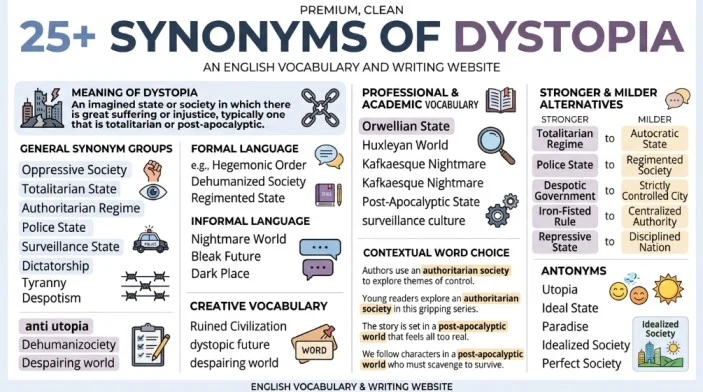
Dystopia describes an imagined society marked by oppression, suffering, extreme control, or severe social problems. Useful alternatives include anti utopia, oppressive society, nightmarish society, and totalitarian society. Academic writing often favors precise phrases, while creative writing can use darker expressions such as nightmare world or bleak future.
The best choice depends on what you want to emphasize. Anti utopia is useful when contrasting an ideal society with its opposite. Totalitarian society highlights political control. Oppressive society focuses on restricted freedom. Nightmarish society adds emotional intensity, while bleak future works well when discussing a fictional future shaped by serious social problems.
Meaning, Tone, and Context
Simple Definition
A dystopia is an imagined society or world in which living conditions are extremely undesirable because of oppression, fear, injustice, environmental destruction, technological control, inequality, or other serious problems.
The word is commonly associated with fiction, especially stories that imagine a troubling future. However, writers can also use it more broadly to describe a society that appears deeply dysfunctional or oppressive.
Part of Speech
Dystopia is primarily a noun.
Example:
The novel presents a dystopia where citizens are constantly monitored.
The plural form is dystopias.
Overall Tone
The word is strongly negative. It usually suggests suffering, restriction, fear, social breakdown, or loss of human freedom.
Its exact emotional effect depends on context. In academic writing, dystopia can sound analytical and neutral in tone even though the concept itself is negative.
Formality Level
Dystopia is a neutral to formal vocabulary word. It is especially common in:
- Literary criticism
- Academic writing
- Film and book reviews
- Political commentary
- Social analysis
- Speculative fiction
- Cultural discussions
It is less common in casual conversation unless someone is discussing a book, movie, political situation, or fictional scenario.
Common Uses
Native English speakers commonly use dystopia when discussing fictional societies, especially societies affected by:
- Authoritarian government
- Mass surveillance
- Censorship
- Extreme inequality
- Environmental collapse
- Technological control
- Loss of privacy
- Social discrimination
- Political oppression
- Economic exploitation
Example:
The film portrays a dystopia where personal privacy has completely disappeared.
Word Forms
Noun: dystopia
Plural noun: dystopias
Adjective: dystopian
Related noun: dystopianism, used in some academic and literary contexts
Opposite concept: utopia
The adjective dystopian is extremely common.
Example:
The author creates a dystopian future controlled by artificial intelligence.
When and How to Use “Dystopia”
The word works best when you are describing an imagined or conceptual society where serious problems have become part of everyday life. It is especially useful when the problems are systemic rather than limited to one individual.
Professional
The report warns that unchecked automation could create a dystopia in which workers have little economic security.
This works when a professional discussion uses the word metaphorically to describe a troubling social outcome.
Academic
The novel uses dystopia to examine the relationship between government power and individual freedom.
This is suitable for literary analysis because the word identifies a specific type of fictional society.
Workplace
A workplace without privacy, autonomy, or trust could feel like a dystopia.
Here, dystopia is being used figuratively to emphasize an unhealthy environment.
Personal
Living under constant surveillance would feel like a dystopia to me.
The word adds emotional weight to a personal statement.
The proposal is designed to prevent what could otherwise become a technological dystopia.
This can work in a formal email, especially when discussing technology, ethics, or policy.
Resume
Directly using dystopia on a resume is unusual. A professional alternative such as high risk environment, challenging conditions, or systemic instability is normally more appropriate.
Social Media
That new science fiction series turns an ordinary city into a terrifying dystopia.
The word works naturally in entertainment commentary and social media discussions.
Best Synonyms of “Dystopia”
No synonym of dystopia is identical in every situation. Some alternatives describe the entire concept, while others emphasize one particular feature, such as oppression, authoritarianism, misery, or social collapse.
Professional Writing
Oppressive society is often the clearest alternative because it directly communicates harmful social control without sounding overly dramatic.
Academic Writing
Anti utopia can work well in literary analysis when discussing a fictional society designed as a negative contrast to an ideal society.
Business Communication
Oppressive system may be more useful than dystopia when discussing workplace or organizational problems.
Casual Conversation
Nightmare world is more conversational and emotionally vivid.
Emotional Writing
Nightmarish society emphasizes fear, suffering, and emotional distress.
Creative Writing
Bleak future works well when the setting is imagined as a troubled future rather than simply an oppressive society.
Resume Writing
Dystopia is usually inappropriate for a resume. Terms such as challenging environment, unstable environment, or high pressure setting are more professional.
Workplace Communication
Highly controlled environment is more precise when discussing excessive monitoring, restrictions, or limited employee autonomy.
Stronger Meaning
Nightmare world can create a stronger emotional reaction than the neutral analytical word dystopia.
Softer Meaning
Troubled society is softer because it suggests serious problems without necessarily implying extreme oppression or suffering.
When Not to Use “Dystopia”
When the Problem Is Too General
If you only mean that something is difficult or unpleasant, dystopia may be too strong.
Less effective:
The new office software is a dystopia.
Better:
The new office software is frustrating and difficult to use.
A dystopia normally refers to much broader social or environmental conditions.
When You Mean Political Dictatorship Specifically
Dystopia does not automatically mean dictatorship.
Less precise:
The country is a dystopia because one leader controls the government.
Better:
The country has become a totalitarian state.
The second sentence identifies political control more precisely.
When You Mean Simple Poverty
Poverty alone does not necessarily create a dystopia.
Less effective:
The neighborhood is a dystopia because many residents are poor.
Better:
The neighborhood faces severe poverty and inadequate public services.
When You Need Professional Neutrality
Dystopia can sound dramatic in corporate communication.
Less effective:
Our department has become a dystopia.
Better:
Our department is experiencing serious organizational and communication problems.
When You Mean a Perfect Society
Do not confuse dystopia with its opposite.
Incorrect:
The novel describes a dystopia where everyone is happy and free.
Better:
The novel describes a utopia where everyone is happy and free.
When the Tone Is Too Informal
Words such as nightmare world can be inappropriate in academic or professional writing.
For formal writing, use precise expressions such as oppressive society, authoritarian system, or socially dysfunctional society, depending on the intended meaning.
Words Commonly Confused With “Dystopia”
Dystopia vs Utopia
Difference:
A dystopia represents an undesirable society, while a utopia represents an ideal or highly desirable society.
When to Use It:
Use utopia when discussing perfection or an ideal social order.
Example:
The novel begins as a utopia but gradually becomes a dystopia.
Dystopia vs Apocalypse
Difference:
A dystopia focuses on a deeply problematic society. An apocalypse usually refers to catastrophic destruction or the end of civilization.
When to Use It:
Use apocalypse when widespread destruction is the central idea.
Example:
The story begins after an environmental apocalypse and follows survivors rebuilding society.
Dystopia vs Totalitarianism
Difference:
Dystopia describes an undesirable society. Totalitarianism describes a political system based on extensive state control.
When to Use It:
Use totalitarianism when political authority and centralized control are the main focus.
Example:
The novel explores how totalitarianism transforms a once free society.
Dystopia vs Authoritarianism
Difference:
Authoritarianism concerns concentrated political power and limited freedom. A dystopia can include authoritarianism but is broader.
When to Use It:
Use authoritarianism for political analysis.
Example:
The story examines the consequences of authoritarianism on ordinary citizens.
Dystopia vs Nightmare
Difference:
A nightmare is generally an intensely frightening experience or situation. A dystopia specifically concerns an undesirable society or social order.
When to Use It:
Use nightmare when emotional fear matters more than the structure of society.
Example:
The city became a nightmare after the communication network collapsed.
Dystopia vs Disaster
Difference:
A disaster is a destructive event. A dystopia is a social condition or imagined society.
When to Use It:
Use disaster for events such as floods, earthquakes, accidents, or major failures.
Example:
The earthquake was a disaster, but the political response created a much deeper social crisis.
Best Synonyms of “Dystopia” by Context
| Context | Best Synonym | Why It Works | Example |
|---|---|---|---|
| Formal writing | Oppressive society | Clear and professional | The novel depicts an oppressive society. |
| Academic writing | Anti utopia | Useful for literary analysis | The text functions as an anti utopia. |
| Professional communication | Oppressive system | Focuses on harmful structures | Employees rejected the oppressive system. |
| Business emails | Troubled system | Softer and more professional | The company needs to reform its troubled system. |
| Resume writing | Challenging environment | Professional and neutral | I performed effectively in a challenging environment. |
| Workplace communication | Highly controlled environment | Highlights restricted autonomy | Staff worked in a highly controlled environment. |
| Casual conversation | Nightmare world | Vivid and easy to understand | The movie creates a nightmare world. |
| Everyday speaking | Terrible society | Simple and accessible | The story imagines a terrible society. |
| Creative writing | Bleak future | Strong atmospheric effect | The novel imagines a bleak future. |
| Storytelling | Nightmarish society | Adds emotional intensity | The hero escapes a nightmarish society. |
| Emotional writing | Nightmare world | Expresses fear and suffering | Their city has become a nightmare world. |
| Strong emphasis | Hellish society | Very intense imagery | The author portrays a hellish society. |
| Mild tone | Troubled society | Avoids excessive drama | The story presents a troubled society. |
| Social media captions | Dark future | Short and accessible | A warning about a dark future. |
| American English | Dystopian society | Natural modern usage | The film explores a dystopian society. |
| British English | Dystopian society | Also natural in British usage | The novel presents a dystopian society. |
How to Choose the Best Synonym of “Dystopia”
Start with the exact meaning you want to communicate.
- If the central idea is social oppression, choose oppressive society. If the focus is political control, totalitarian society or authoritarian society may be more precise.
- If you are discussing fictional literature, anti utopia, dystopian society, or bleak future can work depending on the argument.
- If you want a strong emotional effect, choose nightmare world or hellish society. For a softer and more neutral description, troubled society is safer.
Always consider five factors:
- Meaning: Does the alternative describe the same idea?
- Audience: Will the reader understand the word immediately?
- Tone: Does it sound formal, conversational, emotional, or literary?
- Intensity: Does it make the situation sound stronger or weaker?
- Purpose: Are you informing, analyzing, persuading, describing, or entertaining?
The strongest synonym is not always the most impressive word. The best synonym is the one that communicates your intended meaning with the least confusion.
Real Life Examples of “Dystopia”
School
The student described the novel as a dystopia where education is controlled by the government.
For a school assignment, dystopia is more precise than simply calling the setting a bad society.
College
The essay argues that the novel uses dystopia to criticize excessive government surveillance.
This gives the academic discussion a clear literary focus.
Workplace
Employees worried that constant monitoring could turn the workplace into a dystopia.
Here, the word is metaphorical and emphasizes extreme control.
Business
The technology could create a dystopia if companies use personal data without meaningful limits.
The word can be effective in ethical discussions, but a more neutral business report might use highly controlled environment.
The article raises concerns about whether unchecked automation could produce a technological dystopia.
This works when the email discusses technology and its possible social consequences.
Resume
Instead of:
Worked successfully in a dystopia.
Use:
Performed effectively in a high pressure and rapidly changing environment.
The second version communicates useful professional information without unnecessary drama.
Conversation
That movie feels like a dystopia where nobody can escape surveillance.
This is natural in everyday discussion about science fiction.
Storytelling
Beyond the city gates stood a dystopia built on silence, fear, and constant surveillance.
A more expressive phrase can be used when creating atmosphere.
Blogging
Many science fiction stories use dystopia to explore what happens when convenience becomes more important than freedom.
This gives the word an analytical role in content writing.
Social Media
Another dystopia story, but this one actually makes the technology feel believable.
This informal usage works well in a social media review.
25 Best Synonyms of “Dystopia”
Some entries below are direct or near synonyms, while others are established descriptive alternatives used when a writer wants to emphasize a particular feature of dystopian society. This distinction matters because English does not have 25 interchangeable single word synonyms for dystopia. Forcing unrelated words into a synonym list would reduce accuracy.
| Synonym | Simple Meaning | Best Used For | Example Sentence |
|---|---|---|---|
| Anti utopia | An imagined society opposite to an ideal society | Literary analysis | The novel presents an anti utopia disguised as a perfect community. |
| Dystopian society | A society with severe social problems or oppression | General writing | The film depicts a dystopian society controlled by surveillance. |
| Oppressive society | A society that severely restricts people | Academic and professional writing | Citizens struggled under an oppressive society. |
| Nightmarish society | A society that feels frightening and unbearable | Emotional writing | The protagonist escapes a nightmarish society. |
| Nightmare world | A world characterized by extreme fear or suffering | Creative writing | The author creates a nightmare world ruled by fear. |
| Bleak future | A future with little hope or positive possibility | Fiction and commentary | The story imagines a bleak future after social collapse. |
| Troubled society | A society facing serious problems | Mild descriptions | The documentary examines a deeply troubled society. |
| Authoritarian society | A society dominated by strong political authority | Political analysis | The novel portrays an authoritarian society with limited freedom. |
| Totalitarian society | A society under extremely comprehensive political control | Historical and political writing | The citizens live under a totalitarian society. |
| Oppressive system | A system that harms or restricts people | Workplace and social analysis | The characters challenge an oppressive system. |
| Authoritarian system | A system centered on concentrated authority | Academic writing | The story criticizes an authoritarian system. |
| Totalitarian system | A system seeking extensive control over public and private life | Political analysis | The fictional government operates as a totalitarian system. |
| Repressive society | A society that suppresses freedom or expression | Formal writing | Artists struggle to work in a repressive society. |
| Repressive regime | A government that suppresses opposition or freedom | Political contexts | The novel is set under a repressive regime. |
| Tyrannical society | A society characterized by cruel or oppressive rule | Strong literary writing | The hero rebels against a tyrannical society. |
| Controlled society | A society where behavior is heavily regulated | Technology and fiction | The story explores life in a controlled society. |
| Surveillance society | A society where people are extensively monitored | Technology and politics | The novel warns about a surveillance society. |
| Police state | A state that uses extensive policing and surveillance to control people | Political writing | The fictional nation has become a police state. |
| Oppressive world | A world characterized by severe restrictions | Creative writing | She struggles to survive in an oppressive world. |
| Bleak world | A world offering little hope | Creative and descriptive writing | The author builds a bleak world after environmental collapse. |
| Dark future | A future marked by serious problems or danger | General and media writing | The film imagines a dark future shaped by climate disasters. |
| Hellish society | An extremely unpleasant or horrifying society | Strong emotional writing | The novel depicts a hellish society where fear controls daily life. |
| Nightmarish world | A frightening and disturbing imagined world | Fiction and reviews | The game takes players into a nightmarish world. |
| Social nightmare | A society or social condition viewed as profoundly disturbing | Commentary and opinion | The unchecked housing crisis became a social nightmare. |
| Dysfunctional society | A society whose institutions or relationships fail badly | Academic and social analysis | The book explores how corruption creates a dysfunctional society. |
Synonyms of “Dystopia” by Usage
Professional vs Personal Synonyms
Professional writing usually benefits from precise terms such as oppressive system, controlled environment, authoritarian system, or dysfunctional society.
Personal writing allows stronger imagery. Words such as nightmare world, hellish society, and dark future can communicate emotion more effectively.
Formal vs Conversational Synonyms
For reports and essays, use terms such as:
- Anti utopia
- Oppressive society
- Repressive society
- Authoritarian society
- Totalitarian society
- Surveillance society
For conversations and informal writing, alternatives such as these can feel more natural:
- Nightmare world
- Dark future
- Terrible society
- Bleak world
- Social nightmare
A formal synonym should communicate precision without sounding unnecessarily dramatic.
Academic Synonyms
Academic writing benefits from terms that identify the specific feature being analyzed.
Anti utopia is useful when discussing a literary contrast with utopian ideals.
Authoritarian society works when political authority is central.
Surveillance society is useful when monitoring and privacy are major themes.
Repressive society emphasizes restrictions on expression, freedom, or opposition.
Dysfunctional society works when institutional failure is more important than political dictatorship.
Professional and Business Synonyms
For resumes, interviews, meetings, and business writing, dystopia is usually too dramatic unless the context is explicitly discussing literature or social predictions.
Better alternatives include:
- Challenging environment
- Highly controlled environment
- Dysfunctional system
- Unstable environment
- Repressive system
- Organizational dysfunction
For example:
I worked in a highly controlled environment and developed efficient ways to manage competing priorities.
This is more useful on a resume than describing the workplace as a dystopia.
Creative and Literary Synonyms
Creative writing gives you more freedom to choose emotionally powerful alternatives.
Nightmarish world creates fear.
Bleak future creates a sense of hopelessness.
Hellish society creates extreme emotional intensity.
Oppressive world emphasizes restriction.
Dark future creates a broad sense of danger without specifying the exact cause.
The best creative choice depends on the atmosphere you want the reader to feel.
Slang or Modern Synonyms
There is no single slang word that reliably means dystopia in all contexts.
Informal phrases such as nightmare world, hell on earth, or a total nightmare can communicate a similar emotional reaction, but they are not exact dictionary replacements.
Avoid these expressions in academic papers, formal reports, resumes, and professional correspondence unless the context specifically calls for an informal voice.
Strongest to Mildest Synonyms
Because dystopia can describe many different levels of social dysfunction, intensity depends heavily on context.
| Intensity | Useful Alternative | Effect |
|---|---|---|
| Mild | Troubled society | Signals serious problems without extreme emotion |
| Mild | Dysfunctional society | Emphasizes institutional or social failure |
| Moderate | Controlled society | Highlights restrictions |
| Moderate | Oppressive society | Highlights suppression and lack of freedom |
| Moderate | Repressive society | Strongly emphasizes suppression |
| Strong | Authoritarian society | Emphasizes concentrated political power |
| Strong | Surveillance society | Emphasizes extensive monitoring |
| Very Strong | Totalitarian society | Suggests extremely comprehensive political control |
| Very Strong | Nightmare world | Creates powerful emotional imagery |
| Very Strong | Hellish society | Produces the strongest emotional effect |
Intensity should match the evidence or fictional setting. Avoid choosing the strongest term simply because it sounds impressive.
Emotional vs Neutral Synonyms
Emotional Synonyms
These alternatives add fear, anger, hopelessness, or dramatic imagery:
- Nightmare world
- Nightmarish world
- Hellish society
- Oppressive world
- Bleak world
- Social nightmare
They work best in fiction, reviews, persuasive writing, and emotional commentary.
Neutral Synonyms
These terms focus more directly on structure or social conditions:
- Dystopian society
- Oppressive society
- Authoritarian society
- Controlled society
- Dysfunctional society
- Surveillance society
- Repressive society
They are better for academic analysis, reports, and explanatory writing.
Antonyms of “Dystopia”
Because dystopia describes an undesirable society rather than a simple physical object, its opposites are usually conceptual rather than one word dictionary antonyms. The following terms represent genuine contrasting ideas.
| Antonym | Meaning | Example Sentence |
|---|---|---|
| Utopia | An ideal or highly desirable society | The novel begins by presenting the city as a utopia. |
| Ideal society | A society organized around highly desirable conditions | The proposal imagines an ideal society based on fairness. |
| Perfect society | A society presented as free from major social problems | The story claims to have created a perfect society. |
| Paradise | A place or condition of exceptional happiness | The island appears to be a paradise. |
| Heaven | A state or place associated with perfect happiness | To the characters, the peaceful valley feels like heaven. |
| Ideal world | A world containing highly desirable conditions | The children imagine an ideal world without violence. |
| Harmonious society | A society characterized by cooperation and social peace | The community strives to build a harmonious society. |
| Peaceful society | A society with little violence or conflict | They hoped to create a peaceful society. |
| Just society | A society organized around fairness and justice | The movement sought a more just society. |
| Free society | A society where people enjoy substantial freedom | Citizens defended their free society. |
| Equitable society | A society focused on fair access and treatment | The reform aims to build a more equitable society. |
| Prosperous society | A society enjoying broad economic well being | Education helped create a prosperous society. |
| Thriving community | A community that develops successfully and positively | The project transformed the area into a thriving community. |
| Enlightened society | A society guided by knowledge, reason, and humane values | The novel imagines an enlightened society. |
| Golden age | A period remembered or imagined as exceptionally successful | The story describes the kingdom’s early years as a golden age. |
Comparison: “Dystopia” vs Similar Words
Dystopia vs Utopia
Main Difference:
Dystopia describes an undesirable society, while utopia describes an idealized one.
Which Is Stronger?
Neither is inherently stronger. They represent opposite social ideals.
Which Is More Formal?
Both are suitable for academic and professional discussions.
When to Use Each:
Use dystopia for social decline or oppression. Use utopia for ideal conditions.
Examples
Dystopia:
The city becomes a dystopia after the government eliminates personal freedom.
Utopia:
The founders hoped to create a utopia based on equality.
Dystopia vs Apocalypse
Main Difference:
An apocalypse involves catastrophic destruction, while a dystopia describes a deeply undesirable social order.
Which Is Stronger?
Apocalypse can suggest more immediate physical destruction.
Which Is More Formal?
Both work in academic and creative contexts.
When to Use Each:
Use apocalypse for civilization ending events. Use dystopia for oppressive or dysfunctional societies.
Examples
Dystopia:
The novel presents a dystopia where citizens are constantly monitored.
Apocalypse:
The survivors rebuild their lives after the apocalypse.
Dystopia vs Totalitarianism
Main Difference:
Dystopia describes the society. Totalitarianism describes an extreme form of political control.
Which Is Stronger?
Totalitarianism is more specific about political authority.
Which Is More Formal?
Both are highly suitable for academic writing.
When to Use Each:
Choose totalitarianism when political control is the central issue.
Examples
Dystopia:
The novel imagines a dystopia without personal privacy.
Totalitarianism:
The essay examines how totalitarianism limits individual freedom.
Dystopia vs Authoritarianism
Main Difference:
Authoritarianism concerns concentrated political power. Dystopia is a broader social concept.
Which Is Stronger?
Neither automatically has greater intensity. Authoritarianism is more politically specific.
Which Is More Formal?
Both are appropriate in formal writing.
When to Use Each:
Use authoritarianism when describing a political system. Use dystopia when describing the broader undesirable society.
Examples
Dystopia:
The film portrays a dystopia controlled by fear.
Authoritarianism:
The government gradually adopted authoritarianism.
Dystopia vs Nightmare
Main Difference:
A nightmare is a frightening experience or situation. A dystopia is a problematic social environment or imagined society.
Which Is Stronger?
Nightmare can sound more emotionally intense.
Which Is More Formal?
Dystopia is generally more precise in literary and academic contexts.
When to Use Each:
Use nightmare for emotional impact. Use dystopia for social structure.
Examples
Dystopia:
The novel depicts a dystopia shaped by mass surveillance.
Nightmare:
The evacuation became a nightmare for thousands of residents.
Dystopia vs Disaster
Main Difference:
A disaster is an event causing major harm. A dystopia is a social condition or imagined society.
Which Is Stronger?
A disaster can be sudden and destructive, while a dystopia can develop gradually.
Which Is More Formal?
Both are common in formal writing.
When to Use Each:
Use disaster for major destructive events. Use dystopia for dysfunctional social systems.
Examples
Dystopia:
The story imagines a dystopia where information is tightly controlled.
Disaster:
The hurricane became the region’s worst natural disaster in decades.
Common Phrases and Expressions with “Dystopia”
Dystopian Future
Meaning: A future imagined as deeply undesirable because of social, political, technological, or environmental problems.
Example Sentence:
The novel warns readers about the possibility of a dystopian future shaped by unchecked surveillance.
Dystopian Society
Meaning: A society characterized by severe problems, oppression, or restricted freedom.
Example Sentence:
The author builds a dystopian society where citizens cannot express political opinions freely.
Dystopian World
Meaning: An imagined world with conditions that are deeply unpleasant or oppressive.
Example Sentence:
The movie takes place in a dystopian world controlled by a powerful corporation.
Dystopian Fiction
Meaning: Fiction that explores imagined societies with serious social, political, technological, or environmental problems.
Example Sentence:
She enjoys dystopian fiction because it encourages readers to think about social choices.
Dystopian Novel
Meaning: A novel centered on an undesirable imagined society.
Example Sentence:
The dystopian novel examines how surveillance affects individual freedom.
Dystopian Setting
Meaning: The social and physical environment in a story where dystopian conditions exist.
Example Sentence:
The author creates a dystopian setting through constant surveillance and restricted movement.
Dystopian Government
Meaning: A fictional government that contributes to oppressive or severely undesirable social conditions.
Example Sentence:
The dystopian government controls access to information.
Dystopian Vision
Meaning: An imagined view of a future or society that emphasizes danger, oppression, or decline.
Example Sentence:
The filmmaker offers a dystopian vision of technology without ethical limits.
Common Mistakes to Avoid
Mistake 1: Treating Every Negative Society as a Dystopia
Incorrect:
Our team had a busy week, so the office was a dystopia.
Better:
Our team had a stressful week because of an unusually heavy workload.
Why:
A difficult period does not automatically constitute a dystopian environment.
Mistake 2: Confusing Dystopia With Utopia
Incorrect:
The story describes a dystopia where everyone enjoys complete freedom and equality.
Better:
The story describes a utopia where everyone enjoys complete freedom and equality.
Why:
Dystopia and utopia represent opposing social concepts.
Mistake 3: Using a Political Term Too Broadly
Incorrect:
The novel’s dystopia is exactly the same thing as totalitarianism.
Better:
The novel’s dystopia includes a totalitarian political system.
Why:
Totalitarianism describes a form of political control. Dystopia describes the broader undesirable society.
Mistake 4: Using Dramatic Language in a Resume
Incorrect:
I survived a corporate dystopia while managing customer accounts.
Better:
I managed customer accounts in a demanding and highly regulated environment.
Why:
Professional documents should emphasize useful qualifications rather than dramatic descriptions.
Mistake 5: Repeating Dystopia Too Often
Incorrect:
The dystopia shows a dystopian city. The dystopia controls citizens, and the dystopia creates fear.
Better:
The dystopian city controls its citizens through constant surveillance, creating a culture of fear.
Why:
Using the adjective dystopian and precise descriptive phrases creates more natural variation.
Mistake 6: Choosing an Overly Dramatic Synonym
Incorrect:
The town’s outdated public transportation system is a hellish society.
Better:
The town’s public transportation system is outdated and unreliable.
Why:
The stronger phrase exaggerates the situation instead of clarifying it.
Mistake 7: Using Informal Expressions in Academic Writing
Incorrect:
The author creates a crazy nightmare world that is totally messed up.
Better:
The author creates a nightmarish society characterized by fear and social control.
Why:
The revised version preserves the idea while matching an academic tone.
Frequently Asked Questions
1. What are the best synonyms of “dystopia”?
The best synonyms of dystopia depend on context. Strong choices include anti utopia, oppressive society, dystopian society, repressive society, nightmare world, authoritarian society, and bleak future.
2. What are the best formal synonyms of “dystopia”?
Formal alternatives include anti utopia, oppressive society, repressive society, authoritarian society, totalitarian society, surveillance society, and dysfunctional society. Choose based on the specific feature you want to emphasize.
3. What are common informal synonyms of “dystopia”?
Common informal alternatives include nightmare world, dark future, bleak world, and social nightmare. These expressions are more conversational and should generally be avoided in formal academic or professional writing.
4. What is another word for “dystopia” in professional writing?
In professional writing, alternatives such as oppressive system, controlled environment, dysfunctional system, or unstable environment are often more useful. They sound more precise and less dramatic than dystopia.
5. What is the difference between “dystopia” and “utopia”?
Dystopia describes an undesirable society marked by serious problems, oppression, or suffering. Utopia describes an idealized society where social conditions are imagined to be exceptionally good, fair, peaceful, or harmonious.
6. What is the opposite of “dystopia”?
The clearest opposite of dystopia is utopia. Other contrasting expressions include ideal society, perfect society, paradise, harmonious society, peaceful society, free society, and equitable society.
Conclusion
Dystopia describes an undesirable society or imagined world shaped by oppression, suffering, fear, social dysfunction, or extreme control. The best alternative depends on the specific idea you want to communicate.
Use oppressive society when freedom is restricted, authoritarian society when political power is central, surveillance society when monitoring is the key issue, and nightmare world when you want stronger creative or emotional language. For professional writing, more neutral terms such as controlled environment or dysfunctional system may be more effective.
There is no perfect substitute in every sentence. When choosing among the synonyms of dystopia, consider the meaning, audience, tone, intensity, and purpose first. A practical vocabulary tip is to replace a repeated word only when the new word adds a clearer shade of meaning.
Read More Related Articles:
- 50+ Synonyms of This | Meanings, Uses, Examples, and Best …
- Synonyms for Empty | Meaning, Examples, and Better Word …
- Synonyms for Creativity | Meaning, Examples, and Better …