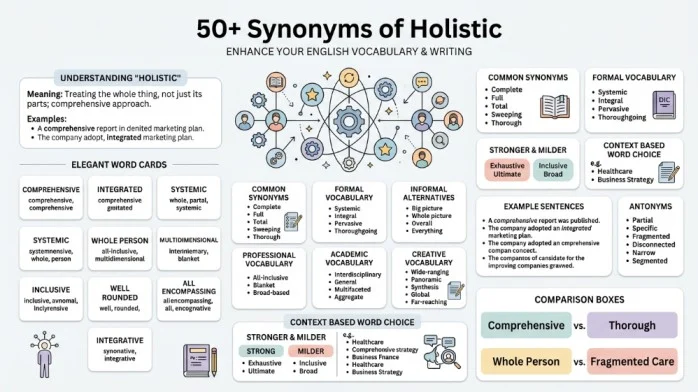
Synonyms of Holistic can make your writing more precise when you want to express the idea of considering something as a complete, interconnected whole. The right alternative depends on context. Words such as comprehensive, all-encompassing, integrated, and whole-person can carry similar meanings, but they are not always interchangeable. A professional report may need a different choice than a wellness article, academic paper, or everyday conversation.
Strong vocabulary is not just about collecting similar words. It is about understanding differences in meaning, tone, and usage. Synonyms of Holistic become especially useful when repeated wording makes your writing feel flat or when a more specific term can communicate your idea clearly. This guide explores accurate alternatives, subtle differences, practical examples, and context-based choices so you can write with greater clarity and confidence in 2026.
What Are the Best Synonyms of “Holistic”?
Holistic means considering a person, system, or problem as a complete whole rather than examining only separate parts. Common alternatives include comprehensive, integrated, whole person, all encompassing, multidimensional, systemic, inclusive, unified, and well rounded. The best choice depends on whether you are discussing health, education, business, research, personal development, or another field.
Meaning, Tone, and Context
Simple Definition
Holistic describes an approach that considers the whole of something, including how its different parts relate to and affect one another.
For example, a holistic approach to health does not focus only on a single symptom. It may consider physical health, emotional well being, lifestyle, environment, habits, and other relevant factors together.
The central idea is not simply “complete.” Holistic thinking often emphasizes relationships, connections, and the interaction of parts within a larger whole.
Part of Speech
Holistic is an adjective.
Examples:
- a holistic approach
- holistic care
- holistic education
- holistic treatment
- holistic development
- holistic assessment
- holistic strategy
Overall Tone
Holistic is generally neutral to positive.
It often has a thoughtful, comprehensive, and balanced tone. In professional and academic contexts, it can suggest that an issue is being considered from multiple connected perspectives.
Formality Level
Holistic is generally neutral to semi formal.
It works naturally in:
- Academic writing
- Healthcare discussions
- Business strategy
- Education
- Psychology
- Personal development
- Environmental studies
- Professional communication
- General informational writing
It can also appear in everyday conversations, although simpler alternatives such as whole person or looking at the whole picture may sound more conversational.
Common Uses
Native English speakers commonly use holistic in phrases such as:
- holistic approach
- holistic health
- holistic care
- holistic treatment
- holistic education
- holistic development
- holistic view
- holistic perspective
- holistic assessment
- holistic strategy
- holistic solution
- holistic understanding
The word is especially common when an issue has several connected dimensions.
Word Forms
The main related forms are:
- Adjective: holistic
- Noun: holism
- Adverb: holistically
Example:
“Researchers approached the problem holistically rather than focusing on one variable.”
When and How to Use “Holistic”
Use holistic when you want to emphasize that multiple parts of a person, problem, system, or situation should be considered together.
It is especially useful when a narrow or isolated approach would miss important relationships.
Professional
“Our company is developing a holistic strategy for improving employee performance.”
This works because the strategy considers more than one factor instead of focusing on a single workplace issue.
Academic
“The researchers adopted a holistic perspective when examining the effects of urban development.”
Here, holistic signals that the research considers several connected effects.
Workplace
“We need a holistic view of the customer’s experience before changing the service process.”
The word suggests looking at the complete customer journey rather than one isolated interaction.
Personal
“She takes a holistic approach to personal growth by focusing on her physical, emotional, and social well being.”
This is a natural use because personal development can involve several interconnected areas.
“We recommend taking a holistic approach before making a final decision.”
The word works well in professional email writing when a decision involves multiple factors.
Resume
“Developed a holistic training program covering technical, communication, and leadership skills.”
This demonstrates that the program addressed several connected areas rather than one skill alone.
Social Media
“A holistic approach to wellness can help people think beyond exercise and consider sleep, nutrition, stress, and daily habits.”
This use is accessible while retaining the broader meaning of the word.
Best Synonyms of “Holistic”
No synonym for holistic works perfectly in every situation. The word can refer to completeness, integration, interconnectedness, or consideration of multiple dimensions, so the best replacement depends on which meaning matters most.
Professional writing: Integrated
Integrated is often the strongest choice when different parts are deliberately combined into one coordinated system.
Example: “The company introduced an integrated approach to employee development.”
Academic writing: Comprehensive
Comprehensive works well when you mean broad coverage of a subject rather than specifically emphasizing relationships among its parts.
Example: “The study provides a comprehensive analysis of educational outcomes.”
Business communication: Systemic
Systemic is useful when a problem involves interconnected parts within a larger system.
Example: “The organization needs a systemic solution to its communication problems.”
Casual conversation: Whole picture
Whole picture is more conversational than holistic and clearly communicates the idea of considering all relevant factors.
Example: “Let’s look at the whole picture before we make a decision.”
Emotional writing: Whole person
Whole person works especially well when discussing health, personal development, or emotional well being.
Example: “The program supports the whole person, not just academic performance.”
Creative writing: All encompassing
All encompassing emphasizes breadth and the inclusion of many aspects.
Example: “She developed an all encompassing vision for the community.”
Resume writing: Integrated
Integrated sounds concise and professional on a resume.
Example: “Designed an integrated leadership development program.”
Workplace communication: Comprehensive
Comprehensive is useful when describing a complete review, plan, assessment, or strategy.
Example: “We conducted a comprehensive review of the customer experience.”
Stronger meaning: All encompassing
All encompassing can sound broader than holistic because it stresses the inclusion of virtually every relevant aspect.
Example: “The proposal offers an all encompassing framework for organizational improvement.”
Softer meaning: Well rounded
Well rounded suggests balanced development across several areas without necessarily implying a formal holistic philosophy.
Example: “The program is designed to create a well rounded learning experience.”
When Not to Use “Holistic”
Although holistic is useful, it is sometimes too broad or less precise than another word.
When the meaning is simply “complete”
If you only mean that something contains all the necessary parts, complete may be clearer.
Less precise:
“The report provides a holistic list of the requirements.”
Better:
“The report provides a complete list of the requirements.”
A list does not necessarily involve relationships among its parts, so complete is more accurate.
When the meaning is “detailed and thorough”
Use comprehensive or thorough when the focus is depth or coverage.
Less precise:
“We conducted a holistic review of the documents.”
Better:
“We conducted a comprehensive review of the documents.”
When the meaning is “combined into one system”
Use integrated when the important idea is coordination.
Less precise:
“The company created a holistic software system.”
Better:
“The company created an integrated software system.”
When the meaning is “affecting an entire system”
Use systemic when you are discussing relationships within a larger system.
Less precise:
“The organization has a holistic staffing problem.”
Better:
“The organization has a systemic staffing problem.”
When the audience may find the word vague
Some readers understand holistic differently depending on the field. If precision matters, explain exactly what the approach includes.
Instead of:
“We use a holistic strategy.”
Consider:
“We consider employee skills, workload, communication, leadership, and workplace culture together.”
The second version tells readers what “holistic” means in practice.
When a stronger technical word exists
Academic and professional writing often benefits from terminology that describes the exact relationship between components.
For example, multidimensional may be better when a study considers several dimensions, while integrated may be better when separate processes are combined.
Words Commonly Confused With “Holistic”
| Word | Difference | When to Use It | Example |
|---|---|---|---|
| Comprehensive | Focuses on broad coverage or completeness. | Reports, reviews, research. | “The report provides a comprehensive assessment.” |
| Integrated | Focuses on combining parts into a coordinated whole. | Business, technology, education. | “The school uses an integrated learning model.” |
| Systemic | Focuses on relationships within a larger system. | Organizations, social issues, research. | “The problem requires systemic reform.” |
| Inclusive | Emphasizes including people, groups, or perspectives. | Education, workplaces, communities. | “The company promotes an inclusive culture.” |
| Complete | Means nothing necessary is missing. | General communication. | “Please submit the complete application.” |
| Multidimensional | Emphasizes several dimensions or aspects. | Research, psychology, social sciences. | “The issue has a multidimensional impact.” |
Best Synonyms of “Holistic” by Context
| Context | Best Synonym | Why It Works | Example |
| Formal writing | Comprehensive | Clearly communicates broad coverage. | “The report presents a comprehensive evaluation.” |
| Academic writing | Multidimensional | Shows that several dimensions are considered. | “The study uses a multidimensional framework.” |
| Professional communication | Integrated | Emphasizes coordination between parts. | “We need an integrated approach to training.” |
| Business emails | Comprehensive | Sounds clear and professional. | “We completed a comprehensive review.” |
| Resume writing | Integrated | Concise and action oriented. | “Created an integrated development program.” |
| Workplace communication | Systemic | Useful for organization wide problems. | “The issue requires a systemic response.” |
| Casual conversation | Whole picture | Natural and easy to understand. | “We need to see the whole picture.” |
| Everyday speaking | Whole person | Natural when discussing personal care. | “The program supports the whole person.” |
| Creative writing | All encompassing | Adds breadth and expressive emphasis. | “He imagined an all encompassing vision.” |
| Storytelling | Complete | Simple and accessible. | “She wanted a complete understanding of what happened.” |
| Emotional writing | Whole person | Highlights multiple aspects of human experience. | “Healing should address the whole person.” |
| Strong emphasis | All encompassing | Suggests very broad coverage. | “The plan offers an all encompassing solution.” |
| Mild tone | Well rounded | Suggests balance without sounding technical. | “The course provides a well rounded education.” |
| Social media captions | Whole picture | Conversational and accessible. | “Sometimes you need to step back and see the whole picture.” |
| American English | Holistic | Commonly understood across many contexts. | “We take a holistic approach to wellness.” |
| British English | Holistic | The same core meaning is widely used. | “The school takes a holistic approach to education.” |
How to Choose the Best Synonym of “Holistic”
Choosing a synonym becomes easier when you identify the exact idea behind holistic.
If you mean broad coverage, choose “comprehensive.”
Use this for reports, reviews, guides, assessments, and research.
Example:
“We need a comprehensive evaluation of the program.”
If you mean connected parts working together, choose “integrated.”
Use this for business systems, healthcare plans, education programs, and technology.
Example:
“The hospital introduced an integrated care model.”
If you mean the interaction of parts within a larger system, choose “systemic.”
Use this for organizational, social, economic, or structural problems.
Example:
“The company needs a systemic approach to employee retention.”
If you mean several dimensions, choose “multidimensional.”
This is especially useful in academic writing.
Example:
“Leadership is a multidimensional concept.”
If you mean the person as a whole, choose “whole person.”
This works naturally in healthcare, wellness, education, and personal development.
Example:
“The program focuses on the whole person.”
If you mean a balanced range of qualities, choose “well rounded.”
This is especially natural for education, skills, and personal development.
Example:
“The course prepares students for a well rounded professional career.”
If you mean nearly every relevant aspect, choose “all encompassing.”
Use it when you want strong emphasis on breadth.
Example:
“The organization developed an all encompassing plan for change.”
The key is to avoid replacing holistic mechanically. First identify whether you mean complete, integrated, systemic, broad, balanced, or multidimensional.
Real Life Examples of “Holistic”
School
Original:
“The school uses a holistic approach to student development.”
Improved:
“The school takes a well rounded approach to student development by supporting academic, social, and personal growth.”
College
Original:
“The university promotes holistic learning.”
Improved:
“The university promotes integrated learning that connects classroom knowledge with practical experience.”
Workplace
Original:
“Managers need a holistic understanding of employee performance.”
Improved:
“Managers need a comprehensive understanding of employee performance, including skills, workload, communication, and engagement.”
Business
Original:
“The company needs a holistic strategy.”
Improved:
“The company needs an integrated strategy that connects marketing, sales, customer service, and product development.”
Original:
“We should take a holistic approach before approving the proposal.”
Improved:
“We should take a comprehensive approach before approving the proposal.”
Resume
Original:
“Created holistic training programs.”
Improved:
“Created integrated training programs covering technical, communication, and leadership skills.”
Conversation
Original:
“I believe in a holistic approach to health.”
More conversational:
“I believe in looking at the whole person when it comes to health.”
Storytelling
Original:
“She wanted a holistic understanding of her family’s history.”
More expressive:
“She wanted a complete understanding of the people, places, and experiences that shaped her family.”
Blogging
Original:
“A holistic approach to productivity can improve your routine.”
Improved:
“A well rounded approach to productivity considers sleep, planning, energy, habits, and work environment.”
Social Media
Original:
“Holistic wellness is about more than exercise.”
More accessible:
“Wellness is about the whole picture, including movement, sleep, nutrition, relationships, and mental well being.”
20 Best Synonyms of “Holistic”
| Synonym | Simple Meaning | Best Used For | Example Sentence |
| Comprehensive | Covering many or all relevant aspects | Reports, research, professional writing | “The team completed a comprehensive assessment.” |
| Integrated | Combining parts into one coordinated whole | Business, education, healthcare | “The clinic offers an integrated care program.” |
| All encompassing | Including nearly every relevant aspect | Formal and creative writing | “The proposal presents an all encompassing strategy.” |
| Whole person | Considering the complete individual | Health, wellness, education | “The program supports the whole person.” |
| Systemic | Relating to an entire interconnected system | Business, social issues, research | “The organization needs a systemic solution.” |
| Multidimensional | Involving several different dimensions | Academic writing, psychology | “The issue requires a multidimensional analysis.” |
| Inclusive | Incorporating different people or perspectives | Education, business, communities | “The policy promotes an inclusive approach.” |
| Unified | Bringing different elements together | Organizations, strategy, communication | “The company developed a unified vision.” |
| Well rounded | Balanced across several areas | Education, personal development | “The course provides a well rounded education.” |
| Broad based | Built on a wide range of factors | Education, policy, business | “The initiative uses a broad based strategy.” |
| Wide ranging | Covering many subjects or areas | Reports, discussions, research | “The panel held a wide ranging discussion.” |
| Complete | Containing all necessary parts | General communication | “We need a complete understanding of the situation.” |
| Total | Relating to the whole rather than one part | General and formal contexts | “The project requires a total review of its processes.” |
| Thorough | Detailed and careful | Reviews, investigations, assessments | “The team conducted a thorough evaluation.” |
| Fundamental | Relating to essential underlying parts | Academic and professional writing | “The course develops a fundamental understanding of the subject.” |
| Interconnected | Emphasizing relationships between parts | Research, systems, social topics | “The study examines interconnected environmental factors.” |
| Integrative | Combining different approaches or perspectives | Academic, healthcare, professional | “The program uses an integrative model of care.” |
| Global | Considering the whole rather than isolated elements | Business, policy, broad analysis | “The report offers a global view of the issue.” |
| Panoramic | Providing a broad view of many aspects | Creative and descriptive writing | “The book gives a panoramic view of modern society.” |
| Ecological | Considering relationships between organisms and their environment | Environmental and health contexts | “The researchers developed an ecological model of community health.” |
Synonyms of “Holistic” by Usage
Professional vs Personal Synonyms
Professional writing often requires precision, while personal writing benefits from language that feels natural and relatable.
For professional communication, integrated, comprehensive, systemic, and multidimensional are usually stronger choices.
Example:
“The company needs an integrated approach to employee development.”
For personal communication, whole person, whole picture, and well rounded may sound more accessible.
Example:
“Taking care of yourself means looking at the whole picture, not just exercise.”
Formal vs Conversational Synonyms
- For reports and academic documents, choose comprehensive, integrated, systemic, or multidimensional when those words accurately describe the intended meaning.
- For business presentations, integrated and comprehensive are especially useful.
- For professional emails, comprehensive often sounds natural because it clearly communicates broad coverage.
- For casual conversations and texting, phrases such as whole picture or whole person are easier for most readers to understand.
Academic Synonyms
Academic writing benefits from precise alternatives rather than simply replacing holistic with another broad word.
Comprehensive is useful when research covers a wide range of relevant information.
Multidimensional works when a topic has several distinct dimensions.
Systemic is appropriate when different elements interact within a larger system.
Integrative works when researchers combine different methods, perspectives, or areas of knowledge.
Examples:
“The researchers conducted a comprehensive review of existing literature.”
“The problem has a multidimensional social and economic impact.”
“The researchers used an integrative framework to connect the findings.”
These choices sound more precise because each word tells the reader something about the nature of the approach.
Professional and Business Synonyms
Resumes
Use integrated, comprehensive, or multidimensional when describing programs, strategies, or responsibilities.
“Designed an integrated employee development program.”
Interviews
Use clear language rather than unnecessarily complex vocabulary.
“I take a comprehensive approach to solving customer problems.”
Meetings
Use integrated or systemic when discussing connected business issues.
“We need a systemic solution rather than another short term fix.”
Presentations
Use comprehensive when explaining broad coverage.
“This presentation provides a comprehensive overview of the new strategy.”
Performance Reviews
Use well rounded or comprehensive when discussing several dimensions of performance.
“We use a comprehensive assessment that considers results, communication, teamwork, and leadership.”
Client Communication
Use integrated when multiple services or processes work together.
“We offer an integrated solution that addresses the client’s operational needs.”
Business Emails
Use comprehensive when requesting or describing a complete review.
“Please provide a comprehensive assessment before the meeting.”
Creative and Literary Synonyms
Creative writing can use more expressive alternatives when the goal is to create a broad sense of experience.
All encompassing can create a sense of enormous scope.
“She felt an all encompassing sense of gratitude.”
Panoramic suggests a broad view and can work well in descriptive prose.
“The novel offers a panoramic view of life in the city.”
Complete is simpler and works when a character wants to understand every part of an experience.
“He searched for a complete explanation of what had happened.”
Whole person can add emotional depth when writing about identity, healing, or personal growth.
“The story was about learning to accept the whole person, not just the successful version everyone admired.”
Slang or Modern Synonyms
There is no widely accepted slang word that is a true synonym for holistic.
In casual modern English, people may use phrases such as the whole picture, the whole thing, or looking at everything together. These are conversational alternatives rather than direct lexical synonyms.
Whole picture
Meaning: considering all relevant factors.
Acceptable in: conversations, social media, blogs, informal presentations.
Avoid in: highly formal academic or technical writing when a more precise term is needed.
Example:
“We need to see the whole picture before deciding.”
Strongest to Mildest Synonyms
The intensity of holistic synonyms depends less on emotional strength and more on the breadth and precision they communicate.
| Level | Word or Phrase | Main Effect |
| Mild | Well rounded | Suggests balanced coverage. |
| Mild | Broad based | Suggests several areas are included. |
| Moderate | Comprehensive | Suggests wide and thorough coverage. |
| Moderate | Integrated | Highlights connected parts working together. |
| Strong | Multidimensional | Emphasizes several distinct dimensions. |
| Strong | Systemic | Highlights interconnected elements within a larger system. |
| Very Strong | All encompassing | Suggests exceptionally broad inclusion. |
The strongest option is not always the best option. In professional writing, precision is usually more valuable than choosing the most dramatic sounding alternative.
Emotional vs Neutral Synonyms
Emotional Synonyms
Some alternatives can create a warmer or more personal feeling.
Whole person works well when discussing human identity, care, and personal development.
Well rounded can suggest balanced growth.
All encompassing can add emotional intensity when describing feelings or experiences.
Complete can communicate a desire for full understanding.
Examples:
“She wanted to support the whole person, not simply treat one problem.”
“The experience gave him a complete sense of belonging.”
Neutral Synonyms
For objective communication, use words such as:
- Comprehensive
- Integrated
- Systemic
- Multidimensional
- Inclusive
- Broad based
- Thorough
Examples:
“The researchers conducted a comprehensive review.”
“The company adopted an integrated strategy.”
These words focus on the structure or scope of an approach rather than adding strong emotional meaning.
Antonyms of “Holistic”
Because holistic describes an approach that considers the whole and the relationships among its parts, its opposites are often words or phrases that emphasize narrowness, separation, or isolated components.
| Antonym | Meaning | Example Sentence |
| Narrow | Limited in scope | “The report takes a narrow view of the problem.” |
| Limited | Restricted to certain areas | “The study has a limited focus.” |
| Partial | Covers only part of something | “The explanation provides a partial picture.” |
| Fragmented | Divided into disconnected parts | “The healthcare system remains fragmented.” |
| Isolated | Considered separately from other factors | “The variable should not be studied in isolation.” |
| Specialized | Focused on one specific area | “The clinic provides specialized treatment.” |
| Singular | Focused on one element or perspective | “The policy takes a singular approach.” |
| Specific | Concentrated on one defined matter | “The report addresses a specific issue.” |
| Selective | Including only chosen elements | “The analysis uses a selective set of data.” |
| Incomplete | Missing necessary parts | “The assessment is incomplete.” |
| Disconnected | Lacking meaningful relationships | “The recommendations seem disconnected from the evidence.” |
| Compartmentalized | Divided into separate categories | “The department uses a compartmentalized structure.” |
| One dimensional | Lacking multiple perspectives | “The article presents a one dimensional explanation.” |
| Reductionist | Explaining a complex issue by reducing it to simpler parts | “A reductionist approach may overlook social factors.” |
| Piecemeal | Done in separate small parts rather than as a whole | “The company addressed the problem in a piecemeal way.” |
Comparison: “Holistic” vs Similar Words
Holistic vs Comprehensive
Main Difference
Holistic emphasizes the whole and the connections among its parts. Comprehensive emphasizes broad or complete coverage.
Which Is Stronger?
Neither is automatically stronger. They emphasize different ideas.
Which Is More Formal?
Both are appropriate in formal writing, but comprehensive is often more straightforward in reports and academic documents.
When to Use Each
Use holistic when relationships among parts matter.
Use comprehensive when you want to show that many or all relevant areas have been covered.
Examples
Holistic:
“The clinic takes a holistic approach to patient care.”
Comprehensive:
“The clinic provides a comprehensive health assessment.”
Holistic vs Integrated
Main Difference
Holistic focuses on the whole system or person. Integrated focuses on combining separate parts or services so they work together.
Which Is Stronger?
Neither is inherently stronger.
Which Is More Formal?
Both are suitable for professional and academic writing.
When to Use Each
Use integrated when coordination is the key idea.
Examples
Holistic:
“The program takes a holistic approach to student development.”
Integrated:
“The program uses an integrated curriculum.”
Holistic vs Systemic
Main Difference
Holistic considers the whole. Systemic specifically emphasizes how parts interact within a larger system.
Which Is Stronger?
Systemic can be more precise when discussing structural problems.
Which Is More Formal?
Systemic is common in academic, organizational, social science, and professional writing.
When to Use Each
Use systemic for problems that arise from relationships or structures within a system.
Examples
Holistic:
“We need a holistic approach to employee well being.”
Systemic:
“The company has a systemic problem with communication.”
Holistic vs Inclusive
Main Difference
Holistic means considering the whole. Inclusive means making sure different people, groups, perspectives, or elements are included.
Which Is Stronger?
Neither is stronger.
Which Is More Formal?
Both are widely used in professional and academic writing.
When to Use Each
Use inclusive when participation or representation matters.
Examples
Holistic:
“The program takes a holistic approach to education.”
Inclusive:
“The program uses an inclusive teaching model.”
Holistic vs Complete
Main Difference
Complete means nothing necessary is missing. Holistic suggests considering the whole and the relationships among its parts.
Which Is Stronger?
Neither.
Which Is More Formal?
Complete is simpler and works across almost all levels of formality.
When to Use Each
Use complete when you mean all necessary parts are present.
Examples
Holistic:
“We need a holistic understanding of the issue.”
Complete:
“We need a complete record of the transactions.”
Holistic vs Multidimensional
Main Difference
Holistic emphasizes the whole and its interconnected parts. Multidimensional emphasizes that something has several distinct dimensions.
Which Is Stronger?
Multidimensional can sound more technical and precise.
Which Is More Formal?
Multidimensional is especially useful in academic and research contexts.
When to Use Each
Use multidimensional when the number or variety of dimensions matters.
Examples
Holistic:
“The organization needs a holistic approach to employee development.”
Multidimensional:
“Employee performance is a multidimensional concept.”
Common Phrases and Expressions with “Holistic”
Phrase: Holistic Approach
Meaning
A way of dealing with something by considering its different parts and their relationships as a whole.
Example Sentence
“The organization adopted a holistic approach to workplace wellness.”
Phrase: Holistic Health
Meaning
An approach to health that considers several dimensions of a person’s well being rather than focusing only on one symptom or condition.
Example Sentence
“She became interested in holistic health after changing her daily routine.”
Phrase: Holistic Care
Meaning
Care that considers the broader needs of a person rather than focusing only on one immediate issue.
Example Sentence
“The hospital aims to provide holistic care for patients and their families.”
Phrase: Holistic Development
Meaning
Development that considers multiple areas such as intellectual, emotional, social, physical, or professional growth.
Example Sentence
“The school emphasizes holistic development rather than grades alone.”
Phrase: Holistic Education
Meaning
An educational approach that considers the learner’s broader development.
Example Sentence
“The program promotes holistic education through academic and practical learning.”
Phrase: Holistic Perspective
Meaning
A viewpoint that considers a subject as a complete and connected whole.
Example Sentence
“Researchers used a holistic perspective when evaluating the community.”
Phrase: Holistic Strategy
Meaning
A strategy that addresses several connected factors instead of concentrating on one area.
Example Sentence
“The company developed a holistic strategy for improving customer experience.”
Phrase: Holistic Assessment
Meaning
An evaluation that considers multiple aspects rather than relying on a single measurement.
Example Sentence
“The school uses holistic assessment to evaluate student progress.”
Common Mistakes to Avoid
Mistake 1: Treating Every Synonym as Identical
Incorrect
“The words holistic and comprehensive always mean exactly the same thing.”
Better
“Holistic and comprehensive overlap, but they emphasize different ideas.”
Why
Comprehensive focuses on broad coverage, while holistic often emphasizes relationships among parts.
Mistake 2: Using “Holistic” When You Only Mean “Complete”
Incorrect
“Please send me a holistic copy of the contract.”
Better
“Please send me a complete copy of the contract.”
Why
A document can be complete without involving a whole system or interconnected perspective.
Mistake 3: Using Informal Language in Formal Writing
Incorrect
“The report looks at the whole picture of the economy.”
Better
“The report provides a comprehensive analysis of the economy.”
Why
The informal phrase is understandable, but comprehensive sounds more appropriate for formal analytical writing.
Mistake 4: Choosing “Systemic” Without a System
Incorrect
“We used a systemic approach to choosing a birthday gift.”
Better
“We used a comprehensive approach to choosing a birthday gift.”
Why
Systemic is best when the subject involves relationships within a larger system.
Mistake 5: Overusing “Holistic”
Incorrect
“We need a holistic plan, a holistic review, and a holistic strategy.”
Better
“We need a comprehensive plan, an integrated review process, and a systemic strategy.”
Why
Different alternatives can communicate the specific meaning more clearly and prevent repetition.
Mistake 6: Using “Inclusive” as a Universal Synonym
Incorrect
“Inclusive means the same thing as holistic.”
Better
“Inclusive emphasizes participation or representation, while holistic emphasizes the whole and its interconnected parts.”
Why
The words overlap in some contexts but are not interchangeable.
Mistake 7: Using a Strong Word Without Checking Its Meaning
Incorrect
“The company needs an all encompassing solution to fix one small scheduling problem.”
Better
“The company needs a specific solution to address the scheduling problem.”
Why
All encompassing suggests a very broad approach. A narrow problem may require a focused solution instead.
Frequently Asked Questions
What is a good holistic synonym?
A good holistic synonym is comprehensive, meaning it considers all important parts of something as a whole.
What are the synonyms of holistic?
Common synonyms of holistic include comprehensive, whole, integrated, complete, all-inclusive, and broad-based.
What is another synonym for holistic?
Integrated is a useful synonym for holistic, especially when different parts are considered together as one connected system.
What is a synonym for holistic thinking?
Big-picture or integrated can work as a synonym for holistic thinking, depending on the context.
What is a holistically synonym?
Useful alternatives for holistically include comprehensively, collectively, integratively, and as a whole.
What can I find in a holistic thesaurus?
A holistic thesaurus typically provides related words such as comprehensive, integrated, inclusive, complete, and whole-system.
What is a holistic development synonym?
Well-rounded development is a strong holistic development synonym because it describes growth across multiple areas rather than just one.
What are the holistic antonyms?
Common holistic antonyms include partial, narrow, limited, fragmented, and isolated.
What are the antonyms of holistic?
The antonyms of holistic generally describe approaches that focus on only one part, such as partial, specific, fragmented, or narrow.
What are the best synonyms of “holistic”?
The best synonyms of holistic include comprehensive, integrated, systemic, whole person, multidimensional, inclusive, well rounded, all encompassing, and integrative. The ideal choice depends on whether you mean breadth, connection, balance, or multiple perspectives.
What are the best formal synonyms of “holistic”?
The strongest formal alternatives include comprehensive, integrated, systemic, multidimensional, integrative, and all encompassing. Choose based on meaning: comprehensive emphasizes coverage, integrated emphasizes coordination, and systemic emphasizes relationships within a larger system.
What are common informal synonyms of “holistic”?
Common conversational alternatives include whole picture, whole person, and looking at everything together. These phrases are easier to understand in everyday speech but may be less suitable than precise terms in academic or technical writing.
What is another word for “holistic” in professional writing?
Integrated is often an excellent professional alternative to holistic when separate areas are intentionally combined. Comprehensive is better when the main idea is broad coverage, while systemic works when interconnected organizational problems are being discussed.
What is the difference between “holistic” and “comprehensive”?
Holistic emphasizes considering a whole and the relationships among its parts. Comprehensive emphasizes covering a broad range of relevant information or elements. A holistic approach can be comprehensive, but the two words do not always mean exactly the same thing.
What is the opposite of “holistic”?
Common opposites include narrow, partial, fragmented, isolated, limited, incomplete, compartmentalized, reductionist, and one dimensional. The best antonym depends on whether you mean limited scope, separated parts, or excessive focus on one element.
Conclusion
The word holistic describes an approach that considers a person, problem, or system as a whole while paying attention to the relationships among its parts. It is useful across healthcare, education, business, research, personal development, and many other areas.
The best alternative depends on the intended meaning. Choose comprehensive for broad coverage, integrated for coordinated parts, systemic for interconnected systems, multidimensional for several dimensions, and whole person when discussing the complete individual. For more conversational writing, whole picture and well rounded can sound more natural.
There is no single replacement that works perfectly in every sentence. When choosing among the synonyms of holistic, consider your audience, tone, purpose, and the exact relationship you want the reader to understand. A useful vocabulary habit is to identify the specific meaning behind a word before replacing it with a synonym.
Read More Related Articles:
- 50+ Synonyms of Because | Meanings, Uses, Examples, and …
- 50+ Synonyms of The | Meanings, Uses, Examples, and Best …