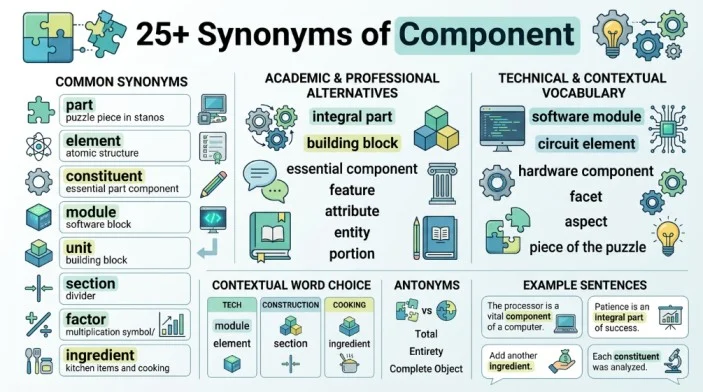
Writers often use the word component repeatedly when describing technology, machines, systems, projects, or larger structures. In an essay, technical report, product description, or business document, using the same word again and again can make otherwise clear writing feel repetitive.
Knowing the right synonym of component gives you more control over meaning and tone. Words such as part, element, constituent, module, and ingredient can all describe something that contributes to a larger whole, but they are not interchangeable in every situation. The best choice depends on what you are describing and how precise your writing needs to be.
What Are the Best Synonyms of “Component”?
A component is one part of a larger system, object, structure, or whole. The best synonyms include part, element, constituent, section, unit, module, ingredient, factor, piece, and building block. Use constituent for formal writing, module for technology, ingredient for mixtures, and part for everyday communication.
Meaning, Tone, and Context
Simple Definition
A component is one individual part that contributes to a larger whole. The larger whole may be a machine, system, product, organization, plan, mixture, or process.
For example, a battery is a component of an electric vehicle, while a lesson can be a component of a course. In both cases, the component has a relationship with something larger.
Part of Speech
Component is primarily a noun.
It can also function as an adjective in technical contexts, especially when describing something related to components.
Noun:
“The processor is an important component of the computer.”
Adjective:
“The component manufacturer supplied replacement parts.”
Overall Tone
The word component has a neutral tone.
It does not normally express positive or negative emotion. Instead, it describes how one part relates to a larger structure, system, or whole.
Formality Level
Component is generally neutral to formal.
It is especially common in:
- Technical writing
- Engineering
- Science
- Business
- Software development
- Manufacturing
- Academic writing
- Product documentation
- Professional communication
In casual conversation, part is often more natural.
Common Uses
Native English speakers commonly use component when discussing:
- Computer components
- Mechanical components
- Electronic components
- Software components
- System components
- Business components
- Project components
- Educational components
- Chemical components
- Design components
- Product components
- Infrastructure components
Word Forms
| Form | Example |
|---|---|
| Noun | component |
| Plural noun | components |
| Related noun | componentry, in specialized usage |
| Related phrase | component part |
The most useful everyday form is simply component.
When and How to Use “Component”
Use component when you want to emphasize that something forms part of a larger system or structure.
It is especially useful when the relationship between the smaller part and the larger whole matters. This is why the word appears frequently in technical, academic, business, and professional writing.
Professional
“The training program includes a leadership component.”
Here, component shows that leadership is one part of a broader training program.
Academic
“Language is an important component of cultural identity.”
The word works well because the sentence describes one element within a larger concept.
Workplace
“Communication is a key component of effective teamwork.”
This sounds natural in professional communication because it identifies communication as one part of a larger process.
Personal
“Trust is an important component of a healthy relationship.”
Although component is somewhat formal for casual speech, it can work when the speaker wants a thoughtful or analytical tone.
“The revised proposal includes a new cost component.”
This is appropriate for a professional email discussing the parts of a proposal.
Resume
“Managed the technical component of a large software project.”
The word works well on a resume because it clearly identifies a specific area of responsibility.
Social Media
“Good planning is a major component of any successful launch.”
For social media, component can work in educational or professional content, although part may sound more conversational.
Best Synonyms of “Component”
No single synonym of component works perfectly in every sentence. The word you choose should reflect whether you mean a physical part, an abstract element, a technical module, a contributing factor, or one section of a larger structure.
Professional Writing: Constituent
Constituent is a strong choice when discussing something that forms part of a larger whole.
Example:
“Each constituent of the system must be tested independently.”
It has a formal, precise tone and works particularly well in technical and academic contexts.
Academic Writing: Element
Element is one of the most flexible alternatives because it can describe both physical and abstract parts.
Example:
“Trust is a central element of effective leadership.”
It works especially well when the subject is an idea, quality, or concept rather than a physical object.
Business Communication: Factor
Use factor when the component contributes to an outcome rather than simply forming a physical part.
Example:
“Customer satisfaction is a major factor in long term retention.”
This is better than component when you are discussing influence or causation.
Casual Conversation: Part
Part is usually the most natural everyday alternative.
Example:
“The battery is a major part of the system.”
It is simple, familiar, and rarely sounds overly technical.
Emotional Writing: Element
Element often sounds more natural than component when discussing relationships, emotions, or personal experiences.
Example:
“Hope became an important element of her recovery.”
Creative Writing: Ingredient
Ingredient can be used figuratively when describing qualities that combine to create a result.
Example:
“Patience was an essential ingredient in their success.”
It adds a more expressive quality than the technical word component.
Resume Writing: Module
Module is useful when describing a distinct section of a software system, training program, or structured project.
Example:
“Developed a reporting module for the company’s internal platform.”
It tells the reader that the item was a defined, functional section.
Workplace Communication: Unit
Unit works when the component functions as a distinct, identifiable part of a larger system.
Example:
“The testing unit was responsible for quality assurance.”
Stronger Meaning: Integral Part
Integral part emphasizes that something is necessary to the identity or functioning of the whole.
Example:
“Data security is an integral part of modern software development.”
Softer Meaning: Part
When you simply want to say that something belongs to a larger whole without suggesting special importance, part is the safest choice.
Example:
“The final report contains a separate section for recommendations.”
When Not to Use “Component”
Although component is versatile, it can sound unnatural when a simpler or more specific word communicates the idea better.
When It Sounds Too General
If you know exactly what kind of part you mean, component may hide useful information.
Less Effective:
“The car has an important component for safety.”
Better:
“The car has an important braking system for safety.”
The more specific term gives the reader clearer information.
When It Sounds Too Technical
In casual conversation, component can sound more formal than necessary.
Less Natural:
“The refrigerator has a damaged cooling component.”
More Natural:
“The refrigerator has a damaged part.”
Part is simpler and more conversational.
When You Mean Influence Rather Than Structure
Sometimes people use component when they really mean a factor that affects an outcome.
Less Precise:
“Price is a major component of customer choice.”
Better:
“Price is a major factor in customer choice.”
Factor focuses on influence rather than membership within a system.
When You Mean a Physical Section
If you are referring to a simple physical piece, part may be clearer.
Less Natural:
“This component needs to be replaced.”
Better:
“This part needs to be replaced.”
The second sentence sounds more natural in everyday speech.
When You Mean a Software Section
In software discussions, module may communicate the structure more precisely.
Less Precise:
“The application contains several components.”
More Specific:
“The application contains several modules.”
A module generally suggests a distinct functional section of a software system.
When You Mean a Mixture
For food, chemistry, or figurative mixtures, ingredient may be the better choice.
Less Natural:
“Flour is an important component of the recipe.”
Better:
“Flour is an important ingredient in the recipe.”
When You Mean a Section of a Document
If you are discussing a report, article, or form, section can be more precise.
Less Natural:
“The introduction is an important component of the report.”
Better:
“The introduction is an important section of the report.”
Words Commonly Confused With “Component”
Part
Difference:
Part is the broadest and most everyday term. Component often suggests a functional role within a system.
When to Use It:
Use part when simplicity matters or when describing an ordinary physical piece.
Example:
“The mechanic replaced the damaged part.”
Element
Difference:
Element can describe both physical and abstract features. It often focuses on one feature that contributes to a whole.
When to Use It:
Use it for ideas, qualities, systems, designs, and concepts.
Example:
“Trust is an important element of a successful partnership.”
Constituent
Difference:
Constituent emphasizes that something forms part of a larger whole.
When to Use It:
Use it in formal, academic, scientific, or technical writing.
Example:
“Water is a major constituent of the human body.”
Module
Difference:
A module is usually a self contained or clearly defined functional section of a larger system.
When to Use It:
Use it frequently in software, education, engineering, and structured programs.
Example:
“The developer created a new payment module.”
Ingredient
Difference:
Ingredient traditionally refers to something used to create a mixture or result. It is also common as a metaphor.
When to Use It:
Use it for recipes, mixtures, formulas, and figurative combinations.
Example:
“Creativity is an important ingredient in good design.”
Factor
Difference:
A factor contributes to a result or influences an outcome. It does not necessarily form a physical or structural part.
When to Use It:
Use it when discussing causes, influences, decisions, or results.
Example:
“Cost was a major factor in the final decision.”
Best Synonyms of “Component” by Context
| Context | Best Synonym | Why It Works | Example |
|---|---|---|---|
| Formal writing | Constituent | Precise and formal | Each constituent contributes to the final structure. |
| Academic writing | Element | Works for abstract and concrete ideas | Trust is a central element of cooperation. |
| Professional communication | Component | Neutral and precise | Security is a core component of the platform. |
| Business emails | Part | Clear and accessible | This part of the proposal needs revision. |
| Resume writing | Module | Shows a defined functional area | Developed a new software module. |
| Workplace communication | Unit | Identifies a distinct working section | The testing unit handles quality control. |
| Casual conversation | Part | Simple and natural | This is an important part of the machine. |
| Everyday speaking | Piece | Informal and familiar | I need a replacement piece for the device. |
| Creative writing | Ingredient | Adds figurative meaning | Courage was an essential ingredient in her success. |
| Storytelling | Element | Works well for abstract ideas | Mystery was a central element of the story. |
| Emotional writing | Element | Sounds reflective and natural | Hope remained an important element of his life. |
| Strong emphasis | Integral part | Shows necessity | Trust is an integral part of the relationship. |
| Mild tone | Part | Neutral and uncomplicated | This is simply one part of the process. |
| Social media captions | Part | Conversational and accessible | Planning is a big part of success. |
| American English | Part | Common everyday usage | Replace the broken part. |
| British English | Part | Also standard and natural | The engineer replaced the damaged part. |
How to Choose the Best Synonym of “Component”
Choosing the right alternative starts with identifying what component means in your particular sentence.
1. Consider the Meaning
Ask whether you mean a physical part, an abstract element, a contributing influence, or a technical section.
- Physical object: part
- Abstract feature: element
- Influence on an outcome: factor
- Software section: module
- Mixture or figurative combination: ingredient
- Formal constituent: constituent
2. Consider the Tone
- For everyday communication, part usually sounds better than component.
- For technical writing, component and module may be more appropriate.
- For formal academic writing, constituent or element can provide greater precision.
3. Consider Your Audience
A software engineer may immediately understand module or component. A general reader may understand part more easily.
The best synonym is not necessarily the most sophisticated word. It is the word your intended reader can understand quickly and accurately.
4. Consider Emotional Strength
Part is generally neutral.
Element can sound thoughtful or analytical.
Ingredient can add warmth or creativity.
Integral part creates stronger emphasis by suggesting necessity.
5. Consider Your Writing Purpose
- For a technical manual, use component or module.
- For an academic essay, consider element or constituent.
- For a business report, factor, element, or component may work depending on the meaning.
- For casual conversation, choose part or piece.
6. Check Natural Usage
A synonym should fit the sentence naturally.
For example:
“Patience is an important ingredient in a successful relationship.”
This sounds natural because ingredient is being used figuratively.
“Patience is an important machine part in a successful relationship.”
This does not work because the physical meaning of part conflicts with the abstract subject.
7. Do Not Choose a Word Simply Because It Sounds More Advanced
Sophisticated vocabulary is useful only when it improves precision.
Replacing component with constituent does not automatically make a sentence better. If the audience expects simple language, part may be the stronger choice.
Real Life Examples of “Component”
School
Original:
“Vocabulary is an important component of language learning.”
Alternative:
“Vocabulary is an important element of language learning.”
Element sounds natural because vocabulary is an abstract part of a broader process.
College
Original:
“Research is a major component of the assignment.”
Alternative:
“Research is a major part of the assignment.”
For general academic writing, part is perfectly clear, while component gives the sentence a more formal tone.
Workplace
Original:
“Training is an essential component of employee development.”
Alternative:
“Training is an essential element of employee development.”
Both work, but element may sound smoother when discussing an abstract development process.
Business
Original:
“Pricing is an important component of our marketing strategy.”
Alternative:
“Pricing is a key factor in our marketing strategy.”
Use factor when pricing is being discussed as something that influences results.
Original:
“The proposal contains a new cost component.”
Alternative:
“The proposal contains a new cost section.”
Use section when the reference is specifically to a documented part of the proposal.
Resume
Original:
“Managed the software component of the project.”
Alternative:
“Managed the software module within the project.”
Module provides more technical detail and may better communicate a defined software responsibility.
Conversation
Original:
“The engine component needs to be replaced.”
Alternative:
“The engine part needs to be replaced.”
Part sounds more natural in ordinary conversation.
Storytelling
Original:
“Fear was a major component of the character’s decision.”
Alternative:
“Fear was a powerful element in the character’s decision.”
Element creates a more literary and analytical tone.
Blogging
Original:
“Consistency is an important component of successful blogging.”
Alternative:
“Consistency is a key element of successful blogging.”
The alternative avoids repetition while preserving the original meaning.
Social Media
Original:
“Good planning is a major component of a successful event.”
Alternative:
“Good planning is a major part of a successful event.”
The simpler version is more conversational and social media friendly.
25 Best Synonyms of “Component”
| Synonym | Simple Meaning | Best Used For | Example Sentence |
|---|---|---|---|
| Part | A piece of a larger whole | Everyday English | This part needs to be replaced. |
| Element | One feature or part of a whole | Academic and abstract writing | Trust is an important element of teamwork. |
| Constituent | Something that forms part of a whole | Formal and technical writing | Each constituent contributes to the final structure. |
| Unit | A distinct individual part | Organizations and systems | The testing unit handles quality control. |
| Module | A separate functional section | Software and education | The course includes a practical module. |
| Section | A defined portion of something | Documents and structures | Read the final section of the report. |
| Segment | One portion of a larger whole | Markets, systems, and structures | The company serves a growing market segment. |
| Piece | An individual part or item | Informal conversation | I need a replacement piece for the device. |
| Factor | Something that contributes to an outcome | Analysis and decision making | Cost was a major factor in the decision. |
| Ingredient | Something that contributes to a result | Recipes and figurative writing | Patience is an essential ingredient in success. |
| Building block | A basic part used to create something larger | Education and conceptual writing | Communication is a basic building block of teamwork. |
| Feature | A distinct part or characteristic | Products and software | Security is a useful feature of the platform. |
| Item | An individual thing within a collection | Lists and inventories | Each item is checked before shipment. |
| Member | An individual part of a group | Organizations and systems | Each member plays a role in the team. |
| Portion | A part or share of something larger | Quantities and general description | A large portion of the budget goes to research. |
| Division | A separate part of a larger organization or structure | Business and administration | The sales division expanded rapidly. |
| Subsection | A smaller section within a larger section | Documents and academic writing | The subsection explains the research method. |
| Segment | A distinct part of a larger category | Business and markets | This segment targets younger consumers. |
| Assembly | A collection of parts forming a whole | Engineering and manufacturing | The assembly must be inspected before installation. |
| Structure | An organized arrangement of parts | Systems and organizations | The structure contains several interconnected sections. |
| Aspect | One side or feature of something | Abstract subjects | Cost is one important aspect of the proposal. |
| Constituent part | A part that forms a larger whole | Formal writing | Each constituent part must meet the required standard. |
| Integral part | A necessary part of something | Strong emphasis | Communication is an integral part of effective leadership. |
| Core element | A central and important part | Business and academic writing | Innovation is a core element of the company’s strategy. |
| Key part | A particularly important section | Professional and general writing | Customer service is a key part of the business. |
Synonyms of “Component” by Usage
Professional vs Personal Synonyms
Professional writing often benefits from component, constituent, module, element, and factor because these terms can communicate structure or function precisely.
Personal communication usually sounds more natural with part, piece, or element.
Professional:
“Security is a critical component of the system.”
Personal:
“Trust is a big part of a healthy friendship.”
The second sentence sounds more natural because everyday communication generally favors familiar words.
Formal vs Conversational Synonyms
- For reports and academic essays, use constituent, element, factor, or component when their meanings fit.
- For business presentations and emails, component, element, key part, or module can work.
- For casual conversation and texting, part and piece are usually easier and more natural.
Academic Synonyms
Academic writing benefits from precise alternatives rather than unnecessary complexity.
Element is useful when discussing concepts or qualities.
Constituent is useful when something literally forms a larger whole.
Factor is better when something influences a result.
Aspect works when discussing one side or dimension of an issue.
Building block is useful when explaining foundational ideas in an accessible way.
Professional and Business Synonyms
For resumes, choose words that clearly describe responsibility.
Module works well for software or structured training.
Unit can describe a defined operational section.
Key part works when simplicity is preferred.
Component remains useful when describing technical responsibility.
For interviews and performance reviews, element, factor, and integral part can help explain contributions without sounding repetitive.
For client communication, part may be preferable when the audience is not technical.
Creative and Literary Synonyms
Creative writing allows more expressive alternatives.
Ingredient can describe a quality that contributes to a result.
Element works for emotions, themes, and story structure.
Aspect can introduce a particular side of a character or situation.
Building block can create a metaphor for growth or development.
Integral part adds stronger emphasis when something is essential to a character’s identity or experience.
Slang or Modern Synonyms
There is no widely accepted slang word that functions as a direct synonym of component across contexts.
In casual American English, speakers often simplify the word to part or piece.
Part
Meaning: A portion of something larger.
Acceptable: Everyday speech, texting, casual explanations.
Avoid: Use a more specific technical term when precision is necessary.
Example:
“This is the part that controls the temperature.”
Piece
Meaning: An individual physical item or section.
Acceptable: Casual conversation.
Avoid: Formal technical documents where component, module, or unit provides greater precision.
Example:
“One piece of the machine is missing.”
Strongest to Mildest Synonyms
Unlike adjectives describing emotions, component synonyms do not form a perfect universal intensity scale. Their strength depends mainly on the relationship they describe.
A useful practical scale is:
| Level | Expression | Typical Effect |
|---|---|---|
| Mild | Part | Neutral and general |
| Mild | Piece | Casual and physical |
| Moderate | Section | Clearly defined portion |
| Moderate | Element | General structural or conceptual part |
| Moderate | Unit | Distinct functional part |
| Strong | Key part | Highlights importance |
| Strong | Core element | Emphasizes centrality |
| Very Strong | Integral part | Suggests necessity |
The strongest choices should be reserved for cases where the component is genuinely central or necessary.
Emotional vs Neutral Synonyms
Emotional Synonyms
Component itself is neutral, but some alternatives can create a more expressive tone.
Ingredient:
Adds warmth or creativity.
Building block:
Suggests growth, development, or foundation.
Integral part:
Can emphasize emotional or personal necessity.
Meaningful element:
Adds emotional significance when appropriate.
Example:
“Her family became an integral part of her new life.”
Neutral Synonyms
For objective communication, use:
- Component
- Part
- Element
- Constituent
- Unit
- Section
- Module
- Factor
These words describe relationships without adding unnecessary emotion.
Antonyms of “Component”
Strictly speaking, component does not have 15 direct lexical antonyms. Its conceptual opposite is usually a whole, complete entity, or overall system rather than a single opposite word.
For completeness, the following 15 contextual opposites describe the larger whole in relation to its component:
| Contextual Opposite | Meaning | Example Sentence |
|---|---|---|
| Whole | Something considered in its entirety | The whole is greater than any individual part. |
| Entirety | The complete amount or structure | The report should be reviewed in its entirety. |
| Totality | The complete whole | The totality of the evidence supports the conclusion. |
| Complete entity | Something viewed as a complete thing | The device functions as a complete entity. |
| Overall system | The full system containing parts | The overall system was tested after installation. |
| Complete structure | The entire organized form | Engineers inspected the complete structure. |
| Aggregate | A whole formed from several parts | The aggregate includes data from every department. |
| Composite whole | A complete structure made from multiple parts | The composite whole contains several interconnected elements. |
| Full assembly | A complete collection of connected parts | The full assembly was ready for testing. |
| Entire unit | The complete object or system | The entire unit was replaced after the failure. |
| Complete system | A system considered as a whole | The complete system passed the final inspection. |
| Overall structure | The full arrangement rather than one part | The overall structure remained stable. |
| Complete collection | Everything considered together | The complete collection was moved to storage. |
| Whole organization | The organization viewed as a complete body | The whole organization adopted the new policy. |
| Total structure | The complete arrangement of parts | Researchers examined the total structure of the model. |
These are contextual opposites, not strict dictionary antonyms. This distinction matters because component describes a part, while its natural conceptual contrast is the larger whole that contains that part.
Comparison: “Component” vs Similar Words
Component vs Part
Main Difference
Part is a broad everyday word for something belonging to a larger whole. Component more strongly suggests a functional or structural role within a system.
Which Is Stronger?
Neither is inherently stronger. Component is more specific in technical contexts.
Which Is More Formal?
Component is generally more formal or technical.
When to Use Each
Use part for ordinary conversation and simple descriptions. Use component when discussing systems, machines, products, or organized structures.
Examples
Component:
“The processor is a key component of the computer.”
Part:
“The processor is an important part of the computer.”
Component vs Element
Main Difference
Element can refer to an abstract quality, feature, or concept, while component often suggests a defined structural part.
Which Is Stronger?
Neither is automatically stronger.
Which Is More Formal?
Both can work in formal writing.
When to Use Each
Use element for ideas, qualities, themes, and concepts. Use component for defined parts of systems.
Examples
Component:
“The database is a core component of the application.”
Element:
“Trust is a central element of the partnership.”
Component vs Constituent
Main Difference
Constituent emphasizes that something forms part of a larger whole. It is more formal and can be used for physical or abstract structures.
Which Is Stronger?
Neither expresses greater importance automatically.
Which Is More Formal?
Constituent is generally more formal.
When to Use Each
Use constituent in academic, scientific, and technical contexts when emphasizing composition.
Examples
Component:
“The battery is a major component of the device.”
Constituent:
“Carbon is a major constituent of the material.”
Component vs Module
Main Difference
A module usually refers to a distinct functional section that can often be considered separately from other sections.
Which Is Stronger?
Neither is inherently stronger.
Which Is More Formal?
Both are professional terms, but module has a more specialized technical meaning.
When to Use Each
Use module for software, courses, training systems, and modular designs.
Examples
Component:
“The application contains several components.”
Module:
“The application contains a separate payment module.”
Component vs Factor
Main Difference
A factor influences an outcome, while a component forms part of a larger structure.
Which Is Stronger?
Neither.
Which Is More Formal?
Both are suitable for professional and academic writing.
When to Use Each
Use factor for causes and influences. Use component for structural parts.
Examples
Component:
“Training is a key component of the program.”
Factor:
“Training was a major factor in the team’s success.”
Component vs Ingredient
Main Difference
An ingredient contributes to a mixture or result. Component is broader and more structural.
Which Is Stronger?
Neither.
Which Is More Formal?
Component is more technical, while ingredient can be either literal or figurative.
When to Use Each
Use ingredient for recipes, mixtures, formulas, and metaphors.
Examples
Component:
“Water is a component of the solution.”
Ingredient:
“Water is an important ingredient in the recipe.”
Common Phrases and Expressions with “Component”
Key Component
Meaning:
A particularly important part of a larger system or process.
Example:
“Communication is a key component of effective leadership.”
Major Component
Meaning:
A large or significant part of something.
Example:
“Labor costs are a major component of the total budget.”
Core Component
Meaning:
A central part that supports the larger system.
Example:
“Security is a core component of the platform.”
Essential Component
Meaning:
A part that is necessary for something to work or succeed.
Example:
“Testing is an essential component of software development.”
Critical Component
Meaning:
A part whose failure could seriously affect the larger system.
Example:
“The backup system is a critical component of the network.”
Integral Component
Meaning:
A part that is deeply connected to the whole and difficult to separate from it.
Example:
“Research is an integral component of the program.”
Main Component
Meaning:
One of the principal parts of something.
Example:
“Steel is the main component of the structure.”
Major Component of
Meaning:
A significant part of a larger process, system, or result.
Example:
“Customer service is a major component of the company’s strategy.”
Common Mistakes to Avoid
1. Treating Every Synonym as Identical
Incorrect:
“Price is a major component in whether customers buy the product.”
Better:
“Price is a major factor in whether customers buy the product.”
Why:
Factor is better because the sentence describes influence on a decision rather than a structural part.
2. Using “Module” for Every Type of Component
Incorrect:
“The engine module needs replacement.”
Better:
“The engine component needs replacement.”
Why:
Module usually suggests a defined functional section. It should not replace component automatically.
3. Using Informal “Piece” in Technical Writing
Incorrect:
“The device contains several small pieces that regulate voltage.”
Better:
“The device contains several small components that regulate voltage.”
Why:
Components provides the technical precision expected in professional documentation.
4. Using “Factor” for a Physical Part
Incorrect:
“The battery is an important factor of the phone.”
Better:
“The battery is an important component of the phone.”
Why:
A battery physically forms part of the phone. It is not merely an influence on an outcome.
5. Choosing an Overly Formal Synonym
Incorrect:
“Please replace the constituent of the printer.”
Better:
“Please replace the part of the printer.”
Why:
Constituent sounds unnecessarily formal in a simple maintenance instruction.
6. Confusing Component With Whole
Incorrect:
“The entire computer is a component of the processor.”
Better:
“The processor is a component of the computer.”
Why:
The processor forms part of the computer. The larger computer contains the component.
7. Repeating “Component” When a More Precise Word Exists
Incorrect:
“The report has several components, including an introduction component and a conclusion component.”
Better:
“The report has several sections, including an introduction and a conclusion.”
Why:
Section precisely describes parts of a document and avoids unnecessary technical wording.
Frequently Asked Questions
1. What is the best synonym of component?
The best synonym of component depends on context. Part works for everyday language, element suits abstract ideas, constituent fits formal writing, module works for software, and factor describes an influence.
2. What are the best formal synonyms of component?
The strongest formal alternatives include constituent, element, unit, module, integral part, and constituent part. The correct choice depends on whether you are describing structure, function, composition, or necessity.
3. What are common informal synonyms of component?
The most natural informal alternatives are part and piece. Both are easier to understand in casual conversation, although part is usually more appropriate when accuracy matters.
4. What is another word for component in professional writing?
Professional alternatives include element, constituent, module, unit, factor, and integral part. Choose module for software, factor for influence, and element or constituent for broader systems.
5. What is the difference between component and part?
Part is a general everyday term, while component often emphasizes a functional or structural role within a larger system. For casual communication, part is usually simpler and more natural.
6. What is the opposite of component?
There is no single perfect dictionary antonym for component. Its usual conceptual opposite is a whole, entirety, complete system, or complete entity, depending on the context.
Conclusion
A component is a part that contributes to a larger whole, system, structure, or process. The best synonym of component depends on exactly what you mean. Part is the simplest everyday alternative, element works well for abstract ideas, constituent suits formal writing, module fits technical systems, and factor is better when discussing influence.
No synonym should be selected simply because it sounds more advanced. Strong vocabulary comes from choosing the word that communicates the intended relationship clearly, whether that means structure, function, influence, composition, or necessity.
The most useful vocabulary habit is to identify the exact meaning before replacing a repeated word. When you understand the difference between component, part, element, module, factor, and ingredient, you can make your writing more precise without making it unnecessarily complicated.
Read More Related Articles:
Synonyms for Creativity | Meaning, Examples, and Better …
Synonyms for Pros and Cons | Meaning, Examples, and Better …