You’re writing a character description, crafting a critical review, preparing a college essay, or publishing a blog post about skepticism. Using the same word repeatedly can make your writing feel repetitive. If you’ve searched for synonyms of cynical, you’re likely looking for stronger, more natural words that better match your message and improve the overall quality of your writing.
The word cynical is useful in almost every type of communication, but it doesn’t always express the exact level of meaning you intend. Sometimes you need a word that sounds more descriptive, more critical, more emotional, or more precise. This guide explores the best alternatives, explains when each synonym works best, and helps you choose the right word with confidence.
What Are the Best Synonyms of “Cynical”?
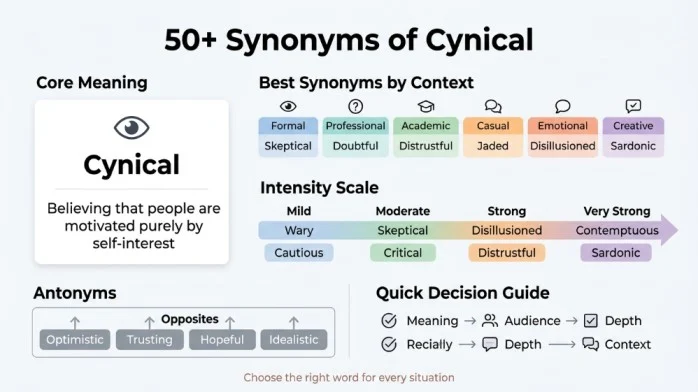
Cynical describes a person who believes that people are motivated purely by self-interest. The best synonyms include skeptical, distrustful, pessimistic, sarcastic, mocking, contemptuous, and jaded. Choose skeptical for questioning attitudes, pessimistic for negative outlooks, sarcastic for cutting humor, and jaded for worn-out disillusionment.
Meaning, Tone, and Context
Simple Definition
The word cynical describes someone who believes that people act only out of selfish motives. It can also refer to a negative, distrustful, or mocking attitude toward others. Cynics often question the sincerity, goodness, or honesty of people and institutions.
Part of Speech
Cynical is an adjective.
Overall Tone
The word usually has a negative or critical tone. It suggests distrust, skepticism, or a belief that others are insincere. However, in some contexts, cynical can also imply a realistic, world-weary perspective.
Formality Level
Cynical is considered neutral to formal. It appears naturally in academic writing, literature, professional communication, and everyday conversations.
Common Uses
Native English speakers commonly use cynical when talking about:
- Cynical attitudes
- Cynical remarks
- Cynical view of human nature
- Cynical humor
- Cynical outlook
- Cynical perspective
- Cynical personality
- Politically cynical
- Socially cynical
- Cynical response
Word Forms
| Form | Word |
|---|---|
| Noun | cynic, cynicism |
| Adjective | cynical |
| Adverb | cynically |
| Related Form | cynic |
| Opposite Form | optimistic, trusting |
When and How to Use “Cynical”
The word cynical works well whenever you want to describe a distrustful, negative, or skeptical attitude. However, choosing a more specific synonym can make your message clearer and more impactful.
Professional
“His cynical view of corporate culture made him question every company policy.”
Academic
“The study explored the relationship between cynical attitudes and political disengagement.”
Workplace
“A cynical attitude among employees often reduces team morale.”
Personal
“She became cynical about relationships after several disappointing experiences.”
“It’s easy to become cynical about these promises, but let’s hope for the best.”
Resume
“Avoid appearing cynical in interviews by focusing on positive outcomes.”
Social Media
“In a world full of fake news, it’s hard not to feel cynical about everything we read.”
Best Synonyms of Cynical
The word cynical is useful because it fits almost every type of writing, but no single synonym works perfectly in every situation. Some alternatives emphasize distrust, while others highlight negativity, sarcasm, or contempt. Choosing the right synonym helps your writing sound more natural and precise.
Professional Writing: Skeptical
Skeptical is one of the strongest professional alternatives to cynical. It shows a questioning, evidence-based attitude rather than pure negativity.
Example:
“The committee remained skeptical of the proposal due to a lack of supporting evidence.”
Why it works:
Skeptical sounds more objective and less emotionally negative than cynical.
Academic Writing: Distrustful
In essays, research papers, and reports, distrustful is often a better choice than cynical because it highlights a specific lack of trust.
Example:
“The participants expressed distrustful attitudes toward institutional authorities.”
Why it works:
It sounds objective, formal, and academically appropriate.
Business Communication: Doubtful
Doubtful indicates uncertainty or skepticism without the harshness of cynical.
Example:
“We remain doubtful about the feasibility of the proposed timeline.”
Why it works:
It communicates uncertainty while maintaining a professional tone.
Casual Conversation: Jaded
For everyday speaking, jaded sounds natural without becoming overly formal. It suggests being worn down by negative experiences.
Example:
“After years of working in customer service, he became completely jaded.”
Why it works:
Native English speakers frequently use jaded to describe world-weariness.
Emotional Writing: Disillusioned
When discussing feelings of disappointment and loss of belief, disillusioned is usually more expressive than cynical.
Example:
“She felt disillusioned by the political system after the scandal.”
Why it works:
It emphasizes the emotional journey from belief to disappointment.
Creative Writing: Sardonic
Creative writing often benefits from descriptive vocabulary. Sardonic, meaning grimly mocking, creates strong characterization.
Example:
“His sardonic smile suggested he was unimpressed by the performance.”
Why it works:
It captures the reader’s attention and adds depth to character description.
Resume Writing: Skeptical
Recruiters may respond better to skeptical than cynical. It shows critical thinking rather than negativity.
Example:
“A skeptical approach to data analysis ensured accuracy in all reports.”
Why it works:
It sounds concise, professional, and achievement-focused.
Workplace Communication: Guarded
Guarded suggests caution and protectiveness without the harsh judgment of cynical.
Example:
“The team remained guarded about the new policy until they saw results.”
Why it works:
It communicates caution while maintaining a professional tone.
Stronger Meaning: Contemptuous
When you need stronger emphasis, contemptuous is one of the best replacements for cynical. It expresses outright disdain and disrespect.
Example:
“His contemptuous remarks about the management alienated his colleagues.”
Why it works:
It suggests a stronger level of criticism and negative judgment.
Softer Meaning: Wary
Sometimes you want to express caution without the full weight of cynicism.
Example:
“She remained wary about making new friends after the betrayal.”
Why it works:
It gives balanced emphasis without exaggeration.
When Not to Use “Cynical”
Although cynical is versatile, it is not always the most effective word. In many situations, a more specific synonym communicates your message more clearly.
When the Attitude Is Questioning Rather Than Negative
If someone is simply asking questions, cynical may be too harsh.
Less Effective
“He was cynical about the proposal.”
Better
“He was skeptical about the proposal.”
Why
Skeptical suggests questioning, while cynical implies negative judgment.
When Expressing Disappointment Rather Than Negativity
If someone is hurt rather than negative, disillusioned is more appropriate.
Less Effective
“She became cynical after the betrayal.”
Better
“She became disillusioned after the betrayal.”
Why
Disillusioned emphasizes disappointment and loss of belief.
When Describing Dark Humor
Cynical can describe humor, but sardonic is often more precise for mocking humor.
Less Effective
“His cynical joke made everyone laugh.”
Better
“His sardonic joke made everyone laugh.”
Why
Sardonic specifically describes mocking or grim humor.
In Professional Feedback
Calling someone cynical in a performance review sounds overly harsh.
Less Effective
“His cynical attitude is problematic.”
Better
“His skeptical approach may need to be balanced with openness.”
Why
Skeptical sounds more constructive and professional.
When the Tone Should Be Neutral
Cynical adds emotional weight that may be unnecessary in neutral writing.
Less Effective
“The data suggests a cynical view of the program.”
Better
“The data suggests a critical view of the program.”
Why
Critical is more neutral and objective.
When Expressing Personal Feelings
If someone feels hurt rather than judgmental, choose a more expressive word.
Less Effective
“I feel cynical about love.”
Better
“I feel disillusioned about love.”
Why
Disillusioned communicates personal pain more naturally.
Words Commonly Confused with “Cynical”
| Word | Difference | When to Use It | Example |
|---|---|---|---|
| Skeptical | Questioning, doubting without negative judgment. | Professional, academic contexts. | “I remain skeptical about the claims.” |
| Pessimistic | Expecting the worst outcome. | Describing outlook, future predictions. | “He has a pessimistic view of the economy.” |
| Sarcastic | Saying the opposite of what you mean for humor. | Casual humor, social situations. | “She made a sarcastic comment.” |
| Sardonic | Grimly mocking or cynical humor. | Creative writing, character descriptions. | “His sardonic wit was unforgettable.” |
| Distrustful | Lacking trust in others. | Personal relationships, institutional contexts. | “She is distrustful of strangers.” |
| Jaded | Worn down by experience. | Describing world-weariness. | “He felt jaded by the entertainment industry.” |
Best Synonyms of Cynical by Context
| Context | Best Synonym | Why It Works | Example |
|---|---|---|---|
| Formal Writing | Skeptical | Sounds objective and precise. | “The researcher remained skeptical.” |
| Academic Writing | Distrustful | Fits research and essays naturally. | “Distrustful attitudes were observed.” |
| Professional Communication | Doubtful | Maintains professional tone. | “We remain doubtful about the plan.” |
| Business Emails | Skeptical | Concise and professional. | “I am skeptical about the timeline.” |
| Resume Writing | Critical | Emphasizes analytical skills. | “Critical thinking was applied to all tasks.” |
| Workplace Communication | Guarded | Stresses cautious approach. | “The team was guarded about changes.” |
| Casual Conversation | Jaded | Sounds natural in daily speech. | “She’s become so jaded.” |
| Everyday Speaking | Pessimistic | Common informal alternative. | “That’s a pessimistic outlook.” |
| Creative Writing | Sardonic | Adds vivid description. | “His sardonic smile said everything.” |
| Storytelling | Contemptuous | Shows strong disdain. | “His contemptuous laugh chilled the room.” |
| Emotional Writing | Disillusioned | Expresses personal pain. | “He felt disillusioned by the outcome.” |
| Strong Emphasis | Contemptuous | Indicates strong disdain. | “Her contemptuous tone was unmistakable.” |
| Mild Tone | Wary | Gives moderate emphasis. | “She was wary of the new plan.” |
| Social Media Captions | Skeptical | Sounds thoughtful and critical. | “Staying skeptical in a world of hype.” |
| American English | Skeptical | Frequently used in business. | “That’s a skeptical take.” |
| British English | Cynical | Common in formal and everyday usage. | “His cynical outlook is well known.” |
Synonyms of Cynical by Usage
The word cynical works in almost every situation, but choosing a more specific synonym makes your writing stronger and more natural. The sections below explain which alternatives fit different types of communication.
Professional vs Personal Synonyms
- Professional communication requires precise vocabulary, while personal conversations sound better with simpler, more relatable words.
Professional Synonyms
| Synonym | Best Used For | Why It Works |
|---|---|---|
| Skeptical | Reports, analysis | Shows questioning attitude |
| Doubtful | Business decisions | Indicates uncertainty |
| Critical | Professional evaluation | Analytical rather than emotional |
| Guarded | Workplace communication | Cautious approach |
| Cautious | Risk assessment | Careful rather than negative |
Recommendation
Use skeptical, critical, or doubtful in professional writing and communication.
Personal Synonyms
| Synonym | Best Used For | Example |
|---|---|---|
| Jaded | Life experiences | “He’s become so jaded.” |
| Disillusioned | Personal disappointments | “I feel disillusioned.” |
| Pessimistic | Future outlook | “That’s a pessimistic view.” |
| Wary | Caution in relationships | “She is wary of new people.” |
Recommendation
In conversations with friends and family, natural words like jaded, disillusioned, and wary often sound better than formal alternatives.
Formal vs Conversational Synonyms
Choosing the right level of formality helps your writing match the audience.
| Situation | Best Synonyms |
|---|---|
| Reports | Skeptical, Distrustful |
| Essays | Disillusioned, Distrustful |
| Business Writing | Skeptical, Doubtful |
| Presentations | Skeptical, Critical |
| Professional Emails | Skeptical, Doubtful |
| Casual Conversations | Jaded, Pessimistic |
| Text Messages | Jaded, Wary |
Example
Formal:
“The committee adopted a skeptical stance toward the proposal.”
Conversational:
“He’s just become so jaded about everything.”
Academic Synonyms
Academic writing benefits from vocabulary that sounds precise and objective.
Skeptical
Commonly used when discussing questioning attitudes.
Example
“Participants expressed skeptical views about government policies.”
Distrustful
Best for describing lack of trust.
Example
“The study examined distrustful attitudes toward institutional authorities.”
Critical
Ideal when describing analytical assessment.
Example
“Critical perspectives on social media are well documented.”
Disillusioned
Useful when describing disappointment leading to lack of belief.
Example
“Disillusioned voters are less likely to participate in elections.”
Wary
Appropriate when describing cautious attitudes.
Example
“Residents remain wary of development proposals.”
Recommendation
For essays and research papers, skeptical, distrustful, and critical usually sound stronger and more authoritative than cynical.
Professional and Business Synonyms
Business communication often requires concise and specific language.
Skeptical
Perfect for describing questioning attitudes.
Example
“We remain skeptical about the new strategy.”
Doubtful
Highlights uncertainty.
Example
“The team is doubtful about meeting the deadline.”
Critical
Describes analytical assessment.
Example
“Critical evaluation of the data is essential.”
Guardedly Optimistic
Shows cautious hope.
Example
“We are guardedly optimistic about the results.”
Cautious
Shows careful consideration.
Example
“A cautious approach is recommended.”
Recommendation
Use these words in resumes, interviews, meetings, presentations, business emails, and client communication to sound more professional.
Creative and Literary Synonyms
Creative writing benefits from expressive vocabulary that creates emotion and imagery.
Sardonic
Adds grimly mocking humor.
Example
“His sardonic wit was legendary.”
Contemptuous
Expresses strong disdain.
Example
“He gave a contemptuous shrug and walked away.”
Bitter
Describes resentment and disappointment.
Example
“Her bitter words revealed years of frustration.”
Jaded
Portrays world-weariness.
Example
“The jaded detective had seen it all.”
Scornful
Shows contempt and mockery.
Example
“Her scornful laugh echoed through the courtroom.”
These words make stories, speeches, and descriptive writing more engaging.
Strongest to Mildest Synonyms
The following scale shows how different synonyms express different levels of intensity.
| Intensity | Synonyms |
|---|---|
| Mild | Wary, Cautious, Doubtful |
| Moderate | Skeptical, Critical, Guarded |
| Strong | Disillusioned, Distrustful, Pessimistic |
| Very Strong | Contemptuous, Sardonic, Scornful, Bitter |
Understanding the Scale
- Wary means cautious and careful.
- Cautious means careful to avoid danger.
- Doubtful means uncertain.
- Skeptical means questioning and doubting.
- Critical means analytical and evaluating.
- Guarded means cautious and protective.
- Disillusioned means disappointed with loss of belief.
- Distrustful means lacking trust.
- Pessimistic means expecting the worst.
- Contemptuous means feeling strong disdain.
- Sardonic means grimly mocking.
- Scornful means showing contempt.
- Bitter means resentful and angry.
Emotional vs Neutral Synonyms
Some synonyms express feelings, while others simply communicate a critical attitude.
Emotional Synonyms
| Synonym | Best Used For |
|---|---|
| Disillusioned | Personal disappointment |
| Bitter | Resentment and anger |
| Jaded | World-weariness |
| Contemptuous | Strong disdain |
| Scornful | Mocking contempt |
These words add emotion and help readers connect with the message.
Neutral Synonyms
| Synonym | Best Used For |
|---|---|
| Skeptical | Professional contexts |
| Doubtful | Business decisions |
| Critical | Analysis and evaluation |
| Guarded | Cautious approaches |
| Cautious | Risk assessment |
Neutral words communicate a critical attitude without adding unnecessary emotion.
Antonyms of Cynical
| Antonym | Meaning | Example Sentence |
|---|---|---|
| Optimistic | Expecting the best outcome | He remains optimistic about the future. |
| Trusting | Believing others are good | She is trusting and open with people. |
| Idealistic | Believing in high ideals | His idealistic view of humanity is inspiring. |
| Hopeful | Having hope | I feel hopeful about our future. |
| Positive | Having a good attitude | She has a positive outlook on life. |
| Faithful | Having faith in others | His faithful nature was admirable. |
| Naive | Lacking experience or judgment | Her naive trust led to disappointment. |
| Open-minded | Willing to consider new ideas | He is open-minded about different opinions. |
| Sanguine | Optimistic and cheerful | She has a sanguine view of the situation. |
| Trustful | Willing to trust | He is trustful of his friends. |
| Confident | Believing in success | She is confident about her future. |
| Assured | Confident and certain | He is assured of his decisions. |
| Bullish | Confident and optimistic | The market outlook is bullish. |
| Buoyant | Cheerful and optimistic | His buoyant spirit lifted everyone. |
| Rosy | Bright and promising | The future looks rosy for the company. |
Comparison: “Cynical” vs Similar Words
Although cynical is a versatile word, several similar words carry different shades of meaning. Understanding these differences helps you choose the most accurate word for each situation.
Cynical vs Skeptical
Main Difference
Cynical implies a negative belief that others are selfish. Skeptical implies questioning without negative judgment.
Which Is Stronger?
Cynical is stronger because it includes judgment and negativity.
Which Is More Formal?
Skeptical is more common in professional and academic contexts.
When to Use Each
Use cynical for negative, distrustful attitudes.
Use skeptical for questioning, evidence-based attitudes.
Examples
Cynical:
“He is cynical about politicians’ motives.”
Skeptical:
“He is skeptical about the politician’s claims.”
Cynical vs Pessimistic
Main Difference
Cynical focuses on distrust of others’ motives. Pessimistic focuses on expecting negative outcomes.
Which Is Stronger?
Both are strong, but they emphasize different aspects.
Which Is More Formal?
Pessimistic is more common in formal writing.
When to Use Each
Use cynical for distrust of motives.
Use pessimistic for expecting the worst.
Examples
Cynical:
“She is cynical about her colleagues’ intentions.”
Pessimistic:
“She is pessimistic about the project’s success.”
Cynical vs Sardonic
Main Difference
Cynical is a general attitude of distrust. Sardonic is a specific type of mocking humor.
Which Is Stronger?
Sardonic is more specific and literary.
Which Is More Formal?
Sardonic is more common in literary contexts.
When to Use Each
Use cynical for general attitude.
Use sardonic for describing mocking humor.
Examples
Cynical:
“His cynical remarks revealed his distrust.”
Sardonic:
“His sardonic wit made the audience laugh nervously.”
Cynical vs Distrustful
Main Difference
Cynical includes negative judgment and belief in selfishness. Distrustful simply means lacking trust.
Which Is Stronger?
Cynical is stronger because it includes judgment.
Which Is More Formal?
Distrustful is common in academic and professional writing.
When to Use Each
Use cynical for negative judgment about motives.
Use distrustful for simply lacking trust.
Examples
Cynical:
“He is cynical about all politicians.”
Distrustful:
“He is distrustful of strangers.”
Cynical vs Jaded
Main Difference
Cynical involves believing others are selfish. Jaded involves being worn down by experience.
Which Is Stronger?
Jaded is more specific to being tired and worn out.
Which Is More Formal?
Jaded is common in both formal and casual contexts.
When to Use Each
Use cynical for distrust of motives.
Use jaded for world-weariness.
Examples
Cynical:
“His cynical view of love came from betrayal.”
Jaded:
“His jaded view of love came from years of disappointment.”
Cynical vs Contemptuous
Main Difference
Cynical involves distrust and negative belief. Contemptuous involves strong disdain and disrespect.
Which Is Stronger?
Contemptuous is much stronger.
Which Is More Formal?
Both are formal, but contemptuous is more intense.
When to Use Each
Use cynical for general distrust.
Use contemptuous for active disdain and disrespect.
Examples
Cynical:
“He is cynical about the new policy.”
Contemptuous:
“He gave a contemptuous laugh at the new policy.”
Common Phrases and Expressions with “Cynical”
| Phrase | Meaning | Example Sentence |
|---|---|---|
| Cynical about | Distrustful of something | He is cynical about the company’s promises. |
| Cynical view | Negative perspective | She holds a cynical view of human nature. |
| Cynical remark | A critical or mocking comment | His cynical remarks angered his coworkers. |
| Cynical attitude | Negative, distrustful outlook | Her cynical attitude was off-putting. |
| Cynical laugh | Mocking or contemptuous laugh | He gave a cynical laugh at the suggestion. |
| Cynical humor | Dark, mocking comedy | He is known for his cynical humor. |
| Become cynical | Develop a cynical outlook | He became cynical after years of disappointments. |
Common Mistakes to Avoid
1. Using “Cynical” When “Skeptical” Is More Appropriate
Incorrect
“He is cynical about the scientific claims.”
Better
“He is skeptical about the scientific claims.”
Why
Skeptical suggests questioning, while cynical implies negative judgment.
2. Confusing “Cynical” with “Pessimistic”
Incorrect
“The weather forecast made him cynical.”
Better
“The weather forecast made him pessimistic.”
Why
Pessimistic is about expecting negative outcomes.
3. Using “Cynical” for Simple Disappointment
Incorrect
“I felt cynical when I didn’t get the job.”
Better
“I felt disappointed when I didn’t get the job.”
Why
Disappointed is simpler and more appropriate.
4. Repeating “Cynical” Too Often
Incorrect
“Cynical people are cynical because cynical experiences made them cynical.”
Better
“Skeptical people often become jaded because difficult experiences erode their trust.”
Why
Using varied vocabulary improves readability and style.
5. Using “Cynical” When “Sardonic” Is More Specific
Incorrect
“His cynical joke made everyone laugh.”
Better
“His sardonic joke made everyone laugh.”
Why
Sardonic specifically describes mocking humor.
6. Using Emotional Words in Academic Writing
Incorrect
“The participants felt cynical toward government.”
Better
“The participants expressed skeptical attitudes toward government.”
Why
Academic writing generally prefers objective language.
7. Overusing Strong Synonyms
Incorrect
“I feel contemptuous about my coffee.”
Better
“I feel skeptical about my coffee.”
Why
Saving stronger words for genuinely serious situations makes them more effective.
Frequently Asked Questions
What are the best synonyms of “cynical”?
The best synonyms of cynical include skeptical, distrustful, pessimistic, sarcastic, mocking, contemptuous, and jaded. The right choice depends on your audience, tone, and writing purpose.
What are the best formal synonyms of “cynical”?
Strong formal alternatives include skeptical, distrustful, critical, doubtful, and guarded. These words work well in academic papers, reports, and business communication.
What are common informal synonyms of “cynical”?
Common informal alternatives include jaded, pessimistic, sarcastic, and wary. These expressions sound natural in everyday conversations and social media posts.
What is another word for “cynical” in professional writing?
In professional communication, excellent alternatives include skeptical, critical, doubtful, and guarded. These words make reports, emails, and presentations sound more precise and polished.
Conclusion
The word cynical is a powerful way to describe distrust and negative judgment, but using it repeatedly can make your writing feel repetitive. Learning the best synonyms of cynical helps you express your ideas with greater accuracy, stronger style, and better clarity.
You’re writing an essay, preparing a business presentation, updating your resume, or having a personal conversation, no single synonym fits every situation. Words like skeptical, disillusioned, jaded, sardonic, and distrustful each carry unique meanings and should be chosen based on your audience, tone, and purpose.
A simple way to improve your vocabulary is to pause before writing cynical and ask yourself what kind of negativity you mean. Choosing the most appropriate synonym will make your writing more engaging, professional, and natural.
Read More Related Articles:
Synonyms for Empty | Meaning, Examples, and Better Word …
Synonyms for Thus | Meaning, Examples, and Better Word …