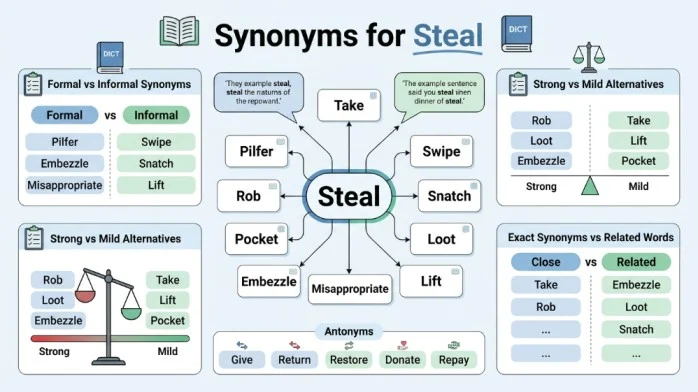
The best synonyms for steal depend on what you mean by steal. If you are talking about taking something without permission, words such as take, pilfer, swipe, and rob may fit. However, these words are not always interchangeable. Some sound formal, others are casual, and a few describe different types of theft. Understanding these differences helps you choose the most accurate word for every situation.
you’re writing a school essay, a news report, a novel, or simply expanding your vocabulary, selecting the right synonym makes your writing clearer and more natural. This guide explains the meaning of steal, compares useful alternatives, and shows when each one works best.
Best Synonyms for Steal
The best synonyms for steal are take, pilfer, swipe, and rob. The right choice depends on tone, context, and intensity.
- Take – a broad alternative that sometimes implies theft depending on context.
- Pilfer – stealing small or low-value items.
- Swipe – an informal word for stealing quickly.
- Rob – taking property through force or threats, usually from a person or business.
What Does Steal Mean?
Steal is a verb.
It means to take someone else’s property without permission and with the intention of keeping it permanently. The word almost always describes an illegal or dishonest action.
People also use steal in figurative expressions. For example, someone can steal the spotlight by attracting everyone’s attention, or a sports team can steal a victory by winning unexpectedly.
Example sentences:
- Someone tried to steal a bicycle from outside the school.
- Her performance managed to steal the entire audience’s attention.
Core Meaning of Steal
At its core, steal describes taking something that belongs to another person without consent.
Although the central idea remains the same, the word can describe different situations.
- Secretly taking money from a wallet.
- Shoplifting from a store.
- Taking valuable information without permission.
- Using someone else’s ideas without giving credit.
- Drawing attention away from another person in a figurative sense.
Because these situations differ, choosing the right synonym matters. A journalist, novelist, lawyer, and casual speaker may all choose different words even when describing similar events.
Grammar and Usage Notes
Part of speech
- Verb
- Forms: steal, steals, stole, stolen, stealing
Common sentence patterns
- steal something
- steal from someone
- steal something from someone
- steal away
- steal into
- steal a glance
- steal the show
- steal someone’s heart
When “steal” sounds natural
Use steal whenever the action involves taking property unlawfully or when using common figurative expressions.
Examples:
- Someone stole my backpack.
- The comedian stole the show.
- The company accused an employee of stealing confidential files.
When another word works better
Sometimes a synonym gives readers a clearer picture.
For example:
- Pilfer suggests small-scale theft.
- Swipe sounds informal.
- Rob focuses on taking property through force.
- Loot usually refers to theft during riots or wars.
Using the precise word improves clarity and avoids confusion.
Best Synonyms for Steal
| Synonym | Meaning | Tone | Best Use Case | Example Sentence |
|---|---|---|---|---|
| Take | Remove something without permission | Neutral | General writing | Someone took the wallet without asking. |
| Pilfer | Steal small items | Neutral | Everyday theft | The worker pilfered office supplies. |
| Swipe | Steal quickly | Informal | Conversation | Someone swiped my phone at the café. |
| Rob | Take property by force | Serious | Crime reporting | The suspects robbed a local bank. |
| Snatch | Grab suddenly | Strong | Fast theft | A thief snatched her purse. |
| Lift | Secretly steal | Informal | British English | Someone lifted my umbrella. |
| Secretly keep something | Neutral | Small theft | He pocketed the loose cash. | |
| Loot | Steal during disorder | Serious | News writing | Stores were looted after the unrest. |
| Burglarize | Break into a building to steal | Formal | Legal or news contexts | The house was burglarized overnight. |
| Misappropriate | Wrongfully use property | Formal | Business or legal writing | The official misappropriated public funds. |
Common Synonyms for Steal
These alternatives appear frequently in everyday English.
Take
Meaning: Remove something that belongs to another person.
Best context: General writing where the surrounding sentence makes the theft clear.
Example:
Someone took my jacket from the restaurant.
Pilfer
Meaning: Steal small or inexpensive items.
Best context: Workplace, schools, shops, or homes.
Example:
The employee was caught pilfering stationery.
Swipe
Meaning: Steal something quickly and quietly.
Best context: Casual conversation.
Example:
Someone swiped my headphones while I was away.
Rob
Meaning: Steal property using force, threats, or intimidation.
Best context: Crime reports and formal writing.
Example:
The masked men robbed the jewelry store.
Snatch
Meaning: Grab something suddenly before escaping.
Best context: Describing fast theft.
Example:
A cyclist snatched her handbag while passing by.
Meaning: Secretly keep something that should not be taken.
Best context: Small acts of theft or dishonest behavior.
Example:
The visitor quietly pocketed a souvenir from the display.
Lift
Meaning: Secretly steal an item.
Best context: Informal speech, especially British English.
Example:
Someone lifted my backpack from the train station.
Loot
Meaning: Steal goods during riots, wars, or disasters.
Best context: News reporting and historical writing.
Example:
Several abandoned shops were looted after the storm.
Burglarize
Meaning: Enter a building illegally to steal property.
Best context: Legal documents and news articles.
Example:
The family’s home was burglarized while they were on vacation.
Misappropriate
Meaning: Use money or property dishonestly for personal benefit.
Best context: Business, finance, and legal writing.
Example:
The investigation found that company funds had been misappropriated.
Formal Synonyms for Steal
Formal alternatives are useful in academic papers, legal writing, business communication, news reports, and professional documents. These words often describe specific types of theft or dishonest behavior.
Misappropriate
Meaning: To use money, property, or resources dishonestly for personal gain.
Best for: Legal documents, financial reports, and business writing.
Example:
The audit revealed that the manager had misappropriated company funds.
Embezzle
Meaning: To steal money that has been entrusted to your care.
Best for: Financial crime, legal writing, and news articles.
Example:
The accountant was charged with embezzling thousands of dollars.
Appropriate (Formal Sense)
Meaning: To take something for one’s own use, often without permission.
Best for: Academic or legal discussions.
Example:
The company was accused of appropriating another firm’s design.
Misuse
Meaning: To use something in an improper or dishonest way.
Best for: Professional and workplace contexts.
Example:
Employees must not misuse confidential information.
Divert
Meaning: To redirect money, resources, or property for an unauthorized purpose.
Best for: Financial reports and government documents.
Example:
Investigators discovered that public funds had been diverted to private accounts.
Wrongfully Take
Meaning: To unlawfully remove another person’s property.
Best for: Legal descriptions where precision matters.
Example:
The complaint stated that the defendant wrongfully took valuable equipment.
Informal Synonyms for Steal
These casual alternatives appear often in everyday conversation, social media, novels, and dialogue. Some are slang, so they may not fit professional writing.
Swipe
Tone: Casual
Best use: Everyday conversation.
Example:
Someone swiped my sunglasses at the beach.
Nick
Tone: Informal, especially British English.
Best use: Friendly conversations and fiction.
Example:
Who nicked my pen?
Lift
Tone: Informal.
Best use: Quiet or unnoticed theft.
Example:
Someone lifted my wallet while I was shopping.
Pinch
Tone: Informal, mainly British English.
Best use: Casual speech.
Example:
He pinched a cookie before dinner.
Sneak Off With
Tone: Conversational.
Best use: Describing someone secretly taking an item.
Example:
The child sneaked off with his brother’s toy.
Make Off With
Tone: Informal but common in news and conversation.
Best use: Escaping after taking something.
Example:
The thieves made off with several expensive watches.
Strong Synonyms for Steal
Some synonyms express greater seriousness, violence, or criminal intent. Use them only when they accurately describe the situation.
Rob
Unlike steal, rob focuses on taking property from a person or place through force or intimidation.
Example:
The criminals robbed the convenience store late at night.
Plunder
This word describes stealing on a large scale, often during war, invasion, or conflict.
Example:
The invading army plundered nearby villages.
Loot
Loot usually refers to widespread theft during riots, disasters, or social unrest.
Example:
Several businesses were looted after the evacuation order.
Snatch
This emphasizes speed and sudden action.
Example:
A thief snatched the woman’s purse before running away.
Ransack
Although it mainly means searching a place thoroughly, it often implies stealing while causing damage.
Example:
Burglars ransacked the house looking for valuables.
Pillage
A stronger historical term often associated with war and organized destruction.
Example:
The soldiers pillaged towns during the campaign.
Tip: Avoid using these stronger words unless the facts support them. They carry heavier emotional and legal meanings than steal.
Mild Synonyms for Steal
Sometimes a softer or more neutral word fits better, especially when the action is figurative or when the exact nature of the act is unknown.
Take
The broadest alternative. Context determines whether it implies theft.
Example:
Someone took my notebook without asking.
Borrow (Incorrectly)
People sometimes use borrow when they actually mean take without permission. Although it softens the action, it is not a true synonym because borrowing usually implies returning the item.
Example:
He borrowed my charger without telling me.
A relatively mild way to describe secretly keeping something.
Example:
She quietly pocketed the loose change.
Keep
In some situations, keep describes refusing to return something rather than stealing it outright.
Example:
He kept the book instead of returning it.
Remove
A neutral word that may or may not imply theft depending on context.
Example:
Someone removed several documents from the office.
Synonyms for Steal by Context
Choosing the right synonym depends on where and how you’re using the word.
Everyday Conversation
For casual speech, simple words work best.
Recommended synonyms:
- Take
- Swipe
- Nick
- Lift
These sound natural in conversations and personal stories.
Professional Writing
Business and workplace communication requires precise wording.
Recommended synonyms:
- Misappropriate
- Misuse
- Divert
- Wrongfully take
These terms sound objective and professional without exaggerating the situation.
Academic Writing
Essays and research papers benefit from formal vocabulary.
Recommended synonyms:
- Appropriate
- Misappropriate
- Unlawfully take
These words clearly describe dishonest actions while maintaining an academic tone.
Creative Writing
Stories often need vivid language that matches the scene.
Recommended synonyms:
- Snatch
- Swipe
- Pilfer
- Plunder
Each creates a different image and level of tension.
News Reporting
Journalistic writing values accuracy over drama.
Recommended synonyms:
- Rob
- Burglarize
- Loot
- Embezzle
- Steal
Each term refers to a specific kind of crime, making reports clearer and more precise.
Personal Communication
When talking with friends or family, simple language is usually the most natural.
Recommended synonyms:
- Take
- Swipe
- Nick
- Lift
These words are easy to understand and fit informal conversations.
Another Word for Steal in a Sentence
Here are practical examples showing how different synonyms for steal work in everyday English. Each sentence uses a different word naturally.
- Someone took my umbrella from the café by mistake—or so they claimed.
- The teenager swiped a bag of chips from the convenience store.
- An employee was caught pilfering office supplies over several months.
- Armed suspects robbed the jewelry store before fleeing the scene.
- A cyclist snatched the tourist’s phone and disappeared into traffic.
- Someone lifted my backpack while I was waiting for the train.
- The child quietly pocketed a handful of candies from the bowl.
- Several abandoned buildings were looted after the storm.
- The accountant was accused of embezzling company funds.
- Officials claimed that public money had been misappropriated.
- Burglars burglarized three homes in the neighborhood overnight.
- The invading army plundered villages along its route.
- Investigators discovered that grant money had been diverted for personal use.
- The museum reported that several rare artifacts had been taken without permission.
- The comedian stole the show with an unforgettable performance.
Steal Synonyms Compared
Many synonyms share a similar meaning but differ in tone, intensity, or the type of theft they describe.
| Word | Meaning | Tone | Intensity | Best Use Case |
|---|---|---|---|---|
| Steal | General unlawful taking | Neutral | Medium | Everyday writing |
| Take | Remove something; context may imply theft | Neutral | Mild | General situations |
| Pilfer | Steal small items secretly | Neutral | Mild | Workplace or petty theft |
| Swipe | Steal quickly | Informal | Mild | Casual conversation |
| Lift | Secretly steal | Informal | Mild | British English |
| Secretly keep something | Neutral | Mild | Small-scale theft | |
| Rob | Take property using force or threats | Serious | Strong | Crime reporting |
| Snatch | Grab something suddenly | Strong | Strong | Fast theft |
| Loot | Steal during disorder | Serious | Strong | News and history |
| Plunder | Steal on a large scale | Formal | Very Strong | Historical writing |
| Embezzle | Steal entrusted money | Formal | Strong | Finance and law |
| Misappropriate | Wrongfully use money or property | Formal | Medium | Business and legal writing |
Key Differences
- Steal is the broad, everyday term.
- Rob is not interchangeable with steal. You rob a person, bank, or store, but you steal money, jewelry, or property.
- Pilfer usually involves inexpensive or small items.
- Embezzle applies only to money or assets trusted to someone’s care.
- Loot and plunder describe theft during conflict, riots, or disasters rather than ordinary crimes.
Words Similar to Steal
The following words belong to the same semantic field but are not always exact synonyms.
Borrow
Why it’s related: Both involve taking an item.
Difference: Borrowing normally means intending to return it.
Example:
She borrowed my notebook and returned it the next day.
Confiscate
Why it’s related: Something is taken away.
Difference: An authority removes property legally or officially.
Example:
Customs officers confiscated prohibited items.
Seize
Why it’s related: It involves taking possession.
Difference: It often refers to legal, military, or official action rather than theft.
Example:
Police seized illegal weapons during the investigation.
Acquire
Why it’s related: It means obtaining something.
Difference: It does not imply dishonesty.
Example:
She acquired valuable research materials for her project.
Claim
Why it’s related: Someone takes ownership.
Difference: The ownership may be legitimate or disputed.
Example:
The company claimed the abandoned equipment.
Inherit
Why it’s related: Property changes ownership.
Difference: It happens legally after someone’s death.
Example:
He inherited his grandfather’s collection.
Antonyms of Steal
These words express the opposite idea of taking something unlawfully.
| Antonym | Meaning | Example Sentence |
|---|---|---|
| Give | Transfer ownership voluntarily | She gave her old bicycle to a neighbor. |
| Return | Give something back | He returned the borrowed book on time. |
| Restore | Put something back to its rightful owner | Police restored the recovered jewelry to the family. |
| Donate | Give freely to help others | They donated clothes to a local shelter. |
| Repay | Pay back money or value owed | She repaid every dollar she had borrowed. |
| Hand over | Transfer possession willingly | The suspect handed over the missing documents. |
How to Choose the Right Synonym for Steal
The best synonym depends on more than the dictionary definition. Consider these points before replacing steal.
Match the Context
Choose a word that accurately describes what happened.
- Embezzle for financial fraud.
- Pilfer for petty theft.
- Rob when force is involved.
Match the Tone
Formal writing often requires more precise vocabulary.
- Business reports: misappropriate
- News articles: rob, burglarize
- Casual conversation: swipe, take
Check the Intensity
Some words sound much stronger than others.
For example, plunder suggests widespread destruction, while take sounds much milder.
Think About Your Reader
Use language your audience will easily understand. Everyday readers usually recognize steal, take, and rob more readily than specialized legal terms.
Confirm the Meaning
Not every related word is an exact replacement.
For instance:
- Borrow is usually temporary.
- Confiscate is often legal.
- Acquire has no dishonest meaning.
Replacing steal with one of these words could change the meaning completely.
Keep the Sentence Natural
Sometimes the original word is still the strongest choice. Replacing every repeated word with a synonym can make writing sound forced.
Common Mistakes When Using Synonyms for Steal
Many writers choose a synonym simply because it appears in a thesaurus. That can create confusing or inaccurate sentences.
Using the Wrong Level of Seriousness
Calling every theft plunder exaggerates the event.
Likewise, describing a bank robbery as someone simply taking money understates the crime.
Confusing “Rob” and “Steal”
This is one of the most common mistakes.
Correct:
- They stole the painting.
- They robbed the museum.
Incorrect:
- They robbed the painting.
Choosing an Overly Formal Word
Legal terms such as misappropriate or embezzle sound unnatural in casual conversations.
A simple word like steal is often better.
Using Informal Slang in Professional Writing
Words like swipe, nick, or pinch may not suit reports, essays, or legal documents.
Match the vocabulary to the situation.
Treating Related Words as Exact Synonyms
Words like borrow, confiscate, and acquire have different meanings.
Always check whether the replacement preserves the original idea.
Ignoring Context
Some synonyms describe specific crimes.
For example:
- Burglarize involves entering a building illegally.
- Embezzle involves entrusted money.
- Loot usually occurs during public disorder.
Choosing the wrong word can make a sentence inaccurate.
Quick Synonym List for Steal
Common Synonyms
- Take
- Pilfer
- Swipe
- Rob
- Snatch
- Lift
- Burglarize
Formal Synonyms
- Misappropriate
- Embezzle
- Appropriate
- Divert
- Wrongfully take
Informal Synonyms
- Swipe
- Nick
- Lift
- Pinch
- Make off with
Strong Synonyms
- Rob
- Plunder
- Loot
- Ransack
- Snatch
Mild Synonyms
- Take
- Remove
- Keep (in some contexts)
Related Words
- Borrow
- Confiscate
- Seize
- Acquire
- Claim
- Inherit
FAQs
What is the best synonym for steal?
The best synonym depends on the situation. For general use, take, pilfer, swipe, and rob are among the most accurate alternatives. Choose the one that best matches the context, tone, and type of theft.
What is another word for steal?
Another word for steal is take, but it isn’t always an exact replacement. Other useful alternatives include pilfer, swipe, snatch, pocket, and rob, depending on how the item was taken.
What is a formal synonym for steal?
Formal synonyms include misappropriate, embezzle, appropriate, and divert. These words are common in legal, financial, academic, and professional writing because they describe specific forms of dishonest taking.
What is an informal synonym for steal?
Informal synonyms include swipe, nick, lift, and pinch. These words are common in everyday conversation and fiction but may not be suitable for formal documents.
What is a stronger word for steal?
Stronger alternatives include rob, plunder, loot, ransack, and snatch. These words often suggest violence, force, large-scale theft, or greater emotional impact.
What is a milder word for steal?
Milder alternatives include take, pocket, and remove. These words can sound less direct, but they should only be used when they accurately reflect the situation.
What words are similar to steal?
Related words include borrow, confiscate, seize, acquire, claim, and inherit. They involve taking or receiving something but do not necessarily mean stealing. Always check the exact meaning before using them as replacements.
What is the opposite of steal?
Common antonyms are give, return, restore, donate, and repay. These words describe giving property back or transferring it legally instead of taking it unlawfully.
How do I choose the right synonym for steal?
Start by considering the context. Ask yourself what kind of theft is being described, how formal your writing should be, and how strong the word needs to sound. A precise synonym improves clarity, while the wrong one can change the meaning of your sentence.
Conclusion
Finding the best synonyms for steal is about more than replacing one word with another. Each alternative carries its own meaning, level of formality, and degree of intensity. While take works as a broad substitute in some situations, words like pilfer, rob, swipe, loot, embezzle, and misappropriate describe more specific actions.
Before choosing a synonym, think about your audience, the tone of your writing, and the exact message you want to convey. Using the most accurate word makes your writing clearer, more engaging, and more trustworthy. When in doubt, keep the sentence simple and choose the synonym that fits the context naturally rather than forcing a more complex alternative.
Read More Related Articles:
Synonyms for Review | Meaning, Examples, and Better Word …
Synonyms for Thinking | Meaning, Examples, and Better Word …