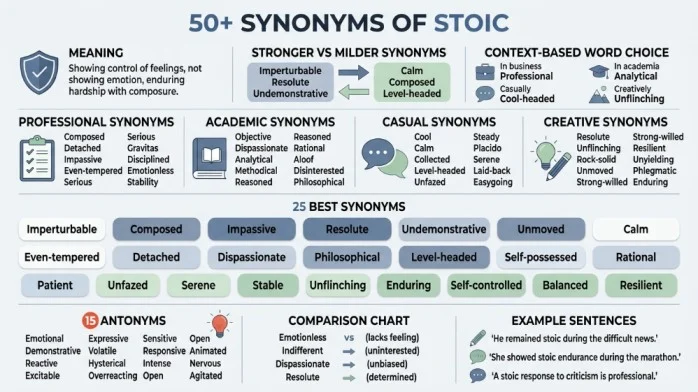
When writing a character description, resume, essay, novel, or even a social media post, using the word stoic repeatedly can make your writing feel repetitive. Learning the best synonyms of stoic helps you express emotional restraint, mental strength, and calm behavior with greater precision while matching the tone of your message.
Not every situation calls for the same word. Some alternatives sound more formal, others emphasize resilience, patience, or self-control. This guide explains what stoic means, explores its best synonyms, and shows exactly when to use each one so your writing feels natural, accurate, and more engaging.
What Are the Best Synonyms of “Stoic”?
A stoic person remains calm, composed, and emotionally controlled, especially during difficult situations. The best synonyms depend on context. Composed and self-controlled suit professional writing, unemotional and impassive fit formal descriptions, resilient works well in motivational writing, while calm and unshaken sound more natural in everyday conversations.
Meaning, Tone, and Context
Simple Definition
Stoic describes a person who remains calm, emotionally controlled, and resilient, particularly during hardship, pain, stress, or disappointment. Rather than reacting emotionally, a stoic individual stays steady and composed.
Part of Speech
Stoic is primarily used as:
- Adjective: Describing someone who shows little emotion.
- Noun: A person who practices or displays stoicism.
Overall Tone
The tone of stoic is generally neutral to positive.
It often conveys emotional strength, discipline, patience, and composure. However, depending on the context, it can also suggest emotional distance or a lack of expressiveness.
Formality Level
Stoic is considered semi-formal to formal.
It is commonly used in:
- Literature
- Psychology
- Professional writing
- News articles
- Character descriptions
- Historical discussions
- Motivational content
Although native speakers understand the word, it appears less frequently in casual conversations than simpler alternatives like calm or composed.
Common Uses
Native English speakers commonly use stoic when describing:
- A person who remains calm during adversity
- Leaders handling pressure
- Soldiers facing danger
- Athletes overcoming setbacks
- Characters in novels and films
- Individuals showing emotional restraint
- Someone enduring pain without complaint
Word Forms
| Word Form | Example |
|---|---|
| Adjective | stoic |
| Noun | stoic |
| Abstract Noun | stoicism |
| Adverb | stoically |
| Related Adjective | composed |
| Opposite Form | emotional |
When and How to Use “Stoic”
Use stoic when you want to describe someone who stays emotionally steady, patient, and composed despite challenges. It is especially effective when emphasizing resilience rather than a complete absence of emotion.
Professional
“Despite the unexpected setbacks, the project manager remained stoic and focused on finding practical solutions.”
Academic
“The novel portrays a stoic protagonist who endures hardship without losing his sense of purpose.”
Workplace
“She maintained a stoic attitude during the company’s restructuring, helping reassure her colleagues.”
Personal
“My grandfather was always stoic, rarely complaining even during difficult times.”
“His stoic approach to unexpected challenges helped the entire team stay productive.”
Resume
“Known for maintaining a stoic and solution-oriented mindset while managing high-pressure projects.”
Social Media
“Being stoic doesn’t mean hiding your feelings. It means staying calm and thoughtful when life becomes challenging.”
Best Synonyms of “Stoic”
No synonym perfectly replaces stoic in every situation. Some words emphasize emotional control, while others highlight patience, resilience, calmness, or self-discipline. Choosing the right synonym depends on your audience, tone, and writing purpose.
Professional Writing: Composed
Composed is one of the best professional alternatives to stoic. It describes someone who remains calm and in control under pressure without suggesting emotional coldness.
Example:
“The CEO remained composed during the difficult negotiations.”
Why it works:
It sounds polished, professional, and suitable for workplace communication.
Academic Writing: Impassive
Impassive is frequently used in literature, psychology, and academic analysis to describe someone who shows little outward emotion.
Example:
“The witness remained impassive throughout the questioning.”
Why it works:
It provides a formal and objective description of emotional restraint.
Business Communication: Self-Controlled
Self-controlled highlights emotional discipline and sound judgment, making it an excellent choice for business writing.
Example:
“A self-controlled leader makes thoughtful decisions under pressure.”
Why it works:
It emphasizes professionalism and emotional intelligence.
Casual Conversation: Calm
In everyday English, calm is usually more natural than stoic.
Example:
“He stayed calm even after hearing the unexpected news.”
Why it works:
It is simple, familiar, and widely understood by native speakers.
Emotional Writing: Resilient
When describing someone who overcomes hardship while staying emotionally strong, resilient is often the best choice.
Example:
“She remained resilient after facing numerous challenges.”
Why it works:
It combines emotional strength with perseverance.
Creative Writing: Unshaken
Unshaken creates vivid imagery and suggests unwavering confidence despite adversity.
Example:
“He stood unshaken as the storm approached.”
Why it works:
It adds drama and emotional depth to storytelling.
Resume Writing: Level-Headed
Level-headed is an excellent resume keyword because employers value employees who stay calm under pressure.
Example:
“Recognized for remaining level-headed during high-pressure situations.”
Why it works:
It communicates sound judgment and reliability.
Workplace Communication: Steady
Steady describes someone who remains dependable and emotionally balanced during difficult circumstances.
Example:
“Her steady leadership helped the team navigate uncertainty.”
Why it works:
It emphasizes consistency and reliability rather than emotional distance.
Stronger Meaning: Unflinching
Unflinching expresses exceptional courage and emotional firmness when facing fear, criticism, or hardship.
Example:
“He showed unflinching determination throughout the investigation.”
Why it works:
It conveys greater strength and bravery than stoic.
Softer Meaning: Reserved
Reserved suggests someone who naturally expresses fewer emotions without implying exceptional endurance.
Example:
“Although reserved, she was always kind and supportive.”
Why it works:
It provides a gentler description of quiet behavior.
When Not to Use “Stoic”
Although stoic is a valuable word, it does not fit every situation. Sometimes a more specific or natural synonym communicates your meaning more clearly.
1. When You Simply Mean Calm
If someone is only relaxed for a short time, stoic may sound too strong.
Less Effective:
“He stayed stoic during the meeting.”
Better:
“He stayed calm during the meeting.”
Why:
Calm describes temporary emotional control without implying a personality trait.
2. When You Want to Highlight Recovery
If your focus is overcoming hardship rather than suppressing emotion, another synonym is more accurate.
Less Effective:
“She remained stoic after losing her job.”
Better:
“She remained resilient after losing her job.”
Why:
Resilient emphasizes recovery and perseverance.
3. In Friendly Conversations
Many people do not regularly use stoic in casual speech.
Less Effective:
“My brother is stoic.”
Better:
“My brother is really calm.”
Why:
Simple words sound more natural in everyday conversations.
4. When Describing Good Leadership
Professional writing often benefits from more approachable language.
Less Effective:
“The manager was stoic.”
Better:
“The manager remained composed throughout the crisis.”
Why:
Composed highlights professionalism without suggesting emotional distance.
5. When Warmth Is Important
Stoic can sometimes make someone seem emotionally distant.
Less Effective:
“The teacher remained stoic while helping students.”
Better:
“The teacher remained patient while helping students.”
Why:
Patient conveys calmness while still suggesting kindness and empathy.
6. When Describing Facial Expression
If you are referring only to someone’s expression, expressionless may be more accurate.
Less Effective:
“He gave a stoic look.”
Better:
“He gave an expressionless look.”
Why:
This focuses on appearance rather than personality.
Words Commonly Confused With “Stoic”
| Word | Main Difference | Best Time to Use | Example |
|---|---|---|---|
| Composed | Calm and emotionally balanced, often temporarily. | Professional communication and leadership. | “She remained composed during the interview.” |
| Reserved | Naturally quiet and private, not necessarily emotionally strong. | Personality descriptions. | “He is reserved around new people.” |
| Impassive | Showing almost no visible emotion. | Literature, psychology, formal writing. | “Her face remained impassive throughout the conversation.” |
| Resilient | Recovers quickly after difficulties. | Motivational, educational, workplace writing. | “Children can be remarkably resilient after setbacks.” |
| Patient | Able to wait calmly without frustration. | Everyday conversations and workplace settings. | “She stayed patient while training the new employees.” |
| Unemotional | Does not express emotions openly, often sounding colder than stoic. | Psychological descriptions or character analysis. | “He appeared unemotional during the interview.” |
Best Synonyms of “Stoic” by Context
| Context | Best Synonym | Why It Works | Example |
|---|---|---|---|
| Formal writing | Impassive | Sounds objective and precise. | “The judge remained impassive.” |
| Academic writing | Composed | Common in literary and behavioral analysis. | “The character stayed composed throughout the conflict.” |
| Professional communication | Level-headed | Highlights sound judgment. | “She is a level-headed leader.” |
| Business emails | Composed | Professional and positive. | “He remained composed during the discussion.” |
| Resume writing | Level-headed | Employers value calm decision-making. | “Known for a level-headed approach to problem solving.” |
| Workplace communication | Steady | Emphasizes dependability. | “Her steady leadership inspired confidence.” |
| Casual conversation | Calm | Most natural everyday choice. | “He stayed calm under pressure.” |
| Everyday speaking | Cool-headed | Common and conversational. | “She’s always cool-headed in stressful situations.” |
| Creative writing | Unshaken | Adds vivid imagery and emotional depth. | “He remained unshaken despite the chaos.” |
| Storytelling | Unflinching | Conveys courage and determination. | “The hero was unflinching in battle.” |
| Emotional writing | Resilient | Highlights inner strength. | “She stayed resilient through every challenge.” |
| Strong emphasis | Unyielding | Suggests exceptional mental toughness. | “His unyielding spirit inspired everyone.” |
| Mild tone | Reserved | Gentle description of personality. | “She’s naturally reserved.” |
| Social media captions | Calm | Simple and relatable. | “Stay calm, stay focused.” |
| American English | Level-headed | Frequently used in everyday and business English. | “He’s a level-headed decision-maker.” |
| British English | Composed | Widely understood and appropriate in formal contexts. | “She remained composed throughout the proceedings.” |
How to Choose the Best Synonym of “Stoic”
Choosing the right synonym for stoic depends on what quality you want to emphasize. Some alternatives focus on emotional control, while others highlight resilience, patience, courage, or quiet confidence. Selecting the most suitable word helps your writing sound more natural and precise.
Choose Based on Meaning
Ask yourself what aspect of stoic you want to express.
| If You Mean… | Best Synonym | Why It Fits |
|---|---|---|
| Remaining calm under pressure | Composed | Emphasizes emotional balance and self-control. |
| Recovering from hardship | Resilient | Highlights strength and the ability to bounce back. |
| Showing little emotion | Impassive | Focuses on an emotionless outward appearance. |
| Thinking clearly during stress | Level-headed | Suggests practical judgment and calm decision-making. |
| Quiet personality | Reserved | Describes someone who naturally keeps emotions private. |
| Mental toughness | Unflinching | Conveys courage and determination under pressure. |
| Steady behavior | Steady | Highlights consistency and reliability. |
| Emotional restraint | Self-controlled | Emphasizes discipline over emotional reactions. |
Choose Based on Tone
Different synonyms create different impressions.
| Tone | Recommended Synonyms |
|---|---|
| Professional | Composed, Self-controlled, Level-headed |
| Academic | Impassive, Reserved, Composed |
| Business | Steady, Level-headed, Composed |
| Casual | Calm, Cool-headed |
| Emotional | Resilient, Strong |
| Creative | Unshaken, Unflinching, Unwavering |
Example
Instead of:
“She remained stoic.”
Choose the version that better fits your purpose:
- “She remained composed.” (Professional)
- “She remained resilient.” (Inspirational)
- “She remained impassive.” (Formal)
- “She remained calm.” (Everyday conversation)
Choose Based on Your Audience
Different audiences respond better to different vocabulary.
Students and Teachers
Use composed, reserved, or impassive in essays and literary discussions because these words sound precise and analytical.
Managers and Professionals
Choose level-headed, self-controlled, or steady for reports, presentations, interviews, and workplace communication.
Friends and Family
Simple words like calm, cool-headed, or strong feel more natural in everyday conversations.
Choose Based on Emotional Strength
Some synonyms simply describe behavior, while others suggest remarkable inner strength.
| Mild | Moderate | Strong | Very Strong |
|---|---|---|---|
| Reserved | Calm | Resilient | Unflinching |
| Quiet | Composed | Steadfast | Unyielding |
Choose stronger words only when the situation truly calls for them.
Choose Based on Writing Purpose
Business Email
Use composed, self-controlled, or level-headed.
Essay
Choose impassive, reserved, or composed.
Resume
Use level-headed, steady, or resilient.
Story
Try unshaken, steadfast, or unflinching.
Blog Post
Use calm, resilient, or composed, depending on your audience.
Choose the Right Level of Formality
Formal writing often benefits from more precise vocabulary.
| Formal | Neutral | Informal |
|---|---|---|
| Impassive | Stoic | Calm |
| Self-controlled | Composed | Cool-headed |
| Reserved | Steady | Easygoing (only when appropriate) |
| Unflinching | Resilient | Strong |
Avoid highly formal words like impassive in casual conversations unless the context specifically calls for them.
Aim for Natural-Sounding English
Native English speakers do not always use stoic in everyday conversation. They usually choose simpler alternatives based on context.
For example:
❌ “He remained stoic during the team meeting.”
✅ “He remained composed during the team meeting.”
Or:
✅ “He stayed calm during the meeting.”
These versions sound more natural while preserving the original meaning.
Real Life Examples of “Stoic”
The following examples show how stoic and its synonyms appear in real-world communication.
School
Original:
“The student remained stoic after receiving constructive criticism.”
Improved:
“The student remained composed after receiving constructive criticism.”
College
Original:
“The professor described the main character as stoic.”
Improved:
“The professor described the main character as impassive and emotionally restrained.”
Workplace
Original:
“Our supervisor stayed stoic during the crisis.”
Improved:
“Our supervisor remained level-headed throughout the crisis.”
Business
Original:
“The CEO appeared stoic during the press conference.”
Improved:
“The CEO remained composed while answering difficult questions.”
Original:
“Her stoic attitude helped resolve the conflict.”
Improved:
“Her self-controlled approach helped resolve the conflict professionally.”
Resume
Original:
“Maintained a stoic attitude during high-pressure situations.”
Improved:
“Maintained a level-headed and solution-focused approach during high-pressure situations.”
Conversation
Original:
“My father is very stoic.”
Improved:
“My father is always calm, even when things go wrong.”
Storytelling
Original:
“The warrior remained stoic.”
Improved:
“The warrior stood unflinching, refusing to surrender despite overwhelming odds.”
Blogging
Original:
“Being stoic can improve emotional control.”
Improved:
“Developing a composed mindset can help you respond more thoughtfully to life’s challenges.”
Social Media
Original:
“Stay stoic.”
Improved:
“Stay calm, stay focused, and let your actions speak louder than your emotions.”
25 Best Synonyms of “Stoic”
| Synonym | Simple Meaning | Best Used For | Example Sentence |
|---|---|---|---|
| Composed | Calm and in control | Professional writing | She remained composed during the interview. |
| Calm | Free from panic | Everyday conversation | He stayed calm throughout the storm. |
| Resilient | Able to recover from hardship | Motivational writing | She proved remarkably resilient after the setback. |
| Self-controlled | Controls emotions well | Business communication | A self-controlled manager inspires confidence. |
| Level-headed | Thinks clearly under pressure | Workplace | He is known for being level-headed in emergencies. |
| Steady | Emotionally dependable | Leadership | Her steady leadership united the team. |
| Reserved | Quiet and emotionally private | Personality descriptions | He’s naturally reserved around strangers. |
| Impassive | Showing little outward emotion | Academic writing | The witness remained impassive during questioning. |
| Unemotional | Not openly emotional | Psychology | She appeared unemotional despite the news. |
| Cool-headed | Calm in stressful situations | Everyday English | The pilot stayed cool-headed throughout the flight. |
| Unshaken | Not disturbed by events | Storytelling | He remained unshaken despite the criticism. |
| Unflinching | Fearless and unwavering | Creative writing | She showed unflinching courage. |
| Steadfast | Firm and loyal | Literature | His steadfast determination impressed everyone. |
| Unwavering | Constant and firm | Inspirational writing | Her unwavering confidence inspired the team. |
| Patient | Calm while waiting | Daily communication | She remained patient with every customer. |
| Collected | Calm and organized | Professional settings | He stayed collected throughout the presentation. |
| Controlled | Restrained in behavior | Formal writing | His response was calm and controlled. |
| Disciplined | Showing strong self-control | Personal development | A disciplined mindset leads to better decisions. |
| Strong | Emotionally tough | General writing | She remained strong during difficult times. |
| Unyielding | Refusing to give in | High-impact writing | His unyielding spirit earned everyone’s respect. |
| Firm | Resolute and steady | Leadership | She remained firm under pressure. |
| Detached | Emotionally distant | Literary analysis | He sounded detached during the conversation. |
| Even-tempered | Rarely loses composure | Personality descriptions | She’s remarkably even-tempered at work. |
| Poised | Graceful and confident | Professional and social settings | The speaker appeared poised on stage. |
| Unruffled | Not disturbed or upset | Formal and literary writing | She remained unruffled despite the unexpected criticism. |
Synonyms of “Stoic” by Usage
The word stoic can describe emotional control, mental strength, quiet confidence, or the ability to remain calm during difficult situations. However, the best synonym depends on where and how you’re using it. Choosing a context-specific alternative makes your writing more natural and precise.
Professional vs Personal Synonyms
- Professional communication often requires words that sound balanced and objective, while personal conversations usually benefit from simpler, warmer language.
Professional Synonyms
These synonyms work well in workplaces, business reports, interviews, and leadership discussions.
| Synonym | Best Use | Why It Works |
|---|---|---|
| Composed | Leadership | Shows emotional control without sounding cold. |
| Level-headed | Decision making | Highlights clear thinking under pressure. |
| Self-controlled | Business communication | Emphasizes emotional discipline. |
| Steady | Workplace leadership | Suggests consistency and reliability. |
| Poised | Professional presentations | Indicates confidence and calmness. |
| Collected | High-pressure situations | Describes someone who remains organized and calm. |
Recommendation:
For business reports, interviews, performance reviews, and client communication, composed, level-headed, and self-controlled are usually stronger choices than stoic because they sound more approachable and professional.
Personal Synonyms
These alternatives sound more natural in conversations with family and friends.
| Synonym | Best Use | Example |
|---|---|---|
| Calm | Everyday conversations | “She stayed calm during the storm.” |
| Strong | Emotional support | “He stayed strong after the accident.” |
| Patient | Relationships | “She’s always patient with children.” |
| Cool-headed | Casual conversations | “He’s cool-headed in stressful situations.” |
| Resilient | Personal growth | “She became more resilient after the experience.” |
Recommendation:
For everyday conversations, choose words that sound friendly and familiar instead of formal vocabulary.
Formal vs Conversational Synonyms
The right synonym depends on the level of formality your audience expects.
| Writing Situation | Best Synonyms |
|---|---|
| Business Reports | Composed, Self-controlled |
| Academic Essays | Impassive, Reserved |
| Research Papers | Impassive, Emotionally restrained |
| Presentations | Level-headed, Composed |
| Business Emails | Composed, Professional |
| Casual Conversation | Calm, Cool-headed |
| Text Messages | Calm, Strong |
Example
Formal
“The witness remained impassive throughout the proceedings.”
Conversational
“He stayed calm even when everything went wrong.”
Using the appropriate level of formality makes your writing sound more authentic.
Academic Synonyms
Academic writing values precision and objectivity. These synonyms are commonly used in essays, literary criticism, psychology, and behavioral studies.
Impassive
Best for describing someone who displays very little outward emotion.
“The protagonist remained impassive despite repeated setbacks.”
Reserved
Useful when discussing personality traits rather than temporary emotions.
“The researcher described the participant as naturally reserved.”
Composed
Works well when analyzing behavior during stressful situations.
“The leader remained composed throughout the conflict.”
Emotionally Restrained
Useful in psychology and behavioral analysis.
“The character appears emotionally restrained in difficult situations.”
Self-Controlled
Appropriate when discussing emotional regulation.
“A self-controlled response often leads to better decision-making.”
Recommendation:
Academic readers generally prefer precise terms such as impassive, reserved, and self-controlled because they describe specific behaviors rather than broad personality traits.
Professional and Business Synonyms
Employers value emotional intelligence, good judgment, and stability. These synonyms communicate those qualities effectively.
Composed
Ideal for describing calm leadership.
“She remained composed during the crisis meeting.”
Level-headed
Excellent for resumes and interviews.
“He is a level-headed problem solver.”
Self-controlled
Highlights emotional maturity.
“Successful managers are self-controlled under pressure.”
Steady
Emphasizes reliability.
“The company’s steady leadership inspired employee confidence.”
Poised
Suggests confidence combined with professionalism.
“She appeared poised during the client presentation.”
Recommendation:
These alternatives generally sound more natural than stoic in business communication because they focus on leadership rather than emotional distance.
Creative and Literary Synonyms
Creative writing often benefits from expressive language that creates vivid imagery.
Unflinching
Perfect for heroes, soldiers, and determined characters.
“The knight remained unflinching before his enemies.”
Unshaken
Creates a powerful image of emotional stability.
“She stood unshaken despite the chaos surrounding her.”
Steadfast
Suggests loyalty and determination.
“His steadfast devotion never changed.”
Unwavering
Highlights confidence and persistence.
“Her unwavering faith carried her through every challenge.”
Unruffled
Describes someone who stays calm regardless of circumstances.
“He remained unruffled while everyone else panicked.”
These words add emotion, depth, and vivid imagery without losing the core meaning of stoic.
Slang or Modern Synonyms
Unlike many adjectives, stoic has very few true slang equivalents. Modern English speakers usually replace it with simple conversational expressions.
| Expression | Meaning | Acceptable In | Avoid In |
|---|---|---|---|
| Cool-headed | Calm under pressure | Everyday speech | Academic papers |
| Chill | Relaxed and calm | Friends, texting | Business reports |
| Unbothered | Not easily upset | Social media | Formal writing |
Example
Casual:
“She’s completely unbothered by the criticism.”
Formal:
“She remained composed despite the criticism.”
Strongest to Mildest Synonyms
The following scale shows how emotional intensity increases from mild calmness to exceptional mental toughness.
| Intensity | Synonyms |
|---|---|
| Mild | Calm, Reserved |
| Moderate | Composed, Collected, Cool-headed |
| Strong | Resilient, Level-headed, Steadfast |
| Very Strong | Unflinching, Unyielding, Unwavering |
How Intensity Changes
- Calm simply describes someone who is relaxed.
- Composed suggests emotional control.
- Resilient adds recovery and perseverance.
- Steadfast emphasizes determination.
- Unflinching communicates exceptional courage.
- Unwavering highlights complete consistency under pressure.
- Unyielding expresses extraordinary mental strength.
Emotional vs Neutral Synonyms
Selecting an emotional or neutral synonym depends on the message you want to communicate.
Emotional Synonyms
These words emphasize inner strength, perseverance, or courage.
| Synonym | Best Used For |
|---|---|
| Resilient | Personal growth |
| Strong | Emotional support |
| Steadfast | Loyalty and commitment |
| Unwavering | Inspirational writing |
| Unflinching | Courage and determination |
These words inspire readers and create stronger emotional impact.
Neutral Synonyms
These alternatives simply describe behavior without adding emotional weight.
| Synonym | Best Used For |
|---|---|
| Composed | Professional communication |
| Calm | Everyday English |
| Reserved | Personality descriptions |
| Impassive | Academic writing |
| Self-controlled | Business communication |
| Collected | Workplace situations |
| Poised | Public speaking |
Neutral vocabulary works best in reports, essays, workplace communication, and objective descriptions.
Antonyms of “Stoic”
| Antonym | Meaning | Example Sentence |
|---|---|---|
| Emotional | Easily expresses feelings | She became emotional during the speech. |
| Expressive | Shows emotions openly | He’s naturally expressive when telling stories. |
| Sensitive | Easily affected emotionally | She is highly sensitive to criticism. |
| Dramatic | Overly emotional or theatrical | His dramatic reaction surprised everyone. |
| Excitable | Easily excited or upset | The puppy remained excitable around visitors. |
| Reactive | Responds emotionally and quickly | He became reactive after the disagreement. |
| Impulsive | Acts without thinking | Her impulsive decision caused problems. |
| Passionate | Shows strong emotions | She gave a passionate speech. |
| Animated | Full of lively expression | The children had an animated conversation. |
| Nervous | Easily anxious | He felt nervous before the interview. |
| Agitated | Disturbed or upset | The crowd became agitated after the announcement. |
| Hysterical | Extremely emotional | She became hysterical after the accident. |
| Volatile | Emotionally unpredictable | The negotiations became volatile. |
| Overemotional | Excessively emotional | His overemotional response distracted the team. |
| Temperamental | Mood changes easily | The actor was known for being temperamental on set. |
Comparison: “Stoic” vs Similar Words
Although stoic has several close alternatives, each word carries a different meaning, level of emotion, and degree of formality. Understanding these differences helps you choose the most accurate word for every situation.
Stoic vs Calm
Main Difference
Stoic describes someone who consistently controls emotions, especially during hardship. Calm simply means relaxed or free from anxiety in a particular situation.
Which Is Stronger?
Stoic is stronger because it suggests lasting emotional discipline.
Which Is More Formal?
Stoic is more common in formal and literary writing.
When to Use Each
Use stoic when describing enduring emotional strength.
Use calm for everyday situations where someone remains relaxed.
Examples
Stoic:
“The firefighter remained stoic despite the danger.”
Calm:
“She stayed calm during the meeting.”
Stoic vs Composed
Main Difference
Composed focuses on staying calm and controlled in the moment. Stoic often describes a person’s overall character or approach to hardship.
Which Is Stronger?
Stoic usually conveys greater emotional endurance.
Which Is More Formal?
Both suit formal writing, but composed is more common in business communication.
When to Use Each
Use composed in workplaces, interviews, and presentations.
Use stoic when discussing personality or resilience.
Examples
Stoic:
“My grandfather remained stoic throughout his illness.”
Composed:
“The attorney stayed composed during cross-examination.”
Stoic vs Resilient
Main Difference
Stoic emphasizes emotional restraint.
Resilient emphasizes recovering after setbacks.
Which Is Stronger?
Neither is stronger. They describe different qualities.
Which Is More Formal?
Both are common in professional and academic writing.
When to Use Each
Choose stoic when highlighting emotional control.
Choose resilient when emphasizing recovery and perseverance.
Examples
Stoic:
“She remained stoic after hearing the news.”
Resilient:
“She proved remarkably resilient after losing her business.”
Stoic vs Reserved
Main Difference
A reserved person is naturally quiet or private. A stoic person deliberately maintains emotional control during difficult circumstances.
Which Is Stronger?
Stoic expresses greater emotional discipline.
Which Is More Formal?
Both work well in formal writing.
When to Use Each
Use reserved for personality traits.
Use stoic for emotional endurance.
Examples
Stoic:
“The captain stayed stoic despite the pressure.”
Reserved:
“He’s naturally reserved around strangers.”
Stoic vs Impassive
Main Difference
Impassive focuses on showing no visible emotion.
Stoic focuses on controlling emotions with inner strength.
Which Is Stronger?
Impassive often sounds colder, while stoic sounds stronger and more admirable.
Which Is More Formal?
Impassive is slightly more common in academic and literary analysis.
When to Use Each
Use impassive when describing facial expressions.
Use stoic when describing character.
Examples
Stoic:
“The soldier remained stoic during the ceremony.”
Impassive:
“Her face stayed impassive throughout the interview.”
Stoic vs Unflinching
Main Difference
Unflinching emphasizes courage and determination.
Stoic emphasizes emotional restraint.
Which Is Stronger?
Unflinching usually carries greater emotional intensity.
Which Is More Formal?
Both fit formal writing, although unflinching is especially common in storytelling and journalism.
When to Use Each
Use stoic for emotional control.
Use unflinching for bravery under pressure.
Examples
Stoic:
“He remained stoic despite the criticism.”
Unflinching:
“She gave an unflinching defense of her beliefs.”
Common Phrases and Expressions with “Stoic”
| Phrase | Meaning | Example Sentence |
|---|---|---|
| Stoic attitude | A calm and emotionally controlled outlook | His stoic attitude helped the team stay focused. |
| Stoic expression | A face showing little emotion | She maintained a stoic expression throughout the interview. |
| Stoic personality | A naturally emotionally restrained character | His stoic personality made him difficult to read. |
| Remain stoic | Continue showing emotional control | She chose to remain stoic despite the criticism. |
| Stoic acceptance | Calmly accepting hardship | The novel explores themes of stoic acceptance. |
| Stoic response | A calm reaction to adversity | His stoic response impressed everyone. |
| Stoic demeanor | A consistently calm manner | The coach’s stoic demeanor reassured the players. |
Common Mistakes to Avoid
1. Using “Stoic” When You Simply Mean Calm
Incorrect
“He was stoic during the meeting.”
Better
“He remained composed during the meeting.”
Why
Professional situations usually call for composed, which sounds more natural.
2. Confusing “Stoic” with “Reserved”
Incorrect
“My quiet neighbor is stoic.”
Better
“My quiet neighbor is reserved.”
Why
Being quiet is different from showing emotional endurance.
3. Using “Stoic” in Casual Conversation Too Often
Incorrect
“My brother is stoic.”
Better
“My brother is usually calm.”
Why
Native speakers often prefer simpler vocabulary in everyday conversations.
4. Choosing an Overly Strong Synonym
Incorrect
“He was unyielding during the class discussion.”
Better
“He remained composed during the class discussion.”
Why
Unyielding suggests extreme determination and may sound exaggerated.
5. Repeating “Stoic” Throughout Your Writing
Incorrect
“The stoic leader inspired the stoic team with his stoic behavior.”
Better
“The composed leader inspired the resilient team through his steady leadership.”
Why
Using varied vocabulary improves readability and keeps your writing engaging.
6. Using “Impassive” When You Mean Strong
Incorrect
“She gave an impassive speech.”
Better
“She gave a resilient and confident speech.”
Why
Impassive describes a lack of visible emotion, not courage or determination.
Frequently Asked Questions
1. What are the best synonyms of “stoic”?
The best synonyms of stoic include composed, calm, self-controlled, level-headed, resilient, impassive, steady, and unflinching. The right choice depends on whether you’re writing formally, professionally, or casually.
2. What are the best formal synonyms of “stoic”?
Excellent formal alternatives include impassive, composed, self-controlled, reserved, poised, and collected. These words work well in academic papers, business writing, and literary analysis.
3. What are common informal synonyms of “stoic”?
Common informal alternatives include calm, cool-headed, strong, and unbothered. These expressions sound more natural in conversations, text messages, and social media than stoic.
4. What is another word for “stoic” in professional writing?
For professional communication, consider composed, level-headed, self-controlled, steady, or poised. These words emphasize emotional intelligence and sound more natural in resumes, meetings, and business emails.
5. What is the difference between “stoic” and “calm”?
Stoic describes a person who consistently shows emotional restraint, especially during hardship. Calm simply refers to being relaxed or free from anxiety in a particular situation and is more common in everyday English.
6. What is the opposite of “stoic”?
Common opposites include emotional, expressive, sensitive, dramatic, reactive, agitated, and impulsive. Each describes someone who openly displays emotions rather than controlling them.
Conclusion
The word stoic represents emotional control, inner strength, and the ability to remain composed during difficult circumstances. However, no single synonym works perfectly in every context. Words such as composed, level-headed, resilient, impassive, calm, and unflinching each communicate a slightly different shade of meaning.
Learning the best synonyms of stoic helps you write with greater precision, whether you’re creating essays, resumes, business emails, stories, or everyday messages. Always choose a synonym based on your audience, tone, and purpose rather than replacing words automatically. A thoughtful vocabulary choice makes your communication clearer, more engaging, and more effective.
Read More Related Articles:
Synonyms for Empty | Meaning, Examples, and Better Word …
Synonyms for Thus | Meaning, Examples, and Better Word …