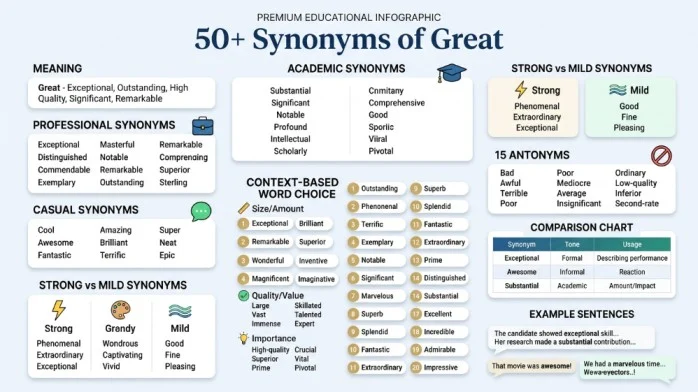
Great words have the power to make writing more expressive, memorable, and impactful. While “great” is a common choice, using more precise alternatives can help your message sound stronger, more professional, and better suited to the situation. Exploring synonyms of great allows writers, students, and professionals to discover words that add clarity, emotion, and variety to their communication.
From powerful descriptions to everyday conversations, the right replacement for “great” can completely change the tone of a sentence. This guide to synonyms of great covers meaningful alternatives with examples, helping you choose words that fit every context naturally.
What Are the Best Synonyms of “Great”?
Great generally describes something excellent, impressive, important, or highly successful. The best synonym depends on your purpose. For formal writing, use excellent or exceptional. In academic writing, significant or remarkable work well. Professional communication often benefits from outstanding or superb, while creative writing may use magnificent or splendid. Choosing the right synonym makes your writing clearer, stronger, and more engaging.
Meaning, Tone, and Context
Simple Definition
The word great describes someone or something that is excellent, impressive, highly skilled, important, large in size, or worthy of admiration. Its meaning changes slightly depending on the situation.
Part of Speech
Great is primarily an adjective.
Overall Tone
The word generally has a positive tone because it expresses approval, admiration, or excellence. In some contexts, it can also describe importance or size rather than quality.
Formality Level
Great is considered neutral. It sounds natural in both informal conversations and many professional situations, although formal documents sometimes benefit from more precise alternatives.
Common Uses
Native English speakers commonly use great when talking about:
- Great achievements
- Great ideas
- Great opportunities
- Great leaders
- Great performance
- Great success
- Great experience
- Great effort
- Great teacher
- Great place
Word Forms
| Word Form | Example |
|---|---|
| Adjective | great |
| Adverb | greatly |
| Noun | greatness |
| Related Adjective | outstanding |
| Opposite Form | poor, mediocre |
When and How to Use “Great”
The word great works best when you want to express admiration, excellence, importance, or high quality. However, choosing a more specific synonym often communicates your message more effectively.
Professional
“Our team achieved great results during the final quarter.”
Academic
“The scientist made a great contribution to environmental research.”
Workplace
“Building strong communication skills is great for career growth.”
Personal
“We had a great weekend with our family.”
“Thank you for your great support throughout the project.”
Resume
“Delivered great customer service while consistently exceeding performance goals.”
Social Media
“We had a great time exploring the national park this weekend.”
Best Synonyms of “Great”
No synonym replaces great perfectly in every situation. Sometimes it means excellent, while in other contexts it refers to importance, size, skill, or achievement. Choosing the right synonym makes your writing sound more precise and natural.
Professional Writing: Outstanding
Outstanding is an excellent choice when describing exceptional work, performance, or achievements in professional settings.
Example:
“The team delivered outstanding results during the product launch.”
Why it works:
It sounds polished and highlights excellence without exaggeration.
Academic Writing: Exceptional
Exceptional fits essays, reports, and academic discussions because it emphasizes unusually high quality or ability.
Example:
“She demonstrated exceptional analytical skills throughout the research project.”
Why it works:
It sounds objective and formal while recognizing excellence.
Business Communication: Excellent
Excellent is widely used in client communication, business emails, and performance reviews.
Example:
“The proposal received excellent feedback from senior management.”
Why it works:
It communicates high quality in a professional yet approachable tone.
Casual Conversation: Awesome
Among friends and family, awesome is a natural alternative to great.
Example:
“That movie was awesome.”
Why it works:
It feels relaxed, enthusiastic, and conversational.
Emotional Writing: Wonderful
Wonderful expresses admiration, appreciation, and positive emotion.
Example:
“She has been a wonderful friend through every challenge.”
Why it works:
It conveys warmth and sincere appreciation.
Creative Writing: Magnificent
Magnificent adds vivid imagery and dramatic emphasis.
Example:
“The castle stood on the hill in magnificent silence.”
Why it works:
It creates a memorable visual impression.
Resume Writing: Outstanding
Recruiters appreciate specific words that highlight achievement.
Example:
“Recognized for outstanding customer service and leadership.”
Why it works:
It immediately communicates exceptional performance.
Workplace Communication: Superb
Superb is an effective alternative when praising work quality or results.
Example:
“You did a superb job presenting the quarterly report.”
Why it works:
It sounds professional while expressing genuine appreciation.
Stronger Meaning: Extraordinary
Extraordinary describes something far beyond ordinary expectations.
Example:
“She showed extraordinary determination during the competition.”
Why it works:
It emphasizes exceptional ability or achievement.
Softer Meaning: Good
Sometimes great sounds stronger than necessary. In those situations, good is a more balanced alternative.
Example:
“We had a good discussion during the meeting.”
Why it works:
It provides positive feedback without overstating the situation.
When Not to Use “Great”
Although great is one of the most useful words in English, it is not always the most accurate choice. A more specific synonym often communicates your message more effectively.
1. When It Sounds Too General
Using great repeatedly can make your writing feel vague.
Less Effective:
“She did a great job.”
Better:
“She did an outstanding job.”
Why:
Outstanding clearly communicates exceptional performance.
2. In Academic Writing
Research papers and essays usually require more precise language.
Less Effective:
“The study had great results.”
Better:
“The study produced exceptional results.”
Why:
Exceptional sounds more formal and academically appropriate.
3. In Business Reports
Professional documents benefit from objective vocabulary.
Less Effective:
“The company achieved great success.”
Better:
“The company achieved remarkable success.”
Why:
Remarkable sounds more polished and credible.
4. When Describing Importance
Sometimes great actually means important, not excellent.
Less Effective:
“He made a great decision.”
Better:
“He made a critical decision.”
Why:
Critical emphasizes importance instead of quality.
5. In Creative Writing
Creative writing becomes more engaging with descriptive vocabulary.
Less Effective:
“The palace was great.”
Better:
“The palace was magnificent.”
Why:
Magnificent creates stronger imagery.
6. When Expressing Mild Praise
Sometimes great can sound exaggerated.
Less Effective:
“The presentation was great.”
Better:
“The presentation was good.”
Why:
Good sounds more natural when the praise is moderate.
Words Commonly Confused With “Great”
| Word | Difference | When to Use It | Example |
|---|---|---|---|
| Excellent | Focuses on very high quality. | Professional feedback, reviews, evaluations. | “She delivered an excellent presentation.” |
| Outstanding | Describes performance that stands above others. | Awards, resumes, achievements. | “He received an outstanding employee award.” |
| Exceptional | Highlights unusual skill or quality. | Academic and professional writing. | “The athlete showed exceptional discipline.” |
| Remarkable | Emphasizes something worth noticing. | Stories, articles, reports. | “The team made remarkable progress.” |
| Magnificent | Adds admiration and visual impact. | Creative writing, travel, descriptions. | “The mountains looked magnificent at sunrise.” |
| Superb | Expresses extremely high quality. | Workplace praise, reviews, recommendations. | “The restaurant provided superb service.” |
Best Synonyms of “Great” by Context
| Context | Best Synonym | Why It Works | Example |
|---|---|---|---|
| Formal Writing | Exceptional | Sounds polished and precise. | “She delivered an exceptional performance.” |
| Academic Writing | Remarkable | Highlights meaningful achievement. | “The research produced remarkable findings.” |
| Professional Communication | Outstanding | Emphasizes excellence. | “Your work has been outstanding.” |
| Business Emails | Excellent | Professional and positive. | “Thank you for your excellent support.” |
| Resume Writing | Outstanding | Strengthens achievements. | “Led outstanding client initiatives.” |
| Workplace Communication | Superb | Professional praise. | “You did a superb job today.” |
| Casual Conversation | Awesome | Sounds friendly and natural. | “That concert was awesome.” |
| Everyday Speaking | Good | Balanced and natural. | “We had a good weekend.” |
| Creative Writing | Magnificent | Creates vivid imagery. | “A magnificent sunset filled the sky.” |
| Storytelling | Extraordinary | Adds dramatic emphasis. | “She lived an extraordinary life.” |
| Emotional Writing | Wonderful | Expresses warmth. | “You have been a wonderful friend.” |
| Strong Emphasis | Exceptional | Shows the highest quality. | “His talent is exceptional.” |
| Mild Tone | Good | Suitable for everyday situations. | “That’s a good idea.” |
| Social Media Captions | Amazing | Captures excitement. | “We had an amazing vacation!” |
| American English | Awesome | Very common in daily conversation. | “That game was awesome!” |
| British English | Brilliant | Frequently used to express praise. | “The performance was brilliant.” |
How to Choose the Best Synonym of “Great”
The word great is flexible, but it does not always express the exact meaning you want. Sometimes it refers to excellence, while in other cases it describes importance, size, achievement, or admiration. Choosing a more precise synonym helps your writing sound natural and professional.
Choose Based on Meaning
Think about what you want to emphasize before selecting a synonym.
| If You Mean… | Best Synonym | Why It Fits |
|---|---|---|
| Excellent quality | Excellent | Highlights high standards and quality. |
| Exceptional performance | Outstanding | Shows performance above expectations. |
| Remarkable achievement | Exceptional | Emphasizes uncommon ability or success. |
| Impressive beauty | Magnificent | Creates vivid visual imagery. |
| Personal admiration | Wonderful | Expresses warmth and appreciation. |
| Extraordinary success | Remarkable | Focuses on noticeable accomplishments. |
| Powerful impact | Extraordinary | Suggests something beyond the ordinary. |
| Casual praise | Awesome | Sounds friendly and conversational. |
Choose Based on Tone
Different situations require different levels of enthusiasm.
| Tone | Recommended Synonyms |
|---|---|
| Professional | Outstanding, Excellent, Exceptional |
| Academic | Significant, Remarkable, Exceptional |
| Business | Outstanding, Excellent, Superior |
| Casual | Awesome, Fantastic, Cool |
| Emotional | Wonderful, Amazing |
| Creative | Magnificent, Splendid, Glorious |
Example
Instead of:
“She gave a great presentation.”
Choose the version that best fits your purpose.
- “She gave an outstanding presentation.” (Professional)
- “She gave an exceptional presentation.” (Formal)
- “She gave an amazing presentation.” (Casual)
- “She gave a magnificent performance.” (Creative)
Choose Based on Your Audience
Your readers influence which synonym sounds most natural.
Students and Teachers
Use exceptional, remarkable, or excellent because they sound clear and appropriate for academic writing.
Managers and Professionals
Choose outstanding, superior, or exceptional in reports, meetings, and business communication.
Friends and Family
Use awesome, amazing, fantastic, or wonderful in everyday conversations.
Choose Based on Emotional Strength
Some words express mild appreciation, while others communicate strong admiration.
| Mild | Moderate | Strong | Very Strong |
|---|---|---|---|
| Good | Great | Excellent | Outstanding |
| Nice | Wonderful | Exceptional | Extraordinary |
| Pleasant | Remarkable | Superb | Magnificent |
Reserve the strongest words for achievements or experiences that truly deserve extra praise.
Choose Based on Writing Purpose
Business Email
Use excellent, outstanding, or superior.
Essay
Choose remarkable, significant, or exceptional.
Resume
Use outstanding, exceptional, or superior.
Story
Try magnificent, glorious, or splendid.
Blog Post
Use amazing, excellent, or remarkable, depending on your audience.
Choose the Right Level of Formality
Formal documents benefit from precise vocabulary, while casual conversations sound better with everyday words.
| Formal | Neutral | Informal |
|---|---|---|
| Exceptional | Great | Awesome |
| Outstanding | Excellent | Amazing |
| Superior | Good | Fantastic |
| Remarkable | Wonderful | Cool |
Aim for Natural-Sounding English
Native speakers rarely use the strongest synonym every time.
For example:
❌ “Every idea is extraordinary.”
✅ “Most ideas are good, but this one is outstanding.”
Using stronger words only when they truly fit makes your writing sound more believable and effective.
Real Life Examples of “Great”
These examples show how great and its synonyms appear in everyday communication.
School
Original:
“Our teacher is great.”
Improved:
“Our teacher is exceptional at explaining difficult topics.”
College
Original:
“The professor gave a great lecture.”
Improved:
“The professor delivered an outstanding lecture on climate science.”
Workplace
Original:
“Our team achieved great results.”
Improved:
“Our team achieved remarkable results this quarter.”
Business
Original:
“The company had a great year.”
Improved:
“The company had an exceptional year with record revenue.”
Original:
“Thank you for your great support.”
Improved:
“Thank you for your excellent support throughout the project.”
Resume
Original:
“Provided great customer service.”
Improved:
“Delivered outstanding customer service while exceeding performance targets.”
Conversation
Original:
“We had a great vacation.”
Improved:
“We had an amazing vacation and made unforgettable memories.”
Storytelling
Original:
“He became a great leader.”
Improved:
“He became an extraordinary leader who inspired an entire generation.”
Blogging
Original:
“Great content improves SEO.”
Improved:
“High-quality content plays a vital role in long-term SEO success.”
Social Media
Original:
“We had a great day together.”
Improved:
“We had an awesome day together. Can’t wait to do it again!”
25 Best Synonyms of “Great”
| Synonym | Simple Meaning | Best Used For | Example Sentence |
|---|---|---|---|
| Excellent | Very high quality | Professional writing | She delivered an excellent presentation. |
| Outstanding | Better than others | Resumes, business | He received an outstanding performance award. |
| Exceptional | Unusually impressive | Academic writing | She showed exceptional leadership skills. |
| Remarkable | Worth noticing | Reports, articles | The team achieved remarkable progress. |
| Superb | Extremely good | Workplace | The chef prepared a superb meal. |
| Magnificent | Impressively beautiful | Creative writing | The palace looked magnificent at sunset. |
| Splendid | Excellent and attractive | Literature | They enjoyed a splendid evening together. |
| Wonderful | Inspiring admiration | Personal writing | She has been a wonderful mentor. |
| Fantastic | Extremely good | Casual conversation | We had a fantastic weekend. |
| Amazing | Causing surprise and admiration | Social media | The concert was amazing. |
| Awesome | Very impressive | Everyday speech | That’s an awesome idea. |
| Extraordinary | Beyond ordinary | Storytelling | She showed extraordinary courage. |
| Brilliant | Exceptionally intelligent or excellent | UK English, praise | He came up with a brilliant solution. |
| Superior | Better in quality | Business | Our product offers superior performance. |
| First-rate | Of the highest quality | Reviews | They received first-rate service. |
| Top-notch | Excellent quality | Informal business | The hotel provides top-notch hospitality. |
| Impressive | Creating admiration | General writing | Her resume is impressive. |
| Distinguished | Highly respected | Formal writing | He is a distinguished professor. |
| Eminent | Famous and respected | Academic | She is an eminent scientist. |
| Grand | Large and impressive | Architecture | They entered a grand ballroom. |
| Glorious | Full of beauty or success | Creative writing | It was a glorious summer morning. |
| Celebrated | Widely recognized | News, biographies | He became a celebrated author. |
| Prestigious | Highly respected | Education | She attended a prestigious university. |
| Admirable | Worth respect | Personal, professional | His honesty is admirable. |
| High-quality | Of excellent standard | Business, blogging | Customers expect high-quality products. |
Synonyms of “Great” by Usage
The word great fits many situations, but the best synonym depends on your audience and purpose. A business report, academic essay, and casual text message often require different vocabulary to sound natural and appropriate.
Professional vs Personal Synonyms
- Professional writing usually favors precise, polished language, while personal communication benefits from warm and conversational words.
Professional Synonyms
These synonyms are commonly used in workplaces, business communication, resumes, and presentations.
| Synonym | Best Use | Why It Works |
|---|---|---|
| Outstanding | Performance reviews | Highlights exceptional achievement. |
| Excellent | Business emails | Professional and universally accepted. |
| Exceptional | Reports | Shows unusually high quality. |
| Superior | Product descriptions | Emphasizes better performance. |
| Remarkable | Company achievements | Draws attention to impressive success. |
| First-rate | Client communication | Suggests premium quality. |
Recommendation:
For professional writing, replace great with outstanding, excellent, or exceptional whenever you want your message to sound more polished.
Personal Synonyms
These alternatives sound more natural in everyday conversations with friends and family.
| Synonym | Best Use | Example |
|---|---|---|
| Awesome | Casual conversations | “That concert was awesome.” |
| Amazing | Social media | “We had an amazing trip.” |
| Wonderful | Family conversations | “You are a wonderful friend.” |
| Fantastic | Everyday speaking | “The food was fantastic.” |
| Nice | Mild praise | “That’s a nice idea.” |
Recommendation:
Use simple, conversational words in personal communication instead of formal vocabulary.
Formal vs Conversational Synonyms
The level of formality should match the situation.
| Writing Situation | Best Synonyms |
|---|---|
| Business Reports | Exceptional, Outstanding |
| Essays | Remarkable, Significant |
| Research Papers | Significant, Exceptional |
| Presentations | Excellent, Outstanding |
| Business Emails | Excellent, Superior |
| Casual Conversation | Awesome, Amazing |
| Text Messages | Great, Awesome, Fantastic |
Example
Formal
“The company achieved exceptional financial growth.”
Conversational
“The company had an awesome year.”
The first sentence fits business writing, while the second sounds natural in conversation.
Academic Synonyms
Academic writing benefits from objective and precise vocabulary.
Significant
Ideal for discussing research findings or measurable results.
“The study revealed significant improvements.”
Exceptional
Useful for describing outstanding ability or achievement.
“The student demonstrated exceptional analytical skills.”
Remarkable
Appropriate when highlighting noticeable accomplishments.
“Researchers reported remarkable progress.”
Distinguished
Commonly used when referring to respected scholars or professionals.
“She is a distinguished professor of biology.”
Eminent
Best for describing highly respected experts.
“The conference welcomed several eminent scientists.”
Recommendation:
Academic readers generally expect precise words like significant, remarkable, and exceptional instead of repeatedly using great.
Professional and Business Synonyms
Business communication should sound confident, clear, and credible.
Outstanding
Perfect for performance evaluations.
“She delivered outstanding customer service.”
Excellent
Works naturally in emails and presentations.
“The team produced excellent results.”
Superior
Useful when comparing products or services.
“Our software provides superior security features.”
Exceptional
Highlights achievements and leadership.
“He demonstrated exceptional management skills.”
First-rate
Suggests premium quality.
“The company offers first-rate customer support.”
Recommendation:
These words sound stronger and more professional than simply saying great.
Creative and Literary Synonyms
Creative writing often benefits from expressive vocabulary.
Magnificent
Creates vivid visual imagery.
“The magnificent mountains stretched across the horizon.”
Splendid
Adds elegance to descriptions.
“They spent a splendid evening beneath the stars.”
Glorious
Expresses beauty, victory, or celebration.
“It was a glorious spring morning.”
Extraordinary
Highlights events beyond ordinary expectations.
“She lived an extraordinary life.”
Wonderful
Communicates warmth and admiration.
“It became one of the most wonderful memories of her childhood.”
These words create richer imagery than the general adjective great.
Slang or Modern Synonyms
Modern English includes several informal alternatives to great.
| Expression | Meaning | Acceptable In | Avoid In |
|---|---|---|---|
| Awesome | Extremely good | Conversation, social media | Academic papers |
| Amazing | Very impressive | Casual writing | Formal reports |
| Cool | Good or impressive | Friends, texting | Business communication |
| Epic | Extremely impressive | Gaming, online communities | Professional documents |
| Fire | Excellent | Informal social media | Workplace writing |
Example
Casual:
“That new phone is awesome.”
Formal:
“The new product delivers excellent performance.”
Strongest to Mildest Synonyms
The following scale shows how praise increases from mild approval to the highest level of admiration.
| Intensity | Synonyms |
|---|---|
| Mild | Nice, Good |
| Moderate | Great, Wonderful, Impressive |
| Strong | Excellent, Remarkable, Outstanding |
| Very Strong | Exceptional, Extraordinary, Magnificent, Superb |
How Intensity Changes
- Nice offers gentle praise.
- Great expresses clear approval.
- Excellent suggests very high quality.
- Outstanding means better than most.
- Exceptional describes uncommon excellence.
- Extraordinary goes beyond ordinary expectations.
- Magnificent expresses the highest level of admiration, especially in descriptive writing.
Emotional vs Neutral Synonyms
Choosing between emotional and neutral vocabulary depends on your purpose.
Emotional Synonyms
These words express enthusiasm, admiration, or appreciation.
| Synonym | Best Used For |
|---|---|
| Wonderful | Relationships |
| Amazing | Personal stories |
| Fantastic | Conversations |
| Magnificent | Descriptive writing |
| Glorious | Literature |
| Extraordinary | Inspirational writing |
These synonyms create emotional impact and make writing more expressive.
Neutral Synonyms
These words communicate excellence without adding strong emotion.
| Synonym | Best Used For |
|---|---|
| Excellent | Business communication |
| Outstanding | Performance reviews |
| Exceptional | Academic writing |
| Superior | Product comparisons |
| Significant | Research papers |
| Remarkable | Reports |
| High-quality | Professional content |
Neutral synonyms are ideal for reports, resumes, essays, and workplace communication because they sound objective and professional.
Antonyms of “Great”
| Antonym | Meaning | Example Sentence |
|---|---|---|
| Poor | Below average in quality | The report received poor feedback. |
| Bad | Not good | We had a bad experience at the hotel. |
| Awful | Extremely bad | The weather was awful all weekend. |
| Terrible | Very poor or unpleasant | They made a terrible mistake. |
| Inferior | Lower in quality | This model is inferior to the newer version. |
| Mediocre | Average and unimpressive | The movie received mediocre reviews. |
| Ordinary | Not special | It was an ordinary afternoon. |
| Common | Not unique | The design looked common. |
| Unremarkable | Not worth noticing | His first performance was unremarkable. |
| Insignificant | Lacking importance | The difference was insignificant. |
| Minor | Small in importance | They made only minor changes. |
| Inadequate | Not sufficient | The evidence was inadequate. |
| Unsatisfactory | Not meeting expectations | Customer service was unsatisfactory. |
| Weak | Lacking strength or effectiveness | The proposal was weak. |
| Substandard | Below the expected quality | The product was considered substandard. |
Comparison: “Great” vs Similar Words
Choosing the right synonym depends on what you want to emphasize. Although great is versatile, several similar words communicate different levels of quality, achievement, or admiration.
Great vs Excellent
Main Difference
Great is a broad word that expresses approval or high quality. Excellent specifically describes something of very high quality or performance.
Which Is Stronger?
Excellent is generally stronger because it suggests a higher standard.
Which Is More Formal?
Excellent is more common in professional, academic, and business writing.
When to Use Each
Use great in everyday conversation and general writing.
Use excellent when giving formal praise or evaluating quality.
Examples
Great:
“We had a great discussion after the meeting.”
Excellent:
“The report received excellent feedback from the review committee.”
Great vs Outstanding
Main Difference
Great expresses general approval, while outstanding means clearly better than others.
Which Is Stronger?
Outstanding is stronger because it highlights exceptional performance.
Which Is More Formal?
Outstanding sounds more professional and is common in workplaces.
When to Use Each
Use great for general compliments.
Use outstanding for awards, achievements, and performance reviews.
Examples
Great:
“She did a great job.”
Outstanding:
“She delivered an outstanding presentation.”
Great vs Amazing
Main Difference
Great shows approval, while amazing emphasizes surprise and admiration.
Which Is Stronger?
Amazing usually carries stronger emotional impact.
Which Is More Formal?
Great is more suitable in formal writing.
When to Use Each
Choose great for balanced praise.
Choose amazing for enthusiastic conversations or social media.
Examples
Great:
“We had a great vacation.”
Amazing:
“We had an amazing vacation with unforgettable experiences.”
Great vs Exceptional
Main Difference
Exceptional describes something that is far above average, while great is a more general compliment.
Which Is Stronger?
Exceptional is considerably stronger.
Which Is More Formal?
Exceptional is widely used in academic and professional writing.
When to Use Each
Use great for everyday situations.
Use exceptional when recognizing uncommon skill or achievement.
Examples
Great:
“He is a great teacher.”
Exceptional:
“He is an exceptional educator who inspires every student.”
Great vs Remarkable
Main Difference
Remarkable focuses on something worth noticing or remembering.
Which Is Stronger?
Neither is always stronger. Remarkable emphasizes impact rather than general quality.
Which Is More Formal?
Remarkable is more common in reports, articles, and academic writing.
When to Use Each
Use great for general praise.
Use remarkable when discussing significant achievements or progress.
Examples
Great:
“The company had a great year.”
Remarkable:
“The company achieved remarkable growth this year.”
Great vs Magnificent
Main Difference
Great is versatile, while magnificent expresses beauty, grandeur, or exceptional visual appeal.
Which Is Stronger?
Magnificent is stronger in descriptive and creative writing.
Which Is More Formal?
Both work in formal writing, but magnificent appears more often in literature and descriptive content.
When to Use Each
Use great in everyday communication.
Use magnificent when describing places, scenery, architecture, or memorable experiences.
Examples
Great:
“We visited a great museum.”
Magnificent:
“We visited a magnificent palace filled with historic artwork.”
Common Phrases and Expressions with “Great”
| Phrase | Meaning | Example Sentence |
|---|---|---|
| Great job | Praise for good work | You did a great job on the presentation. |
| Great idea | A smart or creative suggestion | That’s a great idea for the project. |
| Great opportunity | An excellent chance | This internship is a great opportunity to gain experience. |
| Great success | A highly successful outcome | The event was a great success. |
| Great effort | Strong determination or hard work | Your great effort really paid off. |
| Great achievement | An impressive accomplishment | Winning the scholarship was a great achievement. |
| Great experience | A memorable or enjoyable event | Visiting New York was a great experience. |
| Great leader | Someone admired for leadership | She became a great leader through dedication and integrity. |
Common Mistakes to Avoid
1. Using “Great” Too Often
Incorrect
“The presentation was great, and the team did a great job with great ideas.”
Better
“The presentation was excellent, and the team shared outstanding ideas.”
Why
Using different synonyms makes writing more engaging and professional.
2. Choosing an Informal Synonym in Formal Writing
Incorrect
“The research produced awesome results.”
Better
“The research produced remarkable results.”
Why
Academic and professional writing should avoid informal expressions like awesome.
3. Using an Overly Strong Synonym
Incorrect
“The sandwich was extraordinary.”
Better
“The sandwich was excellent.”
Why
Reserve extraordinary for achievements or experiences that truly exceed expectations.
4. Confusing “Great” with “Important”
Incorrect
“This is a great decision for the company.”
Better
“This is a critical decision for the company.”
Why
If you mean something is important rather than excellent, choose a word that reflects importance.
5. Using Emotional Words in Business Writing
Incorrect
“Our company had an amazing financial year.”
Better
“Our company had an exceptional financial year.”
Why
Professional writing benefits from objective language.
6. Ignoring Context
Incorrect
“The scientist made an awesome discovery.”
Better
“The scientist made a remarkable discovery.”
Why
Formal audiences expect more precise vocabulary.
7. Replacing Every “Great” with the Strongest Synonym
Incorrect
“Every lesson was magnificent.”
Better
“Most lessons were good, while a few were exceptional.”
Why
Using the strongest words sparingly creates greater impact.
Frequently Asked Questions
1. What are the best synonyms of “great”?
The best synonyms of great include excellent, outstanding, exceptional, remarkable, superb, wonderful, magnificent, and amazing. The best choice depends on whether you are writing formally, professionally, academically, or casually.
2. What are the best formal synonyms of “great”?
Formal alternatives include excellent, outstanding, exceptional, remarkable, superior, and distinguished. These words sound more polished in business reports, essays, resumes, and professional communication.
3. What are common informal synonyms of “great”?
Popular informal alternatives include awesome, amazing, fantastic, cool, and wonderful. These expressions are common in everyday conversations, text messages, and social media.
4. What is another word for “great” in professional writing?
For professional communication, the strongest choices include outstanding, excellent, exceptional, superior, and remarkable. They communicate quality and achievement more precisely than the general word great.
5. What is the difference between “great” and “excellent”?
Great is a broad adjective used in many situations, while excellent specifically describes very high quality or performance. Excellent is generally more formal and better suited to professional and academic writing.
6. What is the opposite of “great”?
Common antonyms include poor, bad, mediocre, inferior, ordinary, weak, substandard, and unsatisfactory. The best opposite depends on whether you are describing quality, importance, or performance.
Conclusion
The word great is one of the most versatile adjectives in English, but it does not always communicate your exact meaning. Learning the best synonyms of great allows you to express quality, achievement, admiration, and excellence with greater precision.
Whether you are writing an essay, preparing a resume, sending a business email, creating social media content, or telling a story, choosing the right synonym can make your message more effective. Words such as excellent, outstanding, exceptional, remarkable, magnificent, and wonderful each serve different purposes and fit different audiences.
No single synonym works perfectly in every situation. Consider your audience, tone, purpose, and level of formality before selecting the best alternative. A simple vocabulary habit is to pause before writing great and ask yourself whether a more specific word would communicate your message more clearly.
Read More Related Articles:
Synonyms for Empty | Meaning, Examples, and Better Word …
Synonyms for Pros and Cons | Meaning, Examples, and Better …