Understanding the right words can make complex ideas feel clearer, sharper, and more precise. Synonyms of cognitive help writers describe thinking, learning, understanding, reasoning, and mental processes without repeating the same expression. Whether you are improving academic writing, refining professional content, or expanding your vocabulary, choosing a suitable alternative can make your message more polished and meaningful. The right word also adds depth by showing exactly what kind of mental activity you intend to describe.
Exploring synonyms of cognitive reveals useful alternatives such as intellectual, mental, cerebral, perceptual, and thoughtful, each carrying its own nuance and context. Some work better in academic discussions, while others sound more natural in everyday communication. Learning these distinctions makes word choice easier and helps create writing that feels confident, accurate, and sophisticated. This guide brings together practical alternatives, clear meanings, and examples to help you select the strongest word for every context.
What Are the Best Synonyms of “Cognitive”?
Cognitive relates to mental processes like thinking, learning, remembering, and problem-solving. The best synonyms depend on context. For formal writing, use intellectual or mental. Academic contexts, use perceptual or rational. For casual conversation, use thinking or reasoning. Professional communication, use analytical or logical.
Meaning, Tone, and Context
Understanding the word cognitive is the first step to using it effectively.
Simple Definition:
Cognitive means related to conscious mental activities such as thinking, understanding, learning, remembering, and problem-solving. It describes the processes of the mind.
Part of Speech:
Adjective
Overall Tone:
Neutral and academic. Cognitive is a technical word used in psychology, education, and neuroscience.
Formality Level:
Formal. Cognitive is primarily used in academic, professional, and scientific contexts.
Common Uses:
Native English speakers use cognitive in psychology, education, neuroscience, business, and everyday discussions about thinking and learning. Common phrases include cognitive abilities, cognitive development, cognitive function, and cognitive skills.
Word Forms:
- Adjective: cognitive
- Noun: cognition (the mental process of knowing)
- Adverb: cognitively (in a cognitive manner)
- Related Noun: cognizance (awareness or knowledge)
Opposite Form:
Noncognitive (not related to conscious mental processes)
When and How to Use “Cognitive”
The word cognitive fits academic and professional contexts perfectly. However, it can sound overly formal in casual conversation.
Professional Context:
The training program is designed to improve cognitive skills in the workplace.
Academic Context:
The study examined the cognitive development of children aged five to seven.
Workplace Context:
Employees with strong cognitive abilities adapt quickly to new technologies.
Personal Context:
As she aged, she noticed changes in her cognitive function.
Email Context:
The research paper focuses on cognitive factors that influence decision-making.
Resume Context:
Applied cognitive psychology principles to design effective training programs.
Social Media Context:
Cognitive science reveals how our brains process information every second.
Best Synonyms of “Cognitive”
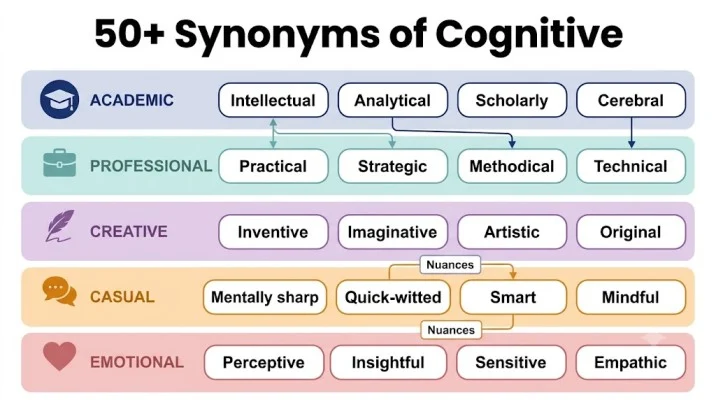
No single synonym works perfectly in every situation because cognitive has multiple shades of meaning. The best choice depends on the specific mental process you are describing.
For Professional Writing:
Use analytical or intellectual. These words sound precise and professional.
For Academic Writing:
Use perceptual, rational, or logical. These words sound scholarly and authoritative.
For Business Communication:
Use mental or intellectual. These words are clear and widely understood.
For Casual Conversation:
Use thinking or reasoning. These words feel natural and accessible.
For Emotional Writing:
Use perceptive or insightful. These words add depth and understanding.
For Creative Writing:
Use rational or contemplative. These words add variety and imagery.
For Resume Writing:
Use analytical or problem-solving. These words highlight valuable skills.
For Workplace Communication:
Use mental or intellectual. These words fit professional discussions.
For Stronger Meaning:
Use rational or logical. These words emphasize careful thinking.
For Softer Meaning:
Use thinking or mental. These words are gentler and more general.
When Not to Use “Cognitive”
Even though cognitive is a useful word, there are times when it is not the best choice.
When the Word Sounds Too Academic:
In casual conversation, cognitive can feel overly technical.
Original:
She has strong cognitive abilities.
Better Recommendation:
Use thinking or reasoning.
Rewritten Sentence:
She has strong thinking skills.
When the Word Sounds Too Formal:
In personal writing, cognitive can feel stiff.
Original:
His cognitive development was remarkable.
Better Recommendation:
Use mental or intellectual.
Rewritten Sentence:
His mental growth was remarkable.
When the Word Sounds Too Broad:
Cognitive is sometimes too general to describe specific mental processes.
Original:
The task requires cognitive effort.
Better Recommendation:
Use analytical or problem-solving.
Rewritten Sentence:
The task requires analytical effort.
When the Word Sounds Too Clinical:
In emotional contexts, cognitive can feel detached.
Original:
She showed cognitive awareness of the situation.
Better Recommendation:
Use perceptive or insightful.
Rewritten Sentence:
She showed insightful awareness of the situation.
Words Commonly Confused With “Cognitive”
Several words are often confused with cognitive because they relate to mental processes.
- Cognitive vs Intellectual
- Difference: Cognitive focuses on mental processes like thinking and learning. Intellectual emphasizes the capacity for deep thinking and knowledge.
- When to Use It: Use cognitive for mental functions. Use intellectual for advanced reasoning and learning.
- Example: Cognitive skills include memory and attention. / Intellectual pursuits include reading and research.
- Cognitive vs Perceptual
- Difference: Cognitive involves higher-level thinking. Perceptual involves processing sensory information.
- When to Use It: Use cognitive for thinking and reasoning. Use perceptual for seeing, hearing, and sensing.
- Example: Cognitive development includes problem-solving. / Perceptual awareness includes recognizing colors.
- Cognitive vs Rational
- Difference: Cognitive is broader. Rational specifically means based on logic and reason.
- When to Use It: Use cognitive for general mental processes. Use rational for logical decision-making.
- Example: Cognitive abilities include memory and learning. / Rational thinking involves careful reasoning.
- Cognitive vs Analytical
- Difference: Cognitive describes all mental processes. Analytical describes breaking down complex information.
- When to Use It: Use cognitive for general thinking. Use analytical for detailed examination.
- Example: Cognitive skills support learning. / Analytical skills help solve complex problems.
- Cognitive vs Logical
- Difference: Cognitive is a broad term. Logical specifically means following clear reasoning.
- When to Use It: Use cognitive for mental processes. Use logical for structured thinking.
- Example: Cognitive development occurs throughout life. / Logical thinking requires structured reasoning.
- Cognitive vs Mental
- Difference: Mental is a broader term that includes emotions and moods. Cognitive focuses on conscious thinking and learning.
- When to Use It: Use mental for general mind-related matters. Use cognitive for specific thinking processes.
- Example: Mental health includes emotional well-being. / Cognitive health focuses on memory and thinking.
Best Synonyms of “Cognitive” by Context
| Context | Best Synonym | Why It Works | Example |
|---|---|---|---|
| Formal Writing | Intellectual | Sounds precise and scholarly | The study examined intellectual development in children. |
| Academic Writing | Perceptual | Sounds precise and scientific | Perceptual reasoning was assessed in the experiment. |
| Professional Communication | Analytical | Sounds skills-oriented | Analytical thinking is valued in leadership. |
| Business Emails | Mental | Clear and professional | The training improves mental agility. |
| Resume Writing | Problem-solving | Highlights valuable skills | Demonstrated strong problem-solving abilities. |
| Workplace Communication | Intellectual | Professional and clear | The role requires intellectual curiosity. |
| Casual Conversation | Thinking | Simple and natural | She has great thinking skills. |
| Everyday Speaking | Reasoning | Clear and accessible | His reasoning is always logical. |
| Creative Writing | Rational | Adds depth and variety | The rational mind seeks answers. |
| Storytelling | Contemplative | Adds emotional depth | His contemplative nature led to discoveries. |
| Emotional Writing | Perceptive | Emphasizes understanding | Her perceptive insights were valuable. |
| Strong Emphasis | Logical | Sounds decisive and clear | Logical reasoning is essential for success. |
| Mild Tone | Mental | Gentle and general | Mental effort is required for this task. |
| Social Media Captions | Thinking | Short and relatable | Thinking about how our minds work. |
How to Choose the Best Synonym of “Cognitive”
Choosing the right synonym depends on several factors. Use this practical guide to make the best decision.
Meaning:
What specific mental process are you describing? Is it thinking, learning, remembering, or problem-solving? Choose a synonym that matches the specific meaning.
Tone:
Do you want to sound formal, casual, or emotional? Formal words like intellectual and analytical fit academic writing. Casual words like thinking fit conversation.
Audience:
Who is reading your writing? Academic readers expect precise vocabulary. Business readers expect professional language. General readers respond better to simple words.
Emotional Strength:
Do you want to emphasize deep understanding? Strong words like rational and logical suggest careful thinking.
Writing Purpose:
Are you writing a research paper, a business report, a blog post, or a social media caption? Match your synonym to the purpose.
Level of Formality:
Consider the formality of your situation. Reports, essays, and official documents require formal synonyms. Blogging and social media allow casual language.
Natural Sounding Usage:
Always read your sentence aloud. If the synonym sounds forced or awkward, choose a different word.
Real Life Examples of “Cognitive”
School Context:
The teacher designed activities to improve cognitive skills in young students.
Stronger Version:
The teacher designed activities to improve thinking skills in young students.
College Context:
The psychology course covered cognitive development across the lifespan.
Stronger Version:
The psychology course covered intellectual development across the lifespan.
Workplace Context:
Employees with strong cognitive abilities adapt quickly to new challenges.
Stronger Version:
Employees with strong analytical abilities adapt quickly to new challenges.
Business Context:
The training program focuses on cognitive skills like memory and attention.
Stronger Version:
The training program focuses on mental skills like memory and attention.
Email Context:
The research team is studying cognitive factors that influence productivity.
Stronger Version:
The research team is studying mental factors that influence productivity.
Resume Context:
Applied cognitive psychology principles to design training materials.
Stronger Version:
Applied psychological principles to design effective training materials.
Conversation Context:
She has always had strong cognitive abilities.
Stronger Version:
She has always had strong thinking abilities.
Storytelling Context:
His cognitive journey led him to understand the world differently.
Stronger Version:
His intellectual journey led him to understand the world differently.
Blogging Context:
Cognitive science reveals how our brains process information.
Stronger Version:
Brain science reveals how our minds process information.
Social Media Context:
Cognitive health matters at every age.
Stronger Version:
Mental health matters at every age.
25 Best Synonyms of “Cognitive”
| Synonym | Simple Meaning | Best Used For | Example Sentence |
|---|---|---|---|
| Intellectual | Relating to the ability to think and understand | Academic, professional | She has strong intellectual abilities. |
| Mental | Relating to the mind | General, casual | Mental health is important for well-being. |
| Analytical | Relating to logical analysis | Professional, resume | He has excellent analytical skills. |
| Rational | Based on reason and logic | Academic, formal | Rational thinking leads to better decisions. |
| Logical | Following clear reasoning | Formal, professional | Logical reasoning is essential in science. |
| Perceptual | Relating to sensory awareness | Academic, scientific | Perceptual skills develop early in childhood. |
| Thinking | Relating to thought processes | Casual, general | She has great thinking skills. |
| Reasoning | Relating to logical thought | General, professional | His reasoning is always sound. |
| Contemplative | Relating to deep thought | Creative, literary | He is a contemplative person. |
| Reflective | Relating to careful thinking | Creative, personal | She is a reflective thinker. |
| Perceptive | Relating to insight and awareness | Emotional, personal | Her perceptive insights were helpful. |
| Insightful | Relating to deep understanding | Emotional, creative | He offered insightful comments. |
| Knowledgeable | Relating to knowledge and learning | Professional, academic | She is a knowledgeable expert. |
| Scholarly | Relating to academic study | Academic, formal | His scholarly work is well regarded. |
| Educated | Relating to learning and knowledge | Professional, general | She is an educated professional. |
| Learned | Relating to deep knowledge | Formal, academic | The learned professor spoke eloquently. |
| Wise | Relating to good judgment | Personal, creative | She is a wise and thoughtful person. |
| Judicious | Relating to good judgment | Formal, professional | His judicious decisions benefited the team. |
| Prudent | Relating to careful judgment | Formal, professional | She made a prudent choice. |
| Sensible | Relating to practical thinking | General, casual | He gave sensible advice. |
| Reasonable | Relating to fair and logical thinking | General, professional | Her approach was reasonable. |
| Clear-thinking | Relating to clarity of thought | Professional, resume | He is a clear-thinking leader. |
| Sharp | Relating to quick thinking | Casual, general | She has a sharp mind. |
| Bright | Relating to intelligence | Casual, general | He is a bright student. |
| Brilliant | Relating to exceptional intelligence | Strong, emotional | Her brilliant ideas changed the project. |
Synonyms of “Cognitive” by Usage
Professional vs Personal Synonyms
Professional Synonyms:
Analytical, intellectual, logical, mental, rational, perceptive.
Why They Work:
These words sound skills-oriented and professional. They fit resumes, business reports, and professional communication.
Personal Synonyms:
Thinking, reasoning, perceptive, insightful, wise.
Why They Work:
These words feel natural in conversation, personal writing, and creative contexts. They focus on understanding and insight.
Formal vs Conversational Synonyms
Formal Synonyms:
Intellectual, rational, perceptual, analytical, logical.
Why They Fit:
These words sound authoritative and precise. They work in academic papers, research reports, and official documents.
Conversational Synonyms:
Thinking, reasoning, mental, smart, bright.
Why They Fit:
These words feel natural in everyday speech, texting, and casual writing.
Academic Synonyms
Recommended Words:
Intellectual, perceptual, rational, analytical, logical.
Why They Work:
These words sound precise and scholarly. They show attention to detail and accurate communication.
Professional and Business Synonyms
Recommended Words:
Analytical, intellectual, mental, rational, logical.
Why They Fit:
These words are specific and professional. They fit business emails, reports, presentations, and resumes.
Creative and Literary Synonyms
Recommended Words:
Contemplative, reflective, perceptive, insightful, wise.
Why They Fit:
These words add emotion, depth, and variety to storytelling, poetry, and descriptive writing.
Modern English Synonyms
Recommended Words:
Thinking, mental, analytical, intellectual, smart.
These words are widely used in modern American English. They are clear, direct, and easy to understand.
Strongest to Mildest Synonyms
Mild (General Awareness):
Mental, thinking, reasoning.
Moderate (Clear Thought):
Analytical, intellectual, perceptive.
Strong (Deep Understanding):
Rational, logical, insightful.
Very Strong (Exceptional Thinking):
Brilliant, wise, scholarly.
Emotional vs Neutral Synonyms
Emotional Synonyms:
Perceptive, insightful, wise, contemplative.
When to Use Emotional Synonyms:
Use them in creative writing, personal reflection, and situations where understanding and empathy matter.
Neutral Synonyms:
Mental, intellectual, analytical, rational, logical.
When to Use Neutral Synonyms:
Use them in professional writing, academic papers, and factual communication.
Antonyms of “Cognitive”
| Antonym | Meaning | Example Sentence |
|---|---|---|
| Noncognitive | Not related to conscious mental processes | Noncognitive skills include emotional intelligence. |
| Emotional | Relating to feelings | Emotional responses differ from cognitive ones. |
| Instinctive | Relating to natural impulses | Instinctive reactions are not cognitive. |
| Intuitive | Relating to instinct rather than logic | Intuitive decisions are not always cognitive. |
| Irrational | Not based on reason | Irrational thinking contradicts cognitive reasoning. |
| Unthinking | Without conscious thought | Unthinking actions are not cognitive. |
| Mindless | Without mental engagement | Mindless activities require no cognitive effort. |
| Physical | Relating to the body | Physical health differs from cognitive health. |
| Behavioral | Relating to observable actions | Behavioral responses are not always cognitive. |
| Automatic | Done without conscious thought | Automatic reactions are not cognitive. |
| Reflexive | Done without thinking | Reflexive movements are not cognitive. |
| Unconscious | Not conscious or aware | Unconscious processes are not cognitive. |
| Subconscious | Below conscious awareness | Subconscious influences affect cognitive thinking. |
| Emotional | Relating to feelings | Emotional intelligence complements cognitive skills. |
| Sensory | Relating to the senses | Sensory input is processed by cognitive systems. |
Comparison: “Cognitive” vs Similar Words
Cognitive vs Intellectual
Main Difference:
Cognitive focuses on mental processes. Intellectual emphasizes capacity for deep thinking and knowledge.
Which Is Stronger?
Intellectual suggests deeper engagement with complex ideas.
Which Is More Formal?
Both are formal. Intellectual is slightly more about personal capacity.
When to Use Each:
Use cognitive for mental functions. Use intellectual for advanced reasoning.
Examples:
Cognitive: Cognitive skills include memory and attention.
Intellectual: Intellectual pursuits include reading and research.
Cognitive vs Perceptual
Main Difference:
Cognitive involves higher-level thinking. Perceptual involves processing sensory information.
Which Is Stronger?
Cognitive is broader. Perceptual is more specific to senses.
Which Is More Formal?
Both are formal and academic.
When to Use Each:
Use cognitive for thinking and reasoning. Use perceptual for seeing, hearing, and sensing.
Examples:
Cognitive: Cognitive development includes problem-solving.
Perceptual: Perceptual awareness includes recognizing colors.
Cognitive vs Rational
Main Difference:
Cognitive is broader. Rational specifically means based on logic and reason.
Which Is Stronger?
Rational suggests stronger reliance on logic.
Which Is More Formal?
Both are formal.
When to Use Each:
Use cognitive for general mental processes. Use rational for logical decision-making.
Examples:
Cognitive: Cognitive abilities include memory and learning.
Rational: Rational thinking involves careful reasoning.
Cognitive vs Analytical
Main Difference:
Cognitive describes all mental processes. Analytical describes breaking down complex information.
Which Is Stronger?
Analytical suggests more specific, detail-oriented thinking.
Which Is More Formal?
Both are formal.
When to Use Each:
Use cognitive for general thinking. Use analytical for detailed examination.
Examples:
Cognitive: Cognitive skills support learning.
Analytical: Analytical skills help solve complex problems.
Cognitive vs Logical
Main Difference:
Cognitive is a broad term. Logical specifically means following clear reasoning.
Which Is Stronger?
Logical suggests structured, systematic thinking.
Which Is More Formal?
Both are formal.
When to Use Each:
Use cognitive for mental processes. Use logical for structured thinking.
Examples:
Cognitive: Cognitive development occurs throughout life.
Logical: Logical thinking requires structured reasoning.
Cognitive vs Mental
Main Difference:
Mental includes emotions and moods. Cognitive focuses on conscious thinking and learning.
Which Is Stronger?
Cognitive is more specific. Mental is broader.
Which Is More Formal?
Cognitive is more formal and academic.
When to Use Each:
Use mental for general mind-related matters. Use cognitive for specific thinking processes.
Examples:
Mental: Mental health includes emotional well-being.
Cognitive: Cognitive health focuses on memory and thinking.
Common Phrases and Expressions with “Cognitive”
| Phrase | Meaning | Example Sentence |
|---|---|---|
| Cognitive abilities | Mental skills like thinking and remembering | The test measures cognitive abilities. |
| Cognitive development | Growth of thinking skills | Cognitive development is rapid in early childhood. |
| Cognitive function | Mental performance | Healthy aging supports cognitive function. |
| Cognitive skills | Thinking skills like reasoning and problem-solving | The training improves cognitive skills. |
| Cognitive dissonance | Mental discomfort from conflicting ideas | She experienced cognitive dissonance about the decision. |
| Cognitive load | Mental effort required | The task created a high cognitive load. |
| Cognitive bias | Systematic error in thinking | Cognitive bias affects decision-making. |
Common Mistakes to Avoid
Choosing a Vague Synonym Instead of a Precise One
Incorrect:
She has good cognitive skills.
Better:
She has strong analytical skills.
Why:
Analytical is more specific about problem-solving abilities.
Confusing “Cognitive” With “Perceptual”
Incorrect:
Cognitive awareness includes seeing colors.
Better:
Perceptual awareness includes seeing colors.
Why:
Perceptual relates to senses. Cognitive relates to thinking.
Using “Cognitive” Too Broadly
Incorrect:
The cognitive issue was a simple misunderstanding.
Better:
The mental issue was a simple misunderstanding.
Why:
Mental is broader and fits casual contexts.
Using an Informal Synonym in Formal Writing
Incorrect:
The study examined thinking abilities.
Better:
The study examined cognitive abilities.
Why:
Thinking is too casual for academic writing.
Selecting an Overly Dramatic Synonym
Incorrect:
Her brilliant cognitive skills were average.
Better:
Her mental skills were average.
Why:
Brilliant is too strong for average abilities.
Repeating the Same Word Too Often
Incorrect:
Cognitive skills are important. Cognitive abilities grow over time. Cognitive development matters.
Better:
Thinking skills are important. Analytical abilities grow over time. Mental development matters.
Why:
Repeating cognitive sounds repetitive. Using synonyms improves flow.
Frequently Asked Questions
What are the best synonyms of “cognitive”?
The best synonyms of cognitive depend on context. Formal writing, use intellectual or analytical. For academic writing, use perceptual or rational. Fasual conversation, use thinking or reasoning. For professional writing, use mental or logical.
What are the best formal synonyms of “cognitive”?
The best formal synonyms of cognitive are intellectual, analytical, rational, and perceptual. These words sound precise and scholarly. They fit academic papers, research reports, and official documents perfectly.
What are common informal synonyms of “cognitive”?
Common informal synonyms of cognitive include thinking, reasoning, mental, and smart. These words are used in casual conversations, texting, and friendly writing. They are simple and natural.
What is another word for “cognitive” in professional writing?
In professional writing, use analytical, mental, or intellectual. These words are specific, clear, and skills-oriented. They fit resumes, business reports, and professional communication perfectly.
What is the difference between “cognitive” and “mental”?
Cognitive focuses on conscious thinking and learning processes. Mental includes all mind-related matters, including emotions and moods. Use cognitive for specific mental functions. Use mental for broader mind-related topics.
What is the opposite of “cognitive”?
The opposite of cognitive is noncognitive. Other antonyms include emotional, instinctive, intuitive, irrational, unthinking, and physical. Choose the most accurate opposite based on the context.
Conclusion
Cognitive is a precise and important word, but overusing it makes your writing feel repetitive and overly academic. The best synonyms of cognitive help you communicate clearly, match the right tone, and avoid repetition. Whether you write a research paper, a business report, a personal reflection, or a social media post, there is a perfect synonym for every situation.
Remember that no synonym works perfectly in every context. Choose words based on your audience, your purpose, and the specific mental process you are describing. The more you practice choosing the right synonym, the more natural and confident your writing will become. A strong vocabulary helps you connect with readers, express your ideas clearly, and make a lasting impression.
Definitions, meanings, and usage recommendations should be verified with trusted language references before publication. Recommended sources include Cambridge Dictionary, Oxford English Dictionary, Merriam Webster, Collins Dictionary, and Britannica.
Read More Related Articles:
Synonyms for Thus | Meaning, Examples, and Better Word …
50+ Synonyms of Significant | Meanings, Uses, Examples, and …
50+ Synonyms of To | Meanings, Uses, Examples, and Best …