A writer may use the word “significant” several times in an essay, report, email, or blog post and then realize that every sentence sounds nearly the same. That is where knowing the synonyms of significant becomes useful. The right alternative can make a sentence more precise without changing its intended meaning.
Not every synonym carries the same level of importance, formality, or emotion. Words such as “substantial,” “notable,” “crucial,” “meaningful,” and “considerable” each emphasize a slightly different idea. Choosing the right one helps your writing sound natural, clear, and appropriate for the audience.
What Are the Best Synonyms of “Significant”?
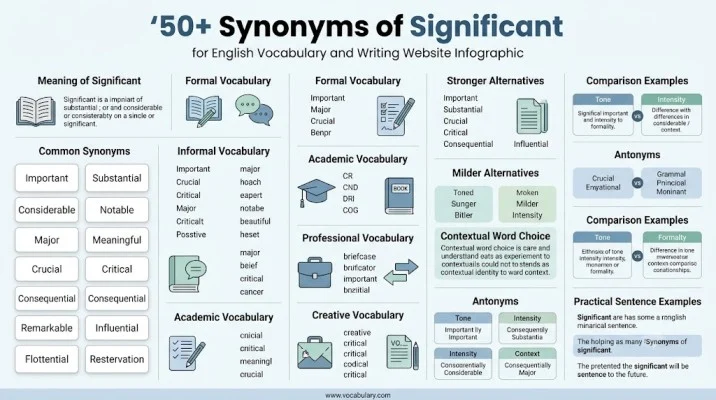
The best synonyms of significant include important, meaningful, notable, substantial, considerable, major, consequential, remarkable, and influential. For academic writing, use “substantial” or “notable.” For professional writing, “important,” “key,” or “considerable” often works well. Stronger emphasis, choose “crucial,” “major,” or “momentous.”
Meaning, Tone, and Context
Simple Definition
Significant generally describes something that is important, noticeable, meaningful, or large enough to matter. The exact meaning depends on context.
For example, “a significant achievement” means an achievement that is important or impressive. “A significant increase in sales” means the increase was large enough to matter. In research, “statistically significant” has a specialized technical meaning and should not automatically be replaced with “important.”
Part of Speech
Significant is an adjective.
It describes nouns such as:
- significant change
- significant achievement
- significant difference
- significant increase
- significant impact
- significant event
- significant contribution
- significant problem
- significant amount
- significant development
Overall Tone
The word significant is generally neutral to positive, depending on the noun it describes.
For example:
“She made a significant contribution to the project.”
This sounds positive.
However:
“The company experienced a significant loss.”
This is neutral in tone but describes a negative situation.
Formality Level
Significant is a neutral to formal word. It works naturally in:
- Academic papers
- Research reports
- Business documents
- Professional emails
- News writing
- Essays
- Presentations
- Everyday communication
It is especially common in academic and professional writing because it can express importance or measurable difference without sounding overly emotional.
Common Uses
Native English speakers commonly use significant when describing:
- Important events
- Major changes
- Large differences
- Meaningful achievements
- Noticeable effects
- Serious problems
- Valuable contributions
- Historical developments
- Financial changes
- Research findings
The word is particularly useful when you want to emphasize that something deserves attention without using an extremely strong expression.
Word Forms
| Word | Form | Example |
|---|---|---|
| Significant | Adjective | The project had a significant impact. |
| Significance | Noun | The discovery has historical significance. |
| Significantly | Adverb | Sales increased significantly. |
| Insignificant | Adjective | The difference was insignificant. |
| Insignificance | Noun | The change was dismissed because of its insignificance. |
When and How to Use “Significant”
Use significant when something has enough importance, size, influence, or meaning to deserve attention. It is particularly useful when “important” feels too general or when you want a more precise professional or academic tone.
Professional
“The new policy represents a significant improvement in workplace safety.”
Here, “significant” indicates that the improvement is meaningful and worth recognizing.
Academic
“The researchers observed a significant difference between the two groups.”
This is appropriate academic language. However, when discussing statistics, “significant” may have a specific technical meaning, so the surrounding evidence matters.
Workplace
“Her feedback made a significant contribution to the final proposal.”
The word emphasizes the value of her contribution.
Personal
“Moving to a new city was a significant change in my life.”
Here, “significant” communicates personal importance without sounding overly emotional.
“Please review the significant updates included in the attached report.”
The word draws attention to changes that matter.
Resume
“Led a significant expansion of the company’s customer support operations.”
In a resume, “significant” can emphasize the scale or impact of an accomplishment.
Social Media
“Today marks a significant milestone in my professional journey.”
This sounds polished while still being natural for a social media caption.
Best Synonyms of “Significant”
No synonym perfectly replaces significant in every sentence. The best choice depends on whether you mean important, large, noticeable, influential, emotionally meaningful, or historically important.
Professional Writing: Important
Important is a straightforward alternative when “significant” means something has value or deserves attention.
Example:
“Clear communication is important for successful teamwork.”
This is more general than “significant,” but it is natural and easy to understand.
Academic Writing: Substantial
Substantial works well when you want to emphasize a considerable amount, degree, or effect.
Example:
“The study found a substantial improvement in reading performance.”
It is especially useful when the subject involves measurable change.
Business Communication: Considerable
Considerable emphasizes a fairly large amount, degree, or effect.
Example:
“The company has made considerable progress during the past year.”
It sounds professional without overstating the result.
Casual Conversation: Major
Major is natural when speaking about something important, serious, or large.
Example:
“Getting that promotion was a major achievement.”
It is more conversational than “significant.”
Emotional Writing: Meaningful
Meaningful is a strong choice when the importance comes from personal or emotional value.
Example:
“Her message was especially meaningful to me.”
Creative Writing: Remarkable
Remarkable suggests that something is unusual, impressive, or worthy of attention.
Example:
“It was a remarkable transformation that changed the entire community.”
Resume Writing: Key
Key is concise and highly useful when describing an important responsibility, role, skill, or contribution.
Example:
“Played a key role in developing the company’s customer retention strategy.”
Workplace Communication: Crucial
Crucial is appropriate when something is extremely important to success or an outcome.
Example:
“Accurate reporting is crucial to making informed decisions.”
Stronger Meaning: Crucial
When “significant” is not strong enough, crucial indicates that something may determine success or failure.
Example:
“Effective planning was crucial to completing the project on time.”
Softer Meaning: Notable
Notable is useful when something deserves attention but you do not want to suggest that it is extremely important.
Example:
“The company made notable improvements in customer service.”
When Not to Use “Significant”
Although significant is versatile, it can sometimes be less effective than a more specific word.
When the Word Is Too General
If you simply say something is significant, readers may still wonder why it matters.
Less precise:
“The meeting was significant.”
Better:
“The meeting was crucial to resolving the contract dispute.”
The second sentence explains the actual importance.
When You Mean Something Is Absolutely Necessary
“Significant” does not necessarily mean necessary.
Less effective:
“Safety equipment is significant for laboratory work.”
Better:
“Safety equipment is essential for laboratory work.”
“Essential” clearly communicates necessity.
When You Mean Something Is Extremely Important
If the situation involves serious consequences, “significant” may be too mild.
Less effective:
“The deadline is significant.”
Better:
“The deadline is critical.”
When You Mean Something Is Emotionally Valuable
“Significant” can sound distant when describing personal feelings.
Less effective:
“Your support has been significant to me.”
Better:
“Your support has been meaningful to me.”
When You Mean Something Is Large in Amount
“Significant” can describe a large amount, but another word may be more precise.
Less effective:
“The company received a significant amount of funding.”
Better:
“The company received a substantial amount of funding.”
When You Mean Something Is Unusual or Impressive
If your main point is that something stands out, “remarkable” may work better.
Less effective:
“She achieved a significant result.”
Better:
“She achieved a remarkable result.”
When You Are Discussing Statistical Significance
Do not automatically replace statistically significant with “important.”
In research writing, “statistically significant” refers to a technical statistical conclusion, not simply something that matters. A statistically significant result can have a small practical effect, so the two ideas should be kept separate.
Words Commonly Confused With “Significant”
Important
Difference: Important focuses directly on value or importance, while significant can also mean noticeable, substantial, or meaningful.
When to Use It: Use “important” when you simply want to say that something matters.
Example: “Good communication is important in every workplace.”
Substantial
Difference: Substantial often emphasizes size, amount, degree, or strength.
When to Use It: Use it when something is considerably large or meaningful in scale.
Example: “The company made a substantial investment in new technology.”
Notable
Difference: Notable means worthy of attention or notice. It does not always imply major importance.
When to Use It: Use it for achievements, changes, characteristics, or events that stand out.
Example: “The report includes several notable findings.”
Crucial
Difference: Crucial is stronger than significant when something is essential to an outcome.
When to Use It: Use it when success or failure depends heavily on something.
Example: “Trust is crucial to a successful partnership.”
Meaningful
Difference: Meaningful focuses on personal, emotional, or deeper value.
When to Use It: Use it for relationships, experiences, achievements, conversations, and memories.
Example: “The award was meaningful because of the people who supported her.”
Consequential
Difference: Consequential emphasizes results or consequences that follow from an action or event.
When to Use It: Use it when discussing decisions, policies, events, or actions with important effects.
Example: “The decision had consequential effects on the local economy.”
Best Synonyms of “Significant” by Context
| Context | Best Synonym | Why It Works | Example |
|---|---|---|---|
| Formal writing | Substantial | Sounds precise and professional | The project required substantial funding. |
| Academic writing | Significant | Fits objective academic discussion | The study found a significant difference. |
| Professional communication | Important | Clear and broadly understood | This is an important consideration. |
| Business emails | Key | Concise and professional | Please review the key changes. |
| Resume writing | Key | Highlights major contributions | Played a key role in the launch. |
| Workplace communication | Crucial | Shows high priority | Clear communication is crucial. |
| Casual conversation | Major | Natural in everyday speech | That was a major achievement. |
| Everyday speaking | Important | Simple and familiar | Family is important to me. |
| Creative writing | Remarkable | Adds expressive emphasis | It was a remarkable journey. |
| Storytelling | Momentous | Suggests major lasting importance | It was a momentous day for the family. |
| Emotional writing | Meaningful | Communicates personal value | Her words were meaningful. |
| Strong emphasis | Crucial | Signals very high importance | Timing was crucial to the outcome. |
| Mild tone | Notable | Draws attention without exaggeration | The report showed notable progress. |
| Social media captions | Major | Sounds natural and engaging | A major milestone for our team. |
| American English | Important | Very common and natural | This is an important issue. |
| British English | Significant | Equally natural in formal usage | The decision had significant consequences. |
How to Choose the Best Synonym of “Significant”
Choosing a synonym is not simply about finding a word that appears in a thesaurus. You need to identify the exact idea you want to communicate.
Choose Based on Meaning
Ask what “significant” means in your sentence.
If you mean important, use:
important, key, major
If you mean large in amount, use:
substantial, considerable, sizable
If you mean worthy of attention, use:
notable, remarkable
If you mean extremely important, use:
crucial, vital, critical
If you mean emotionally valuable, use:
meaningful, memorable
If you mean having important consequences, use:
consequential, influential
Choose Based on Tone
A formal report might say:
“The company experienced a substantial increase in revenue.”
A casual conversation might say:
“The company had a major increase in revenue.”
The basic idea is similar, but the tone changes.
Choose Based on Audience
- For students, teachers, and academic readers, substantial, notable, and considerable can provide useful precision.
- For business audiences, key, critical, strategic, and substantial often communicate priorities effectively.
- For everyday conversations, important, major, and big usually sound more natural.
Choose Based on Emotional Strength
If you want mild emphasis, choose notable.
- For moderate emphasis, choose major or considerable.
- For strong emphasis, choose crucial or critical.
- For emotional importance, choose meaningful.
Choose Based on Writing Purpose
Essay: Significant, substantial, notable
Research paper: Significant, substantial, consequential
Resume: Key, major, influential
Business email: Important, key, critical
Conversation: Important, major, big
Storytelling: Remarkable, momentous, memorable
Check Natural Usage
A synonym may be technically related to “significant” but still sound unnatural in a particular sentence.
For example:
“The color of the wall was crucial.”
This sounds strange unless the color genuinely affects an important outcome.
“The color of the wall was notable.”
This may work if the unusual color is relevant to the story.
The strongest synonym is not always the most dramatic one. It is the word that accurately communicates your intended meaning.
Real Life Examples of “Significant”
School
Original:
“The student’s improvement was significant.”
Improved:
“The student’s improvement was substantial, especially in reading comprehension.”
“Substantial” works because the sentence focuses on the degree of improvement.
College
Original:
“This research is significant.”
Improved:
“This research is important because it provides new evidence about student learning.”
The second version explains the importance rather than simply labeling the research significant.
Workplace
Original:
“Her contribution was significant.”
Improved:
“Her contribution was key to completing the project on schedule.”
“Key” clearly explains her role.
Business
Original:
“The company experienced a significant increase in sales.”
Improved:
“The company experienced a substantial increase in sales.”
“Substantial” emphasizes the size of the increase.
Original:
“We have made significant changes to the policy.”
Improved:
“We have made important changes to the policy that will affect all employees.”
“Important” is direct and easy to understand in workplace communication.
Resume
Original:
“Made a significant contribution to the marketing team.”
Improved:
“Played a key role in developing campaigns that increased customer engagement.”
The revised version is more specific and accomplishment focused.
Conversation
Original:
“That was a significant moment.”
Improved:
“That was a major moment for our family.”
“Major” sounds more natural in casual speech.
Storytelling
Original:
“The decision was significant.”
Improved:
“The decision became a momentous turning point in her life.”
“Momentous” adds stronger narrative weight.
Blogging
Original:
“Mobile traffic has had a significant effect on website design.”
Improved:
“Mobile traffic has had a major effect on how websites are designed.”
“Major” provides a direct and accessible style for general readers.
Social Media
Original:
“This is a significant milestone.”
Improved:
“This is a major milestone, and I’m proud of how far we’ve come.”
“Major” creates a warmer, more conversational social media tone.
25 Best Synonyms of “Significant”
| Synonym | Simple Meaning | Best Used For | Example Sentence |
|---|---|---|---|
| Important | Having value or importance | General writing | This is an important decision for the team. |
| Substantial | Large or considerable in amount or degree | Academic and professional writing | The company made a substantial investment. |
| Considerable | Fairly large or noteworthy | Reports and business writing | The project required considerable effort. |
| Notable | Worth noticing or remembering | Academic and general writing | The study produced several notable findings. |
| Major | Very important, large, or serious | General and professional writing | The company announced a major change. |
| Meaningful | Having personal or emotional value | Personal and creative writing | Her advice was deeply meaningful to me. |
| Crucial | Extremely important to an outcome | Business and professional writing | Timing was crucial to the project’s success. |
| Critical | Extremely important or urgent | Workplace and high stakes situations | Accurate data is critical to the analysis. |
| Vital | Necessary for success or continued operation | Professional and general writing | Trust is vital to a healthy relationship. |
| Consequential | Producing important results or effects | Formal and academic writing | The decision had consequential effects. |
| Remarkable | Unusual or impressive enough to notice | Creative and descriptive writing | She made remarkable progress. |
| Momentous | Extremely important because of lasting effects | History and storytelling | It was a momentous occasion for the nation. |
| Influential | Having the power to affect people or events | Leadership and history | He became an influential voice in education. |
| Prominent | Important, well known, or noticeable | People, organizations, and features | She is a prominent researcher in the field. |
| Valuable | Worth a great deal or useful | Skills, advice, and resources | His experience was valuable to the company. |
| Fundamental | Basic and essential to something | Academic and educational writing | Trust is fundamental to effective leadership. |
| Pivotal | Extremely important because it changes an outcome | Business and storytelling | Her decision was pivotal to the company’s future. |
| Paramount | More important than anything else | Formal writing | Public safety remains paramount. |
| Imperative | Absolutely necessary | Formal and professional writing | Immediate action is imperative. |
| Indispensable | So useful or necessary that it cannot be replaced | Professional writing | Her expertise became indispensable to the team. |
| Meaningful | Important because it has emotional or personal value | Personal writing | The conversation was meaningful for both of them. |
| Memorable | Worth remembering because of its importance or impact | Storytelling and events | Graduation was a memorable experience. |
| Central | At the core of an issue or situation | Academic and professional writing | Communication is central to effective teamwork. |
| Primary | First or greatest in importance | Reports and business writing | Our primary goal is customer satisfaction. |
| Strategic | Important because it supports a planned objective | Business writing | The company made a strategic investment. |
Synonyms of “Significant” by Usage
Professional vs Personal Synonyms
Professional writing usually benefits from words that communicate importance objectively.
Use:
- Significant
- Substantial
- Considerable
- Critical
- Key
- Strategic
- Consequential
Personal writing often benefits from words that communicate emotional value.
Use:
- Meaningful
- Memorable
- Important
- Special
- Remarkable
For example:
Professional:
“The change had a significant effect on productivity.”
Personal:
“The experience was meaningful to me.”
Both sentences describe something that matters, but they communicate different kinds of importance.
Formal vs Conversational Synonyms
Formal settings favor precise vocabulary.
Reports
Use significant, substantial, considerable, consequential.
Essays
Use significant, substantial, notable, fundamental.
Business Writing
Use significant, key, critical, strategic.
Presentations
Use key, major, significant, substantial.
Emails
Use important, significant, key, critical, depending on urgency.
Casual Conversations
Use important, major, big, meaningful.
Texting
Use important, major, big, or conversational expressions such as “a big deal.”
The simpler word is often the better choice in casual communication.
Academic Synonyms
Academic writing requires careful distinctions between importance, size, evidence, and statistical results.
Significant
Use when discussing an important or measurable finding.
Example:
“The researchers identified a significant difference between the groups.”
Substantial
Use when describing a large amount or degree.
Example:
“The program resulted in substantial improvements in attendance.”
Notable
Use when highlighting a finding that deserves attention.
Example:
“One notable finding was the difference in reading habits.”
Considerable
Use when emphasizing a fairly large amount or degree.
Example:
“The participants demonstrated considerable improvement.”
Consequential
Use when discussing effects or outcomes.
Example:
“The policy produced consequential changes in the education system.”
Fundamental
Use when describing a basic principle that supports a larger concept.
Example:
“Access to reliable information is fundamental to effective research.”
A useful academic writing rule is to avoid using “significant” simply because it sounds formal. Select it when the context genuinely supports importance, meaningful difference, or measurable effect.
Professional and Business Synonyms
Resumes
Use key, major, strategic, influential when describing responsibilities or accomplishments.
Example:
“Played a key role in improving customer retention.”
Interviews
Use important, significant, valuable, crucial when explaining why an experience matters.
Example:
“That experience was significant because it taught me how to manage complex projects.”
Meetings
Use key, critical, important when identifying priorities.
Example:
“Let’s focus on the key issues before making a decision.”
Presentations
Use significant, major, substantial, strategic when discussing trends and outcomes.
Example:
“The company experienced substantial growth during the second quarter.”
Performance Reviews
Use valuable, significant, key, notable when describing contributions.
Example:
“She made a significant contribution to improving team efficiency.”
Client Communication
Use important, significant, critical, essential according to the level of urgency.
Example:
“This is an important update regarding your account.”
Business Emails
Use key for concise emphasis.
Example:
“Below are the key points discussed during today’s meeting.”
Use critical only when the matter genuinely requires serious or immediate attention.
Creative and Literary Synonyms
Creative writing allows more expressive alternatives than ordinary professional writing.
Remarkable
Use when something is unusually impressive.
“The old house had a remarkable history.”
Momentous
Use when an event has lasting consequences.
“It was a momentous day for the entire community.”
Memorable
Use when an experience stays in someone’s memory.
“Their final conversation was unforgettable and memorable.”
Meaningful
Use when an event or relationship has emotional significance.
“Her letter became one of the most meaningful gifts he had ever received.”
Pivotal
Use when an event changes the direction of a story.
“That encounter became a pivotal moment in his career.”
Influential
Use when a person or idea shapes other people or events.
“Her writing became influential among a new generation of readers.”
These words should support the story rather than simply replace “significant.” Creative writing is strongest when the chosen word adds a specific shade of meaning.
Slang or Modern Synonyms
There is no single slang word that perfectly replaces significant in every situation. However, casual English often uses expressions such as big and a big deal.
Big
Meaning: Important, serious, or substantial.
Acceptable in:
- Casual conversation
- Text messages
- Social media
- Informal storytelling
Avoid in:
- Academic papers
- Formal reports
- Professional documents when precision matters
Example:
“Getting that job was a big deal for her.”
A Big Deal
Meaning: Something considered especially important.
Acceptable in casual communication.
Example:
“Winning the competition was a big deal for the entire team.”
Avoid it in formal academic or business writing.
Strongest to Mildest Synonyms
There is no universal intensity scale because the synonyms emphasize different aspects of meaning. However, a useful practical scale is:
Mild
Notable, valuable
These words indicate that something deserves attention or has worth.
Moderate
Important, considerable, major, meaningful
These communicate clear importance without necessarily suggesting extreme urgency.
Strong
Significant, substantial, influential, consequential
These emphasize meaningful impact, scale, or effects.
Very Strong
Crucial, critical, vital, pivotal, paramount, indispensable
These suggest that something has an especially high level of importance or may determine an outcome.
For example:
- “Her advice was notable.”
- “Her advice was important.”
- “Her advice was significant.”
- “Her advice was crucial.”
Each sentence increases the emphasis, but the exact meaning changes depending on context.
Emotional vs Neutral Synonyms
Emotional Synonyms
These alternatives add personal feeling or expressive force.
Meaningful: emphasizes personal value.
Memorable: emphasizes lasting emotional impact.
Remarkable: expresses admiration or surprise.
Momentous: adds a sense of historical or life changing importance.
Precious: emphasizes deep personal value, although it is not a universal synonym for significant.
These words work well in personal essays, speeches, stories, tributes, and social media posts.
Neutral Synonyms
These communicate importance without strong emotion.
Important
Significant
Substantial
Considerable
Notable
Major
Key
These are generally better for reports, essays, business communication, and factual explanations.
Antonyms of “Significant”
| Antonym | Meaning | Example Sentence |
|---|---|---|
| Unimportant | Not important or valuable | The detail was unimportant to the final decision. |
| Insignificant | Too small or unimportant to matter | The difference was insignificant. |
| Minor | Less important or serious | The project experienced a minor delay. |
| Trivial | Of little importance or value | They spent the meeting discussing a trivial issue. |
| Inconsequential | Having little or no meaningful effect | The mistake was inconsequential. |
| Irrelevant | Not connected to the matter being discussed | That information is irrelevant to the question. |
| Negligible | So small that it has little practical effect | The additional cost was negligible. |
| Meaningless | Having no meaningful purpose or significance | Without context, the statement seemed meaningless. |
| Ordinary | Not unusual, special, or noteworthy | It appeared to be an ordinary day. |
| Commonplace | Very common and therefore not especially notable | Such problems are commonplace in large organizations. |
| Secondary | Less important than something else | The secondary issue can be addressed later. |
| Superficial | Lacking depth or real importance | The review offered only superficial observations. |
| Worthless | Having no useful or valuable quality | The damaged document was worthless for the investigation. |
| Unremarkable | Not unusual or worthy of special attention | The first part of the trip was unremarkable. |
| Nonessential | Not necessary for the main purpose | Decorative features are nonessential to the design. |
Comparison: “Significant” vs Similar Words
Significant vs Important
Main Difference
Significant can mean important, but it can also describe something noticeable, substantial, or measurable. Important focuses more directly on value or importance.
Which Is Stronger?
Neither is always stronger. “Significant” often sounds more formal and precise, while “important” is broader and more familiar.
Which Is More Formal?
Significant generally sounds more formal.
When to Use Each
Use “important” for simple communication. Use “significant” when you want to emphasize impact, scale, or meaningful difference.
Examples
Significant:
“The study found a significant difference between the two groups.”
Important:
“Good communication is important for a healthy relationship.”
Significant vs Substantial
Main Difference
Significant can emphasize importance or noticeable difference. Substantial usually emphasizes size, amount, degree, or strength.
Which Is Stronger?
It depends on context. “Substantial” is stronger when discussing quantity or scale.
Which Is More Formal?
Both are formal enough for academic and professional writing.
When to Use Each
Use “substantial” for large amounts or major degrees. Use “significant” when importance or impact is the main idea.
Examples
Significant:
“The policy had a significant effect on employment.”
Substantial:
“The company received substantial financial support.”
Significant vs Notable
Main Difference
Significant often suggests real importance or impact. Notable mainly means worthy of attention.
Which Is Stronger?
“Significant” generally suggests greater importance.
Which Is More Formal?
Both work well in formal writing.
When to Use Each
Use “notable” when you want to point out something interesting or distinctive without overstating its importance.
Examples
Significant:
“The discovery had significant consequences.”
Notable:
“The report contains several notable observations.”
Significant vs Crucial
Main Difference
Crucial indicates extremely high importance, often because an outcome depends on it.
Which Is Stronger?
Crucial is stronger.
Which Is More Formal?
Both are appropriate in professional and academic contexts.
When to Use Each
Use “crucial” when something is essential to success, failure, safety, or another important outcome.
Examples
Significant:
“The decision had significant consequences.”
Crucial:
“Accurate information was crucial to making the decision.”
Significant vs Meaningful
Main Difference
Significant often focuses on importance, impact, or measurable difference. Meaningful focuses more on personal, emotional, or deeper value.
Which Is Stronger?
Neither is universally stronger. The words emphasize different types of importance.
Which Is More Formal?
“Significant” is generally more formal and objective.
When to Use Each
Use “meaningful” for experiences, relationships, conversations, and personal achievements.
Examples
Significant:
“The event was significant in the company’s history.”
Meaningful:
“The award was meaningful to everyone involved.”
Significant vs Consequential
Main Difference
Significant can describe importance or noticeable difference. Consequential specifically emphasizes important effects or results.
Which Is Stronger?
“Consequential” can sound stronger when the focus is on outcomes.
Which Is More Formal?
Consequential is more formal and is especially useful in analytical writing.
When to Use Each
Use “consequential” when an action, decision, or event produces important results.
Examples
Significant:
“The change was significant.”
Consequential:
“The decision had consequential effects on the organization.”
Common Phrases and Expressions with “Significant”
Significant Difference
Meaning: A difference that is important, noticeable, or, in research, statistically meaningful according to a specified test.
Example:
“The researchers found a significant difference in test performance.”
Significant Impact
Meaning: A strong or meaningful effect on something.
Example:
“The new policy had a significant impact on employee satisfaction.”
Significant Change
Meaning: A noticeable or important alteration.
Example:
“The company has undergone significant changes since last year.”
Significant Increase
Meaning: A noticeable or considerable rise.
Example:
“The business reported a significant increase in online sales.”
Significant Decrease
Meaning: A noticeable or considerable reduction.
Example:
“The organization recorded a significant decrease in operating costs.”
Significant Contribution
Meaning: A valuable or important contribution.
Example:
“She made a significant contribution to the research project.”
Significant Role
Meaning: An important part or responsibility.
Example:
“The organization played a significant role in supporting local businesses.”
Significant Milestone
Meaning: An important stage or achievement.
Example:
“Graduating from college was a significant milestone in his life.”
Common Mistakes to Avoid
Mistake 1: Treating Every Synonym as Identical
Incorrect:
“The safety equipment was notable for laboratory work.”
Better:
“The safety equipment was essential for laboratory work.”
Why:
“Notable” means worthy of attention, while “essential” means necessary. The second word communicates the intended meaning more accurately.
Mistake 2: Using “Significant” When You Mean “Necessary”
Incorrect:
“Training is significant for new employees.”
Better:
“Training is essential for new employees.”
Why:
The sentence describes a requirement, so “essential” is more precise.
Mistake 3: Using “Crucial” for Ordinary Situations
Incorrect:
“Choosing a font for the presentation was crucial.”
Better:
“Choosing a font for the presentation was important.”
Why:
“Crucial” suggests very high stakes. Using it for minor matters can make writing sound exaggerated.
Mistake 4: Using Informal Words in Formal Writing
Incorrect:
“The company had a big improvement in efficiency.”
Better:
“The company made a substantial improvement in efficiency.”
Why:
“Big” is natural in conversation but less precise for formal business writing.
Mistake 5: Confusing Statistical Significance With Practical Importance
Incorrect:
“The result was statistically significant, so it must have been practically important.”
Better:
“The result was statistically significant, although its practical effect was limited.”
Why:
Statistical significance and practical importance are related but not identical concepts.
Mistake 6: Repeating “Significant” Too Often
Incorrect:
“The study found a significant increase and a significant improvement in significant areas.”
Better:
“The study found a substantial increase and a notable improvement in several key areas.”
Why:
Using precise alternatives improves flow and prevents repetitive writing.
Mistake 7: Choosing an Emotional Word for an Objective Statement
Incorrect:
“The report contained meaningful statistical results.”
Better:
“The report contained significant statistical results.”
Why:
“Meaningful” can suggest personal or emotional value. “Significant” is more appropriate for an objective research context.
Frequently Asked Questions
1. What are the best synonyms of “significant”?
The best synonyms of significant include important, substantial, considerable, notable, major, meaningful, crucial, critical, consequential, remarkable, and influential. The best option depends on whether you mean importance, size, impact, or emotional value.
2. What are the best formal synonyms of “significant”?
Formal synonyms include substantial, considerable, consequential, notable, fundamental, pivotal, and momentous. Academic and professional writers should select the word that matches the exact meaning rather than choosing the most formal sounding option.
3. What are common informal synonyms of “significant”?
Common informal alternatives include important, major, big, and a big deal. “Important” works in most everyday situations, while “big” and “a big deal” are more conversational and should generally be avoided in formal writing.
4. What is another word for “significant” in professional writing?
In professional writing, useful alternatives include important, key, substantial, considerable, critical, strategic, and consequential. Choose “key” for concise business communication and “substantial” when emphasizing size or degree.
5. What is the difference between “significant” and “important”?
“Significant” can mean important, but it can also describe something noticeable, substantial, or measurable. “Important” is broader and more familiar, while “significant” often sounds more precise in academic and professional contexts.
6. What is the opposite of “significant”?
Common opposites include insignificant, unimportant, minor, trivial, inconsequential, negligible, irrelevant, and unremarkable. The best antonym depends on whether you mean low importance, small size, limited effect, or lack of relevance.
Conclusion
Significant is a flexible word that can describe something important, noticeable, substantial, meaningful, or influential. Its best synonym depends on the exact idea you want to communicate.
For academic and formal writing, substantial, considerable, notable, consequential, and fundamental are useful choices. In professional communication, important, key, critical, strategic, and substantial often work well. For casual and personal writing, major, meaningful, memorable, and remarkable may sound more natural.
There is no single synonym that works perfectly in every situation. The strongest word is the one that matches your audience, purpose, tone, and intended meaning. As a simple vocabulary habit, identify what you really mean before replacing a repeated word. Ask whether you mean importance, size, urgency, impact, or emotional value, then choose the synonym that expresses that idea most precisely.
Using the synonyms of significant thoughtfully can make your writing clearer, more varied, and more effective without making it unnecessarily complicated.
Read More Related Articles:
Synonyms for Empty | Meaning, Examples, and Better Word …
Synonyms for Pros and Cons | Meaning, Examples, and Better …











1 thought on “50+ Synonyms of Significant | Meanings, Uses, Examples, and Best Alternatives”