A single grammar term can make a sentence feel more complicated than it really is. When students, teachers, writers, or English learners search for synonyms of infinitive, they are often looking for a clearer way to understand or describe the infinitive form in different grammatical contexts. The right terminology can make explanations, essays, lesson plans, and grammar notes much easier to follow.
An infinitive is usually the base form of a verb, commonly used with to, as in to read, to learn, or to improve. However, not every word that looks like an infinitive has the same grammatical function. That is why finding an infinitive synonym requires attention to context rather than simply replacing one word with another. The phrase infinitive synonyms may also appear in searches from learners who want alternative grammatical terms, while the misspelled form infinitiv synonym reflects the same search intent. Understanding these distinctions helps you choose accurate grammar terminology with confidence.
What Are the Best Synonyms of “Infinitive”?
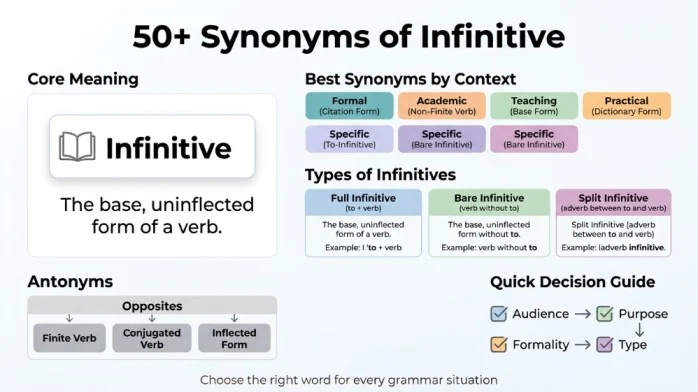
There are no true synonyms for the grammatical term infinitive. Instead, writers and teachers often use related expressions such as to-infinitive, bare infinitive, base verb form, verb base form, or infinitive verb, depending on the grammatical context. The best alternative depends on what aspect of the infinitive you are describing.
Meaning, Tone, and Context
Simple Definition
An infinitive is the basic form of a verb. In English, it most commonly appears with the word to, such as to read, to write, or to learn. In some grammatical structures, the infinitive appears without to, which is called the bare infinitive.
Part of Speech
Infinitive is a noun when referring to the grammatical concept.
Overall Tone
The word has a neutral, technical, and educational tone.
Formality Level
It is considered formal because it belongs to grammatical and linguistic terminology. Native English speakers usually encounter it in classrooms, textbooks, grammar guides, dictionaries, and academic writing.
Common Uses
The term infinitive commonly appears in:
- English grammar lessons
- School assignments
- Academic papers
- Linguistics discussions
- Teaching materials
- ESL and EFL classrooms
- Grammar reference books
- Language learning websites
Word Forms
| Word Form | Example |
|---|---|
| Noun | infinitive |
| Adjective | infinitival |
| Related Form | infinitive phrase |
| Related Form | bare infinitive |
| Related Form | to-infinitive |
When and How to Use “Infinitive”
Use infinitive whenever you are discussing English grammar rather than everyday vocabulary.
Professional
“The training manual explains how the infinitive functions after modal verbs.”
Academic
“The professor compared finite verbs with the infinitive during today’s lecture.”
Workplace
“Our content editor corrected the grammar by replacing the incorrect verb form with the proper infinitive.”
Personal
“I’m finally learning how the infinitive works in English.”
“Please review the section explaining the infinitive before tomorrow’s workshop.”
Resume
“Studied advanced English grammar, including verb tenses and the infinitive.”
Social Media
“Today’s grammar tip: knowing when to use the infinitive makes your English sound much more natural.”
Best Synonyms of “Infinitive”
Unlike everyday vocabulary, infinitive does not have exact synonyms. However, several closely related grammatical terms are commonly used depending on the context.
Academic Writing: To-Infinitive
Use to-infinitive when referring specifically to verb forms beginning with to.
Example
“Students learned how the to-infinitive functions as a noun.”
Why it works
It is the most precise academic term.
Grammar Instruction: Bare Infinitive
Use bare infinitive for verbs that appear without to.
Example
“Modal verbs are followed by the bare infinitive.”
Why it works
It accurately identifies a specific grammatical structure.
Educational Writing: Base Verb Form
This expression helps beginners understand that the infinitive uses the verb’s basic form.
Example
“The base verb form appears after certain helping verbs.”
Why it works
It is easier for English learners to understand.
ESL Teaching: Verb Base Form
Many English teachers use this phrase in beginner classrooms.
Example
“Choose the correct verb base form after ‘can.'”
Why it works
It simplifies grammar explanations.
Grammar Reference: Infinitive Verb
Although less precise, this expression is frequently used in educational resources.
Example
“Underline every infinitive verb in the paragraph.”
Why it works
It is familiar to many students.
Linguistics: Infinitival Form
This technical term appears mainly in linguistic research.
Example
“The sentence contains an infinitival form functioning as a complement.”
Why it works
It is appropriate for advanced grammar discussions.
When Not to Use “Infinitive”
Although infinitive is the correct grammatical term in many situations, it is not always the most appropriate word. In teaching, editing, or everyday communication, a more specific or simpler expression often provides greater clarity.
When Your Audience Is New to Grammar
For beginners, the word infinitive may sound technical and confusing.
Less Effective
“Identify the infinitive in every sentence.”
Better
“Identify the base verb form in every sentence.”
Why
“Base verb form” is easier for new English learners to understand.
When Referring Only to Verbs with “To”
If you specifically mean verbs like to read or to write, using only infinitive may be too general.
Less Effective
“The infinitive follows the adjective.”
Better
“The to-infinitive follows the adjective.”
Why
This makes it clear that you are discussing the form beginning with to.
When Explaining Modal Verbs
After modal verbs such as can, may, must, and should, the correct grammatical term is usually bare infinitive.
Less Effective
“Use the infinitive after ‘can.'”
Better
“Use the bare infinitive after ‘can.'”
Why
This is the precise grammatical terminology.
When Teaching Young Students
Technical terms may make lessons unnecessarily difficult.
Less Effective
“Circle every infinitive.”
Better
“Circle every verb in its base form.”
Why
Simple language improves understanding.
When Writing for a General Audience
Many readers are unfamiliar with grammatical terminology.
Less Effective
“The article explains infinitives.”
Better
“The article explains verb base forms.”
Why
Plain language makes educational content more accessible.
When Academic Precision Is Required
Sometimes infinitive alone is not specific enough.
Less Effective
“The sentence contains an infinitive.”
Better
“The sentence contains a to-infinitive functioning as the subject.”
Why
Specific terminology provides greater grammatical accuracy.
Words Commonly Confused With “Infinitive”
Several grammar terms are closely related to infinitive, but they do not mean exactly the same thing.
| Word | Difference | When to Use It | Example |
|---|---|---|---|
| Bare Infinitive | The infinitive without to. | After modal verbs and certain causative verbs. | “You should study every day.” |
| To-Infinitive | The infinitive beginning with to. | Most standard infinitive constructions. | “She hopes to travel abroad.” |
| Base Verb Form | The simplest form of a verb. | Grammar instruction for beginners. | “The base verb form of went is go.” |
| Finite Verb | A verb showing tense and agreement. | Grammar comparisons. | “She writes every morning.” |
| Gerund | A verb ending in -ing functioning as a noun. | Grammar lessons. | “Reading improves vocabulary.” |
| Participle | A verb form functioning as an adjective or part of a verb phrase. | Advanced grammar. | “The broken window needed repair.” |
Best Synonyms of “Infinitive” by Context
Since infinitive has no exact synonym, the best alternative depends entirely on the grammatical context.
| Context | Best Alternative | Why It Works | Example |
|---|---|---|---|
| Formal grammar writing | To-infinitive | Most precise terminology | “The to-infinitive acts as the object.” |
| Academic writing | Infinitival form | Preferred in linguistic discussions | “The infinitival form introduces the clause.” |
| Professional communication | Base verb form | Easy for mixed audiences | “Choose the correct base verb form.” |
| Business training | Base verb form | Simple and practical | “Employees practiced the base verb form.” |
| Resume writing | English grammar | Better than forcing the technical term | “Strong understanding of English grammar.” |
| Workplace communication | Verb base form | Easy to understand | “Use the verb base form after modal verbs.” |
| Casual conversation | Verb form | Natural wording | “That’s the correct verb form.” |
| Everyday speaking | Base form | Simple explanation | “Use the base form of the verb.” |
| Creative writing | Usually not applicable | Grammar terms rarely appear | Explain only when teaching grammar. |
| Storytelling | Usually not applicable | Not commonly used in fiction | Avoid unless discussing language. |
| Emotional writing | Not applicable | The term has no emotional meaning | Use only in educational contexts. |
| Strong emphasis | Grammatical form | Adds precision | “This grammatical form changes the sentence.” |
| Mild tone | Base verb | Easier for beginners | “Use the base verb here.” |
| Social media captions | Grammar tip | More engaging | “Grammar Tip: Use the to-infinitive after adjectives.” |
| American English | To-infinitive | Standard grammar term | “Learning the to-infinitive improves writing.” |
| British English | To-infinitive | Same usage as American English | “Students studied the to-infinitive today.” |
Synonyms of Infinitive by Usage
The word infinitive is the standard grammatical term, but choosing a more descriptive synonym makes your explanation clearer and more natural for different audiences. The sections below explain which alternatives fit different types of communication.
Professional vs Educational Synonyms
- Professional communication benefits from precise terminology, while educational contexts often require simpler, more accessible language.
Professional Synonyms
| Term | Best Used For | Why It Works |
|---|---|---|
| Non-finite verb | Grammar papers | Uses standard linguistic terminology. |
| Uninflected verb form | Academic writing | Emphasizes the unchanging nature. |
| Infinitive | Professional grammar discussions | Standard and universally understood. |
| Verbal noun | Linguistic analysis | Clarifies noun-like function. |
Recommendation
Use non-finite verb, uninflected verb form, or infinitive in professional and academic writing.
Educational Synonyms
| Term | Best Used For | Example |
|---|---|---|
| Base verb form | Teaching beginners | “The base verb form is what you find in the dictionary.” |
| Simple verb form | Explaining to children | “The simple verb form doesn’t change for past or present.” |
| Verb stem | Describing verb structure | “The verb stem ‘play’ becomes ‘to play.'” |
Recommendation
In classrooms and explanations for beginners, terms like base verb form, simple verb form, and verb stem are more accessible than the technical term infinitive.
Formal vs Conversational Terminology
Choosing the right level of formality helps your writing match the audience.
| Situation | Best Terms |
|---|---|
| Research Papers | Non-finite verb, Infinitive |
| Grammar Guides | To-infinitive, Bare infinitive |
| Linguistic Analysis | Uninflected verb form |
| Classroom Teaching | Base form, Verb stem |
| Student Explanations | Simple verb form, Base verb |
Example
Formal:
“The non-finite verb form does not indicate tense or person.”
Conversational:
“The basic verb form is the one you see in the dictionary.”
Academic Synonyms
Academic writing benefits from vocabulary that sounds precise and objective.
Non-Finite Verb
Commonly used when discussing verbs that do not show tense or person.
Example
“The three types of non-finite verbs are infinitives, gerunds, and participles.”
Uninflected Form
Best for describing the lack of grammatical changes .
Example
“The uninflected form of the verb serves as the dictionary entry.”
Verbal Noun
Ideal when describing noun-like functions .
Example
“The infinitive can function as a verbal noun in a sentence.”
Recommendation
For academic writing, non-finite verb, uninflected form, and verbal noun provide precise alternatives to the word infinitive.
Professional and Educational Synonyms
Teaching grammar often requires clear, accessible language.
Base Form
Perfect for explaining the verb before any changes.
Example
“The base form of ‘went’ is ‘go.'”
Verb Stem
Describes the core of the verb.
Example
“The verb stem ‘run’ becomes ‘to run.'”
Simple Verb Form
Provides the least technical explanation.
Example
“The simple verb form is the one you look up in a dictionary.”
Recommendation
Use base form, verb stem, or simple verb form in classroom settings and educational materials.
Creative and Literary Synonyms
Creative writing rarely needs technical grammar terms, but when it does, simpler language works best.
Base Verb
Simple and clear.
Example
“The base verb ‘to be’ appears in famous quotes.”
Stem
Short and descriptive.
Example
“The stem of the verb helps you conjugate it.”
Dictionary Form
Relatable for general readers.
Example
“The dictionary form of a verb is its infinitive.”
Strongest to Mildest Terminology
The following scale shows how different terms vary in formality and technical precision.
| Level | Terminology |
|---|---|
| Most Technical | Non-finite verb, Uninflected verb form |
| Formal | Infinitive, To-infinitive, Bare infinitive |
| Balanced | Base verb form, Verb stem |
| Simple | Basic verb form, Simple verb form |
| Most Accessible | Dictionary form, Base verb |
Understanding the Scale
- Non-finite verb is a formal grammatical category.
- Uninflected verb form emphasizes lack of change .
- Infinitive is the standard term.
- To-infinitive and bare infinitive distinguish forms .
- Base verb form is clear and accessible.
- Verb stem is descriptive and simple.
- Dictionary form is relatable for general audiences.
Neutral vs Descriptive Terminology
Some terms simply name the concept, while others describe what the infinitive does.
Neutral Terminology
| Term | Best Used For |
|---|---|
| Infinitive | General grammar discussion |
| Non-finite verb | Formal grammar |
| Uninflected form | Linguistic analysis |
These terms communicate the concept without extra explanation.
Descriptive Terminology
| Term | Best Used For |
|---|---|
| Base verb form | Teaching beginners |
| Verb stem | Describing structure |
| Simple verb form | Explaining to children |
| Dictionary form | Relatable explanations |
Descriptive terms help readers understand what the infinitive is and how it works.
Antonyms of “Infinitive”
| Antonym | Meaning | Example Sentence |
|---|---|---|
| Finite verb | A verb that changes for tense and person | “Runs” is a finite verb form. |
| Conjugated verb | A verb with endings for tense and person | “I am” is a conjugated verb. |
| Tensed verb | A verb that shows tense | “Walked” is a tensed verb. |
| Inflected verb | A verb that has grammatical endings | “She goes” uses an inflected verb. |
| Gerund | A verb form ending in -ing | “Swimming” is a gerund, not an infinitive. |
| Participle | A verb form used as an adjective | “Running” in “running water” is a participle. |
Comparison: “Infinitive” vs Similar Terms
Although infinitive is the standard term, several related words carry different shades of meaning. Understanding these differences helps you choose the most accurate word for each situation.
Infinitive vs Gerund
Main Difference
An infinitive is the base form of a verb, usually with “to.” A gerund is a verb form ending in -ing that functions as a noun.
Which Is Stronger?
Neither is stronger. They are different grammatical forms.
Which Is More Formal?
Both are standard grammatical terms.
When to Use Each
Use infinitive when referring to the base form of the verb .
Use gerund when referring to the -ing form functioning as a noun.
Examples
Infinitive:
“I want to eat.” (to + verb)
Gerund:
“Eating is fun.” (verb + ing)
Infinitive vs Participle
Main Difference
An infinitive is the base form of a verb. A participle is a verb form used as an adjective or as part of a verb tense.
Which Is Stronger?
Neither is stronger. They have different functions.
Which Is More Formal?
Both are standard grammatical terms.
When to Use Each
Use infinitive for the base form .
Use participle for the -ing or -ed form used as an adjective.
Examples
Infinitive:
“To run is good exercise.”
Participle:
“The running water is cold.”
Infinitive vs Base Form
Main Difference
The infinitive is often the base form with “to.” The base form is the verb without any changes.
Which Is Stronger?
Neither is stronger. They are closely related.
Which Is More Formal?
Both are used in grammar discussions.
When to Use Each
Use infinitive when discussing the grammatical concept .
Use base form when referring to the uninflected verb.
Examples
Infinitive:
“To go” is the infinitive form.
Base Form:
“Go” is the base form.
To-Infinitive vs Bare Infinitive
Main Difference
The to-infinitive includes the word “to.” The bare infinitive does not .
Which Is Stronger?
Neither is stronger. They are used in different contexts.
Which Is More Formal?
Both are standard grammatical terms.
When to Use Each
Use to-infinitive when the verb includes “to” .
Use bare infinitive when the verb does not include “to” .
Examples
To-Infinitive:
“I want to eat.”
Bare Infinitive:
“I can eat.”
Infinitive vs Non-Finite Verb
Main Difference
The infinitive is one type of non-finite verb. Non-finite verbs also include gerunds and participles .
Which Is Stronger?
Non-finite verb is a broader category.
Which Is More Formal?
Non-finite verb is more formal and technical.
When to Use Each
Use infinitive for the specific form .
Use non-finite verb for the broader category .
Examples
Infinitive:
“To swim” is an infinitive.
Non-Finite Verb:
“To swim,” “swimming,” and “swum” are non-finite verb forms.
Infinitive vs Verb Stem
Main Difference
The infinitive often includes “to,” while the verb stem is the core without any additions.
Which Is Stronger?
Neither is stronger. They describe different aspects of the verb.
Which Is More Formal?
Verb stem is common in linguistic analysis.
When to Use Each
Use infinitive for the grammatical concept .
Use verb stem for the core of the verb.
Examples
Infinitive:
“To write” is an infinitive.
Verb Stem:
“Write” is the verb stem.
Common Phrases and Expressions with “Infinitive”
Common Mistakes to Avoid
1. Using “Infinitive” When “Base Form” Is Clearer
Incorrect
“The infinitive is found in the dictionary.”
Better
“The base form of the verb is found in the dictionary.”
Why
Base form is simpler and more accessible for beginners.
2. Confusing “Infinitive” with “Gerund”
Incorrect
“Swimming is fun” uses an infinitive.
Better
“Swimming is fun” uses a gerund.
Why
Swimming is an -ing form, not the base verb with “to” .
3. Using “Infinitive” When “To-Infinitive” Is More Specific
Incorrect
“The infinitive is used after ‘want.'”
Better
“The to-infinitive is used after ‘want.'”
Why
“Want” takes the full infinitive with “to” .
4. Using “Infinitive” When “Bare Infinitive” Is More Specific
Incorrect
“The infinitive is used after modal verbs.”
Better
“The bare infinitive is used after modal verbs.”
Why
Modal verbs take the infinitive without “to” .
5. Overusing Technical Terms with Beginners
Incorrect
“Today we will learn about the infinitive, which is a non-finite verb form.”
Better
“Today we will learn about the basic form of the verb.”
Why
Less technical language is more appropriate for beginners.
6. Confusing “Infinitive” with “Participle”
Incorrect
“The running water” uses an infinitive.
Better
“The running water” uses a participle.
Why
“Running” is a present participle, not an infinitive .
7. Using “Infinitive” When “Verb Stem” Describes the Core
Incorrect
“The infinitive ‘write’ is the base.”
Better
“The verb stem ‘write’ is the base.”
Why
Verb stem accurately describes the core without “to.”
Frequently Asked Questions
What are the best synonyms of “infinitive”?
The best synonyms of infinitive include base verb form, non-finite verb, verbal noun, to-infinitive, bare infinitive, verb stem, and uninflected verb form. The right choice depends on your audience and purpose.
What are the best formal synonyms of “infinitive”?
Strong formal alternatives include non-finite verb, uninflected verb form, verbal noun, and infinitive itself. These terms work well in academic papers, linguistic analysis, and professional writing.
What are common informal synonyms of “infinitive”?
Common informal alternatives include base form, basic verb form, simple verb form, and dictionary form. These expressions are more accessible for students, beginners, and general readers.
What is the difference between “infinitive” and “gerund”?
An infinitive is the base form of a verb, usually with “to” (to eat). A gerund is a verb form ending in -ing that functions as a noun (eating). They are different grammatical forms with different functions.
What is the difference between “to-infinitive” and “bare infinitive”?
The to-infinitive includes the word “to” (to go). The bare infinitive does not (go). Modal verbs like “can” and “must” are followed by the bare infinitive .
What is the opposite of “infinitive”?
The most common opposites include finite verb, conjugated verb, tensed verb, and inflected verb. Each describes a verb form that changes for tense or person.
What are the synonyms of infinitive?
An infinitive is commonly expressed as the base form of a verb, usually with “to,” such as to write or to learn.
What is an infinitive synonym?
An infinitive synonym can refer to another term or grammatical expression used to describe an infinitive form.
What are infinitive synonyms in English?
Infinitive synonyms are alternative terms used when discussing or explaining the infinitive form of a verb.
Is “infinitiv” the correct spelling?
No. The standard English spelling is infinitive. “Infinitiv” is a common spelling variation or typo.
Conclusion
The word infinitive is the standard grammatical term for the base form of a verb, but it does not always communicate your meaning clearly to every audience. Learning the best synonyms of infinitive helps you explain grammar with greater accuracy and accessibility.
You are teaching a classroom, writing an academic paper, preparing a lesson plan, or helping a student, no single term fits every situation. Words like base verb form, non-finite verb, to infinitive, bare infinitive, and verb stem each carry unique meanings and should be chosen based on your audience, purpose, and the level of detail needed.
A simple way to improve your explanations is to pause before writing infinitive and ask yourself a more descriptive or accessible term would communicate your message more clearly. Choosing the most appropriate alternative will make your grammar explanations more engaging and understandable.
Read More Related Articles:
- Synonyms for Empty | Meaning, Examples, and Better Word …
- Synonyms for Pros and Cons | Meaning, Examples, and Better …