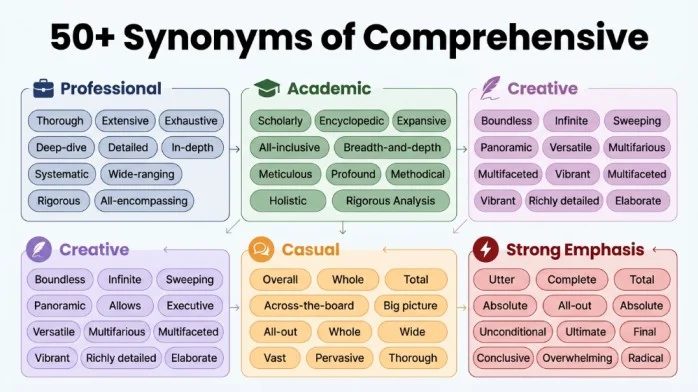
Strong writing does more than cover a topic; it gives readers a complete, clear and confident understanding. That is why synonyms of comprehensive can make a difference when your usual word feels repetitive, too formal, or does not capture the full meaning. The right alternative can sharpen your message, match your tone, and make descriptions, reports, essays, and everyday communication sound more natural and precise.
This guide explores synonyms of comprehensive across formal, professional, academic, casual, strong, and context-specific usage. You will find chosen alternatives with meanings and examples, helping you avoid awkward word swaps and choose language that fits. Whether you want to describe something thorough, detailed, wide-ranging, or all-inclusive, these alternatives give your writing more variety, accuracy, and impact.
What Are the Best Synonyms of “Comprehensive”?
Comprehensive means covering everything thoroughly and completely. Its overall tone is positive and formal. The best synonyms for comprehensive depend on the context. Formal writing, use thorough, exhaustive, or all-encompassing. For academic writing, use extensive or complete. For professional communication, use inclusive or detailed. Creative writing, use sweeping or panoramic.
Meaning, Tone, and Context
Understanding the word comprehensive is the first step to using it effectively.
Simple Definition:
Comprehensive means including everything that is necessary. It describes something that covers a wide range of topics, details, or aspects in a thorough way.
Part of Speech:
Adjective
Overall Tone:
Positive
Formality Level:
Formal. Comprehensive is most appropriate in professional, academic, and serious contexts.
Common Uses:
Native English speakers commonly use comprehensive to describe reports, studies, reviews, analyses, lists, insurance policies, exams, and training programs.
Word Forms:
- Adjective: comprehensive
- Adverb: comprehensively
- Noun: comprehensiveness
Opposite Form:
Incomplete, limited, narrow, superficial
When and How to Use “Comprehensive”
The word comprehensive fits situations where you need to describe something that is thorough and covers every aspect. It is versatile, clear, and widely understood. However, it can feel overly formal in casual contexts.
Professional Context:
The comprehensive report covered every aspect of the company’s performance.
Academic Context:
The study provides a comprehensive analysis of the data collected over five years.
Workplace Context:
The training program offers a comprehensive overview of company policies.
Personal Context:
She gave a comprehensive explanation of her travel plans.
Email Context:
Please find attached a comprehensive summary of our meeting notes.
Resume Context:
Developed a comprehensive marketing strategy that increased brand awareness.
Social Media Context:
This comprehensive guide will help you understand the basics of investing.
Best Synonyms of “Comprehensive”
No single synonym works perfectly in every situation. The best choice depends on your audience, the context, and the specific meaning you want to convey.
For Professional Writing:
Use thorough or exhaustive. These words sound strong, precise, and results oriented. They fit reports, proposals, and business documents perfectly.
For Academic Writing:
Use extensive or complete. Extensive emphasizes breadth. Complete emphasizes that nothing is missing.
For Business Communication:
Use inclusive or detailed. Inclusive suggests that everything and everyone is considered. Detailed emphasizes the level of specificity.
For Casual Conversation:
Use full or broad. These words are simple and friendly. They feel natural in everyday speech.
For Emotional Writing:
Use sweeping or far-reaching. These words add a sense of scale and impact.
For Creative Writing:
Use panoramic or encompassing. These words add imagery and descriptive power.
For Resume Writing:
Use comprehensive itself or thorough. These words highlight your ability to handle complex tasks.
For Workplace Communication:
Use thorough or complete. These words suggest reliability and attention to detail.
For Stronger Meaning:
Use exhaustive or all-encompassing. These words emphasize that nothing has been left out.
For Softer Meaning:
Use general or broad. These words are less intense and more approachable.
When Not to Use “Comprehensive”
Even though comprehensive is a useful word, there are times when it is not the best choice.
When the Word Sounds Too Formal:
In casual conversation, comprehensive can feel stiff and overly serious.
Original:
The party had a comprehensive selection of snacks.
Better Recommendation:
Use wide or broad.
Rewritten Sentence:
The party had a wide selection of snacks.
When the Word Sounds Too General:
Comprehensive is sometimes vague. It does not specify exactly what is covered.
Original:
Her comprehensive knowledge was impressive.
Better Recommendation:
Use extensive or in-depth.
Rewritten Sentence:
Her extensive knowledge of the subject was impressive.
When the Word Sounds Too Strong:
For small everyday tasks, comprehensive can feel like an exaggeration.
Original:
He gave a comprehensive review of the movie.
Better Recommendation:
Use detailed or thorough.
Rewritten Sentence:
He gave a thorough review of the movie.
When the Word Sounds Outdated:
Comprehensive is still current, but in some modern business contexts, holistic or end-to-end may sound more contemporary.
Original:
We need a comprehensive solution.
Better Recommendation:
Use holistic or end-to-end.
Rewritten Sentence:
We need a holistic solution.
Words Commonly Confused With “Comprehensive”
Several words are often confused with comprehensive. Understanding their differences helps you choose the most accurate word.
- Comprehensive vs. Thorough
- Difference: Thorough emphasizes careful attention to detail. Comprehensive emphasizes covering everything without gaps.
- When to Use It: Use thorough when you want to highlight carefulness. Use comprehensive when you want to highlight completeness.
- Example: The thorough review caught every mistake. The comprehensive report included everything.
- Comprehensive vs. Extensive
- Difference: Extensive emphasizes a large scope or wide range. Comprehensive emphasizes that everything is included.
- When to Use It: Use extensive when describing something that covers a lot of ground. Use comprehensive when describing something that leaves nothing out.
- Example: She has extensive experience in marketing. The comprehensive guide covered every topic.
- Comprehensive vs. Complete
- Difference: Complete emphasizes that nothing is missing. Comprehensive emphasizes that everything is covered, often in detail.
- When to Use It: Use complete when something is finished. Use comprehensive when something covers every aspect.
- Example: The project is finally complete. The comprehensive analysis covered all factors.
- Comprehensive vs. Inclusive
- Difference: Inclusive emphasizes including everyone or everything. Comprehensive emphasizes covering all aspects.
- When to Use It: Use inclusive when talking about people or groups. Use comprehensive when talking about topics or details.
- Example: The inclusive policy welcomed all employees. The comprehensive policy covered all situations.
- Comprehensive vs. Detailed
- Difference: Detailed emphasizes many specific facts. Comprehensive emphasizes that every area is covered.
- When to Use It: Use detailed when you want to highlight specificity. Use comprehensive when you want to highlight breadth.
- Example: The detailed instructions were easy to follow. The comprehensive overview covered the entire project.
- Comprehensive vs. All-Encompassing
- Difference: All-encompassing is a stronger, more emphatic version of comprehensive. It suggests that nothing has been left out.
- When to Use It: Use all-encompassing when you want to emphasize total coverage.
- Example: The all-encompassing policy affected every department.
Best Synonyms of “Comprehensive” by Context
| Context | Best Synonym | Why It Works | Example |
|---|---|---|---|
| Formal Writing | Thorough | Precise and professional | The thorough investigation revealed new evidence. |
| Academic Writing | Extensive | Emphasizes broad coverage | The extensive research took three years to complete. |
| Professional Communication | Detailed | Highlights specificity | The detailed proposal impressed the committee. |
| Business Emails | Complete | Clear and efficient | Please find the complete report attached. |
| Resume Writing | Comprehensive | Shows ability to handle complex tasks | Developed a comprehensive training program. |
| Workplace Communication | Thorough | Suggests reliability | The thorough review identified key issues. |
| Casual Conversation | Full | Simple and friendly | She gave a full explanation of the situation. |
| Everyday Speaking | Broad | Natural and approachable | The broad overview covered the main points. |
| Creative Writing | Sweeping | Adds dramatic scale | The sweeping changes transformed the city. |
| Storytelling | Panoramic | Creates vivid imagery | The panoramic view captured every detail. |
| Emotional Writing | Far-reaching | Emphasizes impact | The far-reaching effects were felt by everyone. |
| Strong Emphasis | Exhaustive | Emphasizes complete coverage | The exhaustive list included every item. |
| Mild Tone | General | Gentle and less intense | The general summary covered the basics. |
| Social Media Captions | Full | Short and impactful | A full guide to getting started. |
| American English | Comprehensive | Widely understood | The comprehensive guide is available online. |
How to Choose the Best Synonym of “Comprehensive”
Choosing the right synonym depends on several factors. Use this practical guide to make the best decision.
Meaning:
What type of coverage are you describing? Is it a report, a list, a policy, or a description? Choose a synonym that reflects the specific nature of what you are describing.
Tone:
Do you want to sound formal, casual, emotional, or neutral? Formal words like exhaustive fit business writing. Casual words like broad fit conversation. Emotional words like sweeping fit storytelling.
Audience:
Who is reading your writing? Business executives expect professional language. Friends expect casual language. Academic readers expect precise vocabulary.
Emotional Strength:
How strong is the coverage? Use exhaustive or all-encompassing for complete coverage. Use broad or general for less intense descriptions.
Writing Purpose:
Are you writing a report, an email, a story, or a social media post? Match your synonym to the purpose of the message.
Level of Formality:
Consider the formality of your situation. Reports, essays, and official documents require formal synonyms. Texting and social media allow informal language.
Natural Sounding Usage:
Always read your sentence aloud. If the synonym sounds forced or awkward, choose a different word.
Real Life Examples of “Comprehensive”
School Context:
Her comprehensive notes helped the entire class prepare for the exam.
Stronger Version:
Her thorough notes helped the entire class prepare for the exam.
College Context:
The comprehensive research project covered every aspect of the topic.
Stronger Version:
The extensive research project covered every aspect of the topic.
Workplace Context:
The comprehensive training program was well received by all employees.
Stronger Version:
The thorough training program was well received by all employees.
Business Context:
The comprehensive strategy outlined every step of the plan.
Stronger Version:
The detailed strategy outlined every step of the plan.
Email Context:
I have attached a comprehensive summary of the meeting notes.
Stronger Version:
I have attached a complete summary of the meeting notes.
Resume Context:
Developed a comprehensive marketing campaign that increased sales by 30 percent.
Stronger Version:
Developed a thorough marketing campaign that increased sales by 30 percent.
Conversation Context:
She gave a comprehensive explanation of the project timeline.
Stronger Version:
She gave a full explanation of the project timeline.
Storytelling Context:
The comprehensive changes transformed the small town into a thriving city.
Stronger Version:
The sweeping changes transformed the small town into a thriving city.
Blogging Context:
This comprehensive guide will help you understand the basics of investing.
Stronger Version:
This complete guide will help you understand the basics of investing.
Social Media Context:
Check out our comprehensive list of tips for beginners.
Stronger Version:
Check out our full list of tips for beginners.
25 Best Synonyms of “Comprehensive”
| Synonym | Simple Meaning | Best Used For | Example Sentence |
|---|---|---|---|
| Thorough | Careful and complete | Professional writing | The thorough analysis revealed the problem. |
| Exhaustive | Covering everything | Formal, academic writing | The exhaustive list included every item. |
| Extensive | Large in scope | Academic, research writing | The extensive study took years to complete. |
| Complete | Having all parts | General, professional writing | The complete report is ready for review. |
| Inclusive | Including everything | Business, policy writing | The inclusive policy covered all situations. |
| Detailed | Full of specifics | Professional, technical writing | The detailed instructions were clear. |
| All-encompassing | Covering everything | Strong emphasis | The all-encompassing policy affected everyone. |
| Sweeping | Wide in scope | Creative, dramatic writing | The sweeping changes were historic. |
| Panoramic | Wide and comprehensive | Creative, descriptive writing | The panoramic view captured every detail. |
| Far-reaching | Having wide effects | Emotional, impact writing | The far-reaching effects were significant. |
| Broad | Wide in range | Casual, general writing | The broad overview covered the basics. |
| Full | Complete | Casual, everyday writing | She gave a full explanation. |
| General | Not detailed | Mild, casual writing | The general summary was helpful. |
| Holistic | Considering everything | Modern business writing | The holistic approach solved the problem. |
| End-to-end | Covering the entire process | Business, technology writing | The end-to-end solution was efficient. |
| Across-the-board | Affecting everything | Professional, policy writing | The across-the-board changes were implemented. |
| All-inclusive | Including everything | Travel, business writing | The all-inclusive package was affordable. |
| Encyclopedic | Very comprehensive | Academic, reference writing | His encyclopedic knowledge was impressive. |
| In-depth | Thorough and detailed | Professional, academic writing | The in-depth analysis was valuable. |
| Overarching | Including everything | Formal, strategic writing | The overarching strategy guided the team. |
| Universal | Applicable everywhere | Formal, broad writing | The universal principles were accepted. |
| Wide-ranging | Covering many areas | Professional, descriptive writing | The wide-ranging discussion covered many topics. |
| Blanket | Covering everything | Professional, policy writing | The blanket policy applied to everyone. |
| Umbrella | Covering many things | Professional, organizational writing | The umbrella organization coordinated efforts. |
| Compendious | Concise but comprehensive | Formal, academic writing | The compendious summary was well written. |
Synonyms of “Comprehensive” by Usage
Professional vs Personal Synonyms
Professional Synonyms:
Thorough, exhaustive, detailed, complete, inclusive, extensive, holistic, end-to-end, across-the-board, overarching.
These words sound serious and results oriented. They fit reports, proposals, and business documents perfectly.
Personal Synonyms:
Full, broad, general, wide, complete.
These words feel natural in conversation, personal reflection, and social media. They focus on simplicity rather than formality.
Formal vs Conversational Synonyms
Formal Synonyms:
Exhaustive, comprehensive, encyclopedic, compendious, universal, overarching, all-encompassing.
These words fit essays, research papers, official reports, and formal speeches. They sound authoritative and precise.
Conversational Synonyms:
Full, broad, general, wide, complete.
These words feel natural in texting, everyday speech, and casual writing.
Academic Synonyms
Recommended Words:
Extensive, exhaustive, encyclopedic, complete, thorough, compendious.
Why They Work:
Extensive shows broad research. Exhaustive emphasizes that nothing was missed. Encyclopedic suggests deep knowledge.
Professional and Business Synonyms
Recommended Words:
Detailed, thorough, complete, inclusive, holistic, end-to-end, across-the-board.
Why They Fit:
Detailed highlights precision. Thorough shows careful work. Holistic suggests strategic thinking.
Use in Resumes:
“Developed a comprehensive training program for new employees.”
Use in Interviews:
“My thorough approach to problem-solving ensured successful outcomes.”
Creative and Literary Synonyms
Recommended Words:
Sweeping, panoramic, far-reaching, broad, all-encompassing.
Why They Fit:
These words add drama, emotion, and imagery to storytelling, poetry, and descriptive writing. They create vivid mental pictures and evoke strong feelings.
Example:
“The sweeping reforms transformed the entire nation.”
Modern Business Synonyms
Recommended Words:
Holistic, end-to-end, across-the-board, comprehensive.
These words are widely used in modern business writing. They are clear, direct, and easy to understand.
Slang or Modern Synonyms
Comprehensive does not have widely used slang synonyms. In casual contexts, full or complete are the most natural alternatives.
Strongest to Mildest Synonyms
Mild (Broad Overview):
General, broad, wide.
Moderate (Clear Coverage):
Full, complete, inclusive.
Strong (Thorough Coverage):
Thorough, detailed, extensive.
Very Strong (Total Coverage):
Exhaustive, all-encompassing, encyclopedic, compendious.
Emotional vs Neutral Synonyms
Emotional Synonyms:
Sweeping, far-reaching, panoramic, all-encompassing.
When to Use Emotional Synonyms:
Use them in storytelling, creative writing, and situations where you want to emphasize scale or impact.
Neutral Synonyms:
Thorough, detailed, complete, extensive, exhaustive, inclusive.
When to Use Neutral Synonyms:
Use them in professional writing, business communication, academic papers, and situations where facts matter more than emotions.
Antonyms of “Comprehensive”
| Antonym | Meaning | Example Sentence |
|---|---|---|
| Incomplete | Missing parts | The incomplete report was rejected. |
| Limited | Restricted in scope | The limited study did not cover everything. |
| Narrow | Small in range | The narrow focus ignored other factors. |
| Superficial | Only covering the surface | The superficial review missed important details. |
| Partial | Not complete | The partial list was not helpful. |
| Selective | Choosing only some | The selective analysis was biased. |
| Cursory | Quick and not thorough | The cursory glance missed the error. |
| Fragmented | Broken into parts | The fragmented information was confusing. |
| Piecemeal | Done in pieces | The piecemeal approach was inefficient. |
| Deficient | Lacking something | The deficient plan failed. |
| Short | Brief and incomplete | The short summary was insufficient. |
| Scattered | Disorganized | The scattered data was hard to follow. |
| Truncated | Cut short | The truncated version was incomplete. |
| Abbreviated | Shortened | The abbreviated report lacked detail. |
| Sparse | Thin and scattered | The sparse information was not helpful. |
Comparison: “Comprehensive” vs Similar Words
Comprehensive vs Thorough
Main Difference:
Thorough emphasizes careful attention to detail. Comprehensive emphasizes covering everything.
Which Is Stronger?
Comprehensive is stronger in terms of scope.
Which Is More Formal?
Comprehensive is more formal.
When to Use Each:
Use thorough to highlight carefulness. Use comprehensive to highlight completeness.
Examples:
Comprehensive: The comprehensive guide covered every topic.
Thorough: The thorough inspection found every problem.
Comprehensive vs Extensive
Main Difference:
Extensive emphasizes a large scope. Comprehensive emphasizes full coverage.
Which Is Stronger?
Comprehensive is stronger in terms of completeness.
Which Is More Formal?
Both are formal.
When to Use Each:
Use extensive for breadth. Use comprehensive for coverage.
Examples:
Comprehensive: The comprehensive policy covered every situation.
Extensive: She has extensive experience in the field.
Comprehensive vs Complete
Main Difference:
Complete means nothing is missing. Comprehensive means everything is covered in detail.
Which Is Stronger?
Comprehensive is stronger because it implies both completeness and detail.
Which Is More Formal?
Comprehensive is more formal.
When to Use Each:
Use complete for finished projects. Use comprehensive for thorough overviews.
Examples:
Comprehensive: The comprehensive analysis was detailed.
Complete: The complete project was delivered on time.
Comprehensive vs Inclusive
Main Difference:
Inclusive emphasizes including everyone. Comprehensive emphasizes covering everything.
Which Is Stronger?
Comprehensive is stronger in scope.
Which Is More Formal?
Both are formal.
When to Use Each:
Use inclusive for people and groups. Use comprehensive for topics and details.
Examples:
Comprehensive: The comprehensive plan covered all aspects.
Inclusive: The inclusive policy welcomed all employees.
Comprehensive vs Detailed
Main Difference:
Detailed emphasizes many specific facts. Comprehensive emphasizes breadth.
Which Is Stronger?
Comprehensive is stronger in scope.
Which Is More Formal?
Both are formal.
When to Use Each:
Use detailed for specificity. Use comprehensive for breadth.
Examples:
Comprehensive: The comprehensive overview covered the entire project.
Detailed: The detailed instructions were easy to follow.
Comprehensive vs All-Encompassing
Main Difference:
All-encompassing is a stronger, more emphatic version of comprehensive.
Which Is Stronger?
All-encompassing is stronger.
Which Is More Formal?
All-encompassing is slightly more emphatic.
When to Use Each:
Use all-encompassing when you want to emphasize total coverage.
Examples:
Comprehensive: The comprehensive report was thorough.
All-encompassing: The all-encompassing policy affected every department.
Common Phrases and Expressions with “Comprehensive”
| Phrase | Meaning | Example Sentence |
|---|---|---|
| Comprehensive guide | A complete guide | This comprehensive guide will help you get started. |
| Comprehensive review | A thorough review | The comprehensive review identified key areas for improvement. |
| Comprehensive report | A complete report | Please review the comprehensive report before the meeting. |
| Comprehensive list | A complete list | The comprehensive list includes every item. |
| Comprehensive analysis | A thorough analysis | The comprehensive analysis revealed important trends. |
| Comprehensive insurance | Insurance that covers everything | Comprehensive insurance covers most types of damage. |
| Comprehensive exam | An exam covering all material | The comprehensive exam tested everything we learned. |
Common Mistakes to Avoid
Choosing a Vague Synonym Instead of a Precise One
Incorrect:
The good report was helpful.
Better:
The comprehensive report was helpful.
Why:
Good is vague. Comprehensive is specific and meaningful.
Using “Comprehensive” When You Mean “Thorough”
Incorrect:
The comprehensive inspection found every detail.
Better:
The thorough inspection found every detail.
Why:
Thorough emphasizes attention to detail. Comprehensive emphasizes covering everything.
Using an Informal Synonym in Formal Writing
Incorrect:
The full analysis was impressive.
Better:
The comprehensive analysis was impressive.
Why:
Full is too casual for a formal report. Comprehensive is more appropriate.
Selecting an Overly Dramatic Synonym
Incorrect:
The sweeping review was a quick check.
Better:
The thorough review was a quick check.
Why:
Sweeping is too dramatic for a quick check. Thorough works better.
Repeating the Same Word Too Often
Incorrect:
The comprehensive report was comprehensive and comprehensive.
Better:
The comprehensive report was thorough and detailed.
Why:
Repeating comprehensive sounds repetitive. Using synonyms improves flow.
Choosing a Word With the Wrong Emotional Tone
Incorrect:
The far-reaching memo was about office snacks.
Better:
The comprehensive memo was about office snacks.
Why:
Far-reaching is too dramatic for a simple memo. Comprehensive works better.
Frequently Asked Questions
What are the best formal synonyms of “comprehensive”?
The best formal synonyms of comprehensive are exhaustive, thorough, complete, and extensive. These words fit academic papers, business reports, legal documents, and official speeches. They sound authoritative and precise.
What are common informal synonyms of “comprehensive”?
Common informal synonyms of comprehensive include full, broad, general, and wide. These words are used in casual conversations, texting, social media, and friendly emails. They are simple, friendly, and natural.
What is another word for “comprehensive” in professional writing?
In professional writing, use thorough, detailed, or complete. These words are specific, measurable, and results oriented. They fit reports, proposals, performance reviews, and client emails perfectly.
What is the difference between “comprehensive” and “thorough”?
Comprehensive emphasizes covering everything without gaps. Thorough emphasizes careful attention to detail. Use comprehensive when you want to highlight completeness. Use thorough when you want to highlight carefulness.
What is the opposite of “comprehensive”?
The opposite of comprehensive is incomplete. Other antonyms include limited, narrow, superficial, partial, and cursory. Choose the most accurate opposite based on the context of your sentence.
Conclusion
Comprehensive is a powerful and versatile word, but using the same word repeatedly weakens your writing. The best synonyms of comprehensive help you communicate clearly, match the right tone, and express yourself with precision. Whether you write a business report, a college essay, a personal reflection, or a social media post, there is a perfect synonym for every situation.
The more you practice choosing the right synonym, the more natural and confident your writing will become. A strong vocabulary helps you connect with readers, express your ideas clearly, and make a lasting impression.
Definitions, meanings, and usage recommendations should be verified with trusted language references before publication. Recommended sources include Cambridge Dictionary, Oxford English Dictionary, Merriam Webster, Collins Dictionary, and Britannica.
Read More Related Articles:
Synonyms for Empty | Meaning, Examples, and Better Word …
Synonyms for Pros and Cons | Meaning, Examples, and Better …