A writer may use the word republic several times while discussing government, history, civics, or politics, especially in an essay or school assignment. Repeating the same term can make the writing feel predictable. Learning the synonyms of republic and understanding their precise differences gives writers more flexibility without sacrificing accuracy.
The best alternative depends on what you mean. Words such as commonwealth, polity, and state can overlap with republic, while phrases such as representative government and democratic state explain particular features of a republic. Choosing carefully helps readers understand whether you are describing a political system, a country, a government, or a specific constitutional structure.
What Are the Best Synonyms of “Republic”?
A republic is a political system or state in which supreme public authority is not held by a hereditary monarch. Depending on context, useful alternatives include commonwealth, polity, representative government, democratic state, and constitutional state. These terms are related, but they are not interchangeable in every sentence.
Meaning, Tone, and Context
Simple Definition
A republic is a form of government in which political authority belongs to the public and is exercised through established institutions, commonly through elected representatives. The term is often contrasted with hereditary monarchy.
The exact constitutional structure can differ from one republic to another. Some republics are presidential, some parliamentary, and some federal.
Part of Speech
Republic is a noun.
Example:
“The country became a republic after the monarchy ended.”
Overall Tone
The word republic has a neutral tone when used descriptively. It is common in political science, history, civics, journalism, education, and general discussions about government.
Formality Level
Republic is a neutral to formal word.
It works naturally in:
• Academic essays
• Government documents
• History books
• News articles
• Political discussions
• Civics lessons
• Professional writing
Common Uses
Native English speakers commonly use republic when discussing:
• Forms of government
• Constitutional systems
• Political history
• National identity
• Elected government
• Citizenship
• Public institutions
• Presidential systems
• Parliamentary systems
• Constitutional law
Word Forms
The main related forms are:
Republic, noun
Republican, adjective or noun, depending on context
Republicanism, noun
Republican, adjective describing something related to a republic
The word republican can also refer to a member or supporter of a particular political party, especially in the United States. That political meaning should not automatically be confused with the broader meaning of republican as something related to a republic.
When and How to Use “Republic”
Use republic when you are describing a political system or a state organized without a hereditary monarch as its head of state.
Professional Context
“The organization works closely with government agencies across the republic.”
This use refers to the country as a political state.
Academic Context
“The constitution established the republic’s system of representative government.”
This is suitable for an essay or political science discussion.
Workplace Context
“The company has offices throughout the republic.”
Here, republic refers to the country rather than directly describing its government.
Personal Context
“My family moved to the republic several years ago.”
This is possible in a historical or literary context, although country would usually sound more natural in everyday American English.
Email Context
“The report examines economic development across the republic.”
This works in a formal or institutional email.
Resume Context
“Conducted research on constitutional reforms in the republic.”
This is appropriate when describing academic or professional experience.
Social Media Context
“The republic celebrates its national holiday this week.”
This can work in historical, political, or civic content, although country is often more conversational.
Best Synonyms of “Republic”
No single word can replace republic in every context. Political vocabulary is especially sensitive to meaning because related terms can describe a government, a state, a political philosophy, or a constitutional structure.
Professional Writing
Commonwealth can work in formal political or historical writing when the context supports it. It should not be treated as an automatic replacement because some commonwealths are not republics.
Academic Writing
Polity is a useful academic alternative when discussing an organized political community or system of government.
Example:
“The ancient polity developed complex political institutions.”
Business Communication
State can be appropriate when the focus is on a country’s political or legal status rather than its specific republican structure.
Example:
“The company operates under the laws of the state.”
Casual Conversation
Country is often more natural when the speaker simply means the nation rather than its particular form of government.
Example:
“She moved to the country several years ago.”
Emotional Writing
Homeland can work when the emphasis is on emotional attachment to a person’s country.
Example:
“He returned to his homeland after many years abroad.”
It is not an exact synonym for republic, because a homeland does not describe a form of government.
Creative Writing
Realm can be used in historical or fictional writing when referring to a territory or political domain.
Example:
“The ruler traveled across the distant realm.”
Again, realm describes a domain rather than specifically a republic.
Resume Writing
State is often preferable when describing research, policy, or governmental work.
Example:
“Analyzed public policy across multiple states.”
Workplace Communication
Government may work when the focus is on governing institutions rather than the country itself.
Example:
“The company submitted the proposal to the government.”
Stronger Meaning
When you need to emphasize the constitutional structure, use a more specific phrase such as constitutional republic.
Example:
“The constitution establishes a constitutional republic.”
Softer Meaning
When you simply mean the country and its people, country is usually more natural.
Example:
“The country has experienced significant economic growth.”
When Not to Use “Republic”
The word republic is useful, but it is not always the clearest choice.
When “Republic” Is Too General
If you are specifically discussing elected institutions, representative government may communicate your meaning more clearly.
Less precise:
“The republic protects individual rights.”
More specific:
“The representative government protects individual rights through constitutional institutions.”
When “Republic” Is Too Political
In ordinary conversation, country is often more natural.
Less natural:
“I traveled across the republic last summer.”
More natural:
“I traveled across the country last summer.”
When You Mean the Government
If you mean the institutions currently governing the country, government may be more accurate.
Less precise:
“The republic announced a new policy.”
More precise:
“The government announced a new policy.”
When You Mean a Nation
If your emphasis is cultural or national rather than political, nation may fit better.
Example:
“The nation has a long cultural history.”
When You Mean a Constitutional Structure
If the constitutional arrangement matters, specify it.
Example:
“The country is a federal republic.”
This is more informative than simply calling it a republic.
When You Mean a Historical Political Community
In historical writing, polity may be more appropriate.
Example:
“The ancient polity developed its own political institutions.”
Words Commonly Confused With “Republic”
Democracy
Difference: Democracy describes government based on popular participation or political authority of the people. A republic can be democratic, but the two terms emphasize different features.
When to use it: Use democracy when the focus is popular political participation.
Example:
“The country has democratic elections.”
Commonwealth
Difference: Commonwealth can refer to a political community or state and has been used historically for republics. It does not always mean republic.
When to use it: Use it when the political or historical context specifically supports the term.
Example:
“The commonwealth adopted a new constitution.”
Polity
Difference: Polity refers broadly to an organized political community or system of government.
When to use it: It is particularly useful in academic and political writing.
Example:
“The ancient polity developed sophisticated institutions.”
State
Difference: State refers to a politically organized territory and its governing institutions. It does not specify whether the government is republican.
When to use it: Use state when discussing sovereignty, law, territory, or political institutions.
Example:
“The state introduced new environmental regulations.”
Nation
Difference: Nation emphasizes a people connected by identity, history, culture, or political community.
When to use it: Use nation when national identity is more relevant than governmental structure.
Example:
“The nation celebrated its independence.”
Government
Difference: Government refers to the institutions and people exercising political authority. A republic is a type of political system or state.
When to use it: Use government when discussing current rulers, agencies, policies, or administration.
Example:
“The government introduced a new education policy.”
Best Synonyms of “Republic” by Context
| Context | Best Alternative | Why It Works | Example |
|---|---|---|---|
| Formal writing | Commonwealth | Can have a formal political meaning in suitable contexts | “The commonwealth adopted new institutions.” |
| Academic writing | Polity | Precisely describes an organized political community | “The polity developed representative institutions.” |
| Professional communication | State | Useful for legal and governmental contexts | “The state regulates the industry.” |
| Business emails | Government | Appropriate when referring to governing authorities | “The government issued new regulations.” |
| Resume writing | State | Useful for policy and public sector experience | “Analyzed state policy initiatives.” |
| Workplace communication | Government | Clear when referring to public authorities | “The government approved the proposal.” |
| Casual conversation | Country | Natural when discussing a place rather than its system | “The country has a strong economy.” |
| Everyday speaking | Country | Usually easier for general audiences | “I visited the country last year.” |
| Creative writing | Realm | Useful for fictional or historical settings | “The travelers entered a distant realm.” |
| Storytelling | Kingdom | Appropriate when the setting is a monarchy | “The kingdom faced a difficult winter.” |
| Emotional writing | Homeland | Emphasizes emotional connection to a country | “She returned to her homeland.” |
| Strong emphasis | Constitutional republic | Specifies the political structure | “The constitution created a constitutional republic.” |
| Mild tone | Country | Avoids unnecessary political emphasis | “The country is changing rapidly.” |
| Social media captions | Country | Simple and accessible | “Proud of my country today.” |
| American English | Republic | Standard and widely understood | “The republic adopted a new constitution.” |
| British English | Republic | Also standard, although context determines the preferred alternative | “The republic established new institutions.” |
How to Choose the Best Synonym of “Republic”
Choosing an alternative starts with identifying exactly what republic means in your sentence.
If You Mean a Country
Use country.
“The country has a growing economy.”
If You Mean a Government
Use government.
“The government introduced new regulations.”
If You Mean a Political Community
Use polity.
“The polity developed a complex administrative system.”
If You Mean Sovereign Territory and Institutions
Use state.
“The state has authority over taxation.”
If You Mean National Identity
Use nation.
“The nation celebrated its independence.”
If You Mean Popular Political Rule
Use democracy when that is the specific concept being discussed.
“The democracy relies on regular elections.”
If You Mean a Specific Constitutional System
Use constitutional republic, federal republic, presidential republic, or another precise term when appropriate.
“The country operates as a federal republic.”
The most accurate synonym is therefore the one that preserves the original meaning instead of merely sounding different.
Real Life Examples of “Republic”
School
Original:
“The republic developed a new political system.”
More precise:
“The republic developed a representative political system.”
College
Original:
“The republic’s constitution influenced later governments.”
Alternative:
“The constitutional state influenced later political institutions.”
Workplace
Original:
“Our company operates in the republic.”
More natural:
“Our company operates in the country.”
Business
Original:
“The republic introduced new trade regulations.”
More precise:
“The government introduced new trade regulations.”
Original:
“The report examines economic development in the republic.”
Alternative:
“The report examines economic development in the country.”
Resume
Original:
“Studied political institutions in the republic.”
More academic:
“Studied political institutions within the polity.”
Conversation
Original:
“She moved to the republic last year.”
More natural:
“She moved to the country last year.”
Storytelling
Original:
“The republic faced a dangerous political crisis.”
More specific:
“The state faced a dangerous political crisis.”
Blogging
Original:
“The republic has undergone major political changes.”
Alternative:
“The country has undergone major political changes.”
Social Media
Original:
“The republic celebrates its independence today.”
More accessible:
“The country celebrates its independence today.”
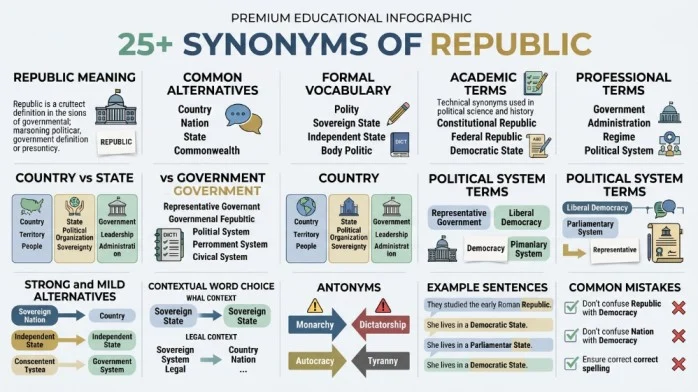
25 Best Synonyms and Related Alternatives for “Republic”
Because English does not contain 25 exact one word synonyms for republic, the following table separates direct alternatives from contextual and structural terms. This approach avoids teaching inaccurate vocabulary.
| Synonym or Alternative | Simple Meaning | Best Used For | Example Sentence |
|---|---|---|---|
| Commonwealth | A political community or state | Formal and historical contexts | “The commonwealth developed new institutions.” |
| Polity | An organized political community | Academic writing | “The polity established representative institutions.” |
| State | A sovereign political entity | Law and politics | “The state protects constitutional rights.” |
| Country | A nation or territory | Everyday English | “The country has a diverse population.” |
| Nation | A people or political community | National identity | “The nation celebrated its independence.” |
| Government | Institutions that exercise political authority | Policies and administration | “The government announced new reforms.” |
| Democracy | Government involving rule by the people | Political participation | “The democracy holds regular elections.” |
| Representative government | Government carried out through representatives | Political science | “Representative government depends on elected officials.” |
| Representative state | A state using representative institutions | Academic and political writing | “The representative state expanded voting rights.” |
| Democratic state | A state organized around democratic principles | Political analysis | “The democratic state protects political participation.” |
| Constitutional state | A state governed through constitutional principles | Law and civics | “The constitutional state limits governmental power.” |
| Constitutional republic | A republic organized under a constitution | Political science | “The country operates as a constitutional republic.” |
| Federal republic | A republic with federal political organization | Government descriptions | “The federal republic divides authority between levels of government.” |
| Presidential republic | A republic with a presidential system | Comparative politics | “The presidential republic elects its executive.” |
| Parliamentary republic | A republic with a parliamentary system | Comparative politics | “The parliamentary republic selects its government through parliament.” |
| Civic state | A state emphasizing civic membership | Political discussion | “The civic state promotes equal citizenship.” |
| Political community | A community organized politically | Academic writing | “The political community developed shared institutions.” |
| Sovereign state | An independent state with political authority | International relations | “The sovereign state controls its foreign policy.” |
| Nation state | A state associated with a national community | History and politics | “The nation state developed during a period of political change.” |
| Political state | A state considered through its political organization | General political writing | “The political state underwent institutional reform.” |
| Public state | A state understood as a public political institution | Specialized discussion | “The public state is accountable to citizens.” |
| Self governing state | A state governing through its own institutions | Political writing | “The self governing state established new laws.” |
| Independent state | A state that governs itself independently | History and international relations | “The independent state joined the international organization.” |
| Free state | A state emphasizing political freedom | Historical or political contexts | “The free state adopted broader voting rights.” |
| Commonwealth state | A state described through commonwealth terminology | Historical or formal contexts | “The commonwealth state developed new civic institutions.” |
These alternatives should not be treated as perfectly interchangeable. For example, state, country, and nation can refer to a republic, but they do not specifically mean a republican form of government. Likewise, federal republic and presidential republic describe particular types of republic rather than synonyms for every republic.
Synonyms of “Republic” by Usage
Professional vs Personal Synonyms
Professional writing benefits from precise political terminology.
Use state, government, polity, constitutional state, or representative government when discussing institutions, law, policy, or governance.
In personal communication, country is usually simpler and more natural.
For example:
Professional:
“The state introduced a revised regulatory framework.”
Personal:
“My family has lived in the country for many years.”
Formal vs Conversational Synonyms
Formal writing can use terms such as polity, commonwealth, state, and constitutional republic when their meanings fit.
Conversational English usually favors country.
For example:
Formal:
“The polity developed representative institutions.”
Conversational:
“The country has changed a lot over the years.”
Academic Synonyms
Academic writing benefits from terminology that clearly identifies the concept being discussed.
Polity
Useful when discussing political organization generally.
State
Useful for sovereignty, institutions, territory, and law.
Representative government
Useful when focusing on elected representation.
Constitutional state
Useful when constitutional limitations are central to the discussion.
Democratic state
Useful when democratic principles and political participation are the focus.
These terms sound authoritative because they communicate specific political concepts rather than simply replacing a word with another broad term.
Professional and Business Synonyms
Political vocabulary appears in professional writing when discussing regulations, markets, public policy, or international operations.
State
Useful for legal and regulatory matters.
Government
Best when referring to public authorities.
Country
Useful when discussing markets or geographic operations.
Constitutional republic
Appropriate when the country’s constitutional system itself matters.
For a resume, precision is especially important.
Instead of:
“Worked on important projects in the republic.”
Consider:
“Conducted policy research across state institutions.”
The second version tells the reader more about the actual work.
Creative and Literary Synonyms
Creative writing allows more flexibility, but the chosen word should match the setting.
Realm
Useful for fictional or historical settings.
Kingdom
Appropriate when the political system is monarchical.
Homeland
Useful when emphasizing emotional attachment.
Nation
Works well when national identity is central.
State
Can create a serious political atmosphere.
A writer should not use republic merely because it sounds formal. The political structure of the fictional or historical setting should determine the word.
Slang or Modern Synonyms
There is no widely accepted slang synonym for republic in standard American English.
Expressions such as country and place may appear in casual speech, but they are not political synonyms.
For example:
Casual:
“I live in the country.”
Formal:
“I live in a republic.”
The first statement identifies a place or nation. The second identifies a political form.
Strongest to Mildest Synonyms
Unlike adjectives such as important, political nouns do not have a simple intensity scale. A better approach is to organize alternatives by specificity.
Mild or General
Country
Nation
State
These terms provide broad information.
Moderate Specificity
Government
Polity
Commonwealth
Political community
These terms identify political organization more clearly.
Strong Specificity
Representative government
Democratic state
Constitutional state
These phrases identify particular political characteristics.
Very Specific
Constitutional republic
Federal republic
Presidential republic
Parliamentary republic
These terms describe specific institutional arrangements.
Emotional vs Neutral Synonyms
Emotional Alternatives
Homeland can communicate attachment and belonging.
Free state can carry historical or ideological associations depending on context.
Nation may also carry emotional meaning when used in discussions of identity, independence, or patriotism.
Example:
“She returned proudly to her homeland.”
Neutral Alternatives
Republic, state, country, polity, and government are generally more neutral.
Example:
“The state introduced new environmental regulations.”
Neutral terminology is preferable when the goal is objective academic or professional communication.
Antonyms of “Republic”
There is an important distinction here: republic does not have 15 exact dictionary antonyms. Its clearest political contrast is monarchy, especially hereditary monarchy. Other terms can describe non republican political systems, but treating all 15 as exact antonyms would be misleading.
For accurate vocabulary learning, the following table identifies contrasting political systems and explains their relationship to republic.
| Contrasting Term | Meaning | Example Sentence |
|---|---|---|
| Monarchy | Government headed by a monarch | “The monarchy passed power through the royal family.” |
| Absolute monarchy | Monarchy in which the ruler holds extensive political power | “The absolute monarchy concentrated authority in the ruler.” |
| Hereditary monarchy | Monarchy in which leadership passes through a family line | “The hereditary monarchy followed established succession rules.” |
| Kingdom | A state traditionally headed by a king or queen | “The kingdom maintained its royal institutions.” |
| Empire | A political system or state ruling multiple territories or peoples | “The empire expanded across several regions.” |
| Dictatorship | Government concentrated under a dictator | “The dictatorship restricted political opposition.” |
| Autocracy | Government in which one person holds extensive power | “The autocracy limited public participation.” |
| Absolute rule | Rule without effective constitutional limitations | “The ruler exercised absolute rule.” |
| Tyranny | Oppressive or unjust rule | “The population resisted tyranny.” |
| Despotism | Government characterized by concentrated and often oppressive authority | “The reform movement opposed despotism.” |
| Oligarchy | Rule by a small group | “The oligarchy controlled major political decisions.” |
| Theocracy | Government strongly based on religious authority | “The theocracy organized political institutions around religious law.” |
| Military dictatorship | Rule dominated by military leadership | “The military dictatorship suspended several political institutions.” |
| One party state | A state dominated by a single political party | “The one party state restricted political competition.” |
| Totalitarian state | State seeking extensive control over political and social life | “The totalitarian state controlled many areas of public life.” |
These are contrasting or non republican systems, not all strict dictionary antonyms. Monarchy is the clearest direct contrast because the distinction between republican and monarchical government is fundamental.
Comparison: “Republic” vs Similar Words
Republic vs Democracy
Main Difference
A republic describes a form of state or government without hereditary monarchy, while democracy focuses on political authority and participation by the people.
Which Is Stronger?
Neither is stronger. They describe different political concepts.
Which Is More Formal?
Both are standard formal terms.
When to Use Each
Use republic when discussing the political structure of a state.
Use democracy when discussing popular participation, elections, or political rights.
Examples
Republic:
“The country became a republic after the monarchy ended.”
Democracy:
“The democracy expanded voting rights.”
Republic vs Commonwealth
Main Difference
Commonwealth can describe a political community or state and has historical connections with republican government, but it is not always synonymous with republic.
Which Is Stronger?
Neither.
Which Is More Formal?
Both can appear in formal and historical writing.
When to Use Each
Use commonwealth only when the political or historical context supports it.
Examples
Republic:
“The republic adopted a new constitution.”
Commonwealth:
“The commonwealth developed its own political institutions.”
Republic vs Polity
Main Difference
A polity is any organized political community or system. A republic identifies a particular political arrangement.
Which Is Stronger?
Neither.
Which Is More Formal?
Polity is more specialized and academic.
When to Use Each
Use polity when discussing political organization broadly.
Examples
Republic:
“The republic established representative institutions.”
Polity:
“The ancient polity developed a complex legal system.”
Republic vs State
Main Difference
A state is a sovereign political entity. A republic is a type of political system or state.
Which Is Stronger?
Neither.
Which Is More Formal?
Both are formal and widely used.
When to Use Each
Use state for sovereignty, territory, law, and institutions.
Examples
Republic:
“The republic adopted a new constitution.”
State:
“The state introduced new regulations.”
Republic vs Nation
Main Difference
A nation emphasizes people, identity, culture, or shared history. A republic emphasizes political organization.
Which Is Stronger?
Neither.
Which Is More Formal?
Both are standard terms.
When to Use Each
Use nation when discussing national identity.
Examples
Republic:
“The republic created a new electoral system.”
Nation:
“The nation celebrated its independence.”
Republic vs Government
Main Difference
Government refers to the institutions and people exercising political authority. Republic describes a broader political system or state structure.
Which Is Stronger?
Neither.
Which Is More Formal?
Both are common in formal political writing.
When to Use Each
Use government for policies, officials, agencies, and administration.
Examples
Republic:
“The republic has a written constitution.”
Government:
“The government announced new policies.”
Common Phrases and Expressions with “Republic”
Republic of
Meaning: Used as part of the official or conventional name of some countries.
Example:
“The Republic of Ireland has a distinctive constitutional system.”
Federal Republic
Meaning: A republic in which political authority is divided between a federal government and constituent units.
Example:
“The federal republic divides certain powers between national and regional governments.”
Constitutional Republic
Meaning: A republic organized under constitutional principles.
Example:
“The constitution establishes a constitutional republic.”
Presidential Republic
Meaning: A republic with a presidential form of government.
Example:
“The presidential republic elects its executive separately from the legislature.”
Parliamentary Republic
Meaning: A republic in which parliament plays a central role in forming the government.
Example:
“The parliamentary republic relies on legislative support to form its government.”
Republic of Letters
Meaning: A historical expression referring to an international community of scholars and intellectuals.
Example:
“Letters and publications connected scholars across the Republic of Letters.”
Republic of
Meaning: A formal naming structure used by some states.
Example:
“The document was issued by the Republic of Korea.”
Common Mistakes to Avoid
Mistake 1: Treating “Country” as an Exact Synonym
Incorrect:
“A republic and a country mean exactly the same thing.”
Better:
“A republic is a type of political system or state, while country is a broader term for a nation or territory.”
Why:
A country can have different forms of government.
Mistake 2: Assuming Every Democracy Is a Republic
Incorrect:
“Every democracy is automatically a republic.”
Better:
“Many democracies are republics, but democracy and republic describe different features of political organization.”
Why:
Some democratic systems are constitutional monarchies.
Mistake 3: Confusing Government With Republic
Incorrect:
“The republic announced a new law.”
Better:
“The government announced a new law.”
Why:
The government makes and administers policy, while the republic describes the broader political structure.
Mistake 4: Using “Monarchy” as a Universal Opposite
Incorrect:
“Republic is the opposite of every political system.”
Better:
“Monarchy is the clearest traditional contrast with a republic.”
Why:
Other systems, such as oligarchies and dictatorships, do not form a simple one word opposite pair.
Mistake 5: Using “Polity” in Casual Conversation
Incorrect:
“I visited the polity last summer.”
Better:
“I visited the country last summer.”
Why:
Polity is specialized academic vocabulary and can sound unnatural in everyday speech.
Mistake 6: Using “Commonwealth” Automatically
Incorrect:
“Commonwealth is always another word for republic.”
Better:
“Commonwealth can overlap with republican terminology in some contexts, but its meaning depends on the historical and political setting.”
Why:
The two terms are related but not universally interchangeable.
Mistake 7: Using Political Vocabulary When Geographic Vocabulary Is Enough
Incorrect:
“The republic has beautiful beaches.”
Better:
“The country has beautiful beaches.”
Why:
If the political system is irrelevant, country is simpler and more natural.
Frequently Asked Questions
What are the best synonyms of “republic”?
The best alternatives depend on context. Commonwealth, polity, state, country, and representative government can work in specific situations, but they do not all carry exactly the same political meaning as republic.
What are the best formal synonyms of “republic”?
Formal alternatives include polity, commonwealth, state, and constitutional republic. However, polity and state are broader terms, so the best choice depends on whether you mean political organization, sovereignty, or governmental structure.
What are common informal synonyms of “republic”?
There is no exact informal synonym for republic. In everyday American English, country is often used when the speaker simply means the nation or place rather than its particular form of government.
What is another word for “republic” in professional writing?
In professional writing, state, government, polity, or country may be appropriate depending on the intended meaning. Use state for legal matters, government for authorities, and country for general geographic references.
What is the difference between “republic” and “democracy”?
A republic describes a political system that does not rely on hereditary monarchy, while democracy emphasizes political participation and authority of the people. A republic can be democratic, but the terms describe different concepts.
What is the opposite of “republic”?
The clearest traditional contrast is monarchy, especially hereditary monarchy. Other contrasting systems include autocracy, oligarchy, dictatorship, and theocracy, but they are not all exact dictionary antonyms of republic.
Conclusion
A republic is a political system or state in which public authority is organized through institutions rather than a hereditary monarchy. Although there are several useful alternatives, words such as state, country, polity, commonwealth, and government each emphasize a different aspect of political organization.
The best synonyms of republic depend on your purpose. Use polity for academic discussion, state for legal and political contexts, government for governing institutions, and country when you simply mean the nation or place. More specific phrases such as constitutional republic or federal republic are better when the constitutional structure matters.
A useful vocabulary habit is to identify exactly what you mean before replacing a word. Instead of choosing a synonym only because it sounds sophisticated, choose the term that preserves the original meaning most accurately.
Read More Related Articles:
50+ Synonyms of Love | Powerful Words to Express Every …
Synonyms for Thus | Meaning, Examples, and Better Word …