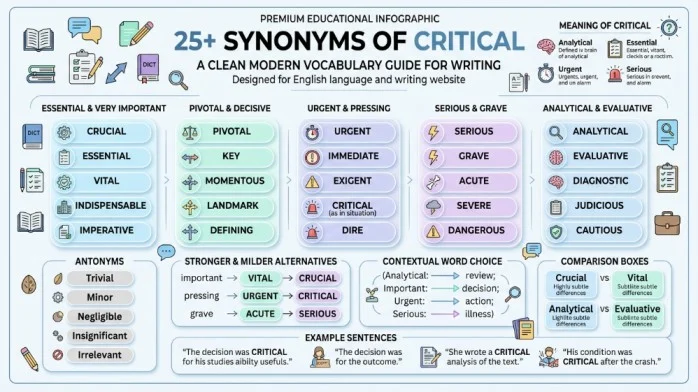
You may notice the word critical appearing again and again in emails, essays, reports, resumes, and professional conversations. While it is a useful word, repeating it can make your writing feel predictable, especially when you are trying to express different shades of importance, urgency, seriousness, or judgment.
Learning the right synonyms of critical gives you more control over your writing. Words such as crucial, essential, vital, pivotal, and significant can communicate importance, but they do not all carry exactly the same meaning or emotional weight. Choosing the right alternative helps your message sound clearer, more natural, and better suited to its context.
What Are the Best Synonyms of “Critical”?
Critical can mean extremely important, urgent, serious, or related to careful judgment. The best synonyms depend on context. Use crucial, essential, or vital for importance, urgent or pressing for immediate action, grave or serious for danger, and analytical or evaluative when discussing critical thinking.
Meaning, Tone, and Context
Simple Definition
Critical has several meanings in English, so its best synonym depends heavily on the sentence.
When it means extremely important, critical describes something that can strongly affect an outcome.
For example:
“Accurate data is critical to the success of the project.”
Here, critical means extremely important or necessary.
When it describes a serious or dangerous condition, it can refer to something requiring immediate attention.
“The patient’s condition remains critical.”
When it describes careful analysis or judgment, it has another meaning.
“Students should develop critical thinking skills.”
In this sentence, critical relates to analyzing information carefully rather than simply being important.
Part of Speech
Critical is primarily an adjective.
Related forms include:
| Word | Part of Speech | Example |
|---|---|---|
| Critical | Adjective | This is a critical decision. |
| Critically | Adverb | The issue was critically important. |
| Criticism | Noun | The proposal received criticism. |
| Critic | Noun | The critic reviewed the film. |
| Critique | Noun or verb | The professor asked students to critique the argument. |
Overall Tone
The tone of critical depends on how it is used.
- When it means extremely important, it is generally neutral to strong.
- When it describes a dangerous condition, it can sound serious or alarming.
- When it describes evaluation, as in critical analysis, it is generally neutral and academic.
- When it describes someone’s negative judgment, such as critical comments, it can have a negative tone.
Formality Level
Critical is a neutral to formal word. It works naturally in:
- Academic essays
- Research papers
- Business reports
- Professional emails
- Workplace discussions
- News writing
- Technical documents
- Everyday conversations
It is especially useful in professional and academic writing because it can communicate a high level of importance without sounding overly emotional.
Common Uses
Native English speakers commonly use critical with words and phrases such as:
- Critical information
- Critical decision
- Critical issue
- Critical role
- Critical factor
- Critical problem
- Critical situation
- Critical condition
- Critical thinking
- Critical analysis
- Critical feedback
- Critical skills
- Critical moment
- Critical stage
- Critical error
- Critical deadline
Different Meanings of Critical
Understanding these meanings is essential before choosing a synonym.
| Meaning | Example | Suitable Alternatives |
|---|---|---|
| Extremely important | This decision is critical. | Crucial, essential, vital |
| Urgent | We need critical repairs immediately. | Urgent, pressing |
| Serious or dangerous | His condition is critical. | Grave, severe, life threatening |
| Analytical | She has strong critical thinking skills. | Analytical, evaluative |
| Negative or disapproving | He was critical of the proposal. | Disapproving, judgmental |
| At a decisive point | The team reached a critical stage. | Pivotal, decisive |
When and How to Use “Critical”
Use critical when you want to communicate that something has an unusually high level of importance, requires serious attention, involves significant consequences, or relates to careful evaluation.
The word is stronger than ordinary terms such as important or useful. However, using it for every minor issue can weaken its impact.
Professional
“Clear communication is critical to maintaining strong client relationships.”
Here, critical emphasizes that communication has a major effect on professional success.
Academic
“Critical analysis is essential when evaluating conflicting research findings.”
In this example, critical refers to analytical thinking, while essential means necessary.
Workplace
“Meeting the safety requirements is critical before production can begin.”
The word communicates a high level of importance and responsibility.
Personal
“Her support was critical during one of the most difficult periods of my life.”
Here, critical means extremely important to the speaker.
“Please review the critical information before tomorrow’s meeting.”
The word signals that the information deserves immediate attention.
Resume
“Provided critical support during the company’s transition to a new operating system.”
In a resume, critical can emphasize the importance of a contribution, although a more specific word may sometimes create a stronger result.
Social Media
“Grateful for the people who played a critical role in reaching this milestone.”
This sounds natural in a professional or personal social media post.
Best Synonyms of “Critical”
No synonym is identical to critical in every situation. The best alternative depends on whether you mean extreme importance, urgency, seriousness, influence, or analytical judgment.
Professional Writing: Essential
Essential is one of the strongest alternatives when something is necessary for success or completion.
Example:
“Accurate documentation is essential for maintaining compliance.”
Use it when you want to communicate necessity rather than simply high importance.
Academic Writing: Significant
Significant works well in academic contexts when something has notable meaning, influence, or measurable impact.
Example:
“The findings revealed a significant change in student performance.”
It sounds objective and precise.
Business Communication: Crucial
Crucial is an excellent business synonym when a decision, factor, or action can strongly affect results.
Example:
“Customer feedback is crucial to improving the product.”
Casual Conversation: Important
In casual speech, you do not always need a stronger synonym. Big or major may work when the situation is informal.
Example:
“That’s a big decision.”
Emotional Writing: Vital
Vital can express strong personal or emotional importance.
Example:
“Her encouragement was vital during that difficult period.”
Creative Writing: Pivotal
Pivotal works especially well when describing a turning point.
Example:
“That conversation became a pivotal moment in his life.”
Resume Writing: Key
Key is concise and highly useful on resumes.
Example:
“Played a key role in improving customer retention.”
It communicates importance without sounding exaggerated.
Workplace Communication: Critical
Sometimes the original word is actually the best choice. In workplace settings, critical is particularly effective when urgency, risk, or consequences matter.
Example:
“Resolving this issue is critical to meeting the launch deadline.”
Stronger Meaning: Crucial
Crucial can be used when you want to stress that success depends heavily on something.
“Your feedback is crucial to the next stage of development.”
Softer Meaning: Significant
If you want to reduce the urgency associated with critical, significant can be a better option.
“The project represents a significant opportunity for growth.”
It communicates importance without suggesting an immediate crisis.
When Not to Use “Critical”
Although critical is versatile, there are situations where another word communicates your meaning more accurately.
When “Critical” Sounds Too General
If you simply mean that something matters, critical may be unnecessarily strong.
Less effective:
“Exercise is critical to everyone.”
Better:
“Regular exercise is important for maintaining overall health.”
The stronger word should be reserved for situations where the degree of importance genuinely justifies it.
When “Critical” Sounds Too Vague
A sentence such as “This is critical” does not explain what makes something critical.
Less effective:
“Communication is critical.”
Better:
“Clear communication is critical to preventing misunderstandings between teams.”
The improved sentence explains the consequence.
When “Critical” Sounds Too Strong
Not every useful task is critical.
Less effective:
“Choosing the right notebook is critical for taking class notes.”
Better:
“Choosing the right notebook can be helpful for staying organized.”
This avoids unnecessary exaggeration.
When “Critical” Is Too Formal
In relaxed conversation, critical may sound overly serious.
Formal:
“Your attendance is critical to the success of this gathering.”
Casual:
“It would be great if you could come.”
When “Critical” Is Too Weak
In some situations, critical may not communicate enough urgency.
Less effective:
“The patient needs critical care.”
Better:
“The patient is in a life threatening condition and requires immediate medical attention.”
The more specific wording makes the seriousness clearer.
When “Critical” Does Not Mean “Important”
This is one of the most important distinctions.
In critical thinking, the word does not mean “extremely important.” It refers to careful, logical evaluation.
So replacing it with crucial would change the meaning.
Correct:
“Students need critical thinking skills.”
Incorrect substitution:
“Students need crucial thinking skills.”
Words Commonly Confused With “Critical”
Crucial
Difference: Crucial usually means extremely important or necessary for an outcome.
When to use it: Use it when success depends strongly on something.
Example:
“Timing was crucial to the success of the campaign.”
Essential
Difference: Essential means necessary or indispensable.
When to use it: Use it when something cannot reasonably be omitted.
Example:
“Accurate records are essential for the audit.”
Urgent
Difference: Urgent focuses on the need for immediate action rather than importance alone.
When to use it: Use it when something requires attention quickly.
Example:
“The manager sent an urgent request for the missing documents.”
Significant
Difference: Significant emphasizes importance, impact, or meaning without necessarily implying urgency.
When to use it: Use it in academic, professional, and analytical writing.
Example:
“The company experienced significant growth during the second quarter.”
Serious
Difference: Serious often describes danger, consequences, or a situation that deserves concern.
When to use it: Use it when something has potentially harmful or severe consequences.
Example:
“The company faces a serious financial challenge.”
Pivotal
Difference: Pivotal describes something that plays a decisive role in changing an outcome or direction.
When to use it: Use it for turning points in stories, careers, history, projects, or decisions.
Example:
“The meeting was pivotal to the future of the organization.”
Best Synonyms of “Critical” by Context
| Context | Best Synonym | Why It Works | Example |
|---|---|---|---|
| Formal writing | Essential | Clearly communicates necessity | Accurate records are essential for compliance. |
| Academic writing | Significant | Sounds objective and precise | The study found significant differences. |
| Professional communication | Crucial | Communicates high importance | Trust is crucial to strong partnerships. |
| Business emails | Key | Concise and professional | Please review the key points below. |
| Resume writing | Key | Highlights major contributions | Played a key role in the project. |
| Workplace communication | Vital | Stresses importance to success | Teamwork is vital to productivity. |
| Casual conversation | Major | Sounds natural and conversational | That is a major decision. |
| Everyday speaking | Big | Simple and informal | This is a big opportunity. |
| Creative writing | Pivotal | Suggests a turning point | It was a pivotal moment in her life. |
| Storytelling | Decisive | Shows influence on an outcome | His decisive action changed the outcome. |
| Emotional writing | Meaningful | Highlights personal significance | Her advice was deeply meaningful. |
| Strong emphasis | Crucial | Carries strong importance | Timing is crucial here. |
| Mild tone | Significant | Less urgent than critical | The change was significant. |
| Social media captions | Major | Natural and accessible | A major milestone deserves celebration. |
| American English | Critical | Widely understood and versatile | Safety is critical in this environment. |
| British English | Crucial | Commonly used for high importance | The decision was crucial to the project. |
How to Choose the Best Synonym of “Critical”
Choosing an alternative becomes easier when you identify the exact meaning you want to express.
Choose “Crucial” for High Importance
Use crucial when something can determine success or failure.
“Good planning is crucial to the project’s success.”
Choose “Essential” for Necessity
Use essential when something is required.
“A valid ID is essential for registration.”
Choose “Urgent” for Immediate Action
Use urgent when something needs attention quickly.
“The client has an urgent request.”
Choose “Significant” for Impact
Use significant when something has considerable influence or meaning.
“The company made significant progress.”
Choose “Pivotal” for Turning Points
Use pivotal when an event or decision changes the direction of something.
“The interview was pivotal to her career.”
Choose “Serious” for Concern or Danger
Use serious when the focus is on potential harm or consequences.
“The company is facing a serious challenge.”
Choose “Analytical” for Critical Thinking
Use analytical when discussing careful examination or reasoning.
“The position requires strong analytical skills.”
Consider Your Audience
A resume may benefit from key, strategic, or significant.
An academic paper may favor significant, fundamental, or essential.
A casual conversation may sound more natural with major or big.
Consider Emotional Strength
If the situation is highly serious, use crucial, vital, or critical.
If you only need moderate emphasis, significant, notable, or major may be enough.
Consider Natural Usage
Never replace a word simply because its dictionary definition looks similar.
For example, critical thinking cannot normally be changed to crucial thinking. The phrase refers to analytical judgment, not importance.
Real Life Examples of “Critical”
School
Original:
“Critical thinking is important for students.”
Improved:
“Critical thinking helps students evaluate information carefully and make reasoned decisions.”
Here, critical refers to analysis rather than extreme importance.
College
“Students must develop critical reading skills before writing advanced research papers.”
The word describes careful examination and evaluation.
Workplace
“Resolving the software problem is critical before the team can continue testing.”
Here, the word emphasizes necessity and consequences.
Business
“Customer satisfaction is critical to maintaining long term relationships.”
The word communicates a strong connection between customer satisfaction and business success.
“Please review the critical information in the attached report before the meeting.”
This signals that the recipient should pay close attention.
Resume
“Played a key role in developing a new customer support process.”
Here, key may be more natural than repeatedly using critical.
Conversation
“Getting enough sleep is important, but it becomes critical when you’re recovering from an illness.”
The contrast shows how critical can indicate a higher level of importance.
Storytelling
“The decision became a pivotal moment that changed the direction of her career.”
Pivotal creates a stronger sense of narrative change.
Blogging
“Choosing the right audience is crucial when creating a content strategy.”
Crucial emphasizes the role audience selection plays in success.
Social Media
“Grateful for everyone who played a key role in making this milestone possible.”
Key sounds natural and positive in a social media context.
25 Best Synonyms of “Critical”
Because critical has several meanings, the table below includes alternatives that match its major uses. Some describe extreme importance, while others apply to seriousness, urgency, or analytical judgment.
| Synonym | Simple Meaning | Best Used For | Example Sentence |
|---|---|---|---|
| Crucial | Extremely important | Decisions and outcomes | Timing was crucial to the project’s success. |
| Essential | Absolutely necessary | Requirements and procedures | Clear instructions are essential for new employees. |
| Vital | Necessary for success or survival | Health, business, important needs | Trust is vital to a strong relationship. |
| Significant | Important or meaningful | Academic and professional writing | The research produced significant results. |
| Pivotal | Extremely influential at a turning point | Events and decisions | The interview was pivotal to her career. |
| Key | Most important or central | Business and resumes | She played a key role in the expansion. |
| Fundamental | Basic and necessary | Education and principles | Communication is fundamental to teamwork. |
| Indispensable | Impossible to do without | Skills and resources | Her technical knowledge became indispensable. |
| Imperative | Absolutely necessary | Formal instructions | Immediate action is imperative. |
| Paramount | More important than anything else | Formal writing | Public safety remains paramount. |
| Decisive | Able to determine an outcome | Choices and actions | His decisive response prevented further problems. |
| Consequential | Producing important results | Formal and academic writing | The policy had consequential effects. |
| Momentous | Extremely significant | Major events | The agreement marked a momentous occasion. |
| Major | Very important or large in effect | General communication | The company made a major investment. |
| Serious | Significant or potentially harmful | Problems and risks | The organization faces a serious challenge. |
| Grave | Very serious | Danger and formal contexts | The report raised grave concerns. |
| Pressing | Requiring immediate attention | Problems and requests | Housing has become a pressing issue. |
| Urgent | Requiring immediate action | Emails and emergencies | We received an urgent request from the client. |
| Acute | Extremely severe or intense | Problems and conditions | The region is experiencing an acute shortage. |
| Severe | Very serious or intense | Conditions and problems | The storm caused severe damage. |
| Analytical | Involving careful examination | Critical thinking | The role requires analytical skills. |
| Evaluative | Focused on judging quality or value | Academic work | The assignment requires an evaluative approach. |
| Discerning | Showing careful judgment | People and opinions | She is a discerning editor. |
| Disapproving | Expressing negative judgment | Reviews and opinions | His comments sounded disapproving. |
| Judgmental | Too quick to form negative opinions | Personal behavior | Avoid being judgmental about someone’s decision. |
Synonyms of “Critical” by Usage
Professional vs Personal Synonyms
Professional writing benefits from words that communicate importance precisely.
Key, critical, essential, strategic, significant, and crucial are useful in reports, resumes, meetings, and business communication.
Example:
“She played a critical role in improving customer retention.”
A resume may sound more concise with:
“She played a key role in improving customer retention.”
Personal writing allows more emotional flexibility.
Words such as meaningful, major, pivotal, and significant can express personal importance without sounding overly technical.
Formal vs Conversational Synonyms
- For formal reports and essays, use:
- Significant
- Essential
- Fundamental
- Crucial
- Consequential
- Imperative
- For presentations and business communication, use:
- Key
- Critical
- Strategic
- Vital
- Crucial
- For casual conversations, use:
- Major
- Big
- Serious
- Huge, when appropriate
Texting may use informal phrases such as:
“That’s a big deal.”
That expression is natural in conversation but should generally be avoided in academic or professional writing.
Academic Synonyms
Academic writing requires precise distinctions.
Significant
Use significant when discussing notable results, differences, effects, or findings.
“The researchers observed a significant change in behavior.”
Fundamental
Use fundamental for core principles or concepts.
“Evidence is fundamental to sound scientific reasoning.”
Essential
Use essential when something is necessary for understanding or completing an academic task.
“Accurate citations are essential in academic writing.”
Analytical
Use analytical when discussing careful examination.
“Students need analytical skills to evaluate competing arguments.”
Evaluative
Use evaluative when the purpose is to judge quality, effectiveness, or value.
“The report takes an evaluative approach to the proposed policy.”
These choices can make academic writing more precise because they identify the specific relationship between the subject and its importance.
Professional and Business Synonyms
Resumes
Use key, strategic, significant, or decisive.
Instead of:
“Handled critical projects.”
Try:
“Led key projects that improved operational efficiency.”
Interviews
Use significant, essential, or critical when discussing professional skills.
“Clear communication is critical when working with clients.”
Meetings
Use key when identifying the main issues.
“Let’s focus on the key points before making a decision.”
Presentations
Use critical or significant when discussing major findings.
“The report identifies several critical risks.”
Performance Reviews
Use valuable, significant, or key to describe contributions.
“She made significant contributions to the team’s growth.”
Client Communication
Use essential, critical, or important depending on the level of urgency.
“It is essential that we confirm the specifications before production.”
Business Emails
Use urgent when immediate action is required.
“This is an urgent matter that requires your attention.”
Use critical when the consequences are serious.
“The attached figures contain critical information for tomorrow’s meeting.”
Creative and Literary Synonyms
Creative writing often benefits from alternatives that communicate importance through emotion, influence, or narrative impact.
Pivotal
Useful for turning points.
“That encounter was pivotal to the story.”
Momentous
Useful for major life or historical events.
“They stood together on a momentous day.”
Meaningful
Useful for emotional experiences.
“The letter became a meaningful reminder of home.”
Decisive
Useful when an action determines an outcome.
“Her decisive choice changed everything.”
Remarkable
Useful when importance comes from unusual or impressive qualities.
“It was a remarkable achievement.”
These alternatives can add variety without simply replacing critical word for word.
Slang or Modern Synonyms
There is no single slang word that perfectly replaces critical in all its meanings.
However, casual English sometimes uses expressions such as:
Big Deal
Meaning: Something very important or impressive.
Acceptable in:
- Casual conversations
- Texting
- Social media
- Informal storytelling
Avoid it in:
- Academic essays
- Formal reports
- Business proposals
- Professional resumes
Example:
“Getting promoted was a big deal for her.”
Huge
In informal speech, huge can emphasize importance.
“This is a huge opportunity.”
It should be used carefully in formal writing because it is more conversational and less precise.
Strongest to Mildest Synonyms
There is no universal ranking because strength depends on context. Still, this practical scale can help when critical means importance.
| Level | Useful Words | General Effect |
|---|---|---|
| Mild | Notable, meaningful | Draws attention without strong urgency |
| Moderate | Significant, major, key | Clearly emphasizes importance |
| Strong | Essential, vital, crucial | Shows high importance or necessity |
| Very strong | Critical, indispensable, paramount | Suggests serious consequences or extreme necessity |
For urgency, the scale changes slightly:
Notable → significant → pressing → urgent → critical
For danger or seriousness:
Serious → severe → grave → critical
For analytical judgment:
Thoughtful → analytical → evaluative → critical
This is why context matters more than memorizing a fixed synonym ranking.
Emotional vs Neutral Synonyms
Emotional Synonyms
These words can carry stronger personal or emotional weight:
- Momentous
- Meaningful
- Grave
- Pivotal
- Serious
- Paramount
Example:
“Her decision was a pivotal moment in her life.”
Neutral Synonyms
These words usually communicate information more objectively:
- Significant
- Essential
- Key
- Fundamental
- Analytical
- Evaluative
- Major
Example:
“The study identified significant differences between the two groups.”
For professional and academic writing, neutral alternatives are often safer because they avoid unnecessary emotional intensity.
Antonyms of “Critical”
Because critical has multiple meanings, its opposites also depend on context. The following words work as opposites across its major senses.
| Antonym | Meaning | Example Sentence |
|---|---|---|
| Unimportant | Not important | The detail was unimportant to the final decision. |
| Insignificant | Having little importance | The difference was insignificant. |
| Minor | Small in importance or effect | It was only a minor issue. |
| Trivial | Too small to deserve serious attention | They spent hours discussing a trivial matter. |
| Inconsequential | Having little effect | The delay was inconsequential. |
| Negligible | So small that it barely matters | The cost increase was negligible. |
| Secondary | Less important than something else | This is a secondary concern. |
| Peripheral | Outside the central issue | The discussion focused on peripheral matters. |
| Optional | Not required | Attendance at the workshop is optional. |
| Nonessential | Not necessary | Decorative features are nonessential. |
| Irrelevant | Not connected to the matter | That information is irrelevant to the case. |
| Routine | Ordinary and not requiring special attention | The inspection was routine. |
| Ordinary | Not unusual or especially significant | It seemed like an ordinary day. |
| Mild | Not severe or intense | The patient experienced mild symptoms. |
| Stable | Not in a dangerous or rapidly changing condition | The patient’s condition is now stable. |
Comparison: “Critical” vs Similar Words
Critical vs Crucial
Main Difference
Both words can mean extremely important. Critical often carries a stronger sense of urgency or consequences, while crucial usually emphasizes that something is necessary for success.
Which Is Stronger?
Critical can sound slightly more urgent, especially when danger or immediate action is involved.
Which Is More Formal?
Both are suitable for formal and professional writing.
When to Use Each
Use critical for risks, urgent situations, and major consequences.
Use crucial for decisions, factors, and steps necessary for success.
Examples
Critical:
“The system has a critical security flaw.”
Crucial:
“Planning is crucial to the project’s success.”
Critical vs Essential
Main Difference
Essential means necessary. Critical can mean extremely important but does not always mean absolutely required.
Which Is Stronger?
Essential is stronger when the meaning is necessity.
Which Is More Formal?
Both are appropriate in professional and academic writing.
When to Use Each
Use essential for requirements.
Use critical for high stakes or serious importance.
Examples
Critical:
“The information is critical to the investigation.”
Essential:
“A valid passport is essential for international travel.”
Critical vs Significant
Main Difference
Significant emphasizes importance, impact, or meaning. Critical generally indicates a higher level of importance or urgency.
Which Is Stronger?
Critical usually carries greater intensity.
Which Is More Formal?
Significant is especially common in academic and research writing.
When to Use Each
Use significant for results, trends, changes, and effects.
Use critical for urgent priorities or high stakes.
Examples
Critical:
“The error is critical and must be corrected immediately.”
Significant:
“The study found a significant improvement.”
Critical vs Urgent
Main Difference
Urgent means something needs immediate attention. Critical means something is extremely important, serious, or potentially decisive.
Which Is Stronger?
Neither is always stronger because they emphasize different qualities.
Which Is More Formal?
Both are common in professional communication.
When to Use Each
Use urgent when timing is the main concern.
Use critical when consequences or seriousness are the main concern.
Examples
Critical:
“The issue is critical to system security.”
Urgent:
“The client sent an urgent request.”
Critical vs Serious
Main Difference
Serious focuses on concern, danger, or consequences. Critical often indicates an even higher level of seriousness or importance.
Which Is Stronger?
Critical is often stronger.
Which Is More Formal?
Both work in professional communication.
When to Use Each
Use serious for problems and concerns.
Use critical for extreme situations or high stakes.
Examples
Critical:
“The patient is in critical condition.”
Serious:
“The accident caused serious injuries.”
Critical vs Pivotal
Main Difference
Pivotal describes something that plays a central role in changing an outcome or direction. Critical is broader.
Which Is Stronger?
They are not directly ranked. Pivotal emphasizes influence, while critical emphasizes importance.
Which Is More Formal?
Both work well in formal writing.
When to Use Each
Use pivotal for turning points and major decisions.
Use critical for risks, priorities, requirements, and serious issues.
Examples
Critical:
“Accurate testing is critical before launch.”
Pivotal:
“The first successful test was pivotal to the project’s future.”
Common Phrases and Expressions with “Critical”
Critical Thinking
Meaning: The ability to examine information carefully and form reasoned judgments.
Example:
“College courses often encourage students to develop critical thinking skills.”
Critical Role
Meaning: A very important responsibility or contribution.
Example:
“The manager played a critical role in the company’s expansion.”
Critical Issue
Meaning: A serious or highly important problem that requires attention.
Example:
“The team identified a critical issue with the software.”
Critical Decision
Meaning: A decision with major consequences.
Example:
“The board must make a critical decision before the end of the month.”
Critical Information
Meaning: Information that is extremely important to a decision or process.
Example:
“Please provide the critical information before the meeting.”
Critical Condition
Meaning: A very serious medical state requiring intensive attention.
Example:
“The patient remains in critical condition.”
Critical Analysis
Meaning: Careful examination and evaluation of information or ideas.
Example:
“The assignment requires a critical analysis of the article.”
Critical Moment
Meaning: A point at which an important outcome may be determined.
Example:
“The team stayed calm during the critical moment.”
Common Mistakes to Avoid
Mistake 1: Using “Critical” for Everything Important
Incorrect:
“Choosing a lunch restaurant is a critical decision.”
Better:
“Choosing a lunch restaurant is a minor decision.”
Why:
Critical suggests unusually high importance. Using it for ordinary choices can make your writing sound exaggerated.
Mistake 2: Confusing “Critical” With “Crucial”
Incorrect:
“Critical thinking means crucial thinking.”
Better:
“Critical thinking means carefully evaluating information and ideas.”
Why:
Here, critical refers to analytical judgment, not extreme importance.
Mistake 3: Using “Urgent” as a Complete Replacement
Incorrect:
“Accurate records are urgent for the audit.”
Better:
“Accurate records are critical for the audit.”
Why:
Urgent emphasizes speed. Critical emphasizes importance and consequences.
Mistake 4: Using Casual Language in Formal Writing
Incorrect:
“This is a huge deal for the company.”
Better:
“This is a significant development for the company.”
Why:
The second version is more professional and precise.
Mistake 5: Choosing an Overly Dramatic Synonym
Incorrect:
“The choice of font was paramount to the presentation.”
Better:
“The choice of font was relevant to the presentation’s overall design.”
Why:
Paramount means more important than other considerations. It is too strong for a minor design decision.
Mistake 6: Repeating “Critical” Too Often
Incorrect:
“Critical skills are critical for critical projects and critical decisions.”
Better:
“Essential skills are valuable for demanding projects and high priority decisions.”
Why:
Strategic word variation makes writing smoother and more precise.
Mistake 7: Ignoring the Exact Meaning
Incorrect:
“The patient was crucial.”
Better:
“The patient’s condition was critical.”
Why:
Crucial describes importance. Critical can describe a dangerously serious condition. The noun being modified matters.
Frequently Asked Questions
What are the best synonyms of “critical”?
The best synonyms of critical include crucial, essential, vital, significant, pivotal, key, fundamental, indispensable, imperative, and paramount. The best choice depends on whether you mean importance, urgency, seriousness, or analytical judgment.
What are the best formal synonyms of “critical”?
Strong formal alternatives include crucial, essential, significant, fundamental, indispensable, imperative, paramount, and consequential. For academic writing, significant and fundamental are especially useful because they sound precise and objective.
What are common informal synonyms of “critical”?
Informal alternatives depend on meaning. Big and major can describe importance in casual conversation, while serious can describe a serious problem. Expressions such as a big deal are also common in informal speech.
What is another word for “critical” in professional writing?
In professional writing, useful alternatives include crucial, essential, significant, key, vital, strategic, and pivotal. Choose based on meaning. Use key for central responsibilities, essential for necessity, and crucial for high stakes.
What is the difference between “critical” and “crucial”?
Critical can mean extremely important, urgent, serious, or analytical depending on context. Crucial usually means extremely important or necessary for success. Therefore, critical has a broader range of meanings than crucial.
What is the opposite of “critical”?
When critical means extremely important, opposites include unimportant, insignificant, minor, trivial, inconsequential, secondary, negligible, and nonessential. When it describes a serious medical condition, stable or mild may provide the appropriate contrast.
Conclusion
Critical is a powerful and versatile word, but its meaning changes with context. It can describe something extremely important, an urgent or dangerous situation, a decisive moment, or a careful analytical process.
The best alternatives depend on the message you want to communicate. Choose crucial for high importance, essential for necessity, significant for notable impact, vital for strong necessity, pivotal for turning points, key for professional writing, and urgent when immediate action is the main idea.
No synonym works perfectly in every sentence. Before replacing critical, consider the meaning, audience, tone, emotional strength, and purpose of your writing. A useful vocabulary habit is to ask yourself what you really mean by the word before choosing an alternative. That small step will help you use the synonyms of critical more naturally and accurately.
Read More Related Articles:
50+ Best List of Synonyms | for Better Writing and …
50+ Synonyms of Love | Powerful Words to Express Every …
Synonyms for Thus | Meaning, Examples, and Better Word …