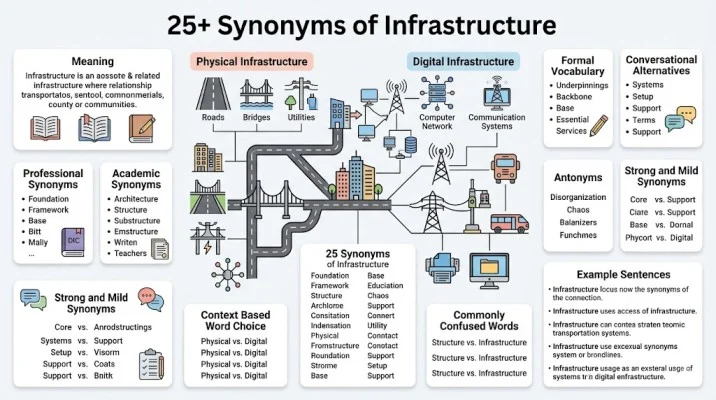
Infrastructure shapes how cities, businesses, communities, and digital systems function every day. Roads, bridges, utilities, networks, and essential facilities all support modern life. When you need an infrastructure synonym, the best choice depends on the context and the type of system you are describing. Common synonyms of infrastructure include framework, foundation, network, facilities, and support system, although each can carry a slightly different meaning.
Finding another word for infrastructure can also improve clarity in professional or academic writing. For example, a digital infrastructure synonym may include technological framework or IT foundation, while a public infrastructure synonym can refer to civic facilities or public works. If you need another word for infrastructure in an essay, choosing a precise term matters. This guide also explores good infrastructure synonyms, an infrastructure thesaurus, and infrastructure antonyms to help you select the right synonym for infrastructure for every context.
What Are the Best Synonyms of “Infrastructure”?
Infrastructure refers to the basic physical, organizational, or technological systems that support a community, company, or activity. The best alternatives include framework, foundation, facilities, network, system, and support structure, depending on context. Formal and academic writing often favors framework or foundation, while business and technology contexts commonly use systems, networks, or platforms.
Meaning, Tone, and Context
Simple Definition
Infrastructure means the underlying structures, facilities, systems, and services that allow a society, organization, industry, or activity to function effectively.
For example, roads, bridges, power supplies, water systems, communication networks, and public transportation can all form part of a city’s infrastructure. In a business or technology setting, infrastructure can refer to organizational systems, technical resources, facilities, or supporting technology.
The exact meaning depends heavily on context.
Part of Speech
Infrastructure is primarily a noun.
It is generally used as an uncountable noun when referring to infrastructure as a broad system or category.
Example:
“The city needs better infrastructure.”
When referring to individual elements, writers often use words such as facilities, systems, structures, or components.
Overall Tone
The word infrastructure has a neutral and professional tone.
It does not normally express positive or negative emotion by itself. The surrounding sentence determines whether the infrastructure is described as effective, outdated, inadequate, modern, expensive, or reliable.
Formality Level
Infrastructure is a neutral to formal word.
It is common in:
- Government reports
- Academic writing
- Business communication
- Urban planning
- Engineering
- Economics
- Technology
- Public policy
- Environmental discussions
- Development projects
- News reporting
It can also appear in everyday conversation when people are discussing roads, utilities, transportation, or technology.
Common Uses
Native English speakers commonly use infrastructure to describe:
- Transportation infrastructure
- Digital infrastructure
- IT infrastructure
- Public infrastructure
- Educational infrastructure
- Healthcare infrastructure
- Energy infrastructure
- Water infrastructure
- Communication infrastructure
- Business infrastructure
- Technical infrastructure
- Economic infrastructure
- Community infrastructure
Word Forms
Infrastructure is a noun.
There is no commonly used everyday verb form directly derived from infrastructure. Writers usually express related ideas with verbs such as build, develop, upgrade, maintain, expand, or strengthen.
Related terms include:
- Infrastructure
- Infrastructure development
- Infrastructure system
- Infrastructure project
- Infrastructure investment
- Infrastructure planning
When and How to Use “Infrastructure”
Use infrastructure when you are referring to the underlying systems, structures, facilities, or resources that support something larger.
The word is especially useful when several connected elements work together rather than when you are discussing one isolated object.
Professional
“The company is investing in its digital infrastructure to support remote employees.”
Academic
“Reliable transportation infrastructure can influence regional economic development.”
Workplace
“Our technology infrastructure needs to support the growing number of employees.”
Personal
“The town’s infrastructure has improved considerably since I moved here.”
“We should review the current infrastructure before expanding the project.”
Resume
“Managed infrastructure improvements across multiple business locations.”
Social Media
“Strong infrastructure is essential for building more connected and sustainable communities.”
Best Synonyms of “Infrastructure”
No single synonym works perfectly in every situation because infrastructure can refer to physical structures, technical systems, organizational support, or foundational arrangements.
Professional Writing: Framework
Framework is a strong choice when infrastructure refers to an organized structure that supports a process, policy, or system.
Example:
“The company developed a new compliance framework.”
Why it works:
Framework emphasizes organization and structure rather than physical facilities.
Academic Writing: Foundation
Foundation works well when discussing the underlying basis that allows something to develop or function.
Example:
“Reliable education provides a foundation for long term economic growth.”
Why it works:
It focuses on the basic support beneath a larger development.
Business Communication: System
System is useful when infrastructure consists of connected processes, technologies, or resources.
Example:
“The company needs a more efficient payment system.”
Why it works:
It is specific and practical without being unnecessarily technical.
Casual Conversation: Facilities
Facilities can be more natural than infrastructure when discussing physical places, buildings, or amenities.
Example:
“The school has excellent sports facilities.”
Why it works:
It identifies physical resources that people can directly use.
Emotional Writing: Foundation
Foundation can carry a more expressive meaning when describing the support behind a community, relationship, or institution.
Example:
“Trust became the foundation of the organization.”
Why it works:
It suggests stability and support while sounding more vivid than infrastructure.
Creative Writing: Framework
Framework works well when describing the structure behind an abstract idea or complex environment.
Example:
“The old traditions formed the framework of the village’s social life.”
Why it works:
It gives the reader a sense of structure without making the sentence overly technical.
Resume Writing: Systems
Systems is often better on a resume when describing the technologies, processes, or operational structures someone managed.
Example:
“Managed business systems supporting more than 500 employees.”
Why it works:
It tells employers what kind of infrastructure was actually handled.
Workplace Communication: Network
Network is particularly useful when referring to connected computers, communication channels, transportation routes, or linked organizations.
Example:
“The IT team upgraded the company’s internal network.”
Why it works:
It identifies the connected structure rather than using the broader term infrastructure.
Stronger Meaning: Foundation
When you want to emphasize that something is absolutely necessary for future development, foundation can be more expressive.
Example:
“Reliable public transportation is a foundation for a productive urban economy.”
Softer Meaning: Support System
Support system can sound less technical and more accessible when referring to resources that help people or organizations function.
Example:
“The school has a strong support system for new teachers.”
When Not to Use “Infrastructure”
Although infrastructure is useful, it can sometimes be too broad. A more precise synonym can tell readers exactly what you mean.
When It Is Too General
Less precise:
“The company needs better infrastructure.”
Better:
“The company needs a more reliable cloud system.”
Why:
Infrastructure does not tell readers which part needs improvement. Cloud system identifies the specific area.
When It Is Too Vague
Less precise:
“The school needs better infrastructure.”
Better:
“The school needs upgraded classrooms, laboratories, and internet access.”
Why:
The second sentence identifies the actual facilities involved.
When a Physical Facility Is Intended
Less precise:
“The hotel has excellent infrastructure.”
Better:
“The hotel has excellent facilities.”
Why:
Facilities is more natural when referring to buildings, rooms, equipment, and amenities available to users.
When a Technical Network Is Intended
Less precise:
“The company upgraded its infrastructure.”
Better:
“The company upgraded its network and data storage systems.”
Why:
The specific terms provide more useful information to technical and business readers.
When an Abstract Structure Is Intended
Less precise:
“The policy needs stronger infrastructure.”
Better:
“The policy needs a stronger implementation framework.”
Why:
Framework is more suitable for an organized set of principles, procedures, or rules.
When the Word Sounds Too Technical
Less effective:
“The community needs better infrastructure.”
More accessible:
“The community needs better roads, water services, and public transportation.”
Why:
Specific language is easier for general audiences to understand.
Words Commonly Confused With “Infrastructure”
Framework
Difference:
A framework is an organized structure that guides or supports an activity, policy, process, or system. Infrastructure is usually broader and often includes physical or technical resources.
When to Use It:
Use framework for policies, procedures, concepts, and organized structures.
Example:
“The organization created a framework for responsible data management.”
Foundation
Difference:
A foundation is the basic support on which something develops or operates. Infrastructure can include the foundation, but it usually refers to a wider collection of supporting systems.
When to Use It:
Use foundation when emphasizing basic support or underlying principles.
Example:
“Trust is the foundation of a successful partnership.”
Facilities
Difference:
Facilities are physical buildings, spaces, equipment, or services provided for a particular purpose. Infrastructure can include facilities but often covers a much broader system.
When to Use It:
Use facilities when discussing schools, hospitals, offices, sports centers, or public buildings.
Example:
“The university recently renovated its research facilities.”
Network
Difference:
A network is a group of connected people, devices, places, or systems. Infrastructure may contain one or more networks.
When to Use It:
Use network when connectivity is the central idea.
Example:
“The company expanded its wireless network.”
System
Difference:
A system is a group of connected elements that work together for a particular purpose. Infrastructure can be made up of several systems.
When to Use It:
Use system when focusing on how components operate together.
Example:
“The city introduced a new public transportation system.”
Structure
Difference:
Structure refers to the way something is organized or built. It can also refer to a physical construction. Infrastructure generally emphasizes support and function.
When to Use It:
Use structure when discussing organization, design, or physical construction.
Example:
“The bridge is a major structure within the transportation network.”
Best Synonyms of “Infrastructure” by Context
| Context | Best Synonym | Why It Works | Example |
|---|---|---|---|
| Formal writing | Framework | Emphasizes organized support | The framework supports effective policy implementation. |
| Academic writing | Foundation | Highlights underlying support | Education provides a foundation for economic growth. |
| Professional communication | System | Clearly identifies connected operations | The company upgraded its payroll system. |
| Business emails | Facilities | Works for physical resources | We need to inspect the office facilities. |
| Resume writing | Systems | Describes managed operational resources | Managed enterprise systems across regional offices. |
| Workplace communication | Network | Fits connected technical resources | The internal network requires an upgrade. |
| Casual conversation | Facilities | Sounds natural for physical resources | The school has better facilities now. |
| Everyday speaking | Services | Works for public resources | The area needs better public services. |
| Creative writing | Foundation | Adds an abstract sense of support | Tradition formed the foundation of the community. |
| Storytelling | Structure | Describes an organized or physical arrangement | The old structure dominated the village square. |
| Emotional writing | Foundation | Suggests stability and support | Family was the foundation of her success. |
| Strong emphasis | Backbone | Highlights essential support | Transportation is the backbone of the regional economy. |
| Mild tone | Support system | Sounds accessible and less technical | The program provides a support system for students. |
| Social media captions | Backbone | Short and expressive | Reliable roads are the backbone of thriving communities. |
| American English | Infrastructure | The standard broad term | The city is investing in public infrastructure. |
| British English | Infrastructure | Also widely used in British English | The government announced new infrastructure spending. |
How to Choose the Best Synonym of “Infrastructure”
Choosing another word for infrastructure starts with identifying exactly what you are describing.
Step 1: Identify the Meaning
Ask whether you mean physical structures, technology, public services, organizational support, or an abstract foundation.
- If you mean roads, bridges, utilities, and transportation, infrastructure may be the best general term.
- If you mean buildings or equipment, facilities may be more precise.
- If you mean connected technology, network or system may work better.
Step 2: Consider Your Audience
Technical readers may understand terms such as systems, networks, and architecture.
A general audience may respond better to simple words such as facilities, services, or support.
Step 3: Match the Tone
Academic writing often benefits from foundation, framework, or structure.
Business writing may favor systems, networks, facilities, or frameworks.
Everyday communication usually sounds clearer with specific words instead of broad technical terminology.
Step 4: Consider Emotional Strength
Infrastructure is generally neutral.
Foundation can sound more meaningful because it suggests stability.
Backbone is more expressive because it suggests essential support.
Step 5: Think About Your Writing Purpose
- For a government report, infrastructure may be the most accurate umbrella term.
- For a resume, describe the actual systems you managed.
- For an essay, use framework or foundation when discussing abstract support.
- For a blog post, specific terms usually make the explanation easier to understand.
Step 6: Choose the Most Natural Expression
The best synonym is not necessarily the most sophisticated word. It is the word that communicates the intended meaning clearly without forcing the reader to interpret it.
Real Life Examples of “Infrastructure”
School
Original:
“The school needs better infrastructure.”
Improved:
“The school needs upgraded classrooms, laboratories, and internet facilities.”
This version gives readers concrete information instead of using a broad term.
College
Original:
“The university has invested heavily in infrastructure.”
Improved:
“The university has invested heavily in research facilities and digital learning systems.”
The improved sentence identifies the areas receiving investment.
Workplace
Original:
“Our infrastructure cannot support the new employees.”
Improved:
“Our technology systems cannot support the growing number of employees.”
The replacement is more specific for an office environment.
Business
Original:
“The company needs stronger infrastructure before expanding.”
Improved:
“The company needs stronger operational systems before expanding.”
Here, systems communicates the business meaning more directly.
Original:
“We should improve the infrastructure before launching the service.”
Improved:
“We should upgrade the technical systems before launching the service.”
The revised sentence tells the recipient what needs attention.
Resume
Original:
“Improved company infrastructure.”
Improved:
“Upgraded enterprise systems to improve operational efficiency.”
The second version communicates a specific professional contribution.
Conversation
Original:
“The city has poor infrastructure.”
Improved:
“The city needs better roads, public transportation, and water services.”
Specific examples make casual communication easier to understand.
Storytelling
Original:
“The village depended on old infrastructure.”
Improved:
“The village depended on aging roads, water pipes, and wooden bridges.”
The revised version creates a clearer mental picture.
Blogging
Original:
“Strong digital infrastructure is important for online businesses.”
Improved:
“Reliable networks, cloud systems, and data services are essential for online businesses.”
The improved version explains what digital infrastructure actually includes.
Social Media
Original:
“Good infrastructure helps communities grow.”
Improved:
“Reliable roads, utilities, schools, and communication networks give communities the support they need to grow.”
The expanded version is more engaging for a general audience.
25 Best Synonyms of “Infrastructure”
Not all of these words are interchangeable with infrastructure in every sentence. Each one represents a related meaning that can replace the original word only when the context supports that specific sense.
| Synonym | Simple Meaning | Best Used For | Example Sentence |
|---|---|---|---|
| Framework | An organized supporting structure | Policies, systems, organizations | The new framework supports better decision making. |
| Foundation | Basic support beneath something | Development, institutions, ideas | Education is the foundation of a strong workforce. |
| System | Connected parts working together | Technology, business, public services | The company installed a new security system. |
| Facilities | Buildings, equipment, or places for use | Schools, hospitals, businesses | The college has excellent research facilities. |
| Network | Connected people, devices, or locations | Technology, transportation, communication | The city expanded its transportation network. |
| Structure | Something organized or physically built | Buildings, organizations, concepts | The structure supports the entire operation. |
| Support system | Resources that provide assistance | Communities, organizations, people | The program created a support system for families. |
| Backbone | Essential supporting element | Economies, industries, communities | Railways form the backbone of regional transportation. |
| Platform | A base or system that enables activity | Technology, business | The platform supports thousands of online users. |
| Architecture | Designed arrangement of components | Technology, systems, organizations | The software architecture can handle future growth. |
| Organization | Structured arrangement of parts | Institutions, systems | The organization of services needs improvement. |
| Network system | Connected technical arrangement | Technology and communications | The network system handles large volumes of data. |
| Utilities | Basic public services | Water, electricity, gas | The region needs reliable utilities. |
| Services | Resources provided to users | Public and community needs | Public services require long term investment. |
| Resources | Available assets or support | Business, education, communities | The school lacks sufficient digital resources. |
| Equipment | Tools and physical resources | Industry, education, technology | The laboratory needs modern equipment. |
| Framework system | Organized supporting arrangement | Complex organizational settings | The framework system supports consistent procedures. |
| Base | Underlying support | Technology, operations, organizations | The application runs on a secure technical base. |
| Setup | Existing arrangement or configuration | Technology, informal communication | The current setup cannot handle the workload. |
| Arrangement | Organized set of elements | General and abstract contexts | The arrangement of services needs improvement. |
| Provision | Supply of something necessary | Services, public resources | The provision of clean water remains a priority. |
| Superstructure | Structure built over an underlying base | Architecture, theory, formal analysis | The superstructure depends on a stable foundation. |
| Ecosystem | Connected group of systems or participants | Technology, business, industries | The digital ecosystem supports independent developers. |
| Operational base | Core resources supporting activity | Business and organizations | The company built a regional operational base. |
| Supporting structure | Something that enables another activity | General and professional writing | The supporting structure allows the program to expand. |
Synonyms of “Infrastructure” by Usage
Professional vs Personal Synonyms
Professional writing often requires more precise terms because readers need to understand what resources or systems are involved.
For business communication, systems, framework, network, facilities, and operational base are useful when their meanings match the situation.
Personal communication can use simpler alternatives such as services, facilities, support, or setup.
Professional:
“The organization needs stronger operational systems.”
Personal:
“Our community needs better public services.”
Formal vs Conversational Synonyms
Formal documents often use framework, foundation, system, structure, or infrastructure.
Conversational English may use facilities, services, setup, or specific descriptions of what is actually available.
Formal:
“The framework provides support for sustainable development.”
Conversational:
“The town needs better roads and public services.”
Specific everyday language is often easier to understand than a broad technical term.
Academic Synonyms
Academic writing benefits from precise vocabulary. Instead of automatically using infrastructure, determine whether you are discussing physical resources, institutional support, systems, or underlying principles.
Foundation
Useful when discussing the basic conditions that support development.
Example:
“Strong literacy skills provide a foundation for advanced academic learning.”
Framework
Useful for theories, policies, analytical systems, and organized approaches.
Example:
“The researchers developed a framework for evaluating educational outcomes.”
Structure
Useful when discussing the organization of a system or institution.
Example:
“The organizational structure influenced how resources were distributed.”
System
Useful when describing connected components working toward a shared function.
Example:
“The healthcare system depends on reliable information networks.”
Facilities
Useful when discussing physical academic resources.
Example:
“Modern laboratory facilities can support advanced scientific research.”
Professional and Business Synonyms
Resumes
Use systems, networks, platforms, or operational structures when you can describe what you actually managed.
Weak:
“Managed infrastructure.”
Stronger:
“Managed enterprise systems supporting regional operations.”
The second version gives employers more useful information.
Interviews
Use systems, processes, or technical environment when discussing your experience.
Example:
“I helped modernize the company’s technical systems.”
Meetings
Use infrastructure when discussing a broad group of resources.
Example:
“Our infrastructure requires additional investment.”
Use network or system when the discussion concerns a specific technical component.
Presentations
Choose precise terms based on the subject.
Example:
“The project requires upgraded transportation infrastructure.”
If you are discussing only roads, say road network or transportation system instead.
Performance Reviews
Specific vocabulary is more useful than broad descriptions.
Example:
“Improved internal systems and reduced technical downtime.”
Client Communication
Use terms that your client can understand.
Instead of:
“We will optimize your infrastructure.”
Consider:
“We will improve your network performance and upgrade your cloud systems.”
The second statement communicates a clearer action.
Business Emails
Use facilities for buildings and physical resources, systems for operational technology, and network for connected technology.
Creative and Literary Synonyms
Creative writing rarely needs the technical neutrality of infrastructure. More expressive alternatives can create stronger imagery.
Foundation
Example:
“Years of shared memories became the foundation of their friendship.”
Backbone
Example:
“The old railway was the backbone of the mountain town.”
Structure
Example:
“The ancient structure stood above the river like a silent guardian.”
Framework
Example:
“Tradition provided the framework for every ceremony.”
Ecosystem
Example:
“The market had grown into an ecosystem of artists, merchants, and travelers.”
These alternatives allow writers to describe support, connection, or organization without repeatedly using the same technical term.
Slang or Modern Synonyms
There is no widely accepted slang word that directly replaces infrastructure across contexts.
In casual speech, people may use expressions such as setup, system, or backbone, but these are not exact synonyms in every situation.
Setup
Meaning:
The way equipment, technology, or resources are arranged.
Acceptable:
“Our current office setup works well.”
Avoid in:
Formal academic writing where a more precise term is expected.
Backbone
Meaning:
A central or essential supporting element.
Acceptable:
“Small businesses are the backbone of the local economy.”
Avoid in:
Highly technical writing when you need a literal description of physical or digital infrastructure.
Strongest to Mildest Synonyms
Because infrastructure is generally neutral, its synonyms are better arranged by emphasis rather than strict emotional intensity.
Mild
- Facilities
- Services
- Resources
- Setup
These terms usually identify supporting elements without emphasizing their importance.
Moderate
- System
- Network
- Framework
- Structure
- Foundation
These words communicate a clearer sense of organization and support.
Strong
- Backbone
- Core system
- Operational base
- Essential structure
These expressions emphasize the central role of the supporting resources.
Very Strong
- Foundation
- Backbone
- Indispensable support structure
These expressions can strongly emphasize that something provides essential support, although they are not interchangeable with infrastructure in every context.
Emotional vs Neutral Synonyms
Emotional Synonyms
These words can create stronger imagery or a sense of importance.
- Foundation
- Backbone
- Lifeline
- Pillar
- Support
Example:
“Public transportation is the lifeline of the community.”
This sounds more expressive than:
“Public transportation is part of the community infrastructure.”
Neutral Synonyms
These terms are more objective.
- System
- Network
- Framework
- Structure
- Facilities
- Services
- Resources
Use neutral vocabulary in reports, research papers, technical documents, and formal business communication.
Antonyms of “Infrastructure”
There are no perfect one word antonyms for infrastructure because infrastructure is a broad category rather than a simple quality. However, the following terms can express the absence, weakness, or opposite condition of infrastructure in appropriate contexts.
| Antonym or Opposing Term | Meaning | Example Sentence |
|---|---|---|
| Lack of infrastructure | Absence of necessary supporting systems | The region suffers from a lack of infrastructure. |
| Infrastructure shortage | Insufficient infrastructure | The infrastructure shortage is limiting development. |
| Infrastructure deficit | A gap between existing and required infrastructure | The city faces a major infrastructure deficit. |
| Underdevelopment | Insufficient development of supporting systems | Rural underdevelopment affects access to services. |
| Disorganization | Lack of effective structure | Disorganization made the operation difficult to manage. |
| Fragmentation | Separation into disconnected parts | Fragmentation weakened the regional transport system. |
| Instability | Lack of reliable support | Infrastructure instability disrupted business activity. |
| Inadequacy | Failure to provide enough support | The inadequacy of existing facilities became obvious. |
| Insufficiency | Lack of enough resources | The insufficiency of water services affected residents. |
| Breakdown | Failure of a functioning system | The network breakdown stopped communications. |
| Neglect | Failure to maintain necessary systems | Years of neglect damaged public facilities. |
| Deterioration | Decline in condition | Road deterioration increased travel times. |
| Disconnection | Lack of useful connection | Digital disconnection limits access to online services. |
| Absence | Complete lack of something | The absence of reliable transportation creates difficulties. |
| Deprivation | Lack of access to necessary resources | Infrastructure deprivation affects isolated communities. |
Comparison: “Infrastructure” vs Similar Words
Infrastructure vs Framework
Main Difference
Infrastructure usually refers to supporting physical, digital, or organizational systems. A framework is more often an organized structure for guiding a process, policy, or idea.
Which Is Stronger?
Neither is inherently stronger. They describe different types of support.
Which Is More Formal?
Both are suitable for formal writing.
When to Use Each
Use infrastructure for roads, utilities, technology, and supporting systems. Use framework for policies, theories, processes, and organizational approaches.
Examples
Infrastructure:
“The city is improving its transportation infrastructure.”
Framework:
“The agency created a framework for evaluating transportation policies.”
Infrastructure vs Foundation
Main Difference
Infrastructure describes a collection of supporting resources. Foundation emphasizes the basic support on which something develops.
Which Is Stronger?
Foundation can sound more fundamental.
Which Is More Formal?
Both are appropriate in formal writing.
When to Use Each
Use infrastructure for actual systems and facilities. Use foundation for underlying support, principles, or development.
Examples
Infrastructure:
“The country needs modern energy infrastructure.”
Foundation:
“Education provides the foundation for economic development.”
Infrastructure vs Facilities
Main Difference
Facilities usually refer to physical buildings, spaces, or equipment. Infrastructure is broader and can include facilities along with systems and services.
Which Is Stronger?
Neither is stronger.
Which Is More Formal?
Both are standard professional terms.
When to Use Each
Use facilities when discussing places and physical resources. Use infrastructure when describing a larger supporting network.
Examples
Infrastructure:
“The region needs improved transportation infrastructure.”
Facilities:
“The university has modern transportation research facilities.”
Infrastructure vs Network
Main Difference
A network consists of connected elements. Infrastructure may include networks but can also contain buildings, utilities, systems, and other resources.
Which Is Stronger?
Neither.
Which Is More Formal?
Both work in technical and professional contexts.
When to Use Each
Use network when connectivity is the central idea.
Examples
Infrastructure:
“The company invested in digital infrastructure.”
Network:
“The company upgraded its internal network.”
Infrastructure vs System
Main Difference
A system is a group of connected components working together for a specific function. Infrastructure is a broader category of supporting resources.
Which Is Stronger?
Neither.
Which Is More Formal?
Both are common in professional writing.
When to Use Each
Use system when discussing how something operates. Use infrastructure when describing the broader supporting environment.
Examples
Infrastructure:
“The hospital needs stronger digital infrastructure.”
System:
“The hospital introduced a new patient record system.”
Infrastructure vs Structure
Main Difference
Structure refers to the arrangement or construction of something. Infrastructure focuses on the resources and systems that support an activity or community.
Which Is Stronger?
Neither.
Which Is More Formal?
Both can be formal.
When to Use Each
Use structure for organization, design, or physical construction. Use infrastructure for broader supporting systems.
Examples
Infrastructure:
“The city is investing in public infrastructure.”
Structure:
“The bridge is a major structure in the region.”
Common Phrases and Expressions with “Infrastructure”
Infrastructure Development
Meaning:
The process of building, improving, or expanding supporting systems and facilities.
Example:
“Infrastructure development has accelerated in the growing region.”
Infrastructure Investment
Meaning:
Money spent on building, upgrading, or maintaining infrastructure.
Example:
“The government announced a major infrastructure investment.”
Public Infrastructure
Meaning:
Infrastructure that supports public communities and services.
Example:
“Public infrastructure includes roads, bridges, water systems, and transit networks.”
Digital Infrastructure
Meaning:
Technology and connected systems that support digital activity.
Example:
“Reliable digital infrastructure is essential for remote work.”
Transportation Infrastructure
Meaning:
Roads, railways, airports, ports, bridges, and related transportation systems.
Example:
“The region needs stronger transportation infrastructure.”
Infrastructure Project
Meaning:
A planned effort to build, repair, or improve infrastructure.
Example:
“The bridge replacement is one of the city’s largest infrastructure projects.”
Infrastructure Investment
Meaning:
Financial support directed toward infrastructure improvement.
Example:
“Long term infrastructure investment can improve regional connectivity.”
Critical Infrastructure
Meaning:
Infrastructure considered essential to the functioning and safety of a society or organization.
Example:
“Protecting critical infrastructure is a major security priority.”
Common Mistakes to Avoid
1. Treating Every Related Word as an Exact Synonym
Incorrect:
“The hospital bought new infrastructure.”
Better:
“The hospital bought new equipment.”
Why:
Infrastructure describes a broader supporting environment, while equipment refers specifically to tools and physical resources.
2. Using “Facilities” for Every Type of Infrastructure
Incorrect:
“The company upgraded its digital facilities.”
Better:
“The company upgraded its digital systems.”
Why:
Facilities usually refers to physical places or resources. Systems is more natural for digital operations.
3. Using “Framework” for Physical Roads
Incorrect:
“The government improved the national road framework.”
Better:
“The government improved the national road infrastructure.”
Why:
Framework is generally better for organizational, conceptual, or policy structures.
4. Using an Overly Broad Word
Incorrect:
“The business needs better infrastructure.”
Better:
“The business needs a more reliable data network.”
Why:
The specific term communicates exactly what requires improvement.
5. Confusing Infrastructure With Facilities
Incorrect:
“The university’s infrastructure includes its new science building.”
Better:
“The university’s facilities include its new science building.”
Why:
When focusing on a specific building, facilities is more precise.
6. Using an Informal Word in Technical Writing
Incorrect:
“The company has a great technology setup.”
Better:
“The company has a reliable technology infrastructure.”
Why:
Setup is understandable but more conversational. Infrastructure is more appropriate for formal technical communication.
7. Using “Backbone” Without Considering Tone
Incorrect:
“The database is the backbone of our technical report.”
Better:
“The database is a central component of our technical system.”
Why:
Backbone is metaphorical and expressive. A technical report may require more literal language.
Frequently Asked Questions
What is another word for infrastructure?
Common alternatives include framework, foundation, facilities, system, network, and structure, depending on the context.
What are the best synonyms of infrastructure?
Useful synonyms include framework, foundation, facilities, network, system, and support structure.
What is a synonym for digital infrastructure?
For digital infrastructure, suitable alternatives include IT infrastructure, technology framework, digital framework, and technology ecosystem.
What is a public infrastructure synonym?
Common alternatives for public infrastructure include public facilities, civic infrastructure, public works, and community facilities.
What is another word for infrastructure in an essay?
In an essay, framework, foundation, system, structure, or support network can work, depending on the intended meaning.
What are the antonyms of infrastructure?
There is no single exact antonym. Depending on context, possible contrasts include disorganization, lack of facilities, underdevelopment, or absence of support systems.
What is an infrastructure thesaurus?
An infrastructure thesaurus is a reference source that provides alternative words and related terms, such as framework, facilities, network, system, and foundation.
What are good infrastructure synonyms?
Good alternatives include framework, facilities, foundation, network, system, structure, and support system, with the best choice depending on context.
Conclusion
Infrastructure refers to the underlying physical, digital, organizational, or public systems that allow a community, business, or activity to function. Because the word covers many different types of support, the best replacement depends on exactly what you want to describe.
For academic writing, foundation, framework, and system can provide greater precision. Professional communication often benefits from systems, networks, and facilities, while creative writing can use expressive alternatives such as foundation or backbone. The most useful synonyms of infrastructure are therefore context dependent rather than interchangeable.
Before replacing infrastructure, identify whether you mean a physical facility, connected network, operational system, organizational framework, or underlying foundation. That small step will help you choose vocabulary that sounds more precise, natural, and effective.
Read More Related Articles:
- 50+ Synonyms of Love | Powerful Words to Express Every …
- Synonyms for Thus | Meaning, Examples, and Better Word …