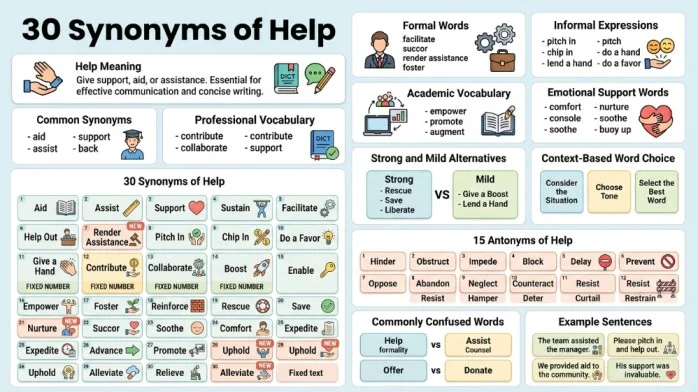
When writing an email, essay, resume, caption, or workplace message, repeating the word “help” can make your writing feel plain. Searching for synonyms of help gives you more precise choices, whether you want to describe assistance, guidance, support, encouragement, or practical action.
The best alternative depends on what you actually mean. “Assist” sounds professional, “aid” can sound formal, “support” focuses on backing someone or something, while “guide” suggests showing someone the right direction. Choosing the right word improves clarity, tone, and natural communication without making your writing unnecessarily complicated.
What Are the Best Synonyms of “Help”?
Help means giving someone assistance, support, advice, or practical aid. The best alternatives include assist for formal writing, aid for formal or serious contexts, support for personal and professional situations, facilitate for business or academic writing, and lend a hand for casual conversation.
Meaning, Tone, and Context
Simple Definition
Help means to make something easier for someone, provide assistance, solve a problem, or support someone in achieving a goal.
The word can describe both an action and the person, thing, or information that provides assistance.
For example:
“Can you help me with this report?”
“Your advice helped me make a better decision.”
Part of Speech
Help can function as both a verb and a noun.
As a verb:
“She helped her brother prepare for the exam.”
As a noun:
“Thank you for your help.”
Overall Tone
The word help is generally neutral and can also carry a positive tone when it describes kindness, cooperation, support, or assistance.
It does not usually sound emotional or formal by itself, which is one reason it works naturally in many different situations.
Formality Level
Help is a neutral word. It works in:
• Academic writing
• Business communication
• Professional emails
• Everyday conversations
• Social media
• Personal messages
• Customer service
• Workplace communication
Some synonyms have a more specific level of formality. For example, “assist” is more formal than “help,” while “lend a hand” is more conversational.
Common Uses
Native English speakers commonly use help when discussing:
• Solving a problem
• Providing information
• Supporting another person
• Giving advice
• Completing a task
• Improving a situation
• Learning something
• Providing emotional support
• Offering practical assistance
• Making something easier
Word Forms
| Word Form | Example |
|---|---|
| Verb | “Can you help me?” |
| Noun | “Thank you for your help.” |
| Past Form | “She helped me yesterday.” |
| Present Participle | “He is helping his team.” |
| Related Adjective | “Helpful advice” |
| Related Adverb | “She responded helpfully.” |
When and How to Use “Help”
Use help when you want a simple, natural way to describe assistance or support. It is often the safest choice because it does not unnecessarily increase the formality or emotional intensity of a sentence.
Professional
“Our technical team can help you resolve the issue.”
Academic
“The survey results may help researchers understand student behavior.”
Workplace
“Could you help me prepare the presentation?”
Personal
“My friends helped me through a difficult week.”
“Please let me know if I can help with anything else.”
Resume
“Helped the marketing team organize customer data and improve reporting processes.”
Social Media
“Thank you to everyone who helped make this event possible.”
Best Synonyms of “Help”
No synonym has exactly the same meaning in every context. The best choice depends on whether you mean practical assistance, emotional support, guidance, advice, cooperation, or making something easier.
Professional Writing: Assist
Assist is one of the safest formal alternatives to “help.” It works especially well in business documents, reports, job descriptions, and professional communication.
Example:
“She assisted the manager with daily operations.”
It sounds more formal and structured than “She helped the manager.”
Academic Writing: Facilitate
Facilitate means to make a process or activity easier or more effective.
Example:
“The program facilitates communication between students and instructors.”
It is particularly useful when discussing systems, processes, learning, research, or organizational activities.
Business Communication: Support
Support is excellent when assistance involves resources, encouragement, cooperation, or ongoing backing.
Example:
“Our team supports clients throughout the implementation process.”
It sounds natural and professional without being overly formal.
Casual Conversation: Lend a Hand
Lend a hand is a friendly expression meaning to help someone with a task.
Example:
“Can you lend me a hand with these boxes?”
It works well in everyday speech but is less appropriate for academic papers or formal reports.
Emotional Writing: Support
Support is often better than “help” when describing emotional or personal assistance.
Example:
“Her family supported her during a difficult period.”
The word suggests continued encouragement or care rather than a single practical action.
Creative Writing: Aid
Aid can add a more serious or literary quality to some creative sentences.
Example:
“The lantern aided their search through the dark forest.”
However, it should not be used simply to make ordinary writing sound fancy.
Resume Writing: Assisted
Assisted is particularly useful on resumes when describing responsibilities without overstating your role.
Example:
“Assisted senior staff with client onboarding and documentation.”
Workplace Communication: Support
Support is a natural workplace choice because it can describe both people and processes.
Example:
“I support the sales team by preparing weekly performance reports.”
Stronger Meaning: Rescue
Rescue is much stronger than “help” because it suggests saving someone from danger, difficulty, or a serious situation.
Example:
“Firefighters rescued the family from the damaged building.”
Softer Meaning: Encourage
Encourage is appropriate when the assistance is mainly emotional or motivational.
Example:
“Her teacher encouraged her to apply for the scholarship.”
When Not to Use “Help”
The word help is versatile, but sometimes it is too general. Replacing it with a more precise word can make your writing clearer.
When “Help” Is Too General
Weak:
“The software helps businesses.”
Better:
“The software streamlines business operations.”
The second sentence explains what the software actually does.
When “Help” Is Too Vague
Weak:
“She helped the team.”
Better:
“She supported the team by preparing weekly reports.”
The improved version shows the type of assistance provided.
When a Formal Alternative Is Better
Less formal:
“The assistant helped the director.”
More formal:
“The assistant assisted the director.”
“Assist” can be more suitable for formal workplace documents.
When “Help” Is Too Weak
Weak:
“The firefighters helped the residents.”
Better:
“The firefighters rescued the residents.”
“Rescued” communicates a much more serious situation.
When “Help” Is Too Broad for Academic Writing
Less precise:
“The study helps explain the results.”
Better:
“The study clarifies the factors behind the results.”
The second version communicates the specific contribution more clearly.
When Emotional Support Is the Main Meaning
General:
“Her friends helped her.”
More precise:
“Her friends supported her during the difficult period.”
“Supported” emphasizes emotional or ongoing assistance.
When the Word Sounds Too Casual
In a formal report, “help” may sometimes sound less precise.
Less formal:
“The new system helps employees manage tasks.”
More professional:
“The new system facilitates task management.”
The stronger alternative emphasizes the process rather than simply saying assistance occurs.
Words Commonly Confused With “Help”
| Word | Difference | When to Use It | Example |
|---|---|---|---|
| Assist | More formal than help and often describes practical participation. | Professional writing and official communication. | “The technician assisted the customer.” |
| Aid | Often suggests useful assistance during difficulty or need. | Formal, medical, humanitarian, or serious contexts. | “The program provides financial aid.” |
| Support | Focuses on backing, encouragement, or ongoing assistance. | Personal and professional situations. | “Her colleagues supported her decision.” |
| Guide | Means showing someone how to proceed. | Education, advice, training, and decision making. | “The mentor guided the students through the process.” |
| Facilitate | Means making an activity or process easier. | Academic, business, and organizational writing. | “The platform facilitates communication.” |
| Encourage | Focuses on motivation rather than practical assistance. | Personal, educational, and emotional situations. | “Her coach encouraged her to keep trying.” |
Best Synonyms of “Help” by Context
| Context | Best Synonym | Why It Works | Example |
|---|---|---|---|
| Formal writing | Assist | More formal and precise. | “Staff assisted visitors with registration.” |
| Academic writing | Facilitate | Describes making a process easier. | “The method facilitates data collection.” |
| Professional communication | Support | Natural and versatile in workplaces. | “We support clients throughout the process.” |
| Business emails | Assist | Polite and professional. | “I would be happy to assist you.” |
| Resume writing | Assist | Accurately describes supporting responsibilities. | “Assisted with customer onboarding.” |
| Workplace communication | Support | Works for people, teams, and processes. | “I support the operations team.” |
| Casual conversation | Help | Simple and natural. | “Can you help me move this?” |
| Everyday speaking | Lend a hand | Friendly and conversational. | “Could you lend me a hand?” |
| Creative writing | Aid | Can suit serious or literary contexts. | “The map aided their journey.” |
| Storytelling | Guide | Useful when someone provides direction. | “The old man guided them through the valley.” |
| Emotional writing | Support | Communicates care and encouragement. | “Her family supported her.” |
| Strong emphasis | Rescue | Indicates serious assistance or saving. | “The crew rescued the passengers.” |
| Mild tone | Encourage | Focuses on motivation. | “Her words encouraged him.” |
| Social media captions | Support | Natural for appreciation and community messages. | “Thanks for supporting my work.” |
| American English | Help | The most natural general-purpose choice. | “Can you help me with this?” |
| British English | Help | Also completely natural in British English. | “Could you help me with this?” |
How to Choose the Best Synonym of “Help”
Choosing another word for help becomes easier when you identify the exact type of assistance you mean.
Choose by Meaning
- If you mean practical assistance, use assist.
- If you mean emotional backing, use support.
- If you mean direction, use guide.
- If you mean motivation, use encourage.
- If you mean making a process easier, use facilitate.
If you mean saving someone from danger, use rescue.
Choose by Tone
- For neutral communication, help is usually best.
- For formal communication, consider assist or aid.
- For professional communication, support and facilitate often sound natural.
- For casual conversation, lend a hand works well.
Choose by Audience
Students can use assist, support, facilitate, and guide in appropriate academic contexts.
Professionals can use assist, support, facilitate, enable, and advise depending on the meaning.
For friends and family, simple words such as help, support, and encourage usually sound more natural.
Choose by Emotional Strength
Help is neutral.
Support can suggest ongoing care.
Encourage emphasizes motivation.
Aid can suggest assistance during difficulty.
Rescue is much stronger and implies serious danger or trouble.
Choose by Writing Purpose
- For a resume, use assisted, supported, coordinated, or facilitated when those words accurately describe your responsibilities.
- For an essay, facilitate, aid, support, or enable may be more precise.
- For an email, assist is useful when maintaining a professional tone.
- For everyday conversation, simply using help is often the most natural choice.
Real Life Examples of “Help”
School
Basic:
“Teachers help students understand difficult subjects.”
Improved:
“Teachers guide students through difficult concepts.”
“Guide” is more precise because it shows that the teacher provides direction.
College
Basic:
“The research helped us understand the problem.”
Improved:
“The research clarified the main factors behind the problem.”
“Clarified” is more specific when the research makes something easier to understand.
Workplace
Basic:
“I help my manager with reports.”
Improved:
“I assist my manager with weekly reports.”
“Assist” fits professional communication.
Business
Basic:
“Our service helps companies save time.”
Improved:
“Our service enables companies to save time.”
“Enables” emphasizes the result made possible by the service.
Basic:
“Please let me know if I can help.”
Improved:
“Please let me know if I can assist you with anything further.”
The second version sounds more formal and customer-service oriented.
Resume
Basic:
“Helped customers with their questions.”
Improved:
“Assisted customers with product questions and account requests.”
The improved version is more specific and professional.
Conversation
Basic:
“Can you help me carry this?”
Natural:
“Can you lend me a hand with this?”
The expression sounds friendly and conversational.
Storytelling
Basic:
“The guide helped them find the village.”
Improved:
“The guide led them safely toward the village.”
“Led” is more precise because the person physically directs the journey.
Blogging
Basic:
This guide will help you improve your writing.”
Improved:
“This guide will enable you to make clearer vocabulary choices.”
“Enable” works when something provides the ability to do something.
Social Media
Basic:
“Thanks for helping my small business.”
Improved:
“Thank you for supporting my small business.”
“Supporting” better expresses ongoing encouragement and customer loyalty.
25 Best Synonyms of “Help”
| Synonym | Simple Meaning | Best Used For | Example Sentence |
|---|---|---|---|
| Assist | Give practical help | Formal and professional writing | “Our staff will assist you with registration.” |
| Aid | Provide useful assistance | Formal or serious situations | “The organization provided aid to affected families.” |
| Support | Give backing or encouragement | Personal and professional contexts | “Her team supported her throughout the project.” |
| Facilitate | Make something easier | Academic and business writing | “The software facilitates online collaboration.” |
| Guide | Show someone the right direction | Education and advice | “The counselor guided students through the application process.” |
| Encourage | Give confidence or motivation | Emotional and educational contexts | “Her parents encouraged her to continue studying.” |
| Advise | Give recommendations or guidance | Professional and personal decisions | “The consultant advised us to review the contract.” |
| Counsel | Give serious or professional advice | Legal, personal, or formal contexts | “The lawyer counseled the client before the hearing.” |
| Enable | Make something possible | Technology, business, and academic writing | “The new system enables faster communication.” |
| Empower | Give someone ability or confidence | Leadership and personal development | “Training empowers employees to make better decisions.” |
| Benefit | Produce a useful result for someone | General and formal writing | “The new policy will benefit local businesses.” |
| Serve | Provide useful assistance or a function | Professional and organizational contexts | “The program serves families in rural communities.” |
| Cooperate | Work together to achieve something | Teams and relationships | “Both departments cooperated to solve the problem.” |
| Collaborate | Work jointly on a task | Business, education, and creative work | “The two teams collaborated on the campaign.” |
| Contribute | Add effort or resources | Projects and group work | “Everyone contributed to the community project.” |
| Rescue | Save someone from danger or difficulty | Emergencies and serious situations | “The crew rescued the passengers.” |
| Relieve | Reduce pain, pressure, or difficulty | Health, work, and emotional contexts | “The new schedule relieved some pressure on staff.” |
| Alleviate | Reduce a problem or burden | Formal and academic writing | “The program aims to alleviate financial pressure.” |
| Remedy | Correct or improve a problem | Formal and professional writing | “The company acted quickly to remedy the issue.” |
| Back | Give support or approval | Informal and professional contexts | “Several investors backed the new project.” |
| Accommodate | Adjust to meet someone’s needs | Customer service and professional settings | “The hotel accommodated the guest’s dietary needs.” |
| Promote | Encourage or advance something | Business, education, and social causes | “The campaign promotes healthy eating.” |
| Care for | Look after someone | Personal and health contexts | “She cared for her elderly neighbor.” |
| Lend a hand | Give casual assistance | Everyday conversation | “Can you lend a hand in the kitchen?” |
| Pitch in | Contribute effort to a shared task | Informal conversation | “Everyone pitched in to clean the room.” |
Synonyms of “Help” by Usage
Professional vs Personal Synonyms
Professional writing often benefits from assist, support, facilitate, enable, and advise.
For personal communication, help, support, encourage, and care for usually sound warmer and more natural.
Compare:
Professional:
“Our consultants assist clients with strategic planning.”
Personal:
“My friends supported me when I needed them.”
The first sentence emphasizes a service. The second emphasizes personal backing.
Formal vs Conversational Synonyms
- For reports and essays, choose words such as assist, aid, facilitate, enable, or alleviate when their meanings fit.
- For presentations and professional emails, assist, support, and help are usually safe choices.
- For casual conversations and texting, help, lend a hand, and pitch in sound more natural.
Academic Synonyms
Academic writing benefits from precise vocabulary rather than simply replacing every occurrence of “help.”
Facilitate is useful when something makes a process easier.
“The visual model facilitates student understanding.”
Enable works when something makes an action possible.
“Digital tools enable researchers to analyze large datasets.”
Support is appropriate when evidence strengthens an argument.
“The findings support the proposed explanation.”
Aid can describe assistance in formal contexts.
“Additional data may aid future research.”
The goal is precision, not complicated vocabulary. A simpler word is better when it communicates the idea clearly.
Professional and Business Synonyms
Resumes
Use assisted, supported, facilitated, or enabled when these accurately describe your contribution.
Example:
“Assisted the sales department with customer account management.”
Interviews
Use support, contribute, or assist to explain how you work with others.
Example:
“I supported the team by improving our reporting process.”
Meetings
Use facilitate when you organize or make communication easier.
Example:
“I facilitated a discussion between the marketing and product teams.”
Presentations
Use support when discussing evidence or information.
Example:
“These results support our recommendation.”
Performance Reviews
Use precise verbs that show what you actually did.
Example:
“Supported new employees during their onboarding period.”
Client Communication
Assist is especially useful for polite professional language.
Example:
“I would be happy to assist you with your request.”
Business Emails
Use assist, support, or simply help, depending on the level of formality.
Example:
“Please let me know how I can assist you.”
Creative and Literary Synonyms
Creative writing gives you more freedom to choose expressive alternatives.
Guide can describe someone leading another person physically or emotionally.
“The old woman guided him toward the mountain path.”
Aid can suit serious or historical scenes.
“The map aided their search.”
Rescue adds urgency.
“At dawn, the villagers rescued the trapped travelers.”
Encourage highlights emotional motivation.
“Her final words encouraged him to continue.”
Support can express loyalty or emotional strength.
“His sister supported him through every setback.”
The best creative synonym should add meaning, not simply make the sentence sound more complicated.
Slang or Modern Synonyms
There are no universal slang synonyms that should replace help in every situation. However, informal expressions such as lend a hand and pitch in are common in conversational American English.
Lend a hand means to provide casual assistance.
“Can you lend a hand with these chairs?”
Use it with friends, coworkers, or family members in relaxed situations. Avoid it in formal reports or academic papers.
Pitch in means to contribute effort to a shared task.
“Everyone pitched in to prepare for the event.”
It is informal and conversational, so it should generally be avoided in highly formal writing.
Strongest to Mildest Synonyms
The intensity of a synonym depends heavily on context, but a practical scale can help.
| Intensity | Useful Alternatives | Typical Meaning |
|---|---|---|
| Mild | Encourage, guide | Motivation or direction |
| Moderate | Help, assist, support | General assistance |
| Strong | Aid, enable, facilitate | Meaningful practical assistance |
| Very Strong | Rescue, relieve, alleviate | Assistance involving serious difficulty or major burden |
These categories are not absolute. For example, facilitate is not emotionally stronger than “help.” It is more specific about making a process easier.
Emotional vs Neutral Synonyms
Emotional Synonyms
These alternatives can carry more personal or emotional meaning:
• Support
• Encourage
• Care for
• Empower
• Rescue
Use them when the sentence involves relationships, motivation, hardship, confidence, or personal care.
Example:
“Her family supported her during the difficult period.”
Neutral Synonyms
These words usually communicate assistance without adding much emotional meaning:
• Help
• Assist
• Aid
• Facilitate
• Enable
• Contribute
They work well in academic, professional, and informational writing.
Antonyms of “Help”
There is no single opposite of help for every meaning because the word can describe assistance, support, improvement, or contribution. The following words represent genuine opposing actions or effects in common contexts.
| Antonym | Meaning | Example Sentence |
|---|---|---|
| Hinder | Make something more difficult | Poor planning can hinder progress. |
| Obstruct | Block progress or movement | The fallen tree obstructed the road. |
| Impede | Slow down progress | Technical problems impeded the project. |
| Hamper | Make an activity harder to complete | Heavy rain hampered the rescue effort. |
| Harm | Cause damage or injury | The decision could harm local businesses. |
| Hurt | Cause physical or emotional damage | His comments hurt her feelings. |
| Damage | Cause physical or practical harm | The mistake damaged the company’s reputation. |
| Undermine | Weaken confidence, effectiveness, or authority | The criticism undermined public trust. |
| Discourage | Reduce someone’s confidence or motivation | The rejection discouraged him from applying again. |
| Prevent | Stop something from happening | The security system prevented unauthorized access. |
| Block | Stop movement, action, or progress | The error blocked the payment process. |
| Restrict | Limit someone’s freedom or ability | The new rule restricts access to the facility. |
| Oppose | Act against something | Several groups opposed the proposed policy. |
| Interfere | Get in the way of an activity or process | Outside pressure interfered with the investigation. |
| Abandon | Leave someone without continued support | The organization abandoned the project before completion. |
Comparison: “Help” vs Similar Words
Help vs Assist
Main Difference
Both words describe giving assistance, but assist is more formal and often sounds more professional.
Which Is Stronger?
Neither is inherently stronger. The difference is mainly tone and formality.
Which Is More Formal?
Assist is more formal.
When to Use Each
Use “help” in everyday communication. Use “assist” in professional documents, customer service, and formal emails.
Examples
Help:
“Can you help me with this form?”
Assist:
“Our representative can assist you with the application.”
Help vs Aid
Main Difference
Aid often suggests assistance given during a difficult, urgent, or serious situation.
Which Is Stronger?
Aid can sound more serious than general help.
Which Is More Formal?
Aid is generally more formal.
When to Use Each
Use “aid” for humanitarian assistance, financial assistance, emergencies, and formal writing.
Examples
Help:
“She helped her neighbor.”
Aid:
“The organization provided aid to families affected by the storm.”
Help vs Support
Main Difference
Support often suggests ongoing backing, encouragement, or assistance.
Which Is Stronger?
Support can suggest a deeper or longer-lasting commitment.
Which Is More Formal?
Both are suitable for professional writing.
When to Use Each
Use support for people, teams, ideas, organizations, and ongoing assistance.
Examples
Help:
“My teacher helped me prepare.”
Support:
“My teacher supported me throughout the semester.”
Help vs Guide
Main Difference
Guide means showing someone how to proceed or helping them make a decision.
Which Is Stronger?
Neither is inherently stronger.
Which Is More Formal?
Both can be formal or neutral depending on context.
When to Use Each
Use “guide” when direction or instruction is central to the meaning.
Examples
Help:
“The counselor helped students.”
Guide:
“The counselor guided students through the application process.”
Help vs Facilitate
Main Difference
Facilitate means making a process or activity easier, smoother, or more possible.
Which Is Stronger?
Facilitate is more specific rather than stronger.
Which Is More Formal?
Facilitate is considerably more formal.
When to Use Each
Use it in academic, business, organizational, and technical contexts.
Examples
Help:
“The tool helps users communicate.”
Facilitate:
“The platform facilitates communication between departments.”
Help vs Encourage
Main Difference
Encourage focuses on motivation, confidence, or emotional support.
Which Is Stronger?
Neither is generally stronger.
Which Is More Formal?
Both are widely acceptable.
When to Use Each
Use encourage when someone motivates another person to continue, try, or believe in themselves.
Examples
Help:
“Her parents helped her pursue her goals.”
Encourage:
“Her parents encouraged her to pursue her goals.”
Common Phrases and Expressions with “Help”
Help Out
Meaning
“Help out” means to provide assistance, usually in a practical or temporary situation.
Example Sentence
“Can you help out at the store this weekend?”
Help With
Meaning
“Help with” identifies the task or problem someone assists with.
Example Sentence
“She helped me with my homework.”
Help Someone Do Something
Meaning
This structure describes assistance that allows someone to complete an action.
Example Sentence
“The guide helped us find the entrance.”
Can’t Help
Meaning
“Can’t help” can mean being unable to assist or being unable to stop yourself from doing something, depending on context.
Example Sentence
“I can’t help you move tomorrow.”
Help Yourself
Meaning
“Help yourself” commonly means to take something freely or serve yourself.
Example Sentence
“Please help yourself to some coffee.”
Help Someone Out
Meaning
This means giving someone practical assistance, often when they need it.
Example Sentence
“Thanks for helping me out yesterday.”
With the Help of
Meaning
This phrase identifies something or someone that made an achievement possible.
Example Sentence
“With the help of her mentor, she improved her writing.”
Ask for Help
Meaning
This means requesting assistance from another person.
Example Sentence
“Don’t hesitate to ask for help when you need it.”
Common Mistakes to Avoid
1. Choosing a Vague Synonym
Incorrect
“The program helps students.”
Better
“The program guides students through the application process.”
Why
“Guides” explains the specific kind of assistance being provided.
2. Confusing Help With Support
Incorrect
“Her friends helped her emotionally for several years.”
Better
“Her friends supported her emotionally for several years.”
Why
“Support” better communicates ongoing emotional assistance.
3. Using Informal Expressions in Formal Writing
Incorrect
“The department pitched in to solve the issue.”
Better
“The department contributed to resolving the issue.”
Why
“Pitch in” is conversational, while “contributed” works better in formal communication.
4. Choosing an Overly Dramatic Synonym
Incorrect
“My coworker rescued me by explaining the spreadsheet.”
Better
“My coworker helped me understand the spreadsheet.”
Why
“Rescue” suggests serious danger or difficulty and is excessive in this situation.
5. Repeating “Help” Too Often
Incorrect
“The guide helps students, helps teachers, and helps parents understand the program.”
Better
“The guide supports students, assists teachers, and enables parents to understand the program.”
Why
Careful variation makes the sentence less repetitive while adding precision.
6. Using a Formal Word Just to Sound Intelligent
Incorrect
“The teacher facilitated me with my homework.”
Better
“The teacher helped me with my homework.”
Why
“Facilitate” does not naturally replace “help” in every sentence. Simple vocabulary is better when it expresses the meaning accurately.
7. Confusing Advice With Assistance
Incorrect
“My manager helped me to a better career decision.”
Better
“My manager advised me to make a different career decision.”
Why
“Advised” is more precise when the main action is giving a recommendation.
Frequently Asked Questions
1. What are the best synonyms of “help”?
The best synonyms of help include assist, aid, support, facilitate, guide, encourage, advise, enable, empower, and contribute. The best option depends on whether you mean practical assistance, emotional support, guidance, or making something possible.
2. What are the best formal synonyms of “help”?
The strongest formal alternatives include assist, aid, facilitate, enable, alleviate, and counsel. These words work well in academic papers, business documents, professional emails, reports, and other situations requiring precise language.
3. What are common informal synonyms of “help”?
Common conversational alternatives include lend a hand, pitch in, and help out. These expressions sound friendly and natural in everyday American English but should generally be avoided in highly formal or academic writing.
4. What is another word for “help” in professional writing?
Assist is one of the best professional alternatives to “help.” Other choices include support, facilitate, enable, and contribute, depending on the specific action or result you want to describe.
5. What is the difference between “help” and “assist”?
“Help” is a neutral, everyday word for providing assistance, while “assist” is more formal. Both can describe practical support, but “assist” is especially common in professional communication and official documents.
6. What is the opposite of “help”?
Common opposites of “help” include hinder, obstruct, impede, hamper, harm, prevent, undermine, discourage, and interfere. The best antonym depends on whether you mean blocking progress, causing harm, or reducing someone’s ability to succeed.
Conclusion
Help is a flexible and useful word that can describe practical assistance, emotional support, guidance, encouragement, or making something easier. However, choosing a more specific alternative can make your writing clearer and better suited to its purpose.
For formal and professional writing, assist, support, facilitate, and enable are useful choices. In academic writing, facilitate, aid, and support can provide greater precision. For emotional situations, support and encourage often work better, while lend a hand and pitch in are natural informal alternatives.
There is no single best synonym for every sentence. When choosing among the synonyms of help, first identify what kind of assistance you mean, then match the word to your audience, tone, and purpose. A simple vocabulary habit is to replace a repeated word only when the alternative adds real meaning or precision.
Read More Related Articles:
50+ Best List of Synonyms | for Better Writing and …
50+ Synonyms of Love | Powerful Words to Express Every …
Synonyms for Thus | Meaning, Examples, and Better Word …