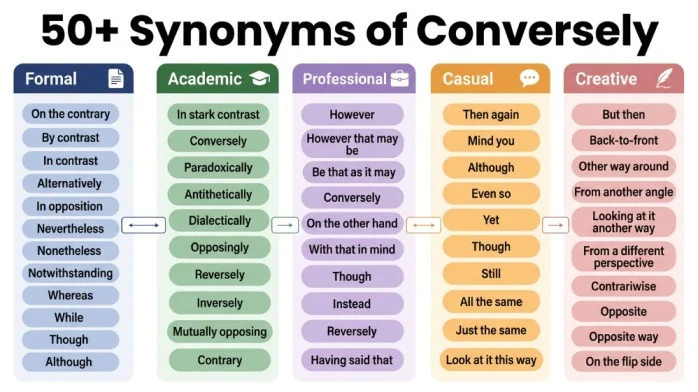
Strong writing depends on showing contrast. When two ideas conflict, the transition can make their connection clear and persuasive. Learning the synonyms of conversely helps writers avoid repetition while choosing expressions that match the tone, purpose, and overall strength of their argument. These alternatives add variety without weakening the relationship between opposing points.
From academic essays and business reports to everyday communication, a well-chosen contrast word can sharpen the message and guide readers from one idea to another. The best synonyms of conversely are not always interchangeable; some sound more formal, while others work better in casual or direct writing. Exploring their meanings, usage, and subtle differences makes it easier to select the most effective expression for every writing context.
What Are the Best Synonyms of “Conversely”?
Conversely means in an opposite or contrasting way. It is used to introduce a statement that reverses or contradicts a previous idea. The best synonyms depend on context. For formal writing, use on the contrary or in contrast. For professional communication, use however or by contrast. Casual conversation, use but or on the flip side.
Meaning, Tone, and Context
Understanding the word conversely is the first step to using it effectively.
Simple Definition:
Conversely means in a way that is opposite to something previously stated. It is used to introduce a contrasting or reverse perspective.
Part of Speech:
Adverb
Overall Tone:
Neutral. Conversely simply indicates contrast without adding emotion.
Formality Level:
Formal. Conversely is more common in academic, professional, and formal writing than in casual conversation.
Common Uses:
Native English speakers use conversely in essays, research papers, reports, presentations, and formal discussions to introduce opposing viewpoints or reverse perspectives.
Word Forms:
- Adverb: conversely
- Adjective: converse (opposite or reverse)
- Noun: converse (the opposite)
- Verb: converse (to talk, unrelated)
Opposite Forms:
Similarly, likewise, in the same way.
When and How to Use “Conversely”
The word conversely fits situations where you want to show the opposite side of an argument or present a contrasting perspective.
Professional Context:
The policy improved efficiency. Conversely, it increased costs significantly.
Academic Context:
Some studies support the theory. Conversely, other research contradicts its findings.
Workplace Context:
Remote work offers flexibility. Conversely, it can reduce team collaboration.
Personal Context:
Exercise boosts energy. Conversely, overtraining can lead to fatigue.
Email Context:
We expected higher sales. Conversely, the numbers show a decline this quarter.
Resume Context:
Managed a large team. Conversely, also handled individual client relationships.
Social Media Context:
Technology connects us globally. Conversely, it can make us feel more isolated.
Best Synonyms of “Conversely”
No single synonym works perfectly in every situation. The best choice depends on your audience, tone, and the specific contrast you want to express.
For Professional Writing:
Use however or by contrast. These words sound clear, professional, and balanced.
For Academic Writing:
Use on the contrary or in contrast. These words add precision and scholarly authority.
For Business Communication:
Use however or on the other hand. These words are professional and widely understood.
For Casual Conversation:
Use but or on the flip side. These words are simple and natural.
For Emotional Writing:
Use yet or still. These words add a sense of surprise or persistence.
For Creative Writing:
Use by contrast or on the other hand. These words add variety to storytelling.
For Resume Writing:
Use however or by contrast. These words show balance and versatility.
For Workplace Communication:
Use however or on the other hand. These words emphasize clear comparisons.
For Stronger Meaning:
Use on the contrary. This phrase strongly emphasizes contradiction.
For Softer Meaning:
Use however or yet. These words are gentler and less forceful.
When Not to Use “Conversely”
Even though conversely is a useful word, there are times when it is not the best choice.
When the Word Sounds Too Formal:
Conversely can feel stiff in casual conversation.
Original:
I love pizza. Conversely, I hate pineapple on it.
Better Recommendation:
Use but or however.
Rewritten Sentence:
I love pizza, but I hate pineapple on it.
When the Word Sounds Too Repetitive:
Using conversely repeatedly loses its impact.
Original:
The plan saved money. Conversely, it increased time. Conversely, it reduced quality.
Better Recommendation:
Use however and by contrast.
Rewritten Sentence:
The plan saved money. However, it increased time. By contrast, it reduced quality.
When the Contrast Is Not Strong:
Conversely is too strong for a weak contrast.
Original:
She likes coffee. Conversely, she prefers tea.
Better Recommendation:
Use but or while.
Rewritten Sentence:
She likes coffee, but she prefers tea.
When the Reader May Not Know the Word:
Conversely may confuse readers who are not familiar with it.
Original:
Conversely, the second option is cheaper.
Better Recommendation:
Use on the other hand.
Rewritten Sentence:
On the other hand, the second option is cheaper.
Words Commonly Confused With “Conversely”
Several words are often confused with conversely because they share similar meanings.
- Conversely vs On the Contrary
- Difference: On the contrary is used to strongly deny a previous statement. Conversely is used to introduce a reverse perspective.
- When to Use It: Use on the contrary for strong contradiction. Use conversely for balanced contrast.
- Example: He is not lazy. On the contrary, he works very hard. / The plan saved money. Conversely, it took more time.
- Conversely vs In Contrast
- Difference: In contrast compares two different things. Conversely introduces a reverse perspective.
- When to Use It: Use in contrast for comparison. Use conversely for reverse logic.
- Example: She prefers city life. In contrast, he loves the countryside. / The first option is fast. Conversely, the second is cheaper.
- Conversely vs However
- Difference: However is more general and versatile. Conversely is more formal and specific to contrast.
- When to Use It: Use however for any contrast. Use conversely for reverse logic.
- Example: She was tired. However, she continued working. / The product is expensive. Conversely, it is high quality.
- Conversely vs On the Other Hand
- Difference: On the other hand is used to present an alternative perspective. Conversely introduces a reverse perspective.
- When to Use It: Use on the other hand for alternatives. Use conversely for reverse logic.
- Example: I want to go out. On the other hand, I should study. / The policy helped the economy. Conversely, it hurt the environment.
- Conversely vs By Contrast
- Difference: By contrast compares two different subjects. Conversely introduces a reverse perspective.
- When to Use It: Use by contrast for comparison. Use conversely for reverse logic.
- Example: He is outgoing. By contrast, his sister is shy. / The first idea is creative. Conversely, the second is practical.
- Conversely vs Yet
- Difference: Yet is softer and more conversational. Conversely is more formal.
- When to Use It: Use yet for gentle contrast. Use conversely for formal contrast.
- Example: She is young, yet she is wise. / The product is popular. Conversely, it is not profitable.
Best Synonyms of “Conversely” by Context
| Context | Best Synonym | Why It Works | Example |
|---|---|---|---|
| Formal Writing | On the contrary | Sounds precise and authoritative | The results do not support the theory. On the contrary, they disprove it. |
| Academic Writing | In contrast | Scholarly and clear | The first study found positive results. In contrast, the second found none. |
| Professional Communication | However | Clear and professional | The project succeeded. However, it exceeded the budget. |
| Business Emails | On the other hand | Professional and balanced | We could expand now. On the other hand, we could wait. |
| Resume Writing | However | Shows balance and versatility | Managed a large team. However, also worked independently. |
| Workplace Communication | Yet | Professional yet conversational | We met the deadline. Yet, quality suffered. |
| Casual Conversation | But | Simple and natural | I like him, but he is not reliable. |
| Everyday Speaking | On the flip side | Friendly and approachable | The job pays well. On the flip side, the hours are long. |
| Creative Writing | By contrast | Adds variety and rhythm | The hero was brave. By contrast, the villain was cowardly. |
| Storytelling | Yet | Adds depth and suspense | He was innocent. Yet, the evidence suggested otherwise. |
| Emotional Writing | Yet | Adds emotional weight | She loved him. Yet, she had to let him go. |
| Strong Emphasis | On the contrary | Strongly emphasizes contradiction | This is not a failure. On the contrary, it is a success. |
| Mild Tone | However | Gentle and balanced | The plan is good. However, it needs improvement. |
| Social Media Captions | On the flip side | Short and relatable | Life is busy. On the flip side, it is exciting. |
How to Choose the Best Synonym of “Conversely”
Choosing the right synonym depends on several factors. Use this practical guide to make the best decision.
Meaning:
What kind of contrast do you want to express? Are you denying a statement, comparing two things, or presenting a reverse perspective? Choose a synonym that matches your specific goal.
Tone:
Do you want to sound formal, casual, or emotional? Formal words like on the contrary fit professional writing. Casual words like but fit conversation.
Audience:
Who is reading your writing? Academic readers expect precise vocabulary. Friends expect natural language. Business readers expect clear communication.
Emotional Strength:
How strong is your contrast? Use on the contrary for strong contradiction. Use however or yet for gentle contrast.
Writing Purpose:
Are you writing a report, an email, a story, or a social media post? Match your synonym to the purpose.
Level of Formality:
Consider the formality of your situation. Reports, essays, and official documents require formal synonyms. Texting and social media allow casual language.
Natural Sounding Usage:
Always read your sentence aloud. If the synonym sounds forced or awkward, choose a different word.
Real Life Examples of “Conversely”
School Context:
The teacher praised hard work. Conversely, she criticized laziness.
Stronger Version:
The teacher praised hard work. However, she criticized laziness.
College Context:
The theory is widely accepted. Conversely, it has some critics.
Stronger Version:
The theory is widely accepted. On the other hand, it has some critics.
Workplace Context:
The new system is faster. Conversely, it is more complex.
Stronger Version:
The new system is faster. However, it is more complex.
Business Context:
The strategy increased profits. Conversely, it reduced employee morale.
Stronger Version:
The strategy increased profits. Yet, it reduced employee morale.
Email Context:
We expected positive results. Conversely, the data shows a decline.
Stronger Version:
We expected positive results. However, the data shows a decline.
Resume Context:
Led a successful project. Conversely, also worked independently.
Stronger Version:
Led a successful project. However, also worked independently.
Conversation Context:
I love traveling. Conversely, I hate packing.
Stronger Version:
I love traveling, but I hate packing.
Storytelling Context:
She was kind. Conversely, her sister was selfish.
Stronger Version:
She was kind. By contrast, her sister was selfish.
Blogging Context:
Exercise improves health. Conversely, overtraining can harm it.
Stronger Version:
Exercise improves health. On the flip side, overtraining can harm it.
Social Media Context:
Life is short. Conversely, each day feels long.
Stronger Version:
Life is short. Yet, each day feels long.
25 Best Synonyms of “Conversely”
| Synonym | Simple Meaning | Best Used For | Example Sentence |
|---|---|---|---|
| On the contrary | Used to strongly deny a previous statement | Formal, argumentative | This is not a problem. On the contrary, it is an opportunity. |
| In contrast | Used to compare different things | Academic, formal | The north is cold. In contrast, the south is warm. |
| However | Used to introduce a contrast | Professional, general | The plan is good. However, it needs work. |
| On the other hand | Used to present an alternative | Professional, balanced | We could expand. On the other hand, we could wait. |
| By contrast | Used to compare two different subjects | Formal, academic | He is outgoing. By contrast, his brother is shy. |
| Yet | Used to introduce a contrasting idea | Emotional, creative | She tried. Yet, she failed. |
| But | Used to introduce a simple contrast | Casual, conversation | I like him, but he is unreliable. |
| On the flip side | Used to present the other perspective | Casual, modern | The job pays well. On the flip side, it is stressful. |
| Then again | Used to introduce a different perspective | Casual, conversational | I want to go. Then again, I am tired. |
| Conversely | The original word | Formal, academic | The first option is fast. Conversely, the second is cheap. |
| Still | Used to introduce a contrast despite something | Emotional, persistent | He was tired. Still, he continued. |
| Nevertheless | Used to introduce a contrast | Formal, professional | The weather was bad. Nevertheless, we went. |
| Nonetheless | Used to introduce a contrast | Formal, professional | She was afraid. Nonetheless, she spoke up. |
| Instead | Used to introduce an alternative | General, clear | We could leave now. Instead, we could wait. |
| Alternatively | Used to introduce another option | General, professional | We could hire more. Alternatively, we could outsource. |
| Rather | Used to introduce a preference or contrast | Formal, academic | This is not a solution. Rather, it is a problem. |
| Whereas | Used to compare two things | Formal, academic | He is tall, whereas his brother is short. |
| While | Used to contrast two ideas | Formal, general | While the idea is creative, it is impractical. |
| Though | Used to introduce a contrast | General, conversational | The task was hard. Though, we finished it. |
| Although | Used to introduce a concession | Formal, general | Although it was raining, we went. |
| Even so | Used to introduce a contrast | Formal, conversational | We were late. Even so, we finished. |
| Be that as it may | Used to introduce a contrast | Formal, polite | We understand your concern. Be that as it may, we must proceed. |
| That said | Used to introduce a contrast after an agreement | Professional, conversational | We agree with the report. That said, we have concerns. |
| At the same time | Used to introduce a contrasting idea | Professional, balanced | The policy helps. At the same time, it has drawbacks. |
| For all that | Used to introduce a contrast | Formal, literary | He is rich. For all that, he is unhappy. |
Synonyms of “Conversely” by Usage
Professional vs Personal Synonyms
Professional Synonyms:
However, on the other hand, by contrast, nevertheless, nonetheless.
Why They Work:
These words sound clear and balanced. They fit reports, emails, and professional communication.
Personal Synonyms:
But, on the flip side, yet, still.
Why They Work:
These words feel natural in conversation, personal writing, and storytelling. They focus on clear communication.
Formal vs Conversational Synonyms
Formal Synonyms:
On the contrary, in contrast, nevertheless, whereas.
Why They Fit:
These words sound authoritative and precise. They work in academic papers, business reports, and official documents.
Conversational Synonyms:
But, on the flip side, yet, though.
Why They Fit:
These words feel natural in everyday speech, texting, and casual writing.
Academic Synonyms
Recommended Words:
In contrast, on the contrary, whereas, by contrast, conversely.
Why They Work:
These words sound precise and scholarly. They show attention to detail and accurate communication.
Professional and Business Synonyms
Recommended Words:
However, on the other hand, nevertheless, nonetheless.
Why They Fit:
These words are specific and professional. They fit business emails, reports, and presentations.
Creative and Literary Synonyms
Recommended Words:
By contrast, yet, still, whereas.
Why They Fit:
These words add variety, rhythm, and depth to storytelling, poetry, and descriptive writing.
Modern English Synonyms
Recommended Words:
However, but, on the flip side, yet.
These words are widely used in modern American English. They are clear, direct, and easy to understand.
Strongest to Mildest Synonyms
Mild (Gentle Contrast):
But, yet, though.
Moderate (Clear Contrast):
However, on the other hand, by contrast.
Strong (Emphatic Contrast):
Nevertheless, nonetheless, in contrast.
Very Strong (Strong Contradiction):
On the contrary, rather.
Emotional vs Neutral Synonyms
Emotional Synonyms:
Yet, still, nevertheless.
When to Use Emotional Synonyms:
Use them in persuasive writing, storytelling, and situations where emotion or persistence matters.
Neutral Synonyms:
However, on the other hand, in contrast, by contrast.
When to Use Neutral Synonyms:
Use them in professional writing, academic papers, and factual communication.
Antonyms of “Conversely”
| Antonym | Meaning | Example Sentence |
|---|---|---|
| Similarly | In a similar way | She enjoys reading. Similarly, her brother loves books. |
| Likewise | In the same way | He works hard. Likewise, his team is dedicated. |
| In the same way | Similarly | The first product succeeded. In the same way, the second did. |
| Correspondingly | In a matching way | Sales increased. Correspondingly, profits rose. |
| Equally | In an equal manner | Both options are good. Equally, they have drawbacks. |
| Also | In addition | She is talented. Also, she is hardworking. |
| Too | Also | He is kind. Too, he is generous. |
| As well | In addition | The service is good. As well, the food is excellent. |
| Additionally | In addition | The policy helped. Additionally, it saved money. |
| Furthermore | In addition | The plan is solid. Furthermore, it is affordable. |
| Moreover | In addition | The product is innovative. Moreover, it is affordable. |
| By the same token | Similarly | We support the idea. By the same token, we have concerns. |
| In like manner | Similarly | The north is cold. In like manner, the east is cold. |
| Correspondingly | In a matching way | The cost increased. Correspondingly, the quality improved. |
| Analogously | In a similar way | The first case was simple. Analogously, the second was similar. |
Comparison: “Conversely” vs Similar Words
Conversely vs On the Contrary
Main Difference:
On the contrary is used to strongly deny a previous statement. Conversely introduces a reverse perspective.
Which Is Stronger?
On the contrary is stronger because it denies a statement.
Which Is More Formal?
On the contrary is more formal and argumentative.
When to Use Each:
Use on the contrary for strong contradiction. Use conversely for balanced contrast.
Examples:
Conversely: The plan saved money. Conversely, it took more time.
On the contrary: This is not a failure. On the contrary, it is a success.
Conversely vs In Contrast
Main Difference:
In contrast compares two different things. Conversely introduces a reverse perspective.
Which Is Stronger?
In contrast is more about comparison. Conversely is more about reverse logic.
Which Is More Formal?
In contrast is slightly more formal.
When to Use Each:
Use in contrast for comparing subjects. Use conversely for reverse logic.
Examples:
Conversely: The first option is fast. Conversely, the second is cheap.
In contrast: She is outgoing. In contrast, her sister is shy.
Conversely vs However
Main Difference:
However is more general and versatile. Conversely is more specific to contrast.
Which Is Stronger?
Conversely is stronger for specific contrast. However is more general.
Which Is More Formal?
Both are formal. Conversely is more specific.
When to Use Each:
Use however for any contrast. Use conversely for reverse logic.
Examples:
Conversely: The product is expensive. Conversely, it is high quality.
However: She was tired. However, she continued working.
Conversely vs On the Other Hand
Main Difference:
On the other hand presents an alternative perspective. Conversely introduces a reverse perspective.
Which Is Stronger?
Conversely is more specific to reverse logic.
Which Is More Formal?
Conversely is more formal.
When to Use Each:
Use on the other hand for alternatives. Use conversely for reverse logic.
Examples:
Conversely: The policy helped the economy. Conversely, it hurt the environment.
On the other hand: I want to go out. On the other hand, I should study.
Conversely vs By Contrast
Main Difference:
By contrast compares two different subjects. Conversely introduces a reverse perspective.
Which Is Stronger?
By contrast is more about comparison.
Which Is More Formal?
Both are formal. By contrast is slightly more focused on comparison.
When to Use Each:
Use by contrast for comparing subjects. Use conversely for reverse logic.
Examples:
Conversely: The first idea is creative. Conversely, the second is practical.
By contrast: He is outgoing. By contrast, his sister is shy.
Conversely vs Yet
Main Difference:
Yet is softer and more conversational. Conversely is more formal.
Which Is Stronger?
Conversely is more formal. Yet is more emotional.
Which Is More Formal?
Conversely is more formal.
When to Use Each:
Use yet for gentle contrast. Use conversely for formal contrast.
Examples:
Conversely: The product is popular. Conversely, it is not profitable.
Yet: She is young, yet she is wise.
Common Phrases and Expressions with “Conversely”
| Phrase | Meaning | Example Sentence |
|---|---|---|
| Conversely speaking | Introducing a reverse perspective | Conversely speaking, the lower cost comes with risks. |
| Viewed conversely | When seen from the opposite perspective | Viewed conversely, the policy has real benefits. |
| Stated conversely | When expressed in reverse | Stated conversely, the problem is also the solution. |
| Put conversely | When stated in the opposite way | Put conversely, success is also a challenge. |
Common Mistakes to Avoid
Choosing a Vague Synonym Instead of a Precise One
Incorrect:
She liked the idea. The opposite was true for him.
Better:
She liked the idea. Conversely, he disliked it.
Why:
Conversely is more precise than the opposite was true.
Confusing “Conversely” With “On the Contrary”
Incorrect:
The plan saved money. On the contrary, it took more time.
Better:
The plan saved money. Conversely, it took more time.
Why:
On the contrary denies a statement. Conversely introduces a reverse perspective.
Using an Informal Synonym in Formal Writing
Incorrect:
The policy helped. On the flip side, it cost a lot.
Better:
The policy helped. Conversely, it cost a lot.
Why:
On the flip side is too casual for formal writing.
Selecting an Overly Dramatic Synonym
Incorrect:
He liked coffee. On the contrary, he loved tea.
Better:
He liked coffee. Conversely, he loved tea.
Why:
On the contrary is too strong for a simple preference.
Repeating the Same Word Too Often
Incorrect:
Conversely, the second option is cheaper. Conversely, it takes longer. Conversely, it is less reliable.
Better:
Conversely, the second option is cheaper. However, it takes longer. By contrast, it is less reliable.
Why:
Varying synonyms improves flow and readability.
Choosing a Word With the Wrong Emotional Tone
Incorrect:
He was tired. Conversely, he kept working.
Better:
He was tired. Nevertheless, he kept working.
Why:
Conversely is for logical contrast. Nevertheless is for persistence despite obstacles.
Frequently Asked Questions
What are the best formal synonyms of “conversely”?
The best formal synonyms of conversely are on the contrary, in contrast, nevertheless, and whereas. These words sound precise and scholarly. They fit academic papers, formal reports, and professional presentations.
What are common informal synonyms of “conversely”?
Common informal synonyms of conversely include but, on the flip side, yet, and though. These words are used in casual conversations, friendly writing, and everyday speech. They are simple and natural.
What is another word for “conversely” in professional writing?
In professional writing, use however, on the other hand, or nevertheless. These words are clear, balanced, and professional. They fit reports, business emails, and presentations.
What is the difference between “conversely” and “on the contrary”?
Conversely introduces a reverse perspective. On the contrary strongly denies a previous statement. Use conversely for balanced contrast. Use on the contrary for strong contradiction.
What is the opposite of “conversely”?
The opposite of conversely is similarly or likewise. Other opposites include in the same way, correspondingly, and equally. Choose the most accurate opposite based on your context.
Conclusion
Conversely is a useful and precise word for introducing contrast, but overusing it makes your writing feel repetitive and mechanical. The best synonyms of conversely help you express opposing ideas with variety and clarity. Whether you write a business report, a college essay, a personal reflection, or a social media post, there is a perfect synonym for every situation.
The more you practice choosing the right synonym, the more natural and confident your writing will become. A strong vocabulary helps you connect with readers, express your ideas clearly, and make a lasting impression.
Definitions, meanings, and usage recommendations should be verified with trusted language references before publication. Recommended sources include Cambridge Dictionary, Oxford English Dictionary, Merriam Webster, Collins Dictionary, and Britannica.
Read More Related Articles:
Fazed or Phased | The Correct Word, Meaning, Examples, and …
Mykonos or Santorini| Which Greek Island Is Better for Your …
Over or Under| Which Word Should You Use? Meaning, …










3 thoughts on “50+ Synonyms of Conversely | Powerful Alternatives for Clearer Writing”