When the same word appears again and again in an essay, email, caption, or blog post, the writing can quickly lose its energy. Synonyms of interesting give writers more precise ways to describe something that attracts attention, creates curiosity, holds someone’s attention, or feels enjoyable and unusual.
The best alternative depends on what you actually mean. A research finding may be significant, a story may be fascinating, a conversation may be engaging, and an unusual idea may be intriguing. Choosing the right word improves clarity, tone, and expression while helping your writing sound more natural and less repetitive.
What Are the Best Synonyms of “Interesting”?
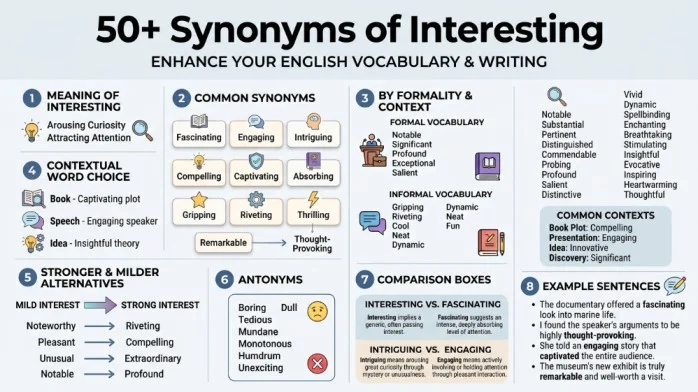
Interesting describes something that attracts attention, creates curiosity, or keeps someone mentally engaged. Strong alternatives include fascinating, engaging, intriguing, compelling, absorbing, captivating, and remarkable. Formal writing often favors significant or noteworthy, while casual conversation naturally uses fascinating, cool, unusual, or intriguing depending on the context.
Meaning, Tone, and Context
Interesting is a flexible adjective with several related uses. It can describe something that catches your attention, gives you something to think about, provides enjoyment, or differs from what you normally expect.
Simple Definition
Something is interesting when it attracts attention or makes you want to learn, think, watch, read, or listen further.
For example:
“She told me an interesting story about her travels.”
Here, interesting means the story held the listener’s attention.
The word can also describe something intellectually stimulating:
“The professor presented an interesting theory.”
In this sentence, the theory creates curiosity or encourages thought.
Part of Speech
Interesting is an adjective.
It describes nouns such as:
- idea
- person
- story
- fact
- article
- conversation
- experience
- question
- discovery
- topic
- movie
- book
Overall Tone
Interesting is generally neutral to positive.
Its exact emotional strength depends on context. Saying something is interesting can express genuine enthusiasm, mild curiosity, or simple acknowledgment.
For example:
“That is interesting.”
This could express strong curiosity, or it could simply mean that the speaker has noticed something unusual.
Formality Level
Interesting is a neutral word. It works comfortably in:
- Everyday conversations
- Emails
- Essays
- Academic discussions
- Business communication
- Social media
- Articles
- Presentations
- Creative writing
Because it is so versatile, it can sometimes sound too general. A more precise synonym can tell readers exactly why something deserves attention.
Common Uses
Native English speakers commonly use interesting to describe:
- An unusual idea
- An engaging conversation
- An entertaining story
- A surprising fact
- A thought provoking question
- A compelling book
- An unusual person
- A memorable experience
- An attractive topic
- A new discovery
Word Forms
The most useful related forms include:
| Word | Part of Speech | Example |
|---|---|---|
| Interest | Noun | “The topic sparked my interest.” |
| Interested | Adjective | “I am interested in history.” |
| Interesting | Adjective | “The lecture was interesting.” |
| Interestingly | Adverb | “Interestingly, the results were different.” |
A useful distinction is that interested usually describes how a person feels, while interesting describes something that creates that feeling.
“I am interested in astronomy.”
“Astronomy is interesting.”
When and How to Use “Interesting”
Use interesting when something catches attention or encourages curiosity without necessarily expressing extreme excitement. It is especially useful when you want a neutral, flexible word.
Professional
“The presentation included several interesting ideas about improving customer retention.”
Academic
“The study raises interesting questions about how students respond to online learning.”
Workplace
“That is an interesting suggestion. Let’s discuss how we could apply it.”
Personal
“I had an interesting conversation with my neighbor yesterday.”
“I found your proposal interesting and would like to discuss the next steps.”
Resume
“Developed interesting content strategies that increased audience engagement.”
For a resume, however, a more measurable and specific word is usually better than interesting. For example, “developed engaging content strategies” gives the reader a clearer sense of value.
Social Media
“Just discovered an interesting little bookstore downtown.”
In casual social media writing, interesting sounds natural, but alternatives such as hidden, fascinating, unusual, charming, or unexpected can create a stronger impression.
Best Synonyms of “Interesting”
No synonym for interesting works perfectly in every sentence. Each alternative emphasizes a slightly different quality, such as curiosity, excitement, attention, intellectual value, emotional appeal, or unusualness.
Professional Writing: Engaging
Engaging is an excellent professional alternative when something holds attention.
Example:
“The speaker delivered an engaging presentation.”
Why it works:
It suggests that the audience remained interested and involved.
Academic Writing: Significant
Significant works well when the subject has meaningful importance, impact, or academic relevance.
Example:
“The researchers identified several significant patterns.”
Why it works:
It is more precise and formal than simply saying the patterns were interesting.
Business Communication: Compelling
Compelling suggests that something is persuasive, convincing, or powerful enough to demand attention.
Example:
“The report presents a compelling case for improving customer support.”
Why it works:
It communicates stronger impact than interesting.
Casual Conversation: Fascinating
Fascinating is natural when something strongly captures your curiosity.
Example:
“That is fascinating. I had no idea the city had such a long history.”
Why it works:
It expresses more enthusiasm than interesting.
Emotional Writing: Meaningful
Meaningful is better when something matters because of personal or emotional value.
Example:
“Her letter was deeply meaningful to me.”
Why it works:
It describes emotional significance rather than simple curiosity.
Creative Writing: Captivating
Captivating suggests that something holds attention very strongly.
Example:
“The novel tells a captivating story of survival and courage.”
Why it works:
It adds vividness and emotional energy to creative writing.
Resume Writing: Engaging
For resumes, engaging is generally more useful than interesting because it describes the ability to attract and retain attention.
Example:
“Created engaging content for social media campaigns.”
Why it works:
It sounds action oriented and connects naturally with communication and marketing work.
Workplace Communication: Intriguing
Intriguing works when an idea or possibility creates curiosity.
Example:
“That is an intriguing proposal. We should examine the potential benefits.”
Why it works:
It communicates curiosity without sounding overly emotional.
Stronger Meaning: Fascinating
Fascinating is stronger than interesting because it suggests that something holds your attention intensely.
Example:
“The documentary was fascinating from beginning to end.”
Softer Meaning: Noteworthy
Noteworthy suggests that something deserves attention without necessarily expressing excitement.
Example:
“The report contains several noteworthy observations.”
Why it works:
It is restrained and appropriate for formal communication.
When Not to Use “Interesting”
Although interesting is useful in many contexts, it can sometimes be too broad. Replacing it with a more specific word can make your writing clearer.
When It Sounds Too General
“She gave an interesting presentation.”
This does not explain what made the presentation interesting.
Better:
“She gave an engaging presentation that encouraged audience participation.”
Engaging explains how the presentation affected the audience.
When It Sounds Too Vague
“The article contains interesting information.”
Better:
“The article contains valuable information about small business financing.”
Valuable communicates usefulness rather than simply saying the information attracted attention.
When You Need Stronger Emotion
“The movie was interesting.”
Better:
“The movie was captivating.”
If the movie held your attention intensely, captivating gives readers a more accurate impression.
When Academic Precision Matters
“The results were interesting.”
Better:
“The results were significant.”
In academic writing, significant can communicate importance or meaningful findings more precisely. However, it should not be used to imply statistical significance unless that meaning is actually supported.
When You Mean Unusual
“She has an interesting style.”
Better:
“She has an unusual style.”
If the real point is that the style differs from what is typical, unusual is more precise.
When You Mean Persuasive
“The proposal was interesting.”
Better:
“The proposal was compelling.”
If the proposal convinced the audience, compelling communicates that effect better.
When You Mean Emotionally Valuable
“The experience was interesting.”
Better:
“The experience was meaningful.”
If the experience mattered deeply to the person, meaningful is more accurate.
Words Commonly Confused With “Interesting”
Fascinating
Difference: Fascinating suggests a much stronger level of interest.
When to Use It: Use it when something strongly captures your attention or curiosity.
Example: “The history of the ancient city is fascinating.”
Intriguing
Difference: Intriguing suggests that something creates curiosity, mystery, or a desire to discover more.
When to Use It: Use it for unusual ideas, possibilities, questions, or situations.
Example: “The scientist proposed an intriguing explanation.”
Engaging
Difference: Engaging focuses on the ability to hold someone’s attention.
When to Use It: Use it for presentations, books, speakers, lessons, websites, and content.
Example: “The teacher used an engaging activity to explain the concept.”
Entertaining
Difference: Entertaining means something provides amusement or enjoyment.
When to Use It: Use it for movies, shows, stories, performances, and conversations that are enjoyable.
Example: “The comedian gave an entertaining performance.”
Significant
Difference: Significant emphasizes importance, effect, or meaningful size rather than simple curiosity.
When to Use It: Use it for research, findings, events, changes, and developments with meaningful consequences.
Example: “The company made significant improvements this year.”
Curious
Difference: Curious can describe something unusual or strange enough to make someone want to know more.
When to Use It: Use it when something creates a sense of mystery or raises questions.
Example: “There was a curious detail in the old photograph.”
Best Synonyms of “Interesting” by Context
| Context | Best Synonym | Why It Works | Example |
| Formal writing | Noteworthy | Sounds measured and professional. | “The report contains noteworthy findings.” |
| Academic writing | Significant | Emphasizes meaningful importance or impact. | “The study produced significant results.” |
| Professional communication | Engaging | Focuses on holding attention. | “She gave an engaging presentation.” |
| Business emails | Compelling | Suggests strong persuasive value. | “Your proposal presents a compelling idea.” |
| Resume writing | Engaging | Describes content that attracts attention. | “Created engaging marketing campaigns.” |
| Workplace communication | Intriguing | Shows curiosity about an idea. | “That is an intriguing suggestion.” |
| Casual conversation | Fascinating | Expresses genuine enthusiasm. | “That story is fascinating.” |
| Everyday speaking | Cool | Casual and expressive. | “That is a cool idea.” |
| Creative writing | Captivating | Creates strong emotional and visual impact. | “She told a captivating story.” |
| Storytelling | Compelling | Keeps readers or listeners involved. | “The novel has a compelling plot.” |
| Emotional writing | Meaningful | Highlights personal significance. | “It was a meaningful experience.” |
| Strong emphasis | Fascinating | Communicates intense interest. | “The documentary was fascinating.” |
| Mild tone | Noteworthy | Gives attention without exaggeration. | “There was a noteworthy change.” |
| Social media captions | Fascinating | Creates curiosity and enthusiasm. | “A fascinating afternoon exploring the city.” |
| American English | Interesting | Neutral and widely natural. | “That sounds interesting.” |
How to Choose the Best Synonym of “Interesting”
The easiest way to choose an alternative is to identify what you really mean by interesting.
If It Holds Attention
Choose engaging.
“The speaker was engaging.”
This means the speaker kept the audience involved.
If It Creates Strong Curiosity
Choose fascinating or intriguing.
“The subject is fascinating.”
“The theory is intriguing.”
Use fascinating for strong interest and intriguing when mystery or curiosity is involved.
If It Is Enjoyable
Choose entertaining.
“The show was entertaining.”
This is better than interesting when enjoyment is the main point.
If It Has Important Effects
Choose significant.
“The findings were significant.”
This works particularly well in academic and professional writing.
If It Is Persuasive
Choose compelling.
“The argument was compelling.”
This indicates that the argument was convincing or powerful.
If It Has Emotional Value
Choose meaningful.
“The conversation was meaningful.”
This emphasizes personal importance rather than simple curiosity.
If It Is Unusual
Choose unusual, remarkable, or curious, depending on the context.
“The museum contained several unusual objects.”
This is more precise than calling everything interesting.
Consider Your Audience
- For an academic audience, significant, noteworthy, and intriguing can work well.
- For a business audience, engaging, compelling, relevant, and noteworthy may be more effective.
- For casual conversations, fascinating, cool, unusual, and fun can sound more natural.
Consider Emotional Strength
- Use noteworthy for mild emphasis.
- Use interesting for neutral emphasis.
- Use engaging when something holds attention.
- Use intriguing when something creates curiosity.
- Use fascinating when interest is especially strong.
Use captivating when something holds attention intensely.
Consider Your Writing Purpose
Do not choose a synonym simply because it sounds sophisticated. Choose the word that communicates the exact quality you want the reader to understand.
For example:
- “The lecture was interesting.”
- “The lecture was engaging.”
- “The lecture was informative.”
- “The lecture was entertaining.”
These sentences are not identical. Each one describes a different reason the lecture may have been worth experiencing.
Real Life Examples of “Interesting”
School
Original:
“The book was interesting.”
Improved:
“The book presented an engaging story that made the historical period easier to understand.”
College
Original:
“The professor discussed an interesting theory.”
Improved:
“The professor introduced an intriguing theory about human decision making.”
Workplace
Original:
“She gave an interesting presentation.”
Improved:
“She delivered an engaging presentation that kept the team focused.”
Business
Original:
“The proposal contains interesting ideas.”
Improved:
“The proposal contains several compelling ideas for improving customer retention.”
Original:
“Your idea sounds interesting.”
Improved:
“Your idea sounds intriguing, and I would be interested in discussing it further.”
Resume
Original:
“Created interesting social media content.”
Improved:
“Created engaging social media content that encouraged audience interaction.”
Conversation
Original:
“That is interesting.”
Improved:
“That is fascinating. I would love to hear more about it.”
Storytelling
Original:
“It was an interesting night.”
Improved:
“It was an unforgettable night filled with unexpected events.”
Blogging
Original:
“This article contains interesting information about travel.”
Improved:
“This article explores fascinating travel tips that many first time visitors overlook.”
Social Media
Original:
“Found an interesting place today.”
Improved:
“Found a charming little place today that I never knew existed.”
20 Best Synonyms of “Interesting”
| Synonym | Simple Meaning | Best Used For | Example Sentence |
| Fascinating | Extremely interesting | Strong curiosity and enthusiasm | “The documentary offered a fascinating look at ocean life.” |
| Engaging | Able to hold attention | Presentations, content, lessons | “The writer created an engaging introduction.” |
| Intriguing | Creates curiosity | Ideas, theories, mysteries | “She presented an intriguing explanation.” |
| Compelling | Powerful enough to attract attention | Arguments, stories, proposals | “The report makes a compelling case for change.” |
| Captivating | Holds attention very strongly | Stories, performances, creative writing | “The author created a captivating opening scene.” |
| Absorbing | Keeps someone deeply interested | Books, movies, activities | “The novel was so absorbing that I finished it in one evening.” |
| Entertaining | Provides enjoyment | Movies, shows, stories | “The speaker gave an entertaining presentation.” |
| Thought provoking | Encourages deeper thought | Essays, discussions, articles | “The documentary raised several thought provoking questions.” |
| Noteworthy | Worth attention | Formal and professional writing | “The report highlights several noteworthy developments.” |
| Significant | Meaningful or important | Academic and professional writing | “The research revealed significant changes.” |
| Remarkable | Unusual or impressive | Achievements and events | “She made remarkable progress in a short time.” |
| Memorable | Worth remembering | Events and experiences | “It was a memorable trip for the entire family.” |
| Curious | Unusual and attention grabbing | Situations and details | “A curious pattern appeared in the data.” |
| Stimulating | Encourages thought or mental activity | Discussions and learning | “The workshop provided a stimulating environment.” |
| Appealing | Attractive or pleasing | Ideas, designs, products | “The new layout has an appealing visual style.” |
| Intricate | Detailed and complex | Designs, systems, stories | “The artist created an intricate pattern.” |
| Absorbing | Deeply engaging | Reading and entertainment | “The historical account was absorbing from start to finish.” |
| Enjoyable | Pleasant and fun | Experiences and activities | “The class was informative and enjoyable.” |
| Unusual | Different from what is normal | People, events, objects | “The museum displayed several unusual artifacts.” |
| Remarkable | Exceptionally notable | Achievements and discoveries | “The team achieved remarkable results.” |
Synonyms of “Interesting” by Usage
Professional vs Personal Synonyms
Professional writing usually benefits from precise alternatives that explain why something deserves attention.
- Use engaging for presentations and content.
- Use compelling for arguments and proposals.
- Use significant for meaningful developments or findings.
- Use noteworthy for observations that deserve formal attention.
Personal communication can be warmer and more expressive.
- Use fascinating for strong curiosity.
- Use meaningful for emotional value.
- Use memorable for experiences.
- Use cool or fun in very casual conversation when the context allows.
Formal vs Conversational Synonyms
Reports often benefit from significant or noteworthy.
Essays can use significant, intriguing, or thought provoking, depending on the meaning.
Business writing often favors compelling, relevant, engaging, or noteworthy.
Presentations can use engaging.
Emails can use intriguing, compelling, or simply interesting.
Casual conversations naturally use fascinating, unusual, cool, or fun.
Texting generally favors simple expressions such as cool, fascinating, or interesting.
Academic Synonyms
Academic writing requires careful distinctions because interesting can be too subjective or vague.
Significant
Use significant when discussing findings, changes, relationships, or effects that have meaningful importance.
“Researchers identified significant differences between the two groups.”
Intriguing
Use intriguing when an idea raises questions or creates curiosity.
“The findings present an intriguing possibility for future research.”
Thought Provoking
Use this phrase when a subject encourages deeper reflection.
“The article offers a thought provoking discussion of digital privacy.”
Noteworthy
Use noteworthy when a result or observation deserves attention.
“The researchers reported several noteworthy patterns.”
Stimulating
Use stimulating for intellectual discussions, classes, or environments that encourage thinking.
“The seminar provided a stimulating discussion of modern ethics.”
Academic vocabulary should be precise rather than simply more complicated. The best word is the one that accurately describes why the material deserves attention.
Professional and Business Synonyms
Resumes
Use engaging when describing content or communication.
“Created engaging content for a national marketing campaign.”
Interviews
Use compelling when describing an argument, proposal, or professional achievement.
“I developed a compelling customer retention strategy.”
Meetings
Use relevant or valuable when the point is usefulness rather than curiosity.
“The meeting provided valuable insights into customer behavior.”
Presentations
Use engaging to describe a presentation that successfully holds attention.
“Delivered engaging presentations for clients and internal teams.”
Performance Reviews
Use noteworthy or significant when describing achievements.
“Made significant improvements to the team’s reporting process.”
Client Communication
Use valuable, relevant, or compelling according to the intended meaning.
“Your feedback provides valuable insight into customer expectations.”
Business Emails
- Use interesting when expressing neutral interest.
- Use intriguing when something creates curiosity.
- Use compelling when something is persuasive.
For example:
“Your proposal is intriguing, and I would like to learn more about the approach.”
Creative and Literary Synonyms
Creative writing benefits from words that communicate stronger imagery and emotion.
Captivating
Best for stories, characters, performances, and scenes that hold attention intensely.
“The author created a captivating portrait of life in a remote village.”
Compelling
Useful for characters, plots, arguments, and narratives that make readers want to continue.
“The novel follows a compelling character searching for her missing brother.”
Fascinating
Works when the subject is unusually rich or absorbing.
“The old house had a fascinating history.”
Memorable
Useful when describing scenes or experiences that stay with the reader.
“The final chapter created a memorable ending.”
Remarkable
Appropriate for unusual or impressive events.
“The explorer made a remarkable discovery.”
These alternatives can make creative writing more specific than simply repeating interesting.
Slang or Modern Synonyms
There is no single slang word that perfectly replaces interesting in every situation.
Cool
Meaning: Interesting, impressive, enjoyable, or appealing.
Acceptable In: Casual conversation, texting, and social media.
Avoid In: Academic papers, formal reports, and professional documents where a more precise word is needed.
Example:
“That is a cool idea.”
A Big Deal
Meaning: Something considered important, impressive, or significant.
Acceptable In: Casual speech and informal online communication.
Avoid In: Formal academic and business writing.
Example:
“Getting invited to the event was a big deal for her.”
These expressions should not be treated as exact synonyms in every context. They add a casual tone and often communicate more than simple interest.
Strongest to Mildest Synonyms
There is no universal intensity scale because these words emphasize different qualities. However, a practical interest scale can help writers understand their general emotional force.
| Level | Words | General Effect |
| Mild | Noteworthy, Curious | Draws attention |
| Mild to Moderate | Interesting, Appealing, Enjoyable | Creates general interest |
| Moderate | Engaging, Stimulating, Thought provoking | Holds attention or encourages thought |
| Strong | Intriguing, Compelling, Absorbing | Creates strong curiosity or involvement |
| Very Strong | Fascinating, Captivating | Holds attention intensely |
The scale should be treated as a writing guide rather than a strict rule. For example, significant may sound stronger in an academic context because it communicates importance, but it does not necessarily mean that something is fascinating.
Emotional vs Neutral Synonyms
Emotional Synonyms
These words can add stronger feeling or personal reaction:
- Fascinating
- Captivating
- Remarkable
- Memorable
- Meaningful
- Enjoyable
- Absorbing
Example:
“The experience was fascinating.”
This communicates personal enthusiasm.
Neutral Synonyms
These words are more restrained:
- Interesting
- Noteworthy
- Significant
- Relevant
- Curious
- Engaging
- Stimulating
Example:
“The report contains several noteworthy observations.”
This sounds measured and professional.
Use emotional synonyms when your writing should create excitement or connection. Use neutral alternatives when accuracy and restraint matter more.
Antonyms of “Interesting”
There is no single perfect opposite of interesting because the word can mean attention grabbing, enjoyable, unusual, or mentally stimulating. The following words describe common opposite qualities in appropriate contexts.
| Antonym | Meaning | Example Sentence |
| Boring | Not interesting or enjoyable | “The lecture became boring after the first hour.” |
| Dull | Lacking excitement or interest | “The presentation felt dull and repetitive.” |
| Uninteresting | Failing to attract attention | “The article was uninteresting to most readers.” |
| Tedious | Long, repetitive, and tiring | “The paperwork was tedious but necessary.” |
| Mundane | Ordinary and lacking excitement | “The story focused on his mundane daily routine.” |
| Monotonous | Repetitive and lacking variety | “The speaker’s monotonous voice made it difficult to concentrate.” |
| Tiresome | Causing boredom or fatigue | “The repeated explanations became tiresome.” |
| Unexciting | Not producing enthusiasm | “The game was surprisingly unexciting.” |
| Predictable | Easy to anticipate | “The ending was predictable from the beginning.” |
| Repetitive | Repeating the same information or pattern | “The article became repetitive near the end.” |
| Ordinary | Not unusual or remarkable | “It seemed like an ordinary afternoon.” |
| Routine | Regular and lacking novelty | “The job involved routine administrative tasks.” |
| Tedious | Requiring effort without much interest | “Sorting the files was tedious work.” |
| Forgettable | Not memorable | “The movie was entertaining but ultimately forgettable.” |
| Lifeless | Lacking energy or excitement | “The discussion felt lifeless without audience participation.” |
Comparison: “Interesting” vs Similar Words
Interesting vs Fascinating
Main Difference
Interesting means something attracts attention. Fascinating suggests a much stronger level of interest.
Which Is Stronger?
Fascinating is stronger.
Which Is More Formal?
Both are neutral and suitable for formal writing, although fascinating expresses more personal enthusiasm.
When to Use Each
Use interesting for moderate or unspecified interest. Use fascinating when something strongly captures attention.
Examples
Interesting:
“The book was interesting.”
Fascinating:
“The book was fascinating from beginning to end.”
Interesting vs Intriguing
Main Difference
Interesting attracts attention, while intriguing creates curiosity or a desire to learn more.
Which Is Stronger?
Intriguing often sounds stronger when curiosity is the main idea.
Which Is More Formal?
Intriguing works particularly well in formal and academic contexts.
When to Use Each
Use intriguing for theories, questions, possibilities, and unusual ideas.
Examples
Interesting:
“The researcher presented an interesting idea.”
Intriguing:
“The researcher presented an intriguing theory.”
Interesting vs Engaging
Main Difference
Interesting means something attracts attention. Engaging specifically suggests that it holds someone’s attention.
Which Is Stronger?
Neither is always stronger. They emphasize different qualities.
Which Is More Formal?
Both work in professional communication.
When to Use Each
Use engaging for presentations, lessons, speakers, books, websites, and content.
Examples
Interesting:
“The lecture was interesting.”
Engaging:
“The lecture was engaging and encouraged students to participate.”
Interesting vs Entertaining
Main Difference
Interesting involves attention or curiosity. Entertaining involves enjoyment or amusement.
Which Is Stronger?
Neither is automatically stronger.
Which Is More Formal?
Both are neutral.
When to Use Each
Use entertaining when something makes people enjoy themselves.
Examples
Interesting:
“The documentary was interesting.”
Entertaining:
“The comedy show was entertaining.”
Interesting vs Significant
Main Difference
Interesting describes attention or curiosity. Significant describes importance, impact, or meaningful effect.
Which Is Stronger?
They measure different qualities, so neither is universally stronger.
Which Is More Formal?
Significant is more common in academic and professional writing.
When to Use Each
Use significant when the subject has meaningful consequences or importance.
Examples
Interesting:
“The study produced interesting observations.”
Significant:
“The study produced significant findings.”
Interesting vs Remarkable
Main Difference
Interesting means attention grabbing. Remarkable suggests something is unusually impressive, notable, or exceptional.
Which Is Stronger?
Remarkable is generally stronger.
Which Is More Formal?
Both are suitable for many formal situations.
When to Use Each
Use remarkable for achievements, discoveries, changes, or unusual events.
Examples
Interesting:
“She made an interesting discovery.”
Remarkable:
“She made a remarkable discovery.”
Common Phrases and Expressions with “Interesting”
Interesting Idea
Meaning: An idea that attracts attention or deserves consideration.
Example Sentence:
“That is an interesting idea, and it could solve part of the problem.”
Interesting Question
Meaning: A question that creates curiosity or encourages thought.
Example Sentence:
“The student raised an interesting question during the discussion.”
Interesting Fact
Meaning: A piece of information that attracts attention because it is unusual, useful, or surprising.
Example Sentence:
“Here is an interesting fact about the history of the building.”
Interesting Story
Meaning: A story that keeps someone’s attention.
Example Sentence:
“She told us an interesting story about her first job.”
Interesting Conversation
Meaning: A discussion that provides ideas, information, or curiosity.
Example Sentence:
“We had an interesting conversation about career changes.”
Interesting Point
Meaning: An idea or observation worth considering.
Example Sentence:
“He made an interesting point about the cost of online advertising.”
Interesting Perspective
Meaning: A distinctive way of viewing a topic.
Example Sentence:
“She offered an interesting perspective on remote work.”
Interesting Development
Meaning: A new event or change that deserves attention.
Example Sentence:
“The latest report includes an interesting development in the market.”
Common Mistakes to Avoid
Choosing a Vague Synonym Instead of a Precise One
Incorrect:
“The campaign was interesting.”
Better:
“The campaign was engaging and encouraged thousands of people to participate.”
Why:
Interesting does not explain what made the campaign effective. Engaging describes its ability to attract participation.
Confusing Interesting With Significant
Incorrect:
“The research was interesting because it changed company policy.”
Better:
“The research was significant because it changed company policy.”
Why:
The sentence focuses on impact, so significant is more precise.
Using Informal Language in Formal Writing
Incorrect:
“The company made a cool discovery.”
Better:
“The company made a noteworthy discovery.”
Why:
Cool is casual and vague, while noteworthy sounds more appropriate in formal communication.
Using an Overly Dramatic Synonym
Incorrect:
“The meeting agenda was fascinating.”
Better:
“The meeting agenda was informative.”
Why:
A routine agenda may be useful without being deeply fascinating.
Repeating Interesting Too Often
Incorrect:
“The book was interesting. The characters were interesting, and the ending was interesting.”
Better:
“The book was engaging. The characters were complex, and the ending was unexpected.”
Why:
Specific vocabulary creates a clearer picture and avoids repetition.
Choosing the Wrong Emotional Tone
Incorrect:
“Her father’s speech was interesting to her.”
Better:
“Her father’s speech was meaningful to her.”
Why:
The sentence describes emotional significance rather than simple curiosity.
Using Slang in Academic Writing
Incorrect:
“The study has some really cool results.”
Better:
“The study produced several noteworthy results.”
Why:
The second version is more objective and appropriate for academic communication.
Frequently Asked Questions
What are the best synonyms of “interesting”?
The best synonyms of interesting include fascinating, engaging, intriguing, compelling, captivating, absorbing, noteworthy, significant, and thought provoking. The best choice depends on whether you mean curiosity, enjoyment, importance, or strong attention.
What are the best formal synonyms of “interesting”?
The best formal alternatives include noteworthy, significant, compelling, intriguing, stimulating, and remarkable. Choose the word according to meaning. For example, significant emphasizes importance, while intriguing emphasizes curiosity.
What are common informal synonyms of “interesting”?
Common informal alternatives include fascinating, cool, unusual, fun, and a big deal, although they are not exact replacements in every context. Cool and a big deal are especially casual and should be avoided in formal writing.
What is another word for “interesting” in professional writing?
Useful professional alternatives include engaging, compelling, noteworthy, significant, relevant, and intriguing. Engaging works well for presentations and content, while significant is better for meaningful developments or findings.
What is the difference between “interesting” and “fascinating”?
Interesting indicates that something attracts attention or curiosity, while fascinating expresses a much stronger level of interest. Use fascinating when something holds your attention intensely or creates strong enthusiasm.
What is the opposite of “interesting”?
Common opposites include boring, dull, tedious, monotonous, uninteresting, mundane, predictable, and unexciting. The best antonym depends on whether the original meaning involves excitement, novelty, enjoyment, or intellectual stimulation.
Conclusion
The word interesting is a flexible and useful adjective for describing anything that attracts attention, creates curiosity, or holds someone’s interest. However, more precise vocabulary can make your writing clearer and more expressive.
The best alternatives depend on context. Use fascinating for strong interest, intriguing for curiosity, engaging for attention, compelling for persuasive power, significant for meaningful impact, noteworthy for formal emphasis, and meaningful for emotional value.
No synonym works perfectly in every situation. The strongest word is the one that matches your audience, purpose, tone, and intended meaning. When improving your vocabulary, do not simply replace a familiar word with a more advanced one. First identify the exact idea you want to communicate, then choose the synonym that expresses it most naturally.
Read More Related Articles:
Synonyms for Thus | Meaning, Examples, and Better Word …
Synonyms for Pros and Cons | Meaning, Examples, and Better …
50+ Synonyms of Show | Meanings, Uses, Examples, and …