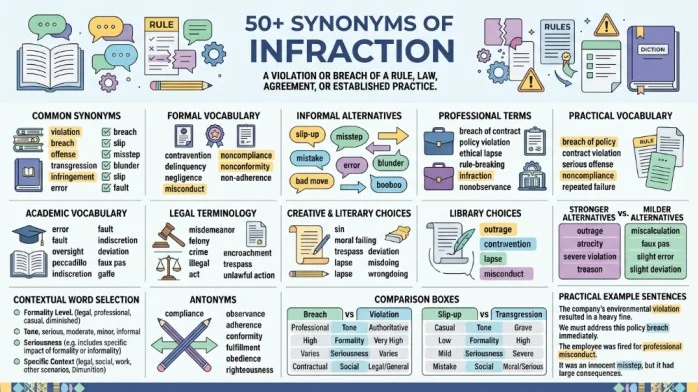
Writers often use the word “infraction” when discussing rules, policies, laws, workplace standards, or regulations, but repeating the same term can make an essay, report, email, or professional document sound predictable. Learning the synonyms of infraction gives you more precise ways to describe a rule violation while matching the seriousness and context of the situation.
The best alternative depends on what was broken and how serious the action was. Violation is broad and common, offense often refers to a punishable act, breach works well for agreements and rules, while infringement is especially useful when discussing rights, laws, or protected interests. Choosing carefully helps your writing sound accurate rather than simply more complicated.
What Are the Best Synonyms of “Infraction”?
An infraction is a violation or breach of a rule, law, policy, or regulation, usually referring to a relatively minor offense. The best alternatives include violation for general use, breach for rules or agreements, offense for punishable conduct, and infringement for rights or legal protections.
Meaning, Tone, and Context
Simple Definition
An infraction is an act of breaking a rule, regulation, law, agreement, or established standard.
The word often suggests that the violation is relatively minor compared with a serious crime. However, its exact seriousness depends on the context and the rule involved.
For example, a parking rule violation may be described as an infraction, while a more serious criminal act may be classified as an offense or crime under applicable law.
Part of Speech
Infraction is a noun.
Example:
“The employee received a warning for a safety infraction.”
Overall Tone
The word infraction is generally neutral to negative.
It identifies behavior that does not comply with a rule or requirement, so it naturally carries a negative meaning. However, it does not necessarily accuse someone of serious wrongdoing.
Formality Level
Infraction is generally formal or semi formal.
It appears frequently in legal, administrative, workplace, regulatory, educational, sports, and policy related writing.
In everyday conversation, people are more likely to say violation, rule breaking, or offense.
Common Uses
Native English speakers commonly use infraction in contexts involving:
- Traffic rules
- Workplace policies
- School rules
- Sports regulations
- Safety requirements
- Legal regulations
- Professional standards
- Government rules
- Contractual requirements
- Organizational policies
- Licensing requirements
- Disciplinary procedures
Examples include:
“The referee called an infraction.”
“The employee was disciplined for a policy infraction.”
“The driver received a citation for a traffic infraction.”
Word Forms
| Form | Word |
|---|---|
| Noun | Infraction |
| Plural noun | Infractions |
| Related verb | Violate |
| Related noun | Violation |
| Related adjective | Violative, uncommon in everyday English |
| Opposite concept | Compliance |
The most useful related word for everyday writing is violation.
When and How to Use “Infraction”
Choose infraction when you want to describe a breach of a rule or regulation in a relatively formal and precise way. It is particularly useful when the action is a rule violation but does not necessarily rise to the level of a serious crime.
Professional
“The employee received a written warning for a workplace policy infraction.”
This wording fits HR records, disciplinary documents, and workplace policies.
Academic
“The student was penalized for an infraction of the examination rules.”
The word works well when discussing institutional rules in a formal academic setting.
Workplace
“Repeated safety infractions may result in additional training.”
Here, infractions clearly refers to failures to follow workplace safety requirements.
Personal
“I got a ticket for a traffic infraction.”
This is natural when discussing a minor driving violation.
“Please review the attached notice regarding the policy infraction.”
This phrasing is appropriate for a formal workplace message.
Resume
“Maintained compliance standards and reduced recurring policy infractions.”
In a resume, the word can work when describing compliance or risk management responsibilities.
Social Media
“The player was penalized for a rules infraction during the game.”
For sports related posts, infraction is appropriate, although foul or violation may sound more natural depending on the sport.
Best Synonyms of “Infraction”
No synonym for infraction works perfectly in every situation. The best alternative depends on whether you are talking about a law, policy, agreement, right, workplace standard, sports rule, or everyday behavior.
Professional Writing: Violation
Violation is usually the safest professional alternative because it is broad, clear, and widely understood.
Example:
“The employee was investigated for a policy violation.”
Use it when you need a straightforward term without suggesting a particular legal classification.
Academic Writing: Breach
Breach can work well in formal academic discussions involving rules, standards, agreements, or obligations.
Example:
“The committee determined that the researcher had committed a breach of institutional policy.”
Business Communication: Noncompliance
Noncompliance emphasizes failure to follow a requirement.
Example:
“The audit identified several cases of regulatory noncompliance.”
This is especially useful in compliance, auditing, risk management, and corporate writing.
Casual Conversation: Rule Breaking
Rule breaking is more conversational than infraction.
Example:
“That was just a minor case of rule breaking.”
Use it when speaking with friends or explaining the concept to someone who may not know formal vocabulary.
Emotional Writing: Wrongdoing
Wrongdoing carries more moral judgment than infraction.
Example:
“The investigation uncovered serious wrongdoing.”
Choose it when the focus is on unethical or improper behavior rather than simply technical rule breaking.
Creative Writing: Transgression
Transgression has a more literary and serious tone.
Example:
“His transgression changed the way the entire community viewed him.”
It works especially well when the violation has moral, emotional, or symbolic importance.
Resume Writing: Violation
For resumes, violation is usually clearer than infraction.
Example:
“Reviewed regulatory violations and implemented corrective procedures.”
Workplace Communication: Breach
Breach works particularly well with policies, confidentiality, contracts, duties, and security.
Example:
“The company investigated a potential data security breach.”
Stronger Meaning: Offense
Offense can suggest conduct that is punishable under a rule or law.
Example:
“The court treated the conduct as a serious offense.”
It is stronger than infraction in many legal and disciplinary contexts, although the exact distinction depends on the jurisdiction or governing rules.
Softer Meaning: Lapse
Lapse can describe a temporary failure to follow a standard without strongly labeling the person as a wrongdoer.
Example:
“The incident was treated as a brief lapse in judgment.”
Use it when the focus is on an isolated mistake rather than deliberate rule breaking.
When Not to Use “Infraction”
Although infraction is useful, it is not always the clearest word. The wrong choice can make a sentence sound overly formal, vague, or legally inaccurate.
When the Word Is Too General
If you know exactly what happened, a more specific term may communicate the situation better.
Less effective:
“The company discovered an infraction.”
Better:
“The company discovered a safety violation.”
The second sentence tells the reader what kind of rule was broken.
When the Word Is Too Vague
An infraction does not explain whether someone broke a law, policy, contract, or sports rule.
Less effective:
“The employee committed an infraction.”
Better:
“The employee violated the company’s confidentiality policy.”
The revised sentence gives readers useful information immediately.
When the Word Sounds Too Formal
In casual conversation, infraction can sound unnecessarily official.
Less natural:
“Your parking infraction was frustrating.”
More natural:
“Your parking violation was frustrating.”
Or:
“You got a ticket for breaking the parking rules.”
When the Word Is Too Weak
If the conduct is serious, calling it an infraction may understate the situation.
Less effective:
“The investigation involved a serious infraction.”
Better:
“The investigation involved serious misconduct.”
The stronger term better communicates the seriousness of the behavior.
When the Word Is Too Strong
Sometimes the behavior is better described as a mistake rather than a rule violation.
Less effective:
“Missing one deadline was a major infraction.”
Better:
“Missing one deadline was a lapse in time management.”
The second sentence avoids unnecessarily harsh language.
When a Legal Classification Matters
Do not automatically replace a legally defined term with infraction. Legal terminology can vary by jurisdiction, and an offense, violation, misdemeanor, or civil violation may have specific meanings.
For legal documents, use the classification recognized by the relevant law or regulation rather than choosing a synonym simply because it sounds formal.
When a More Specific Word Is Available
- If the situation involves a contract, breach may be better.
- If it involves someone’s rights, infringement may be better.
- If it involves workplace behavior, misconduct may be better.
- If it involves failure to meet a regulatory requirement, noncompliance may be better.
Words Commonly Confused With “Infraction”
Violation
Difference: A violation is a broad term for breaking a law, rule, regulation, agreement, or standard.
When to Use It: Use it when you want a general and widely understood alternative.
Example: “The company investigated a violation of its privacy policy.”
Offense
Difference: An offense generally refers to an act that violates a law or rule and may be subject to punishment.
When to Use It: Use it when the action has a disciplinary or legal consequence.
Example: “The judge determined that the offense warranted a fine.”
Breach
Difference: A breach emphasizes failure to fulfill a duty, agreement, obligation, or rule.
When to Use It: Use it for contracts, confidentiality, security, duties, and formal obligations.
Example: “The disclosure represented a breach of confidentiality.”
Infringement
Difference: Infringement usually focuses on violating a right, legal protection, intellectual property interest, or established boundary.
When to Use It: Use it in legal, copyright, trademark, patent, and rights related contexts.
Example: “The company was accused of trademark infringement.”
Misconduct
Difference: Misconduct focuses on improper or unacceptable behavior, especially in professional or institutional settings.
When to Use It: Use it when the behavior itself is the main concern rather than a technical rule violation.
Example: “The employee was investigated for professional misconduct.”
Transgression
Difference: Transgression often suggests a violation of a moral, social, religious, or important rule.
When to Use It: Use it in formal, literary, ethical, or emotionally charged writing.
Example: “The character viewed his betrayal as a serious transgression.”
Best Synonyms of “Infraction” by Context
| Context | Best Synonym | Why It Works | Example |
| Formal writing | Violation | Broad and precise | The report documented a regulatory violation. |
| Academic writing | Breach | Fits formal rules and obligations | The study identified a breach of research policy. |
| Professional communication | Violation | Clear and widely understood | The employee received notice of a policy violation. |
| Business emails | Noncompliance | Emphasizes failure to meet requirements | The audit found regulatory noncompliance. |
| Resume writing | Violation | Concise and professional | Reviewed workplace safety violations. |
| Workplace communication | Misconduct | Focuses on improper behavior | The complaint involved alleged workplace misconduct. |
| Casual conversation | Rule breaking | Natural and easy to understand | The referee called it rule breaking. |
| Everyday speaking | Violation | Common and familiar | He received a ticket for a traffic violation. |
| Creative writing | Transgression | Adds moral or literary weight | His transgression changed the family forever. |
| Storytelling | Wrongdoing | Emphasizes bad conduct | The investigation exposed years of wrongdoing. |
| Emotional writing | Transgression | Can convey moral seriousness | She considered the betrayal a deep transgression. |
| Strong emphasis | Offense | Can imply punishable conduct | The court treated the act as a serious offense. |
| Mild tone | Lapse | Softens the judgment | It was an unfortunate lapse in judgment. |
| Social media captions | Violation | Simple and recognizable | The player was penalized for a rule violation. |
| American English | Violation | Common general alternative | The driver committed a traffic violation. |
| British English | Breach | Common in formal rule and obligation contexts | The organization reported a breach of regulations. |
How to Choose the Best Synonym of “Infraction”
Choosing the best synonym is less about finding a more sophisticated word and more about identifying exactly what happened.
Consider the Meaning
Ask what was broken.
A rule may involve a violation.
An agreement may involve a breach.
A right may be infringed.
A professional standard may involve misconduct.
A regulation may involve noncompliance.
Consider the Tone
- If you want neutral language, choose violation.
- If you want a stronger legal or disciplinary tone, consider offense.
- If you want a softer description of a mistake, consider lapse.
If you want moral or emotional emphasis, transgression or wrongdoing may fit.
Consider Your Audience
A general audience usually understands violation immediately.
Legal or compliance professionals may prefer terms such as breach, noncompliance, or infringement because these words can identify specific types of problems.
Consider Emotional Strength
The scale below can help:
Mild: lapse, mistake
Moderate: violation, breach, noncompliance
Strong: offense, misconduct, transgression
Very strong: serious wrongdoing, serious offense
These levels are contextual rather than absolute. A traffic violation and a serious regulatory violation can both be called violations, even though their consequences may differ greatly.
Consider the Writing Purpose
- For a school essay, violation, breach, and transgression can be useful.
- For a business report, violation, noncompliance, and breach are often more precise.
- For a resume, choose concise language such as violation, especially when describing compliance responsibilities.
- For casual speech, rule breaking or violation will usually sound more natural.
Consider Natural Usage
Do not choose a synonym simply because it sounds advanced.
“The employee committed an infringement of company policy” sounds less natural than:
“The employee violated company policy.”
Good vocabulary is not about using the most complicated word. It is about using the word that communicates the intended meaning most clearly.
Real Life Examples of “Infraction”
School
Original:
“The student received a penalty for an infraction.”
Improved:
“The student received a warning for a violation of the school’s attendance policy.”
The improved sentence tells the reader exactly what rule was broken.
College
“The committee investigated a possible breach of academic integrity rules.”
Here, breach creates a formal academic tone.
Workplace
“Repeated safety violations may result in additional training.”
Violation is more direct than repeatedly using infraction.
Business
“The audit identified several cases of regulatory noncompliance.”
Noncompliance precisely describes failure to meet a regulatory requirement.
“Please review the attached report concerning the alleged policy violation.”
This sounds professional and neutral.
Resume
“Monitored compliance procedures and investigated regulatory violations.”
This wording is concise and action oriented.
Conversation
“That was a minor rule violation, but the referee still called it.”
The phrase sounds more natural in everyday speech than the formal noun infraction.
Storytelling
“His betrayal was more than a mistake. To his family, it was a serious transgression.”
The stronger synonym creates emotional weight.
Blogging
“Even a small privacy violation can damage a company’s reputation.”
Violation is clear for a broad online audience.
Social Media
“The player was penalized for a rules violation in the final minutes.”
The phrase is easy to understand and works well for general audiences.
20 Best Synonyms of “Infraction”
| Synonym | Simple Meaning | Best Used For | Example Sentence |
| Violation | Breaking a rule or law | General use | The driver received a citation for a traffic violation. |
| Offense | An act that breaks a rule or law | Legal and disciplinary contexts | The court treated the offense seriously. |
| Breach | Failure to follow an agreement, duty, or rule | Contracts and policies | The disclosure was a breach of confidentiality. |
| Infringement | Violation of a right or protected interest | Copyright and legal contexts | The company faced an infringement claim. |
| Transgression | A serious violation of a moral or important rule | Literary and ethical writing | He regretted his transgression. |
| Contravention | An act that conflicts with a law or rule | Formal legal writing | The agency reported a contravention of regulations. |
| Misconduct | Improper or unacceptable behavior | Workplace and institutions | The employee was investigated for misconduct. |
| Wrongdoing | Improper or unethical conduct | General and investigative writing | The report revealed financial wrongdoing. |
| Noncompliance | Failure to follow a requirement | Business and regulatory writing | The audit identified regulatory noncompliance. |
| Disobedience | Refusal or failure to obey | Rules and authority | The student was disciplined for disobedience. |
| Misdemeanor | A legally defined less serious crime in U.S. law | Criminal law | The charge was classified as a misdemeanor. |
| Fault | A mistake or failure that causes a problem | General situations | The manager admitted fault for the error. |
| Lapse | A temporary failure to maintain a standard | Mild or softened descriptions | It was a brief lapse in judgment. |
| Failure | Not doing something required or expected | Requirements and duties | The failure to report the incident violated policy. |
| Delinquency | Failure to fulfill an obligation, often on time | Payments and duties | The account was placed in delinquency after missed payments. |
| Default | Failure to fulfill a contractual or required obligation | Contracts and finance | The borrower was in default on the agreement. |
| Trespass | Unlawful entry onto another person’s property | Property law | The owner reported a trespass. |
| Encroachment | Intrusion into another person’s rights or property | Property and legal contexts | The fence was considered an encroachment. |
| Disregard | Failure to give proper attention to a rule or requirement | Policies and standards | The incident showed a disregard for safety rules. |
| Defiance | Open refusal to obey authority or rules | Stronger behavioral contexts | His defiance of the order led to disciplinary action. |
Synonyms of “Infraction” by Usage
Professional vs Personal Synonyms
Professional settings usually require precise and neutral terminology.
Use violation, breach, noncompliance, or misconduct when writing reports, policies, HR documents, or business communications.
Personal conversations can use simpler expressions such as rule breaking, mistake, or violation.
Professional:
“The audit identified several compliance violations.”
Personal:
“He got in trouble for breaking the rules.”
Both communicate the basic idea, but the second sounds more natural in everyday conversation.
Formal vs Conversational Synonyms
- For reports and essays, use:
- Violation
- Breach
- Contravention
- Infringement
- Noncompliance
- Transgression
- For presentations and emails, use:
- Violation
- Breach
- Noncompliance
- Offense
- For casual conversations and texting, use:
- Rule breaking
- Violation
- Breaking the rules
- Mistake
Avoid using highly formal terms such as contravention in casual messages unless the context genuinely requires them.
Academic Synonyms
Academic writing benefits from words that identify the exact type of rule breaking.
Violation is useful for general discussions.
Breach works well for institutional rules and formal obligations.
Transgression fits discussions involving ethics, morality, social norms, or literary analysis.
Infringement works for rights, intellectual property, and legal protections.
Example:
“Researchers must avoid any violation of institutional ethical standards.”
This is clearer than choosing a more complicated synonym without a reason.
Professional and Business Synonyms
- For resumes, violation and noncompliance are especially useful.
- For interviews, misconduct may be appropriate when discussing workplace behavior.
- For meetings, breach can be useful when discussing confidentiality, contracts, or security.
- For presentations, noncompliance clearly communicates regulatory problems.
- For performance reviews, misconduct may be appropriate when the issue concerns behavior.
- For client communication, violation is generally safer because it is familiar and easy to understand.
- For business emails, policy violation and regulatory noncompliance are concise and professional.
Creative and Literary Synonyms
Creative writing can use more expressive alternatives.
Transgression suggests moral or emotional weight.
Wrongdoing focuses on unethical conduct.
Trespass can be used metaphorically in literary writing.
Defiance emphasizes deliberate resistance to authority.
Example:
“Crossing the boundary was not merely a mistake. It was a deliberate transgression.”
The choice creates more emotional meaning than simply repeating infraction.
Slang or Modern Synonyms
There is no single slang word that functions as a universal synonym for infraction.
In casual American English, people commonly say:
- Breaking the rules
- Rule breaking
- Breaking a rule
- Getting in trouble
- Doing something against the rules
These expressions are acceptable in conversation, texting, social media, and informal explanations.
They should generally be avoided in legal documents, academic papers, compliance reports, and formal workplace policies.
Example:
Casual:
“He got in trouble for breaking the rules.”
Formal:
“He was cited for a policy violation.”
Strongest to Mildest Synonyms
The intensity of an alternative depends heavily on context.
Mild
Lapse
A lapse can suggest an isolated mistake without strongly judging the person.
Example:
“It was a brief lapse in judgment.”
Mild to Moderate
Violation
A neutral term that identifies a rule being broken.
Example:
“The company investigated a policy violation.”
Moderate
Breach
This can sound more serious when it involves confidentiality, contracts, duties, or security.
Example:
“The incident represented a breach of confidentiality.”
Strong
Misconduct
This focuses on unacceptable behavior and can carry professional or disciplinary consequences.
Example:
“The employee was dismissed for serious misconduct.”
Strong
Offense
This can indicate conduct that is punishable under a legal or disciplinary system.
Example:
“The defendant was charged with an offense.”
Very Strong
Serious wrongdoing
This strongly emphasizes unethical or unacceptable conduct.
Example:
“The investigation uncovered serious wrongdoing.”
The strongest word is not always the best word. Precision matters more than intensity.
Emotional vs Neutral Synonyms
Emotional Synonyms
These alternatives can carry stronger judgment or feeling:
- Wrongdoing
- Transgression
- Defiance
- Misconduct
- Serious offense
Use them when the writer wants readers to recognize moral, emotional, or behavioral significance.
Neutral Synonyms
These alternatives communicate the violation more objectively:
- Infraction
- Violation
- Breach
- Noncompliance
- Infringement
- Contravention
Neutral terms are generally better for reports, policies, academic writing, and professional communication.
Compare:
“An employee committed an infraction.”
“The employee engaged in serious wrongdoing.”
The first statement is relatively neutral. The second expresses a much stronger judgment.
Antonyms of “Infraction”
Because infraction describes a violation, its opposites usually describe compliance, obedience, conformity, or lawful behavior rather than a single direct antonym.
| Antonym | Meaning | Example Sentence |
| Compliance | Following a rule or requirement | The company demonstrated full compliance with the regulation. |
| Conformity | Acting according to an established standard | The process requires conformity with safety standards. |
| Obedience | Following an order or rule | The employee showed obedience to the safety procedure. |
| Adherence | Consistent following of a rule or standard | Strict adherence to policy is expected. |
| Observance | Following or respecting a rule, law, or custom | The observance of safety rules reduced risks. |
| Lawfulness | Acting according to the law | The investigation confirmed the lawfulness of the transaction. |
| Legality | The condition of being permitted by law | The attorney questioned the legality of the agreement. |
| Propriety | Correctness or appropriateness of conduct | The committee reviewed the propriety of the decision. |
| Good conduct | Behavior that follows accepted standards | The employee was recognized for good conduct. |
| Proper conduct | Behavior that meets expected standards | The handbook explains expectations for proper conduct. |
| Rule following | Acting according to established rules | Consistent rule following is required during competitions. |
| Regulatory compliance | Meeting applicable regulations | Regulatory compliance is a priority for the company. |
| Law abiding conduct | Behavior that respects the law | The organization promotes law abiding conduct. |
| Conformance | Meeting an established requirement or standard | The product was tested for conformance with industry standards. |
| Respect for rules | Willingness to follow established rules | Respect for rules is essential in organized competition. |
Comparison: “Infraction” vs Similar Words
Infraction vs Violation
Main Difference
Both words describe breaking a rule, law, or requirement. Violation is broader and more common, while infraction often suggests a relatively minor violation.
Which Is Stronger?
Violation can be either mild or serious. Infraction often sounds somewhat less serious.
Which Is More Formal?
Both are suitable for formal writing, but infraction can sound more administrative or legal.
When to Use Each
Use infraction when the minor nature of the rule breaking matters. Use violation for general communication.
Examples
Infraction: “The driver received a citation for a traffic infraction.”
Violation: “The driver committed a traffic violation.”
Infraction vs Offense
Main Difference
An offense often refers to conduct that can be punished under a legal or disciplinary system.
Which Is Stronger?
Offense often sounds stronger.
Which Is More Formal?
Both are formal enough for legal or institutional contexts.
When to Use Each
Use offense when punishment or legal classification is relevant.
Examples
Infraction: “The referee recorded the player’s infraction.”
Offense: “The court classified the act as a criminal offense.”
Infraction vs Breach
Main Difference
A breach commonly involves failure to fulfill an agreement, duty, obligation, or formal rule.
Which Is Stronger?
Neither is automatically stronger. The context determines seriousness.
Which Is More Formal?
Both are common in formal communication.
When to Use Each
Use breach for contracts, confidentiality, duties, and formal obligations.
Examples
Infraction: “The employee committed a policy infraction.”
Breach: “The disclosure was a breach of confidentiality.”
Infraction vs Infringement
Main Difference
Infringement often focuses on violating rights, intellectual property, or legal protections.
Which Is Stronger?
Neither word is inherently stronger.
Which Is More Formal?
Infringement is particularly common in legal and intellectual property contexts.
When to Use Each
Use infringement for copyright, patents, trademarks, rights, and protected interests.
Examples
Infraction: “The player committed a rules infraction.”
Infringement: “The company was accused of copyright infringement.”
Infraction vs Misconduct
Main Difference
Misconduct describes improper behavior, while infraction specifically emphasizes breaking a rule or requirement.
Which Is Stronger?
Misconduct often sounds more serious because it focuses on unacceptable behavior.
Which Is More Formal?
Both are appropriate for workplace and institutional contexts.
When to Use Each
Use misconduct when the person’s behavior is the central concern.
Examples
Infraction: “The employee was warned about a safety infraction.”
Misconduct: “The employee was investigated for professional misconduct.”
Infraction vs Transgression
Main Difference
Transgression often has moral, ethical, social, or literary overtones.
Which Is Stronger?
Transgression can sound more serious or emotionally charged.
Which Is More Formal?
Transgression is formal and can also sound literary.
When to Use Each
Use transgression when discussing moral boundaries, social norms, ethics, or emotionally significant wrongdoing.
Examples
Infraction: “The student committed a minor school infraction.”
Transgression: “He regarded the betrayal as an unforgivable transgression.”
Common Phrases and Expressions with “Infraction”
Traffic Infraction
Meaning: A violation involving traffic laws or driving regulations.
Example: “The officer issued a citation for a traffic infraction.”
Minor Infraction
Meaning: A relatively small violation of a rule.
Example: “The student received a warning for a minor infraction.”
Policy Infraction
Meaning: An act that violates an organization’s policy.
Example: “The employee was notified of a policy infraction.”
Safety Infraction
Meaning: A failure to follow a safety rule or procedure.
Example: “The supervisor documented the safety infraction.”
Rules Infraction
Meaning: An act that breaks established rules.
Example: “The referee stopped play after a rules infraction.”
Regulatory Infraction
Meaning: A violation of an official regulation.
Example: “The inspection identified a regulatory infraction.”
Serious Infraction
Meaning: A violation considered particularly significant within a specific system.
Example: “The school handbook defines cheating as a serious infraction.”
Repeated Infractions
Meaning: Multiple violations occurring over time.
Example: “Repeated infractions may lead to stronger disciplinary action.”
Common Mistakes to Avoid
Mistake 1: Treating Every Infraction as a Crime
Incorrect:
“The student committed a crime by breaking the school dress code.”
Better:
“The student committed a school rule violation.”
Why:
Breaking an institutional rule does not automatically mean someone committed a crime.
Mistake 2: Using “Infringement” for Every Rule Violation
Incorrect:
“The employee committed an infringement of the attendance policy.”
Better:
“The employee committed a violation of the attendance policy.”
Why:
Infringement is especially useful for rights, intellectual property, and protected interests.
Mistake 3: Using Informal Language in Formal Reports
Incorrect:
“The worker got in trouble for breaking the rules.”
Better:
“The employee was cited for a policy violation.”
Why:
The second version is more concise and appropriate for professional documentation.
Mistake 4: Making a Minor Problem Sound Serious
Incorrect:
“The employee committed serious misconduct by arriving five minutes late once.”
Better:
“The employee experienced a minor lapse in punctuality.”
Why:
The revised wording better matches the limited seriousness of the situation.
Mistake 5: Using “Infraction” When a More Specific Term Exists
Incorrect:
“The company found an infraction.”
Better:
“The company identified a regulatory compliance violation.”
Why:
Specific language tells readers what kind of problem occurred.
Mistake 6: Assuming “Offense” and “Infraction” Always Mean the Same Thing
Incorrect:
“Every infraction is a criminal offense.”
Better:
“An infraction is a type of rule violation, while an offense may have a specific legal or disciplinary classification.”
Why:
Legal terminology depends on the governing system and context.
Mistake 7: Choosing a Complicated Synonym Just to Sound Professional
Incorrect:
“The company documented a contravention of the office parking policy.”
Better:
“The company documented a violation of the parking policy.”
Why:
Clear language is usually more effective than unnecessarily technical vocabulary.
Frequently Asked Questions
What are the best synonyms of “infraction”?
The best synonyms of infraction include violation, breach, offense, infringement, noncompliance, and misconduct. The best choice depends on whether the context involves rules, laws, contracts, rights, regulations, or behavior.
What are the best formal synonyms of “infraction”?
Strong formal alternatives include violation, breach, contravention, infringement, noncompliance, and transgression. Choose based on context rather than formality alone, because each word emphasizes a different kind of rule breaking.
What are common informal synonyms of “infraction”?
Common informal alternatives include breaking the rules, rule breaking, and breaking a rule. Violation is also natural in everyday American English and remains more concise than many formal alternatives.
What is another word for “infraction” in professional writing?
Violation is usually the safest professional alternative. Noncompliance works well for regulations, breach fits agreements and confidentiality, and misconduct is better when the focus is unacceptable workplace behavior.
What is the difference between “infraction” and “violation”?
Infraction usually refers to a relatively minor rule violation, while violation is broader and can describe anything from a minor rule breach to a serious legal violation. Context determines the exact seriousness.
What is the opposite of “infraction”?
Common opposites include compliance, adherence, obedience, conformity, observance, and lawfulness. These words describe following rules, meeting requirements, or behaving according to established standards.
Conclusion
An infraction is an act that breaks a rule, regulation, law, policy, or established standard, often with an implication that the violation is relatively minor. The most useful alternatives include violation, breach, offense, infringement, noncompliance, misconduct, and transgression, but each carries a different shade of meaning.
Use violation when you need a broad and familiar term, breach for agreements and obligations, infringement for rights and intellectual property, noncompliance for regulations, and misconduct when unacceptable behavior is the main issue. For emotional or literary writing, transgression may create stronger moral weight.
The most effective vocabulary choice depends on your audience, purpose, tone, and the exact type of rule that was broken. A useful vocabulary habit is to identify what was violated first, then choose the synonym that describes that specific situation most clearly.
Read More Related Articles:
Synonyms for Thus | Meaning, Examples, and Better Word …
Synonyms for Pros and Cons | Meaning, Examples, and Better …
50+ Synonyms of Show | Meanings, Uses, Examples, and …