A writer may use the word simile several times while explaining poetry, analyzing a novel, or describing a literary technique. Repeating the same term can make an essay or lesson feel limited, especially when the goal is to explain how one idea is compared with another.
Understanding the synonyms of simile can help you describe this literary device more precisely. Words and phrases such as comparison, figurative comparison, likeness, and analogy can be useful, but they do not all mean exactly the same thing. Knowing the difference helps students, teachers, writers, and content creators choose language that is accurate rather than simply replacing one word with another.
What Are the Best Synonyms of “Simile”?
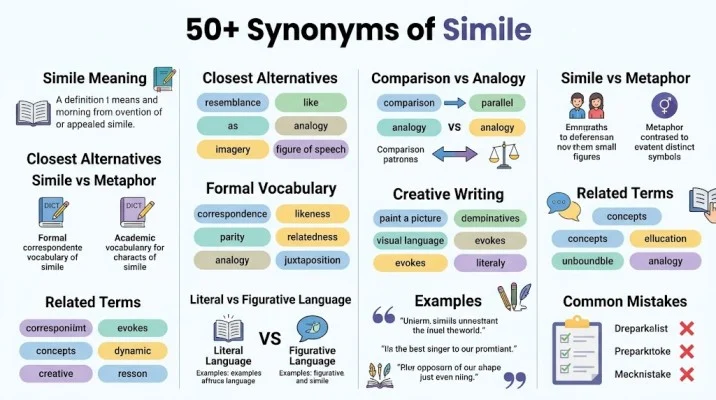
A simile is a figure of speech that directly compares two different things, usually with words such as like or as. The closest general alternative is comparison, while figurative comparison, likeness, and analogy can work in related contexts. For literary analysis, figurative comparison is often the clearest choice because it preserves the idea of comparing unlike things.
Meaning, Tone, and Context
Simple Definition
A simile is a figure of speech that compares two different things to highlight a shared quality, image, or idea.
Similes commonly use words such as like, as, similar to, or resembles.
For example:
“The baby’s skin was as soft as silk.”
The sentence does not claim that the baby’s skin is literally silk. It creates a comparison to communicate softness in a vivid way.
Another example is:
“He ran like the wind.”
The person is not literally the wind. The comparison emphasizes speed.
Part of Speech
Simile is primarily a noun.
Example:
“The author uses a simile to describe the character’s fear.”
The plural form is similes.
Overall Tone
The word simile is neutral and educational. It does not express a positive or negative feeling by itself.
The emotional effect comes from the comparison being made.
For example:
“Her smile was like sunshine.”
This creates a warm and positive image.
By contrast:
“His voice was like a rusty door.”
This creates a less pleasant image.
Formality Level
Simile is a neutral to formal literary term. It is common in:
- English classes
- Literary analysis
- Academic essays
- Poetry discussions
- Creative writing
- Language lessons
- Writing instruction
- Literary criticism
It is less common in casual conversation unless people are discussing writing or figurative language.
Common Uses
Native English speakers and English learners commonly use simile when discussing:
- Poetry
- Fiction
- Speeches
- Descriptive writing
- Figurative language
- Literary devices
- Character descriptions
- Creative writing
- Storytelling
- Rhetorical techniques
Word Forms
| Form | Word |
|---|---|
| Noun | simile |
| Plural noun | similes |
There is no commonly used verb form of simile in standard American English.
When and How to Use “Simile”
Use simile when you specifically mean a comparison between different things that is expressed openly, often with like or as.
A simile is particularly useful when explaining an image, feeling, object, person, or experience in a way that makes it easier for the reader to visualize.
Professional
Example:
“The presentation uses a simile to make the technical concept easier to understand.”
This use is appropriate when discussing communication techniques or explanatory writing.
Academic
Example:
“The poet uses a simile to compare the speaker’s loneliness to an empty room.”
This is a natural use in literary analysis.
Workplace
Example:
“The trainer used a simple simile to explain how the new system works.”
Here, the simile makes an unfamiliar idea easier to understand.
Personal
Example:
“She described her childhood as being like a long summer afternoon.”
This use is more expressive and personal.
Example:
“In the attached lesson plan, I included a simile to help students understand the concept.”
This works when communicating about education or writing.
Resume
Example:
“Created engaging language lessons using similes, metaphors, and other literary devices.”
A resume should use simile only when the skill is relevant to the position.
Social Media
Example:
“That sunset looked like a painting.”
This is a simile in everyday language, although people do not usually need to label it as one during casual conversation.
Best Synonyms of “Simile”
No word can replace simile perfectly in every context. The closest general synonym is comparison, but several related expressions emphasize different parts of the concept.
Professional Writing: Comparison
Comparison is the most flexible alternative.
Example:
“The writer creates a comparison between the two characters.”
It works well when the exact literary classification is not the main focus.
Academic Writing: Figurative Comparison
Figurative comparison is especially useful in literary analysis because it makes clear that the comparison is not intended literally.
Example:
“The poem uses figurative comparison to emphasize the speaker’s isolation.”
Business Communication: Analogy
Analogy can work when a comparison is used to explain a complicated idea by relating it to something familiar.
Example:
“The manager used an analogy to explain the new workflow.”
An analogy is related to a simile but is not always a simile.
Casual Conversation: Comparison
Comparison sounds more natural than simile when speaking generally.
Example:
“That’s a funny comparison.”
Emotional Writing: Likeness
Likeness emphasizes the quality that two things share.
Example:
“The poet draws a likeness between the moon and a silver lamp.”
This is more literary and less common in everyday writing.
Creative Writing: Figurative Comparison
Figurative comparison accurately describes the creative technique without incorrectly suggesting that every comparison is a simile.
Example:
“The story is filled with figurative comparisons that create vivid images.”
Resume Writing: Literary Devices
For a resume, literary devices may be more useful than simply replacing simile.
Example:
“Taught literary devices, including similes and metaphors, to high school students.”
Workplace Communication: Analogy
When comparing an unfamiliar process with something familiar, analogy is usually better than simile.
Example:
“The instructor used an analogy to explain the software update.”
Stronger Meaning: Explicit Comparison
Explicit comparison emphasizes that the relationship between the two things is directly stated.
Example:
“The poet makes an explicit comparison between the ocean and a restless animal.”
Softer Meaning: Resemblance
Resemblance focuses on similarity rather than the literary device itself.
Example:
“The description creates a resemblance between the character and a wounded bird.”
When Not to Use “Simile”
The word simile is specific. It should not be used simply because two things are related or similar.
When the Comparison Is Literal
If two objects genuinely resemble each other, calling the statement a simile may be unnecessary.
Less precise:
“The two houses are a simile.”
Better:
“The two houses have a similar design.”
A simile is a figure of speech, not merely a statement about physical similarity.
When You Mean Metaphor
A metaphor and a simile are related but different.
Less precise:
“The sentence ‘Time is a thief’ is a simile.”
Better:
“The sentence ‘Time is a thief’ is a metaphor.”
The sentence directly identifies time with a thief rather than openly comparing time to a thief with like or as.
When You Mean Analogy
An analogy is often a broader explanatory comparison.
Less precise:
“The entire explanation is a simile.”
Better:
“The explanation uses an analogy.”
An analogy can involve several similarities and may extend across multiple sentences.
When You Mean Similarity
If you simply want to say that two things are alike, similarity, resemblance, or likeness may be better.
Example:
“There is a strong resemblance between the two paintings.”
When the Term Sounds Too Technical
In a general audience article, comparison may be easier for readers than simile.
Instead of:
“The author uses a simile to clarify the idea.”
You could write:
“The author uses a comparison to clarify the idea.”
However, use simile when identifying the specific literary device matters.
Words Commonly Confused With “Simile”
Comparison
Difference:
Comparison is a broad term for examining similarities or differences between things. A simile is a specific type of figurative comparison.
When to Use It:
Use comparison when you are discussing similarities generally.
Example:
“The essay makes a comparison between city and country life.”
Metaphor
Difference:
A metaphor directly presents one thing as another, while a simile usually signals the comparison with words such as like or as.
When to Use It:
Use metaphor when the comparison is expressed directly.
Example:
“Her voice was music.”
Analogy
Difference:
An analogy explains or illustrates an idea by showing how it resembles another situation. It can be much broader than a simile.
When to Use It:
Use analogy when the comparison helps explain a concept or relationship.
Example:
“The teacher used an analogy to explain how memory works.”
Metonymy
Difference:
Metonymy replaces a thing with something closely associated with it. It does not work by directly comparing two unlike things.
When to Use It:
Use metonymy when one related term stands for another.
Example:
“The White House announced a new policy.”
Personification
Difference:
Personification gives human qualities to nonhuman things. It may overlap with figurative comparison but has a different purpose.
When to Use It:
Use personification when an object, animal, or abstract idea is presented with human traits.
Example:
“The wind whispered through the trees.”
Allegory
Difference:
An allegory uses an extended story, character, or situation to represent a broader idea.
When to Use It:
Use allegory when the symbolic meaning extends across a larger work.
Example:
“The novel functions as an allegory for political power.”
Best Synonyms of “Simile” by Context
| Context | Best Synonym or Alternative | Why It Works | Example |
| Formal writing | Figurative comparison | Clearly identifies the literary function | “The poem uses figurative comparison.” |
| Academic writing | Figurative comparison | Precise and explanatory | “The author develops a figurative comparison.” |
| Professional communication | Comparison | Broad and easy to understand | “The report includes a useful comparison.” |
| Business emails | Analogy | Useful for explaining complex ideas | “The analogy makes the process easier to understand.” |
| Resume writing | Literary device | Describes the broader writing skill | “Taught literary devices to students.” |
| Workplace communication | Analogy | Helps explain unfamiliar concepts | “The trainer used an analogy.” |
| Casual conversation | Comparison | Natural and familiar | “That’s an interesting comparison.” |
| Everyday speaking | Comparison | Simple and flexible | “I like that comparison.” |
| Creative writing | Figurative comparison | Highlights expressive language | “The story uses vivid figurative comparisons.” |
| Storytelling | Likeness | Emphasizes shared qualities | “The narrator creates a likeness between them.” |
| Emotional writing | Resemblance | Focuses on emotional or visual similarity | “The description creates a resemblance to childhood.” |
| Strong emphasis | Explicit comparison | Makes the comparison especially clear | “The poet makes an explicit comparison.” |
| Mild tone | Similarity | Focuses on shared features without literary labeling | “The similarity is easy to notice.” |
| Social media captions | Comparison | Simple and accessible | “The caption uses a playful comparison.” |
| American English | Comparison | Common and natural | “The author makes a comparison.” |
| British English | Comparison | Also natural and widely understood | “The writer creates a comparison.” |
How to Choose the Best Synonym of “Simile”
Choosing an alternative depends on what you actually want to communicate. Start by identifying whether you are naming a literary device, explaining a relationship, or simply describing similarity.
Choose Based on Meaning
- If you mean the specific literary device, use simile.
- If you mean a broad relationship between two things, use comparison.
- If you mean an explanatory relationship, use analogy.
- If you mean visual or conceptual similarity, use resemblance or likeness.
Choose Based on Tone
- For academic writing:
“The poet uses a figurative comparison.”
- For everyday conversation:
“That’s an interesting comparison.”
- For teaching:
“The instructor uses an analogy.”
For creative criticism:
“The author creates a striking likeness between the characters.”
Choose Based on Audience
Students may understand comparison more easily than technical literary terminology.
Literature students may need the more precise word simile.
Business audiences may respond better to analogy when the purpose is explanation.
General readers usually benefit from simple terms such as comparison and similarity.
Choose Based on Emotional Strength
A simile itself is not necessarily emotional. The emotional effect depends on the image chosen.
Compare:
“Her face was like a flower.”
with:
“His face was like cracked stone.”
The structure is similar, but the emotional effect is very different.
Choose Based on Writing Purpose
- Use simile when identifying a literary technique.
- Use comparison when discussing similarities generally.
- Use analogy when explaining a difficult concept.
- Use resemblance when focusing on similarity.
- Use figurative comparison when you want both clarity and literary precision.
Real Life Examples of “Simile”
School
Basic:
“The poem contains a simile.”
Stronger:
“The poem uses a simile to compare the speaker’s sadness to a fading shadow.”
College
Basic:
“The author uses a simile in the final paragraph.”
Stronger:
“The author uses a vivid simile to reinforce the character’s sense of isolation.”
Workplace
Basic:
“The trainer used a simile.”
Stronger:
“The trainer used a simple comparison to make the complicated process easier to understand.”
Business
Basic:
“The presentation included a simile.”
Stronger:
“The presentation used an analogy to explain the company’s growth strategy.”
Basic:
“The lesson includes a simile.”
Stronger:
“The lesson includes a clear figurative comparison that students can analyze.”
Resume
Basic:
“Used similes in teaching.”
Stronger:
“Designed creative English lessons covering similes, metaphors, and other literary devices.”
Conversation
Basic:
“That’s a simile.”
Natural:
“That’s a clever comparison.”
Storytelling
Basic:
“She used a simile to describe the night.”
Stronger:
“She described the night as being as quiet as an abandoned library.”
Blogging
Basic:
“The article uses a simile.”
Stronger:
“The article uses a simple comparison to make the technical concept easier for beginners to visualize.”
Social Media
Basic:
“The city looked like a movie.”
Analysis:
This is a natural simile because the city is being compared directly to a movie using like.
20 Best Synonyms and Related Alternatives for “Simile”
A crucial vocabulary point comes first: simile does not have 20 exact synonyms in standard American English. Treating unrelated literary devices as exact synonyms would be misleading. The table below therefore distinguishes the closest synonyms and useful related alternatives.
| Term | Simple Meaning | Best Used For | Example Sentence |
| Comparison | Showing how two things are alike or different | General writing | “The author makes a comparison between the two characters.” |
| Figurative comparison | A nonliteral comparison used for effect | Literary analysis | “The poem contains a vivid figurative comparison.” |
| Analogy | A comparison used to explain an idea | Teaching and explanation | “The teacher used an analogy to explain the process.” |
| Likeness | A quality shared by two things | Literary description | “The poem creates a likeness between nature and memory.” |
| Resemblance | Similarity between things | Descriptive writing | “The character bears a resemblance to his father.” |
| Similarity | A shared quality or feature | General communication | “The similarity between the examples is clear.” |
| Explicit comparison | A comparison stated directly | Literary analysis | “The poet makes an explicit comparison between love and fire.” |
| Figurative expression | Language used beyond literal meaning | Language analysis | “The sentence contains a figurative expression.” |
| Literary device | A technique used in literature | Academic writing | “The simile is an important literary device.” |
| Figure of speech | Nonliteral or expressive language | Language education | “A simile is a common figure of speech.” |
| Comparative expression | Language that creates a comparison | Grammar and writing instruction | “The sentence contains a comparative expression.” |
| Descriptive comparison | A comparison used to create an image | Creative writing | “The writer uses descriptive comparison to portray the landscape.” |
| Imaginative comparison | A creative comparison between ideas | Fiction and poetry | “The poem contains an imaginative comparison.” |
| Poetic comparison | A comparison used in poetry | Poetry analysis | “The poetic comparison strengthens the image.” |
| Literary comparison | A comparison within literary writing | Academic analysis | “The literary comparison connects the two characters.” |
| Illustrative comparison | A comparison used to make something clearer | Teaching | “The writer uses an illustrative comparison.” |
| Figurative analogy | A nonliteral comparison used for explanation | Essays and instruction | “The author creates a figurative analogy.” |
| Comparative figure | A figure of speech based on comparison | Literary discussion | “The comparative figure adds depth to the description.” |
| Image | A mental picture created through language | Poetry and creative writing | “The image of a silver moon creates a peaceful mood.” |
| Metaphorical comparison | A comparison expressed through metaphor | Literary analysis | “The passage develops a metaphorical comparison.” |
The final terms in this table are related alternatives, not perfect synonyms. In precise academic writing, use simile when you specifically mean the literary device.
Synonyms of “Simile” by Usage
Professional vs Personal Synonyms
Professional writing generally benefits from clear terms such as comparison, analogy, and figurative comparison.
For example:
“The presenter used an analogy to explain the company’s new structure.”
Personal and creative writing can use more expressive terms such as likeness, resemblance, and figurative comparison.
“The memory created a strange resemblance to an old dream.”
Formal vs Conversational Synonyms
- For reports and essays, figurative comparison, literary comparison, and simile are useful.
- For presentations, comparison and analogy are often easier for a general audience.
- For casual conversations, comparison is usually the most natural choice.
- For texting, simple expressions such as comparison or similarity are usually enough.
Academic Synonyms
Academic writing should prioritize precision.
The strongest choices include:
- Simile
- Figurative comparison
- Literary comparison
- Comparative expression
- Figure of speech
- Analogy, when the meaning fits
Example:
“The poet uses a figurative comparison to connect the speaker’s emotional state with the changing weather.”
This is more precise than simply calling every comparison a simile.
Professional and Business Synonyms
Business writing does not normally need the technical term simile unless the topic involves language, advertising, communication, or creative content.
Useful alternatives include:
- Comparison
- Analogy
- Figurative comparison
- Illustrative comparison
Example:
“The consultant used an analogy to make the financial concept easier for new employees to understand.”
Creative and Literary Synonyms
Creative writing can benefit from:
- Simile
- Figurative comparison
- Poetic comparison
- Imagery
- Likeness
- Resemblance
- Figurative expression
These terms help writers discuss how language creates mental pictures and emotional associations.
Slang or Modern Synonyms
There is no widely accepted slang synonym for simile in standard American English.
In casual conversation, people may simply say:
“That’s a comparison.”
or:
“That’s comparing one thing to another.”
These expressions are natural but broader than the technical literary term.
Strongest to Mildest Synonyms
Unlike words such as important, simile does not have a meaningful emotional intensity scale. A simile is a type of literary structure, not a word that naturally becomes stronger or weaker.
However, related terms can vary in specificity:
| Level | Term | Explanation |
| Mild | Similarity | Simply identifies shared qualities. |
| Moderate | Resemblance | Highlights a noticeable likeness. |
| Moderate | Comparison | Broadly identifies a relationship. |
| Stronger specificity | Figurative comparison | Clearly identifies a nonliteral comparison. |
| High specificity | Simile | Identifies a particular literary device. |
This is a specificity scale, rather than an emotional intensity scale.
Emotional vs Neutral Synonyms
Emotional Terms
Some related expressions can create or emphasize emotion:
- Meaningful comparison
- Poetic comparison
- Imaginative comparison
- Figurative expression
- Vivid image
Example:
“The poet creates a meaningful comparison between the lost child and a fading star.”
These expressions are useful when discussing emotional or artistic effects.
Neutral Terms
For objective analysis, use:
- Simile
- Comparison
- Figurative comparison
- Analogy
- Similarity
- Resemblance
- Literary device
Example:
“The author uses a simile to compare the character’s movement to that of a bird.”
Neutral vocabulary works especially well in essays and academic reports.
Antonyms of “Simile”
There is an important accuracy issue here. Simile is the name of a literary device, so it does not have true antonyms in the same way that adjectives such as hot and cold do.
The following concepts can function as contrasts in specific literary discussions, but they should not be presented as strict dictionary antonyms.
| Contrasting Concept | Meaning | Example Sentence |
| Literal language | Words used in their direct meaning | “The sentence uses literal language rather than figurative language.” |
| Literal expression | A statement without a figurative comparison | “The writer chose a literal expression.” |
| Direct statement | Information stated plainly | “The author uses a direct statement.” |
| Plain language | Simple, straightforward wording | “The instructions use plain language.” |
| Factual statement | A statement presenting information directly | “The paragraph begins with a factual statement.” |
| Nonfigurative language | Language without figurative devices | “The report uses nonfigurative language.” |
| Literal description | Description without a figurative comparison | “The scene receives a literal description.” |
| Straightforward expression | Direct communication of an idea | “The writer uses a straightforward expression.” |
| Plain description | Direct description without imagery | “The paragraph provides a plain description.” |
| Direct description | Description that states what something is | “The author gives a direct description of the building.” |
| Literal comparison | A comparison based on actual similarity | “The sentence describes a literal comparison.” |
| Simple statement | A direct statement of information | “The writer replaces the figurative phrase with a simple statement.” |
| Objective wording | Language focused on direct information | “The report uses objective wording.” |
| Nonfigurative expression | Expression without figurative meaning | “The sentence is a nonfigurative expression.” |
| Literal wording | Words understood directly | “The instructions rely on literal wording.” |
These are contrasting concepts rather than strict antonyms. A precise vocabulary guide should make that distinction clear.
Comparison: “Simile” vs Similar Words
Simile vs Comparison
Main Difference
A comparison is a broad category that can describe any process of identifying similarities or differences. A simile is a specific literary form of comparison.
Which Is Stronger?
Neither is stronger. Simile is more specific.
Which Is More Formal?
Both are appropriate in formal writing, but simile is more precise when discussing literary technique.
When to Use Each
Use comparison for general similarities.
Use simile when analyzing a specific figure of speech.
Examples
Simile:
“Her eyes were like stars.”
Comparison:
“The author compares her eyes to stars.”
Simile vs Metaphor
Main Difference
A simile usually signals comparison with words such as like or as. A metaphor presents one thing as another without that explicit comparison.
Which Is Stronger?
Neither is automatically stronger. Their effects depend on the wording.
Which Is More Formal?
Both are standard literary terms.
When to Use Each
Use simile for explicit comparison.
Use metaphor for direct figurative identification.
Examples
Simile:
“His voice was like thunder.”
Metaphor:
“His voice was thunder.”
Simile vs Analogy
Main Difference
A simile is usually a concise literary comparison. An analogy can be broader and is often used to explain how two situations or systems are similar.
Which Is Stronger?
Neither is stronger.
Which Is More Formal?
Analogy is particularly common in educational, professional, and explanatory writing.
When to Use Each
Use simile when discussing literary language.
Use analogy when explaining an idea through another familiar concept.
Examples
Simile:
“The child was as quiet as a mouse.”
Analogy:
“The teacher compared the brain to a computer to explain how memory works.”
Simile vs Resemblance
Main Difference
A simile is a deliberate figure of speech. Resemblance simply describes similarity.
Which Is Stronger?
Simile is more specific.
Which Is More Formal?
Both can appear in formal writing.
When to Use Each
Use resemblance when discussing actual similarity.
Use simile when discussing figurative language.
Examples
Simile:
“The writer compares the city to a sleeping giant.”
Resemblance:
“There is a strong resemblance between the two buildings.”
Simile vs Personification
Main Difference
A simile compares two things. Personification gives human characteristics to something nonhuman.
Which Is Stronger?
Neither is stronger.
Which Is More Formal?
Both are established literary terms.
When to Use Each
Use simile for direct comparison.
Use personification for human traits given to nonhuman subjects.
Examples
Simile:
“The wind moved like a dancer.”
Personification:
“The wind danced through the trees.”
Simile vs Metonymy
Main Difference
A simile creates a comparison. Metonymy uses a related word or concept to refer to something else.
Which Is Stronger?
Neither.
Which Is More Formal?
Both are appropriate in literary analysis.
When to Use Each
Use simile when the language compares two things.
Use metonymy when association replaces direct naming.
Examples
Simile:
“The city glittered like a jewel.”
Metonymy:
“The White House issued a statement.”
Common Phrases and Expressions with “Simile”
Simile in Poetry
Meaning:
A simile used to create imagery or communicate an emotion in poetry.
Example:
“The poet uses a simile in the final stanza to express loneliness.”
Extended Simile
Meaning:
A comparison that continues across several lines or sentences.
Example:
“The writer develops an extended simile comparing the journey to a difficult climb.”
Simple Simile
Meaning:
A short, easy-to-understand comparison.
Example:
“The teacher began with a simple simile: ‘The snow was like a blanket.'”
Simile and Metaphor
Meaning:
The two literary devices are often taught together because both create figurative comparisons.
Example:
“Students learned the difference between simile and metaphor.”
Use a Simile
Meaning:
To create a direct figurative comparison.
Example:
“The author uses a simile to make the character’s fear easier to imagine.”
Simile Examples
Meaning:
Examples that demonstrate how the literary device works.
Example:
“The worksheet contains several simile examples for students to analyze.”
Simile in Literature
Meaning:
The use of similes within literary works.
Example:
“The class studied simile in literature through several poems.”
Common Mistakes to Avoid
1. Calling Every Comparison a Simile
Incorrect:
“The two products are a simile.”
Better:
“The two products can be compared.”
Why:
A simile is a figurative literary device, not simply any comparison.
2. Confusing Simile With Metaphor
Incorrect:
“Her heart is like stone is a metaphor.”
Better:
“Her heart is like stone is a simile.”
Why:
The word like makes the comparison explicit.
3. Calling an Analogy a Simile
Incorrect:
“The teacher’s entire explanation is a simile.”
Better:
“The teacher’s explanation uses an analogy.”
Why:
An analogy can explain a relationship across a larger idea.
4. Treating Resemblance as a Literary Device
Incorrect:
“The resemblance between the buildings is a simile.”
Better:
“The resemblance between the buildings is striking.”
Why:
Actual similarity is not automatically figurative language.
5. Using “Simile” When You Mean “Similarity”
Incorrect:
“There is a simile between the two ideas.”
Better:
“There is a similarity between the two ideas.”
Why:
Similarity describes shared qualities, while simile identifies a literary technique.
6. Overusing Literary Terminology
Incorrect:
“The advertisement contains a simile.”
Better:
“The advertisement uses a comparison to make the product easier to imagine.”
Why:
For a general audience, comparison may communicate the idea more clearly.
7. Calling a Direct Statement Figurative
Incorrect:
“The room was cold” is a simile.
Better:
“The room was cold” is a literal statement.
Why:
There is no figurative comparison in the sentence.
Frequently Asked Questions
1. What are the best synonyms of “simile”?
The closest synonyms of simile include comparison and figurative comparison. Related terms such as analogy, likeness, and resemblance can fit certain contexts, but they do not have exactly the same meaning.
2. What are the best formal synonyms of “simile”?
In formal and academic writing, figurative comparison, literary comparison, and comparative expression can work when the context does not require the precise term simile. Use simile itself for maximum literary accuracy.
3. What are common informal synonyms of “simile”?
Comparison is the most natural informal alternative. In everyday conversation, people usually describe something as “a comparison” rather than using the technical literary term simile.
4. What is another word for “simile” in professional writing?
Comparison is usually the clearest professional alternative, while analogy works when a comparison is being used to explain a complex idea. The best choice depends on the purpose of the comparison.
5. What is the difference between “simile” and “metaphor”?
A simile usually compares two things explicitly using words such as like or as. A metaphor makes a direct figurative identification, such as “Her voice was music,” without using an explicit comparison word.
6. What is the opposite of “simile”?
Simile does not have a true dictionary antonym because it is a literary device. In contrast, writers may discuss literal language, plain language, or nonfigurative expression when comparing figurative language with direct wording.
Conclusion
A simile is a specific figure of speech that creates an explicit comparison between different things, often with words such as like or as. While comparison is the closest broad alternative, related terms such as figurative comparison, analogy, likeness, and resemblance carry different meanings and should not be treated as interchangeable in every sentence.
For academic and literary analysis, using simile is usually the most accurate choice when the specific device is being discussed. For general communication, comparison is simpler, while analogy is particularly useful when explaining a complex concept through a familiar one.
The most useful vocabulary habit is to identify the exact relationship you want to describe before replacing a word. That small step will help you choose the right synonyms of simile without sacrificing accuracy.
Read More Related Articles:
Synonyms for Thus | Meaning, Examples, and Better Word …
Synonyms for Pros and Cons | Meaning, Examples, and Better …
50+ Synonyms of Show | Meanings, Uses, Examples, and …