A writer can describe a memory as “vivid,” a sunset as “vivid,” and an image as “vivid” so often that the word starts losing its impact. The same problem appears in emails, essays, captions, resumes, blog posts, school assignments, and everyday conversations. Finding the right alternative can make the writing more precise and natural.
The best synonyms of vivid depend on what you want to emphasize. Words such as striking, graphic, and evocative can add impact, while clear, distinct, and lifelike highlight clarity or realism. Choosing carefully helps readers understand not only what you mean, but also the feeling, intensity, and visual quality behind your words.
What Are the Best Synonyms of “Vivid”?
Featured Snippet Answer:
The best synonyms of vivid include striking, vibrant, graphic, colorful, intense, evocative, lifelike, descriptive, clear, distinct, and lively. Use striking for strong impact, vibrant for color or energy, graphic for detailed description, and evocative when something strongly brings a feeling or memory to mind.
The right synonym changes with context. Formal and academic writing often benefits from distinct, descriptive, striking, or graphic. Casual speech naturally uses bright, colorful, lively, or clear. Creative writing often becomes stronger with evocative, picturesque, lifelike, or expressive.
Meaning, Tone, and Context
Simple Definition
Vivid describes something that is unusually clear, strong, bright, detailed, or easy to imagine. It can describe visual experiences, memories, descriptions, colors, dreams, emotions, and impressions.
For example, a vivid photograph is visually striking and detailed. A vivid memory feels unusually clear, while a vivid description helps the reader picture a scene in the mind.
Part of Speech
Vivid is an adjective.
It normally appears before a noun or after a linking verb.
Examples:
- She gave a vivid description of the storm.
- The painting has vivid colors.
- I have a vivid memory of that afternoon.
- His dream was remarkably vivid.
Overall Tone
Vivid is generally positive or neutral. It usually suggests strength, clarity, detail, or intensity.
However, the emotional effect depends on the noun it modifies. A vivid sunset sounds positive, while a vivid description of an accident can feel disturbing because the description is extremely clear.
Formality Level
Vivid is a neutral and versatile word. It works comfortably in everyday speech, academic writing, journalism, creative writing, professional communication, and business content.
It is not strongly formal or informal, which makes it useful when you want one dependable word across different settings.
Common Uses
Native English speakers commonly use vivid with:
- memories
- dreams
- descriptions
- images
- colors
- scenes
- photographs
- imagination
- stories
- details
- experiences
- emotions
- impressions
- language
- pictures
The meaning shifts slightly depending on the noun.
- A vivid color is bright and intense.
- A vivid memory is clear and strongly remembered.
- A vivid description is detailed and easy to picture.
- A vivid imagination is rich and capable of creating strong mental images.
Word Forms
The main word forms are limited because vivid is an adjective.
Related forms include:
- vividly, adverb: She vividly remembered the conversation.
- vividness, noun: The vividness of the scene made the story memorable.
When and How to Use “Vivid”
Choose vivid when you want to communicate more than simple clarity. It often suggests that something creates a strong mental picture, produces a powerful impression, or has noticeable visual intensity.
Here are realistic examples across common contexts.
Professional
“The presentation used vivid examples to explain the customer experience.”
Here, vivid means memorable and easy to visualize.
Academic
“The researcher provides a vivid description of the community’s changing landscape.”
The word adds descriptive strength without making the sentence overly emotional.
Workplace
“She gave a vivid account of what happened during the client meeting.”
The phrase suggests that her account contained clear and memorable details.
Personal
“I still have a vivid memory of my first day at college.”
Here, vivid emphasizes how clearly the memory remains in the person’s mind.
“Your vivid description helped me understand the issue before the meeting.”
This sounds natural when someone has explained a situation with enough detail to create a clear picture.
Resume
“Created vivid visual concepts that improved audience engagement.”
In a resume, vivid can work, but a more specific word such as engaging, striking, or compelling may sometimes communicate the achievement more professionally.
Social Media
“The sunset was so vivid that the photo barely needed editing.”
In casual writing, vivid naturally emphasizes strong color and visual impact.
Best Synonyms of “Vivid”
No synonym for vivid works perfectly in every sentence. The best alternative depends on whether you mean bright, clear, detailed, realistic, emotional, memorable, or energetic.
Best for Professional Writing: Striking
Striking is useful when you want to emphasize strong visual or intellectual impact.
Example:
“Her report included several striking statistics.”
Best for Academic Writing: Distinct
Distinct works well when the main idea is clarity or something that can be clearly recognized.
Example:
“The study identified distinct differences between the two groups.”
Best for Business Communication: Clear
Clear is often more practical than vivid in business writing because it emphasizes understandable information rather than visual intensity.
Example:
“The manager provided a clear explanation of the new process.”
Best for Casual Conversation: Colorful
Colorful works naturally when discussing visual appearance, personality, stories, or experiences.
Example:
“He told us a colorful story about his travels.”
Best for Emotional Writing: Evocative
Evocative is especially useful when something brings a strong memory, feeling, or image to mind.
Example:
“The poem contains evocative descriptions of childhood.”
Best for Creative Writing: Lifelike
Lifelike is excellent when a description, character, image, or representation seems unusually realistic.
Example:
“The author created a lifelike portrait of life in a small town.”
Best for Resume Writing: Striking
For a resume, striking can describe visual work, presentations, designs, or results that immediately attract attention.
Example:
“Designed striking campaign visuals for multiple product launches.”
Best for Workplace Communication: Clear
When workplace communication is about information rather than imagery, clear is usually safer and more precise.
Example:
“The team received clear instructions before the project began.”
For a Stronger Meaning: Intense
Use intense when vivid means powerful or emotionally strong rather than visually detailed.
Example:
“She experienced an intense emotional reaction to the news.”
For a Softer Meaning: Clear
Use clear when you want to preserve the idea of understandable or recognizable detail without suggesting exceptional intensity.
Example:
“I have a clear memory of the conversation.”
When Not to Use “Vivid”
When the Meaning Is Simply “Easy to Understand”
Vivid can imply imagery or intensity. If you only mean that information is understandable, clear is better.
Less precise:
“The manager gave a vivid explanation of the schedule.”
Better:
“The manager gave a clear explanation of the schedule.”
When the Meaning Is “Highly Realistic”
Vivid can suggest realism, but lifelike or realistic is more exact when resemblance is the main point.
Less precise:
“The sculpture has vivid features.”
Better:
“The sculpture has lifelike features.”
When the Meaning Is “Very Bright”
Vivid works for strong colors, but bright, brilliant, or vibrant may communicate color intensity more directly.
Less precise:
“She wore a vivid yellow dress.”
Better:
“She wore a vibrant yellow dress.”
When the Writing Is Highly Technical
Technical documents usually value precision over expressive language.
Less precise:
“The device produced a vivid warning signal.”
Better:
“The device produced a strong visual warning signal.”
When the Intended Meaning Is Emotional Power
If the point is emotional intensity rather than visual clarity, intense, powerful, or moving may be more accurate.
Less precise:
“He had a vivid reaction to the announcement.”
Better:
“He had a strong emotional reaction to the announcement.”
When You Want to Avoid Repetition
Using vivid repeatedly can make descriptive writing feel predictable.
Instead of writing:
“The author uses vivid descriptions and vivid imagery to create a vivid scene.”
Try:
“The author uses detailed descriptions and evocative imagery to create a striking scene.”
Words Commonly Confused With “Vivid”
Vivid vs Clear
Difference: Vivid can mean clear and strong, while clear primarily means easy to understand, see, or recognize.
When to Use It: Use clear when comprehension is the priority. Use vivid when clarity comes with strong imagery or intensity.
Example:
“I have a clear memory of the meeting.”
“The novel contains vivid descriptions of the battlefield.”
Vivid vs Bright
Difference: Bright mainly describes light or color. Vivid can describe color, but it also applies to memories, descriptions, dreams, and experiences.
When to Use It: Choose bright for light and basic color intensity. Choose vivid when the impression is stronger or more detailed.
Example:
“The room was filled with bright sunlight.”
“The artist used vivid colors throughout the painting.”
Vivid vs Vibrant
Difference: Vibrant suggests energy, liveliness, or strong color. Vivid focuses more broadly on intensity, clarity, or strong mental imagery.
When to Use It: Use vibrant for energetic places, cultures, personalities, and colors. Use vivid for memories, descriptions, images, and mental impressions.
Example:
“The neighborhood has a vibrant street culture.”
“She gave a vivid account of her journey.”
Vivid vs Graphic
Difference: Graphic emphasizes detailed and explicit representation, especially in descriptions. Vivid emphasizes strong imagery or clarity without necessarily being explicit.
When to Use It: Use graphic when details are unusually direct or explicit. Use vivid when you want strong imagery without implying disturbing or explicit content.
Example:
“The article contains a graphic description of the accident.”
“The writer created a vivid picture of the city.”
Vivid vs Lifelike
Difference: Lifelike means closely resembling real life. Vivid means strong, clear, intense, or easy to imagine.
When to Use It: Choose lifelike for portraits, models, characters, or representations. Choose vivid for descriptions, memories, colors, and experiences.
Example:
“The digital character looks remarkably lifelike.”
“She has a vivid memory of meeting him.”
Vivid vs Colorful
Difference: Colorful can describe literal color or something interesting, varied, and lively. Vivid often emphasizes intensity and mental clarity.
When to Use It: Use colorful for visual variety, personalities, stories, and cultures. Use vivid when the impression is especially strong.
Example:
“The market was filled with colorful fabrics.”
“She gave a vivid description of the market.”
Best Synonyms of “Vivid” by Context
| Context | Best Synonym | Why It Works | Example |
|---|---|---|---|
| Formal writing | Striking | Adds controlled emphasis | The report presents a striking contrast. |
| Academic writing | Distinct | Emphasizes recognizable differences | The study found distinct patterns. |
| Professional communication | Clear | Prioritizes understanding | The manager gave clear instructions. |
| Business emails | Clear | Sounds direct and efficient | Thank you for the clear explanation. |
| Resume writing | Striking | Highlights visual or measurable impact | Created striking campaign materials. |
| Workplace communication | Clear | Avoids unnecessary imagery | She gave a clear account of the issue. |
| Casual conversation | Colorful | Sounds natural and expressive | He told a colorful story. |
| Everyday speaking | Bright | Works well for visual descriptions | The room had bright decorations. |
| Creative writing | Evocative | Creates emotional or sensory associations | The poem uses evocative imagery. |
| Storytelling | Graphic | Emphasizes detailed description | He gave a graphic account of the storm. |
| Emotional writing | Evocative | Connects imagery with emotion | The song has evocative lyrics. |
| Strong emphasis | Intense | Communicates powerful feeling | She felt intense excitement. |
| Mild tone | Clear | Keeps the meaning restrained | I have a clear memory of it. |
| Social media captions | Vibrant | Sounds energetic and visual | Vibrant colors made the photo pop. |
| American English | Vivid | Natural and widely understood | She has a vivid imagination. |
| British English | Vivid | Also natural and commonly used | He gave a vivid description of the event. |
How to Choose the Best Synonym of “Vivid”
Choosing the right alternative starts with identifying what vivid means in your particular sentence.
1. Identify the Core Meaning
Ask whether you mean:
- bright
- clear
- detailed
- realistic
- memorable
- emotional
- energetic
- visually powerful
If the sentence is about color, vibrant may be better. If it is about memory, clear or distinct may work better.
2. Consider Your Audience
A casual reader may respond naturally to colorful or bright. An academic audience may prefer distinct, descriptive, or striking.
Professional readers usually benefit from precise wording rather than expressive language.
3. Check the Emotional Strength
Some synonyms add emotion.
Clear is relatively neutral.
Striking adds impact.
Evocative adds emotional or sensory association.
Intense suggests strong feeling or force.
Choose the word that matches the strength you actually intend.
4. Match the Writing Purpose
A resume needs concise, achievement focused language. A novel can use more expressive vocabulary. An academic paper usually benefits from careful and precise wording.
The best synonym is not necessarily the most sophisticated word. It is the one that communicates the intended meaning with the least confusion.
5. Read the Sentence Aloud
A synonym can be technically accurate and still sound unnatural.
Compare:
“She presented a vivid report of quarterly sales.”
with:
“She presented a detailed report of quarterly sales.”
The second sentence is more natural because detailed directly describes the amount of information.
Real Life Examples of “Vivid”
School
Original:
“The student wrote a vivid description of the science experiment.”
Alternative:
“The student wrote a detailed description of the science experiment.”
Detailed is more precise when the goal is to show thorough explanation.
College
Original:
“The professor gave a vivid explanation of the historical event.”
Alternative:
“The professor gave a compelling explanation of the historical event.”
Compelling works when the explanation was especially engaging.
Workplace
Original:
“She gave a vivid explanation of the customer’s complaint.”
Alternative:
“She gave a clear explanation of the customer’s complaint.”
Clear is more appropriate because workplace communication usually prioritizes understanding.
Business
Original:
“The campaign used vivid imagery.”
Alternative:
“The campaign used striking imagery.”
Striking emphasizes the immediate visual impact of the campaign.
Original:
“Your vivid description helped us understand the problem.”
Alternative:
“Your detailed description helped us understand the problem.”
Detailed is often more natural in professional correspondence.
Resume
Original:
“Created vivid graphics for marketing campaigns.”
Alternative:
“Created striking graphics for marketing campaigns.”
Striking better emphasizes visual impact in a professional context.
Conversation
Original:
“She gave a vivid account of her trip.”
Alternative:
“She gave a colorful account of her trip.”
Colorful sounds conversational and expressive.
Storytelling
Original:
“The writer created a vivid scene in the opening chapter.”
Alternative:
“The writer created an evocative scene in the opening chapter.”
Evocative emphasizes the emotions and associations created by the scene.
Blogging
Original:
“The article includes vivid examples of common workplace problems.”
Alternative:
“The article includes realistic examples of common workplace problems.”
Realistic works when the examples closely reflect real situations.
Social Media
Original:
“The sunset looked vivid against the dark sky.”
Alternative:
“The sunset looked vibrant against the dark sky.”
Vibrant is especially natural for visually intense colors.
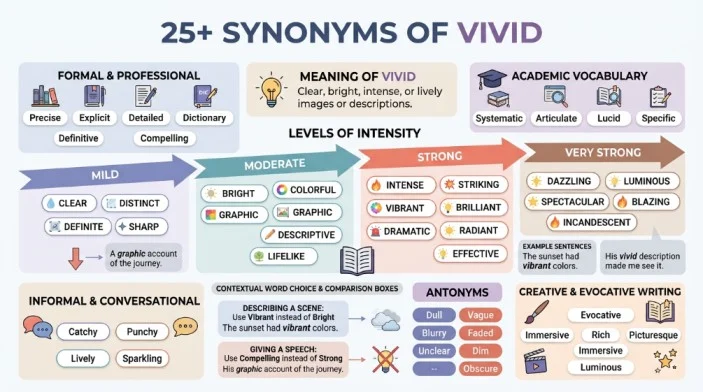
25 Best Synonyms of “Vivid”
| Synonym | Simple Meaning | Best Used For | Example Sentence |
|---|---|---|---|
| Striking | Immediately noticeable or impressive | Visual impact, writing, business | The designer created a striking presentation. |
| Vibrant | Full of strong color, energy, or life | Colors, places, cultures | The mural uses vibrant shades of blue and orange. |
| Graphic | Extremely detailed or explicit | Descriptions, accounts, imagery | The article provides a graphic account of the event. |
| Colorful | Full of color, variety, or interest | Descriptions, stories, personalities | He shared a colorful story about his childhood. |
| Intense | Very strong or powerful | Emotions, experiences, sensations | She felt intense excitement before the performance. |
| Evocative | Bringing strong images or feelings to mind | Creative and emotional writing | The photograph is deeply evocative. |
| Lifelike | Closely resembling real life | Art, characters, models | The painting contains a remarkably lifelike portrait. |
| Descriptive | Giving many useful details | Academic and explanatory writing | Her essay is descriptive without becoming repetitive. |
| Clear | Easy to understand, see, or remember | Professional and everyday communication | I have a clear memory of that afternoon. |
| Distinct | Clearly different or recognizable | Academic and analytical writing | The researchers identified distinct patterns. |
| Animated | Full of movement, energy, or expression | People, conversations, performances | They had an animated discussion about the proposal. |
| Lively | Energetic, active, or interesting | Conversation, writing, places | The article offers a lively account of city life. |
| Spirited | Full of enthusiasm and energy | People, debates, performances | The team had a spirited discussion about the plan. |
| Dynamic | Active, energetic, and changing | Business, people, environments | The company operates in a dynamic market. |
| Bold | Strong, confident, or visually noticeable | Design, ideas, writing | The campaign uses bold visual elements. |
| Brilliant | Extremely bright or impressive | Colors, light, performance | The artist chose brilliant colors for the background. |
| Radiant | Bright and glowing | Light, appearance, colors | The flowers looked radiant in the morning sun. |
| Picturesque | Visually attractive like a picture | Landscapes, towns, scenes | They stayed in a picturesque mountain village. |
| Expressive | Clearly showing thoughts or feelings | Faces, art, writing | Her expressive writing captured the character’s fear. |
| Realistic | Closely representing real life | Examples, art, descriptions | The training included realistic workplace scenarios. |
| Memorable | Easy to remember because of its impact | Events, writing, experiences | The speaker gave a memorable presentation. |
| Fresh | New, lively, or not dull | Ideas, descriptions, writing | The article offers a fresh perspective on the issue. |
| Sharp | Clear, precise, or strongly defined | Images, memories, observations | He has a sharp memory for small details. |
| Distinguishable | Easy to recognize or tell apart | Features, sounds, objects | The two voices were clearly distinguishable. |
| Lucid | Very clear and easy to understand | Explanations and formal writing | The author provides a lucid explanation of the theory. |
Synonyms of “Vivid” by Usage
Professional vs Personal Synonyms
Professional writing generally benefits from precise alternatives such as clear, distinct, striking, descriptive, realistic, and lucid.
Personal writing can use more expressive words such as colorful, vibrant, evocative, lively, and memorable.
For example, a workplace email might say, “Thank you for the clear explanation.” A personal story might say, “She gave a colorful description of the trip.”
Formal vs Conversational Synonyms
For reports, essays, presentations, and formal documents, consider:
- distinct
- descriptive
- striking
- lucid
- graphic
- realistic
For casual conversations and texting, more natural choices include:
- bright
- colorful
- lively
- clear
- vibrant
- memorable
The goal is not to make formal writing complicated. It is to select vocabulary that fits the communication setting.
Academic Synonyms
Academic writing needs precision. Useful alternatives to vivid include:
Distinct: best when describing clear differences or identifiable features.
Descriptive: useful when discussing detailed language or representation.
Graphic: appropriate when discussing highly detailed representation, especially when the description is explicit.
Lucid: useful when praising an explanation that is unusually clear.
Striking: useful when a finding, contrast, or observation is especially noticeable.
For example:
“The study revealed a striking difference between the two populations.”
This communicates stronger impact than simply saying the difference was vivid.
Professional and Business Synonyms
Resumes
Use striking, dynamic, effective, or memorable when describing work that attracts attention or produces an impression.
Example:
“Developed striking visual materials for national marketing campaigns.”
Interviews
Use clear, specific, realistic, or memorable when describing examples and experiences.
Example:
“I can provide a clear example of how I solved the problem.”
Meetings
Use clear, distinct, and descriptive when accuracy matters.
Example:
“The manager provided a clear overview of the project.”
Presentations
Use striking, engaging, dynamic, and memorable when discussing audience impact.
Example:
“The presentation used striking visuals to explain the results.”
Performance Reviews
Use precise language rather than dramatic vocabulary.
Example:
“Provided clear recommendations that helped the team improve workflow.”
Client Communication
Choose clear, specific, and detailed when explaining services, problems, or next steps.
Example:
“Thank you for providing such a detailed description of the issue.”
Creative and Literary Synonyms
Creative writing has more freedom to use expressive alternatives.
Evocative is useful when a description creates emotion or association.
Picturesque works especially well for beautiful scenery.
Lifelike is useful for characters, portraits, and representations.
Colorful can describe both literal color and a rich personality or story.
Expressive focuses on the communication of emotion.
Example:
“The old photograph offered an evocative glimpse into the family’s past.”
The word evocative does more than say the photograph was clear. It suggests that the image triggered memories or feelings.
Slang or Modern Synonyms
There is no perfect slang replacement for vivid that works across all of its meanings.
In casual modern speech, people may use expressions such as bright, bold, wild, or intense, depending on the context.
For example:
“That jacket is really bold.”
However, these words should not automatically replace vivid. Wild can suggest unusualness rather than visual clarity, while bold may describe confidence or design rather than detailed imagery.
Avoid informal alternatives in academic papers, formal reports, resumes, and professional documents unless the context specifically calls for conversational language.
Strongest to Mildest Synonyms
Because vivid has several meanings, intensity depends on the specific sense.
Mild
- clear
- fresh
- distinct
- descriptive
These words communicate clarity or detail without necessarily adding strong emotion.
Moderate
- colorful
- lively
- realistic
- expressive
- memorable
These create a stronger impression while remaining fairly neutral.
Strong
- striking
- vibrant
- graphic
- evocative
- dynamic
- intense
These words make the quality more noticeable or emotionally powerful.
Very Strong
- brilliant
- radiant
- graphic
- intense
- striking
These can create a particularly powerful visual, emotional, or sensory impression.
Remember that intensity is context dependent. A “brilliant color” is strongly bright, while a “brilliant explanation” can mean exceptionally intelligent or effective.
Emotional vs Neutral Synonyms
Emotional Synonyms
These alternatives add feeling, energy, or expressive force:
- evocative
- intense
- striking
- lively
- spirited
- vibrant
- memorable
- expressive
Use them in storytelling, speeches, creative writing, personal essays, and emotionally engaging content.
Neutral Synonyms
These communicate information with less emotional coloring:
- clear
- distinct
- descriptive
- realistic
- distinguishable
- lucid
Use these in reports, instructions, academic writing, business communication, and technical explanations.
Antonyms of “Vivid”
Because vivid has multiple meanings, its opposites depend on whether you mean color, clarity, imagery, intensity, or liveliness. The following words function as genuine contextual antonyms.
| Antonym | Meaning | Example Sentence |
|---|---|---|
| Dull | Lacking brightness or interest | The room had dull lighting. |
| Vague | Not clearly expressed or defined | His explanation was vague. |
| Indistinct | Difficult to recognize or distinguish | The figure remained indistinct in the fog. |
| Unclear | Difficult to understand or perceive | The instructions were unclear. |
| Blurry | Lacking visual sharpness | The photograph looked blurry. |
| Faded | Having lost brightness or intensity | The poster had faded colors. |
| Muted | Softened in color, sound, or intensity | The designer chose muted tones. |
| Lifeless | Lacking energy or vitality | The writing felt lifeless. |
| Colorless | Lacking strong color or expressive quality | The walls looked colorless. |
| Bland | Lacking excitement, variety, or strong character | The description was bland. |
| Weak | Lacking strength or force | The argument made a weak impression. |
| Dim | Not brightly lit or visually strong | A dim light filled the hallway. |
| Drab | Dull and lacking brightness | The office had a drab appearance. |
| Monotonous | Lacking variation or energy | The speech became monotonous. |
| Unimaginative | Lacking creative or original ideas | The story felt unimaginative. |
Comparison: “Vivid” vs Similar Words
Vivid vs Striking
Main Difference: Vivid emphasizes clarity, imagery, or intensity. Striking emphasizes immediate impact or noticeability.
Which Is Stronger? Striking often sounds stronger when describing impact.
Which Is More Formal? Both are neutral and suitable for professional writing.
When to Use Each: Choose vivid for memories and descriptions. Choose striking for contrasts, designs, findings, and impressive features.
Examples
Vivid:
“She has a vivid memory of the ceremony.”
Striking:
“The report revealed a striking difference in customer satisfaction.”
Vivid vs Vibrant
Main Difference: Vivid often focuses on strong imagery or clarity. Vibrant strongly suggests color, energy, or life.
Which Is Stronger? Vibrant often feels more energetic.
Which Is More Formal? Both work in formal and informal writing.
When to Use Each: Use vivid for memories and descriptions. Use vibrant for colors, communities, personalities, and energetic environments.
Examples
Vivid:
“The novel creates vivid images of rural life.”
Vibrant:
“The city has a vibrant arts scene.”
Vivid vs Graphic
Main Difference: Graphic emphasizes detailed representation and can imply explicit content. Vivid does not necessarily imply explicitness.
Which Is Stronger? Graphic can feel stronger because it may suggest explicit detail.
Which Is More Formal? Both can appear in formal writing, depending on context.
When to Use Each: Use graphic for unusually detailed descriptions. Use vivid for strong imagery without necessarily suggesting explicit content.
Examples
Vivid:
“The writer creates a vivid picture of the neighborhood.”
Graphic:
“The article includes a graphic description of the accident.”
Vivid vs Lifelike
Main Difference: Vivid means strong, clear, or intense. Lifelike specifically means resembling real life.
Which Is Stronger? Neither is universally stronger because they describe different qualities.
Which Is More Formal? Both are neutral.
When to Use Each: Use lifelike for art, models, images, and characters. Use vivid for memories, descriptions, colors, and experiences.
Examples
Vivid:
“He described the scene in vivid detail.”
Lifelike:
“The sculpture has remarkably lifelike facial features.”
Vivid vs Clear
Main Difference: Clear focuses on understanding or recognition. Vivid adds strength, detail, imagery, or intensity.
Which Is Stronger? Vivid generally carries more expressive force.
Which Is More Formal? Clear is often preferable in professional and technical writing.
When to Use Each: Use clear for instructions and explanations. Use vivid for descriptions and memories.
Examples
Vivid:
“She gave a vivid description of the storm.”
Clear:
“She gave clear instructions for the procedure.”
Vivid vs Colorful
Main Difference: Colorful emphasizes color, variety, or lively character. Vivid emphasizes strong visual or mental impressions more broadly.
Which Is Stronger? Neither is automatically stronger.
Which Is More Formal? Both are neutral, but colorful can sound more conversational in some contexts.
When to Use Each: Use colorful for stories, personalities, cultures, and visual variety. Use vivid for memories, images, and detailed descriptions.
Examples
Vivid:
“I have a vivid memory of that summer.”
Colorful:
“She told a colorful story about her travels.”
Common Phrases and Expressions with “Vivid”
Vivid Memory
Meaning: A memory that remains unusually clear and strong.
Example Sentence:
“I still have a vivid memory of walking into my first classroom.”
Vivid Imagination
Meaning: A strong ability to create detailed mental images or ideas.
Example Sentence:
“Children often have a vivid imagination that turns ordinary objects into characters.”
Vivid Description
Meaning: A detailed description that helps someone form a strong mental picture.
Example Sentence:
“The journalist provided a vivid description of the damaged neighborhood.”
Vivid Colors
Meaning: Bright, intense, noticeable colors.
Example Sentence:
“The designer used vivid colors to make the poster stand out.”
Vivid Dream
Meaning: A dream that feels unusually clear, detailed, or realistic.
Example Sentence:
“She woke up with a vivid dream that she could remember in detail.”
Vivid Picture
Meaning: A strong mental or visual representation.
Example Sentence:
“The documentary gives viewers a vivid picture of life in the region.”
Vivid Detail
Meaning: A detail presented with enough clarity or intensity to make it memorable.
Example Sentence:
“The author included vivid detail without slowing the story.”
Vivid Description of an Experience
Meaning: A detailed account that allows readers or listeners to imagine an experience.
Example Sentence:
“He gave a vivid description of his first flight.”
Common Mistakes to Avoid
Mistake 1: Using a Vague Synonym Instead of a Precise One
Incorrect:
“The manager gave a vivid explanation of the deadline.”
Better:
“The manager gave a clear explanation of the deadline.”
Why: The purpose is understanding, not imagery. Clear communicates the intended meaning more directly.
Mistake 2: Confusing Vivid With Bright
Incorrect:
“I have a bright memory of my childhood.”
Better:
“I have a vivid memory of my childhood.”
Why: Bright normally relates to light, color, intelligence, or cheerfulness. Vivid is the natural choice for a strong, clear memory.
Mistake 3: Using an Informal Synonym in Formal Writing
Incorrect:
“The report gives a colorful rundown of the findings.”
Better:
“The report provides a detailed summary of the findings.”
Why: Colorful can sound conversational. Detailed and summary focused language is more suitable for formal analysis.
Mistake 4: Choosing an Overly Dramatic Synonym
Incorrect:
“The employee gave an intense description of the meeting.”
Better:
“The employee gave a clear description of the meeting.”
Why: Intense suggests strong emotion or force. If the goal is simply accurate reporting, clear is more appropriate.
Mistake 5: Repeating Vivid Too Often
Incorrect:
“The vivid colors create a vivid scene with vivid details.”
Better:
“The vibrant colors create a striking scene filled with detailed imagery.”
Why: Strategic variation makes writing more natural and gives each description a specific purpose.
Mistake 6: Choosing the Wrong Emotional Tone
Incorrect:
“The company sent a vibrant explanation of the policy.”
Better:
“The company sent a clear explanation of the policy.”
Why: Vibrant suggests energy or strong color. Clear is better for straightforward business information.
Mistake 7: Using Slang in Academic or Professional Writing
Incorrect:
“The experiment produced a really wild set of results.”
Better:
“The experiment produced a striking set of results.”
Why: Wild is informal and ambiguous. Striking communicates that the results were unusually noticeable without sounding casual.
Frequently Asked Questions
1. What are the best synonyms of “vivid”?
The best synonyms of vivid include striking, vibrant, graphic, colorful, evocative, lifelike, clear, distinct, descriptive, and intense. The best choice depends on whether you mean visual intensity, clarity, detail, realism, or emotional impact.
2. What are the best formal synonyms of “vivid”?
Useful formal synonyms of vivid include striking, distinct, descriptive, graphic, realistic, and lucid. These choices work particularly well in academic writing, reports, presentations, professional analysis, and formal descriptions.
3. What are common informal synonyms of “vivid”?
Common conversational alternatives include bright, colorful, lively, clear, vibrant, and memorable. The right option depends on the meaning. For example, bright suits colors, while clear works better for memories or explanations.
4. What is another word for “vivid” in professional writing?
In professional writing, clear, striking, distinct, detailed, descriptive, or realistic can replace vivid depending on context. Clear is usually best for explanations, while striking works well for noticeable findings or visual materials.
5. What is the difference between “vivid” and “clear”?
Vivid suggests strong imagery, intensity, or memorable detail, while clear mainly means easy to understand, see, or recognize. A vivid memory is especially strong and detailed, while a clear memory is simply easy to recall.
6. What is the opposite of “vivid”?
Common opposites of vivid include dull, vague, indistinct, unclear, blurry, faded, muted, lifeless, colorless, drab, and unimaginative. The best antonym depends on whether vivid refers to color, clarity, imagery, or emotional intensity.
Conclusion
Vivid describes something that is especially clear, strong, bright, detailed, memorable, or easy to imagine. Its best alternative depends on the exact meaning you want to communicate.
Use clear for straightforward communication, striking for noticeable impact, vibrant for strong color or energy, evocative for emotional imagery, lifelike for realism, and distinct for clear differences or features.
No synonym works perfectly in every situation. Before replacing a word, consider your audience, tone, purpose, and the specific quality you want to emphasize. The simplest vocabulary improvement is to stop asking only whether a synonym is correct and start asking whether it expresses your exact meaning.
Read More Related Articles:
- Synonyms for Everything | Meaning, Examples, and Better …
- Synonyms for Unexpected | Meaning, Examples, and Better …
- 50+ Synonyms of This | Meanings, Uses, Examples, and Best …