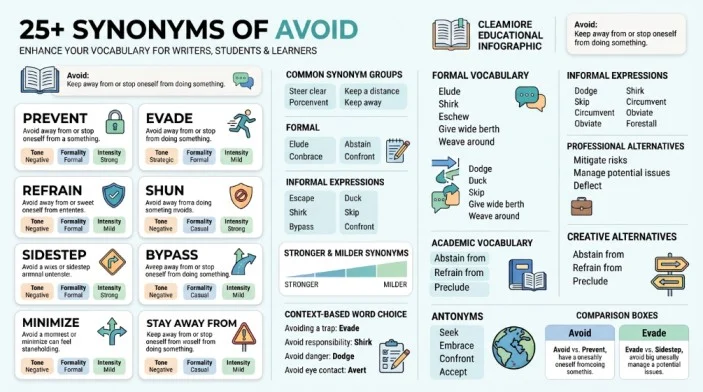
Finding the right avoid synonym can make your writing clearer, more precise, and more natural. The word “avoid” can describe staying away from a person, preventing a problem, skipping an action, or choosing not to deal with something. Because the meaning changes with context, one replacement word may not always work in every sentence.
If you need another word for avoid, options such as prevent, evade, escape, sidestep, and shun can provide a more specific meaning. A suitable synonym for avoid depends on your tone and intention. This guide explains common synonyms for avoid, practical avoid synonyms, and useful alternatives for different situations. It also covers an avoiding synonym, the synonym of avoid, synonyms of avoid, and forms such as synonym avoid and avoids synonym so you can choose the most accurate word with confidence.
What Are the Best Synonyms of “Avoid”?
A synonym of avoid is a word that describes staying away from someone or something, preventing an unwanted situation, or deliberately choosing not to do something. The best alternatives include prevent for stopping something, evade for escaping something, refrain for choosing not to act, and shun for deliberately staying away.
Meaning, Tone, and Context
Simple Definition
Avoid means to stay away from someone or something, deliberately not do something, or take action so that an unwanted event does not happen.
The exact meaning changes slightly depending on how the word is used.
Compare these examples:
- She avoided the crowded restaurant.” This means she stayed away from it.
- “He avoided answering the question.” This means he deliberately did not answer.
- “Regular maintenance can avoid serious problems.” Here, the idea is preventing an unwanted result.
Because avoid covers several related ideas, its synonyms must be chosen carefully.
Part of Speech
Avoid is a verb.
- “Try to avoid distractions.”
- “She avoided the argument.”
- “They are avoiding unnecessary expenses.”
The noun form is avoidance.
Example:
“His avoidance of difficult conversations created more problems.”
Overall Tone
Avoid has a generally neutral tone. It does not automatically sound positive or negative.
The emotional effect depends on what is being avoided.
“She avoided unnecessary conflict.”
This sounds sensible and positive.
“He avoided his responsibilities.”
This sounds negative because the action suggests unwillingness to deal with a duty.
Formality Level
Avoid is a neutral word that works naturally in formal, semi formal, and informal English.
It is suitable for:
- Academic writing
- Business communication
- Workplace discussions
- Emails
- Resumes
- Everyday conversation
- Social media
- Creative writing
Some alternatives, such as shun, eschew, and refrain, can sound more formal or specialized.
Common Uses
Native English speakers commonly use avoid when discussing:
- Problems
- Mistakes
- Risks
- Conflict
- People
- Places
- Responsibilities
- Unwanted situations
- Unhealthy habits
- Difficult conversations
- Unnecessary expenses
- Dangerous situations
- Certain actions
Word Forms
| Form | Word | Example |
|---|---|---|
| Verb | Avoid | “Avoid unnecessary distractions.” |
| Past tense | Avoided | “She avoided the discussion.” |
| Present participle | Avoiding | “He is avoiding the issue.” |
| Noun | Avoidance | “Avoidance rarely solves the problem.” |
When and How to Use “Avoid”
Use avoid when you want to communicate the idea of deliberately staying away from something, not doing something, or preventing an unwanted outcome.
Professional
“Employees should avoid sharing confidential information through unsecured channels.”
Here, avoid clearly communicates a workplace rule without sounding overly dramatic.
Academic
“Researchers should avoid making conclusions that are not supported by the available evidence.”
This usage is appropriate because it describes an action writers and researchers should deliberately not take.
Workplace
“Let’s avoid unnecessary delays by confirming the schedule today.”
The word works naturally in workplace communication because it identifies an unwanted result that can be prevented.
Personal
“I try to avoid arguments when everyone is already frustrated.”
Here, avoid describes a personal choice to stay away from conflict.
“Please avoid sending duplicate files so we can keep the project folder organized.”
This sounds polite and direct.
Resume
“Avoided unnecessary project costs by improving the purchasing process.”
In a resume, a stronger alternative may sometimes be better:
“Reduced unnecessary project costs by improving the purchasing process.”
The second version focuses on the achievement rather than simply describing what was avoided.
Social Media
“I’ve learned to avoid comparing my progress with everyone else’s.”
This sounds natural and conversational.
Best Synonyms of “Avoid”
No single alternative works perfectly in every sentence. The best avoid synonyms depend on whether you mean staying away, escaping, preventing, ignoring, refusing, or deliberately choosing not to participate.
Professional Writing: Prevent
Use prevent when the main idea is stopping something from happening.
“Regular backups help prevent data loss.”
This is stronger and more precise than avoid when the focus is on stopping an outcome before it occurs.
Academic Writing: Refrain
Use refrain when someone deliberately chooses not to perform an action.
“Participants were asked to refrain from discussing the study during the experiment.”
It works especially well when describing rules, behavior, or controlled actions.
Business Communication: Prevent
Prevent is useful when discussing risks, errors, delays, or negative outcomes.
“The new system should prevent duplicate payments.”
It clearly communicates an active effort to stop a problem.
Casual Conversation: Stay Away From
Stay away from is a natural conversational expression when talking about people, places, situations, or things someone should not approach.
“I’d stay away from that restaurant during the lunch rush.”
It sounds much more casual than refrain or eschew.
Emotional Writing: Shun
Shun suggests deliberately avoiding a person, group, or social interaction.
“After the disagreement, he began to shun his former friends.”
It can carry a stronger emotional or social meaning than avoid.
Creative Writing: Flee
Flee works when avoiding involves physically escaping from danger or a threatening situation.
“The villagers fled the burning town.”
It is more vivid and dramatic than avoid.
Resume Writing: Minimize
Minimize is useful when describing efforts to reduce risk, waste, cost, or problems.
“Implemented quality controls to minimize production errors.”
It sounds more achievement focused than simply saying avoided errors.
Workplace Communication: Prevent
Use prevent when the workplace context involves stopping a problem before it happens.
“Clear documentation can prevent misunderstandings between departments.”
Stronger Meaning: Evade
Evade suggests deliberately escaping something difficult, unwanted, or demanding.
“He tried to evade responsibility for the mistake.”
It can sound more negative than avoid because it often implies deliberate escape from an obligation or consequence.
Softer Meaning: Sidestep
Sidestep can sound less direct than evade and is often used when someone avoids dealing with a question, problem, or issue.
“The manager sidestepped the question during the meeting.”
When Not to Use “Avoid”
Although avoid is extremely versatile, there are situations where another word communicates the intended meaning more precisely.
When “Avoid” Is Too General
Less Precise:
“The new policy avoids problems.”
Better:
“The new policy prevents billing errors.”
Why:
Prevent clearly shows that the policy stops the problem from occurring.
When “Avoid” Is Too Vague
Less Precise:
“She avoided the meeting.”
This could mean she stayed away, skipped it, or deliberately refused to attend.
Better:
“She skipped the meeting because she was sick.”
Why:
Skipped gives the reader a clearer picture of what happened.
When “Avoid” Is Too Weak
Less Precise:
“The driver avoided the accident.”
Better:
“The driver escaped the accident without injury.”
Why:
Escape emphasizes getting out of a dangerous situation.
When “Avoid” Is Too Neutral
Less Precise:
“He avoided his responsibilities.”
Better:
“He evaded his responsibilities.”
Why:
Evade can communicate deliberate unwillingness to face a duty.
When “Avoid” Does Not Express Prevention
Less Precise:
“The software avoids security problems.”
Better:
“The software prevents security problems.”
Why:
Prevent specifically focuses on stopping something from happening.
When a More Formal Word Is Needed
Less Precise:
“Participants should avoid discussing the results.”
Better:
“Participants should refrain from discussing the results.”
Why:
Refrain is particularly natural when describing a formal instruction to not perform an action.
When the Situation Is Physically Dangerous
Less Precise:
“The hikers avoided the burning area.”
Better:
“The hikers fled the burning area.”
Why:
Fled communicates rapid physical movement away from danger.
Words Commonly Confused With “Avoid”
Prevent
Difference: Prevent means stopping something from happening. Avoid can mean staying away from something or choosing not to do something.
When to Use It: Use prevent when an action blocks an unwanted outcome.
Example: “Regular inspections help prevent equipment failures.”
Evade
Difference: Evade means deliberately escaping or avoiding something difficult, often a responsibility, question, rule, or threat.
When to Use It: Use it when deliberate escape is central to the meaning.
Example: “The witness tried to evade the reporter’s questions.”
Escape
Difference: Escape means successfully getting away from a person, place, danger, or difficult situation.
When to Use It: Use it when physical or figurative release from a situation is important.
Example: “The hikers managed to escape the storm.”
Ignore
Difference: Ignore means deliberately giving no attention to something. Avoid can involve actively staying away from it.
When to Use It: Use ignore when the main idea is lack of attention.
Example: “He ignored the warning signs.”
Refuse
Difference: Refuse means saying no or declining to do something. Avoid may involve not engaging without directly saying no.
When to Use It: Use refuse when someone explicitly rejects an action or request.
Example: “She refused to sign the agreement.”
Refrain
Difference: Refrain means deliberately choosing not to do something.
When to Use It: Use it for controlled behavior, instructions, formal writing, and situations where self restraint matters.
Example: “Please refrain from using your phone during the presentation.”
Best Synonyms of “Avoid” by Context
| Context | Best Synonym | Why It Works | Example |
|---|---|---|---|
| Formal writing | Refrain | Clearly expresses deliberate nonaction. | “Please refrain from unnecessary comments.” |
| Academic writing | Refrain | Fits formal instructions and research contexts. | “Researchers should refrain from unsupported claims.” |
| Professional communication | Prevent | Emphasizes stopping problems. | “The update should prevent future errors.” |
| Business emails | Prevent | Sounds direct and practical. | “These checks can prevent duplicate orders.” |
| Resume writing | Minimize | Focuses on reducing risks or problems. | “Minimized processing errors through automation.” |
| Workplace communication | Prevent | Works well for risks and mistakes. | “Clear instructions prevent confusion.” |
| Casual conversation | Stay away from | Sounds natural and conversational. | “I’d stay away from that place tonight.” |
| Everyday speaking | Skip | Works when someone chooses not to attend or do something. | “I decided to skip the meeting.” |
| Creative writing | Flee | Adds movement and urgency. | “They fled the burning building.” |
| Storytelling | Escape | Emphasizes getting free from danger. | “She escaped before the storm arrived.” |
| Emotional writing | Shun | Expresses deliberate social rejection. | “He began to shun his old friends.” |
| Strong emphasis | Evade | Suggests deliberate escape or avoidance. | “He tried to evade responsibility.” |
| Mild tone | Sidestep | Suggests indirect avoidance. | “She sidestepped the difficult question.” |
| Social media captions | Skip | Short, casual, and familiar. | “Skip the drama and protect your peace.” |
| American English | Avoid | Natural and widely understood. | “Try to avoid unnecessary stress.” |
| British English | Avoid | Equally natural and standard. | “Try to avoid unnecessary delays.” |
How to Choose the Best Synonym of “Avoid”
The easiest way to select the right alternative is to identify the exact action behind avoid.
If You Mean “Stop Something From Happening”
Choose prevent.
“Good planning can prevent costly mistakes.”
If You Mean “Stay Away”
Choose stay away from.
“Try to stay away from crowded areas.”
If You Mean “Escape”
Choose escape or flee, depending on the situation.
“She escaped the dangerous situation.”
“The family fled the burning building.”
If You Mean “Avoid Doing Something”
Choose refrain when the context is formal.
“Please refrain from interrupting.”
If You Mean “Avoid Responsibility”
Choose evade.
“He attempted to evade responsibility.”
If You Mean “Avoid Attention”
Choose keep a low profile or stay out of the spotlight, depending on the context.
“She prefers to stay out of the spotlight.”
If You Mean “Avoid a Question”
Choose sidestep or evade.
“The spokesperson sidestepped the question.”
If You Mean “Avoid a Person Socially”
Choose shun when the avoidance is deliberate and strong.
“The group shunned him after the dispute.”
Consider Your Audience
For academic and professional readers, use precise words such as prevent, refrain, minimize, and evade when their meanings fit.
For casual audiences, stay away from, skip, and steer clear of often sound more natural.
Consider Emotional Strength
Avoid is neutral.
Sidestep can suggest indirect behavior.
Evade can sound negative.
Shun suggests deliberate social rejection.
Flee suggests urgency or danger.
Choosing the right level of intensity prevents your writing from sounding exaggerated.
Real Life Examples of “Avoid”
School
Basic: “Students should avoid distractions while studying.”
Improved: “Students should steer clear of unnecessary distractions while studying.”
The second version is more conversational and vivid.
College
Basic: “Students should avoid unsupported claims.”
Improved: “Students should refrain from making unsupported claims.”
The revised sentence fits academic writing better.
Workplace
Basic: “We need to avoid delays.”
Improved: “We need to prevent unnecessary delays.”
The word prevent emphasizes taking action before delays happen.
Business
Basic: “The company wants to avoid financial losses.”
Improved: “The company wants to minimize financial losses.”
Minimize is especially useful when some level of loss may still occur but the goal is to reduce it.
Basic: “Please avoid sending large attachments.”
Improved: “Please refrain from sending large attachments unless necessary.”
The revised sentence sounds more formal and polite.
Resume
Basic: “Avoided unnecessary expenses.”
Improved: “Reduced unnecessary expenses through improved purchasing controls.”
The improved version focuses on the measurable business action rather than simply describing avoidance.
Conversation
Basic: “I try to avoid crowded places.”
Improved: “I usually stay away from crowded places.”
The second option sounds natural in casual speech.
Storytelling
Basic: “The family avoided the storm.”
Improved: “The family escaped the storm before it reached the town.”
Escaped creates a clearer sense of danger and movement.
Blogging
Basic: “Writers should avoid repetitive phrases.”
Improved: “Writers should steer clear of repetitive phrases that make an article feel predictable.”
The expression adds a more conversational tone.
Social Media
Basic: “Avoid negative people.”
Improved: “Sometimes it’s healthier to stay away from people who constantly drain your energy.”
The revised version feels more natural and expressive for social media.
25 Best Synonyms of “Avoid”
| Synonym | Simple Meaning | Best Used For | Example Sentence |
|---|---|---|---|
| Prevent | Stop something from happening | Risks and problems | Regular maintenance can prevent costly repairs. |
| Evade | Escape or avoid deliberately | Responsibility, questions, threats | He tried to evade responsibility for the mistake. |
| Escape | Get away from something | Danger and difficult situations | They escaped the flooded area safely. |
| Refrain | Choose not to do something | Formal instructions | Please refrain from interrupting the speaker. |
| Shun | Deliberately stay away from someone | Social relationships | She chose to shun the group after the conflict. |
| Sidestep | Avoid dealing with something directly | Questions and issues | The official sidestepped the question. |
| Bypass | Go around or avoid something | Systems and procedures | The technician found a way to bypass the faulty connection. |
| Elude | Successfully avoid capture or understanding | Pursuit and difficult concepts | The suspect managed to elude police for several days. |
| Dodge | Quickly move away or avoid | Physical danger and questions | He dodged the question during the interview. |
| Steer clear of | Deliberately stay away | Casual conversation | We decided to steer clear of the crowded highway. |
| Stay away from | Keep at a distance | Everyday speech | Try to stay away from unnecessary arguments. |
| Keep away from | Maintain distance | People, places, or things | Keep away from the wet paint. |
| Skip | Choose not to attend or do | Casual situations | I decided to skip the meeting. |
| Forego | Choose not to have or do | Formal and professional writing | She decided to forego the extra expense. |
| Abstain | Deliberately not participate | Formal and controlled contexts | Participants agreed to abstain from voting. |
| Eschew | Deliberately avoid something | Formal writing | The writer chose to eschew unnecessary jargon. |
| Circumvent | Find a way around a rule or obstacle | Formal and technical contexts | The company found a legal way to circumvent the obstacle. |
| Ward off | Prevent something unwanted | Illness, danger, problems | The vaccine can help ward off serious illness. |
| Deter | Discourage an action | Crime, behavior, risks | Strong security can deter theft. |
| Deflect | Turn attention or something away | Questions, criticism, attention | The spokesperson deflected criticism during the interview. |
| Duck | Avoid something, especially a question or responsibility | Informal speech | He ducked the question again. |
| Flee | Run away from danger | Dramatic or physical situations | The residents fled the burning building. |
| Minimize | Reduce something unwanted | Costs, risks, damage | New procedures helped minimize errors. |
| Neglect | Fail to deal with something | Responsibilities and duties | Do not neglect important maintenance. |
| Omit | Leave something out | Writing and information | The editor omitted unnecessary details. |
Synonyms of “Avoid” by Usage
Professional vs Personal Synonyms
Professional writing benefits from words that identify the exact action being taken.
Use prevent for stopping problems, minimize for reducing risks, refrain for controlled behavior, and circumvent when describing a method of getting around an obstacle.
Personal conversations usually favor simpler expressions such as stay away from, skip, steer clear of, and keep away from.
Compare:
Professional: “The new procedure will prevent processing errors.”
Personal: “I usually stay away from stressful situations.”
Both communicate avoidance, but the vocabulary matches the audience.
Formal vs Conversational Synonyms
Reports
Use prevent, minimize, refrain, or circumvent when their meanings are accurate.
Essays
Choose refrain, prevent, evade, or eschew based on the specific meaning.
Business Writing
Prevent, minimize, and circumvent can provide greater precision.
Presentations
Avoid, prevent, and minimize are generally clear and easy for an audience to understand.
Emails
Use avoid or refrain depending on how formal the instruction needs to sound.
Casual Conversations
Use avoid, skip, stay away from, or steer clear of.
Texting
Short expressions such as skip and stay away from usually sound more natural than formal terms such as eschew.
Academic Synonyms
Academic writing should favor precision rather than complicated vocabulary.
Refrain
Useful when researchers, participants, or writers deliberately choose not to perform an action.
“Participants were instructed to refrain from discussing the experiment.”
Prevent
Best when discussing actions that stop a result from occurring.
“Proper controls can prevent contamination.”
Avoid
Still appropriate when the meaning is simple and clear.
“Researchers should avoid unsupported assumptions.”
Eschew
A formal choice when someone deliberately rejects a particular approach, style, or practice.
“The author chose to eschew overly technical terminology.”
Circumvent
Useful when describing a method of getting around an obstacle, rule, or restriction.
“The researchers developed a method to circumvent the technical limitation.”
The strongest academic vocabulary is not necessarily the most complicated vocabulary. A precise, familiar word is usually better than an obscure one.
Professional and Business Synonyms
Resumes
Use minimize, prevent, or a stronger achievement focused construction.
Instead of:
“Avoided customer complaints.”
Consider:
“Reduced customer complaints through improved support procedures.”
Interviews
Use prevent, manage, or address when explaining how you handled a problem.
“How did you avoid repeated errors?”
“I introduced a review process that prevented repeated errors.”
Meetings
Use avoid or sidestep depending on the situation.
“We should avoid unnecessary discussion.”
“The speaker sidestepped the question.”
Presentations
Use prevent, minimize, and reduce when discussing business outcomes.
“These changes will minimize operational risk.”
Performance Reviews
Use achievement focused language rather than simply saying you avoided something.
Instead of:
“Avoided delays.”
Use:
“Reduced project delays by improving scheduling procedures.”
Client Communication
Use polite and neutral vocabulary.
“To avoid confusion, we’ve included the updated specifications below.”
Business Emails
Use avoid for direct instructions and refrain for more formal requests.
“Please avoid sending duplicate invoices.”
“Please refrain from submitting duplicate invoices.”
Creative and Literary Synonyms
Creative writing gives you more freedom to choose words based on imagery and emotional impact.
Flee
Use when a character physically runs from danger.
“The villagers fled before the fire reached the valley.”
Escape
Useful for physical or emotional release.
“She escaped the life she had never wanted.”
Shun
Useful for social rejection.
“He was shunned by the community after the scandal.”
Elude
Adds a sense of pursuit or difficulty.
“The answer continued to elude him.”
Sidestep
Works well when a character avoids a difficult issue indirectly.
“She sidestepped the question with a nervous smile.”
These choices can create a stronger image than repeatedly using avoid.
Slang or Modern Synonyms
There is no single slang word that perfectly replaces avoid in every situation. However, casual American English uses several informal expressions.
Duck
Meaning: Avoid something quickly, often a question or responsibility.
Acceptable: Casual conversations.
Avoid: Academic papers, formal reports, and professional documents.
Example:
“He ducked the question again.”
Dodge
Meaning: Avoid something, especially a question, responsibility, or physical object.
Acceptable: Casual and conversational English.
Avoid: Very formal writing when a more precise term is available.
Example:
“She dodged the question during the interview.”
A Big No
This is an informal expression rather than a direct synonym.
Example:
“Going back there is a big no for me.”
It works in casual speech and social media but should not replace formal vocabulary in academic or business writing.
Strongest to Mildest Synonyms
The intensity of an avoidance word depends on the situation.
| Intensity | Words | Typical Meaning |
|---|---|---|
| Mild | Avoid, sidestep, skip | Simple nonparticipation or distance |
| Moderate | Stay away from, steer clear of, bypass | Deliberate distance or indirect avoidance |
| Strong | Evade, shun, circumvent | Deliberate or determined avoidance |
| Very Strong | Flee, escape | Urgent or successful departure from danger |
Intensity is not absolute. Escape, for example, is not always emotionally stronger than evade. It simply describes getting free from a situation, while evade often emphasizes deliberate avoidance.
Emotional vs Neutral Synonyms
Emotional Synonyms
These words can add stronger emotional or dramatic meaning:
- Shun
- Flee
- Escape
- Dodge
- Evade
Example:
“He shunned everyone after the betrayal.”
The word shunned suggests social rejection and emotional distance.
Neutral Synonyms
These words communicate avoidance more objectively:
- Avoid
- Prevent
- Refrain
- Minimize
- Bypass
- Omit
Example:
“Researchers should avoid unsupported conclusions.”
Neutral vocabulary is usually better for academic, technical, and professional writing.
Antonyms of “Avoid”
| Antonym | Meaning | Example Sentence |
|---|---|---|
| Approach | Move toward something | She approached the manager calmly. |
| Face | Deal with something directly | He decided to face the problem. |
| Confront | Directly deal with a difficult situation | She chose to confront the issue. |
| Attend | Be present at an event or place | I will attend the meeting tomorrow. |
| Engage | Become involved with something | Students should engage with the material. |
| Accept | Agree to receive or take something | She accepted the invitation. |
| Embrace | Accept something willingly | He embraced the new opportunity. |
| Pursue | Actively seek or follow something | She decided to pursue her career goals. |
| Participate | Take part in something | Everyone was encouraged to participate. |
| Seek | Look for something deliberately | They sought professional advice. |
| Welcome | Receive something positively | The team welcomed the new ideas. |
| Address | Deal with an issue directly | The manager addressed the complaint. |
| Enter | Go into a place or situation | The visitors entered the building. |
| Approach | Move closer to something | The car approached the intersection. |
| Encounter | Meet or experience something | We encountered several challenges during the project. |
Comparison: “Avoid” vs Similar Words
Avoid vs Prevent
Main Difference
Avoid can mean staying away from something or choosing not to do something. Prevent means taking action to stop something from happening.
Which Is Stronger?
Prevent is stronger when the focus is on stopping an outcome.
Which Is More Formal?
Both are suitable for professional and academic writing.
When to Use Each
Use avoid for personal choices and distance. Use prevent for stopping events or problems.
Examples
Avoid: “We avoided unnecessary delays.”
Prevent: “The new system prevented unnecessary delays.”
Avoid vs Evade
Main Difference
Avoid is neutral. Evade often suggests deliberate escape from something difficult, especially responsibility, questions, or capture.
Which Is Stronger?
Evade usually carries stronger and sometimes negative implications.
Which Is More Formal?
Both can appear in formal writing, but evade is more specialized.
When to Use Each
Use evade when deliberate escape is important to the meaning.
Examples
Avoid: “He avoided the discussion.”
Evade: “He evaded responsibility for the mistake.”
Avoid vs Escape
Main Difference
Avoid can happen before contact or involvement. Escape usually means getting away from something after being in or near a difficult situation.
Which Is Stronger?
Escape often creates a stronger sense of danger or difficulty.
Which Is More Formal?
Both are standard English words.
When to Use Each
Use escape when freedom from a situation is the main idea.
Examples
Avoid: “They avoided the storm.”
Escape: “They escaped the storm.”
Avoid vs Ignore
Main Difference
Ignore means deliberately giving no attention to something. Avoid can involve actively staying away from it.
Which Is Stronger?
Neither is universally stronger.
Which Is More Formal?
Both are neutral.
When to Use Each
Use ignore when attention is the main issue.
Examples
Avoid: “She avoided the difficult conversation.”
Ignore: “She ignored his messages.”
Avoid vs Refrain
Main Difference
Refrain means deliberately choosing not to perform an action. Avoid has a wider range of meanings.
Which Is Stronger?
Neither is necessarily stronger.
Which Is More Formal?
Refrain is more formal.
When to Use Each
Use refrain for instructions, formal behavior, and controlled actions.
Examples
Avoid: “Avoid using unnecessary jargon.”
Refrain: “Please refrain from using unnecessary jargon.”
Avoid vs Sidestep
Main Difference
Sidestep often means avoiding an issue, question, or responsibility indirectly rather than dealing with it directly.
Which Is Stronger?
Sidestep can suggest evasive behavior, but its intensity depends on context.
Which Is More Formal?
Both are acceptable, though sidestep is less formal in some contexts.
When to Use Each
Use sidestep when someone avoids dealing with a specific issue.
Examples
Avoid: “He avoided the topic.”
Sidestep: “He sidestepped the topic during the interview.”
Common Phrases and Expressions with “Avoid”
Avoid at All Costs
Meaning: Make every effort to stay away from something.
Example: “We should avoid unnecessary delays at all costs.”
Avoid Conflict
Meaning: Stay away from arguments or disagreements.
Example: “She tries to avoid conflict whenever possible.”
Avoid the Risk
Meaning: Stay away from a situation that could create danger or loss.
Example: “The company changed its policy to avoid the risk of fraud.”
Avoid Mistakes
Meaning: Take action so that errors do not happen.
Example: “Double check your work to avoid mistakes.”
Avoid Unnecessary Expenses
Meaning: Do not spend money that is not needed.
Example: “We can avoid unnecessary expenses by comparing prices.”
Avoid Doing Something
Meaning: Deliberately choose not to perform an action.
Example: “Try to avoid making decisions when you’re exhausted.”
Avoid Someone
Meaning: Deliberately stay away from a person.
Example: “He began to avoid his former coworker.”
Avoid Trouble
Meaning: Stay away from situations that could cause problems.
Example: “She left early to avoid trouble on the road.”
Common Mistakes to Avoid
Mistake 1: Treating Every Synonym as Identical
Incorrect:
“Regular maintenance avoids equipment failure.”
Better:
“Regular maintenance prevents equipment failure.”
Why:
Prevent clearly communicates that maintenance stops the failure from happening.
Mistake 2: Using “Evade” for Every Situation
Incorrect:
“I evaded the crowded restaurant.”
Better:
“I avoided the crowded restaurant.”
Why:
Evade often suggests escaping a person, responsibility, question, threat, or difficult situation. It sounds unnatural for ordinary choices such as selecting a different restaurant.
Mistake 3: Using Informal Language in Academic Writing
Incorrect:
“Students should steer clear of unsupported claims.”
Better:
“Students should avoid unsupported claims.”
Why:
The original expression is understandable but conversational. Avoid is cleaner and more appropriate for academic writing.
Mistake 4: Choosing an Overly Dramatic Synonym
Incorrect:
“The employee fled the difficult meeting.”
Better:
“The employee left the difficult meeting.”
Why:
Fled suggests urgent escape, often from danger. It exaggerates an ordinary workplace situation.
Mistake 5: Repeating “Avoid” Too Often
Incorrect:
“To avoid mistakes, avoid distractions and avoid rushing.”
Better:
“To prevent mistakes, reduce distractions and take your time.”
Why:
Varying the vocabulary improves flow while preserving the meaning.
Mistake 6: Confusing “Avoid” With “Ignore”
Incorrect:
“She avoided his text message by never reading it.”
Better:
“She ignored his text message.”
Why:
Ignore is more precise when someone deliberately gives no attention to a message.
Mistake 7: Using “Refrain” When “Prevent” Is Needed
Incorrect:
“The security system refrains from unauthorized access.”
Better:
“The security system prevents unauthorized access.”
Why:
A system does not normally exercise personal self restraint. Prevent accurately describes a system stopping something from occurring.
Frequently Asked Questions
What is a synonym for avoid?
Common synonyms include prevent, evade, escape, shun, dodge, bypass, and steer clear of.
What is another word for avoid?
Another word for avoid can be evade, prevent, escape, dodge, or shun, depending on the context.
What are the best synonyms for avoid?
The best synonyms for avoid include evade, prevent, shun, dodge, bypass, and escape.
What is the synonym of avoid?
A common synonym of avoid is evade, especially when referring to staying away from something deliberately.
What is an avoiding synonym?
An avoiding synonym can be evading, shunning, dodging, or steering clear of, depending on the sentence.
What are the synonyms of avoid?
The main synonyms of avoid are evade, escape, prevent, dodge, shun, bypass, and ignore.
What is a synonym for avoids?
Synonyms for avoids include evades, dodges, shuns, prevents, bypasses, and stays away from.
What are the best synonyms of “avoid”?
The best synonyms of avoid include prevent, evade, escape, refrain, sidestep, shun, and bypass. The best choice depends on whether you mean staying away, preventing something, or deliberately not acting.
What are the best formal synonyms of “avoid”?
Formal alternatives include refrain, prevent, circumvent, eschew, evade, and minimize. Choose based on meaning rather than formality alone, because these words describe different kinds of avoidance.
What are common informal synonyms of “avoid”?
Common informal alternatives include stay away from, steer clear of, skip, duck, and dodge. These expressions work naturally in everyday American English but may be unsuitable for academic or highly formal writing.
What is another word for “avoid” in professional writing?
Prevent, minimize, refrain, and bypass can work well in professional writing. The best synonym depends on whether you are describing risk reduction, deliberate nonaction, or getting around an obstacle.
What is the difference between “avoid” and “prevent”?
Avoid generally means staying away from something or choosing not to do it, while prevent means actively stopping something from happening. For example, you can avoid a problem, while a safety measure can prevent it.
What is the opposite of “avoid”?
Common opposites of avoid include approach, face, confront, engage, accept, embrace, pursue, and participate. The most suitable antonym depends on the specific meaning of the original sentence.
Conclusion
The best synonym of avoid depends on the exact idea you want to communicate. Use prevent when you mean stopping something, refrain when someone deliberately chooses not to act, evade when someone escapes responsibility or a difficult situation, and stay away from for casual everyday speech.
Words such as escape, shun, sidestep, bypass, and minimize can also be useful, but each carries a slightly different meaning, tone, or level of intensity. No synonym works perfectly in every sentence, so the strongest choice is the one that matches your intended meaning, audience, and purpose.
A simple vocabulary improvement habit is to identify why something is being avoided before choosing a replacement. That small step will help you select a more precise synonym of avoid instead of simply replacing one word with another.
Read More Related Articles:
- Synonyms for Pros and Cons | Meaning, Examples, and Better …
- Synonyms for Creativity | Meaning, Examples, and Better …