You write an email and use “cute.” Then it appears again in a caption, essay, product description, or conversation. The word is useful, but repeating it can make your writing feel less precise. That is where understanding the synonyms of cute becomes valuable.
Cute can describe a person, animal, object, design, behavior, or even an idea. However, the best alternative depends on what you mean. “Adorable” adds affection, “charming” suggests appeal and personality, while “attractive” focuses more directly on appearance. Choosing the right synonym helps your writing sound more natural, specific, and appropriate for the situation.
What Are the Best Synonyms of “Cute”?
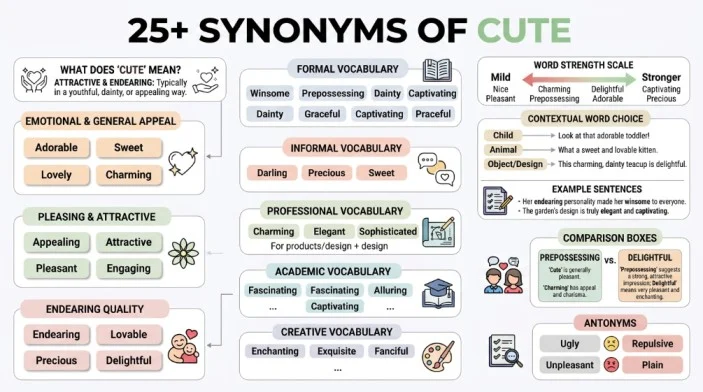
Cute generally means attractive, charming, appealing, or endearing, often with a sense of smallness, youth, sweetness, or playful appeal. The best alternatives include adorable, charming, endearing, lovely, appealing, pretty, attractive, sweet, precious, and delightful, depending on context and tone.
For formal writing, appealing, attractive, delightful, or charming usually work well. In casual conversation, adorable, sweet, lovely, precious, and darling sound natural. Academic writing often benefits from more precise terms such as appealing or attractive. Emotional and creative writing can use expressive choices such as endearing, enchanting, winsome, or captivating.
Meaning, Tone, and Context
Simple Definition
Cute is an adjective used to describe someone or something that is attractive, charming, pleasing, or endearing. It often carries a warm, affectionate, playful, or youthful feeling.
For example, a puppy can be cute because it looks small and lovable. A child may be cute because of an amusing expression, while a piece of clothing can be cute because of its appealing style.
Part of Speech
Cute is primarily an adjective.
Examples:
- “That puppy is cute.”
- “She bought a cute dress.”
- “That was a cute idea.”
Overall Tone
Cute is generally positive. It often expresses approval, affection, fondness, or amusement.
Its exact emotional effect depends on context. Calling a puppy “cute” sounds affectionate, while calling a clever remark “cute” can sometimes sound playful, teasing, or even slightly dismissive.
Formality Level
Cute is neutral to informal in everyday American English.
It is perfectly normal in conversation, social media, advertising, product descriptions, and casual writing. In highly formal or academic writing, a more precise alternative is usually better.
Common Uses
Native English speakers commonly use cute for:
- babies and children
- pets and animals
- clothing
- accessories
- decorations
- small objects
- romantic gestures
- facial expressions
- playful behavior
- attractive designs
- amusing comments
- charming ideas
Word Forms
Cute has a few related forms:
- Cute, adjective
- Cuteness, noun
- Cuter, comparative adjective
- Cutest, superlative adjective
- Cutely, adverb
Examples:
- “The kitten is cute.”
- “The design has a playful cuteness.”
- “This one is cuter.”
- “That is the cutest puppy here.”
When and How to Use “Cute”
Cute works best when you want to communicate simple positive appeal without sounding overly formal. It is especially natural when describing something charming, small, playful, youthful, or visually pleasing.
Professional
“The company created a cute but professional illustration for the campaign.”
In business writing, cute is acceptable when discussing branding, design, or marketing, but appealing, playful, or charming may be more precise.
Academic
“The study examined how cute animal images affect online engagement.”
Here, cute works when it is part of the subject being analyzed. For more analytical writing, appealing or endearing may provide greater precision.
Workplace
“That is a cute idea for the team event.”
This sounds natural in an informal workplace conversation. In a formal presentation, “creative idea” or “appealing concept” may be stronger.
Personal
“Your new puppy is so cute.”
Cute is completely natural for friendly personal communication.
“Thank you for the cute birthday card.”
This is appropriate for a personal or friendly email. For a business email, a phrase such as “thoughtful card” may be more suitable.
Resume
Cute is rarely appropriate for describing professional abilities on a resume. Instead of “cute presentation,” use polished presentation, engaging presentation, or visually appealing presentation.
Social Media
“This little café is so cute.”
Cute is extremely natural for casual captions because it communicates visual appeal and enthusiasm in a simple way.
Best Synonyms of “Cute”
No synonym is identical to cute in every situation. Each alternative emphasizes a slightly different quality.
Professional Writing: Appealing
Appealing works well when describing designs, products, services, ideas, or visual presentations. It sounds more professional than cute without losing the sense of positive attraction.
Academic Writing: Attractive
Attractive is generally more precise when discussing visual appeal or attractiveness in an analytical context.
Business Communication: Appealing
Use appealing for products, marketing concepts, designs, or customer experiences.
Casual Conversation: Adorable
Adorable is stronger and more affectionate than cute. It works especially well for babies, pets, children, and particularly lovable behavior.
Emotional Writing: Endearing
Endearing describes something that creates affection or fondness. It is useful when the emotional response matters more than appearance alone.
Creative Writing: Enchanting
Enchanting creates a more vivid and magical feeling. It works particularly well for scenes, places, characters, and experiences.
Resume Writing: Appealing
Instead of saying a design is cute, professional writing can use visually appealing, engaging, or attractive, depending on the accomplishment being described.
Workplace Communication: Charming
Charming can describe a pleasant personality, idea, gesture, or design without sounding as casual as cute.
Stronger Meaning: Adorable
When cute does not express enough affection, adorable is usually the stronger choice.
Softer Meaning: Pleasant
When you want to express mild approval without strong affection, pleasant may work better, although it is not interchangeable with cute in every context.
When Not to Use “Cute”
When the Meaning Is Too General
Cute can cover many different types of appeal. If you know exactly what makes something attractive, use a more precise word.
Less precise: “She wore a cute outfit.”
More precise: “She wore an elegant outfit.”
The second sentence communicates a specific style rather than general approval.
When You Need Formal Language
Cute may sound too casual in formal reports.
Less suitable: “The company has a cute visual identity.”
Better: “The company has an appealing visual identity.”
When You Need Professional Precision
A resume should focus on measurable or professional qualities.
Less suitable: “Created cute graphics for social media.”
Better: “Created engaging graphics for social media campaigns.”
When the Emotion Is Stronger
Cute may sound too mild when something creates intense affection.
Less suitable: “The rescued puppy was cute.”
Stronger: “The rescued puppy was absolutely adorable.”
When the Meaning Is Romantic or Physically Attractive
Cute can describe romantic attractiveness, but attractive, beautiful, handsome, or gorgeous may communicate physical appeal more directly.
When You Are Being Sarcastic
Cute can sometimes sound sarcastic.
For example:
“Cute excuse.”
This can mean the speaker does not believe the excuse. If you want to avoid ambiguity, choose a more direct expression.
Words Commonly Confused With “Cute”
| Word | Difference | When to Use It | Example |
|---|---|---|---|
| Adorable | Stronger affection than cute | Babies, pets, lovable behavior | “The puppy is adorable.” |
| Charming | Focuses on pleasing personality or appeal | People, places, ideas, behavior | “The village has a charming atmosphere.” |
| Pretty | Usually focuses on attractive appearance | People, clothes, objects | “She chose a pretty dress.” |
| Attractive | More direct and neutral | Appearance, designs, products | “The website has an attractive layout.” |
| Lovely | Warm, positive, and often affectionate | People, experiences, places, objects | “We had a lovely evening.” |
| Beautiful | Stronger emphasis on beauty | People, nature, art, objects | “The painting is beautiful.” |
Best Synonyms of “Cute” by Context
| Context | Best Synonym | Why It Works | Example |
|---|---|---|---|
| Formal writing | Appealing | Professional and broad | “The design is visually appealing.” |
| Academic writing | Attractive | Clear and analytical | “The layout is attractive to younger users.” |
| Professional communication | Appealing | Suitable for business contexts | “The packaging has an appealing design.” |
| Business emails | Charming | Warm without being overly casual | “It was a charming addition to the event.” |
| Resume writing | Engaging | Highlights audience interest | “Created engaging visual content.” |
| Workplace communication | Charming | Natural for informal professional discussion | “That is a charming idea.” |
| Casual conversation | Adorable | Warm and affectionate | “Your kitten is adorable.” |
| Everyday speaking | Lovely | Friendly and natural | “That is a lovely little shop.” |
| Creative writing | Enchanting | Adds imagery and emotion | “They discovered an enchanting garden.” |
| Storytelling | Charming | Builds character and atmosphere | “He lived in a charming old house.” |
| Emotional writing | Endearing | Highlights affection | “Her endearing laugh made everyone smile.” |
| Strong emphasis | Adorable | Stronger positive emotion | “The baby was adorable.” |
| Mild tone | Appealing | Less emotionally intense | “The design is appealing.” |
| Social media captions | Adorable | Expressive and conversational | “Adorable moments from today.” |
| American English | Cute | Extremely common and natural | “That little bookstore is cute.” |
| British English | Lovely | Very natural for general approval | “That is a lovely little café.” |
How to Choose the Best Synonym of “Cute”
Choosing another word is not simply about finding a word with a similar dictionary meaning. Think about the exact quality you want to communicate.
1. Identify the Meaning
Ask what makes the person, object, or idea cute.
Is it:
- visually attractive?
- lovable?
- charming?
- playful?
- stylish?
- emotionally touching?
- small and appealing?
The answer determines the best alternative.
2. Consider Your Audience
A social media audience can handle casual words such as adorable or precious. A business audience may respond better to appealing, engaging, or attractive.
3. Check Emotional Strength
Use lovely for gentle approval, adorable for stronger affection, and enchanting for a more expressive or imaginative effect.
4. Match the Writing Purpose
A resume needs professional vocabulary. A personal message can be warmer. A story may benefit from more descriptive language.
5. Choose Natural Usage
A synonym may be technically related to cute but still sound unnatural in a particular sentence. Always read the complete sentence aloud and consider whether a native speaker would naturally choose that word.
Real Life Examples of “Cute”
School
“The student designed a cute poster for the school fundraiser.”
A more formal version could use appealing if the poster’s visual design is being evaluated.
College
“The professor showed a cute cartoon to introduce the topic.”
Here, cute sounds natural because the context is informal and descriptive.
Workplace
“Our marketing team created a cute social media graphic.”
For a report, engaging social media graphic would sound more professional.
Business
“The store has a cute, welcoming interior.”
A formal business description might say charming and welcoming interior.
“Thanks for the cute note you left on my desk.”
Cute communicates warmth and affection naturally.
Resume
Instead of “designed cute graphics,” write:
“Designed engaging graphics that supported social media campaigns.”
The revised wording focuses on professional value rather than personal opinion.
Conversation
“That little dog is so cute.”
This is one of the most natural everyday uses of cute.
Storytelling
“The cottage looked cute from the road.”
For richer description, charming or picturesque may provide more detail.
Blogging
“The boutique has a cute collection of handmade accessories.”
If the article targets a professional audience, charming or stylish may be more informative.
Social Media
“Found the cutest little coffee shop downtown.”
This casual use sounds natural and expressive.
25 Best Synonyms of “Cute”
The following alternatives are grouped according to their most useful meanings. Some are strongest when cute refers to appearance, while others work better for personality, emotion, or atmosphere.
| Synonym | Simple Meaning | Best Used For | Example Sentence |
|---|---|---|---|
| Adorable | Extremely lovable or appealing | Babies, pets, behavior | “The puppy made an adorable attempt to catch its tail.” |
| Charming | Pleasant and attractive in a warm way | People, places, ideas | “The small town has a charming main street.” |
| Endearing | Creating affection or fondness | Behavior, personality, expressions | “His endearing smile made the children laugh.” |
| Lovable | Easy to love or feel affection for | People, animals, characters | “The character is flawed but completely lovable.” |
| Lovely | Pleasant, beautiful, or delightful | People, places, experiences | “We spent a lovely afternoon by the lake.” |
| Appealing | Attractive or interesting | Products, designs, ideas | “The simple layout is appealing to new users.” |
| Attractive | Pleasing to look at or consider | People, products, designs | “The company created an attractive package design.” |
| Pretty | Attractive in appearance | People, clothing, objects | “She wore a pretty blue scarf.” |
| Sweet | Pleasant, kind, or affectionately appealing | People, gestures, behavior | “That was a sweet thing to say.” |
| Precious | Dear, cherished, or especially lovable | Children, pets, sentimental things | “The child gave her grandmother a precious drawing.” |
| Darling | Dear and lovable | People, children, pets | “Her little nephew is an absolute darling.” |
| Dear | Loved, valued, or cherished | People and sentimental contexts | “The old photograph is very dear to him.” |
| Winsome | Cheerfully attractive and appealing | People, expressions, writing | “Her winsome personality quickly won over the audience.” |
| Fetching | Attractive in a pleasing way | Clothing, appearance | “She looked particularly fetching in the new jacket.” |
| Delightful | Highly pleasant and enjoyable | Experiences, objects, people | “The café offers a delightful selection of pastries.” |
| Enchanting | Beautiful or charming in a captivating way | Places, stories, experiences | “The garden was enchanting after sunset.” |
| Captivating | Holding attention through strong appeal | People, stories, visuals | “The artist created a captivating portrait.” |
| Engaging | Interesting and able to hold attention | Content, people, presentations | “The speaker gave an engaging presentation.” |
| Beautiful | Highly pleasing to look at | People, nature, art | “The sunset was beautiful.” |
| Handsome | Attractive, traditionally used especially for men | People | “He looked handsome in his suit.” |
| Good-looking | Pleasant in physical appearance | People, animals | “Their new puppy is surprisingly good-looking.” |
| Comely | Attractive in appearance, formal or old-fashioned | Literary descriptions | “The novel describes a comely young traveler.” |
| Winning | Charming in a way that gains approval | Personality, manner | “Her winning personality made her easy to trust.” |
| Bewitching | Extremely attractive or fascinating | Literary and creative writing | “The performer had a bewitching stage presence.” |
| Fair | Attractive or beautiful, mainly literary or traditional | Literary descriptions | “The poem describes a fair maiden.” |
Usage note: Words such as comely, bewitching, and fair are less common in everyday American conversation. They can be useful in literary or deliberately stylized writing, but they should not replace cute in ordinary professional communication.
Synonyms of “Cute” by Usage
Professional vs Personal Synonyms
Professional writing usually benefits from precise terms such as appealing, attractive, and engaging.
Personal communication allows warmer choices such as adorable, sweet, precious, and darling.
For example:
Personal: “Your new puppy is adorable.”
Professional: “The campaign uses an appealing visual style.”
Formal vs Conversational Synonyms
For reports and essays, choose attractive, appealing, or engaging when those words accurately describe the intended quality.
For texting and casual conversations, cute, adorable, sweet, and lovely are more natural.
Academic Synonyms
Academic writing should prioritize precision over emotional language.
Useful choices include:
- attractive
- appealing
- engaging
- visually appealing
- aesthetically pleasing
For example:
“Participants responded more positively to the visually appealing interface.”
This gives readers more information than simply calling the interface cute.
Professional and Business Synonyms
For resumes, interviews, meetings, presentations, and client communication, consider:
Appealing: Useful for products, designs, and ideas.
Engaging: Useful for presentations, content, and audiences.
Attractive: Useful for visual presentation and product design.
Charming: Useful for describing atmosphere, personality, or customer experience.
Polished: Better than cute when describing professional presentation quality.
Creative and Literary Synonyms
Creative writing gives you more freedom to select expressive alternatives.
Enchanting can create a magical atmosphere.
Winsome can suggest cheerful charm.
Bewitching can add mystery or fascination.
Endearing works well when a character’s behavior creates affection.
Slang or Modern Synonyms
There is no single slang replacement that works as a universal synonym for cute in American English.
Expressions such as adorbs can appear in casual internet communication, especially social media and texting. It is intentionally playful and should generally be avoided in academic, professional, resume, and formal business writing.
Strongest to Mildest Synonyms
The emotional strength of a synonym depends on context, but a useful general scale is:
Mild: appealing, pretty, attractive
Moderate: lovely, charming, sweet, delightful
Strong: adorable, endearing, enchanting
Very Strong or Expressive: precious, captivating, bewitching
This is not a strict linguistic ranking. For example, beautiful can be much stronger than cute when describing someone’s appearance, while adorable may be stronger when describing a puppy.
Emotional vs Neutral Synonyms
Emotional Synonyms
These words add affection, warmth, or emotional response:
- adorable
- endearing
- lovable
- precious
- darling
- sweet
- enchanting
Use them when the writer wants readers to feel the speaker’s emotional reaction.
Neutral Synonyms
These words communicate positive appeal with less personal emotion:
- attractive
- appealing
- engaging
- pretty
- beautiful
These are generally safer for analytical, professional, or descriptive writing.
Antonyms of “Cute”
Because cute can refer to attractiveness, charm, or endearing qualities, its opposites vary by context. The following words represent genuine contrasts in common uses of cute.
| Antonym | Meaning | Example Sentence |
|---|---|---|
| Ugly | Unpleasant to look at | “The building looked ugly after years of neglect.” |
| Unattractive | Not visually appealing | “The old layout was unattractive to visitors.” |
| Unappealing | Lacking attractive or desirable qualities | “The packaging looked unappealing on the shelf.” |
| Unpleasant | Not enjoyable or pleasing | “The room had an unpleasant atmosphere.” |
| Repulsive | Extremely unpleasant or offensive | “The smell was repulsive.” |
| Hideous | Extremely ugly or unpleasant-looking | “The character wore a hideous costume.” |
| Grotesque | Disturbingly strange or ugly | “The sculpture had a grotesque appearance.” |
| Unsightly | Visually unpleasant | “The damaged wall was unsightly.” |
| Unlovable | Difficult to love or feel affection for | “The villain is intentionally portrayed as unlovable.” |
| Detestable | Strongly disliked | “His cruel behavior made him detestable.” |
| Repellent | Causing strong dislike or avoidance | “The insect’s appearance was repellent to many people.” |
| Disagreeable | Unpleasant or difficult to like | “His disagreeable manner frustrated the team.” |
| Forbidding | Unwelcoming or intimidating | “The building had a forbidding appearance.” |
| Awkward | Lacking grace or ease | “The awkward design made the small room difficult to use.” |
| Unpleasant-looking | Not attractive in appearance | “The unfinished surface was unpleasant-looking.” |
Comparison: “Cute” vs Similar Words
Cute vs Adorable
Main Difference: Cute expresses general appeal, while adorable usually adds stronger affection.
Which Is Stronger? Adorable.
Which Is More Formal? Neither is particularly formal, although cute is slightly broader.
When to Use Each: Use cute for general appeal and adorable when something inspires especially strong affection.
Examples
Cute: “That puppy is cute.”
Adorable: “That puppy is absolutely adorable.”
Cute vs Charming
Main Difference: Cute often emphasizes appearance, smallness, or playfulness. Charming focuses more on personality, atmosphere, or pleasant appeal.
Which Is Stronger? Neither universally. Charming is often richer in descriptive meaning.
Which Is More Formal? Charming.
When to Use Each: Use cute for casual descriptions. Use charming for people, places, personalities, and experiences.
Examples
Cute: “She has a cute hairstyle.”
Charming: “She has a charming personality.”
Cute vs Pretty
Main Difference: Pretty usually describes physical beauty, while cute often adds youthfulness, playfulness, or affection.
Which Is Stronger? Pretty can sound more directly focused on beauty.
Which Is More Formal? Neither is highly formal.
When to Use Each: Use pretty for appearance and cute for playful or youthful appeal.
Examples
Cute: “That is a cute little bag.”
Pretty: “That is a pretty evening dress.”
Cute vs Attractive
Main Difference: Attractive is broader and more neutral. Cute often feels warmer, younger, or more playful.
Which Is Stronger? Attractive can sound more direct regarding physical appeal.
Which Is More Formal? Attractive.
When to Use Each: Use attractive in professional or analytical writing. Use cute in casual speech.
Examples
Cute: “She bought a cute notebook.”
Attractive: “The company created an attractive package design.”
Cute vs Lovely
Main Difference: Lovely expresses general pleasure, beauty, or warmth, while cute often suggests playful or youthful appeal.
Which Is Stronger? It depends on context.
Which Is More Formal? Lovely can sound slightly more polished.
When to Use Each: Use lovely for people, experiences, places, and objects. Use cute for playful or youthful things.
Examples
Cute: “The puppy is cute.”
Lovely: “We had a lovely afternoon.”
Cute vs Beautiful
Main Difference: Beautiful focuses strongly on beauty. Cute usually suggests charm, playfulness, or affectionate appeal.
Which Is Stronger? Beautiful is generally stronger when discussing beauty.
Which Is More Formal? Beautiful can work in more descriptive and formal contexts.
When to Use Each: Use beautiful for nature, art, people, and striking appearances. Use cute for softer, playful appeal.
Examples
Cute: “She found a cute little dress.”
Beautiful: “The dress was beautifully designed.”
Common Phrases and Expressions with “Cute”
Cute as a Button
Meaning: A playful expression meaning extremely cute or charming.
Example Sentence: “That little puppy is cute as a button.”
Cute Little
Meaning: Used to emphasize the small, charming quality of something.
Example Sentence: “We found a cute little bookstore near the park.”
Cute Couple
Meaning: A couple who appear affectionate, charming, or well matched.
Example Sentence: “They are such a cute couple.”
Cute Outfit
Meaning: An outfit that looks attractive, stylish, playful, or charming.
Example Sentence: “You picked a cute outfit for the party.”
Cute Puppy
Meaning: A puppy that looks especially charming or lovable.
Example Sentence: “Everyone stopped to admire the cute puppy.”
Cute Idea
Meaning: An idea that feels charming, thoughtful, playful, or pleasantly creative.
Example Sentence: “That is a cute idea for a birthday surprise.”
Cute Little Thing
Meaning: An affectionate way to describe a small or charming object, animal, or person.
Example Sentence: “Look at this cute little thing I found at the market.”
Cute Story
Meaning: A story that feels sweet, charming, or pleasantly amusing.
Example Sentence: “She told us a cute story about her childhood.”
Common Mistakes to Avoid
1. Using Cute When You Need Precision
Incorrect: “The presentation had cute visuals.”
Better: “The presentation had engaging visuals.”
Why: Engaging explains that the visuals attract and hold the audience’s attention.
2. Confusing Cute With Beautiful
Incorrect: “The Grand Canyon is cute.”
Better: “The Grand Canyon is breathtaking.”
Why: Cute is too weak and playful for something being described for its enormous visual impact.
3. Using Informal Language in a Formal Report
Incorrect: “The company created a cute website.”
Better: “The company created an appealing website.”
Why: Appealing fits professional evaluation better.
4. Choosing an Overly Dramatic Alternative
Incorrect: “The puppy was bewitching.”
Better: “The puppy was adorable.”
Why: Bewitching adds a dramatic or mysterious quality that may not fit an ordinary puppy description.
5. Repeating Cute Too Often
Incorrect: “She bought a cute bag, wore a cute dress, and visited a cute café.”
Better: “She bought an adorable bag, wore a pretty dress, and visited a charming café.”
Why: Varied vocabulary makes the description more precise and less repetitive.
6. Choosing the Wrong Emotional Tone
Incorrect: “The research found that the interface was adorable.”
Better: “The research found that the interface was appealing.”
Why: Appealing communicates positive evaluation without unnecessary emotion.
7. Using Slang in Professional Writing
Incorrect: “The new logo is totally adorbs.”
Better: “The new logo has an appealing visual style.”
Why: “Adorbs” is playful internet language and is unsuitable for most professional documents.
Frequently Asked Questions
What are the best synonyms of “cute”?
The best synonyms of cute include adorable, charming, endearing, lovely, appealing, attractive, sweet, precious, delightful, and pretty. The strongest choice depends on whether you mean appearance, affection, personality, or style.
What are the best formal synonyms of “cute”?
The best formal alternatives include appealing, attractive, engaging, delightful, charming, and visually pleasing. Choose the word that precisely describes the quality you want to communicate rather than replacing cute automatically.
What are common informal synonyms of “cute”?
Common informal alternatives include adorable, sweet, lovely, precious, darling, and pretty. These words work especially well in conversations, texts, personal messages, and social media posts.
What is another word for “cute” in professional writing?
In professional writing, appealing is often the most flexible alternative to cute. Depending on context, attractive, engaging, polished, charming, or visually appealing may communicate the intended quality more accurately.
What is the difference between “cute” and “adorable”?
Cute describes something attractive, charming, playful, or appealing. Adorable usually expresses stronger affection and means that someone or something is especially lovable. For example, a puppy can be cute, while an exceptionally lovable puppy may be adorable.
What is the opposite of “cute”?
Common opposites of cute include ugly, unattractive, unappealing, unsightly, hideous, repulsive, and unpleasant-looking. The best antonym depends on whether cute refers to appearance, emotional appeal, charm, or overall pleasantness.
Conclusion
Cute is a flexible everyday adjective that can describe appearance, personality, behavior, objects, designs, and experiences. However, the best alternative changes with context. Adorable adds affection, charming highlights pleasant appeal, endearing emphasizes emotional warmth, and appealing works especially well in professional writing.
There is no single replacement that works perfectly in every sentence. When choosing among the synonyms of cute, consider your audience, purpose, formality, and intended emotional strength. A useful vocabulary habit is to ask yourself what specifically makes something cute, then choose the word that names that quality most clearly.
Read More Related Articles:
- Synonyms for Everything | Meaning, Examples, and Better …
- Synonyms for Unexpected | Meaning, Examples, and Better …
- 50+ Synonyms of This | Meanings, Uses, Examples, and Best …