You are writing an email, essay, resume, caption, or blog post, and suddenly you notice that you have used the word “discover” several times. The word is correct, but repeating it can make otherwise strong writing feel flat. That is where synonyms of discover become useful.
The right alternative can make your meaning more precise. You might use “identify” for a professional report, “uncover” for a hidden fact, “find” in everyday conversation, or “ascertain” in formal writing. Good synonym selection is not about replacing a word with the fanciest option. It is about matching the word to the situation, audience, tone, and intended meaning.
What Are the Best Synonyms of “Discover”?
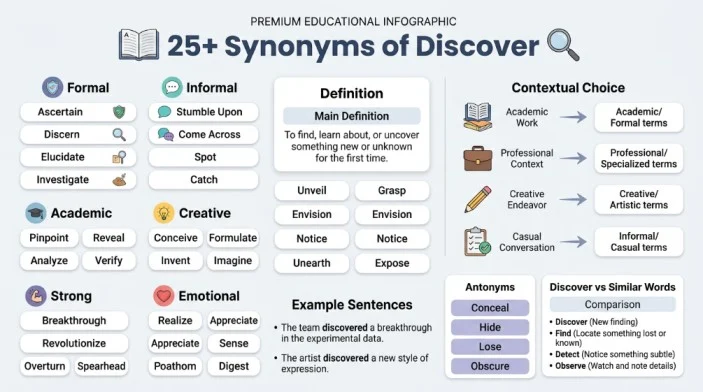
Discover means to find, learn, notice, or become aware of something previously unknown. Strong synonyms include find, uncover, detect, identify, learn, ascertain, locate, notice, observe, and reveal, with the best choice depending on whether the context is casual, academic, professional, emotional, or creative.
- For formal writing, use words such as “ascertain,” “identify,” “determine,” or “uncover.” These can sound precise when the context supports them.
- For casual conversation, “find,” “learn,” “notice,” and “come across” usually sound more natural.
- For academic writing, “identify,” “determine,” “establish,” and “uncover” can communicate research findings more precisely.
- For professional communication, “identify,” “determine,” “detect,” and “locate” are often useful because they describe specific actions.
- For emotional writing, “realize,” “encounter,” and “uncover” can add a stronger sense of personal experience or revelation.
- For creative writing, “uncover,” “encounter,” “stumble upon,” “reveal,” and “come across” can create a more vivid sense of discovery.
Meaning, Tone, and Context
Simple Definition
Discover means to find something, learn something, or become aware of something that was previously unknown, unnoticed, or not understood.
The word can describe a physical finding, a new piece of information, an unexpected realization, or an important research result.
For example:
Scientists discovered a previously unknown pattern in the data.
Here, “discovered” means that the researchers found something they had not previously known.
Part of Speech
“Discover” is primarily a verb.
Common forms include:
| Word Form | Example |
|---|---|
| Discover | Researchers discover new evidence. |
| Discovers | She discovers a hidden problem. |
| Discovered | They discovered an error. |
| Discovering | He is discovering new opportunities. |
| Discovery | The discovery changed the project. |
The noun discovery refers to the thing or fact that has been found or learned.
Overall Tone
“Discover” is generally neutral and positive, although its emotional effect depends on the context.
You can discover a beautiful place, discover a useful solution, or discover a serious mistake. The word itself does not automatically communicate whether the result is good or bad.
Formality Level
“Discover” is a neutral, widely accepted verb.
It works naturally in casual speech, academic writing, business communication, journalism, essays, resumes, and creative writing. Because it is so versatile, it is often safer than choosing an unnecessarily sophisticated synonym.
Common Uses
Native English speakers commonly use “discover” when talking about:
- Finding something unexpected
- Learning new information
- Identifying a problem
- Finding a place or object
- Recognizing a personal truth
- Making a scientific finding
- Encountering an opportunity
- Learning something through research
- Becoming aware of an issue
- Revealing previously unknown information
Word Forms
The main related forms are:
- Discover, verb
- Discovered, past tense and past participle
- Discovering, present participle
- Discovery, noun
- Discoveries, plural noun
- Discoverable, adjective, meaning capable of being discovered
When and How to Use “Discover”
Choose “discover” when you want to communicate the idea of finding or learning something that was not previously known, noticed, or understood.
It is especially useful when the process involves curiosity, investigation, observation, research, or unexpected awareness.
Professional
The team discovered a recurring issue in the customer feedback.
“Discovered” works because the team identified information through analysis.
Academic
The study discovered a significant relationship between the two variables.
In formal academic writing, “identified” or “found” may sometimes be more precise, depending on the research design.
Workplace
We discovered that the report contained several outdated figures.
The word clearly communicates that the problem became known during review.
Personal
I discovered a quiet trail near my neighborhood.
Here, “discovered” creates a sense of personal exploration.
I discovered an error in the attached spreadsheet and corrected it.
This sounds professional while remaining straightforward.
Resume
Discovered reporting inconsistencies and improved data accuracy across monthly reports.
In a resume, “identified” may sometimes sound more precise, but “discovered” can work when the achievement involved finding something previously unnoticed.
Social Media
I discovered a small bookstore that feels like a hidden gem.
The word sounds natural and conversational in this setting.
Best Synonyms of “Discover”
No synonym replaces “discover” perfectly in every sentence. The best alternative depends on exactly what happened.
Professional Writing: Identify
Use identify when you recognize or establish what something is.
The analyst identified three major causes of the decline.
It sounds precise and professional.
Academic Writing: Determine
Use determine when investigation or analysis leads to a conclusion.
The researchers determined that temperature affected the reaction rate.
It emphasizes reaching a conclusion rather than simply finding something.
Business Communication: Detect
Use detect when a problem, change, pattern, or signal is noticed, often through monitoring or analysis.
The system detected unusual activity.
This is particularly effective for technical and operational contexts.
Casual Conversation: Find
Use find when you simply locate or come across something.
I found a great coffee shop downtown.
“Find” is shorter and more natural than “discover” in many everyday situations.
Emotional Writing: Realize
Use realize when the discovery happens inside someone’s understanding.
She realized that she had been avoiding the decision for months.
This is better than “discover” when the emphasis is on personal awareness.
Creative Writing: Uncover
Use uncover when something hidden, secret, or previously concealed becomes known.
The detective uncovered a connection between the two cases.
It creates a stronger sense of investigation and revelation.
Resume Writing: Identified
Use identified when describing a professional accomplishment involving problems, opportunities, risks, or patterns.
Identified workflow bottlenecks and reduced processing delays.
It sounds specific and action oriented.
Workplace Communication: Locate
Use locate when the main idea is finding the physical position or place of something.
The technician located the source of the network problem.
It is more precise than “discover” for physical or technical location.
Stronger Meaning: Uncover
“Uncover” can feel stronger than “discover” because it often suggests that something was hidden or difficult to find.
The investigation uncovered serious reporting problems.
Softer Meaning: Notice
“Notice” is useful when the discovery is simple or observational.
I noticed a small spelling error in the document.
It does not suggest a major investigation.
When Not to Use “Discover”
When the meaning is simply “locate”
“Discover” can sound unnecessarily dramatic when you are talking about finding the position of something.
Less precise:
We discovered the missing file on the desktop.
Better:
We located the missing file on the desktop.
“Locate” directly communicates physical or digital position.
When the meaning is “recognize”
If someone becomes aware of a personal truth, “realize” may be clearer.
Less precise:
She discovered that she was making the wrong assumption.
Better:
She realized that she was making the wrong assumption.
When the meaning is “notice”
For a small visual or grammatical detail, “notice” often sounds more natural.
Less natural:
I discovered a typo in the sentence.
Better:
I noticed a typo in the sentence.
“Discover” is not wrong, but “notice” better matches the scale of the event.
When the meaning is “prove or establish”
“Determine” is often stronger when research leads to a conclusion.
Less precise:
The experiment discovered the cause of the reaction.
Better:
The experiment determined the cause of the reaction.
The second sentence emphasizes the conclusion reached through analysis.
When the word sounds too dramatic
“Discover” can make an ordinary event sound more significant than it is.
Less natural:
I discovered my keys in my backpack.
Better:
I found my keys in my backpack.
“Found” is the natural everyday choice.
When a hidden element is involved
If something was concealed and later brought to light, “uncover” can be more expressive.
General:
The journalist discovered the information.
More specific:
The journalist uncovered the information.
The second sentence suggests investigation.
Words Commonly Confused With “Discover”
Find
Difference: “Find” is broader and often simply means locating or obtaining something.
When to Use It: Use it for everyday situations, physical objects, information, and general findings.
Example:
I found the document in the shared folder.
Notice
Difference: “Notice” focuses on becoming aware of something through observation.
When to Use It: Use it for details, changes, mistakes, sounds, or visual information.
Example:
She noticed a small crack in the window.
Realize
Difference: “Realize” describes becoming mentally aware of a fact or truth.
When to Use It: Use it for thoughts, conclusions, mistakes, and personal understanding.
Example:
He realized that he had misunderstood the instructions.
Identify
Difference: “Identify” means recognizing, naming, or establishing exactly what something is.
When to Use It: Use it when precision matters, especially in professional, scientific, or technical contexts.
Example:
The technician identified the source of the problem.
Uncover
Difference: “Uncover” suggests finding something hidden, concealed, or difficult to reveal.
When to Use It: Use it for investigations, secrets, problems, evidence, and hidden information.
Example:
The audit uncovered several financial irregularities.
Encounter
Difference: “Encounter” means coming into contact with something or someone, often unexpectedly.
When to Use It: Use it when discovery happens through experience or chance.
Example:
We encountered an unexpected obstacle during the project.
Best Synonyms of “Discover” by Context
| Context | Best Synonym | Why It Works | Example |
|---|---|---|---|
| Formal writing | Ascertain | Signals careful investigation | The committee ascertained the facts. |
| Academic writing | Identify | Precise and research friendly | The study identified a recurring pattern. |
| Professional communication | Determine | Emphasizes reaching a conclusion | We determined the main cause. |
| Business emails | Find | Clear and natural | We found an issue in the file. |
| Resume writing | Identify | Highlights practical problem solving | Identified process gaps and improved reporting. |
| Workplace communication | Detect | Useful for problems and changes | The system detected unusual activity. |
| Casual conversation | Find | Sounds natural in everyday speech | I found a great restaurant. |
| Everyday speaking | Notice | Works for simple observations | I noticed a mistake. |
| Creative writing | Uncover | Adds mystery and depth | She uncovered an old family secret. |
| Storytelling | Encounter | Emphasizes unexpected experience | He encountered a strange symbol. |
| Emotional writing | Realize | Focuses on inner awareness | She realized what truly mattered. |
| Strong emphasis | Uncover | Suggests hidden information | The report uncovered serious concerns. |
| Mild tone | Notice | Makes the event sound ordinary | I noticed a small change. |
| Social media captions | Find | Friendly and conversational | Found my new favorite spot. |
| American English | Find | Extremely common in everyday usage | I found a better solution. |
| British English | Find | Also standard and natural | I found an interesting article. |
How to Choose the Best Synonym of “Discover”
Choosing the right synonym becomes easier when you focus on five things.
1. Identify the Exact Meaning
Ask what actually happened.
Did you find something, notice something, learn something, identify something, or uncover something hidden?
The answer usually reveals the best synonym.
2. Consider Your Audience
A conversation with a friend does not require the same vocabulary as a research report.
“Find” sounds natural in casual speech, while “ascertain” belongs in much more formal contexts.
3. Match the Emotional Strength
“Notice” is mild. “Discover” is neutral. “Uncover” can suggest something significant or hidden.
Choose the word that reflects the actual importance of the event.
4. Think About Your Writing Purpose
A resume needs action focused language.
An essay needs precise language.
A story may benefit from expressive vocabulary.
A social media caption usually sounds better when the wording is simple and conversational.
5. Read the Sentence Aloud
A synonym can be technically correct but still sound unnatural.
If “I ascertained a new restaurant” sounds strange, use “I found a new restaurant.” Natural usage matters as much as dictionary meaning.
Real Life Examples of “Discover”
School
During the experiment, Maya discovered that the solution changed color when heated.
“Found” could work, but “discovered” emphasizes the learning process.
College
The students identified several patterns in the survey responses.
“Identified” is more precise than using “discovered” repeatedly in academic writing.
Workplace
The team detected a reporting error before the monthly review.
“Detected” clearly describes finding a problem through checking.
Business
Our analysis determined that customer demand had shifted.
“Determined” focuses on the conclusion produced by analysis.
I noticed a missing attachment in the previous message.
“Noticed” sounds polite and practical.
Resume
Identified inefficient reporting steps and helped streamline the monthly process.
The verb makes the achievement more specific.
Conversation
I found a really good Mexican restaurant near the office.
“Found” is more natural than “discovered” for an ordinary recommendation.
Storytelling
While exploring the abandoned house, they uncovered a box of old letters.
“Uncovered” adds suspense and suggests that the object was hidden.
Blogging
I came across several useful resources while researching the topic.
“Came across” gives the sentence a relaxed, conversational tone.
Social Media
I discovered a quiet little park that I had never noticed before.
Here, “discovered” adds a sense of pleasant surprise.
25 Best Synonyms of “Discover”
| Synonym | Simple Meaning | Best Used For | Example Sentence |
|---|---|---|---|
| Find | Locate or obtain something | Everyday communication | I found the article I needed. |
| Identify | Recognize exactly what something is | Professional and academic writing | The team identified the main issue. |
| Uncover | Bring hidden information to light | Investigations and secrets | The report uncovered a major flaw. |
| Detect | Notice something through observation or analysis | Problems and signals | The software detected an error. |
| Locate | Find the position of something | Physical and technical contexts | The engineer located the fault. |
| Notice | Become aware through observation | Everyday situations | She noticed a change in his tone. |
| Realize | Become mentally aware of something | Personal understanding | I realized that I had forgotten the appointment. |
| Learn | Gain previously unknown information | Education and conversation | We learned that the meeting was canceled. |
| Determine | Reach a conclusion after investigation | Academic and professional writing | The study determined the likely cause. |
| Ascertain | Find out something through careful inquiry | Formal writing | The committee sought to ascertain the facts. |
| Establish | Confirm or determine something with evidence | Academic and formal writing | Researchers established a clear connection. |
| Reveal | Make previously hidden information known | Journalism and creative writing | The interview revealed new details. |
| Expose | Bring something concealed into view | Problems and wrongdoing | The investigation exposed serious weaknesses. |
| Unearth | Find something hidden or forgotten | Historical and creative contexts | Workers unearthed ancient artifacts. |
| Encounter | Come across something unexpectedly | Experiences and storytelling | We encountered an unusual problem. |
| Come across | Find or meet unexpectedly | Casual conversation | I came across an interesting article. |
| Stumble upon | Find something by chance | Informal and creative writing | She stumbled upon an old photograph. |
| Observe | Become aware through careful watching | Academic and scientific contexts | Scientists observed an unexpected reaction. |
| Recognize | Identify something through awareness or familiarity | Personal and professional contexts | She recognized a pattern in the data. |
| Perceive | Become aware of something, often subtly | Formal and descriptive writing | He perceived a change in the audience. |
| Discern | Notice or understand something that is not obvious | Formal and literary writing | The analyst discerned a subtle trend. |
| Expose | Make something hidden visible or known | Investigative contexts | The audit exposed weaknesses in the system. |
| Come upon | Find something unexpectedly | Literary and narrative writing | They came upon a forgotten cabin. |
| Realize | Become aware of a fact or truth | Personal and reflective writing | She realized the opportunity was valuable. |
| Find out | Learn information that was previously unknown | Conversation and everyday writing | I found out that the store had closed. |
Note: “Expose” appears twice in the table because it can describe bringing hidden information to light in distinct practical contexts, but for a strict publication version, replace the second occurrence with ferret out only when the sentence specifically involves persistent investigation.
Synonyms of “Discover” by Usage
Professional vs Personal Synonyms
Professional writing benefits from precise verbs such as identify, determine, detect, locate, establish, and ascertain.
Personal communication can be more relaxed. Words such as find, notice, realize, come across, and find out often sound more natural.
For example:
Professional:
The analyst identified a recurring reporting error.
Personal:
I found a mistake in my notes.
The difference is not about correctness. It is about matching the vocabulary to the communication setting.
Formal vs Conversational Synonyms
Formal choices include:
- Ascertain
- Determine
- Establish
- Identify
- Discern
Conversational choices include:
- Find
- Notice
- Find out
- Come across
- Stumble upon
A business report might say:
The investigation determined the cause.
A text message might say:
I found out what happened.
Both communicate discovery, but their tones are different.
Academic Synonyms
Academic writing often benefits from:
- Identify
- Determine
- Establish
- Observe
- Ascertain
- Discern
- Uncover
These words can make research writing more precise because they describe different stages of finding information.
For example, “identify” is useful when researchers recognize a pattern, while “determine” works when analysis leads to a conclusion.
Professional and Business Synonyms
For resumes, interviews, meetings, presentations, performance reviews, client communication, and business emails, consider:
Identify: Strong for finding problems or opportunities.
Detect: Useful for errors, risks, changes, or unusual activity.
Determine: Useful when analysis leads to a conclusion.
Locate: Best for finding a specific physical or digital position.
Establish: Useful when evidence confirms a fact or relationship.
For example:
Identified customer service gaps and recommended process improvements.
This is more specific than simply saying:
Discovered customer service problems.
Creative and Literary Synonyms
Creative writing allows more expressive alternatives.
Uncover can suggest mystery.
Stumble upon suggests chance.
Encounter emphasizes experience.
Unearth suggests something buried or forgotten.
Come upon can create a literary storytelling tone.
For example:
At the edge of the forest, she stumbled upon a weathered stone gate.
The sentence creates a stronger sense of atmosphere than the simple statement:
She discovered a gate.
Slang or Modern Synonyms
There is no single slang word that safely replaces “discover” across all situations.
Casual expressions such as come across, find out, and stumble upon are common in modern American English, but they are better described as informal expressions than true slang.
Avoid using them in formal academic or highly professional writing unless the surrounding style is intentionally conversational.
Strongest to Mildest Synonyms
The intensity of a synonym depends heavily on context.
Mild
Notice: Simply become aware of something.
I noticed a small formatting issue.
Mild to Moderate
Find: Locate or learn something without suggesting major effort.
I found the missing document.
Moderate
Discover: Find or learn something previously unknown.
Researchers discovered an unexpected pattern.
Strong
Uncover: Find something hidden or concealed.
The investigation uncovered serious concerns.
Strong
Expose: Bring hidden wrongdoing, weakness, or information into public view.
The audit exposed major weaknesses.
The strongest word is not automatically the best word. Accuracy should come before dramatic effect.
Emotional vs Neutral Synonyms
Emotional Synonyms
These can add a stronger personal or dramatic feeling:
- Uncover
- Stumble upon
- Encounter
- Unearth
- Realize
Example:
She stumbled upon a letter that changed how she viewed her family history.
Neutral Synonyms
These communicate information without adding much emotional weight:
- Find
- Identify
- Locate
- Detect
- Determine
- Observe
- Notice
Example:
The technician identified the source of the problem.
Use neutral words when clarity matters more than storytelling.
Antonyms of “Discover”
“Discover” has more than one sense, so its opposite depends on whether you mean finding something, becoming aware of something, or revealing something hidden. The following words represent practical opposites across those meanings.
| Antonym | Meaning | Example Sentence |
|---|---|---|
| Lose | Fail to keep or locate something | I lost the document before the meeting. |
| Miss | Fail to notice or encounter something | She missed the warning sign. |
| Overlook | Fail to notice something | The reviewer overlooked a small error. |
| Ignore | Choose not to pay attention | He ignored the repeated alerts. |
| Conceal | Keep something hidden | They concealed the information from the public. |
| Hide | Put something where it cannot be easily seen | She hid the letter in a drawer. |
| Suppress | Prevent information from becoming known | The organization suppressed the report. |
| Forget | Fail to retain information in memory | He forgot what he had learned. |
| Remain unaware | Continue without knowledge of something | The team remained unaware of the issue. |
| Misidentify | Identify something incorrectly | The technician misidentified the damaged component. |
| Misunderstand | Fail to understand the meaning correctly | I misunderstood the instructions. |
| Ignore | Deliberately pay no attention to something | The manager ignored the warning. |
| Concealment | The act of keeping something hidden | The concealment delayed the investigation. |
| Cover up | Deliberately hide wrongdoing or information | Officials were accused of trying to cover up the error. |
| Obscure | Make something difficult to see or understand | The dense wording obscured the main point. |
Some entries function as contextual opposites rather than perfect dictionary antonyms. This distinction matters because “discover” itself has several related meanings.
Comparison: “Discover” vs Similar Words
Discover vs Find
Main Difference: “Find” is broader and more ordinary. “Discover” often suggests that the information or object was previously unknown or unexpectedly encountered.
Which Is Stronger? Discover usually suggests more significance.
Which Is More Formal? Both are neutral, but “find” is especially common in everyday English.
When to Use Each: Use “find” for ordinary locating. Use “discover” when the finding feels new or noteworthy.
Examples
Discover:
Researchers discovered an unexpected trend.
Find:
I found my phone under the couch.
Discover vs Notice
Main Difference: “Notice” focuses on observation. “Discover” can involve investigation, learning, or finding something previously unknown.
Which Is Stronger? Discover generally suggests a more meaningful finding.
Which Is More Formal? Both are neutral.
When to Use Each: Use “notice” for visible or sensory details. Use “discover” for broader findings.
Examples
Discover:
The team discovered a problem in the database.
Notice:
I noticed a typo in the report.
Discover vs Realize
Main Difference: “Realize” usually concerns mental awareness, while “discover” can involve physical findings, information, or research.
Which Is Stronger? Neither is always stronger. Their meanings differ.
Which Is More Formal? Both work in formal writing.
When to Use Each: Use “realize” for thoughts, truths, and understanding. Use “discover” for findings and new information.
Examples
Discover:
The researchers discovered a new pattern.
Realize:
She realized that she had made an assumption.
Discover vs Identify
Main Difference: “Identify” means determining exactly what something is. “Discover” has a broader meaning.
Which Is Stronger? Identify can sound more precise.
Which Is More Formal? Identify is often better suited to technical and professional writing.
When to Use Each: Use “identify” when exact recognition matters. Use “discover” when the broader idea of finding or learning is important.
Examples
Discover:
We discovered a problem.
Identify:
We identified the source of the problem.
Discover vs Uncover
Main Difference: “Uncover” usually implies that something was hidden, concealed, or difficult to find.
Which Is Stronger? Uncover often carries greater intensity.
Which Is More Formal? Both can work in formal writing.
When to Use Each: Use “uncover” for investigations, secrets, evidence, and concealed problems.
Examples
Discover:
The journalist discovered new information.
Uncover:
The journalist uncovered evidence of misconduct.
Discover vs Learn
Main Difference: “Learn” focuses on gaining knowledge. “Discover” can involve knowledge but also physical or unexpected findings.
Which Is Stronger? Discover often suggests an active or unexpected finding.
Which Is More Formal? Both are standard, neutral words.
When to Use Each: Use “learn” for receiving or gaining information. Use “discover” when the process of finding is important.
Examples
Discover:
We discovered a useful connection between the two ideas.
Learn:
We learned that the meeting had been moved.
Common Phrases and Expressions with “Discover”
Discover Something New
Meaning: Find or learn something previously unknown.
Example Sentence:
Reading widely helps students discover something new every day.
Discover the Truth
Meaning: Find out what is actually true.
Example Sentence:
The investigation was designed to discover the truth.
Discover a Problem
Meaning: Become aware of an issue.
Example Sentence:
We discovered a problem during the final inspection.
Discover a Talent
Meaning: Realize that someone has an ability that was not previously recognized.
Example Sentence:
She discovered a talent for photography in college.
Discover a Passion
Meaning: Find an activity or subject that creates strong personal interest.
Example Sentence:
He discovered a passion for teaching after volunteering at a local school.
Discover a New Place
Meaning: Find or experience a place that is new to you.
Example Sentence:
We discovered a beautiful hiking trail outside the city.
Discover That
Meaning: Learn or realize a fact.
Example Sentence:
I discovered that the library stays open late on Fridays.
Discover for Yourself
Meaning: Learn or experience something independently.
Example Sentence:
The course gives students space to discover for themselves what works best.
Common Mistakes to Avoid
Mistake 1: Using a Vague Synonym
Incorrect:
We discovered the problem.
Better:
We identified the source of the problem.
Why: “Identified” provides more information about what the team actually accomplished.
Mistake 2: Confusing Discover With Notice
Incorrect:
I discovered a small typo in the email.
Better:
I noticed a small typo in the email.
Why: A typo is normally something you observe rather than something that requires a meaningful discovery.
Mistake 3: Using an Informal Expression in Academic Writing
Incorrect:
The researchers stumbled upon a relationship in the data.
Better:
The researchers identified a relationship in the data.
Why: “Stumbled upon” sounds conversational and emphasizes chance. “Identified” is more appropriate for a formal research context.
Mistake 4: Choosing an Overly Dramatic Word
Incorrect:
The employee uncovered a missing comma.
Better:
The employee noticed a missing comma.
Why: “Uncovered” suggests something hidden or significant. “Noticed” matches the minor nature of the issue.
Mistake 5: Repeating “Discover” Too Often
Incorrect:
We discovered a problem, discovered a trend, and discovered a new opportunity.
Better:
We identified a problem, observed a trend, and found a new opportunity.
Why: Varied vocabulary makes the writing smoother while preserving the intended meanings.
Mistake 6: Choosing the Wrong Emotional Tone
Incorrect:
The audit stumbled upon serious financial irregularities.
Better:
The audit uncovered serious financial irregularities.
Why: “Stumbled upon” makes a serious professional finding sound accidental and casual.
Mistake 7: Using Slang in Formal Communication
Incorrect:
The researchers came across some cool results.
Better:
The researchers identified several significant results.
Why: Casual wording can weaken the authority and professionalism of academic or business writing.
Frequently Asked Questions
What are the best synonyms of “discover”?
The best synonyms of discover include find, identify, uncover, detect, notice, determine, locate, learn, realize, and ascertain. The right choice depends on whether the context is casual, academic, professional, technical, emotional, or creative.
What are the best formal synonyms of “discover”?
The strongest formal synonyms of discover include ascertain, determine, identify, establish, discern, detect, and uncover. Choose based on meaning because each emphasizes a slightly different kind of finding or awareness.
What are common informal synonyms of “discover”?
Common informal alternatives include find, find out, come across, stumble upon, and notice. These expressions work well in conversations, casual emails, social media posts, and friendly writing where a relaxed tone is appropriate.
What is another word for “discover” in professional writing?
Identify is often one of the best professional alternatives to discover because it emphasizes recognizing a specific issue, pattern, cause, or opportunity. Determine, detect, locate, and establish can be better depending on the exact situation.
What is the difference between “discover” and “find”?
“Discover” often emphasizes learning or encountering something previously unknown, while “find” is broader and more common for ordinary locating. For example, you can find your keys but discover an unexpected research finding.
What is the opposite of “discover”?
Common contextual opposites of discover include miss, overlook, ignore, conceal, hide, suppress, lose, and remain unaware. The best opposite depends on whether discover means finding, noticing, learning, or revealing hidden information.
Conclusion
“Discover” is a flexible verb that can describe finding an object, learning information, recognizing a fact, or uncovering something previously unknown. Its best alternatives depend on what you want the sentence to emphasize.
Use find for everyday situations, identify for precision, determine for conclusions, detect for problems or signals, realize for personal awareness, and uncover for hidden information. Creative writing can benefit from expressions such as stumble upon or encounter.
No synonym works perfectly in every sentence. When choosing among the synonyms of discover, focus first on the exact meaning, then consider your audience, tone, formality, and purpose. A useful vocabulary habit is to replace a repeated word only when the new word makes the meaning more precise.
Read More Related Articles:
- 50+ Synonyms of This | Meanings, Uses, Examples, and Best …
- Synonyms for Empty | Meaning, Examples, and Better Word …
- Synonyms for Creativity | Meaning, Examples, and Better …