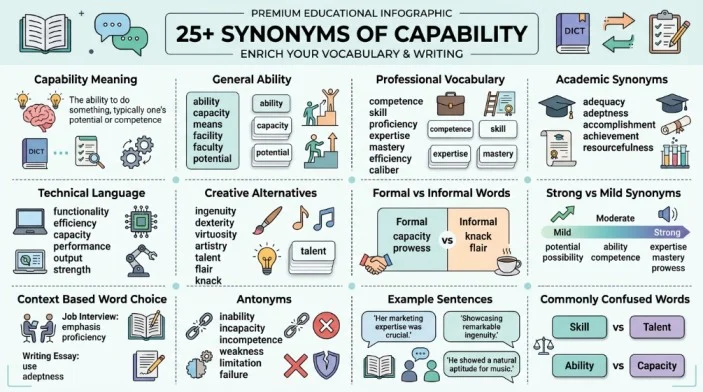
When writing a resume, essay, business email, or professional profile, repeating the word capability can make your language feel predictable. Finding the right synonym of capability helps you describe someone’s ability, skill, capacity, or potential with greater precision.
The best alternative depends on what you actually mean. Ability is natural and general, competence highlights adequate skill, proficiency suggests a developed level of skill, while capacity often describes the power or potential to perform something. Choosing the right word can make your writing clearer, more professional, and better suited to its audience.
What Are the Best Synonyms of “Capability”?
The best synonyms of capability include ability, capacity, competence, proficiency, skill, aptitude, expertise, talent, potential, and power. For formal or academic writing, capacity and competence work well. Professional writing often favors expertise or proficiency, while casual English usually sounds more natural with ability or skill.
Meaning, Tone, and Context
Simple Definition
Capability means the ability, power, or capacity to do something successfully. It can describe a person’s skills, a team’s abilities, an organization’s resources, or what a machine or system is able to do.
For example:
“The new software has the capability to process large amounts of data.”
Here, capability refers to what the software is able to do.
The word can also describe a person’s potential to perform a task:
“She has the capability to become an effective leader.”
In this sentence, the focus is on her ability or potential.
Part of Speech
Capability is a noun.
It commonly appears with phrases such as:
- technical capability
- leadership capability
- communication capability
- physical capability
- professional capability
- operational capability
- analytical capability
- learning capability
Overall Tone
Capability has a generally neutral to positive tone.
It does not automatically express praise. The surrounding context determines whether the word describes an ordinary ability or an impressive level of competence.
Formality Level
Capability is generally neutral to formal.
It is especially common in:
- Business writing
- Technical documentation
- Professional reports
- Academic discussions
- Government and organizational communication
- Resumes and job descriptions
In everyday conversation, ability or skill often sounds more natural.
Common Uses
Native English speakers commonly use capability when discussing:
- A person’s ability to perform a task
- An employee’s professional strengths
- A company’s operational abilities
- A machine’s technical functions
- A team’s capacity to achieve something
- A system’s performance features
- An organization’s resources and skills
- Someone’s potential for future achievement
Word Forms
| Word | Part of Speech | Example |
|---|---|---|
| Capability | Noun | Her capability impressed the hiring manager. |
| Capable | Adjective | She is capable of managing the project. |
| Capably | Adverb | He handled the assignment capably. |
| Capableness | Noun, uncommon | The term is rarely used in modern English. |
The most useful related form for everyday writing is capable.
When and How to Use “Capability”
Use capability when you want to describe someone’s or something’s ability to perform an action, accomplish a goal, or handle a particular responsibility.
The word works especially well when the focus is on what a person, organization, machine, or system can do.
Professional
“The candidate demonstrated strong leadership capability during the interview.”
This works well in professional settings because it emphasizes the person’s ability to perform effectively.
Academic
“The research examines the brain’s capability to adapt to new information.”
Here, capability refers to an ability that can be studied or evaluated.
Workplace
“Our team has the capability to complete the project before the deadline.”
The word emphasizes the team’s overall ability to accomplish the task.
Personal
“He has the capability to handle difficult situations calmly.”
This describes a person’s ability to respond effectively.
“Our current system has the capability to generate automated reports.”
This is suitable for technical or professional email communication.
Resume
“Demonstrated capability in managing cross functional projects and improving workflow efficiency.”
For a resume, more specific words such as expertise, proficiency, or experience may sometimes create a stronger statement.
Social Media
“This new tool gives creators the capability to produce professional videos from their phones.”
The word works naturally when discussing what technology enables people to do.
Best Synonyms of “Capability”
No single synonym perfectly replaces capability in every sentence. The right alternative depends on whether you mean general ability, learned skill, professional expertise, available capacity, natural talent, or potential.
Best for Professional Writing: Competence
Competence emphasizes having enough knowledge and skill to perform a task effectively.
“The position requires demonstrated competence in project management.”
It is particularly useful in evaluations, workplace documents, and professional discussions.
Best for Academic Writing: Capacity
Capacity works well when discussing someone’s ability or potential to understand, develop, perform, or handle something.
“The study explores the student’s capacity for independent learning.”
It has a precise and formal sound.
Best for Business Communication: Capability
Sometimes the original word is already the clearest choice, especially when discussing organizational or technical abilities.
“The company is expanding its digital capabilities.”
However, capacity, expertise, or competence may be better when you want to emphasize a specific aspect of that ability.
Best for Casual Conversation: Ability
Ability is the most natural general alternative in everyday English.
“She has the ability to solve complicated problems quickly.”
It sounds simpler and less corporate than capability.
Best for Emotional Writing: Potential
Potential focuses on what someone may be capable of achieving in the future.
“Everyone could see his potential from an early age.”
Use it when future development matters more than current performance.
Best for Creative Writing: Talent
Talent highlights a natural or noticeable ability.
“Her talent for storytelling captivated the audience.”
It adds a more personal and expressive quality than capability.
Best for Resume Writing: Expertise
Expertise is useful when the capability comes from advanced knowledge, training, or experience.
“Demonstrated expertise in digital marketing and content strategy.”
It is stronger and more specific than simply saying capability.
Best for Workplace Communication: Proficiency
Proficiency emphasizes a developed level of skill.
“The role requires proficiency in Microsoft Excel.”
It is particularly useful for technical and job related skills.
Stronger Meaning: Mastery
Mastery suggests an exceptionally high level of knowledge or skill.
“Her mastery of data analysis made her a valuable member of the team.”
Use it carefully because it expresses much stronger ability than capability.
Softer Meaning: Ability
Ability is broader and less formal than capability.
“He has the ability to work independently.”
It is a safe choice when you simply want to say that someone can do something.
When Not to Use “Capability”
Although capability is useful, it is not always the most natural choice.
When It Sounds Too General
If you know the exact skill involved, a more specific word may communicate more.
Less precise:
“She has strong capability in writing.”
Better:
“She has strong writing skills.”
The second version identifies the specific ability instead of using a broad noun.
When It Sounds Too Corporate
In casual conversation, capability can sound unnecessarily formal.
Less Natural:
“Do you have the capability to fix my laptop?”
More Natural:
“Can you fix my laptop?”
Or:
“Do you have the ability to fix my laptop?”
When You Mean Advanced Skill
If someone has extensive knowledge and experience, capability may undersell their expertise.
Less Precise:
“She has capability in financial analysis.”
Better:
“She has expertise in financial analysis.”
When You Mean Natural Talent
If an ability appears to be naturally strong, talent or aptitude may fit better.
Less Precise:
“He has great capability for music.”
Better:
“He has a natural talent for music.”
When You Mean Skill Level
For language, software, or technical skills, proficiency can be more specific.
Less Precise:
“She has capability in Spanish.”
Better:
“She has proficiency in Spanish.”
When You Mean Future Possibility
When the emphasis is on what someone may achieve later, potential is usually more appropriate.
Less Precise:
“The young athlete has great capability.”
Better:
“The young athlete has tremendous potential.”
Words Commonly Confused With “Capability”
| Word | Difference | When to Use It | Example |
|---|---|---|---|
| Ability | A general power or skill to do something. | Everyday and professional communication. | “She has the ability to lead the team.” |
| Capacity | The amount or level someone or something can handle or achieve. | Formal, technical, and academic contexts. | “The system has the capacity to store millions of records.” |
| Competence | The knowledge and skill needed to perform adequately. | Workplace evaluation and education. | “His competence was clear during the interview.” |
| Skill | A learned ability developed through practice or training. | Jobs, hobbies, education, and everyday speech. | “Communication is an essential skill.” |
| Expertise | Advanced knowledge or skill in a particular area. | Professional and academic writing. | “She has expertise in cybersecurity.” |
| Potential | The possibility of developing or achieving something in the future. | Education, careers, sports, and personal development. | “The student has considerable potential.” |
Best Synonyms of “Capability” by Context
| Context | Best Synonym | Why It Works | Example |
|---|---|---|---|
| Formal writing | Capacity | Sounds precise and formal. | “The organization has the capacity to expand.” |
| Academic writing | Competence | Fits discussions of knowledge and performance. | “The course develops research competence.” |
| Professional communication | Expertise | Highlights advanced professional ability. | “She brings expertise in project management.” |
| Business emails | Ability | Clear and natural. | “The team has the ability to meet the deadline.” |
| Resume writing | Proficiency | Shows a developed skill level. | “Proficiency in data analysis.” |
| Workplace communication | Competence | Useful for evaluating performance. | “The manager recognized his technical competence.” |
| Casual conversation | Ability | Most natural in everyday English. | “She has the ability to stay calm.” |
| Everyday speaking | Skill | Simple and familiar. | “Cooking is one of his best skills.” |
| Creative writing | Talent | Adds personality and natural ability. | “Her talent for music was obvious.” |
| Storytelling | Gift | Suggests an exceptional natural ability. | “He had a gift for storytelling.” |
| Emotional writing | Potential | Focuses on future possibilities. | “She saw his potential before anyone else did.” |
| Strong emphasis | Mastery | Indicates very advanced ability. | “His mastery of the subject was impressive.” |
| Mild tone | Ability | Broad and neutral. | “He has the ability to learn quickly.” |
| Social media captions | Skill | Short, natural, and accessible. | “A useful skill every creator should learn.” |
| American English | Ability | Very common and versatile. | “She has the ability to adapt.” |
| British English | Ability | Also natural and widely understood. | “He has the ability to work independently.” |
How to Choose the Best Synonym of “Capability”
Choosing the right synonym becomes easier when you identify the exact meaning you want to communicate.
If You Mean General Ability
Choose ability.
“She has the ability to solve complex problems.”
This is the safest alternative in most everyday situations.
If You Mean Available Capacity
Choose capacity.
“The factory has the capacity to produce 10,000 units each month.”
Here, the focus is on how much can be handled or produced.
If You Mean Learned Skill
Choose skill.
“Communication is an important skill for managers.”
This is ideal when practice or training has developed the ability.
If You Mean Adequate Professional Performance
Choose competence.
“The employee demonstrated competence in managing customer accounts.”
If You Mean Advanced Knowledge
Choose expertise.
“The consultant offers expertise in financial planning.”
If You Mean Developed Skill Level
Choose proficiency.
“The position requires proficiency in Excel.”
If You Mean Natural Ability
Choose talent, aptitude, or gift.
“She has a natural talent for languages.”
If You Mean Future Ability
Choose potential.
“The young engineer has enormous potential.”
If You Mean Exceptional Skill
Choose mastery.
“His mastery of the subject was evident throughout the presentation.”
The strongest synonym is not always the best synonym. Choose the word that communicates the intended meaning most accurately.
Real Life Examples of “Capability”
School
Basic:
“Students need the capability to work independently.”
More natural:
“Students need the ability to work independently.”
Ability sounds simpler and more natural in general educational writing.
College
“The program develops students’ capacity for critical thinking.”
Here, capacity emphasizes the ability to develop and apply a particular form of thinking.
Workplace
“The manager recognized her competence in handling complex customer complaints.”
This is more specific than simply calling her capability important.
Business
“The company has expanded its technical capabilities to support larger clients.”
In business and technology, the original word works particularly well because it can describe a range of organizational functions.
“Our team has the ability to deliver the revised report by Friday.”
This sounds direct and professional without unnecessary formality.
Resume
Instead of:
“Strong capability in project management.”
Use:
“Demonstrated expertise in project management.”
The second version sounds more specific and credible.
Conversation
Instead of:
“She possesses excellent capability in cooking.”
Say:
“She’s a skilled cook.”
Natural conversation usually favors simpler constructions.
Storytelling
“The young musician showed remarkable talent from the moment she stepped onto the stage.”
Talent gives the sentence more personality and emotional appeal.
Blogging
“Modern AI tools have the capacity to analyze large amounts of information quickly.”
Capacity works well when discussing what technology can handle.
Social Media
“Learning this one skill can completely change the way you create content.”
Skill sounds more approachable and engaging than capability in a social media caption.
25 Best Synonyms of “Capability”
| Synonym | Simple Meaning | Best Used For | Example Sentence |
|---|---|---|---|
| Ability | Power or skill to do something | General communication | “She has the ability to solve difficult problems.” |
| Capacity | Power or potential to handle something | Formal and technical writing | “The system has the capacity to process more data.” |
| Competence | Sufficient knowledge and skill | Workplace and education | “His competence made him a strong candidate.” |
| Skill | Learned ability | Jobs, hobbies, education | “Writing is an essential skill for the role.” |
| Proficiency | A developed level of skill | Resumes and technical fields | “The position requires proficiency in Excel.” |
| Expertise | Advanced knowledge or skill | Professional writing | “She has expertise in digital marketing.” |
| Aptitude | Natural ability to learn or do something | Education and careers | “He has a strong aptitude for mathematics.” |
| Talent | Natural or impressive ability | Creative and personal contexts | “Her talent for singing was obvious.” |
| Facility | Natural ease or skill in doing something | Formal and literary writing | “He showed remarkable facility with languages.” |
| Power | Ability or force to accomplish something | General and technical contexts | “The device has the power to operate continuously.” |
| Potential | Future ability or possibility | Education and careers | “The student has significant potential.” |
| Mastery | Very high level of skill | Academic and professional contexts | “Her mastery of the subject impressed the panel.” |
| Know how | Practical knowledge of how to do something | Business and everyday communication | “He has the know how to repair the equipment.” |
| Faculty | Natural mental or physical ability | Formal and academic writing | “The exercise tested the body’s physical faculties.” |
| Gift | Exceptional natural ability | Personal and creative writing | “She has a gift for explaining difficult ideas.” |
| Dexterity | Skillful control, especially physical | Manual and technical work | “The job requires excellent manual dexterity.” |
| Savvy | Practical knowledge and good judgment | Business and informal communication | “Her marketing savvy helped the company grow.” |
| Command | Strong control or knowledge of a subject | Professional and academic writing | “He has a strong command of the English language.” |
| Resourcefulness | Ability to solve problems creatively | Workplace and personal contexts | “Her resourcefulness helped the team overcome the shortage.” |
| Strength | An area where someone performs well | Resumes and evaluations | “Communication is one of his greatest strengths.” |
| Functionality | What a system or product is able to do | Technology and product writing | “The update adds useful functionality to the app.” |
| Potentiality | Possibility of developing into something | Formal or philosophical writing | “The theory considers the potentiality of future change.” |
| Endowment | A natural ability or quality | Formal and literary writing | “His natural endowment for mathematics was evident early.” |
| Wherewithal | Means or resources needed to accomplish something | Formal writing | “The organization has the wherewithal to expand internationally.” |
| Effectiveness | Ability to produce a desired result | Business and performance writing | “The team’s effectiveness improved after training.” |
Some of these words are context specific rather than interchangeable in every sentence. For example, functionality is especially appropriate for technology, while dexterity focuses on physical skill and potentiality is much more specialized. This distinction is important when selecting an accurate alternative.
Synonyms of “Capability” by Usage
Professional vs Personal Synonyms
Professional writing often requires words that identify a specific type or level of ability.
For workplace documents, competence, expertise, proficiency, capacity, and strength are useful choices.
“The candidate demonstrated strong competence in team leadership.”
Personal communication generally benefits from simpler words such as ability, skill, talent, or gift.
“She has a real talent for making people feel comfortable.”
Formal vs Conversational Synonyms
For reports, essays, and formal business writing, choose capacity, competence, proficiency, or expertise when they accurately describe the intended meaning.
For presentations and emails, ability, skill, and strength often sound more direct.
In casual conversations and texting, ability and skill are usually preferable to more formal words such as competence or capability.
Academic Synonyms
Academic writing benefits from precise distinctions.
Capacity is useful when discussing a person’s or system’s ability to handle, develop, or achieve something.
Competence works when the focus is on demonstrated knowledge and performance.
Proficiency is appropriate when describing a developed level of skill.
Aptitude is useful when discussing someone’s natural ability to learn or perform.
Examples:
“The study measured students’ capacity for independent learning.”
“The assessment evaluated language proficiency.”
“The results indicated a strong mathematical aptitude.”
Professional and Business Synonyms
- For resumes, expertise, proficiency, and strength are often more specific than capability.
- For interviews, ability, competence, and experience can help describe what a candidate can actually do.
- For meetings and presentations, capacity and capability work well when discussing organizational resources.
- For performance reviews, competence, strength, and effectiveness can help describe performance.
- For client communication, expertise is useful when demonstrating specialized knowledge.
- For business emails, ability and capacity usually keep the message clear and professional.
Creative and Literary Synonyms
Creative writing often benefits from words that suggest personality, potential, or exceptional ability.
Talent highlights natural ability.
Gift suggests an unusual or impressive natural strength.
Facility can describe an ease or natural skill with a subject.
Mastery creates a sense of exceptional achievement.
Potential works especially well when describing someone who has not yet reached their full ability.
Slang or Modern Synonyms
There is no single slang word that universally replaces capability.
In informal American English, phrases such as know how, savvy, and skill can sometimes communicate a similar idea.
“She has the tech know how to solve the problem.”
“His business savvy helped the company succeed.”
These expressions should generally be avoided in highly formal academic or professional documents when a more precise term is available.
Strongest to Mildest Synonyms
The strength of a synonym depends heavily on context. The following scale is a practical guide rather than an absolute ranking.
Mild
Ability, skill, facility
These words simply indicate that someone can do something.
Moderate
Capacity, competence, proficiency, aptitude
These suggest a more developed or defined form of ability.
Strong
Expertise, talent, mastery, command
These words indicate advanced knowledge, exceptional skill, or strong control.
Very Strong or Highly Specific
Mastery, gift, exceptional expertise
These expressions suggest unusually high ability and should be used when the evidence supports that level of praise.
A strong word should not be used simply to make writing sound impressive. Precision is more valuable than exaggeration.
Emotional vs Neutral Synonyms
Emotional Synonyms
Words such as talent, gift, potential, and mastery can create stronger emotional or evaluative effects.
“Her gift for storytelling touched everyone in the room.”
This sounds more personal than:
“She has the ability to tell stories.”
Neutral Synonyms
Ability, capacity, competence, skill, and proficiency are generally more neutral.
They work well when you want to communicate information without adding strong praise.
“The candidate demonstrated proficiency in data analysis.”
For resumes, academic papers, reports, and technical documents, neutral words are often the safest choice.
Antonyms of “Capability”
Capability does not have one perfect opposite in every context. The most useful antonyms describe a lack of ability, skill, capacity, or effectiveness.
| Antonym | Meaning | Example Sentence |
|---|---|---|
| Inability | Lack of ability to do something | “His inability to adapt caused delays.” |
| Incompetence | Lack of sufficient skill or knowledge | “The report revealed serious managerial incompetence.” |
| Incapacity | Lack of capacity or ability | “The injury resulted in temporary physical incapacity.” |
| Powerlessness | Lack of power or control | “The community felt powerless during the crisis.” |
| Helplessness | Inability to act or solve a problem | “She experienced a sense of helplessness.” |
| Ineptness | Lack of skill or effectiveness | “His ineptness became obvious during the demonstration.” |
| Unskilledness | Lack of developed skill | “The task was difficult because of his unskilledness.” |
| Inexperience | Lack of practical experience | “Her inexperience showed during the first presentation.” |
| Unfitness | Lack of suitability or ability for a role | “The evaluation showed his unfitness for the position.” |
| Weakness | An area of limited ability | “Public speaking was once his biggest weakness.” |
| Ineffectiveness | Failure to produce the desired result | “The policy’s ineffectiveness became clear over time.” |
| Impotence | Lack of power or effectiveness | “The organization faced political impotence.” |
| Limit | A point beyond which ability cannot continue | “The equipment has a strict operating limit.” |
| Constraint | Something that restricts ability or action | “Budget constraints reduced the team’s options.” |
| Restriction | A rule or condition that limits what can be done | “Technical restrictions prevented the software from running.” |
Comparison: “Capability” vs Similar Words
Capability vs Ability
Main Difference
Ability is the broader and more common word. Capability often sounds more formal and can emphasize what a person, organization, machine, or system is equipped or able to do.
Which Is Stronger?
Neither is inherently stronger. The difference is mainly one of usage and emphasis.
Which Is More Formal?
Capability generally sounds more formal.
When to Use Each
Use ability for everyday communication and general descriptions. Use capability for professional, technical, organizational, or formal contexts.
Examples
Capability:
“The system has the capability to detect unusual activity.”
Ability:
“She has the ability to solve difficult problems.”
Capability vs Capacity
Main Difference
Capability focuses on what something or someone can do. Capacity often emphasizes how much can be handled, produced, contained, or developed.
Which Is Stronger?
Neither is stronger. They highlight different aspects of ability.
Which Is More Formal?
Both are common in formal and technical writing.
When to Use Each
Use capacity when quantity, limits, or potential are central.
Examples
Capability:
“The software has advanced reporting capabilities.”
Capacity:
“The server has enough capacity to support additional users.”
Capability vs Competence
Main Difference
Competence refers to sufficient knowledge and skill for performing a task. Capability can refer more broadly to what someone or something can do.
Which Is Stronger?
Competence can imply demonstrated ability.
Which Is More Formal?
Competence is common in professional and academic writing.
When to Use Each
Use competence when evaluating someone’s performance or qualifications.
Examples
Capability:
“The team has the capability to handle the project.”
Competence:
“The manager demonstrated competence in project planning.”
Capability vs Skill
Main Difference
A skill is usually a learned ability developed through practice. Capability can be broader and may include skills, resources, capacity, or potential.
Which Is Stronger?
Neither is automatically stronger.
Which Is More Formal?
Capability generally sounds more formal.
When to Use Each
Use skill for specific abilities such as writing, coding, cooking, or communication.
Examples
Capability:
“The company has strong technological capabilities.”
Skill:
“Programming is an important skill for this position.”
Capability vs Expertise
Main Difference
Expertise means advanced knowledge or skill. Capability does not necessarily imply an expert level.
Which Is Stronger?
Expertise is stronger when discussing professional knowledge.
Which Is More Formal?
Both are appropriate for professional writing.
When to Use Each
Use expertise when the person has specialized knowledge or advanced skill.
Examples
Capability:
“The team has the capability to manage the project.”
Expertise:
“The team has extensive expertise in project management.”
Capability vs Potential
Main Difference
Capability can describe an existing ability. Potential emphasizes what someone or something may be able to achieve in the future.
Which Is Stronger?
Neither is stronger. They refer to different time frames.
Which Is More Formal?
Both work in formal writing.
When to Use Each
Use potential when future development or achievement is the main idea.
Examples
Capability:
“The engineer has the capability to lead the project.”
Potential:
“The engineer has the potential to become an excellent leader.”
Common Phrases and Expressions with “Capability”
Capability to Do Something
Meaning: The ability or power to perform an action.
Example:
“The device has the capability to monitor air quality.”
Have the Capability
Meaning: To possess the ability to accomplish something.
Example:
“Our team has the capability to complete the work internally.”
Technical Capability
Meaning: The technical ability of a person, organization, or system.
Example:
“The company is investing in its technical capability.”
Operational Capability
Meaning: The ability to carry out operations effectively.
Example:
“The new facility will improve our operational capability.”
Core Capability
Meaning: A central ability that provides value or supports success.
Example:
“Customer service is one of the company’s core capabilities.”
Develop Capability
Meaning: To build or improve an ability.
Example:
“The training program helps employees develop leadership capability.”
Demonstrate Capability
Meaning: To show that someone or something can perform effectively.
Example:
“The candidate demonstrated strong analytical capability.”
Build Capability
Meaning: To develop greater skill or organizational ability.
Example:
“The company is building capability in artificial intelligence.”
Common Mistakes to Avoid
1. Using “Capability” When “Skill” Is More Precise
Incorrect:
“She has excellent capability in graphic design.”
Better:
“She has excellent graphic design skills.”
Why:
Skill directly identifies the learned ability being discussed.
2. Confusing Capability With Capacity
Incorrect:
“The warehouse has the capability of holding 50,000 boxes.”
Better:
“The warehouse has the capacity to hold 50,000 boxes.”
Why:
Capacity is more precise when discussing a measurable amount that can be contained or handled.
3. Using Capability for Advanced Expertise
Incorrect:
“He has capability in cybersecurity.”
Better:
“He has expertise in cybersecurity.”
Why:
Expertise communicates specialized knowledge and advanced skill.
4. Using Formal Language in Casual Conversation
Incorrect:
“Do you possess the capability to cook dinner?”
Better:
“Can you cook dinner?”
Why:
The second sentence sounds natural and conversational.
5. Confusing Capability With Potential
Incorrect:
“The student has the capability to become successful someday.”
Better:
“The student has the potential to become successful someday.”
Why:
Potential specifically emphasizes future possibility.
6. Using an Overly Strong Word
Incorrect:
“She has mastered basic spreadsheet formatting.”
Better:
“She has proficiency in basic spreadsheet formatting.”
Why:
Mastery suggests an exceptionally high level of skill and may exaggerate the actual ability.
7. Using a Vague Synonym
Incorrect:
“His capability is excellent.”
Better:
“His project management skills are excellent.”
Why:
The improved version tells the reader exactly which capability is being evaluated.
Frequently Asked Questions
What is another word for capability?
Ability, capacity, competence, skill, and potential are common alternatives.
What is a synonym for capability?
Common synonyms include ability, capacity, competence, proficiency, and aptitude.
What are the best capability synonyms?
The best choices include ability, capacity, competence, skill, and potential, depending on context.
What is another word for capabilities?
Abilities, skills, capacities, competencies, and strengths can replace capabilities.
What are the synonyms of capability?
Capability synonyms include ability, capacity, competence, proficiency, aptitude, and potential.
What is a synonym for capabilities?
Abilities, skills, competencies, capacities, and strengths are useful synonyms for capabilities.
What are the best synonyms of “capability”?
The best synonyms of capability include ability, capacity, competence, skill, proficiency, expertise, aptitude, talent, potential, and power. The best choice depends on whether you mean general ability, learned skill, professional expertise, or future potential.
What are the best formal synonyms of “capability”?
The strongest formal alternatives include capacity, competence, proficiency, expertise, faculty, mastery, and facility. These choices work particularly well in academic papers, professional reports, technical documents, and formal evaluations.
What are common informal synonyms of “capability”?
Common conversational alternatives include ability, skill, know how, talent, and savvy. Among these, ability and skill are the safest choices for everyday American English because they sound natural and widely understood.
What is another word for “capability” in professional writing?
In professional writing, competence, expertise, proficiency, capacity, and ability are useful alternatives. Choose based on meaning. Expertise suggests advanced knowledge, while proficiency highlights a developed skill level.
What is the difference between “capability” and “ability”?
Capability and ability are closely related, but capability often sounds more formal and can describe the broader functions of people, organizations, or systems. Ability is more common in everyday English and general descriptions.
What is the opposite of “capability”?
The most direct opposite of capability is inability, meaning a lack of ability to perform something. Other context dependent opposites include incompetence, incapacity, powerlessness, ineffectiveness, and helplessness.
Conclusion
Capability refers to the ability, capacity, or power to perform an action or achieve a result. Although it is useful in professional, technical, and formal writing, a more precise alternative can often make your message clearer.
The best synonym depends on your intended meaning. Use ability for general communication, skill for learned abilities, capacity for limits or potential, competence for adequate professional performance, expertise for advanced knowledge, proficiency for developed skill, and talent for natural ability.
There is no single perfect synonym for every sentence. Always consider your audience, tone, purpose, and the exact type of ability you want to describe. A useful vocabulary habit is to identify the specific kind of capability first, then choose the word that expresses that meaning most accurately.
Read More Related Articles:
- 25+ Synonyms, Meanings, Uses, Examples, and Best …
- Meaning, Uses, Examples, and the Best Synonym of Complain
- 25+ Synonyms of Frequency | Meanings, Uses, Examples …