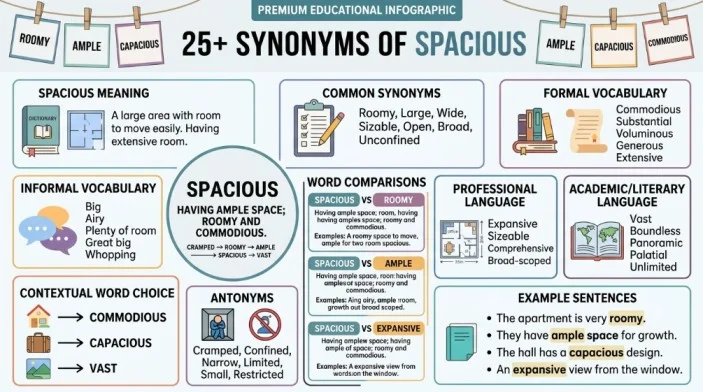
When writing a home description, real estate listing, travel blog, essay, or social media caption, repeating the word spacious can make your writing feel predictable. Finding the right synonym of spacious helps you describe size, openness, comfort, and available room with greater precision.
Words such as roomy, ample, airy, expansive, and capacious can all replace spacious in certain situations, but they do not create exactly the same impression. A real estate listing may benefit from generously sized, while creative writing may sound better with expansive or open. Understanding these differences helps you choose vocabulary that matches your audience, purpose, and tone.
What Are the Best Synonyms of “Spacious”?
Spacious means having plenty of room or a large amount of available space. The best alternatives include roomy for casual English, ample for a polished general tone, capacious for formal descriptions, airy for bright interiors, and expansive for large areas or impressive spaces.
Meaning, Tone, and Context
Simple Definition
Spacious describes a place, area, room, building, vehicle, or sometimes an arrangement that has plenty of available space.
For example, a spacious apartment has enough room for people to move around comfortably without feeling crowded.
The word can describe physical dimensions, but it often communicates more than simple size. Depending on context, spacious can suggest comfort, openness, freedom of movement, and a lack of clutter.
Part of Speech
Spacious is an adjective.
It modifies nouns by describing how much space something provides.
Examples include:
- a spacious bedroom
- a spacious kitchen
- a spacious office
- a spacious house
- a spacious vehicle
- a spacious garden
- a spacious interior
Overall Tone
The word spacious generally has a positive tone.
It often suggests comfort, convenience, freedom, and quality. A spacious home sounds appealing because people usually value having enough room to live, work, relax, and move comfortably.
Formality Level
Spacious is a neutral word.
It works naturally in casual conversations, professional descriptions, academic writing, real estate listings, travel content, advertisements, and everyday speech.
Common Uses
Native English speakers commonly use spacious when describing:
- Homes
- Apartments
- Bedrooms
- Kitchens
- Offices
- Cars
- Hotels
- Restaurants
- Classrooms
- Gardens
- Yards
- Buildings
- Storage areas
- Public spaces
- Interiors
The word is especially common when describing places that feel larger or less crowded than expected.
Word Forms
| Form | Word |
|---|---|
| Adjective | spacious |
| Adverb | spaciously |
| Noun | spaciousness |
| Opposite idea | cramped or confined |
The noun spaciousness refers to the quality of having plenty of room.
Example:
“The spaciousness of the living room makes the apartment feel comfortable.”
When and How to Use “Spacious”
Choose spacious when you want to emphasize that an area provides plenty of room and does not feel cramped.
It is especially useful when describing physical environments. The word can also communicate comfort and openness rather than simply giving a measurement.
Professional
“Our new office provides a spacious environment for collaborative work.”
Academic
“The library offers a spacious study area for students and researchers.”
Workplace
“The spacious conference room can accommodate the entire department.”
Personal
“I love my new apartment because the living room is spacious.”
“The hotel has a spacious meeting room available for Thursday’s presentation.”
Resume
“Managed operations in a spacious warehouse designed for high volume inventory.”
Social Media
“Finally moved into a spacious new home with plenty of room to relax.”
Best Synonyms of “Spacious”
No alternative works perfectly in every sentence. The best choice depends on whether you want to emphasize physical size, comfort, openness, elegance, capacity, or freedom of movement.
Professional Writing: Ample
Ample is an excellent professional alternative when you want to say that there is enough or more than enough room.
Example:
“The facility provides ample space for training sessions.”
It sounds polished without being unnecessarily formal.
Academic Writing: Expansive
Expansive works well when describing a large physical area or a broad environment.
Example:
“The campus features an expansive outdoor learning area.”
It is especially useful when the size or broad extent of the space matters.
Business Communication: Ample
Ample is useful in business communication because it sounds concise and professional.
Example:
“The new facility offers ample workspace for the growing team.”
Casual Conversation: Roomy
Roomy is one of the most natural informal alternatives to spacious.
Example:
“Your new car is surprisingly roomy.”
It sounds relaxed and conversational.
Emotional Writing: Airy
Airy can describe a space that feels light, open, bright, and comfortable.
Example:
“The airy bedroom made the house feel peaceful.”
It adds an emotional quality that simple descriptions of size may not provide.
Creative Writing: Expansive
Expansive can create a stronger visual impression in storytelling.
Example:
“They stepped into an expansive hall filled with warm sunlight.”
The word gives the reader a sense of scale.
Resume Writing: Ample
For a resume, ample can describe workspace or facilities without sounding exaggerated.
Example:
“Maintained inventory in a facility with ample storage capacity.”
Workplace Communication: Roomy
Use roomy in less formal workplace conversations.
Example:
“We moved the meeting to the roomy conference room upstairs.”
For formal reports, ample or spacious may be preferable.
Stronger Meaning: Expansive
Expansive can suggest a space that is not merely comfortable but broad, extensive, or impressive.
Example:
“The property includes an expansive outdoor area.”
Softer Meaning: Roomy
Roomy gives a simple and approachable impression of having enough space.
Example:
“The kitchen is small from the outside but surprisingly roomy inside.”
When Not to Use “Spacious”
Although spacious is useful in many situations, sometimes a more precise word communicates your meaning better.
When “Spacious” Is Too General
If you specifically mean that there is enough room for something, ample may be more precise.
Less Precise:
“The room is spacious for the event.”
Better:
“The room provides ample space for the event.”
When “Spacious” Is Too Vague
If you want to emphasize brightness and openness rather than physical dimensions, use airy.
Less Precise:
“The apartment feels spacious.”
Better:
“The apartment feels airy and bright.”
When You Need a More Formal Word
In highly formal descriptions, capacious or commodious may be more appropriate.
General:
“The facility has spacious storage areas.”
More formal:
“The facility contains capacious storage areas.”
When You Need a Casual Word
In everyday conversation, roomy often sounds more natural.
Formal:
“The vehicle has a spacious interior.”
Casual:
“The car is really roomy inside.”
When You Need a Stronger Description
If the space is unusually large, expansive or vast may communicate the scale more effectively.
General:
“The hotel has a spacious courtyard.”
Stronger:
“The hotel has an expansive courtyard.”
When “Spacious” Does Not Describe the Right Quality
A room can be large but still feel dark or uncomfortable. If your main point is brightness and openness, airy is often better.
Less Precise:
“The room is spacious.”
Better:
“The room is airy, bright, and comfortable.”
Words Commonly Confused With “Spacious”
Roomy
Difference: Roomy means having plenty of room and is one of the closest everyday alternatives to spacious.
When to Use It: Use it in casual speech, home descriptions, and conversations.
Example: “The back seat is surprisingly roomy.”
Ample
Difference: Ample means enough or more than enough. It focuses on sufficiency rather than the overall impression of a large space.
When to Use It: Use it when describing available room, storage, time, resources, or capacity.
Example: “The kitchen has ample counter space.”
Expansive
Difference: Expansive emphasizes broad size, extent, or scale and can sound more impressive than spacious.
When to Use It: Use it for large properties, landscapes, buildings, rooms, and outdoor areas.
Example: “The house opens onto an expansive backyard.”
Airy
Difference: Airy suggests a light, open, fresh feeling. It does not necessarily mean the space is physically very large.
When to Use It: Use it for rooms with natural light, good ventilation, or an open atmosphere.
Example: “The dining room feels airy and inviting.”
Capacious
Difference: Capacious emphasizes the ability of something to hold a large amount.
When to Use It: Use it for rooms, containers, vehicles, bags, and storage areas, especially in formal writing.
Example: “The capacious garage provides room for two vehicles.”
Commodious
Difference: Commodious means comfortably spacious and is more formal and less common than roomy or spacious.
When to Use It: Use it in formal descriptions or polished literary writing.
Example: “The commodious residence offered comfortable accommodation for the guests.”
Best Synonyms of “Spacious” by Context
| Context | Best Synonym | Why It Works | Example |
|---|---|---|---|
| Formal writing | Capacious | Sounds precise and formal | “The building contains capacious storage areas.” |
| Academic writing | Expansive | Describes broad physical scale | “The campus has an expansive research facility.” |
| Professional communication | Ample | Clear and polished | “The office provides ample workspace.” |
| Business emails | Ample | Sounds natural and concise | “There is ample room for additional equipment.” |
| Resume writing | Generously sized | Describes facilities positively | “Managed inventory in a generously sized warehouse.” |
| Workplace communication | Roomy | Natural in everyday office speech | “The new conference room is roomy.” |
| Casual conversation | Roomy | Common and relaxed | “The apartment is pretty roomy.” |
| Everyday speaking | Big | Simple and familiar | “They have a big kitchen.” |
| Creative writing | Expansive | Creates a sense of scale | “An expansive hall stretched before them.” |
| Storytelling | Vast | Creates dramatic scale | “They crossed a vast open field.” |
| Emotional writing | Airy | Adds a feeling of openness | “The airy room felt peaceful.” |
| Strong emphasis | Expansive | Suggests impressive size | “The property has an expansive garden.” |
| Mild tone | Roomy | Suggests comfortable space without exaggeration | “The guest room is roomy.” |
| Social media captions | Roomy | Friendly and conversational | “Our new place is so roomy!” |
| American English | Roomy | Very natural in casual US English | “The SUV is roomy inside.” |
| British English | Spacious | Remains widely understood and natural | “The flat has a spacious living room.” |
How to Choose the Best Synonym of “Spacious”
The best alternative depends on the exact idea you want to communicate.
Choose “Roomy” for Casual English
Use roomy when talking naturally with friends, family, customers, or coworkers.
“That hotel room is really roomy.”
This sounds more conversational than that hotel room is really capacious.
Choose “Ample” for Sufficiency
Use ample when the key point is that there is enough room for a particular purpose.
“The kitchen provides ample storage.”
This is more precise than simply saying the kitchen is spacious.
Choose “Capacious” for Formal Descriptions
Choose capacious when you want a formal word that emphasizes capacity.
“The museum features a capacious exhibition hall.”
Choose “Expansive” for Large Scale
Use expansive when the space is broad, extensive, or visually impressive.
“The property has an expansive lawn.”
Choose “Airy” for Light and Openness
Use airy when the space feels bright, fresh, open, or well ventilated.
“The bedroom has an airy, relaxing atmosphere.”
Choose “Generously Sized” for Real Estate
Generously sized works well in property descriptions because it sounds positive without making an exaggerated claim.
“The home includes a generously sized master bedroom.”
Consider Your Audience
- For students, spacious, ample, and expansive are useful choices.
- For professional writing, ample, capacious, and generously sized can be effective.
- For everyday conversation, roomy and big sound more natural.
Consider the Emotional Effect
- If you want the reader to imagine comfort, choose roomy or airy.
- If you want to create a sense of grandeur, choose expansive or vast.
- If you want to emphasize capacity, choose ample or capacious.
Real Life Examples of “Spacious”
School
Original:
“The classroom is spacious.”
Stronger:
“The classroom is spacious enough to accommodate group activities comfortably.”
College
“The university built an expansive study center with separate areas for individual and group work.”
Workplace
“The new office provides ample workspace for each department.”
Business
“The company moved its operations to a generously sized facility.”
“The conference center has a spacious room available for our afternoon session.”
Resume
“Coordinated warehouse operations in a large facility with ample storage capacity.”
Conversation
“Your new apartment is really roomy.”
Storytelling
“Beyond the narrow entrance was an expansive hall flooded with morning light.”
Blogging
“A spacious kitchen can make everyday cooking more comfortable and organized.”
Social Media
“Finally found a roomy apartment with enough space for my home office.”
25 Best Synonyms of “Spacious”
Some alternatives below are direct synonyms, while others are context based equivalents that work when the sentence focuses on size, capacity, openness, or available room. They should not be treated as interchangeable in every situation.
| Synonym | Simple Meaning | Best Used For | Example Sentence |
|---|---|---|---|
| Roomy | Having plenty of room | Casual descriptions | “The new apartment is surprisingly roomy.” |
| Ample | More than enough space | Professional writing | “The office provides ample workspace.” |
| Capacious | Able to contain a lot | Formal descriptions | “The capacious hall can hold hundreds of guests.” |
| Commodious | Comfortably spacious | Formal or literary writing | “They moved into a commodious home.” |
| Expansive | Very broad or extensive | Properties and large areas | “The hotel has an expansive garden.” |
| Voluminous | Having great volume or capacity | Storage, clothing, containers | “The voluminous storage area holds all the equipment.” |
| Airy | Open, light, and fresh | Interior descriptions | “The airy bedroom feels calm and welcoming.” |
| Open | Unrestricted or unobstructed | Interiors and layouts | “The open living area connects the kitchen and dining room.” |
| Unconfined | Not restricted or enclosed | Formal descriptions | “The design creates an unconfined sense of movement.” |
| Uncongested | Free from crowding | Roads, spaces, facilities | “The terminal has an uncongested waiting area.” |
| Broad | Wide from side to side | Rooms, spaces, surfaces | “The building has broad interior corridors.” |
| Wide | Having considerable side to side distance | Doors, rooms, areas | “The wide entrance makes the room easier to access.” |
| Large | Greater than average in size | General descriptions | “They bought a large house.” |
| Big | Large in size | Casual conversation | “We found a big apartment downtown.” |
| Vast | Extremely large | Landscapes and areas | “The resort overlooks a vast open field.” |
| Extensive | Covering a large area | Properties and facilities | “The property includes extensive outdoor space.” |
| Sizable | Fairly large | General and professional writing | “The company operates from a sizable office.” |
| Generous | Providing plenty of room | Property and design writing | “The kitchen offers generous counter space.” |
| Well proportioned | Designed with comfortable dimensions | Architecture and interiors | “The well proportioned rooms make the house feel balanced.” |
| Sprawling | Spread across a large area | Homes, properties, campuses | “The sprawling estate includes several gardens.” |
| Generously sized | Larger than expected or comfortably large | Real estate and marketing | “The home features a generously sized living room.” |
| Ample in size | Large enough for a purpose | Formal descriptions | “The dining area is ample in size for large gatherings.” |
| With plenty of room | Having sufficient available space | Everyday English | “The garage has plenty of room for two cars.” |
| Open plan | Arranged with few dividing walls | Homes and offices | “The apartment has an open plan kitchen and living area.” |
| Room to spare | Having more than enough space | Conversational English | “There is room to spare in the new office.” |
Synonyms of “Spacious” by Usage
Professional vs Personal Synonyms
Professional writing generally benefits from precise and restrained vocabulary.
Best professional choices:
- Ample
- Capacious
- Expansive
- Generously sized
- Well proportioned
Example:
“The company moved into a generously sized office with ample meeting space.”
For personal communication, simpler words usually sound more natural.
Best personal choices:
- Roomy
- Big
- Airy
- Open
- Comfortable
Example:
“Our new living room is so roomy.”
Formal vs Conversational Synonyms
Formal writing often favors words such as capacious, ample, and expansive.
Conversational English usually favors roomy, big, open, and plenty of room.
| Situation | Better Choice | Example |
|---|---|---|
| Formal report | Capacious | “The facility includes a capacious storage area.” |
| Academic essay | Expansive | “The campus contains an expansive green space.” |
| Business writing | Ample | “The office provides ample workspace.” |
| Presentation | Spacious | “The venue offers a spacious conference room.” |
| Ample | “There is ample room for additional seating.” | |
| Casual conversation | Roomy | “The house is really roomy.” |
| Texting | Big | “The new place is pretty big.” |
Academic Synonyms
Academic writing should favor precision over decorative vocabulary.
Significant Note About “Expansive”
Expansive can work well when discussing physical areas, architecture, landscapes, or spatial design.
Example:
“The university developed an expansive outdoor research area.”
Ample
Use ample when discussing available space for a specific academic purpose.
Example:
“The laboratory provides ample space for student experiments.”
Extensive
Extensive can be useful when describing a facility or area that covers a large range or physical area.
Example:
“The university has extensive grounds for field research.”
Avoid using unusually formal words simply to sound intelligent. The clearest accurate synonym is usually the strongest choice.
Professional and Business Synonyms
Resumes
Use ample, large, or generously sized when the size of a facility is relevant to your responsibilities.
Example:
“Managed inventory across a large distribution facility.”
Interviews
Natural spoken language is usually better than highly formal vocabulary.
Example:
“The company had a spacious workspace that made collaboration easier.”
Meetings
Use spacious, roomy, or ample depending on formality.
Example:
“The venue has ample room for our full team.”
Presentations
Spacious and expansive work well in formal presentations.
Example:
“The new campus includes an expansive conference center.”
Performance Reviews
Use precise language when describing working environments.
Example:
“The team benefited from a spacious workspace that supported collaboration.”
Client Communication
Ample and spacious are safe professional choices.
Example:
“The venue provides ample seating and spacious reception areas.”
Business Emails
Choose natural vocabulary rather than unnecessarily complex terms.
Example:
“The proposed location has a spacious meeting room with enough seating for all attendees.”
Creative and Literary Synonyms
Creative writing gives you more freedom to describe how a space feels.
Expansive
Creates a sense of broad scale.
“The expansive room seemed to stretch toward the distant windows.”
Airy
Creates a feeling of lightness and freshness.
“An airy breeze drifted through the open windows.”
Vast
Suggests an impressive or overwhelming amount of space.
“They stood before a vast field beneath the evening sky.”
Sprawling
Works well for large properties, cities, estates, and landscapes.
“The sprawling estate disappeared into the surrounding hills.”
Open
Can create a feeling of freedom.
“The open courtyard gave her a welcome sense of freedom.”
Slang or Modern Synonyms
There is no single slang word that directly replaces spacious in every context.
However, casual American English commonly uses expressions such as roomy, big, huge, and plenty of room.
Roomy
Meaning: Comfortable because there is enough space.
Acceptable in: Conversations, reviews, social media, casual descriptions.
Avoid in: Highly formal reports where a more precise term is preferable.
Big
Meaning: Large in size.
Acceptable in: Everyday conversation.
Avoid in: Academic writing when greater precision is needed.
A Lot of Room
Meaning: A casual way to say that there is substantial available space.
Acceptable in: Conversations and informal writing.
Avoid in: Formal property reports or academic work.
Strongest to Mildest Synonyms
The intensity of spatial vocabulary depends on the context.
| Level | Suitable Words | Effect |
|---|---|---|
| Mild | Roomy, ample | Suggests comfortable or sufficient space |
| Moderate | Spacious, sizable, broad | Clearly communicates substantial space |
| Strong | Expansive, extensive, sprawling | Emphasizes considerable scale |
| Very Strong | Vast, enormous | Creates a powerful sense of exceptional size |
There is no universal ranking because these words emphasize different qualities.
For example, vast describes extreme physical scale, while capacious emphasizes the ability to contain a large amount.
Emotional vs Neutral Synonyms
Emotional Synonyms
These words can create a stronger impression of how a space feels.
- Airy
- Expansive
- Vast
- Inviting
- Open
- Generously sized
Example:
“The airy room created a peaceful atmosphere.”
Neutral Synonyms
These alternatives communicate space without adding much emotional meaning.
- Spacious
- Roomy
- Ample
- Large
- Sizable
- Capacious
Example:
“The facility has ample storage space.”
Use emotional vocabulary in creative descriptions and lifestyle content. Use neutral vocabulary in reports, instructions, and factual communication.
Antonyms of “Spacious”
The opposite of spacious can describe a place that has limited room, feels crowded, or restricts movement.
| Antonym | Meaning | Example Sentence |
|---|---|---|
| Cramped | Uncomfortably short of space | “The cramped room made movement difficult.” |
| Confined | Restricted to a limited area | “Workers felt confined in the small office.” |
| Crowded | Filled with too many people or things | “The waiting area became crowded.” |
| Congested | Overfilled or blocked | “The station was congested during rush hour.” |
| Narrow | Limited in width | “The narrow hallway connects the two rooms.” |
| Tight | Offering little available room | “The back seat feels tight with three passengers.” |
| Small | Limited in physical size | “They moved out of the small apartment.” |
| Tiny | Extremely small | “The tiny bathroom has very little storage.” |
| Compact | Designed to occupy little space | “The compact kitchen uses every available corner.” |
| Restricted | Limited in space or movement | “Access was restricted because the area was small.” |
| Limited | Not providing much room | “The office has limited storage space.” |
| Claustrophobic | Giving an uncomfortable feeling of confinement | “The basement felt claustrophobic without windows.” |
| Poky | Small and uncomfortable | “The old apartment had a poky kitchen.” |
| Undersized | Smaller than expected or needed | “The undersized meeting room could not accommodate everyone.” |
| Confined | Limited and enclosed | “The confined workspace made collaboration difficult.” |
The word confined appears twice conceptually in spatial vocabulary because it can describe both limited movement and restricted physical space. In polished writing, use it only when that specific meaning is intended.
Comparison: “Spacious” vs Similar Words
Spacious vs Roomy
Main Difference
Both words describe places with plenty of room. Roomy is more conversational, while spacious works comfortably in both casual and formal settings.
Which Is Stronger?
Neither is inherently stronger. They communicate a similar basic idea.
Which Is More Formal?
Spacious is more neutral and formal.
When to Use Each
Use roomy in casual speech and spacious in professional descriptions.
Examples
Spacious:
“The apartment has a spacious living room.”
Roomy:
“The apartment has a really roomy living room.”
Spacious vs Ample
Main Difference
Spacious describes the overall quality of a place. Ample emphasizes that there is enough or more than enough space for a particular need.
Which Is Stronger?
Neither is necessarily stronger.
Which Is More Formal?
Ample often sounds slightly more polished in professional writing.
When to Use Each
Use spacious for the overall environment and ample for available space or capacity.
Examples
Spacious:
“The office is spacious and comfortable.”
Ample:
“The office has ample space for additional desks.”
Spacious vs Expansive
Main Difference
Expansive emphasizes broad scale and can sound more impressive.
Which Is Stronger?
Expansive usually creates a stronger impression of size.
Which Is More Formal?
Both work in formal writing.
When to Use Each
Use expansive for large properties, landscapes, buildings, and impressive interiors.
Examples
Spacious:
“The house has a spacious backyard.”
Expansive:
“The house has an expansive backyard stretching toward the hills.”
Spacious vs Capacious
Main Difference
Capacious emphasizes the ability to contain a large amount, while spacious emphasizes available room.
Which Is Stronger?
Capacious can sound stronger when capacity is the focus.
Which Is More Formal?
Capacious is considerably more formal.
When to Use Each
Use it for storage areas, containers, rooms, vehicles, and other things that hold substantial amounts.
Examples
Spacious:
“The garage is spacious.”
Capacious:
“The capacious garage can accommodate several vehicles.”
Spacious vs Airy
Main Difference
Airy describes a feeling of openness, light, and fresh air. It does not necessarily mean the space is large.
Which Is Stronger?
Neither is stronger because they describe different qualities.
Which Is More Formal?
Both are neutral.
When to Use Each
Use airy when atmosphere and light matter as much as size.
Examples
Spacious:
“The bedroom is spacious.”
Airy:
“The bedroom is airy and filled with natural light.”
Spacious vs Vast
Main Difference
Vast describes an extremely large area. It is much stronger than the everyday word spacious.
Which Is Stronger?
Vast is stronger.
Which Is More Formal?
Both are suitable for formal writing, but vast can sound more dramatic.
When to Use Each
Use vast for landscapes, regions, fields, oceans, and exceptionally large areas.
Examples
Spacious:
“The property has a spacious garden.”
Vast:
“The property overlooks a vast valley.”
Common Phrases and Expressions with “Spacious”
Spacious Living Room
Meaning: A living room with plenty of available space.
Example:
“The apartment features a spacious living room with large windows.”
Spacious Bedroom
Meaning: A bedroom that provides comfortable room for furniture and movement.
Example:
“The spacious bedroom includes a walk in closet.”
Spacious Interior
Meaning: An inside area that feels large and comfortable.
Example:
“The vehicle has a surprisingly spacious interior.”
Spacious Kitchen
Meaning: A kitchen with substantial room for movement, storage, or work.
Example:
“The spacious kitchen has enough counter space for meal preparation.”
Spacious Office
Meaning: An office with plenty of workspace.
Example:
“The team moved into a spacious office downtown.”
Spacious Accommodation
Meaning: Lodging that provides comfortable available space.
Example:
“The hotel offers spacious accommodation near the city center.”
Spacious Backyard
Meaning: A large outdoor area behind a house.
Example:
“The home includes a spacious backyard for outdoor activities.”
Spacious Workspace
Meaning: A work area with enough room for equipment and movement.
Example:
“Employees now have a spacious workspace with better lighting.”
Common Mistakes to Avoid
Choosing “Big” When You Mean Comfortable Space
Incorrect:
“The hotel has a big room.”
Better:
“The hotel has a spacious room.”
Why:
Big only tells readers that something is large. Spacious communicates that there is comfortable usable room.
Using “Ample” as a Direct Replacement Everywhere
Incorrect:
“The apartment is ample.”
Better:
“The apartment is spacious.”
Why:
Ample normally describes the amount of something, such as space, storage, or room, rather than functioning naturally as a direct replacement for spacious in every sentence.
Using “Vast” for Ordinary Rooms
Incorrect:
“My bedroom is vast.”
Better:
“My bedroom is spacious.”
Why:
Vast suggests an unusually large scale and can sound exaggerated for a normal bedroom.
Confusing “Airy” With “Spacious”
Incorrect:
“The tiny room is spacious because it has large windows.”
Better:
“The tiny room is airy because it has large windows.”
Why:
A room can feel airy without being physically large.
Using “Capacious” in Casual Conversation
Incorrect:
“Your new apartment is remarkably capacious.”
Better:
“Your new apartment is really roomy.”
Why:
Capacious is correct but unusually formal for an ordinary conversation.
Repeating “Spacious” Too Often
Incorrect:
“The spacious kitchen connects to the spacious dining room and spacious living room.”
Better:
“The spacious kitchen connects to an airy dining area and a roomy living room.”
Why:
Controlled variation makes descriptive writing smoother without sacrificing accuracy.
Choosing a Dramatic Synonym Without Context
Incorrect:
“The company rented a vast office for six employees.”
Better:
“The company rented a spacious office for six employees.”
Why:
Vast creates an unnecessarily dramatic impression when the goal is simply to describe comfortable working space.
Frequently Asked Questions
What are the best synonyms of “spacious”?
The best synonyms of spacious include roomy, ample, capacious, expansive, airy, and commodious. Choose roomy for casual English, ample for professional writing, and expansive for impressive large areas.
What are the best formal synonyms of “spacious”?
The strongest formal alternatives include capacious, commodious, expansive, and ample. Capacious emphasizes capacity, while commodious suggests comfortable space and expansive emphasizes broad physical scale.
What are common informal synonyms of “spacious”?
The most natural informal alternatives are roomy, big, open, and plenty of room. Among these, roomy is the closest everyday synonym because it directly describes a place with comfortable available space.
What is another word for “spacious” in professional writing?
Ample is often an excellent professional alternative, especially when describing available workspace, storage, seating, or capacity. Capacious, expansive, and generously sized can also work when the context supports them.
What is the difference between “spacious” and “roomy”?
Both describe places with plenty of space, but roomy is more conversational. Spacious is neutral and works well in formal, professional, and everyday writing, while roomy sounds especially natural in casual American English.
What is the opposite of “spacious”?
Common opposites include cramped, confined, crowded, narrow, tight, and small. The best antonym depends on what makes the space feel limited, such as physical size, crowding, restricted movement, or lack of comfort.
Conclusion
Spacious describes a place or area that provides plenty of room and usually creates a positive sense of comfort and freedom. The best alternative depends on the exact quality you want to emphasize.
Use roomy for casual conversation, ample for professional writing, capacious for formal descriptions, airy for light and openness, and expansive when you want to emphasize broad scale. Words such as vast, generously sized, and well proportioned can also work in specific contexts.
No single synonym of spacious works perfectly in every sentence. Before replacing the word, consider the meaning, audience, tone, and purpose of your writing. A useful vocabulary habit is to ask what you really want to emphasize, size, capacity, comfort, openness, or scale, and then choose the word that expresses that idea most clearly.
Read More Related Articles:
- Synonyms for Empty | Meaning, Examples, and Better Word …
- Synonyms for Creativity | Meaning, Examples, and Better …
- 25+ Synonyms of Perseverance | Meanings, Uses, Examples …










1 thought on “25+ Synonyms of Spacious | Find the Right Synonym of Spacious in 2026”