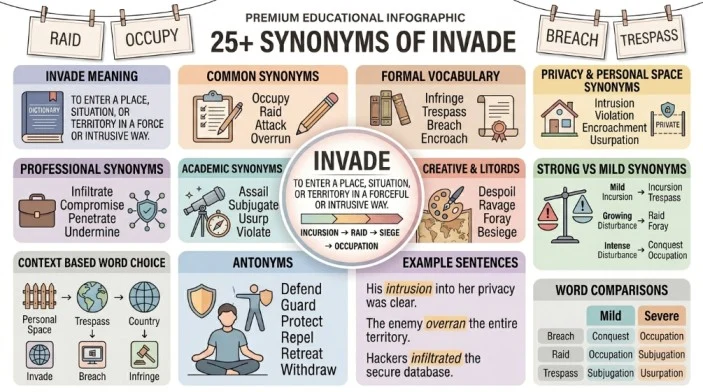
When writing an essay, news report, business article, or story, repeating the word invade can make your sentences feel predictable. Searching for the right synonym of invade can help you describe military attacks, unwanted entry, privacy violations, or the spread of something with much greater precision.
The best alternative depends on what you mean. Infiltrate suggests entering secretly, occupy focuses on controlling a place, encroach describes gradually crossing a boundary, and intrude often refers to entering someone’s personal space without permission. Choosing the right word improves clarity because it tells readers not only that someone entered, but also how, why, and with what effect.
What Are the Best Synonyms of “Invade”?
- A strong synonym of invade depends on the context. For military action, use attack, occupy, overrun, conquer, or storm. For secret entry, infiltrate works well. For unwanted personal entry, choose intrude, trespass, or encroach. For something spreading widely, permeate, engulf, inundate, or overwhelm may be more accurate.
Meaning, Tone, and Context
Simple Definition
Invade generally means to enter a place, area, or person’s space without permission, often in a forceful, unwanted, or aggressive way. The word can describe military action, personal intrusion, physical spread, or the gradual extension of something into an area where it was not previously present.
For example:
“The army invaded the neighboring country.”
Here, invaded describes a hostile military entry.
The word can also be used figuratively:
“Advertising has invaded almost every part of modern life.”
In this sentence, no physical army is involved. The word describes something spreading into many areas in a way that may feel excessive or unwanted.
Part of Speech
Invade is a verb.
It is normally used to describe an action involving entry, movement, spread, or intrusion.
Overall Tone
The tone of invade is usually negative because the word often suggests unwanted entry, aggression, disruption, or violation.
However, the emotional intensity depends on context.
Compare:
“The army invaded the country.”
This is strongly negative and aggressive.
“Tourists invaded the small town during the holiday weekend.”
This can be figurative and may sound humorous, critical, or mildly negative depending on the context.
Formality Level
Invade is a neutral English word that works in formal, semi formal, and informal contexts.
It appears naturally in:
- News reporting
- Academic writing
- Historical discussions
- Political writing
- Business articles
- Everyday conversation
- Fiction
- Social media
- Personal discussions
The important issue is not usually formality, but meaning and intensity.
Common Uses
Native English speakers commonly use invade in several major ways.
Military Entry
“The forces invaded the country during the early hours of the morning.”
Personal Space
“I didn’t mean to invade your privacy.”
Physical Spread
“The vines have invaded the garden.”
Gradual Encroachment
“The construction project is beginning to invade nearby wetlands.”
Figurative Spread
“Screens have invaded almost every part of daily life.”
Large Numbers Entering a Place
“Fans invaded the city after the team won the championship.”
The exact meaning becomes clearer when you consider the object that follows the verb.
Word Forms
| Word Form | Example |
|---|---|
| Verb | invade |
| Noun | invasion |
| Noun | invader |
| Adjective | invasive |
| Adverb | invasively |
The adjective invasive is especially useful when describing something that spreads aggressively or interferes with an existing system.
Example:
“The doctor recommended treatment for an invasive infection.”
When and How to Use “Invade”
Use invade when you want to emphasize unauthorized entry, forceful entry, unwanted presence, or the spread of something into an area.
The word is particularly effective when the action crosses a physical, territorial, social, or figurative boundary.
Professional
“The new construction could invade protected environmental areas.”
Here, invade emphasizes unwanted expansion into a protected space.
Academic
“The species began to invade habitats previously occupied by native plants.”
This works in environmental and biological discussions where one species spreads into another habitat.
Workplace
“Constant notifications can invade employees’ personal time.”
This figurative use describes something interfering with private time.
Personal
“I don’t want to invade your privacy, but I wanted to check whether everything is okay.”
This is a common polite expression using invade figuratively.
“I hope this message does not invade your personal time.”
The expression acknowledges that the message may be arriving outside normal working hours.
Resume
“Developed strategies to prevent invasive competitors from entering established markets.”
A resume generally should not use invade unless the subject genuinely involves aggressive market entry or territorial expansion. Enter, expand into, or penetrate may be more professional depending on the meaning.
Social Media
“The new trend seems to have invaded every corner of social media.”
This figurative use suggests that something has become widespread and difficult to avoid.
Best Synonyms of “Invade”
There is no single replacement that works perfectly in every sentence. Invade covers several related ideas, including military entry, unwanted intrusion, territorial expansion, and widespread penetration.
Professional Writing: Encroach
Encroach works well when something gradually extends beyond an acceptable boundary.
“Urban development continues to encroach on protected land.”
It is more precise than invade when the movement is gradual rather than sudden or violent.
Academic Writing: Infiltrate
Infiltrate is useful when describing something entering a system, group, environment, or structure gradually or secretly.
“The bacteria can infiltrate damaged tissue.”
It emphasizes the process of getting inside rather than openly attacking.
Business Communication: Penetrate
Penetrate is often more appropriate than invade when discussing markets.
“The company plans to penetrate the international market.”
The word sounds analytical rather than aggressive.
Casual Conversation: Intrude
Intrude works naturally when talking about entering someone’s private space or personal affairs.
“I don’t want to intrude, but are you doing okay?”
It is more natural than invade for many everyday interpersonal situations.
Emotional Writing: Overwhelm
Overwhelm works when something becomes so extensive or intense that it feels difficult to manage.
“A wave of memories overwhelmed her.”
It does not mean physical invasion, but it can communicate a similar sense of being overtaken.
Creative Writing: Engulf
Engulf creates a strong visual image of something surrounding or covering another thing.
“Darkness began to engulf the valley.”
It is especially effective for descriptive and literary writing.
Resume Writing: Enter
For resumes, enter is often better than invade when describing a company moving into a new market.
“Led the company’s expansion as it entered three international markets.”
It is neutral, professional, and precise.
Workplace Communication: Intrude
When discussing personal boundaries at work, intrude is usually more natural.
“We should respect employees’ boundaries rather than intrude on their personal time.”
Stronger Meaning: Overrun
Overrun suggests that people, forces, or things spread across an area and gain control or occupy it in large numbers.
“The town was overrun by flooding.”
It can be more vivid than invade.
Softer Meaning: Enter
Enter is much more neutral.
“The company plans to enter a new market.”
Unlike invade, it does not automatically suggest hostility or unwanted action.
When Not to Use “Invade”
When the Entry Is Completely Neutral
If someone simply goes into a place with permission, invade is too strong.
Less Effective:
“The students invaded the classroom.”
Better:
“The students entered the classroom.”
Why:
Enter simply describes movement into a place without suggesting aggression or disruption.
When You Mean Gradual Boundary Expansion
When something slowly moves into an area, encroach is usually more accurate.
Less Effective:
“The road invaded the surrounding farmland.”
Better:
“The road gradually encroached on the surrounding farmland.”
Why:
Encroach clearly communicates gradual movement beyond an accepted boundary.
When You Mean Secret Entry
If the important idea is entering secretly, infiltrate is more precise.
Less Effective:
“The agents invaded the organization.”
Better:
“The agents infiltrated the organization.”
Why:
Infiltrate highlights secrecy and gradual entry.
When You Mean Business Expansion
Using invade for a company’s market expansion can sound unnecessarily aggressive.
Less Effective:
“The company invaded the European market.”
Better:
“The company entered the European market.”
Why:
Enter is standard business language and does not imply hostility.
When You Mean Personal Interference
For personal matters, intrude is often more natural.
Less Effective:
“I don’t want to invade your conversation.”
Better:
“I don’t want to intrude on your conversation.”
Why:
Intrude directly communicates unwanted involvement in another person’s situation.
When You Mean Widespread Presence
If something simply becomes common, invade may add unnecessary negativity.
Less Effective:
“Technology has invaded modern workplaces.”
Better:
“Technology has become widespread in modern workplaces.”
Why:
The second version communicates prevalence without suggesting that technology is unwanted.
When You Need a Neutral Scientific Description
Scientific writing often benefits from precise terms.
Less Effective:
“The cells invaded the surrounding area.”
Better:
“The cells penetrated the surrounding tissue.”
Why:
Penetrated can describe movement into tissue without automatically creating the military or emotional associations of invade.
Words Commonly Confused With “Invade”
| Word | Difference | When to Use It | Example |
|---|---|---|---|
| Attack | Focuses on aggressive action rather than entry into territory. | Violence or military conflict. | “The forces attacked the base before sunrise.” |
| Occupy | Focuses on remaining in and controlling a place. | Military control or physical possession. | “The troops occupied the city for several months.” |
| Infiltrate | Emphasizes secret or gradual entry. | Intelligence, organizations, systems, or biological processes. | “The group attempted to infiltrate the network.” |
| Intrude | Focuses on unwanted involvement or entry into someone’s space. | Privacy and personal boundaries. | “I didn’t mean to intrude on your discussion.” |
| Encroach | Describes gradual movement beyond a boundary. | Land, rights, time, or personal boundaries. | “The development is encroaching on protected land.” |
| Penetrate | Emphasizes movement through or into something. | Markets, materials, tissue, defenses, or physical structures. | “The company is trying to penetrate the Asian market.” |
Best Synonyms of “Invade” by Context
| Context | Best Synonym | Why It Works | Example |
|---|---|---|---|
| Formal writing | Encroach | Precise for boundary crossing | “Development continues to encroach on wetlands.” |
| Academic writing | Infiltrate | Works for systems and biological processes | “The organism can infiltrate damaged tissue.” |
| Professional communication | Enter | Neutral and business friendly | “The company will enter a new market.” |
| Business emails | Penetrate | Useful for market discussions | “The brand hopes to penetrate new markets.” |
| Resume writing | Enter | Clear and professional | “Helped the company enter international markets.” |
| Workplace communication | Intrude | Appropriate for personal boundaries | “We should not intrude on private matters.” |
| Casual conversation | Intrude | Natural for unwanted involvement | “Sorry to intrude.” |
| Everyday speaking | Get into | Informal and simple | “He got into an area he was not supposed to enter.” |
| Creative writing | Engulf | Creates vivid imagery | “Fog engulfed the village.” |
| Storytelling | Overrun | Suggests overwhelming spread | “The streets were overrun with crowds.” |
| Emotional writing | Overwhelm | Communicates intense emotional impact | “Grief overwhelmed him.” |
| Strong emphasis | Overrun | Suggests extensive takeover | “Floodwater overran the lower streets.” |
| Mild tone | Enter | Removes aggressive implications | “Visitors entered the building.” |
| Social media captions | Take over | Conversational and vivid | “Spring flowers have taken over the garden.” |
| American English | Intrude | Common for personal boundaries | “I don’t want to intrude.” |
| British English | Intrude | Also natural for personal boundaries | “I hope I’m not intruding.” |
How to Choose the Best Synonym of “Invade”
Choosing the right word becomes easier when you identify the exact type of entry or spread you are describing.
If Force Is the Main Idea
Choose attack, storm, or overrun.
“The troops stormed the fortress.”
These words make the aggressive action more prominent.
If Control Is the Main Idea
Choose occupy, conquer, or subjugate.
“The army occupied the city.”
The focus is on control after entry.
If Secret Entry Is the Main Idea
Choose infiltrate.
“The spies infiltrated the organization.”
This is more precise than invade because it emphasizes secrecy.
If Personal Boundaries Are Involved
Choose intrude, trespass, or encroach.
“I don’t want to intrude on your privacy.”
If Gradual Expansion Is Involved
Choose encroach.
“The construction gradually encroached on the forest.”
If Physical Movement Into Something Is Important
Choose penetrate.
“The light penetrated the thick fog.”
If Something Spreads Everywhere
Choose permeate, inundate, engulf, or overrun, depending on the exact meaning.
“The smell permeated the entire building.”
If You Need Neutral Business Language
Choose enter, expand into, or penetrate.
“The company plans to expand into the Latin American market.”
If You Want a Strong Literary Image
Choose engulf, overrun, or swarm.
“Dark clouds engulfed the mountain.”
The key is to choose based on meaning first, tone second, and formality third. A synonym should not merely sound impressive. It should communicate exactly what happened.
Real Life Examples of “Invade”
School
Basic:
“The new construction invaded the school grounds.”
More precise:
“The construction project encroached on the school’s outdoor space.”
Why it works:
Encroached makes it clear that the construction extended into an area where it did not belong.
College
Basic:
“The new technology has invaded college classrooms.”
Improved:
“Digital technology has become widespread in college classrooms.”
Why it works:
The improved sentence is more neutral and appropriate for an academic discussion.
Workplace
Basic:
“Work has invaded my personal life.”
Improved:
“Work has begun to intrude on my personal time.”
Why it works:
Intrude naturally describes unwanted interference with personal boundaries.
Business
Basic:
“The company invaded the foreign market.”
Improved:
“The company entered the foreign market.”
Stronger alternative:
“The company aggressively penetrated the foreign market.”
The first improved version is neutral. The second emphasizes an aggressive market strategy.
Basic:
“Sorry to invade your privacy.”
Improved:
“I apologize for intruding on your privacy.”
Why it works:
Intruding sounds natural when discussing an interpersonal boundary.
Resume
Basic:
“Helped the company invade new markets.”
Improved:
“Helped the company enter and expand across new markets.”
Why it works:
Business resumes usually benefit from neutral, achievement focused vocabulary.
Conversation
Basic:
“I don’t want to invade your personal space.”
Natural:
“I don’t want to intrude on your personal space.”
Both can work, but intrude is often the more natural choice for everyday interpersonal situations.
Storytelling
Basic:
“The darkness invaded the town.”
Creative:
“Darkness engulfed the town as the last light disappeared.”
Why it works:
Engulfed creates a stronger visual image and makes the scene more vivid.
Blogging
Basic:
“Social media has invaded our daily lives.”
Alternative:
“Social media has permeated nearly every part of daily life.”
Why it works:
Permeated emphasizes widespread presence rather than physical attack.
Social Media
Basic:
“Holiday decorations have invaded every store.”
Casual:
“Holiday decorations have taken over every store.”
Why it works:
Taken over sounds conversational and fits social media better than the formal or aggressive associations of invade.
25 Best Synonyms of “Invade”
The following list includes words that match different senses of invade, including military entry, unwanted intrusion, territorial expansion, penetration, and widespread spread. They are not interchangeable in every sentence.
| Synonym | Simple Meaning | Best Used For | Example Sentence |
|---|---|---|---|
| Attack | Use force against someone or something | Military conflict | “The forces attacked the enemy position at dawn.” |
| Occupy | Take and hold control of a place | Military control | “The army occupied the city after the battle.” |
| Infiltrate | Enter secretly or gradually | Groups, systems, tissue | “The agents infiltrated the organization.” |
| Intrude | Enter or become involved without welcome | Privacy and personal space | “I apologize if I intruded on your conversation.” |
| Encroach | Gradually move beyond a boundary | Land, rights, time | “The development began to encroach on farmland.” |
| Penetrate | Move into or through something | Markets, materials, defenses | “The company hopes to penetrate the global market.” |
| Overrun | Spread across and overwhelm an area | Crowds, armies, flooding | “The streets were overrun with visitors.” |
| Conquer | Defeat and gain control | Countries, territories | “The empire conquered several neighboring regions.” |
| Storm | Enter a place forcefully | Buildings and military action | “The officers stormed the building.” |
| Subjugate | Bring under control through force | Political or military contexts | “The regime sought to subjugate the population.” |
| Trespass | Enter property without permission | Property and boundaries | “The hikers were warned not to trespass.” |
| Breach | Break through a barrier or boundary | Security, defenses, privacy | “The hackers breached the company’s security.” |
| Violate | Break or disregard a protected boundary or right | Privacy, rights, rules | “The search could violate the suspect’s privacy.” |
| Overwhelm | Become too powerful or extensive to resist | People, systems, places | “The sudden demand overwhelmed the staff.” |
| Engulf | Surround or cover completely | Water, darkness, emotions | “Smoke quickly engulfed the building.” |
| Inundate | Flood or overwhelm with a large amount | Water, requests, information | “The office was inundated with complaints.” |
| Permeate | Spread throughout something | Ideas, smells, influences | “The smell of coffee permeated the room.” |
| Pervade | Be present throughout an area or situation | Atmosphere, attitudes | “A sense of uncertainty pervaded the meeting.” |
| Swarm | Move into an area in a large group | People, insects, crowds | “Fans swarmed the stadium entrance.” |
| Flood | Enter an area in very large amounts | Water, people, information | “Messages flooded the company’s inbox.” |
| Overtake | Move beyond or take control of something | Places, trends, competition | “The new trend quickly overtook the market.” |
| Overwhelm | Surpass the ability to cope or resist | Systems, emotions, groups | “The number of visitors overwhelmed the small town.” |
| Assail | Attack strongly or repeatedly | People, forces, criticism | “The fortress was assailed from several directions.” |
| Impinge | Have an unwanted effect on a boundary or right | Privacy, freedom, interests | “The policy could impinge on individual privacy.” |
| Colonize | Establish control or settlement in another territory | Historical and political contexts | “The empire sought to colonize the region.” |
Important usage note: Some of these words overlap with only one meaning of invade. For example, intrude is suitable for personal boundaries, while occupy is better when continued control of territory is the main idea. This distinction is essential when selecting an accurate synonym.
Synonyms of “Invade” by Usage
Professional vs Personal Synonyms
- Professional writing generally benefits from precise and neutral alternatives.
Professional Choices
Enter is useful for business expansion.
“The company entered the Asian market.”
Penetrate works when discussing market reach or access.
“The brand successfully penetrated several regional markets.”
Encroach is appropriate when discussing gradual boundary expansion.
“The development encroached on protected land.”
Infiltrate works when describing secret or gradual entry into a system.
“The malware infiltrated the network.”
Personal Choices
Intrude is often the best choice for conversations, privacy, and personal space.
“I don’t want to intrude on your private conversation.”
Trespass works for unauthorized physical entry.
“The hikers were accused of trespassing.”
Violate is appropriate when a right, privacy boundary, or protected rule has been seriously breached.
“The action could violate the individual’s privacy.”
Formal vs Conversational Synonyms
Reports
Use encroach, penetrate, infiltrate, or permeate, depending on meaning.
Essays
Use significant, infiltrate, encroach, or penetrate when they accurately describe the subject.
Business Writing
Use enter, expand into, or penetrate.
Presentations
Use occupy, overrun, enter, or encroach based on context.
Emails
Use intrude when discussing personal boundaries.
“I hope I’m not intruding.”
Casual Conversations
Use intrude, get into, take over, or enter depending on the situation.
Texting
Informal phrases such as get into or take over may sound more natural.
“Sorry to get into your business.”
The best choice depends on whether the conversation is serious, casual, humorous, or professional.
Academic Synonyms
Academic writing requires precision. Rather than automatically replacing invade with a more complicated word, select the term that describes the exact process.
Infiltrate
Useful for biological, technological, and social systems.
“The microorganism can infiltrate damaged tissue.”
Penetrate
Useful when something moves into or through a material, structure, or market.
“The substance can penetrate the outer layer.”
Encroach
Useful when one activity gradually extends into another area.
“Urban development continues to encroach on agricultural land.”
Permeate
Useful when something spreads throughout an environment.
“The ideology began to permeate the political system.”
Pervade
Useful when a quality, attitude, or influence exists throughout something.
“Fear pervaded the community after the announcement.”
These choices can make academic writing more precise without unnecessarily making it complicated.
Professional and Business Synonyms
Resumes
Use entered, expanded into, penetrated, or launched operations in.
“Led expansion into three international markets.”
This is generally stronger than saying:
“Helped the company invade three markets.”
Interviews
Use enter or expand into when discussing business strategy.
“We entered the market after identifying a strong customer need.”
Meetings
Use encroach when discussing resources, schedules, or boundaries.
“The new project could encroach on existing resources.”
Presentations
Use penetrate when discussing market share.
“The company has successfully penetrated the regional market.”
Performance Reviews
Use precise language based on the actual achievement.
“Expanded the company’s presence in three new markets.”
This is usually more informative than using invade.
Client Communication
Choose neutral language.
“The company plans to enter the market next year.”
Business Emails
Avoid dramatic military language unless the subject specifically involves military action.
“Our team is preparing to enter a new market.”
Creative and Literary Synonyms
Creative writing allows stronger imagery.
Engulf
Use when something surrounds or covers another thing.
“Fog engulfed the village.”
Overrun
Use when people, animals, or forces spread uncontrollably through a place.
“Wildflowers overran the abandoned garden.”
Swarm
Use for large groups moving rapidly into an area.
“Children swarmed around the performer.”
Permeate
Use when an atmosphere, smell, or influence spreads throughout a setting.
“The scent of rain permeated the old house.”
Pervade
Use for moods, emotions, or qualities that seem present everywhere.
“An uneasy silence pervaded the room.”
These words help writers communicate more than simple entry. They also create atmosphere, movement, and emotional texture.
Slang or Modern Synonyms
There is no single slang word that perfectly replaces invade in every context.
However, casual expressions can sometimes communicate the same idea.
Take Over
Meaning: Become dominant or occupy most of a space.
Acceptable in:
- Casual conversation
- Social media
- Informal writing
- Humorous comments
Avoid in:
- Academic papers
- Formal reports
- Serious historical writing
“Spring flowers have taken over the backyard.”
Get Into Someone’s Business
Meaning: Become involved in another person’s private affairs.
Acceptable in:
- Casual conversation
- Texting
- Social media
Avoid in:
- Professional communication
- Academic writing
“I don’t want to get into your business.”
This is not a direct dictionary synonym of invade, but it can express a similar idea when the topic is unwanted personal involvement.
Strongest to Mildest Synonyms
Because invade has several meanings, intensity should be judged by context rather than treated as a universal ranking.
| Intensity | Useful Alternatives | General Effect |
|---|---|---|
| Mild | Enter, approach, intrude | Describes entry with limited aggression |
| Moderate | Trespass, encroach, penetrate | Suggests crossing a boundary |
| Strong | Attack, infiltrate, occupy, overrun | Adds force, control, or aggression |
| Very Strong | Conquer, subjugate, overwhelm | Suggests domination or powerful control |
A word can become stronger because of its consequences, not simply because it is more dramatic.
For example, enter is neutral, while conquer implies defeating another power and gaining control. They should never be treated as interchangeable.
Emotional vs Neutral Synonyms
Emotional Synonyms
These words can create stronger emotional or dramatic effects:
- Attack
- Overrun
- Conquer
- Subjugate
- Engulf
- Overwhelm
- Storm
- Assail
Example:
“The enemy forces overran the village.”
The word overran creates a stronger image of force and loss of control.
Neutral Synonyms
These alternatives can communicate entry or spread with less emotional weight:
- Enter
- Penetrate
- Infiltrate
- Encroach
- Permeate
- Occupy
Example:
“The company entered the international market.”
The sentence provides information without suggesting that the company behaved aggressively.
Antonyms of “Invade”
Because invade has several meanings, its opposites also depend on context. The following words and expressions represent genuine oppositional ideas such as leaving territory, respecting boundaries, preventing entry, or withdrawing from control.
| Antonym | Meaning | Example Sentence |
|---|---|---|
| Withdraw | Move away from an area or conflict | “The troops withdrew from the region.” |
| Retreat | Move back from a place or enemy | “The soldiers retreated before nightfall.” |
| Depart | Leave a place | “The visitors departed before the storm.” |
| Evacuate | Leave an area for safety | “Residents evacuated the town before the flood.” |
| Vacate | Leave or give up possession of a place | “The tenants were asked to vacate the building.” |
| Exit | Go out of a place | “Everyone exited the building calmly.” |
| Respect | Honor another person’s boundaries or rights | “We should respect everyone’s privacy.” |
| Protect | Keep someone or something safe from harm or intrusion | “Security measures protect the property.” |
| Defend | Resist an attack or protect territory | “The soldiers defended the border.” |
| Repel | Force an attacking person or group to move away | “The defenders repelled the attack.” |
| Resist | Oppose an attempt to enter or control | “The community resisted the occupation.” |
| Exclude | Keep someone or something outside | “The barrier excludes unauthorized visitors.” |
| Contain | Prevent something from spreading beyond a limit | “The team contained the outbreak quickly.” |
| Preserve | Keep something protected from damaging change | “The project aims to preserve the natural habitat.” |
| Avoid | Stay away from something or someone | “The hikers avoided the restricted area.” |
These words do not all function as direct grammatical replacements for invade. Their oppositional relationship depends on whether invade means entering territory, violating privacy, spreading into an area, or gaining control.
Comparison: “Invade” vs Similar Words
Invade vs Attack
Main Difference
Invade emphasizes entering a territory or area, while attack emphasizes using force against a target.
Which Is Stronger?
Neither is automatically stronger. Attack focuses on violence, while invade focuses on entry.
Which Is More Formal?
Both are neutral and appropriate in historical, military, and news writing.
When to Use Each
Use invade when territory is entered.
Use attack when the main event is violent action.
Examples
Invade:
“The army invaded the neighboring country.”
Attack:
“The army attacked the military base.”
Invade vs Occupy
Main Difference
Invade describes entering a territory by force. Occupy describes remaining in and controlling that territory.
Which Is Stronger?
Invade emphasizes aggression. Occupy emphasizes continued control.
Which Is More Formal?
Both are common in formal writing.
When to Use Each
Use occupy when control or presence after entry is the main idea.
Examples
Invade:
“The forces invaded the country.”
Occupy:
“The forces occupied the capital.”
Invade vs Infiltrate
Main Difference
Infiltrate suggests secret, gradual, or concealed entry. Invade usually suggests open, forceful entry.
Which Is Stronger?
Invade generally sounds more aggressive.
Which Is More Formal?
Both are suitable for academic and professional contexts.
When to Use Each
Use infiltrate for spies, organizations, computer systems, biological systems, or substances.
Examples
Invade:
“The army invaded the territory.”
Infiltrate:
“The agents infiltrated the organization.”
Invade vs Intrude
Main Difference
Intrude is primarily about unwanted involvement or entry into personal space, privacy, or a situation.
Which Is Stronger?
Invade can sound stronger and more aggressive.
Which Is More Formal?
Both work in formal and informal contexts.
When to Use Each
Use intrude for personal boundaries and social situations.
Examples
Invade:
“I don’t want to invade your privacy.”
Intrude:
“I don’t want to intrude on your private conversation.”
Invade vs Encroach
Main Difference
Encroach describes gradual movement beyond an acceptable boundary.
Which Is Stronger?
Invade often sounds more forceful. Encroach emphasizes gradual expansion.
Which Is More Formal?
Encroach is particularly useful in formal discussions of land, rights, time, and boundaries.
When to Use Each
Use encroach when something slowly takes space or interferes with another area.
Examples
Invade:
“The development invaded the protected area.”
Encroach:
“The development gradually encroached on protected land.”
Invade vs Penetrate
Main Difference
Penetrate focuses on movement into or through something. It does not necessarily imply hostility.
Which Is Stronger?
Invade generally has stronger negative associations.
Which Is More Formal?
Penetrate is common in technical, scientific, and business writing.
When to Use Each
Use penetrate for materials, markets, defenses, tissue, or physical barriers.
Examples
Invade:
“The forces invaded the territory.”
Penetrate:
“The substance penetrated the outer layer.”
Common Phrases and Expressions with “Invade”
Invade a Country
Meaning
Enter another country by force, usually as part of military action.
Example
“The army planned to invade the neighboring country.”
Invade Someone’s Privacy
Meaning
Interfere with someone’s personal affairs or private information.
Example
“I don’t want to invade your privacy.”
Invade Someone’s Personal Space
Meaning
Move physically too close to someone or interfere with their personal boundaries.
Example
“He stepped back because he did not want to invade her personal space.”
Invade the Market
Meaning
Enter a market aggressively or in a way that creates strong competition.
Example
“Several new brands are trying to invade the local market.”
For professional writing, enter the market or expand into the market is usually more neutral.
Invade the Mind
Meaning
Become a persistent or unwanted thought or influence.
Example
“Doubt began to invade his mind before the competition.”
This expression is especially common in creative writing.
Invade Someone’s Thoughts
Meaning
Become strongly present in someone’s thinking.
Example
“Memories of the past continued to invade her thoughts.”
Invade a Space
Meaning
Enter or spread into an area where the presence may be unwanted.
Example
“The smoke began to invade the living room.”
Common Mistakes to Avoid
Mistake 1: Using “Invade” for Any Type of Entry
Incorrect
“The guests invaded the restaurant at 7 p.m.”
Better
“The guests entered the restaurant at 7 p.m.”
Why
Invade suggests unwanted, forceful, or excessive entry. If the guests simply entered normally, enter is more accurate.
Mistake 2: Confusing “Invade” With “Attack”
Incorrect
“The army attacked the neighboring country for three years.”
Better
“The army invaded the neighboring country and occupied several cities.”
Why
An attack can happen without an invasion. Invade specifically emphasizes entry into territory.
Mistake 3: Using “Invade” When “Intrude” Is Better
Incorrect
“I don’t want to invade your conversation.”
Better
“I don’t want to intrude on your conversation.”
Why
Intrude is the natural choice for unwanted involvement in another person’s conversation or personal situation.
Mistake 4: Using “Invade” for Neutral Business Expansion
Incorrect
“Our company plans to invade the European market.”
Better
“Our company plans to enter the European market.”
Why
Enter is standard business language. Invade can make a company’s expansion sound hostile.
Mistake 5: Choosing a Synonym That Changes the Meaning
Incorrect
“The researchers occupied the cells.”
Better
“The researchers infiltrated the cells.”
Why
Occupy suggests taking control or possession. Infiltrate describes entering gradually or secretly. The intended meaning determines the correct word.
Mistake 6: Overusing Dramatic Alternatives
Incorrect
“Advertising has conquered every part of the internet.”
Better
“Advertising has spread throughout much of the internet.”
Why
Conquered implies domination and can sound exaggerated. A neutral phrase is better when the evidence only shows widespread presence.
Mistake 7: Using Slang in Formal Writing
Incorrect
“The new trend took over the academic field.”
Better
“The new trend became widespread in the academic field.”
Why
Take over is conversational. More neutral wording is usually better for academic writing.
Frequently Asked Questions
1. What are the best synonyms of “invade”?
The best synonyms of invade depend on context. Use attack or occupy for military action, infiltrate for secret entry, intrude for privacy, encroach for gradual boundary crossing, and penetrate for movement into something.
2. What are the best formal synonyms of “invade”?
Formal alternatives include infiltrate, encroach, penetrate, occupy, overrun, and subjugate. The best choice depends on the intended meaning. For neutral professional writing, enter or expand into is often more appropriate than invade.
3. What are common informal synonyms of “invade”?
In casual English, intrude, get into, and take over can express related ideas, depending on context. For example, “I don’t want to intrude” is natural when discussing someone’s privacy or personal space.
4. What is another word for “invade” in professional writing?
Enter is often the best professional alternative when discussing markets or business expansion. Penetrate can work for market strategy, while encroach is more precise for gradual boundary expansion.
5. What is the difference between “invade” and “infiltrate”?
Invade usually suggests open, forceful entry, especially into territory. Infiltrate suggests entering secretly, gradually, or discreetly. For example, an army may invade a country, while agents infiltrate an organization.
6. What is the opposite of “invade”?
Depending on context, opposites include withdraw, retreat, depart, evacuate, vacate, defend, repel, resist, protect, and respect. The most suitable opposite depends on whether invade refers to territory, privacy, or unwanted spread.
Conclusion
Invade describes forceful, unwanted, unauthorized, or extensive entry into a place, system, territory, or personal space. Because the word carries several meanings, the best synonym of invade depends heavily on context.
Use occupy when control is the focus, infiltrate when entry is secret or gradual, intrude for personal boundaries, encroach for gradual boundary crossing, penetrate for movement into something, and enter when you need a neutral expression. Stronger words such as overrun, conquer, and subjugate should be reserved for situations that genuinely involve extensive control or aggression.
The most effective vocabulary choice is not always the strongest word. Before replacing invade, consider your audience, intended meaning, emotional tone, and level of formality. A useful vocabulary habit is to identify the exact action first, then choose the word that describes that action most precisely.
Read More Related Articles:
- Synonyms for Empty | Meaning, Examples, and Better Word …
- Synonyms for Creativity | Meaning, Examples, and Better …
- 25+ Synonyms of Perseverance | Meanings, Uses, Examples …