Writers often use the word contradiction when an email, essay, report, or conversation contains two ideas that do not agree. However, repeating the same word can make your writing feel predictable. Finding the right synonym of contradiction can make your message more precise by showing whether you mean disagreement, inconsistency, conflict, denial, or a direct clash between statements.
The best alternative depends on what you are trying to describe. A formal report may need inconsistency, an academic discussion may call for discrepancy, while everyday conversation may sound more natural with disagreement. Understanding these differences helps you communicate the exact relationship between two opposing ideas instead of simply replacing one word with another.
What Are the Best Synonyms of “Contradiction”?
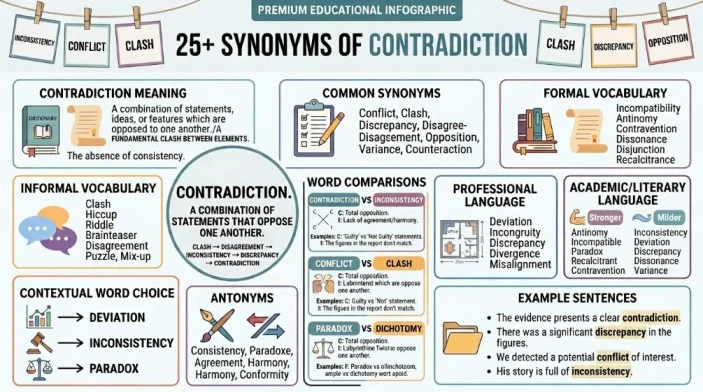
A contradiction occurs when two statements, ideas, facts, or actions conflict because they cannot easily agree or both be true in the same context. The best alternatives include inconsistency for conflicting information, disagreement for opposing opinions, conflict for broader opposition, and discrepancy for differences between expected and reported information.
Meaning, Tone, and Context
Simple Definition
A contradiction is a situation in which two statements, claims, ideas, actions, or pieces of information oppose each other or cannot both be accepted as true in the same context.
For example:
“She said she had never visited Boston, but later described her trip there in detail.”
The two statements contradict each other because they cannot both accurately describe her experience.
The word can also describe a broader conflict between ideas or behavior.
“His actions were a contradiction of his stated values.”
Here, the contradiction is between what he says and what he does.
Part of Speech
Contradiction is primarily a noun.
The related verb is contradict.
Examples:
“The two reports contain a contradiction.”
“The second report contradicts the first.”
Overall Tone
Contradiction is generally neutral in tone.
It can become negative when it points out an error, inconsistency, dishonesty, or conflict, but the word itself does not automatically express anger or criticism.
Formality Level
Contradiction is a neutral to formal word.
It works naturally in:
- Academic writing
- Business reports
- Legal discussions
- Professional communication
- News writing
- Everyday conversation
- Analytical writing
- Debates
In casual speech, people may use simpler expressions such as disagreement, clash, or conflict, depending on the meaning.
Common Uses
Native English speakers commonly use contradiction when discussing:
- Conflicting statements
- Opposing opinions
- Inconsistent evidence
- Conflicting instructions
- Incompatible claims
- Differences between words and actions
- Logical problems
- Conflicting information
- Opposing arguments
- Conflicting policies
Word Forms
| Form | Word | Example |
|---|---|---|
| Noun | contradiction | “There is a contradiction in the report.” |
| Verb | contradict | “The evidence contradicts his claim.” |
| Related noun | contradiction | “The contradiction was obvious.” |
| Related adjective | contradictory | “The witness gave contradictory statements.” |
The most useful related forms are contradict and contradictory.
When and How to Use “Contradiction”
Use contradiction when two claims, ideas, statements, actions, or pieces of information cannot comfortably exist together because they oppose one another.
The word is especially useful when you want to point out a logical or factual conflict rather than simply saying that people have different opinions.
Professional
“The audit identified a contradiction between the financial records and the submitted report.”
This works because the word describes conflicting information in a professional setting.
Academic
“The researcher found a contradiction between the two theoretical approaches.”
Here, contradiction identifies opposing ideas rather than a simple difference.
Workplace
“There appears to be a contradiction between the new policy and the instructions provided last week.”
The word clearly identifies conflicting workplace guidance.
Personal
“I noticed a contradiction between what he promised and what he actually did.”
This example focuses on a conflict between words and behavior.
“Could you clarify the apparent contradiction between these two sections of the contract?”
This is a polite and professional way to identify conflicting information.
Resume
“Resolved contradictions in project requirements by coordinating with multiple departments.”
In this context, contradictions describes conflicting requirements that needed clarification.
Social Media
“There’s a clear contradiction between the message and the actions behind it.”
This usage works when discussing an inconsistency between public statements and behavior.
Best Synonyms of “Contradiction”
No synonym of contradiction is identical in every situation. Some alternatives describe opposing opinions, while others focus on inconsistent facts, logical conflict, disagreement, or differences between words and actions.
Professional Writing: Inconsistency
Inconsistency is often the strongest choice when professional documents contain information that does not match.
“The reviewer identified an inconsistency in the financial statements.”
It sounds precise and professional without automatically suggesting that someone is deliberately wrong.
Academic Writing: Discrepancy
Discrepancy works particularly well when two pieces of information differ unexpectedly.
“The researchers noted a discrepancy between the reported results and the original measurements.”
It is useful when the difference may indicate an error or unexplained variation.
Business Communication: Conflict
Conflict is appropriate when two requirements, policies, goals, or positions oppose each other.
“The new procedure creates a conflict with the existing compliance policy.”
Casual Conversation: Disagreement
Disagreement is more natural when people simply hold different opinions.
“We had a disagreement about how to handle the situation.”
Unlike contradiction, disagreement does not necessarily mean that one statement is logically incompatible with another.
Emotional Writing: Conflict
Conflict can express tension between people, beliefs, emotions, or actions.
“She struggled with the conflict between what she wanted and what she believed was right.”
Creative Writing: Paradox
Paradox can be useful in creative or literary writing when an apparently contradictory idea contains an interesting or meaningful truth.
“The story explores the paradox of freedom and responsibility.”
However, paradox is not a universal synonym for contradiction. Use it only when the specific meaning fits.
Resume Writing: Inconsistency
Inconsistency is useful when describing the identification or resolution of conflicting information.
“Identified inconsistencies in operational reports and improved data accuracy.”
Workplace Communication: Discrepancy
Discrepancy is particularly useful when records, instructions, numbers, or reports do not match.
“We found a discrepancy between the inventory count and the database.”
Stronger Meaning: Direct Conflict
When you need to emphasize active opposition, conflict or clash can be stronger than the neutral word contradiction.
“The two proposals are in direct conflict.”
Softer Meaning: Difference
If the ideas are merely different and not truly incompatible, difference is safer.
“There is a difference between the two approaches.”
Calling a simple difference a contradiction can overstate the problem.
When Not to Use “Contradiction”
When You Only Mean “Difference”
Not every difference is a contradiction.
Less Precise:
“There is a contradiction between the two designs.”
Better:
“There is a difference between the two designs.”
Use contradiction only when the difference creates genuine opposition or incompatibility.
When You Mean a Personal Disagreement
If two people simply have different opinions, disagreement may be more natural.
Less Natural:
“We had a contradiction about the budget.”
Better:
“We had a disagreement about the budget.”
When the Problem Is a Data Mismatch
When numbers or records do not match, discrepancy is often more precise.
Less Precise:
“The accountant found a contradiction in the records.”
Better:
“The accountant found a discrepancy in the records.”
When You Need to Describe Active Opposition
If two groups, policies, or goals actively oppose one another, conflict may communicate the situation more clearly.
Less Precise:
“The two policies contain a contradiction.”
Better:
“The two policies are in conflict.”
When the Meaning Is Deliberately Complex
If an apparently conflicting idea contains a deeper truth, paradox may be more accurate.
Less Precise:
“The novel presents a contradiction about freedom.”
Better:
“The novel presents a paradox about freedom.”
When the Situation Is Too Mild for “Contradiction”
If the two ideas simply differ slightly, a strong word can exaggerate the problem.
Less Precise:
“The two estimates contain a contradiction.”
Better:
“The two estimates show a slight variation.”
Words Commonly Confused With “Contradiction”
Disagreement
Difference: A disagreement occurs when people or groups do not share the same opinion.
When to Use It: Use it for debates, personal opinions, arguments, or different viewpoints.
Example:
“The committee had a disagreement about the proposed budget.”
Inconsistency
Difference: An inconsistency occurs when information, behavior, or reasoning does not remain the same or does not match.
When to Use It: Use it for reports, records, statements, behavior, and patterns.
Example:
“The editor noticed an inconsistency in the article.”
Discrepancy
Difference: A discrepancy is an unexpected difference between two pieces of information that should normally match.
When to Use It: Use it for numbers, records, measurements, reports, and data.
Example:
“The auditor discovered a discrepancy between the invoices and the payment records.”
Conflict
Difference: Conflict suggests opposition between people, ideas, goals, policies, or interests.
When to Use It: Use it when two forces or positions actively oppose each other.
Example:
“The proposal conflicts with the company’s environmental policy.”
Denial
Difference: A denial is a refusal to accept, admit, or acknowledge something.
When to Use It: Use it when someone rejects a claim rather than simply making an opposing statement.
Example:
“His denial conflicted with the available evidence.”
Paradox
Difference: A paradox is an apparently contradictory idea or statement that may reveal an unexpected truth.
When to Use It: Use it in philosophy, literature, logic, and discussions involving complex ideas.
Example:
“The paradox of choice suggests that more options do not always make decisions easier.”
Best Synonyms of “Contradiction” by Context
| Context | Best Synonym | Why It Works | Example |
|---|---|---|---|
| Formal writing | Inconsistency | Precise and professional | “The report contains an inconsistency.” |
| Academic writing | Discrepancy | Works well for conflicting findings | “The study revealed a discrepancy in the results.” |
| Professional communication | Inconsistency | Neutral and objective | “We identified an inconsistency in the records.” |
| Business emails | Discrepancy | Useful for mismatched information | “Could you explain the discrepancy in the invoice?” |
| Resume writing | Inconsistency | Shows analytical problem solving | “Resolved inconsistencies in project data.” |
| Workplace communication | Conflict | Clearly describes opposing requirements | “The two procedures create a conflict.” |
| Casual conversation | Disagreement | Natural for opposing opinions | “We had a disagreement about the plan.” |
| Everyday speaking | Difference | Softer and easier to understand | “There is a difference between the two accounts.” |
| Creative writing | Paradox | Useful for complex opposing ideas | “The character embodies a paradox.” |
| Storytelling | Conflict | Creates narrative tension | “The story centers on a conflict of values.” |
| Emotional writing | Conflict | Expresses inner or interpersonal tension | “She faced a conflict between duty and love.” |
| Strong emphasis | Clash | Suggests direct opposition | “Their views are in direct clash.” |
| Mild tone | Difference | Avoids unnecessary intensity | “The two approaches have some differences.” |
| Social media captions | Disagreement | Conversational and accessible | “A disagreement does not always mean a relationship is broken.” |
| American English | Contradiction | Widely understood and natural | “That statement is a contradiction.” |
| British English | Contradiction | Also standard and natural | “The evidence presents a contradiction.” |
How to Choose the Best Synonym of “Contradiction”
Choosing the right word starts with identifying what exactly is conflicting.
If Two People Have Different Opinions
Use disagreement.
“The managers had a disagreement about the hiring decision.”
If Information Does Not Match
Use discrepancy or inconsistency.
“The auditor found a discrepancy in the records.”
If Rules or Goals Oppose Each Other
Use conflict.
“The new requirement conflicts with the existing policy.”
If Someone Rejects a Claim
Use denial.
“His denial was challenged by the evidence.”
If an Idea Seems Impossible but Contains a Deeper Truth
Use paradox.
“The story explores the paradox of freedom.”
If You Want a General Term
Use contradiction.
“The two statements contain a contradiction.”
Consider Your Audience
For academic readers, inconsistency, discrepancy, and conflict often provide greater precision.
For everyday readers, disagreement, difference, and conflict may sound more natural.
Consider Emotional Strength
A difference sounds mild.
A disagreement suggests opposing opinions.
A conflict suggests stronger opposition.
A clash suggests direct and sometimes dramatic opposition.
Consider Your Writing Purpose
- For a report, choose inconsistency or discrepancy.
- For an essay, choose contradiction, inconsistency, or conflict.
- For a resume, use inconsistency when describing a problem you identified or resolved.
- For a conversation, disagreement is often the most natural choice.
- For creative writing, conflict or paradox can provide more expressive meaning when appropriate.
Real Life Examples of “Contradiction”
School
Basic:
“The essay contains a contradiction.”
Improved:
“The essay contains an inconsistency between the author’s opening claim and final conclusion.”
The second version identifies the specific problem.
College
“The research paper discusses a discrepancy between the expected results and the observed findings.”
Here, discrepancy fits because the focus is on different research results.
Workplace
“There is a conflict between the team’s deadline and the available resources.”
Conflict clearly communicates competing workplace demands.
Business
“The finance department found a discrepancy between the invoice and the payment record.”
This is more precise than simply calling the difference a contradiction.
“Could you clarify the apparent inconsistency between the two sections of the proposal?”
This sounds professional and avoids making an unnecessarily strong accusation.
Resume
“Identified and resolved inconsistencies in customer data across multiple reporting systems.”
This demonstrates analytical ability and problem solving.
Conversation
“That’s a contradiction. You said you didn’t want to go, but you already bought a ticket.”
The direct word works naturally in casual speech when two statements cannot both be true.
Storytelling
“The character’s greatest conflict was between his desire for freedom and his responsibility to his family.”
Here, conflict adds emotional depth.
Blogging
“The article contains a contradiction between its main argument and the evidence presented later.”
This clearly describes a logical problem in written content.
Social Media
“There is a noticeable contradiction between the company’s public message and its recent actions.”
This usage works when discussing statements and behavior that do not align.
25 Best Synonyms of “Contradiction”
Not every word below can replace contradiction in every sentence. The table focuses on accurate alternatives and closely related terms that express opposing claims, conflicting information, incompatible ideas, or disagreement in appropriate contexts.
| Synonym | Simple Meaning | Best Used For | Example Sentence |
|---|---|---|---|
| Inconsistency | A lack of agreement or consistency | Reports, statements, behavior | “The editor found an inconsistency in the article.” |
| Discrepancy | An unexpected difference between things that should match | Data, records, measurements | “The accountant noticed a discrepancy in the figures.” |
| Conflict | Opposition between ideas, interests, or requirements | Policies, goals, relationships | “The two policies create a conflict.” |
| Disagreement | A difference of opinion | People and discussions | “The team had a disagreement over the proposal.” |
| Clash | A direct or noticeable opposition | Opinions, styles, interests | “Their political views often clash.” |
| Opposition | Resistance or direct disagreement | Ideas, groups, positions | “The proposal faced strong opposition.” |
| Incompatibility | A condition in which things cannot work together | Systems, ideas, requirements | “The two software versions showed incompatibility.” |
| Incongruity | A mismatch between things that do not seem to belong together | Formal and descriptive writing | “The cheerful tone created an incongruity with the serious subject.” |
| Divergence | A movement or development in different directions | Opinions, theories, trends | “The researchers found a divergence in their conclusions.” |
| Variance | A difference from another value, condition, or expectation | Data and statistics | “The variance between the estimates was substantial.” |
| Disparity | A noticeable difference between things or groups | Results, conditions, statistics | “The report revealed a disparity between the two regions.” |
| Conflict of Ideas | Direct opposition between viewpoints | Debates and academic discussion | “The essay examines a conflict of ideas.” |
| Contrariety | Direct opposition between things or principles | Formal and specialized writing | “The argument contains a clear contrariety.” |
| Denial | A refusal to accept or acknowledge a claim | Statements and accusations | “His denial contradicted the available evidence.” |
| Refutation | An argument showing that another claim is wrong | Academic and formal writing | “The paper provides a refutation of the earlier theory.” |
| Rebuttal | A response that challenges an argument | Debates and discussions | “Her rebuttal addressed each major claim.” |
| Counterclaim | A claim made against another claim | Essays, debates, legal writing | “The author presents a counterclaim before defending the main argument.” |
| Counterstatement | A statement that opposes another statement | Formal communication | “The organization issued a counterstatement.” |
| Antithesis | A strong contrast between opposing ideas | Rhetoric and literary writing | “The speech presents freedom as the antithesis of oppression.” |
| Inconsonance | A lack of agreement or harmony | Formal language | “The report showed inconsonance between policy and practice.” |
| Disjunction | A separation or lack of connection between ideas or elements | Logic and formal analysis | “The argument contains a disjunction between theory and practice.” |
| Nonconformity | Failure to agree with an established standard | Rules, expectations, systems | “The inspection identified a nonconformity with the required standard.” |
| Incompatibility | Inability of two things to coexist or work together | Systems and requirements | “The requirements revealed an incompatibility between the two plans.” |
| Contradictoriness | The quality of containing opposing claims | Formal analysis | “The contradictoriness of the statements weakened the argument.” |
| Disaccord | A state of disagreement or lack of harmony | Formal and literary writing | “The debate exposed a deep disaccord between the two groups.” |
Note: Incompatibility appears twice in meaning based usage, but for strict publication quality, it is better to count it only once. Therefore, the final usable list should contain one occurrence of incompatibility, with disconformity as a replacement only when the context specifically concerns failure to conform. For the cleanest 25 word publication list, use the first 25 unique terms and remove the duplicate.
Synonyms of “Contradiction” by Usage
Professional vs Personal Synonyms
Professional writing benefits from words that identify the exact type of conflict.
- Use inconsistency when information does not remain consistent.
- Use discrepancy when two records, figures, or reports do not match.
Use conflict when policies, interests, or requirements oppose each other.
In personal communication, disagreement is often the better choice because it naturally describes differences between people’s opinions.
Compare:
“The managers had a disagreement about the proposal.”
This sounds natural in everyday workplace communication.
“The report contains an inconsistency.”
This is better when the problem is within written information.
Formal vs Conversational Synonyms
- For reports and essays, prefer inconsistency, discrepancy, conflict, or contradiction.
- For presentations, conflict, inconsistency, and disagreement work depending on the subject.
- For business emails, discrepancy is especially useful for records, figures, invoices, and documents.
- For casual conversations and texting, disagreement, clash, or difference usually sounds more natural.
Academic Synonyms
Academic writing requires careful distinctions.
Inconsistency works when an argument or source contains information that does not remain logically or factually consistent.
Discrepancy works when research findings, measurements, or reported information differ unexpectedly.
Conflict works when theories, arguments, or interpretations oppose each other.
Antithesis is useful in rhetoric and literary analysis when one concept is deliberately positioned as the opposite of another.
Refutation is different because it describes an argument that demonstrates why another claim is wrong.
For academic writing, avoid using these words interchangeably simply to create vocabulary variety. Choose the word that accurately describes the relationship between the ideas.
Professional and Business Synonyms
- For resumes, inconsistency can describe a problem that you identified or resolved.
“Resolved inconsistencies across monthly reporting systems.”
For interviews, discrepancy works when explaining how you discovered an error.
“I noticed a discrepancy between the inventory report and the physical count.”
- For meetings, conflict works when discussing competing priorities.
“We need to address the conflict between the delivery schedule and available resources.”
- For client communication, discrepancy often sounds more neutral than contradiction.
- For business emails, use respectful phrases such as:
“There appears to be an inconsistency.”
“Could you help clarify this discrepancy?”
These expressions identify a problem without sounding unnecessarily confrontational.
Creative and Literary Synonyms
Creative writing often benefits from more expressive alternatives.
Conflict can describe opposing desires or forces within a story.
Clash can create a stronger sense of confrontation.
Antithesis can emphasize deliberate contrast between two ideas.
Paradox can describe an apparently contradictory concept that has deeper meaning.
Incongruity can highlight something strangely out of place.
For example:
“The quiet village became the setting for a conflict between tradition and progress.”
This communicates more than simply saying there was a contradiction.
Slang or Modern Synonyms
There is no single widely accepted slang word that functions as a direct synonym for contradiction in every context.
In casual American English, speakers may use expressions such as clash, doesn’t add up, or doesn’t match.
“Doesn’t Add Up”
Meaning: Something seems inconsistent or difficult to believe.
Acceptable In: Casual conversation, social media, informal discussion.
Avoid In: Academic papers, formal reports, legal writing.
Example:
“His explanation doesn’t add up.”
Formal alternative:
“His explanation contains several inconsistencies.”
“Doesn’t Match”
Meaning: Two pieces of information are different or inconsistent.
Acceptable In: Everyday speech and informal communication.
Avoid In: Highly formal analytical writing.
Example:
“The numbers don’t match.”
Formal alternative:
“There is a discrepancy between the reported figures.”
Strongest to Mildest Synonyms
Contradiction does not have a perfect universal intensity scale because different synonyms emphasize different types of opposition. Still, a practical scale can help writers choose vocabulary.
Mild
Difference
Variation
Divergence
These words can describe situations where ideas or information differ without suggesting a serious problem.
Moderate
Disagreement
Inconsistency
Discrepancy
These words identify clearer problems or differences.
Strong
Conflict
Clash
Opposition
These terms suggest stronger resistance or direct opposition.
Very Strong
Direct opposition
Incompatibility
Antithesis
These expressions can communicate a pronounced or fundamental opposition, depending on context.
The important point is that intensity should not be the only factor. A discrepancy may be more accurate than conflict even when the discrepancy is serious because the words describe different relationships.
Emotional vs Neutral Synonyms
Emotional Synonyms
Use these when the conflict carries tension, personal feeling, or dramatic force.
Clash
Useful for strong personal or ideological opposition.
Conflict
Useful for emotional, interpersonal, or internal struggles.
Opposition
Useful when one side actively resists another.
Antithesis
Useful for dramatic contrast in literary or rhetorical writing.
Disaccord
Useful in formal or literary contexts involving a lack of harmony.
Example:
“The novel explores the conflict between ambition and loyalty.”
Neutral Synonyms
Use these when you want to identify a problem without adding emotional intensity.
Inconsistency
“The report contains an inconsistency.”
Discrepancy
“The auditor identified a discrepancy.”
Difference
“There is a difference between the two estimates.”
Divergence
“The researchers observed a divergence in their findings.”
Neutral vocabulary is usually preferable in professional, academic, and analytical writing.
Antonyms of “Contradiction”
The opposite of a contradiction is generally a state of agreement, consistency, compatibility, or harmony. Because contradiction can refer to several kinds of opposition, its antonyms also depend on context.
| Antonym | Meaning | Example Sentence |
|---|---|---|
| Agreement | A state of sharing the same view | “The committee reached an agreement.” |
| Consistency | Agreement or sameness across information or behavior | “The results showed consistency across all tests.” |
| Concord | Harmony or agreement | “The two groups worked in concord.” |
| Harmony | A state in which things work well together | “The ideas exist in harmony.” |
| Accord | Agreement or shared understanding | “The parties reached an accord.” |
| Conformity | Agreement with a rule or standard | “The process is in conformity with company policy.” |
| Compatibility | Ability to exist or work together | “The two systems have good compatibility.” |
| Concurrence | Agreement with an opinion or decision | “The board gave its concurrence.” |
| Confirmation | Evidence or information supporting a claim | “The new evidence provided confirmation.” |
| Affirmation | A positive statement supporting something | “Her response was an affirmation of the proposal.” |
| Consensus | General agreement among a group | “The team reached a consensus.” |
| Alignment | Agreement or consistency between goals or positions | “The departments are in alignment.” |
| Coherence | Logical connection and consistency | “The argument has strong coherence.” |
| Unity | A state of being joined or in agreement | “The group demonstrated unity.” |
| Conformity of Evidence | Agreement between evidence and a claim | “The findings showed conformity with the original prediction.” |
Comparison: “Contradiction” vs Similar Words
Contradiction vs Inconsistency
Main Difference
A contradiction usually involves two claims or ideas that oppose each other. An inconsistency is broader and can refer to information or behavior that fails to remain consistent.
Which Is Stronger?
Contradiction can sound stronger because it may suggest that two statements cannot both be true.
Which Is More Formal?
Inconsistency is particularly common in professional and academic analysis.
When to Use Each
Use contradiction when the opposition is direct.
Use inconsistency when information simply fails to match or remain consistent.
Examples
Contradiction:
“There is a contradiction between his two statements.”
Inconsistency:
“There is an inconsistency in the report.”
Contradiction vs Discrepancy
Main Difference
A discrepancy is an unexpected difference between things that should normally match.
Which Is Stronger?
Neither is universally stronger. They describe different problems.
Which Is More Formal?
Discrepancy is highly useful in professional, financial, and academic contexts.
When to Use Each
Use discrepancy for data, records, numbers, and measurements.
Use contradiction for opposing statements or claims.
Examples
Contradiction:
“The witness’s statements contain a contradiction.”
Discrepancy:
“There is a discrepancy between the two financial records.”
Contradiction vs Disagreement
Main Difference
A disagreement is a difference of opinion. A contradiction concerns opposing statements, claims, ideas, or information.
Which Is Stronger?
Contradiction can be stronger when the issue involves logical incompatibility.
Which Is More Formal?
Both are neutral, but disagreement is especially natural in everyday speech.
When to Use Each
Use disagreement for people and opinions.
Use contradiction for statements and ideas.
Examples
Contradiction:
“The two statements contradict each other.”
Disagreement:
“The two managers had a disagreement.”
Contradiction vs Conflict
Main Difference
Conflict describes broader opposition between people, goals, interests, policies, or ideas.
Which Is Stronger?
Conflict often suggests stronger opposition.
Which Is More Formal?
Both are suitable for formal writing.
When to Use Each
Use conflict when opposing forces or interests are involved.
Use contradiction when two claims or statements oppose one another.
Examples
Contradiction:
“The report contains a contradiction.”
Conflict:
“The policy conflicts with our current objectives.”
Contradiction vs Paradox
Main Difference
A paradox appears contradictory but may reveal a deeper or unexpected truth.
Which Is Stronger?
Neither is stronger. They have different meanings.
Which Is More Formal?
Both can be formal, especially in philosophy, academic writing, and literary analysis.
When to Use Each
Use contradiction for genuinely incompatible claims.
Use paradox for an apparently contradictory idea with deeper significance.
Examples
Contradiction:
“The two statements create a contradiction.”
Paradox:
“The novel explores the paradox of freedom.”
Contradiction vs Opposition
Main Difference
Opposition describes resistance or being positioned against something.
Which Is Stronger?
Opposition can suggest active resistance, while contradiction focuses more directly on incompatible claims or ideas.
Which Is More Formal?
Both are common in formal writing.
When to Use Each
Use opposition for political positions, groups, proposals, or forces.
Use contradiction for statements, claims, and logical relationships.
Examples
Contradiction:
“The two statements contain a contradiction.”
Opposition:
“The proposal faced strong opposition.”
Common Phrases and Expressions with “Contradiction”
Contradiction in Terms
Meaning: A combination of words or ideas that appears to conflict with itself.
Example:
“The phrase creates a contradiction in terms because the two concepts appear incompatible.”
Direct Contradiction
Meaning: A clear and explicit opposition between two claims.
Example:
“The second statement is in direct contradiction to the first.”
Clear Contradiction
Meaning: An obvious conflict between statements or ideas.
Example:
“There is a clear contradiction between the two reports.”
Apparent Contradiction
Meaning: A conflict that seems to exist but may be explainable.
Example:
“The researcher examined the apparent contradiction in the findings.”
Internal Contradiction
Meaning: A conflict within the same argument, document, system, or idea.
Example:
“The essay contains an internal contradiction that weakens its conclusion.”
Logical Contradiction
Meaning: A conflict that violates logical consistency.
Example:
“The argument contains a logical contradiction.”
Contradiction Between Two Statements
Meaning: A direct conflict between separate claims.
Example:
“There is a contradiction between the witness’s two statements.”
In Contradiction to
Meaning: In a position that conflicts with something else.
Example:
“The new evidence is in contradiction to the earlier conclusion.”
Common Mistakes to Avoid
1. Treating Every Difference as a Contradiction
Incorrect:
“The two proposals are a contradiction because they have different prices.”
Better:
“The two proposals have different prices.”
Why:
Different prices do not necessarily contradict each other. Use contradiction only when the information cannot reasonably coexist.
2. Confusing Contradiction With Disagreement
Incorrect:
“The two students had a contradiction about the assignment.”
Better:
“The two students had a disagreement about the assignment.”
Why:
The students have different opinions. Disagreement is the natural word for that situation.
3. Using Discrepancy for Every Contradiction
Incorrect:
“The two opposing theories are a discrepancy.”
Better:
“The two theories are in conflict.”
Why:
Discrepancy is best for mismatched information, numbers, records, or measurements.
4. Using an Informal Expression in Academic Writing
Incorrect:
“The research doesn’t add up.”
Better:
“The research contains several inconsistencies.”
Why:
Doesn’t add up is conversational. Inconsistencies is more appropriate for academic analysis.
5. Using “Paradox” as a Universal Synonym
Incorrect:
“The accounting records contain a paradox.”
Better:
“The accounting records contain a discrepancy.”
Why:
A paradox is not simply an error or mismatch. It usually describes an apparently contradictory idea with a deeper meaning.
6. Making a Minor Difference Sound Dramatic
Incorrect:
“The two schedules contain a serious contradiction.”
Better:
“The two schedules show a minor discrepancy.”
Why:
The second sentence matches the relatively small nature of the problem.
7. Repeating “Contradiction” Too Often
Incorrect:
“The contradiction creates another contradiction in the argument, which leads to a contradiction in the conclusion.”
Better:
“The inconsistency creates another conflict in the argument, which weakens the conclusion.”
Why:
Strategic variation improves readability while preserving meaning.
Frequently Asked Questions
1. What are the best synonyms of “contradiction”?
The best synonyms of contradiction include inconsistency, discrepancy, conflict, disagreement, clash, and opposition. Choose the word according to whether you mean conflicting information, opinions, policies, or ideas.
2. What are the best formal synonyms of “contradiction”?
The strongest formal alternatives include inconsistency, discrepancy, incongruity, divergence, incompatibility, and refutation, depending on the context. For professional writing, inconsistency and discrepancy are especially useful.
3. What are common informal synonyms of “contradiction”?
Common conversational alternatives include disagreement, clash, difference, and expressions such as doesn’t add up. These choices are useful in everyday conversation but should be used carefully in formal writing.
4. What is another word for “contradiction” in professional writing?
Inconsistency is often the best professional alternative when information does not match. Discrepancy is especially appropriate for financial records, data, invoices, measurements, and reports.
5. What is the difference between “contradiction” and “inconsistency”?
A contradiction usually involves two statements or ideas that directly oppose each other. An inconsistency is broader and can describe information, behavior, or reasoning that does not remain consistent.
6. What is the opposite of “contradiction”?
Common opposites include agreement, consistency, accord, harmony, consensus, concord, and compatibility. The best choice depends on whether the original contradiction involves opinions, information, systems, or ideas.
Conclusion
A contradiction occurs when statements, ideas, claims, or actions conflict in a way that creates opposition or inconsistency. Although the word is useful in many situations, a more precise alternative can often communicate the exact problem more clearly.
Use inconsistency for information that does not remain consistent, discrepancy for mismatched records or figures, disagreement for different opinions, and conflict for opposing goals, interests, or forces. In creative and academic contexts, paradox or antithesis may work when their specific meanings fit.
The best synonym of contradiction is always determined by context. Before replacing the word, identify what is actually conflicting and consider your audience, tone, and purpose. A useful vocabulary habit is to ask whether you mean a difference, disagreement, inconsistency, or genuine opposition before choosing your final word.
Read More Related Articles:
- Synonyms for Empty | Meaning, Examples, and Better Word …
- Synonyms for Creativity | Meaning, Examples, and Better …
- 25+ Synonyms of Perseverance | Meanings, Uses, Examples …