When writing an essay, resume, speech, email, or social media caption, repeating the word noble can make your vocabulary feel limited. Finding the right synonym of noble can make your message more precise, especially when you want to describe strong character, honorable behavior, impressive qualities, or elevated status.
The best alternative depends on what you mean. Honorable works well for admirable behavior, virtuous emphasizes moral goodness, dignified highlights self respect, and lofty can describe elevated ideals. In historical or literary contexts, words such as aristocratic, highborn, and majestic may be more accurate. Choosing carefully helps your writing communicate the exact quality you intend rather than simply replacing one word with another.
What Are the Best Synonyms of “Noble”?
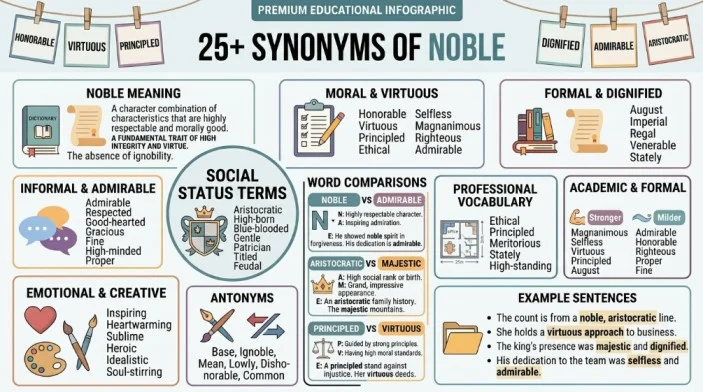
- A noble person or idea is honorable, morally admirable, or elevated in character, purpose, or status. The best synonyms include honorable, virtuous, upright, principled, dignified, and selfless. For formal writing, use honorable or virtuous. For emotional writing, selfless works well. For social rank, use aristocratic or highborn.
Meaning, Tone, and Context
Simple Definition
The word noble has several related meanings. Most commonly, it describes someone with admirable moral qualities, honorable intentions, or a strong sense of right and wrong.
It can also describe something that is impressive in character or purpose, such as a noble cause, noble goal, or noble ambition. In historical contexts, noble can refer to someone belonging to a social class associated with aristocracy or hereditary rank.
Part of Speech
Noble is primarily an adjective.
Example:
“She made a noble effort to help the community.”
The word can also function as a noun when referring to a member of a hereditary aristocratic class.
Example:
“The noble attended the royal ceremony.”
Overall Tone
The usual tone of noble is positive and admiring. It suggests moral excellence, dignity, courage, generosity, or elevated purpose.
When it refers to social class, however, the meaning is descriptive rather than necessarily praising someone’s character.
Formality Level
Noble is generally neutral to formal. It is common in literature, speeches, essays, historical discussions, ethical writing, and descriptions of admirable behavior.
It can sound somewhat elevated in ordinary conversation, especially when a simpler word such as honorable or good would communicate the idea more naturally.
Common Uses
Native English speakers commonly use noble with words and expressions such as:
- Noble character
- Noble person
- Noble cause
- Noble purpose
- Noble goal
- Noble intention
- Noble effort
- Noble ambition
- Noble deed
- Noble ideal
- Noble sacrifice
- Noble spirit
- Noble heart
- Noble family
- Noble birth
The exact meaning changes according to the noun it modifies. A noble person usually refers to character, while a noble family may refer to social or hereditary status.
Word Forms
| Form | Word |
|---|---|
| Adjective | Noble |
| Noun | Nobility |
| Noun | Noble |
| Adverb | Nobly |
| Related adjective | Noble |
| Opposite | Ignoble |
When and How to Use “Noble”
Use noble when you want to communicate more than simple goodness. The word often suggests that someone’s actions, intentions, or character are admirable because they reflect strong principles, courage, generosity, dignity, or selflessness.
Professional Context
“The organization supports a noble mission to improve access to education.”
Here, noble emphasizes the positive purpose of the organization.
Academic Context
“The philosopher argued that humans are capable of pursuing noble ideals.”
This works in academic writing because the word refers to elevated moral or philosophical goals.
Workplace Context
“Her noble commitment to helping new employees made her a respected mentor.”
The word emphasizes admirable dedication rather than simply saying she was helpful.
Personal Context
“He made a noble decision to forgive his former friend.”
Here, noble suggests moral strength and generosity.
Email Context
“Thank you for supporting such a noble cause.”
This is suitable for a respectful message about charitable or socially beneficial work.
Resume Context
“Demonstrated a strong commitment to noble community initiatives.”
A more precise professional alternative might be meaningful, community focused, or socially responsible, depending on the specific achievement.
Social Media Context
“Helping others without expecting anything in return is a truly noble act.”
The word works naturally in inspirational or reflective content.
Best Synonyms of “Noble”
No single synonym of noble works perfectly in every context because noble itself covers several meanings. Some alternatives describe moral character, while others focus on dignity, social status, generosity, or elevated ideals.
Professional writing: Honorable
Use honorable when describing conduct, decisions, commitments, or people who deserve respect.
Example:
“She made an honorable decision to accept responsibility.”
Academic writing: Virtuous
Use virtuous when discussing morality, ethics, philosophy, or admirable personal qualities.
Example:
“The text presents courage as a virtuous quality.”
Business communication: Principled
Use principled when describing ethical leadership, responsible decisions, or strong professional standards.
Example:
“The company is known for its principled approach to customer privacy.”
Casual conversation: Goodhearted
Use goodhearted when speaking naturally about someone who is kind and caring.
Example:
“He’s a goodhearted person who always helps his neighbors.”
Emotional writing: Selfless
Use selfless when someone’s actions put other people’s needs ahead of their own.
Example:
“Her selfless support helped the family through a difficult period.”
Creative writing: Majestic
Use majestic when the intended meaning involves grandeur, beauty, dignity, or impressive presence rather than morality.
Example:
“The majestic eagle circled above the mountain.”
Resume writing: Principled
This word can be useful when describing ethical leadership or professional integrity.
Example:
“Built a principled leadership culture based on transparency and accountability.”
Workplace communication: Honorable
Use honorable when discussing conduct, commitments, or decisions that deserve respect.
Example:
“His honorable handling of the dispute earned the team’s trust.”
Stronger moral meaning: Virtuous
Virtuous strongly emphasizes moral goodness and ethical behavior.
Example:
“She was admired for her virtuous character.”
Softer moral meaning: Admirable
Admirable expresses approval without suggesting exceptional moral perfection.
Example:
“Her dedication to the project was admirable.”
When Not to Use “Noble”
Although noble is a useful word, it can sometimes be too broad, too elevated, or simply inaccurate. Choosing a more specific synonym often makes the sentence clearer.
When Noble Is Too General
Sentence:
“She is a noble person.”
This gives praise but does not explain what makes her admirable.
Better:
“She is a compassionate person who regularly volunteers at local shelters.”
The second sentence identifies the specific quality.
When Noble Is Too Vague
Sentence:
“He had noble intentions.”
The reader may wonder what those intentions were.
Better:
“He had well intentioned plans to improve access to clean water.”
The alternative gives the reader a clearer idea of the intended meaning.
When Noble Is Too Formal
Sentence:
“You’re a noble friend for helping me move.”
This can sound overly dramatic in casual conversation.
Better:
“You’re a great friend for helping me move.”
A simpler word sounds more natural in an everyday situation.
When Noble Is Too Weak
If you want to emphasize exceptional moral character, noble may not communicate the full strength of the idea.
Sentence:
“Her noble sacrifice saved the team.”
Better:
“Her selfless sacrifice saved the team.”
Selfless makes the personal cost and generosity clearer.
When Noble Is Too Strong
Sentence:
“He made a noble choice by cleaning his room.”
The adjective sounds exaggerated because the action is ordinary.
Better:
“He made a responsible choice by cleaning his room.”
When Noble Refers to Social Status
Sentence:
“She comes from a noble family.”
This may refer to aristocratic or hereditary status rather than moral character.
Better:
“She comes from an aristocratic family.”
The alternative makes the social meaning explicit.
Words Commonly Confused With “Noble”
| Word | Difference | When to Use It | Example |
|---|---|---|---|
| Honorable | Focuses on conduct that deserves respect. | Ethical actions and decisions. | “He made an honorable choice.” |
| Virtuous | Strongly emphasizes moral goodness. | Ethics and character. | “She was known for her virtuous character.” |
| Dignified | Focuses on composure, self respect, and proper behavior. | Behavior during difficult situations. | “She remained dignified under pressure.” |
| Aristocratic | Refers mainly to high social class or inherited status. | History and social class. | “The family had an aristocratic background.” |
| Generous | Focuses on willingness to give or help. | Gifts, support, and kindness. | “He was generous with his time.” |
| Grand | Describes impressive scale, appearance, or style. | Buildings, events, ideas, or settings. | “They held a grand celebration.” |
Best Synonyms of “Noble” by Context
| Context | Best Synonym | Why It Works | Example |
|---|---|---|---|
| Formal writing | Honorable | Sounds respectful and precise. | “He followed an honorable course of action.” |
| Academic writing | Virtuous | Fits discussions of ethics and morality. | “The essay examines the virtuous life.” |
| Professional communication | Principled | Highlights ethical standards. | “She is a principled leader.” |
| Business emails | Respectable | Gives measured professional praise. | “Your organization has a respectable reputation.” |
| Resume writing | Principled | Communicates ethical leadership. | “Developed a principled approach to management.” |
| Workplace communication | Honorable | Describes trustworthy conduct. | “That was an honorable response to the situation.” |
| Casual conversation | Goodhearted | Sounds natural and warm. | “She’s a goodhearted person.” |
| Everyday speaking | Kind | Simple and widely understood. | “He is kind to everyone.” |
| Creative writing | Majestic | Adds grandeur and visual impact. | “A majestic landscape stretched before them.” |
| Storytelling | Admirable | Expresses approval naturally. | “His courage was admirable.” |
| Emotional writing | Selfless | Highlights sacrifice for others. | “Her selfless act touched everyone.” |
| Strong emphasis | Virtuous | Gives moral praise strong emphasis. | “He lived a deeply virtuous life.” |
| Mild tone | Admirable | Praises without sounding excessive. | “Her patience was admirable.” |
| Social media captions | Inspiring | Works well for motivational content. | “A truly inspiring act of kindness.” |
| American English | Honorable | Natural across formal and everyday contexts. | “It was an honorable decision.” |
| British English | Honorable | Also natural in British English, although spelling conventions may vary by context. | “He received an honorable mention.” |
How to Choose the Best Synonym of “Noble”
Start by identifying which meaning of noble you want to communicate. This is especially important because the word can describe moral character, social status, dignity, or an elevated purpose.
- If you mean morally good, choose virtuous, upright, ethical, or principled.
- If you mean deserving respect, choose honorable, admirable, or respectable.
- If you mean generous toward others, choose selfless, generous, or altruistic.
- If you mean calm and dignified, choose dignified, stately, or regal.
- If you mean high social status, choose aristocratic, highborn, or patrician.
- If you mean impressive or elevated, choose majestic, lofty, grand, or exalted.
Consider your audience.
An academic audience may respond better to virtuous or principled, while casual readers may prefer kind, goodhearted, or admirable.
Consider emotional strength.
If you simply want to praise someone, admirable is measured. If you want to emphasize exceptional moral behavior, virtuous or selfless may be more appropriate.
Consider the purpose of the writing.
A resume usually benefits from specific descriptions rather than broad praise. Instead of saying someone has a “noble work ethic,” describe the actual behavior, such as ethical leadership, community service, or responsible decision making.
Real Life Examples of “Noble”
School
Original:
“Helping classmates is a noble thing.”
Improved:
“Helping classmates is an admirable way to build a supportive learning environment.”
College
Original:
“The student pursued a noble goal.”
Improved:
“The student pursued a meaningful goal of expanding educational access.”
Workplace
Original:
“Her noble leadership inspired the team.”
Improved:
“Her principled leadership inspired the team to work with greater integrity.”
Business
Original:
“The company supports a noble cause.”
Improved:
“The company supports a meaningful cause focused on improving access to clean water.”
Original:
“Thank you for supporting this noble project.”
Improved:
“Thank you for supporting this meaningful project.”
Resume
Original:
“Participated in noble community activities.”
Improved:
“Participated in community service initiatives supporting local families.”
Conversation
Original:
“That’s a noble thing to do.”
Improved:
“That’s a really kind thing to do.”
Storytelling
Original:
“The knight had a noble heart.”
Improved:
“The knight had a selfless heart and refused to abandon the villagers.”
Blogging
Original:
“Many people pursue noble goals.”
Improved:
“Many people pursue meaningful goals that improve the lives of others.”
Social Media
Original:
“Her noble act inspired thousands.”
Improved:
“Her selfless act inspired thousands of people to help others.”
25 Best Synonyms of “Noble”
| Synonym | Simple Meaning | Best Used For | Example Sentence |
|---|---|---|---|
| Honorable | Deserving respect | Conduct and decisions | He made an honorable choice. |
| Virtuous | Morally good | Character and ethics | She was admired for her virtuous character. |
| Upright | Honest and morally sound | Personal character | He was an upright citizen. |
| Principled | Guided by strong moral rules | Leadership and professional conduct | She is a principled manager. |
| Dignified | Calm and worthy of respect | Behavior and manner | He remained dignified throughout the dispute. |
| Admirable | Worthy of approval | General praise | Her dedication was admirable. |
| Selfless | Putting others first | Sacrifice and service | His selfless actions helped the community. |
| Altruistic | Concerned with others’ welfare | Charitable or ethical behavior | The organization promotes altruistic values. |
| Ethical | Following moral principles | Business and academic contexts | They made an ethical decision. |
| Goodhearted | Naturally kind and caring | Casual descriptions of people | She is a goodhearted neighbor. |
| Generous | Willing to give or help | Personal relationships and charity | He was generous with his time. |
| Magnanimous | Generous and forgiving | Formal or literary writing | Her magnanimous response surprised everyone. |
| Righteous | Strongly committed to moral right | Moral or religious contexts | He believed he was defending a righteous cause. |
| Worthy | Deserving respect or approval | Causes, people, and goals | The charity supports a worthy cause. |
| Elevated | Morally or intellectually higher | Formal and literary writing | The speech presented an elevated vision of society. |
| Exalted | Highly honored or elevated | Formal and literary contexts | The poem celebrates an exalted ideal. |
| Lofty | High in ideals or purpose | Goals and ambitions | She had lofty ambitions for the organization. |
| Majestic | Grand and impressive | Nature, places, and descriptions | The mountain looked majestic at sunrise. |
| Regal | Resembling royalty in dignity or appearance | People, clothing, and settings | She carried herself with regal confidence. |
| Stately | Impressive, dignified, and grand | Buildings, people, and movements | The stately building dominated the square. |
| Aristocratic | Associated with the upper social class | History and social status | The novel portrays an aristocratic family. |
| Highborn | Born into a socially elevated family | Historical or literary writing | The story follows a highborn young woman. |
| Patrician | Associated with an elite social class | Historical and formal contexts | He came from a patrician background. |
| Grand | Impressive or elevated in scale | Events, ideas, and settings | They had a grand vision for the future. |
| Distinguished | Respected and notable | Professional and formal writing | She had a distinguished career in education. |
Synonyms of “Noble” by Usage
Professional vs Personal Synonyms
Professional writing usually benefits from precise words that explain the quality being praised. Principled, ethical, honorable, and distinguished are often more useful than simply calling someone noble.
For personal conversations, warmer choices such as kind, goodhearted, generous, and selfless tend to sound more natural.
For example, a professional profile might say:
“She is a principled leader who values transparency.”
A personal description might say:
“She’s a goodhearted person who always helps her friends.”
The second sentence sounds more conversational because it focuses on warmth rather than formal moral evaluation.
Formal vs Conversational Synonyms
- For reports and essays, consider virtuous, principled, ethical, honorable, or distinguished.
- For presentations, admirable, honorable, and meaningful can work depending on the subject.
- For professional emails, honorable, meaningful, or worthy may be appropriate.
For casual conversations, kind, goodhearted, generous, and admirable are usually easier and more natural.
- For texting, simple words are generally preferable. Instead of saying, “That was a noble gesture,” you might say, “That was really kind of you.”
Academic Synonyms
Academic writing requires careful distinctions because noble can sound evaluative or literary.
Virtuous is useful when discussing moral philosophy, ethics, or character.
Example:
“The philosopher presents the virtuous person as someone who acts according to reason and moral principles.”
Principled works well when discussing ethical decisions or behavior.
Example:
“The study examines how principled leadership affects institutional trust.”
Ethical is particularly useful in research, business ethics, medicine, law, and social science.
Example:
“Researchers must follow ethical standards when collecting participant data.”
Exalted and lofty can work in literary analysis when the subject involves elevated ideals or aspirations.
Professional and Business Synonyms
- For resumes, principled, ethical, distinguished, and accomplished are usually more useful than a vague phrase such as “noble professional.”
- For interviews, principled can describe decision making and leadership.
- For meetings, meaningful or worthwhile may describe useful initiatives or goals.
- For presentations, strategic, significant, or valuable can provide greater precision.
- For performance reviews, ethical, dependable, principled, and admirable may fit depending on the behavior being evaluated.
For client communication, respectable, reputable, or meaningful can sound more natural than noble.
- For business emails, use a specific phrase when possible.
Instead of:
“We support a noble initiative.”
Try:
“We support a meaningful community initiative that provides educational resources to local students.”
The revised version tells the reader why the initiative matters.
Creative and Literary Synonyms
Creative writing gives noble a broader range of possibilities.
Majestic works for grand landscapes, animals, architecture, and visual scenes.
Regal creates an association with royalty, dignity, and commanding presence.
Stately suggests formal elegance and controlled movement.
Lofty works especially well for ideals, ambitions, principles, and goals.
Exalted gives a strongly elevated or almost ceremonial quality.
Magnanimous is useful when a character responds to conflict with exceptional generosity or forgiveness.
These words should be chosen for their specific effect rather than used simply to make a sentence sound sophisticated.
Slang or Modern Synonyms
There is no exact modern slang equivalent of noble that works across its different meanings.
In casual American English, people are more likely to use expressions such as goodhearted, kind, classy, or a good person, depending on what they mean.
Classy can sometimes describe behavior that is dignified, generous, or respectful, but it is not a direct synonym of noble.
Example:
“That was a classy way to handle the disagreement.”
Avoid using classy as a replacement in academic essays or formal ethical discussions because its meaning is broader and more conversational.
Strongest to Mildest Synonyms
The intensity of a synonym depends on which sense of noble is being discussed. Moral vocabulary and social status vocabulary should not be placed on one simple scale.
For moral character, a useful approximate progression is:
Mild: Admirable, worthy
Moderate: Honorable, goodhearted, principled
Strong: Virtuous, selfless, altruistic
Very strong: Righteous, magnanimous
For elevated ideas or appearance:
Mild: Distinguished
Moderate: Grand, stately
Strong: Majestic, regal
Very strong: Exalted
These categories are contextual rather than absolute. For example, selfless is stronger than admirable when the focus is sacrifice, but it does not mean that the person has higher social status.
Emotional vs Neutral Synonyms
Emotional Synonyms
Words such as selfless, goodhearted, magnanimous, righteous, and admirable can add personal approval or emotional force.
Example:
“Her selfless decision moved everyone in the room.”
The word selfless makes the emotional reason for admiration clear.
Neutral Synonyms
Words such as principled, ethical, distinguished, aristocratic, and highborn can be more descriptive and less emotionally charged.
Example:
“The family had an aristocratic background.”
This sentence describes social status without saying that the family was morally admirable.
Antonyms of “Noble”
Because noble has multiple meanings, its antonyms depend on the sense being used. The following words describe the opposite of noble in moral character, dignity, or elevated social meaning.
| Antonym | Meaning | Example Sentence |
|---|---|---|
| Ignoble | Lacking honorable or admirable qualities | His ignoble actions damaged his reputation. |
| Dishonorable | Not worthy of respect | The decision was considered dishonorable. |
| Immoral | Contrary to accepted moral principles | The court criticized the immoral conduct. |
| Unethical | Violating ethical standards | The company rejected the unethical proposal. |
| Unprincipled | Lacking strong moral standards | His unprincipled behavior concerned his colleagues. |
| Corrupt | Dishonest or morally compromised | The official was accused of corrupt practices. |
| Base | Morally low or contemptible | The story portrays him as a base character. |
| Vile | Extremely unpleasant or morally bad | The villain committed a vile act. |
| Mean | Ungenerous or lacking kindness | His mean behavior hurt his friend. |
| Selfish | Focused excessively on personal interests | Her selfish decision ignored everyone else’s needs. |
| Petty | Concerned with small or unworthy matters | Their argument became petty and unnecessary. |
| Cowardly | Lacking courage | His cowardly response disappointed the team. |
| Contemptible | Deserving strong disapproval | The character’s actions were contemptible. |
| Low | Morally inferior or dishonorable | The attack was a low act. |
| Ignorant | Lacking understanding, especially of important moral or social matters | His ignorant comments caused unnecessary offense. |
Comparison: “Noble” vs Similar Words
Noble vs Honorable
Main Difference
Noble can suggest exceptional moral character, elevated ideals, or high social status. Honorable focuses more directly on behavior or conduct that deserves respect.
Which Is Stronger?
Noble can sound more elevated, while honorable is usually more straightforward.
Which Is More Formal?
Both are suitable for formal writing.
When to Use Each
Use noble for character, ideals, causes, and literary descriptions. Use honorable for decisions, actions, commitments, and conduct.
Examples
Noble: “She devoted her life to a noble cause.”
Honorable: “He made an honorable decision.”
Noble vs Virtuous
Main Difference
Virtuous specifically emphasizes moral excellence. Noble has a wider range of meanings.
Which Is Stronger?
Virtuous is often stronger when discussing moral character.
Which Is More Formal?
Both are formal enough for academic and literary writing.
When to Use Each
Use virtuous for ethical behavior and moral philosophy. Use noble for broader ideas such as causes, ambitions, character, or sacrifice.
Examples
Noble: “They pursued a noble goal.”
Virtuous: “She was respected for her virtuous character.”
Noble vs Dignified
Main Difference
Dignified focuses on composure, self respect, and appropriate behavior. Noble often carries a stronger moral dimension.
Which Is Stronger?
They express different qualities rather than a simple difference in strength.
Which Is More Formal?
Both work well in formal writing.
When to Use Each
Use dignified when describing someone’s manner or behavior, especially under pressure.
Examples
Noble: “He made a noble sacrifice.”
Dignified: “She remained dignified throughout the criticism.”
Noble vs Aristocratic
Main Difference
Noble can describe morality or social rank. Aristocratic primarily describes social class, ancestry, appearance, or manner associated with an aristocracy.
Which Is Stronger?
Neither is stronger because they describe different concepts.
Which Is More Formal?
Both are appropriate in historical and formal contexts.
When to Use Each
Use aristocratic when discussing social status or heritage.
Examples
Noble: “He fought for a noble cause.”
Aristocratic: “She came from an aristocratic family.”
Noble vs Generous
Main Difference
Generous specifically means willing to give, share, or help. Noble can include generosity but also covers courage, dignity, moral principles, and elevated ideals.
Which Is Stronger?
Neither is universally stronger.
Which Is More Formal?
Both are widely used, with generous being more common in everyday English.
When to Use Each
Use generous when giving or helping is the central quality.
Examples
Noble: “His noble actions inspired others.”
Generous: “His generous donation helped the shelter.”
Noble vs Majestic
Main Difference
Majestic describes grandeur, beauty, dignity, or impressive appearance. Noble often refers to moral character or elevated ideals.
Which Is Stronger?
Neither is stronger because their meanings differ.
Which Is More Formal?
Both are common in literary and descriptive writing.
When to Use Each
Use majestic for mountains, animals, buildings, landscapes, and impressive scenes.
Examples
Noble: “She had a noble purpose.”
Majestic: “The horse looked majestic in the sunlight.”
Common Phrases and Expressions with “Noble”
Noble cause
Meaning: A purpose that is considered morally worthwhile or socially beneficial.
Example:
“She volunteers because she believes strongly in the noble cause.”
Noble goal
Meaning: An admirable objective intended to create positive results.
Example:
“Improving literacy is a noble goal.”
Noble purpose
Meaning: A meaningful and morally admirable reason for doing something.
Example:
“The organization was founded with a noble purpose.”
Noble intention
Meaning: A good or morally positive reason behind an action.
Example:
“His noble intentions were clear, even though the plan failed.”
Noble effort
Meaning: An attempt that deserves respect because of its positive purpose.
Example:
“Her noble effort encouraged others to participate.”
Noble sacrifice
Meaning: Giving up something valuable for the benefit of another person or a worthwhile cause.
Example:
“The firefighters made a noble sacrifice to protect the community.”
Noble character
Meaning: A personality marked by admirable moral qualities.
Example:
“The novel’s hero is remembered for his noble character.”
Noble spirit
Meaning: A strong sense of courage, dignity, generosity, or moral purpose.
Example:
“Her noble spirit inspired everyone around her.”
Common Mistakes to Avoid
Mistake 1: Treating Every Synonym as Identical
Incorrect
“His aristocratic behavior showed that he was morally good.”
Better
“His principled behavior showed that he was morally responsible.”
Why
Aristocratic mainly relates to social class, while principled directly addresses moral standards.
Mistake 2: Using Noble When You Mean Rich
Incorrect
“He was noble because he owned several expensive houses.”
Better
“He was wealthy because he owned several expensive houses.”
Why
Noble does not simply mean rich. It can refer to hereditary social status, but wealth alone does not make someone noble.
Mistake 3: Using Aristocratic When You Mean Kind
Incorrect
“She is aristocratic because she always helps people.”
Better
“She is generous because she always helps people.”
Why
Aristocratic describes social class or a related manner, not generosity.
Mistake 4: Using Noble for Ordinary Actions
Incorrect
“Making breakfast was a noble act.”
Better
“Making breakfast was a thoughtful act.”
Why
Noble can sound exaggerated when describing an ordinary action without significant moral meaning.
Mistake 5: Choosing an Overly Dramatic Synonym
Incorrect
“His decision to arrive five minutes early was virtuous.”
Better
“His decision to arrive five minutes early was responsible.”
Why
Virtuous strongly emphasizes moral goodness and may sound excessive for a routine behavior.
Mistake 6: Using Literary Vocabulary in Casual Conversation
Incorrect
“Your assistance was truly magnanimous.”
Better
“That was really generous of you.”
Why
Magnanimous is formal and literary. Generous sounds much more natural in everyday speech.
Mistake 7: Using Noble Instead of a Specific Description
Incorrect
“She is a noble employee.”
Better
“She is a principled and dependable employee who treats clients fairly.”
Why
Specific qualities give readers useful information instead of relying on a broad compliment.
Frequently Asked Questions
What are the best synonyms of “noble”?
The best synonym of noble depends on the intended meaning. Honorable, virtuous, principled, upright, dignified, selfless, and admirable work well for moral character, while aristocratic and highborn fit social status.
What are the best formal synonyms of “noble”?
Formal alternatives include honorable, virtuous, principled, upright, dignified, magnanimous, exalted, and distinguished. The strongest choice depends on whether you are describing moral character, behavior, ideals, or social position.
What are common informal synonyms of “noble”?
Common conversational alternatives include kind, goodhearted, generous, admirable, and sometimes classy. These words are easier to use in everyday conversation because they sound less literary than noble.
What is another word for “noble” in professional writing?
In professional writing, principled, ethical, honorable, distinguished, or admirable can work well. Choose the word that describes the specific quality you want to communicate instead of using noble as a general compliment.
What is the difference between “noble” and “honorable”?
Noble often suggests elevated moral character, ideals, or social status, while honorable focuses more directly on conduct that deserves respect. For actions and decisions, honorable is usually the more precise choice.
What is the opposite of “noble”?
The most direct opposite of noble is ignoble, meaning lacking honorable or admirable qualities. Depending on context, other opposites include dishonorable, immoral, unethical, selfish, base, corrupt, and unprincipled.
Conclusion
The word noble describes admirable moral character, elevated ideals, dignified behavior, or, in certain contexts, high social status. Because it has several meanings, the best synonym depends on exactly what you want to express.
- For moral character, virtuous, principled, upright, and honorable are strong choices. For generosity, selfless or altruistic may be more precise. For social status, aristocratic or highborn is clearer. For impressive appearance or grandeur, majestic, regal, or stately may work better.
No single synonym of noble fits every sentence perfectly. The best vocabulary choice depends on your audience, purpose, tone, and intended meaning. A useful habit is to identify the exact quality behind the word before replacing it, then choose the synonym that describes that quality most precisely
Read More Related Articles:
- Synonyms for Empty | Meaning, Examples, and Better Word …
- Synonyms for Creativity | Meaning, Examples, and Better …
- 25+ Synonyms of Perseverance | Meanings, Uses, Examples …