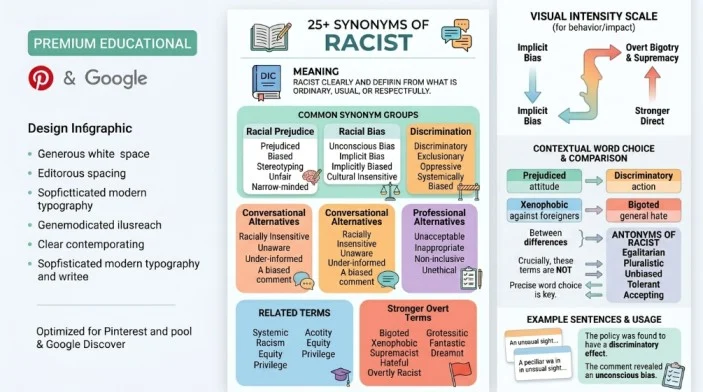
Words carry weight, especially when describing prejudice, discrimination, or attitudes toward people based on race or ethnicity. Synonyms of Racist can help writers communicate the exact meaning they intend, but not every alternative has the same strength, tone, or context. Some words describe racial prejudice directly, while others focus on discriminatory behavior, bias, intolerance, or exclusion. Choosing the right term can make an article, essay, report, conversation, or professional message more precise and responsible.
Understanding Synonyms of Racist is also about recognizing subtle differences in meaning. A formal term may suit academic writing, while a broader expression may work better when discussing discriminatory attitudes or actions. This guide explores accurate alternatives, explains their nuances, and shows how each word works in real sentences. The goal is clearer vocabulary without weakening or exaggerating the intended meaning.
What Are the Best Synonyms of “Racist”?
A racist is a person or belief that expresses prejudice, discrimination, hostility, or a sense of superiority based on race or perceived racial identity. Common alternatives include racially prejudiced, bigoted, discriminatory, biased, intolerant, and, in specific contexts, xenophobic or supremacist. The strongest choice depends on the exact behavior or belief being described.
Meaning, Tone, and Context
Simple Definition
Racist describes a person, belief, attitude, action, policy, or system involving prejudice, discrimination, hostility, or claims of superiority based on race or perceived racial identity.
The word can describe both people and ideas or actions.
For example:
“The organization was criticized for racist policies.”
Here, racist describes policies rather than a person.
Part of Speech
Racist can function primarily as:
- Noun: a person who holds or expresses racist beliefs.
- Adjective: something characterized by racial prejudice or discrimination.
Examples:
“The article criticized the racist.”
“The organization was accused of using racist language.”
Overall Tone
The word racist is strongly negative.
It identifies behavior, beliefs, or attitudes connected to racial prejudice or discrimination. Because it is a serious characterization, it should be used carefully and accurately.
Formality Level
Racist is a standard modern English word and can appear in formal, academic, journalistic, professional, and everyday communication.
However, the seriousness of the term means that formal writing should clearly explain the behavior, statement, policy, or belief being discussed whenever possible.
Common Uses
Native English speakers commonly use racist when discussing:
- Racial prejudice
- Racial discrimination
- Hate speech
- Racial stereotypes
- Racial hostility
- Unequal treatment
- Racial exclusion
- Claims of racial superiority
- Discriminatory policies
- Social and historical issues
Word Forms
| Form | Example |
|---|---|
| Adjective | racist |
| Noun | racist |
| Noun | racism |
| Adverbial phrase | racially |
| Related adjective | racial |
| Related noun | racialism, in specific usage |
The most useful related forms for everyday writing are racist, racism, racial, and racially.
When and How to Use “Racist”
Use racist when the available evidence supports a connection between the behavior, statement, policy, or belief and racial prejudice, discrimination, hostility, or superiority.
The word should not automatically be used for every unfair or offensive action. A precise description is usually stronger than an unsupported label.
Professional Context
“The company terminated the employee after an investigation into racist comments directed at coworkers.”
This wording connects the accusation to specific comments and an investigation.
Academic Context
“The novel contains racist stereotypes that reflect racial attitudes common in its historical setting.”
Here, the term describes the content and its relationship to racial stereotypes.
Workplace Context
“The organization has a policy prohibiting racist and discriminatory behavior.”
The word works naturally in workplace policies when discussing prohibited conduct.
Personal Context
“She said the remark was racist because it relied on a racial stereotype.”
This example makes the basis of the characterization clear.
Email Context
“I am writing to report a comment that I believe was racist and inappropriate.”
This wording identifies the concern without unnecessarily presenting an unverified accusation as established fact.
Resume Context
The word racist is generally not something to use as a self descriptive resume term. If discussing relevant professional experience, describe the actual work instead.
“Developed training materials addressing racial bias and workplace discrimination.”
Social Media Context
“The comment relies on a racial stereotype and is widely perceived as racist.”
This approach explains the concern rather than simply attaching a label.
Best Synonyms of “Racist”
No single synonym of racist works perfectly in every context. Some alternatives describe beliefs, some describe behavior, and others identify specific forms of racial hostility.
Professional Writing: Racially Prejudiced
Racially prejudiced is useful when you want to emphasize an unfair belief or attitude concerning race.
“The report examined racially prejudiced attitudes in the community.”
It can sound more analytical than simply calling someone racist.
Academic Writing: Racially Biased
Racially biased works well when discussing unequal assumptions, representations, judgments, or outcomes.
“The researchers examined whether the assessment contained racially biased assumptions.”
It is especially useful when the evidence concerns bias rather than an explicit statement of racial superiority.
Business Communication: Discriminatory
Discriminatory is often better when the issue involves unequal treatment, rules, decisions, or practices.
“The company investigated allegations of discriminatory hiring practices.”
It focuses on treatment or decisions rather than someone’s entire belief system.
Casual Conversation: Prejudiced
Prejudiced is a common and understandable alternative when discussing unfair attitudes toward a racial group.
“That comment sounded prejudiced.”
It is broader than racist, however, because prejudice can concern many characteristics beyond race.
Emotional Writing: Bigoted
Bigoted communicates strong intolerance toward a group.
“The character’s bigoted remarks revealed deep hostility toward the community.”
It is emotionally stronger in many contexts, but it is broader than race alone.
Creative Writing: Hostile Toward a Racial Group
This descriptive phrase can be more precise in storytelling.
“His speech was openly hostile toward the racial group.”
It allows the writer to describe the behavior without relying on a single label.
Resume Writing: Racially Discriminatory
In professional documents, racially discriminatory is usually more precise than simply using racist.
“Investigated complaints involving racially discriminatory workplace practices.”
Workplace Communication: Racially Biased
Use racially biased when discussing decisions, procedures, language, or assumptions that may disadvantage people based on race.
“The team reviewed the process for potentially racially biased criteria.”
Stronger Meaning: Supremacist
Supremacist is appropriate only when someone explicitly promotes the superiority of one racial group over another.
“The group promotes a white supremacist ideology.”
This is not a general replacement for racist. It describes a specific and more extreme ideology.
Softer or More Precise Meaning: Racially Insensitive
Racially insensitive can describe language or behavior that shows inadequate awareness of racial issues without necessarily establishing deliberate racial hatred.
“The advertisement was criticized as racially insensitive.”
This should not automatically replace racist when the evidence clearly supports the stronger term.
When Not to Use “Racist”
When the Behavior Is Simply Unfair
Not every unfair action is racist.
Less Precise:
“The manager was racist because she rejected my proposal.”
Better:
“The manager treated my proposal unfairly.”
If there is no evidence connecting the decision to race, racist may be an unsupported conclusion.
When You Mean General Prejudice
If the prejudice concerns a characteristic other than race, prejudiced or bigoted may be more accurate.
Less Precise:
“His attitude was racist.”
Better:
“His attitude was prejudiced.”
When You Mean Unequal Treatment
If the evidence concerns a specific policy or action, discriminatory may communicate the issue more precisely.
Less Precise:
“The hiring process was racist.”
Better:
“The hiring process was racially discriminatory.”
When You Mean Hostility Toward Foreigners
Use xenophobic when the hostility specifically concerns people perceived as foreign or outsiders.
Less Precise:
“The speech was racist.”
More Specific:
“The speech was xenophobic toward immigrants.”
The two concepts can overlap, but they are not identical.
When You Mean an Explicit Belief in Racial Superiority
Supremacist is more precise when someone promotes the superiority of one racial group.
General:
“The speaker expressed racist views.”
More Specific:
“The speaker promoted a supremacist ideology.”
When You Need Neutral Academic Language
Academic writing may benefit from describing the specific evidence.
Instead of:
“The policy was racist.”
Consider:
“The policy disproportionately affected one racial group and was criticized as racially discriminatory.”
The second sentence communicates more information and gives readers a clearer basis for the characterization.
Words Commonly Confused With “Racist”
Prejudiced
Difference: Prejudiced means holding an unfair preconceived opinion about a person or group. It can concern race, religion, gender, nationality, age, or other characteristics.
When to Use It: Use it when race is not necessarily the only form of prejudice involved.
Example:
“His comments revealed a prejudiced attitude toward the group.”
Bigoted
Difference: Bigoted suggests strong and unreasonable intolerance toward a group.
When to Use It: Use it when the attitude is strongly intolerant, especially when race is not the only issue.
Example:
“The organization rejected his bigoted statements.”
Discriminatory
Difference: Discriminatory usually focuses on unfair treatment, decisions, policies, or practices.
When to Use It: Use it when discussing concrete actions or unequal treatment.
Example:
“The investigation examined potentially discriminatory hiring practices.”
Xenophobic
Difference: Xenophobic refers specifically to hostility, fear, or prejudice toward foreigners or people perceived as outsiders.
When to Use It: Use it when nationality, foreign origin, or outsider status is central.
Example:
“The politician faced criticism for xenophobic remarks about immigrants.”
Supremacist
Difference: Supremacist refers to someone or an ideology that promotes the supposed superiority of one group over another.
When to Use It: Use it only when a belief in group superiority is actually present.
Example:
“The group openly promoted white supremacist ideas.”
Best Synonyms of “Racist” by Context
| Context | Best Synonym | Why It Works | Example |
|---|---|---|---|
| Formal writing | Racially prejudiced | Sounds analytical and precise | “The study examined racially prejudiced attitudes.” |
| Academic writing | Racially biased | Focuses on bias in evidence or decisions | “The model produced racially biased outcomes.” |
| Professional communication | Discriminatory | Emphasizes unfair treatment | “The company investigated discriminatory conduct.” |
| Business emails | Racially inappropriate | Useful for workplace concerns | “The comment was racially inappropriate.” |
| Resume writing | Racially discriminatory | Describes relevant professional experience precisely | “Reviewed racially discriminatory workplace complaints.” |
| Workplace communication | Racially biased | Suitable for policies and processes | “The hiring criteria may be racially biased.” |
| Casual conversation | Prejudiced | Familiar and broadly understandable | “That comment sounded prejudiced.” |
| Everyday speaking | Bigoted | Natural when emphasizing intolerance | “That was a bigoted thing to say.” |
| Creative writing | Hostile toward a racial group | Descriptive and flexible | “His speech was openly hostile toward the group.” |
| Storytelling | Racially prejudiced | Clearly describes the attitude | “The character held racially prejudiced beliefs.” |
| Emotional writing | Bigoted | Communicates strong intolerance | “The remarks were deeply bigoted.” |
| Strong emphasis | Supremacist | Indicates racial superiority ideology | “The group promotes supremacist beliefs.” |
| Mild tone | Racially insensitive | Useful when deliberate prejudice is not established | “The advertisement was racially insensitive.” |
| Social media captions | Prejudiced | Simple and accessible | “The statement was prejudiced and harmful.” |
| American English | Racist | Standard and widely understood | “The comment was racist.” |
| British English | Racist | Also standard in British English | “The remarks were described as racist.” |
How to Choose the Best Synonym of “Racist”
The most accurate alternative depends on the specific conduct or belief you are describing.
Step 1: Identify the Issue
Ask what actually happened.
Was there:
- An unfair belief?
- Unequal treatment?
- Racial stereotyping?
- Hostility?
- A claim of racial superiority?
- Hostility toward foreigners?
- A biased policy?
The answer determines the best vocabulary.
Step 2: Choose the Meaning
- Use prejudiced for an unfair attitude.
- Use discriminatory for unfair treatment or policies.
Use racially biased for bias in decisions, systems, or judgments.
- Use xenophobic for hostility toward foreigners or perceived outsiders.
Use supremacist for explicit beliefs in racial superiority.
Step 3: Consider Your Audience
- For general readers, prejudiced and racist are easy to understand.
For academic readers, racially biased, racially discriminatory, and racially prejudiced can provide more precision.
- For workplace communication, descriptive terms such as racially inappropriate, racially biased, and discriminatory can be useful when discussing specific incidents.
Step 4: Match the Emotional Strength
Do not automatically choose the strongest word.
Racially insensitive can describe questionable language without necessarily alleging intentional racial hatred.
Racist makes a stronger characterization.
Supremacist is more specific and should be reserved for explicit claims of racial superiority.
Step 5: Describe Evidence When Possible
Strong writing does not depend only on labels.
Instead of:
“The policy was racist.”
You can write:
“The policy was criticized as racially discriminatory because it created unequal requirements for members of different racial groups.”
The second version gives readers a reason for the characterization.
Real Life Examples of “Racist”
School
Basic:
“The book contains racist stereotypes.”
More precise:
“The book contains racial stereotypes that reinforce prejudiced assumptions about the group.”
College
Basic:
“The study examines racist attitudes.”
More academic:
“The study examines racially prejudiced attitudes and their effects on social relationships.”
Workplace
Basic:
“The employee made racist comments.”
More specific:
“The employee made comments that colleagues described as racially discriminatory.”
Business
Basic:
“The company faced accusations of racist hiring.”
More precise:
“The company faced allegations of racially discriminatory hiring practices.”
Basic:
“I want to report a racist comment.”
More careful:
“I would like to report a comment that I believe was racially inappropriate and discriminatory.”
Resume
Instead of writing:
“Worked on racist workplace issues.”
Use:
“Supported initiatives addressing racial bias and workplace discrimination.”
Conversation
“That comment sounds prejudiced because it assumes everyone from that racial group behaves the same way.”
This gives a reason rather than relying only on a label.
Storytelling
“The character’s remarks revealed a deeply prejudiced view of the community.”
This can be more descriptive than repeatedly using racist.
Blogging
“The article examines how racial stereotypes can contribute to discriminatory attitudes.”
This sounds analytical and informative.
Social Media
“The statement relies on a racial stereotype and has been criticized as racist.”
This approach communicates both the specific issue and the broader characterization.
25 Best Synonyms and Closely Related Alternatives for “Racist”
A vocabulary guide about synonym of racist needs an important distinction: several words below are close alternatives rather than perfect replacements. Prejudiced, discriminatory, xenophobic, and supremacist describe overlapping concepts, but each has a different scope. Using these distinctions keeps your writing accurate.
| Synonym or Alternative | Simple Meaning | Best Used For | Example Sentence |
|---|---|---|---|
| Racially prejudiced | Holding unfair racial attitudes | Academic and analytical writing | “The survey examined racially prejudiced attitudes.” |
| Prejudiced | Holding an unfair preconceived opinion | General discussion | “The comment sounded prejudiced.” |
| Racially biased | Showing racial bias | Research, decisions, systems | “The process may be racially biased.” |
| Discriminatory | Treating a group unfairly | Policies and actions | “The organization was accused of discriminatory practices.” |
| Racially discriminatory | Unfair treatment based on race | Formal and legal contexts | “The policy was challenged as racially discriminatory.” |
| Bigoted | Strongly intolerant toward a group | General and emotional writing | “The remarks were openly bigoted.” |
| Intolerant | Unwilling to accept a group or viewpoint | Broad social contexts | “The statement reflected an intolerant attitude.” |
| Xenophobic | Hostile toward foreigners or outsiders | Nationality and immigration | “The campaign was criticized as xenophobic.” |
| Supremacist | Promoting superiority of one group | Explicit racial ideology | “The group promotes supremacist beliefs.” |
| Racially insensitive | Lacking awareness of racial concerns | Workplace and public communication | “The advertisement was considered racially insensitive.” |
| Racially hostile | Showing hostility toward a racial group | Formal descriptions | “The messages contained racially hostile language.” |
| Racially exclusionary | Excluding people based on race | Policies and institutions | “The policy was criticized as racially exclusionary.” |
| Racially prejudicial | Showing racial prejudice | Academic writing | “The language was racially prejudicial.” |
| Race based discriminatory | Based on unequal racial treatment | Formal analysis | “The practice was described as race based discrimination.” |
| Racially oppressive | Involving racial oppression | Historical and social analysis | “The system maintained racially oppressive structures.” |
| Racially intolerant | Showing intolerance based on race | Social commentary | “The remarks appeared racially intolerant.” |
| Racially antagonistic | Showing opposition or hostility | Formal analysis | “The rhetoric was racially antagonistic.” |
| Segregationist | Supporting racial separation | Historical and political contexts | “The movement included segregationist elements.” |
| Nativist | Favoring native born people over immigrants | Immigration and politics | “The rhetoric reflected a nativist approach to immigration.” |
| Ethnocentric | Judging other cultures through one’s own cultural standards | Cultural analysis | “The argument was criticized as ethnocentric.” |
| Racial supremacist | Supporting racial superiority | Explicit extremist ideology | “The text promotes racial supremacist beliefs.” |
| Racially hostile | Expressing hostility based on race | Formal descriptions | “The messages were racially hostile.” |
| Racially exclusionary | Restricting participation based on race | Policies and practices | “The rules created a racially exclusionary environment.” |
| Racially discriminatory | Treating people differently based on race | Legal and professional contexts | “The practice was alleged to be racially discriminatory.” |
| Racially biased | Influenced by racial assumptions | Research and decision making | “The evaluation criteria appeared racially biased.” |
The table deliberately distinguishes close alternatives from exact replacements. For example, nativist, segregationist, and supremacist are narrower terms, while prejudiced and intolerant are broader. Precision matters more than forcing every related word into the same meaning.
Synonyms of “Racist” by Usage
Professional vs Personal Synonyms
In professional settings, choose language that identifies the specific issue.
Professional choices:
- Racially discriminatory
- Racially biased
- Racially prejudiced
- Discriminatory
- Racially inappropriate
Personal or conversational choices:
- Racist
- Prejudiced
- Bigoted
- Intolerant
A workplace report is usually stronger when it describes the specific conduct rather than relying only on an emotionally charged label.
Formal vs Conversational Synonyms
Reports
Use:
- Racially discriminatory
- Racially biased
- Racially prejudiced
Essays
Use:
- Racially prejudiced
- Racially biased
- Discriminatory
- Supremacist, when specifically applicable
Business Writing
Use:
- Discriminatory
- Racially biased
- Racially inappropriate
Presentations
Use clear terms that your audience will understand.
“The research identifies racial bias in the hiring process.”
Emails
When reporting a concern, descriptive language can reduce ambiguity.
“I am reporting a comment that appeared racially discriminatory.”
Casual Conversations
Use:
- Racist
- Prejudiced
- Bigoted
Texting
Simple language is usually most natural.
“That comment was racist.”
Academic Synonyms
Academic writing benefits from precision rather than emotional intensity.
Racially Biased
Useful when discussing judgments, data, systems, assessments, or assumptions.
“The researchers investigated whether the algorithm produced racially biased outcomes.”
Racially Prejudiced
Useful when discussing attitudes or beliefs.
“The survey measured racially prejudiced attitudes among participants.”
Racially Discriminatory
Useful when discussing unequal treatment.
“The researchers examined potentially racially discriminatory practices.”
Segregationist
Useful when specifically discussing support for racial separation.
“The paper analyzes segregationist policies from the period.”
Supremacist
Use only when the source or evidence actually involves claims of racial superiority.
“The study examines the rhetoric of a white supremacist movement.”
These terms sound more authoritative because they identify the specific type of racial issue being discussed.
Professional and Business Synonyms
Resumes
Avoid labeling people or organizations unless the context genuinely requires it.
Prefer describing relevant professional work:
“Developed workplace training addressing racial bias.”
Interviews
Use precise language when discussing diversity, inclusion, or workplace conduct.
“I have experience supporting initiatives focused on racial discrimination and workplace inclusion.”
Meetings
When discussing a specific concern:
“We should review whether the policy creates racially discriminatory outcomes.”
Presentations
“The research identifies racial bias as a factor affecting the results.”
Performance Reviews
Avoid unsupported labels.
Instead of:
“He is racist.”
Use evidence based language:
“He made repeated comments that colleagues reported as racially inappropriate.”
Client Communication
Use professional and descriptive wording.
“The advertisement was criticized for relying on racial stereotypes.”
Business Emails
A careful formulation is often best:
“I would like to raise a concern about language that may be racially discriminatory.”
Creative and Literary Synonyms
Creative writing gives you more freedom to describe behavior through imagery and characterization.
Prejudiced
Useful for describing a character’s beliefs.
“His prejudiced assumptions shaped every conversation he had with the neighbors.”
Bigoted
Stronger and more emotionally charged.
“The character’s bigoted remarks quickly alienated the people around him.”
Racially Hostile
Useful when the focus is aggressive behavior.
“The speech became openly hostile toward the racial community.”
Supremacist
Appropriate when the character explicitly believes one racial group is superior.
“His writings revealed a supremacist ideology.”
Racially Insensitive
Useful when the character demonstrates ignorance or poor awareness rather than explicit hatred.
“Her comment was racially insensitive, even though she claimed she had not intended to offend anyone.”
Slang or Modern Synonyms
There is no single widely accepted slang word that safely replaces racist while preserving its exact meaning.
Casual expressions such as bigoted, prejudiced, or a bigot are sometimes used in conversation, but they are not exact substitutes in every situation.
Avoid inventing slang or using internet expressions as though they were established dictionary synonyms. In professional and academic writing, standard vocabulary is much safer.
Strongest to Mildest Synonyms
There is no universal intensity scale because these words describe different dimensions of racial prejudice. A more useful guide is based on the claim each word makes.
| Level | Word | What It Suggests |
|---|---|---|
| Mild or cautious | Racially insensitive | The language may show poor awareness or racial insensitivity |
| Mild to moderate | Racially biased | A racial bias may influence a decision or belief |
| Moderate | Prejudiced | An unfair preconceived attitude exists |
| Moderate | Racially discriminatory | Unequal treatment based on race is involved |
| Strong | Racist | Racial prejudice, discrimination, hostility, or superiority is involved |
| Strong | Bigoted | Strong intolerance toward a group is present |
| Very strong and specific | Supremacist | Explicit belief in group superiority is involved |
The strongest word is not always the best word. Supremacist is more specific than racist, but it should only be used when superiority is actually part of the belief.
Emotional vs Neutral Synonyms
Emotional Synonyms
These terms can carry stronger emotional force:
- Bigoted
- Racist
- Intolerant
- Supremacist
- Racially hostile
They may be appropriate when discussing serious conduct or expressing moral condemnation.
Neutral or Analytical Synonyms
These terms are often more suitable for objective writing:
- Racially biased
- Racially prejudiced
- Racially discriminatory
- Discriminatory
- Racially insensitive
These alternatives can help writers explain an issue without unnecessarily increasing the emotional intensity.
Antonyms of “Racist”
Because racist describes a person or attitude characterized by racial prejudice or discrimination, its most direct opposites are concepts describing racial equality, inclusion, and rejection of racial prejudice. Some entries below are conceptual opposites rather than single word dictionary antonyms.
| Antonym or Opposite Concept | Meaning | Example Sentence |
|---|---|---|
| Anti racist | Opposed to racism | “The organization describes itself as anti racist.” |
| Egalitarian | Supporting equality among people | “She holds an egalitarian view of society.” |
| Unbiased | Free from relevant prejudice or favoritism | “The evaluation process should be unbiased.” |
| Impartial | Treating relevant parties fairly | “The committee aimed to remain impartial.” |
| Fair | Treating people reasonably and equally | “The employer promised a fair hiring process.” |
| Inclusive | Welcoming people from different backgrounds | “The school promotes an inclusive environment.” |
| Tolerant | Accepting differences | “The community encourages tolerant attitudes.” |
| Accepting | Open to people with different identities or backgrounds | “The group is accepting of cultural differences.” |
| Respectful | Showing regard for others | “Her response was respectful and thoughtful.” |
| Equitable | Fair and just in treatment or opportunity | “The program seeks equitable access to education.” |
| Non discriminatory | Not treating people unfairly based on protected characteristics | “The company maintains a non discriminatory hiring policy.” |
| Open minded | Willing to consider different people and perspectives | “He is open minded about cultural differences.” |
| Humanistic | Emphasizing human dignity and value | “The approach takes a humanistic view of social relationships.” |
| Inclusive minded | Focused on welcoming different groups | “The organization promotes an inclusive minded workplace culture.” |
| Anti prejudiced | Opposed to prejudice | “The campaign promotes anti prejudiced attitudes.” |
Comparison: “Racist” vs Similar Words
Racist vs Prejudiced
Main Difference:
Racist specifically concerns race or perceived racial identity. Prejudiced is broader and can involve race, religion, gender, nationality, age, or other characteristics.
Which Is Stronger?
Neither is automatically stronger. They describe different scopes.
Which Is More Formal?
Both are standard, but prejudiced can sound more general and analytical.
When to Use Each:
Use racist when race is central. Use prejudiced when the specific type of prejudice is broader or unclear.
Racist:
“The comment was racist.”
Prejudiced:
“The comment reflected a prejudiced attitude.”
Racist vs Bigoted
Main Difference:
Racist specifically concerns race. Bigoted describes strong intolerance toward a group and can apply beyond race.
Which Is Stronger?
Bigoted often sounds emotionally stronger, but context determines intensity.
Which Is More Formal?
Both can appear in formal writing, although analytical writing may prefer a more specific description.
When to Use Each:
Use racist for racial prejudice. Use bigoted when strong group based intolerance is the main point.
Racist:
“The statement was racist.”
Bigoted:
“The statement was deeply bigoted.”
Racist vs Discriminatory
Main Difference:
Racist can describe beliefs or attitudes. Discriminatory usually focuses on unfair treatment, decisions, rules, or practices.
Which Is Stronger?
Neither is automatically stronger.
Which Is More Formal?
Discriminatory is particularly useful in professional and institutional writing.
When to Use Each:
Use discriminatory when describing a specific action or policy.
Racist:
“The speaker expressed racist beliefs.”
Discriminatory:
“The policy was discriminatory.”
Racist vs Xenophobic
Main Difference:
Racist concerns race. Xenophobic concerns hostility or prejudice toward foreigners or perceived outsiders.
Which Is Stronger?
Neither universally.
Which Is More Formal?
Both are standard terms.
When to Use Each:
Use xenophobic when nationality or foreign origin is central to the hostility.
Racist:
“The statement contained racist stereotypes.”
Xenophobic:
“The speech contained xenophobic comments about immigrants.”
Racist vs Supremacist
Main Difference:
Supremacist specifically describes a belief that one group is superior to another.
Which Is Stronger?
Supremacist is more specific and can indicate a more extreme ideological position.
Which Is More Formal?
Both can be used in formal writing when accurately supported.
When to Use Each:
Use supremacist only when a belief in racial or group superiority is evident.
Racist:
“The statement expressed racist views.”
Supremacist:
“The statement promoted racial superiority.”
Racist vs Racially Insensitive
Main Difference:
Racially insensitive can describe language or conduct that lacks awareness or consideration of racial issues. It does not necessarily establish intentional racial prejudice.
Which Is Stronger?
Racist generally makes the stronger characterization.
Which Is More Formal?
Racially insensitive can be useful in professional discussions where careful description matters.
When to Use Each:
Use racially insensitive when the evidence supports insensitivity but does not establish a stronger claim.
Racist:
“The organization was accused of racist conduct.”
Racially insensitive:
“The advertisement was criticized as racially insensitive.”
Common Phrases and Expressions with “Racist”
Racist Comment
Meaning: A statement that expresses or relies on racial prejudice.
Example:
“The employee apologized for making a racist comment.”
Racist Remark
Meaning: A spoken or written statement criticized for racial prejudice.
Example:
“The politician faced criticism after making a racist remark.”
Racist Attitude
Meaning: A pattern of racial prejudice or bias.
Example:
“The training program addresses racist attitudes in the workplace.”
Racist Stereotype
Meaning: A generalized and prejudicial belief about a racial group.
Example:
“The article challenges harmful racist stereotypes.”
Racist Behavior
Meaning: Conduct involving racial prejudice or discrimination.
Example:
“The school has policies addressing racist behavior.”
Racist Language
Meaning: Words or expressions that convey racial prejudice or hostility.
Example:
“The platform prohibits racist language.”
Racist Policy
Meaning: A policy characterized by racial discrimination or prejudice.
Example:
“Researchers examined the historical effects of the racist policy.”
Racist Ideology
Meaning: A system of beliefs involving racial hierarchy, prejudice, or superiority.
Example:
“The documentary explores the development of racist ideology.”
Common Mistakes to Avoid
1. Treating Every Related Word as an Exact Synonym
Incorrect:
“Xenophobic is exactly the same as racist.”
Better:
“Xenophobic and racist can overlap, but xenophobia specifically concerns hostility toward foreigners or perceived outsiders.”
Why:
The distinction prevents inaccurate vocabulary choices.
2. Using “Bigoted” When Race Is Not the Issue
Incorrect:
“The statement was racist because it attacked his religion.”
Better:
“The statement was bigoted because it attacked his religion.”
Why:
Religious prejudice is not necessarily racial prejudice.
3. Using “Supremacist” Without Evidence of Superiority
Incorrect:
“Anyone who makes a racial stereotype is automatically a supremacist.”
Better:
“The statement contains a racial stereotype.”
Why:
Supremacist makes a specific claim about beliefs in group superiority.
4. Using “Racist” for Every Unfair Decision
Incorrect:
“The manager rejected my idea, so he is racist.”
Better:
“The manager rejected my idea without giving a clear reason.”
Why:
An unfair decision alone does not establish racial prejudice.
5. Using Informal Language in Academic Writing
Incorrect:
“The author was being super racist.”
Better:
“The author uses racially prejudiced language.”
Why:
The revised sentence is more precise and appropriate for academic analysis.
6. Making the Label Without Explaining the Evidence
Incorrect:
“The advertisement is racist.”
Better:
“The advertisement relies on a racial stereotype and has been criticized as racist.”
Why:
The second version identifies the specific feature that prompted the criticism.
7. Assuming Intent Without Evidence
Incorrect:
“The writer intentionally used racist language.”
Better:
“The writer used language that was criticized as racist.”
Why:
The revised version avoids claiming knowledge of someone’s intent without supporting evidence.
Frequently Asked Questions
What is another word for racist?
Common alternatives include racially prejudiced, discriminatory, bigoted, intolerant, and racially biased, depending on the context.
What are synonyms for racist?
Useful synonyms for racist include bigoted, prejudiced, discriminatory, intolerant, and racially biased.
What are synonyms of racism?
Common synonyms of racism include racial prejudice, racial discrimination, racial bias, and racial intolerance.
What is a racist synonym?
A racist synonym can be bigoted, prejudiced, discriminatory, or racially biased, depending on the intended meaning.
What is another word for racism?
Another word for racism can be racial prejudice, racial discrimination, or racial bias.
What is the synonym for racist?
A suitable synonym for racist is bigoted, prejudiced, or racially discriminatory, depending on the sentence.
What are common racism synonyms?
Common racism synonyms include racial prejudice, racial bias, racial discrimination, and racial intolerance.
What is the opposite of racist?
The opposite of racist is not one exact word. Depending on context, terms such as anti-racist, inclusive, egalitarian, or non-discriminatory may fit.
What are synonyms of racist?
Synonyms of racist include bigoted, prejudiced, intolerant, and racially discriminatory. The best choice depends on the specific context.
Conclusion
The best synonym of racist depends on exactly what you mean. Prejudiced works for unfair attitudes, racially biased fits decisions and assumptions, discriminatory describes unequal treatment, bigoted emphasizes strong intolerance, and supremacist should be reserved for explicit beliefs in racial superiority.
Good vocabulary is not about replacing one word with another simply because a thesaurus suggests it. The strongest choice communicates the precise idea, matches the audience, and reflects the available evidence. Before using a synonym of racist, identify whether you are describing a belief, attitude, statement, policy, behavior, or ideology.
A useful vocabulary habit is to ask what specific meaning you need before choosing an alternative. That small step can make your writing clearer, more accurate, and more responsible.
Read More Related Articles:
- Synonyms for Empty | Meaning, Examples, and Better Word …
- Synonyms for Creativity | Meaning, Examples, and Better …
- 25+ Synonyms of Perseverance | Meanings, Uses, Examples …