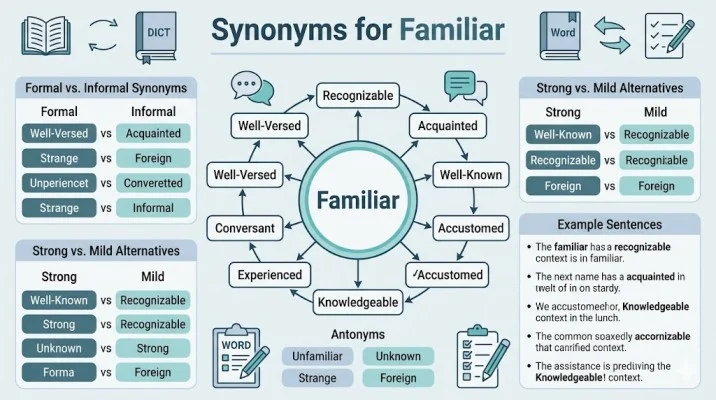
If you’re searching for synonyms for familiar, the best choice depends on what familiar means in your sentence. It can describe someone who knows something well, a person or place that feels recognizable, or behavior that is friendly in a way that may or may not be appropriate. Because the word has several meanings, no single synonym works in every situation. Choosing the right alternative depends on context, tone, and the level of formality you want.
you’re writing an essay, preparing a report, improving your vocabulary, or simply looking for a better word, this guide explains the most accurate synonyms, how they differ, and when each one fits naturally.
Best Synonyms for Familiar
The best synonyms for familiar are well-known, recognized, acquainted, accustomed, and conversant.
The right choice depends on the context:
- Well-known – something widely recognized
- Acquainted – knowing a person or subject
- Accustomed – used to something through experience
- Recognizable – easy to identify
- Conversant – knowledgeable about a topic
What Does Familiar Mean?
Familiar is an adjective with several closely related meanings. In everyday English, it usually describes something or someone that is already known through previous experience.
The word can also describe having good knowledge of a subject or being comfortable because something is not new.
Part of Speech
Adjective
Simple Definition
Someone or something is familiar when it is known, recognized, understood, or experienced before.
Example Sentences
- The song sounded familiar as soon as it started playing.
- She is familiar with the company’s hiring process.
Core Meaning of Familiar
At its heart, familiar expresses the idea of recognition through previous experience.
- A familiar face is one you’ve seen before.
- A familiar place is somewhere you’ve visited enough to recognize easily.
- A familiar topic is one you understand because you’ve studied or worked with it previously.
The word often creates a feeling of comfort because familiar things usually feel less uncertain than unfamiliar ones.
However, familiar can sometimes describe behavior that is overly casual or too friendly.
For example:
The manager felt the employee had become too familiar with clients.
In this case, the word means someone acted with less formality than expected.
Understanding which meaning applies helps you choose the best synonym.
Grammar and Usage Notes
Part of Speech
Familiar is primarily used as an adjective.
Examples:
- familiar surroundings
- familiar voice
- familiar feeling
Common Sentence Patterns
- familiar with
- familiar to
- become familiar with
- look familiar
- sound familiar
- feel familiar
Examples:
- I’m familiar with this software.
- Her name sounds familiar.
- The neighborhood feels familiar.
Common Collocations
Writers frequently pair familiar with nouns such as:
- face
- voice
- place
- smell
- routine
- environment
- topic
- concept
- name
- feeling
- expression
- experience
When Familiar Sounds Natural
Use familiar when discussing recognition, knowledge gained through experience, or comfort with something already known.
Examples:
- The instructions are familiar.
- I’m familiar with the process.
- That melody is familiar.
When Another Word Works Better
Sometimes a synonym communicates your meaning more precisely.
Instead of saying:
She is familiar with international law.
You could write:
She is well-versed in international law.
Instead of:
This building looks familiar.
You could say:
This building looks recognizable.
Selecting a more specific synonym often improves clarity.
Best Synonyms for Familiar
| Synonym | Meaning | Tone | Best Use Case | Example Sentence |
|---|---|---|---|---|
| Well-known | Widely recognized | Neutral | General writing | The landmark is well-known around the city. |
| Recognizable | Easy to identify | Neutral | Appearance, sounds, places | His handwriting is instantly recognizable. |
| Acquainted | Having knowledge through experience | Formal | People and relationships | I’m acquainted with the new manager. |
| Accustomed | Used to something | Neutral | Habits and routines | She’s accustomed to working late. |
| Conversant | Knowledgeable about a subject | Formal | Academic and professional writing | He is conversant with tax regulations. |
| Experienced | Skilled through practice | Neutral | Work and expertise | She’s an experienced engineer. |
| Knowledgeable | Having substantial understanding | Neutral | Education and business | Our guide was knowledgeable about local history. |
| Well-versed | Highly informed | Formal | Reports and academic writing | The lawyer is well-versed in contract law. |
| Recognized | Known by many people | Formal | Public reputation | She is a recognized authority in medicine. |
| Comfortable | Feeling at ease | Informal | Everyday conversation | He’s comfortable using the new system. |
Common Synonyms for Familiar
These are the everyday alternatives people commonly use when familiar doesn’t feel like the best fit. Each synonym has its own shade of meaning, so choosing the right one depends on what you’re trying to express.
Well-Known
Meaning: Known by many people or widely recognized.
Best Context: Public figures, places, brands, events, or ideas.
Example:
The museum is a well-known attraction for visitors from around the world.
Recognizable
Meaning: Easy to identify because you’ve seen or heard it before.
Best Context: Faces, voices, logos, songs, buildings, and styles.
Example:
Her voice was instantly recognizable over the phone.
Acquainted
Meaning: Having some knowledge of a person, place, or subject through experience.
Best Context: Formal conversations, professional writing, and introductions.
Example:
I’m acquainted with the company’s hiring process.
Accustomed
Meaning: Used to something because you’ve experienced it regularly.
Best Context: Habits, routines, weather, work, or daily life.
Example:
After a few weeks, she became accustomed to the early schedule.
Knowledgeable
Meaning: Having a good amount of information or understanding.
Best Context: Experts, teachers, consultants, and professionals.
Example:
The travel guide was knowledgeable about local history and culture.
Experienced
Meaning: Having gained skill through practice or time.
Best Context: Jobs, careers, sports, and technical work.
Example:
The experienced mechanic found the problem within minutes.
Comfortable
Meaning: Feeling relaxed because something is already known.
Best Context: Everyday conversations and personal experiences.
Example:
He’s comfortable using the new software now.
Well-Versed
Meaning: Highly informed about a subject.
Best Context: Academic papers, business writing, and professional communication.
Example:
She is well-versed in environmental policy.
Formal Synonyms for Familiar
Formal writing often benefits from more precise vocabulary. These alternatives work well in essays, reports, research papers, business communication, and professional documents.
Acquainted
This word emphasizes having previous knowledge or experience.
Best for:
- Academic writing
- Business emails
- Professional introductions
Example:
Applicants should be acquainted with the organization’s policies.
Conversant
Conversant suggests a strong working knowledge of a subject.
Best for:
- Legal writing
- Technical documents
- Professional reports
Example:
Engineers should be conversant with current safety standards.
Well-Versed
Use this synonym when describing someone with extensive knowledge.
Example:
The professor is well-versed in medieval literature.
Informed
This word highlights awareness based on reliable information.
Example:
Managers should remain informed about industry changes.
Experienced
When discussing practical knowledge gained over time, experienced often fits better than familiar.
Example:
An experienced auditor reviewed the financial statements.
Proficient
Although not always an exact synonym, proficient works when discussing skill rather than simple familiarity.
Example:
She is proficient in three programming languages.
Informal Synonyms for Familiar
Casual conversations usually call for simpler, friendlier words. These alternatives sound natural in speech, text messages, social media posts, and personal writing.
Used To
Instead of saying someone is familiar with something, everyday English often uses used to.
Example:
I’m used to working weekends.
Know
Sometimes the simplest word is the clearest.
Example:
I know this neighborhood really well.
Seen Before
This phrase works naturally when talking about recognition.
Example:
I’ve seen that actor before.
Ring a Bell
An idiom meaning something sounds familiar.
Example:
That name rings a bell, but I can’t remember where I heard it.
Old Friend
When referring to something comfortably familiar, people sometimes use expressions like an old friend.
Example:
Returning home felt like meeting an old friend.
Feel at Home
This phrase expresses comfort in familiar surroundings.
Example:
After a few days, everyone felt at home in the new office.
Strong Synonyms for Familiar
Some alternatives carry more emphasis than familiar. They suggest deeper knowledge, stronger recognition, or greater experience.
Intimately Familiar
This phrase indicates extremely detailed knowledge.
Example:
She’s intimately familiar with every stage of the project.
Expert
Use this when knowledge reaches a professional level.
Example:
He’s an expert in cybersecurity.
Note: An expert has much greater knowledge than someone who is merely familiar.
Master
This word suggests exceptional skill and complete understanding.
Example:
She mastered the software after years of daily use.
Highly Knowledgeable
A stronger alternative suitable for professional writing.
Example:
The consultant is highly knowledgeable about renewable energy.
Seasoned
This synonym highlights extensive practical experience.
Example:
A seasoned journalist covered the election.
Veteran
Often used for someone with many years of experience in a profession or activity.
Example:
The veteran coach recognized the team’s weaknesses immediately.
Mild Synonyms for Familiar
Sometimes you don’t want to overstate someone’s knowledge or experience. These softer alternatives are more appropriate.
Aware Of
Suggests basic knowledge without implying expertise.
Example:
Most employees are aware of the policy changes.
Recognize
Focuses on identification rather than understanding.
Example:
I recognize that building from my childhood.
Know Of
Means you’ve heard about something but may not know many details.
Example:
I know of the author, but I haven’t read any of her books.
Somewhat Acquainted
A gentle way to describe limited familiarity.
Example:
I’m somewhat acquainted with the software.
Slightly Familiar
Indicates only partial recognition.
Example:
The topic was slightly familiar, but I needed a refresher.
Loosely Familiar
Useful when someone has only general knowledge.
Example:
He’s loosely familiar with the company’s history.
Synonyms for Familiar by Context
Choosing the right synonym becomes much easier when you consider where and how you’re using the word.
Everyday Conversation
In casual speech, people usually prefer simple and natural alternatives.
Good choices include:
- know
- recognize
- used to
- comfortable with
- seen before
Example:
I’m comfortable with this app now because I use it every day.
Professional Writing
Business communication benefits from precise language.
Recommended synonyms:
- acquainted
- experienced
- knowledgeable
- conversant
- proficient
Example:
Candidates should be acquainted with project management software.
Academic Writing
Formal assignments often require vocabulary that sounds objective and specific.
Suitable choices include:
- conversant
- well-versed
- informed
- knowledgeable
- proficient
Example:
Researchers should be well-versed in current methodologies.
Creative Writing
Creative writing allows for more descriptive alternatives that create vivid imagery.
Good options include:
- recognizable
- well-known
- remembered
- long-known
- comforting
Example:
The familiar scent of fresh bread welcomed her home.
Personal Communication
When writing emails, texts, or letters, friendly wording usually feels more natural.
Useful alternatives include:
- know
- comfortable with
- used to
- recognize
Example:
Don’t worry—I already know how the system works.
Emotional Expression
When familiarity creates feelings of comfort or nostalgia, choose words that reflect emotion.
Good options:
- comforting
- reassuring
- recognizable
- welcoming
Example:
The familiar melody brought back happy memories.
Another Word for Familiar in a Sentence
The following examples show how different synonyms for familiar work in everyday English. Each sentence uses a different word naturally.
- I’m acquainted with the company’s onboarding process.
- The tune sounded recognizable after only a few notes.
- She is well-versed in digital marketing strategies.
- Most residents are accustomed to heavy snowfall during winter.
- The professor is knowledgeable about ancient civilizations.
- Our guide was experienced enough to answer every question.
- The restaurant has become a well-known destination for seafood lovers.
- I’m comfortable using the new accounting software now.
- He’s conversant with the latest cybersecurity regulations.
- The logo is instantly recognizable from a distance.
- After several visits, the city felt comfortably familiar.
- Everyone on the team is aware of the updated safety procedures.
- She quickly recognized the voice on the phone.
- I’m used to working under tight deadlines.
- The neighborhood still felt welcoming and familiar after many years.
Familiar Synonyms Compared
Although many words are similar to familiar, they are not always interchangeable. The table below highlights the main differences.
| Word | Meaning | Tone | Intensity | Best Use Case |
|---|---|---|---|---|
| Familiar | Known through previous experience | Neutral | Medium | General use |
| Acquainted | Having some knowledge | Formal | Medium | Professional and academic writing |
| Recognizable | Easy to identify | Neutral | Mild | Appearance, sounds, brands |
| Accustomed | Used to something | Neutral | Medium | Habits and routines |
| Knowledgeable | Having substantial information | Neutral | Strong | Experts and education |
| Well-Versed | Deeply informed | Formal | Strong | Essays and reports |
| Conversant | Competent in a subject | Formal | Strong | Technical and professional contexts |
| Experienced | Skilled through practice | Neutral | Strong | Careers and practical work |
| Comfortable | Feeling relaxed with something | Informal | Mild | Everyday conversation |
| Well-Known | Recognized by many people | Neutral | Medium | Places, people, brands |
Familiar vs. Acquainted
Both words involve previous knowledge.
- Familiar is broader and works in most situations.
- Acquainted usually refers to knowing a person, place, or subject to some extent.
Example:
- I’m familiar with the software.
- I’m acquainted with the software’s basic features.
Familiar vs. Accustomed
These words are related but not identical.
- Familiar means something is known.
- Accustomed means you’ve become used to it through repeated experience.
Example:
- The process is familiar.
- I’m accustomed to following the process every day.
Familiar vs. Well-Versed
The difference is the level of expertise.
Someone can be familiar with a topic without knowing every detail.
Someone who is well-versed has deep knowledge.
Familiar vs. Recognizable
- Familiar often includes understanding or experience.
- Recognizable focuses only on being identifiable.
A face can be recognizable even if you don’t remember the person’s name.
Words Similar to Familiar
Some words belong to the same semantic field but are not exact synonyms. They relate to the idea of recognition, knowledge, or experience but cannot always replace familiar directly.
Aware
Why it’s related:
Both involve knowledge.
Difference:
Being aware simply means knowing that something exists.
Example:
She was aware of the schedule changes.
Proficient
Why it’s related:
Both describe knowledge.
Difference:
Proficient emphasizes skill and competence rather than recognition.
Example:
He’s proficient in graphic design.
Expert
Why it’s related:
Experts are certainly familiar with their field.
Difference:
An expert possesses far more knowledge than someone who is merely familiar.
Comfortable
Why it’s related:
Familiar situations often make people feel comfortable.
Difference:
Comfortable describes a feeling rather than knowledge.
Recognized
Why it’s related:
Both involve recognition.
Difference:
Recognized often means officially acknowledged or identified by others.
Common
Why it’s related:
Common things are often familiar because people encounter them regularly.
Difference:
Common refers to frequency, not personal knowledge.
Routine
Why it’s related:
Routine activities become familiar over time.
Difference:
Routine describes repeated actions instead of recognition itself.
Everyday
Why it’s related:
Everyday experiences often become familiar.
Difference:
It refers to ordinary, daily life rather than previous knowledge.
Antonyms of Familiar
The opposite of familiar depends on the meaning being used. These antonyms express ideas such as being unknown, strange, or inexperienced.
| Antonym | Meaning | Example Sentence |
|---|---|---|
| Unfamiliar | Not known or recognized | The route was unfamiliar to the tourists. |
| Unknown | Not identified or discovered | The source of the noise remained unknown. |
| Strange | Different from what is expected | Everything felt strange after the move. |
| Foreign | Coming from another place or unfamiliar | The customs were completely foreign to him. |
| Unaccustomed | Not used to something | She was unaccustomed to working night shifts. |
| Inexperienced | Lacking practical experience | The inexperienced employee needed extra guidance. |
| Ignorant | Lacking knowledge | He was ignorant of the new regulations. |
| Unrecognized | Not identified or acknowledged | The artist remained unrecognized for many years. |
Example Sentences
- The language sounded completely unfamiliar.
- He was inexperienced but eager to learn.
- The village felt strange at first.
- She was unaccustomed to the colder climate.
- The author remained unknown outside academic circles.
How to Choose the Right Synonym for Familiar
The best synonym for familiar depends on what you want to communicate. Before replacing the word, think about the context, your audience, and the level of knowledge or recognition you want to express.
Match the Context
Ask yourself what familiar means in your sentence.
- If it means recognized, use recognizable or well-known.
- If it means having knowledge, choose acquainted, knowledgeable, or well-versed.
- If it means used to something, accustomed is often the better choice.
Match the Tone
Formal writing benefits from precise vocabulary.
Formal options:
- acquainted
- conversant
- well-versed
- knowledgeable
- proficient
For everyday conversation, simpler words usually sound more natural.
Informal options:
- know
- used to
- comfortable with
- recognize
Check the Intensity
Some synonyms suggest much greater expertise than familiar.
For example:
- Familiar → basic or moderate knowledge
- Knowledgeable → solid understanding
- Well-versed → extensive knowledge
- Expert → exceptional mastery
Avoid using a stronger word unless it accurately reflects the situation.
Think About the Reader
Choose words your audience will understand.
A business report may benefit from conversant or proficient, while a blog post or email is usually clearer with familiar, know, or comfortable with.
Make Sure It’s an Exact Synonym
Some related words cannot replace familiar in every sentence.
For example:
- Comfortable describes a feeling.
- Expert describes a high level of skill.
- Aware means having basic knowledge.
Each is related but has a different meaning.
Keep the Sentence Natural
The simplest word is often the strongest choice. If familiar already fits your sentence well, there is no need to replace it.
Common Mistakes When Using Synonyms for Familiar
Choosing the wrong synonym can change your meaning or make your writing sound unnatural. Here are some common mistakes to avoid.
Choosing a Word With the Wrong Tone
Some words are much more formal than others.
❌ I’m conversant with this game.
✅ I’m familiar with this game.
In casual conversation, familiar with sounds more natural.
Using a Synonym That Is Too Strong
Don’t replace familiar with expert unless someone truly has expert-level knowledge.
❌ I’m an expert in Excel because I use it occasionally.
✅ I’m familiar with Excel.
Using Formal Vocabulary in Casual Writing
Words like well-versed and conversant work well in reports but may sound stiff in text messages or everyday conversation.
Using Casual Words in Professional Documents
Professional writing often benefits from more precise alternatives.
Instead of:
The candidate knows the regulations.
You could write:
The candidate is well-versed in the regulations.
Treating Related Words as Exact Synonyms
Not every related word has the same meaning.
For example:
- Comfortable refers to a feeling.
- Recognizable refers to identification.
- Experienced refers to practical skill.
These words overlap with familiar, but they are not interchangeable in every sentence.
Ignoring Context
Always read the entire sentence after replacing a word.
If the new version sounds awkward or changes the meaning, choose a different synonym or keep the original word.
Quick Synonym List for Familiar
Common Synonyms
- well-known
- recognizable
- acquainted
- accustomed
- knowledgeable
- experienced
- comfortable
- well-versed
Formal Synonyms
- acquainted
- conversant
- well-versed
- proficient
- informed
- knowledgeable
Informal Synonyms
- know
- used to
- comfortable with
- recognize
- seen before
- rings a bell
Strong Synonyms
- expert
- master
- seasoned
- veteran
- highly knowledgeable
- intimately familiar
Mild Synonyms
- aware of
- know of
- recognize
- somewhat acquainted
- slightly familiar
- loosely familiar
Related Words
- proficient
- experienced
- informed
- aware
- common
- routine
- everyday
- recognized
FAQs
What is the best synonym for familiar?
The best synonym depends on the context. Acquainted, recognizable, accustomed, well-known, and knowledgeable are among the most accurate alternatives.
What is another word for familiar?
Common alternatives include recognizable, well-known, acquainted, comfortable with, and accustomed.
What is a formal synonym for familiar?
Formal synonyms include conversant, well-versed, acquainted, knowledgeable, and proficient, depending on the intended meaning.
What is an informal synonym for familiar?
In everyday conversation, people often use know, used to, comfortable with, or recognize instead of familiar.
What is a stronger word for familiar?
If you want to express deeper knowledge, consider well-versed, expert, seasoned, or highly knowledgeable. These words imply greater experience than familiar.
What is a milder word for familiar?
Softer alternatives include aware of, know of, slightly familiar, and somewhat acquainted. These suggest limited knowledge rather than complete understanding.
What words are similar to familiar?
Related words include proficient, experienced, aware, recognized, routine, and common. While these words share similar ideas, they are not always direct substitutes.
What is the opposite of familiar?
The most common antonyms are unfamiliar, unknown, strange, foreign, unaccustomed, and inexperienced.
How do I choose the right synonym for familiar?
Start by identifying what familiar means in your sentence. Then choose a synonym that matches the context, tone, and level of intensity. Finally, read the sentence aloud to make sure the replacement sounds natural.
Conclusion
The word familiar is flexible because it can describe recognition, previous experience, knowledge, comfort, or even casual behavior. That versatility also means there is no single synonym that fits every situation.
If you’re referring to recognition, recognizable or well-known may be the best choice. When discussing knowledge or experience, acquainted, knowledgeable, well-versed, or conversant are often more precise. For everyday conversation, simple expressions like know, used to, or comfortable with usually sound the most natural.
The key is to consider the meaning, tone, context, and intensity before choosing a replacement. A carefully selected synonym makes your writing clearer, more accurate, and more engaging.
Read More Related Articles:
Synonyms for Involved | Meaning, Examples, and Better Word …
Synonyms for Thinking | Meaning, Examples, and Better Word …










1 thought on “Best Synonyms for Familiar | Easy, Advanced & Context Based Alternatives”