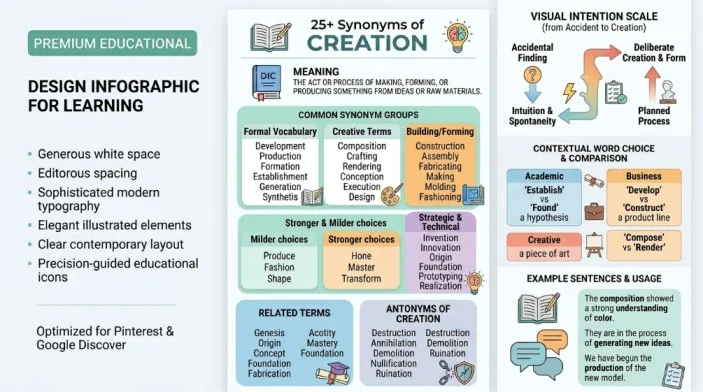
When the word creation appears repeatedly in an essay, blog, email, or professional report, the writing can quickly feel repetitive. Finding the right synonym of creation helps you describe making, developing, designing, producing, or bringing something into existence with greater precision.
The best alternative depends on what you mean by creation. A business may prefer development or production, an artist may choose composition or craftsmanship, while academic writing may favor formation or generation. Choosing a precise word improves clarity, tone, and the overall quality of your writing.
What Is the Best Synonym of “Creation”?
The best synonym of creation depends on context. Production works well for goods or output, development for ideas or projects, formation for something taking shape, invention for something newly devised, and composition for art or writing. In professional writing, development and production are especially useful.
Meaning, Tone, and Context
Creation is a broad noun that refers to the act, process, or result of making something new or bringing something into existence. The word can describe physical objects, ideas, works of art, systems, organizations, content, or abstract concepts.
Because creation covers several different meanings, there is no single synonym that works perfectly in every sentence. The most accurate alternative depends on what is being created and how it comes into existence.
Simple Definition
Creation means the act or result of making something that did not previously exist in its current form.
For example:
“The creation of the new website took three months.”
Here, creation refers to the process of making the website.
The word can also refer to the finished thing:
“The painting is one of her most impressive creations.”
In this sentence, creation means something that has been made.
Part of Speech
Creation is primarily a noun.
It can describe:
- The act of making something
- The process of developing something
- A newly made object or work
- An artistic work
- A new idea or concept
- The establishment of something
- The origin or formation of something
Overall Tone
Creation is generally neutral.
It can become positive or expressive depending on the context. For example, creative creation can suggest artistic achievement, while creation of a new policy is more neutral and professional.
Formality Level
Creation is a neutral to semi formal word.
It works naturally in:
- Academic writing
- Business communication
- Professional reports
- Essays
- Creative writing
- Everyday conversation
- Marketing content
- Technical writing
Common Uses
Native English speakers commonly use creation when discussing:
- Creation of a business
- Creation of a website
- Creation of content
- Creation of a product
- Creation of a new system
- Creation of an artwork
- Creation of a policy
- Creation of an organization
- Creation of an idea
- Creation of a fictional character
- Creation of a document
- Creation of a solution
Word Forms
| Form | Word |
|---|---|
| Noun | Creation |
| Verb | Create |
| Adjective | Creative |
| Adverb | Creatively |
| Related noun | Creator |
| Related noun | Creativity |
When and How to Use “Creation”
Use creation when you want to describe the process or result of bringing something into existence. It is especially useful when the exact method of making something is less important than the fact that something new has been produced.
The word is broad, so it often works as a safe general choice. When you know more about the process, however, a more specific synonym can make your writing stronger.
Professional
“The creation of a clear project timeline helped the team meet its deadlines.”
Academic
“The creation of new theories can change how researchers understand a subject.”
Workplace
“The creation of a shared database improved access to important information.”
Personal
“The creation of a family photo album brought back many happy memories.”
“The creation of the new account has been completed successfully.”
Resume
“Led the creation of a customer support system that improved response times.”
Social Media
“The creation of this project took months of planning, testing, and teamwork.”
Best Synonyms of “Creation”
No synonym of creation is identical in every situation. Some alternatives focus on making something, while others emphasize development, invention, construction, artistic expression, or the process of forming something.
Professional Writing: Development
Development is an excellent choice when something grows from an idea into a more complete product, system, strategy, or project.
“The development of the new software took six months.”
It sounds natural in business and professional environments because it emphasizes progress and improvement.
Academic Writing: Formation
Formation works well when discussing how something takes shape or comes together.
“The formation of social groups is influenced by several factors.”
It is particularly useful for academic discussions involving structures, groups, systems, and processes.
Business Communication: Production
Production is a strong choice when creation involves manufacturing goods, generating content, or producing measurable output.
“The company increased production to meet customer demand.”
It focuses on the process of producing something rather than simply bringing it into existence.
Casual Conversation: Making
Making is a simple and natural alternative when talking about the process of creating something.
“I enjoyed making this gift for my sister.”
It is more conversational than creation.
Emotional Writing: Crafting
Crafting suggests care, attention, and personal effort.
“The crafting of the letter took her several hours.”
It works especially well when the creator has deliberately shaped something meaningful.
Creative Writing: Composition
Composition is useful for music, visual art, written works, and other creative forms.
“The composition of the song reflects the artist’s changing emotions.”
It emphasizes how different elements are arranged into a finished work.
Resume Writing: Development
Development is often stronger than creation on a resume because it can communicate planning, improvement, and responsibility.
“Managed the development of a new employee training program.”
Workplace Communication: Establishment
Establishment works when something new is formally set up or introduced.
“The establishment of new safety procedures improved workplace compliance.”
Stronger Meaning: Invention
Invention suggests that something genuinely new has been devised.
“The invention of the device transformed the industry.”
It is stronger than creation when originality is central to the meaning.
Softer Meaning: Making
Making is a straightforward, less formal alternative that does not add unnecessary emphasis.
“The making of the presentation took most of the afternoon.”
When Not to Use “Creation”
Although creation is flexible, it can sometimes be too broad. A more specific word can communicate the exact process more effectively.
When It Sounds Too General
Less precise:
“The creation of the product took several months.”
Better:
“The development of the product took several months.”
Why:
Development tells readers that the product went through a process of planning, testing, and improvement.
When It Sounds Too Vague
Less precise:
“The creation of the report required extensive research.”
Better:
“The preparation of the report required extensive research.”
Why:
Preparation more directly describes putting a report together.
When a Physical Building Is Involved
Less precise:
“The creation of the bridge took two years.”
Better:
“The construction of the bridge took two years.”
Why:
Construction specifically describes building a physical structure.
When Something Is Manufactured
Less precise:
“The creation of thousands of products occurs every month.”
Better:
“The production of thousands of products occurs every month.”
Why:
Production is the natural term for manufacturing or generating goods at scale.
When Something Is Newly Invented
Less precise:
“The creation of the new machine changed the industry.”
Better:
“The invention of the new machine changed the industry.”
Why:
Invention emphasizes that the machine represents a new idea or technology.
When an Artistic Work Is Being Made
Less precise:
“The creation of the painting took months.”
Better:
“The composition of the painting took months.”
Why:
Composition emphasizes the artistic arrangement of elements.
When Something Is Officially Set Up
Less precise:
“The creation of the organization took place in 2024.”
Better:
“The establishment of the organization took place in 2024.”
Why:
Establishment is more precise when an institution, company, system, or organization is formally created.
Words Commonly Confused With “Creation”
Development
Difference: Development focuses on growth, progress, refinement, or improvement over time.
When to Use It: Use it for products, software, ideas, skills, strategies, and projects that evolve.
Example:
“The development of the application required extensive testing.”
Production
Difference: Production emphasizes making goods, content, or other outputs, often through an organized process.
When to Use It: Use it in manufacturing, media, business, and content production.
Example:
“The company increased production before the holiday season.”
Invention
Difference: Invention emphasizes originality and the introduction of something new.
When to Use It: Use it for new devices, methods, technologies, and ideas.
Example:
“The invention changed the way people communicated.”
Construction
Difference: Construction specifically focuses on building physical structures.
When to Use It: Use it for buildings, bridges, roads, homes, and other physical structures.
Example:
“Construction of the new hospital began in June.”
Formation
Difference: Formation describes the process through which something takes shape or comes together.
When to Use It: Use it for groups, structures, organizations, relationships, and geological or social processes.
Example:
“The formation of the committee took several weeks.”
Composition
Difference: Composition emphasizes the arrangement of parts into an artistic or written whole.
When to Use It: Use it for music, poetry, literature, paintings, and other creative works.
Example:
“The composition of the piece combines several musical styles.”
Best Synonyms of “Creation” by Context
| Context | Best Synonym | Why It Works | Example |
|---|---|---|---|
| Formal writing | Formation | Sounds precise when describing something taking shape. | “The formation of the committee was completed.” |
| Academic writing | Development | Works well for ideas, theories, and processes. | “The development of the theory took decades.” |
| Professional communication | Development | Emphasizes organized progress. | “The development of the platform is underway.” |
| Business emails | Establishment | Works for formal setup or introduction. | “The establishment of the new process is complete.” |
| Resume writing | Development | Shows active responsibility and progress. | “Managed the development of training materials.” |
| Workplace communication | Creation | Neutral and flexible. | “The creation of a shared schedule improved coordination.” |
| Casual conversation | Making | Simple and natural. | “I enjoyed the making of this project.” |
| Everyday speaking | Making | Sounds less formal. | “The making of the cake took an hour.” |
| Creative writing | Composition | Highlights artistic arrangement. | “The composition of the poem took weeks.” |
| Storytelling | Crafting | Suggests care and deliberate effort. | “The crafting of the story took years.” |
| Emotional writing | Crafting | Adds a sense of personal attention. | “The crafting of the letter was deeply personal.” |
| Strong emphasis | Invention | Highlights originality. | “The invention changed modern technology.” |
| Mild tone | Making | Simple and neutral. | “The making of the gift was enjoyable.” |
| Social media captions | Creation | Short and flexible. | “Behind the creation of this artwork.” |
| American English | Development | Very natural in business and general writing. | “The development of the new service continues.” |
| British English | Development | Also natural and widely understood. | “The development of the project is progressing.” |
How to Choose the Best Synonym of “Creation”
Choosing the right synonym starts with identifying what kind of creation you are describing.
If Something Is Being Built
Choose construction.
“The construction of the new stadium began last year.”
If Something Is Being Improved
Choose development.
“The development of the software continues.”
If Something Is Being Manufactured
Choose production.
“Production of the new model has started.”
If Something New Has Been Devised
Choose invention.
“The invention solved a long standing technical problem.”
If Something Is Taking Shape
Choose formation.
“The formation of the partnership took several months.”
If Something Is Art
Choose composition or crafting.
“The composition of the novel required careful planning.”
If Something Is Being Officially Established
Choose establishment.
“The establishment of the foundation marked a new chapter.”
Consider Your Audience
A technical audience may expect precise terms such as production, development, or formation.
A general audience may prefer simpler words such as making.
Consider Your Tone
For formal writing, use formation, development, establishment, or production when appropriate.
For creative writing, crafting, composition, and making can create a more expressive tone.
Consider the Actual Process
Do not choose a synonym simply because it sounds sophisticated. The word should accurately describe what happened.
- If something was built, say construction.
If it was invented, say invention.
- If it was improved over time, say development.
If it was manufactured, say production.
Precision matters more than complexity.
Real Life Examples of “Creation”
School
Original:
“The creation of the poster helped students understand the topic.”
Improved:
“The design of the poster helped students understand the topic.”
Design works better because the example focuses on planning the visual appearance.
College
Original:
“The creation of the research model required several experiments.”
Improved:
“The development of the research model required several experiments.”
Development emphasizes the process of refining the model.
Workplace
Original:
“The creation of a new schedule improved productivity.”
Improved:
“The development of a new schedule improved productivity.”
Business
Original:
“The creation of the new product took a year.”
Improved:
“The development of the new product took a year.”
Original:
“The creation of your account is complete.”
Improved:
“The setup of your account is complete.”
Setup is more natural when referring to an account.
Resume
Original:
“Responsible for the creation of marketing campaigns.”
Improved:
“Responsible for the development of marketing campaigns.”
The revised version sounds more professional and suggests planning and execution.
Conversation
Original:
“I loved the creation of this cake.”
More natural:
“I loved making this cake.”
The conversational form sounds much more natural.
Storytelling
Original:
“The creation of the character took years.”
Improved:
“The crafting of the character took years.”
The revised sentence adds an artistic sense of deliberate development.
Blogging
Original:
“The creation of useful content takes time.”
Improved:
“The production of useful content takes time.”
Production works particularly well when discussing content at scale.
Social Media
Original:
“The creation of this artwork was inspired by nature.”
Improved:
“This artwork was inspired by nature and carefully crafted.”
The second version feels more direct and expressive.
25 Best Synonyms of “Creation”
| Synonym | Simple Meaning | Best Used For | Example Sentence |
|---|---|---|---|
| Development | Process of growing or improving something | Projects, products, ideas | “The development of the new app took six months.” |
| Production | Process of making something | Goods, media, content | “The production of the film lasted several months.” |
| Formation | Process of taking shape | Groups, structures, systems | “The formation of the committee took time.” |
| Invention | Creation of something new | Technology, devices, methods | “The invention transformed the industry.” |
| Construction | Building something physical | Buildings, roads, bridges | “Construction of the bridge began in spring.” |
| Composition | Arrangement into a creative whole | Music, writing, art | “The composition of the song was carefully planned.” |
| Making | Act of producing something | Everyday activities | “The making of the gift was surprisingly easy.” |
| Establishment | Formal creation or setup | Organizations, systems | “The establishment of the company created new jobs.” |
| Crafting | Careful creation or shaping | Writing, art, messages | “The crafting of the speech took several revisions.” |
| Design | Planning how something will look or work | Products, graphics, systems | “The design of the website improved navigation.” |
| Generation | Producing or bringing about something | Data, ideas, energy | “The generation of new ideas encouraged discussion.” |
| Origination | Beginning or source of something | Ideas, processes | “The origination of the concept remains unclear.” |
| Manufacture | Industrial production | Products and goods | “The manufacture of the equipment requires precision.” |
| Fabrication | Making or constructing something | Technical objects, materials | “The fabrication of the parts required specialized tools.” |
| Assembly | Putting parts together | Machines, products, structures | “The assembly of the device took less than an hour.” |
| Preparation | Getting something ready | Documents, meals, materials | “The preparation of the report required detailed research.” |
| Formulation | Developing something carefully | Plans, policies, formulas | “The formulation of the policy involved several departments.” |
| Establishment | Setting something up formally | Institutions, procedures | “The establishment of the new department improved efficiency.” |
| Innovation | Development of a new idea or method | Business, technology | “The innovation changed the way customers interacted with the service.” |
| Initiation | Beginning a process or activity | Programs, projects | “The initiation of the program attracted new participants.” |
| Introduction | Bringing something new into use | Products, systems, ideas | “The introduction of the new service increased demand.” |
| Production | Creation through an organized process | Media, goods, content | “The production of the series required careful planning.” |
| Origination | The point or process where something begins | Ideas, concepts | “The origination of the plan came from a small team.” |
| Building | Gradual creation or development | Relationships, businesses, systems | “Building a strong team takes patience.” |
| Generation | Production or emergence of something | Ideas, information, power | “The generation of fresh ideas improved the project.” |
Synonyms of “Creation” by Usage
Professional vs Personal Synonyms
Professional writing often requires a synonym that explains the process more precisely.
- Use development for projects, products, and strategies.
Use production for goods, media, and content.
- Use establishment for organizations, procedures, and systems.
- Use formulation for policies, plans, and strategies.
Personal communication usually benefits from simpler language.
- Use making for everyday activities.
- Use crafting when personal effort and care matter.
Use building when discussing relationships or gradual progress.
Formal vs Conversational Synonyms
- For reports and academic essays, formation, development, establishment, and formulation are usually more appropriate.
- For presentations, development, design, and production are useful because they communicate the process clearly.
- For emails, choose the synonym that describes the specific action.
For example:
“The development of the proposal is complete.”
In casual conversation:
“I spent all weekend making this.”
The second version is more natural because everyday English generally favors simple verbs and nouns.
Academic Synonyms
Academic writing benefits from precision.
Formation
Use formation when discussing how structures, groups, or systems emerge.
“The formation of social networks can influence individual behavior.”
Development
Use development when an idea, theory, skill, or system changes over time.
“The development of the theory involved several stages.”
Generation
Use generation when something is produced, especially information, data, ideas, or energy.
“The generation of new data supported the research hypothesis.”
Formulation
Use formulation when researchers or policymakers deliberately develop a plan, theory, or framework.
“The formulation of the model required extensive analysis.”
These words sound more precise than using creation repeatedly in an academic paper.
Professional and Business Synonyms
Resumes
Development is often a strong choice.
“Led the development of a new customer service strategy.”
Interviews
Creation can work when discussing achievements, but a more specific word is often better.
“I led the development of a new training program.”
Meetings
Use formulation for plans and development for projects.
“The team contributed to the formulation of the new strategy.”
Presentations
Use design when discussing visual materials.
“I managed the design of the presentation.”
Performance Reviews
Use development to describe professional contributions.
“Contributed to the development of new employee resources.”
Client Communication
Use preparation when discussing documents.
“The preparation of the client proposal is complete.”
Business Emails
Use establishment for formal systems and development for projects.
“The development of the new workflow is now underway.”
Creative and Literary Synonyms
Creative writing often benefits from words that communicate intention and artistry.
Crafting
Crafting suggests patience, skill, and deliberate effort.
“She spent months crafting the perfect opening scene.”
Composition
Composition is useful for poetry, music, visual art, and structured creative work.
“The composition of the piece creates a strong emotional effect.”
Making
Making feels direct and personal.
“The making of the sculpture became a deeply personal experience.”
Building
Building can describe the gradual development of fictional worlds, characters, or tension.
“The author spent years building a complex fictional world.”
Invention
Invention works when originality is central.
“The invention of the fictional language gave the story its distinctive character.”
Slang or Modern Synonyms
There is no single widely accepted slang synonym for creation that works across all contexts.
Informal expressions such as making, building, and putting together are common in everyday American English.
For example:
“I’m putting together a new presentation.”
This is conversational and natural.
However, avoid expressions like putting together in formal academic writing when a more precise term such as development or preparation is available.
Strongest to Mildest Synonyms
Because creation itself is neutral, its alternatives do not form one universal intensity scale. Their strength depends on the specific meaning they add.
| Level | Synonyms | Main Effect |
|---|---|---|
| Mild | Making, preparation | Simple process |
| Moderate | Development, formation, design | Organized creation |
| Strong | Invention, innovation, craftsmanship | Originality or skill |
| Very Specific | Construction, manufacture, formulation | Precise method of creation |
The strongest choice is not necessarily the most formal word. Construction may be more precise than creation for a bridge, while invention may be more precise for a new device.
Emotional vs Neutral Synonyms
Emotional Synonyms
These words can add personal or artistic feeling.
Crafting suggests care and skill.
Making can feel personal and intimate.
Composition can suggest artistic expression.
Building can create an emotional sense of gradual growth.
Invention can suggest originality and imagination.
Neutral Synonyms
These words mainly communicate information.
Development is useful for projects and products.
Production works for output and manufacturing.
Formation describes something taking shape.
Establishment describes formal setup.
Preparation describes getting something ready.
Use neutral alternatives in reports, research papers, business documents, and technical communication. Use more expressive alternatives when emotional or artistic meaning is important.
Antonyms of “Creation”
Because creation can mean making, development, or bringing something into existence, its opposite varies by context. The following words describe destruction, removal, breakdown, or the reversal of something being created.
| Antonym | Meaning | Example Sentence |
|---|---|---|
| Destruction | The act of damaging or eliminating something | “The destruction of the building left the area empty.” |
| Demolition | Deliberate destruction of a structure | “The demolition of the old building began Monday.” |
| Ruin | Severe damage that prevents normal use | “Years of neglect led to the ruin of the property.” |
| Annihilation | Complete destruction | “The conflict threatened the annihilation of the settlement.” |
| Obliteration | Complete removal or destruction | “The fire caused the obliteration of several records.” |
| Dismantling | Taking something apart | “The dismantling of the old system took several weeks.” |
| Disassembly | Separating something into parts | “The disassembly of the machine revealed the problem.” |
| Disintegration | Breaking into smaller or weaker parts | “The material eventually underwent disintegration.” |
| Dissolution | Ending or breaking apart an organized entity | “The dissolution of the organization was announced publicly.” |
| Eradication | Complete removal of something unwanted | “The program focused on the eradication of the invasive species.” |
| Elimination | Removing something completely | “The elimination of unnecessary steps improved efficiency.” |
| Removal | Taking something away | “The removal of the damaged equipment was necessary.” |
| Destruction | The process of causing something to cease to exist | “The destruction of the records created serious problems.” |
| Decay | Gradual deterioration or breakdown | “The wooden structure showed signs of decay.” |
| Deterioration | Gradual decline in condition | “The deterioration of the building became obvious over time.” |
Comparison: “Creation” vs Similar Words
Creation vs Development
Main Difference
Creation focuses on bringing something into existence. Development emphasizes growth, improvement, or progression after an idea or project begins.
Which Is Stronger?
Neither is inherently stronger. They describe different stages.
Which Is More Formal?
Both are suitable for formal writing, but development is often more precise for professional projects.
When to Use Each
Use creation for the act or result of making something.
Use development when the process involves growth or refinement.
Examples
Creation:
“The creation of the website took three months.”
Development:
“The development of the website included several rounds of testing.”
Creation vs Production
Main Difference
Creation is broad. Production emphasizes organized output, especially goods, media, or content.
Which Is Stronger?
Neither is stronger.
Which Is More Formal?
Both are professional, but production is more technical in manufacturing and media.
When to Use Each
Use production when quantity, output, or a production process matters.
Examples
Creation:
“The creation of the video was a collaborative effort.”
Production:
“The production of the video required a large technical team.”
Creation vs Invention
Main Difference
Creation can involve many forms of making. Invention specifically suggests developing something new.
Which Is Stronger?
Invention is stronger when originality is important.
Which Is More Formal?
Both are appropriate in formal writing.
When to Use Each
Use invention for new devices, technologies, methods, and concepts.
Examples
Creation:
“The creation of the tool improved efficiency.”
Invention:
“The invention of the tool introduced a new method.”
Creation vs Construction
Main Difference
Construction specifically involves building something, usually a physical structure.
Which Is Stronger?
Neither is stronger.
Which Is More Formal?
Both are formal enough for professional communication.
When to Use Each
Use construction for buildings, roads, bridges, and similar structures.
Examples
Creation:
“The creation of the new facility took two years.”
Construction:
“Construction of the new facility took two years.”
Creation vs Formation
Main Difference
Formation focuses on something taking shape or coming together.
Which Is Stronger?
Neither is stronger.
Which Is More Formal?
Formation is particularly useful in academic and technical writing.
When to Use Each
Use formation for groups, structures, patterns, and processes.
Examples
Creation:
“The creation of the group took several weeks.”
Formation:
“The formation of the group took several weeks.”
Creation vs Composition
Main Difference
Composition focuses on arranging elements into an artistic, written, or musical whole.
Which Is Stronger?
Neither is stronger, but composition adds a specific artistic meaning.
Which Is More Formal?
Both can appear in formal writing.
When to Use Each
Use composition for music, art, literature, and similar creative works.
Examples
Creation:
“The creation of the song was a personal experience.”
Composition:
“The composition of the song required careful arrangement.”
Common Phrases and Expressions with “Creation”
Creation of a New Product
Meaning: The process of developing or making a new product.
Example:
“The creation of a new product requires research and testing.”
Creation of Content
Meaning: Producing articles, videos, images, posts, or other media.
Example:
“Content creation has become an important part of digital marketing.”
Creation of a Company
Meaning: Establishing a new business.
Example:
“The creation of the company began with a small business idea.”
Creation of a System
Meaning: Developing or establishing an organized process.
Example:
“The creation of a new system reduced administrative work.”
Creation of an Opportunity
Meaning: Making a situation possible or providing a new possibility.
Example:
“The program led to the creation of new employment opportunities.”
Creation of a Policy
Meaning: Developing a formal rule or guideline.
Example:
“The creation of the policy involved input from several departments.”
Creative Creation
Meaning: An artistic or imaginative work that has been produced.
Example:
“The gallery displayed several original creative creations.”
Creation Process
Meaning: The steps involved in making or developing something.
Example:
“The designer explained her creation process during the interview.”
Common Mistakes to Avoid
Choosing a Broad Synonym Instead of a Precise One
Incorrect:
“The creation of the building took two years.”
Better:
“The construction of the building took two years.”
Why:
Construction precisely describes the physical building process.
Confusing Creation With Invention
Incorrect:
“The creation of the new technology was groundbreaking.”
Better:
“The invention of the new technology was groundbreaking.”
Why:
When originality and novelty are central, invention is more precise.
Using an Informal Word in Formal Writing
Incorrect:
“The making of the corporate policy took six months.”
Better:
“The development of the corporate policy took six months.”
Why:
Development is more natural in professional and formal contexts.
Choosing an Overly Technical Word
Incorrect:
“The formulation of my birthday card took five minutes.”
Better:
“The making of my birthday card took five minutes.”
Why:
Formulation sounds unnecessarily technical for a simple personal activity.
Repeating “Creation” Too Often
Incorrect:
“The creation of the website followed the creation of the logo and the creation of the content.”
Better:
“The development of the website followed the design of the logo and the production of the content.”
Why:
Each synonym identifies a different part of the process.
Using a Synonym With the Wrong Meaning
Incorrect:
“The construction of the new business strategy was successful.”
Better:
“The development of the new business strategy was successful.”
Why:
Construction usually refers to physical building, while development naturally fits a strategy.
Using Slang in Academic or Professional Writing
Incorrect:
“The team put together a new theoretical model.”
Better:
“The team developed a new theoretical model.”
Why:
Developed is more precise and appropriate for academic and professional contexts.
Frequently Asked Questions
What are the best synonyms of “creation”?
The best synonym of creation depends on context. Development, production, formation, invention, construction, and composition are strong choices because each describes a different type or process of making.
What are the best formal synonyms of “creation”?
The strongest formal alternatives include development, formation, establishment, production, formulation, and composition. The best choice depends on whether you are discussing a project, organization, product, idea, policy, or creative work.
What are common informal synonyms of “creation”?
Common informal alternatives include making, building, and putting together. These expressions work naturally in everyday conversation, although more precise terms are usually preferable in academic and professional writing.
What is another word for “creation” in professional writing?
Development is often the most useful professional alternative to creation, especially for projects, products, software, strategies, and programs. Other choices include production, establishment, formulation, and design, depending on the specific context.
What is the difference between “creation” and “development”?
Creation focuses on bringing something into existence, while development emphasizes growth, improvement, or refinement. For example, a website can be created, but its development may include planning, testing, revisions, and ongoing improvement.
What is the opposite of “creation”?
The opposite of creation depends on the context, but common opposites include destruction, demolition, dismantling, disintegration, dissolution, elimination, and removal. These words describe different forms of ending, breaking down, or eliminating something.
Conclusion
Creation is a broad noun that describes the act or result of bringing something into existence. Its best alternatives depend on the specific process involved, so development, production, formation, invention, construction, and composition each work best in different situations.
For professional writing, development and production are useful choices. Academic writers can often benefit from formation, development, or formulation, while creative writers may prefer crafting or composition. In everyday conversation, simple words such as making can sound more natural.
There is no single perfect synonym for every sentence. When choosing a synonym of creation, identify what is being made, how it is being made, who will read your writing, and how formal the situation is. A useful vocabulary habit is to replace a general word only when the alternative adds a meaning that genuinely improves the sentence.
Read More Related Articles:
- Synonyms for Empty | Meaning, Examples, and Better Word …
- Synonyms for Creativity | Meaning, Examples, and Better …
- 25+ Synonyms of Perseverance | Meanings, Uses, Examples …