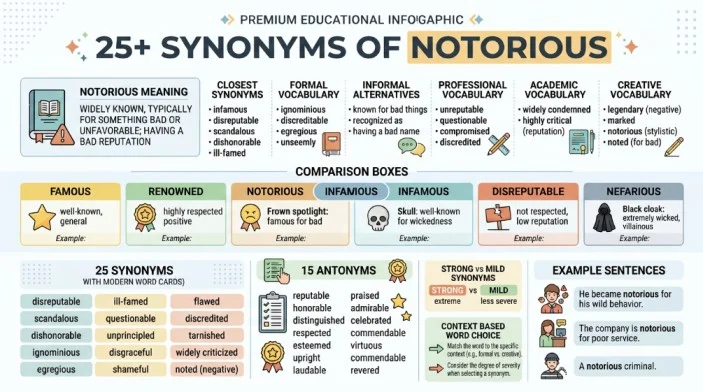
A writer may use notorious in an essay, article, caption, or story and then realize the same word keeps appearing. Finding the right synonym of notorious can make the writing more precise, especially when you need to describe someone or something that is widely known for a negative reason.
Not every alternative carries exactly the same meaning. Infamous is usually the closest replacement, while disreputable emphasizes a poor reputation, scandalous highlights shocking behavior, and nefarious focuses on wicked or criminal actions. Choosing the right word helps readers understand not only that something is known, but also why that reputation exists.
What Are the Best Synonyms of “Notorious”?
Notorious means widely known for something negative, harmful, or disapproved of. The closest synonyms include infamous, ill-famed, disreputable, scandalous, and dishonorable. For formal writing, use infamous or disreputable. Casual writing, infamous works naturally. For stronger descriptions, nefarious or shameful may fit better.
Meaning, Tone, and Context
Simple Definition
Notorious describes a person, place, event, organization, or thing that is widely known because of something bad, unpleasant, controversial, or harmful.
The key idea is not simply being famous. A notorious person or thing has gained attention for a negative reason.
For example:
“The criminal became notorious for a series of bank robberies.”
The sentence does not merely say that the criminal was well known. It explains that the person’s reputation was created by wrongdoing.
Part of Speech
Notorious is an adjective.
It normally appears before a noun or after a linking verb.
Examples:
“He was a notorious criminal.”
“The neighborhood became notorious for violent crime.”
Overall Tone
The tone of notorious is strongly negative.
It normally communicates disapproval, criticism, danger, wrongdoing, or an undesirable reputation.
| Tone | Description |
|---|---|
| Positive | No |
| Neutral | Usually no |
| Negative | Yes |
| Emotional strength | Moderate to strong |
| Reputation | Negative and widely recognized |
Formality Level
Notorious is a neutral to formal word that works well in many forms of writing.
It is common in:
- News articles
- Academic writing
- Essays
- Historical writing
- Professional reports
- Biographical writing
- Legal and criminal discussions
- Everyday conversation
- Creative writing
It can sound more serious than simple expressions such as “badly known” or “known for doing bad things.”
Common Uses
Native English speakers commonly use notorious to describe:
- Notorious criminals
- Notorious gangs
- Notorious scandals
- Notorious criminals
- Notorious dictators
- Notorious behavior
- Notorious incidents
- Notorious locations
- Notorious reputations
- Notorious cases
- Notorious mistakes
- Notorious problems
Word Forms
The most relevant related forms are:
| Form | Word |
|---|---|
| Adjective | notorious |
| Noun | notoriety |
| Adverb | notoriously |
Examples:
“The politician became notorious for corruption.”
“The scandal brought him considerable notoriety.”
“The road is notoriously dangerous at night.”
There is no commonly used verb form directly derived from notorious.
When and How to Use “Notorious”
Use notorious when something is widely recognized for a negative characteristic or action. The word works particularly well when the negative reputation is already established or broadly known.
Professional
“The company became notorious for failing to respond to customer complaints.”
This works when discussing a company’s established negative reputation.
Academic
“The ruler became notorious for his harsh treatment of political opponents.”
In historical or academic writing, notorious can describe a person remembered negatively for particular actions.
Workplace
“The old software system was notorious for unexpected errors.”
Here, the word describes a system with a widely recognized problem.
Personal
“My brother is notorious for forgetting his keys.”
In informal contexts, notorious can be used humorously for a repeated but relatively harmless habit.
“That supplier is notorious for sending invoices late.”
This communicates a recurring negative reputation without requiring a long explanation.
Resume
Notorious is generally inappropriate for a positive resume because it carries a negative meaning.
Instead of writing:
“Notorious for solving difficult problems.”
Use:
“Recognized for solving difficult problems.”
The second sentence communicates a positive reputation.
Social Media
“This city is notorious for its unpredictable traffic.”
This works naturally in an informal post or caption when the negative reputation is widely recognized.
Best Synonyms of “Notorious”
No single synonym works perfectly in every context. The best choice depends on whether you want to emphasize negative fame, poor reputation, wrongdoing, dishonor, scandal, or harmful behavior.
Professional Writing: Disreputable
Disreputable is useful when describing a person, organization, business, or institution with a poor reputation.
“The company was linked to several disreputable practices.”
It is more focused on reputation than public fame.
Academic Writing: Infamous
Infamous is usually the closest direct synonym for notorious. It describes someone or something widely known for a very bad reason.
“The dictator became infamous for his treatment of political prisoners.”
Business Communication: Disreputable
Use disreputable when discussing questionable businesses, organizations, or practices.
“The investigation uncovered connections with several disreputable firms.”
Casual Conversation: Infamous
Infamous sounds natural in everyday English and can replace notorious without changing the basic meaning.
“That restaurant is infamous for its terrible service.”
Emotional Writing: Shameful
Shameful adds stronger moral judgment.
“The incident was a shameful chapter in the organization’s history.”
Creative Writing: Scandalous
Scandalous works well when the negative reputation involves shocking, controversial, or socially unacceptable behavior.
“The actor became associated with a scandalous affair.”
Resume Writing: Recognized
A resume normally should not use notorious because its negative meaning conflicts with professional self-presentation.
If you mean “widely known for,” use recognized, respected, or renowned, depending on the intended meaning.
“Recognized for developing efficient customer service strategies.”
Workplace Communication: Infamous
When describing a recurring workplace problem informally, infamous can work naturally.
“The old scheduling system was infamous for creating duplicate bookings.”
Stronger Meaning: Infamous
Infamous is often the strongest direct replacement because it clearly combines widespread recognition with a very negative reputation.
Softer Meaning: Disreputable
Disreputable can be softer than infamous because it focuses on poor reputation rather than widespread negative fame.
When Not to Use “Notorious”
When You Simply Mean “Famous”
One of the biggest mistakes is treating notorious as a synonym for famous.
Less Effective:
“She is notorious for her award winning research.”
Better:
“She is renowned for her award winning research.”
Why:
Notorious suggests negative recognition. Renowned communicates positive or neutral fame.
When You Mean “Well Known” Without a Negative Meaning
Less Effective:
“The museum is notorious for its beautiful architecture.”
Better:
“The museum is renowned for its beautiful architecture.”
Why:
A beautiful building usually creates a positive reputation, so renowned is more appropriate.
When You Need a Neutral Description
Less Effective:
“The scientist was notorious for her groundbreaking discoveries.”
Better:
“The scientist was widely known for her groundbreaking discoveries.”
Why:
Widely known does not add an unwanted negative judgment.
When You Mean “Very Bad” but Not “Widely Known”
Less Effective:
“The food was notorious.”
Better:
“The food was terrible.”
Why:
Something can be terrible without having a widespread reputation. Notorious requires an established reputation or broad recognition.
When the Subject Has a Positive Reputation
Less Effective:
“He is notorious as one of the country’s best surgeons.”
Better:
“He is renowned as one of the country’s best surgeons.”
Why:
Renowned is appropriate for admiration and positive reputation.
When the Word Sounds Too Strong
Less Effective:
“Our new employee is notorious for arriving five minutes late.”
Better:
“Our new employee is known for arriving a few minutes late.”
Why:
Notorious may sound unnecessarily harsh for a minor habit.
Words Commonly Confused With “Notorious”
Infamous
Difference:
Infamous and notorious are extremely close. Both describe widespread recognition for a negative reason.
When to Use It:
Use infamous when you want the closest direct replacement.
Example:
“The dictator became infamous for his brutal policies.”
Famous
Difference:
Famous simply means widely known. It does not necessarily suggest anything negative.
When to Use It:
Use famous for neutral or positive recognition.
Example:
“The author became famous after publishing her first novel.”
Renowned
Difference:
Renowned usually expresses admiration or respect.
When to Use It:
Use it for people, places, or achievements with a positive reputation.
Example:
“The university is renowned for its medical program.”
Disreputable
Difference:
Disreputable emphasizes poor character or reputation rather than widespread public recognition.
When to Use It:
Use it when describing questionable people, businesses, organizations, or practices.
Example:
“The investigator uncovered a network of disreputable businesses.”
Scandalous
Difference:
Scandalous emphasizes shocking, offensive, or controversial behavior.
When to Use It:
Use it when an action or event causes public outrage or shock.
Example:
“The politician was involved in a scandalous financial arrangement.”
Nefarious
Difference:
Nefarious focuses on wicked, immoral, or criminal behavior. It does not necessarily mean widely known.
When to Use It:
Use it when describing particularly evil or dishonest actions.
Example:
“The group was accused of planning a nefarious scheme.”
Best Synonyms of “Notorious” by Context
| Context | Best Synonym | Why It Works | Example |
|---|---|---|---|
| Formal writing | Infamous | Directly communicates negative fame. | “The ruler became infamous for his policies.” |
| Academic writing | Infamous | Fits historical and analytical discussion. | “The event became infamous in political history.” |
| Professional communication | Disreputable | Focuses on poor reputation. | “The company had dealings with disreputable suppliers.” |
| Business emails | Disreputable | Sounds measured and professional. | “We should avoid working with disreputable vendors.” |
| Resume writing | Recognized | Avoids the negative meaning of notorious. | “Recognized for improving customer retention.” |
| Workplace communication | Infamous | Works for recurring negative problems. | “The system is infamous for unexpected outages.” |
| Casual conversation | Infamous | Natural and familiar. | “That place is infamous for long waits.” |
| Everyday speaking | Known for | Simple and flexible. | “He is known for making bold decisions.” |
| Creative writing | Scandalous | Adds dramatic emphasis. | “The scandalous affair changed her public image.” |
| Storytelling | Infamous | Creates a strong negative reputation. | “The town was home to an infamous outlaw.” |
| Emotional writing | Shameful | Adds moral judgment. | “It was a shameful moment in the family’s history.” |
| Strong emphasis | Infamous | Strongly signals negative fame. | “He became infamous for his crimes.” |
| Mild tone | Disreputable | Focuses on poor reputation without extreme intensity. | “The business had a disreputable history.” |
| Social media captions | Infamous | Short and attention grabbing. | “This road is infamous for its traffic jams.” |
| American English | Infamous | Common and natural in U.S. English. | “The neighborhood became infamous for crime.” |
| British English | Infamous | Also widely understood and used. | “The area became infamous for its poor conditions.” |
How to Choose the Best Synonym of “Notorious”
The best synonym depends on the exact idea you want to communicate.
If You Mean Negative Fame
Choose infamous.
“The criminal became infamous for the robbery.”
If You Mean a Bad Reputation
Choose disreputable.
“The company had a disreputable history.”
If You Mean Shocking Behavior
Choose scandalous.
“The newspaper reported the scandalous affair.”
If You Mean Wicked Behavior
Choose nefarious.
“The criminals were involved in a nefarious scheme.”
If You Mean Moral Disgrace
Choose shameful or disgraceful.
“The decision was widely viewed as disgraceful.”
If You Mean Positive Recognition
Do not use notorious. Choose renowned, celebrated, respected, or famous.
If You Need a Neutral Expression
Use widely known or well known.
The easiest decision rule is this: first identify whether the reputation is positive, negative, or neutral. Then choose a synonym that expresses both the reputation and the level of criticism you intend.
Real Life Examples of “Notorious”
School
Original:
“The historical leader was notorious.”
Improved:
“The historical leader became infamous for suppressing political opposition.”
The improved sentence explains why the person had a negative reputation.
College
“The case became notorious because it exposed serious weaknesses in the legal system.”
A more academic alternative is:
“The case became infamous because it exposed serious weaknesses in the legal system.”
Workplace
“The outdated software was notorious for losing saved changes.”
Here, notorious is appropriate because the software has an established negative reputation.
Business
“The supplier became notorious for failing to meet delivery deadlines.”
A more measured version is:
“The supplier developed a disreputable reputation for failing to meet delivery deadlines.”
“The vendor is notorious for late shipments.”
For a more professional tone:
“The vendor has a poor reputation for late shipments.”
Resume
Avoid:
“Notorious for solving complex problems.”
Use:
“Recognized for solving complex problems efficiently.”
Conversation
“That highway is notorious for traffic jams.”
This is natural because the road has a widely recognized negative reputation.
Storytelling
“The village was once home to an infamous outlaw.”
Infamous adds a strong historical and dramatic quality.
Blogging
“The website became notorious for publishing misleading headlines.”
The word works well because the site’s negative reputation is central to the statement.
Social Media
“This restaurant is infamous for its ridiculously long wait times.”
In informal social media writing, infamous can create a humorous or dramatic effect.
25 Best Synonyms of “Notorious”
The following list focuses on words and expressions that can genuinely overlap with the meaning of notorious. Some emphasize negative fame, while others emphasize reputation, wrongdoing, dishonor, or scandal.
| Synonym | Simple Meaning | Best Used For | Example Sentence |
|---|---|---|---|
| Infamous | Famous for something bad | Direct replacement | “The criminal became infamous for fraud.” |
| Ill-famed | Having a very bad reputation | Formal or literary writing | “The region was once known as an ill-famed district.” |
| Disreputable | Having a poor reputation | Businesses and people | “He had connections with several disreputable figures.” |
| Scandalous | Shockingly improper or controversial | Scandals and behavior | “The scandalous affair dominated the news.” |
| Dishonorable | Lacking moral respectability | Conduct and character | “His dishonorable actions damaged his career.” |
| Disgraceful | Causing shame or disapproval | Behavior and events | “The incident was a disgraceful misuse of authority.” |
| Shameful | Deserving shame | Strong moral criticism | “The treatment of the workers was shameful.” |
| Nefarious | Wicked or criminal | Evil schemes and actions | “The group was accused of a nefarious plan.” |
| Unsavory | Unpleasant or morally questionable | People, dealings, situations | “The investigation revealed some unsavory connections.” |
| Discredited | No longer trusted or respected | People, claims, institutions | “The discredited official resigned after the investigation.” |
| Disgraced | Having lost honor or respect | Public figures | “The disgraced official left public life.” |
| Notorious in reputation | Widely known for something negative | Explicit reputation descriptions | “The organization was notorious in reputation for corruption.” |
| Of ill repute | Known for a poor reputation | Formal writing | “The area was once regarded as a place of ill repute.” |
| Infamously known | Known for a negative reason | Strong emphasis | “The site is infamously known for repeated violations.” |
| Controversial | Causing disagreement or criticism | Public issues and figures | “The controversial decision attracted national attention.” |
| Scandalous in reputation | Known for shocking conduct | Dramatic descriptions | “The politician had a scandalous reputation.” |
| Morally compromised | Damaged in ethical standing | Formal analysis | “The organization was accused of being morally compromised.” |
| Dishonored | Deprived of respect or honor | People and institutions | “The once respected leader died dishonored.” |
| Reprehensible | Deserving strong criticism | Actions and conduct | “The abuse of power was reprehensible.” |
| Deplorable | Extremely bad or unacceptable | Conduct and conditions | “The prisoners faced deplorable conditions.” |
| Condemned | Strongly criticized or rejected | Actions, policies, conduct | “The practice was widely condemned.” |
| Vilified | Publicly portrayed as very bad | People and public figures | “The leader was vilified after the scandal.” |
| Maligned | Spoken about negatively | People or reputations | “The scientist was unfairly maligned by critics.” |
| Infamous for wrongdoing | Widely known because of harmful actions | Explicit criminal context | “The gang was infamous for wrongdoing across the region.” |
| Marked by notoriety | Characterized by negative public attention | Formal or literary writing | “His political career was marked by notoriety.” |
Some entries above are context based alternatives rather than perfect one word replacements. In particular, controversial, maligned, vilified, and condemned should not automatically replace notorious. They describe related forms of negative public attention but do not always include the same idea of widespread negative fame.
Synonyms of “Notorious” by Usage
Professional vs Personal Synonyms
In professional writing, choose measured terms that communicate a negative reputation without sounding unnecessarily dramatic.
Professional choices:
- Disreputable
- Discredited
- Controversial
- Infamous
- Morally compromised
Personal or conversational choices:
- Infamous
- Known for
- Shameful
- Scandalous
- Unsavory
For a formal report, disreputable may be more appropriate than infamous when the goal is careful description rather than dramatic emphasis.
Formal vs Conversational Synonyms
For reports, essays, and business writing, consider:
- Infamous
- Disreputable
- Discredited
- Ill-famed
- Reprehensible
For casual conversation, consider:
- Infamous
- Known for
- Famous for all the wrong reasons
- A big name for something bad
The expression famous for all the wrong reasons is conversational rather than a direct dictionary synonym, but it can explain the meaning of notorious naturally.
Academic Synonyms
Academic writing benefits from precise wording.
Useful choices include:
- Infamous
- Disreputable
- Controversial
- Discredited
- Reprehensible
- Ill-famed
- Use infamous when historical recognition for wrongdoing is central.
- Use controversial when the issue is disputed rather than necessarily immoral.
- Use discredited when evidence has damaged someone’s credibility.
These distinctions make academic writing more accurate.
Professional and Business Synonyms
Resumes
Avoid notorious unless the negative meaning is genuinely intended.
Use:
- Recognized
- Respected
- Acclaimed
- Renowned
Interviews
Use neutral or positive vocabulary when discussing achievements.
“I became recognized for improving customer retention.”
Meetings
For a recurring negative issue:
“The previous system was infamous for producing inaccurate reports.”
Presentations
For a measured professional tone:
“The supplier has developed a disreputable reputation for delayed deliveries.”
Performance Reviews
Use notorious carefully because it can sound insulting.
Instead of:
“He is notorious for missing deadlines.”
Use:
“He has developed a pattern of missing deadlines.”
Client Communication
Choose professional language such as poorly regarded, disreputable, or known for repeated delays, depending on the evidence.
Creative and Literary Synonyms
Creative writing can use stronger alternatives to build atmosphere.
Infamous creates a sense of historical or criminal reputation.
“The infamous outlaw disappeared before dawn.”
Ill-famed creates an older or more literary tone.
“Travelers avoided the ill-famed inn beyond the forest.”
Scandalous emphasizes shocking behavior.
“Her scandalous secret threatened to destroy the family.”
Nefarious gives a dramatic sense of wickedness.
“The villain carried out a nefarious scheme beneath the city.”
Shameful emphasizes moral judgment.
“The betrayal became a shameful memory for the entire community.”
Slang or Modern Synonyms
There is no single modern slang word that perfectly replaces notorious.
Casual speakers may say:
- Infamous
- Famous for all the wrong reasons
- Known for
- A big deal for the wrong reasons
The first option, infamous, is still the safest direct replacement.
Expressions such as famous for all the wrong reasons work well in conversation and social media, but they are usually too informal for academic papers and professional reports.
Strongest to Mildest Synonyms
Because these words emphasize different qualities, intensity cannot be treated as an exact universal scale. Still, a practical guide looks like this:
| Intensity | Useful Alternatives | Main Effect |
|---|---|---|
| Mild | Disreputable, controversial | Negative reputation or disagreement |
| Moderate | Unsavory, ill-famed, discredited | Clearly negative reputation |
| Strong | Infamous, disgraceful, reprehensible | Strong negative judgment |
| Very Strong | Nefarious, shameful, deeply dishonorable | Strong moral condemnation |
Infamous is usually the strongest direct synonym for negative fame.
Nefarious can sound stronger when the focus is wicked conduct, but it does not necessarily mean widespread recognition.
Emotional vs Neutral Synonyms
Emotional Synonyms
These alternatives add stronger judgment:
- Shameful
- Disgraceful
- Reprehensible
- Deplorable
- Nefarious
- Dishonorable
They work best when the writer intentionally wants to communicate condemnation.
Neutral or Measured Synonyms
These choices can describe a negative reputation more objectively:
- Infamous
- Disreputable
- Discredited
- Controversial
- Ill-famed
- Known for
For academic and professional writing, measured vocabulary is usually preferable when strong emotional judgment is not necessary.
Antonyms of “Notorious”
Because notorious means widely known for something negative, its strongest opposites generally describe positive recognition, respect, or neutral visibility.
| Antonym | Meaning | Example Sentence |
|---|---|---|
| Renowned | Widely respected and admired | “She is renowned for her medical research.” |
| Reputable | Having a good reputation | “They hired a reputable accounting firm.” |
| Respected | Admired for good qualities | “He is respected by his colleagues.” |
| Honorable | Deserving respect because of good character | “She made an honorable decision.” |
| Esteemed | Highly respected | “The professor is highly esteemed by her students.” |
| Acclaimed | Publicly praised | “The director created an acclaimed documentary.” |
| Celebrated | Widely admired or praised | “The celebrated author visited the university.” |
| Distinguished | Successful and respected | “He had a distinguished career in medicine.” |
| Revered | Deeply respected or admired | “The leader was revered by the community.” |
| Admired | Regarded with approval or respect | “She is admired for her honesty.” |
| Respected | Viewed positively by others | “The organization is respected nationwide.” |
| Credible | Worthy of trust or belief | “The researcher is considered credible.” |
| Trustworthy | Reliable and deserving trust | “The company has a trustworthy reputation.” |
| Uncontroversial | Not associated with significant disagreement | “The proposal was largely uncontroversial.” |
| Anonymous | Not publicly identified or known | “The donor chose to remain anonymous.” |
The most direct positive opposite depends on context. Reputable is especially useful when discussing reputation, while renowned and esteemed work when someone is widely admired.
Comparison: “Notorious” vs Similar Words
Notorious vs Infamous
Main Difference
Both words describe widespread negative recognition. In most sentences, they can replace one another with little change in meaning.
Which Is Stronger?
Infamous can sound slightly more severe because it strongly emphasizes a bad reputation.
Which Is More Formal?
Both are suitable for formal writing.
When to Use Each
Use notorious for a broad negative reputation.
Use infamous when the negative reputation is especially strong or historically established.
Examples
Notorious:
“The city was notorious for organized crime.”
Infamous:
“The city became infamous for organized crime.”
Notorious vs Famous
Main Difference
Famous means widely known and can be positive, neutral, or negative. Notorious specifically suggests negative recognition.
Which Is Stronger?
Neither is automatically stronger. Their emotional direction is different.
Which Is More Formal?
Both are standard English words.
When to Use Each
Use famous for positive or neutral recognition.
Use notorious when the recognition is undesirable.
Examples
Notorious:
“The road is notorious for dangerous driving.”
Famous:
“The road is famous for its beautiful scenery.”
Notorious vs Renowned
Main Difference
Renowned describes someone or something widely admired or respected. Notorious describes widespread negative recognition.
Which Is Stronger?
Neither is stronger. They point in opposite emotional directions.
Which Is More Formal?
Renowned is particularly useful in polished professional and academic writing.
When to Use Each
Use renowned for achievements and positive reputations.
Use notorious for negative reputations.
Examples
Notorious:
“The politician became notorious for corruption.”
Renowned:
“The scientist became renowned for her discoveries.”
Notorious vs Disreputable
Main Difference
Disreputable means having a poor reputation. It does not necessarily imply that the person or thing is widely known.
Which Is Stronger?
Notorious emphasizes public recognition, while disreputable emphasizes poor character or reputation.
Which Is More Formal?
Disreputable can sound more measured in professional writing.
When to Use Each
Use notorious when widespread recognition matters.
Use disreputable when poor reputation is the main point.
Examples
Notorious:
“The organization became notorious for fraud.”
Disreputable:
“The organization was considered disreputable.”
Notorious vs Scandalous
Main Difference
Scandalous describes something shocking, offensive, or socially unacceptable. It does not necessarily mean widely known.
Which Is Stronger?
Scandalous can sound more emotionally charged.
Which Is More Formal?
Both can appear in formal writing, but scandalous is more judgmental.
When to Use Each
Use notorious for negative fame.
Use scandalous for shocking conduct or events.
Examples
Notorious:
“The politician was notorious for corruption.”
Scandalous:
“The politician made a scandalous statement.”
Notorious vs Nefarious
Main Difference
Nefarious means wicked, evil, or criminal. It does not require public recognition.
Which Is Stronger?
Nefarious can sound stronger when describing the morality of an action.
Which Is More Formal?
Both can be used in formal or literary writing, but nefarious is more dramatic.
When to Use Each
Use notorious for reputation.
Use nefarious for wicked actions or plans.
Examples
Notorious:
“The gang was notorious throughout the region.”
Nefarious:
“The gang carried out a nefarious scheme.”
Common Phrases and Expressions with “Notorious”
Notorious for
Meaning: Widely known for a negative characteristic or behavior.
Example:
“The company is notorious for poor customer service.”
Become notorious
Meaning: Develop a widespread negative reputation.
Example:
“The website became notorious for misleading advertisements.”
Notorious criminal
Meaning: A criminal widely known because of serious or repeated wrongdoing.
Example:
“The notorious criminal was eventually arrested.”
Notorious reputation
Meaning: A widely recognized negative reputation.
Example:
“The organization developed a notorious reputation for corruption.”
Notorious incident
Meaning: An event remembered because of its negative or controversial nature.
Example:
“The notorious incident changed public opinion about the organization.”
Notorious case
Meaning: A case that became widely known for troubling, controversial, or criminal circumstances.
Example:
“The notorious case received extensive media attention.”
Notorious figure
Meaning: A person widely known for negative actions or characteristics.
Example:
“The notorious figure remained a subject of historical debate.”
Notorious history
Meaning: A past marked by widely known negative events or actions.
Example:
“The building has a notorious history involving several criminal investigations.”
Common Mistakes to Avoid
1. Treating “Notorious” as a Positive Synonym for Famous
Incorrect:
“The renowned surgeon is notorious for her successful operations.”
Better:
“The renowned surgeon is famous for her successful operations.”
Why:
Notorious suggests negative fame. Famous or renowned communicates positive recognition.
2. Using “Infamous” for Every Meaning of “Notorious”
Incorrect:
“The road is infamous for beautiful mountain views.”
Better:
“The road is renowned for its beautiful mountain views.”
Why:
Infamous preserves the negative meaning, so it does not fit a positive reputation.
3. Confusing “Disreputable” With “Widely Known”
Incorrect:
“The small local store was disreputable because everyone knew about it.”
Better:
“The small local store was disreputable because customers reported dishonest business practices.”
Why:
Disreputable describes poor reputation, not simply public awareness.
4. Using “Nefarious” When Public Recognition Matters
Incorrect:
“The company was nefarious throughout the country.”
Better:
“The company was notorious throughout the country for fraudulent practices.”
Why:
Nefarious describes wickedness. Notorious communicates widespread negative recognition.
5. Making a Minor Problem Sound Too Serious
Incorrect:
“My colleague is notorious for forgetting a pen.”
Better:
“My colleague is known for occasionally forgetting a pen.”
Why:
Notorious can sound excessive when the behavior is harmless or trivial.
6. Using “Notorious” in a Resume
Incorrect:
“Notorious for achieving sales targets.”
Better:
“Recognized for consistently exceeding sales targets.”
Why:
The negative meaning of notorious conflicts with the positive message a resume should communicate.
7. Using Strong Emotional Vocabulary Without Evidence
Incorrect:
“The company’s nefarious policies caused problems.”
Better:
“The company’s controversial policies caused problems.”
Why:
Nefarious makes a strong moral judgment. Use it only when the context genuinely supports that level of criticism.
Frequently Asked Questions
1. What are the best synonyms of “notorious”?
The closest synonym of notorious is infamous. Other useful alternatives include disreputable, ill-famed, scandalous, and dishonorable, but each emphasizes a slightly different aspect of negative reputation.
2. What are the best formal synonyms of “notorious”?
The best formal alternatives include infamous, disreputable, ill-famed, discredited, and reprehensible. Choose based on whether you mean negative fame, poor reputation, damaged credibility, or serious moral wrongdoing.
3. What are common informal synonyms of “notorious”?
Infamous is the most natural informal alternative. In everyday conversation, people may also say known for, famous for all the wrong reasons, or simply describe the specific negative behavior.
4. What is another word for “notorious” in professional writing?
Disreputable or infamous can work in professional writing, depending on context. If you need a neutral tone, phrases such as known for repeated problems or having a poor reputation may be more appropriate.
5. What is the difference between “notorious” and “famous”?
Notorious means widely known for something negative, while famous simply means widely known. Famous can describe positive, neutral, or negative recognition, but notorious normally carries a negative meaning.
6. What is the opposite of “notorious”?
Common opposites include renowned, reputable, respected, esteemed, acclaimed, and honorable. The best choice depends on whether you want to emphasize positive fame, good reputation, trust, or moral character.
Conclusion
Notorious describes someone or something that has become widely known for a negative reason. The closest synonym of notorious is usually infamous, while alternatives such as disreputable, scandalous, dishonorable, and nefarious highlight different aspects of negative reputation or behavior.
The most effective word depends on your purpose. Use infamous for negative fame, disreputable for poor reputation, scandalous for shocking conduct, and nefarious for wicked actions. When the reputation is positive, replace notorious with words such as renowned, respected, or acclaimed.
A useful vocabulary habit is to identify the exact quality you want to describe before choosing a synonym. That small step will help you select words that match your audience, tone, and purpose more precisely when searching for the right synonym of notorious.
Read More Related Articles:
25+ Synonyms, Meanings, Uses, Examples, and Best …
Meaning, Uses, Examples, and the Best Synonym of Complain
25+ Synonyms of Frequency | Meanings, Uses, Examples …