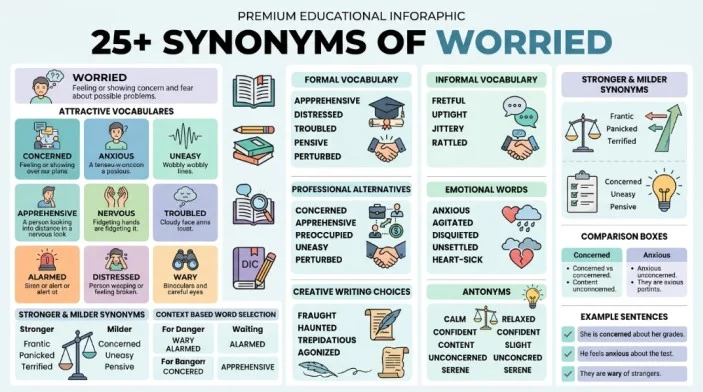
Worry can sound different depending on the situation. You may feel uneasy before an important meeting, anxious about an uncertain result, or concerned about someone you care about. That is why choosing the right alternative to worried matters. Synonyms of Worried can help you express the exact level and type of concern instead of repeating the same word. From everyday conversations to professional emails, academic writing, and creative work, the right word can make your message clearer and more natural.
Understanding these alternatives also requires attention to tone and context. Words such as concerned, anxious, uneasy, troubled, and apprehensive are related to worry, but they are not always interchangeable. Each carries a slightly different meaning or emotional intensity. This guide explores useful synonyms of worried, with clear meanings, examples, and practical usage so you can choose a word that fits your message naturally.
What Is the Best Synonym of “Worried”?
A synonym of worried is a word that describes concern, uneasiness, anxiety, or fear about a person, situation, or possible outcome. The best choices include concerned for general concern, anxious for stronger nervousness, uneasy for mild discomfort, apprehensive for future uncertainty, and troubled for ongoing emotional concern.
Meaning, Tone, and Context
Simple Definition
Worried describes a feeling of concern, uneasiness, or anxiety about something that may happen, has happened, or is currently happening.
For example:
“She was worried about her brother’s health.”
The sentence shows that she feels concern because she believes there may be a problem.
Part of Speech
Worried is primarily an adjective and is also the past participle of the verb worry.
Examples:
“I am worried about the results.”
“The news worried his parents.”
Overall Tone
The word worried usually has a negative emotional tone because it describes concern or mental discomfort.
However, the intensity can range from mild concern to serious anxiety.
Compare:
“I am a little worried about the weather.”
with:
“She was deeply worried about her child’s safety.”
The first expresses mild concern. The second communicates much stronger emotion.
Formality Level
Worried is a neutral word. It works naturally in casual conversations, professional communication, academic writing, personal messages, and general English.
It is not overly formal or informal, which makes it one of the most flexible words for describing concern.
Common Uses
Native English speakers commonly use worried when discussing:
- Health
- Money
- Family
- Relationships
- Exams
- Jobs
- Deadlines
- Safety
- Future plans
- Business decisions
- Personal problems
- Unexpected situations
Common structures include:
- worried about
“He is worried about the exam.”
- worried that
“She was worried that she might miss the flight.”
- worried for
“We are worried for his safety.”
- worried someone
“The sudden silence worried everyone.”
Word Forms
| Form | Word | Example |
|---|---|---|
| Verb | worry | “Try not to worry about it.” |
| Past form | worried | “She worried about the results.” |
| Adjective | worried | “He looks worried.” |
| Present participle | worrying | “The situation is worrying.” |
| Noun | worry | “His worry was understandable.” |
| Related noun | concern | “Her concern was reasonable.” |
When and How to Use “Worried”
Use worried when someone feels concern about a problem, possible danger, uncertain result, or unpleasant outcome. It is especially natural when the concern is personal or emotional.
Professional
“I am worried that the current delay could affect the project schedule.”
A more formal alternative may be concerned:
“I am concerned that the current delay could affect the project schedule.”
Academic
“Researchers were worried about the reliability of the initial data.”
For a more objective academic tone, concerned may work better:
“Researchers were concerned about the reliability of the initial data.”
Workplace
“The manager was worried about the team’s ability to meet the deadline.”
If the concern is professional rather than emotional, concerned sounds more measured.
Personal
“I was worried about my friend after she stopped answering my messages.”
Here, worried sounds natural because the sentence expresses personal concern.
“I was worried that you had not received my previous message.”
This sounds polite and natural in a personal or professional email.
Resume
The word worried is rarely useful on a resume because resumes should focus on skills, actions, and achievements rather than personal anxiety.
Instead of:
“Worried about customer complaints.”
Write:
“Addressed customer concerns and resolved service issues.”
Social Media
“I was really worried when I heard about the storm, but thankfully everyone is safe.”
For social media, worried works well because it sounds direct and conversational.
Best Synonyms of “Worried”
No synonym is identical to worried in every situation. Some alternatives emphasize concern, others focus on nervousness, fear, uncertainty, emotional distress, or a lack of peace.
Professional Writing: Concerned
Concerned is usually the strongest professional alternative.
“We are concerned about the recent decline in customer satisfaction.”
It communicates a serious issue without sounding overly emotional.
Academic Writing: Concerned
Academic writing generally benefits from concerned because it sounds objective and measured.
“Researchers were concerned about the limitations of the study.”
Business Communication: Concerned
Concerned works well in business emails, reports, meetings, and client communication.
“The management team is concerned about the increase in operating costs.”
Casual Conversation: Anxious
Anxious is common in everyday English when someone feels nervous about an upcoming event or uncertain outcome.
“I’m anxious about my job interview tomorrow.”
Emotional Writing: Troubled
Troubled suggests deeper or more persistent emotional concern.
“She was troubled by what she had seen.”
Creative Writing: Apprehensive
Apprehensive creates a more literary sense of uncertainty or fear about what may happen.
“He felt apprehensive as he approached the abandoned house.”
Resume Writing: Concerned
Although worried itself is usually inappropriate on a resume, concerned can be useful when describing professional issues.
“Identified areas of concern and developed practical solutions.”
Workplace Communication: Concerned
Use concerned when raising an issue professionally.
“I am concerned about the impact of the proposed change on our customers.”
Stronger Meaning: Alarmed
Alarmed suggests that something has caused serious concern or fear.
“The sudden drop in sales alarmed the management team.”
Softer Meaning: Uneasy
Uneasy expresses mild discomfort or uncertainty without suggesting intense fear.
“I felt uneasy about the decision.”
When Not to Use “Worried”
The word worried is useful, but it is not always the most precise choice.
When It Sounds Too General
Problem:
“I am worried about the situation.”
The sentence does not explain the type or level of concern.
Better:
“I am concerned about the financial impact of the situation.”
Why:
Concerned gives the statement a more professional and specific tone.
When It Sounds Too Emotional
In a formal report, worried can sound more personal than necessary.
Less Suitable:
“Residents are worried about rising costs.”
Better:
“Residents are concerned about rising costs.”
Why:
Concerned sounds more objective.
When You Mean Nervousness
If someone is nervous before an event, anxious may be more precise.
Less Precise:
“She was worried before the interview.”
Better:
“She was anxious before the interview.”
Why:
Anxious naturally describes nervous anticipation.
When You Mean Fear
If someone believes immediate danger exists, worried may be too mild.
Less Strong:
“He was worried when he heard the explosion.”
Better:
“He was alarmed when he heard the explosion.”
Why:
Alarmed communicates a stronger reaction to possible danger.
When You Mean Mild Discomfort
If you have an uncertain feeling but are not deeply concerned, uneasy may be better.
Less Precise:
“I was worried about the plan.”
Better:
“I felt uneasy about the plan.”
Why:
Uneasy communicates discomfort without suggesting serious anxiety.
When You Mean Deep Emotional Distress
If the concern has become emotionally painful, distressed may be more accurate.
Less Strong:
“She was worried after the accident.”
Better:
“She was deeply distressed after the accident.”
Why:
Distressed indicates stronger emotional suffering.
Words Commonly Confused With “Worried”
| Word | Difference | When to Use It | Example |
|---|---|---|---|
| Concerned | Shows thoughtful concern rather than necessarily strong anxiety. | Professional and formal communication. | “The doctor is concerned about the patient’s symptoms.” |
| Anxious | Often suggests nervousness, especially about something expected in the future. | Exams, interviews, events, uncertain outcomes. | “She felt anxious before the presentation.” |
| Nervous | Focuses on physical or emotional tension. | Public speaking, interviews, unfamiliar situations. | “I was nervous before my first interview.” |
| Uneasy | Suggests mild discomfort or uncertainty. | Situations that feel wrong or uncertain. | “He felt uneasy about the agreement.” |
| Afraid | Indicates fear of danger, harm, or a threatening situation. | Physical or emotional danger. | “She was afraid of walking home alone.” |
| Distressed | Indicates significant emotional suffering. | Serious personal or emotional situations. | “The family was distressed by the news.” |
Best Synonyms of “Worried” by Context
| Context | Best Synonym | Why It Works | Example |
|---|---|---|---|
| Formal writing | Concerned | Sounds measured and objective. | “Officials are concerned about the findings.” |
| Academic writing | Concerned | Maintains an objective tone. | “Researchers were concerned about data quality.” |
| Professional communication | Concerned | Communicates an issue without excessive emotion. | “We are concerned about the delay.” |
| Business emails | Concerned | Professional and respectful. | “I am concerned about the revised deadline.” |
| Resume writing | Concerned | Works when discussing identified problems. | “Identified areas of concern and improved processes.” |
| Workplace communication | Concerned | Suitable for raising issues diplomatically. | “I am concerned about the current workload.” |
| Casual conversation | Worried | Natural and direct. | “I’m worried about tomorrow.” |
| Everyday speaking | Anxious | Common for nervous anticipation. | “I’m anxious about the test.” |
| Creative writing | Apprehensive | Adds a literary sense of uncertainty. | “She felt apprehensive as the door opened.” |
| Storytelling | Uneasy | Builds subtle tension. | “He grew uneasy as the room became silent.” |
| Emotional writing | Troubled | Suggests deeper emotional concern. | “He was troubled by the memory.” |
| Strong emphasis | Alarmed | Communicates serious concern or fear. | “The sudden noise left everyone alarmed.” |
| Mild tone | Uneasy | Suggests limited concern. | “I feel slightly uneasy about the proposal.” |
| Social media captions | Worried | Sounds natural and conversational. | “I was worried for a moment, but everything worked out.” |
| American English | Concerned | Common and natural in formal American English. | “We are concerned about the results.” |
How to Choose the Best Synonym of “Worried”
Choosing the right word starts with identifying exactly what kind of concern you want to communicate.
Consider the Meaning
Ask whether you mean:
- General concern: concerned
- Future nervousness: anxious
- Mild discomfort: uneasy
- Fear of danger: afraid
- Uncertainty about what may happen: apprehensive
- Serious emotional suffering: distressed
- Strong concern caused by a sudden event: alarmed
- Ongoing emotional concern: troubled
Consider the Tone
- For professional writing, concerned is usually safer than worried.
- For casual conversation, worried is often the most natural choice.
- For creative writing, words such as apprehensive, uneasy, and troubled can create more precise emotional effects.
Consider Your Audience
A business client may respond better to:
“We are concerned about the delay.”
A close friend may hear:
“I’m worried about you.”
Both sentences communicate concern, but the relationship changes the most natural word choice.
Consider Emotional Strength
Use a mild word when the concern is small.
“I felt slightly uneasy.”
Use a stronger word when the situation is serious.
“Everyone was alarmed by the warning.”
Avoid using terrified or similarly extreme language unless genuine fear is involved.
Consider Your Writing Purpose
- For academic writing, choose objective vocabulary.
- For business communication, choose measured vocabulary.
- For personal writing, emotional vocabulary can sound more natural.
- For creative writing, select words that reveal the character’s exact emotional state.
Consider Formality
| Situation | Good Choice |
|---|---|
| Academic paper | Concerned |
| Business report | Concerned |
| Client email | Concerned |
| Workplace conversation | Concerned |
| Personal message | Worried |
| Casual conversation | Worried |
| Social media | Worried |
| Fiction | Apprehensive, uneasy, troubled |
Choose the Most Natural Word
Do not replace worried simply because another word sounds more advanced.
For example:
“I’m worried about my sister.”
is completely natural.
Replacing it with:
“I’m apprehensive about my sister.”
would sound unnatural because apprehensive usually describes concern about an anticipated situation rather than general concern for another person’s well being.
Real Life Examples of “Worried”
School
Original:
“The students were worried about the final exam.”
More precise:
“The students were anxious about the final exam.”
Why it works:
Anxious fits the nervous anticipation associated with an upcoming exam.
College
Original:
“I was worried about getting into college.”
Improved:
“I was anxious about my college application.”
The second version focuses specifically on uncertainty about a future result.
Workplace
Original:
“The employees were worried about the company changes.”
Improved:
“The employees were concerned about the proposed changes.”
Why it works:
Concerned sounds more professional and appropriate for workplace communication.
Business
Original:
“Customers are worried about the price increase.”
Improved:
“Customers are concerned about the price increase.”
The second sentence sounds more suitable for a business report.
Original:
“I was worried that you had not received my message.”
This is natural in a friendly or moderately informal email.
A more professional version is:
“I was concerned that you may not have received my previous message.”
Resume
Original:
“I was worried about customer complaints.”
Improved:
“I identified customer concerns and developed solutions to improve satisfaction.”
The improved version focuses on professional action rather than personal emotion.
Conversation
“I was worried when you didn’t answer your phone.”
This is a natural use of worried because the speaker is expressing personal concern.
Storytelling
“She felt uneasy as she walked toward the dark house.”
Why it works:
Uneasy creates subtle tension without immediately suggesting extreme fear.
Blogging
Original:
“Many homeowners are worried about rising energy costs.”
Improved:
“Many homeowners are concerned about rising energy costs.”
The second version is more suitable for an informative article.
Social Media
“I was so worried when I saw the storm heading our way, but thankfully everyone made it home safely.”
The direct emotional tone of worried works naturally on social media.
25 Best Synonyms of “Worried”
| Synonym | Simple Meaning | Best Used For | Example Sentence |
|---|---|---|---|
| Concerned | Feeling concern about a problem or situation. | Professional and general writing | “The team is concerned about the unexpected delay.” |
| Anxious | Nervous or uneasy about something expected to happen. | Exams, interviews, future events | “She felt anxious before the interview.” |
| Uneasy | Slightly uncomfortable or uncertain. | Mild concern | “I felt uneasy about the sudden change.” |
| Apprehensive | Nervous about what may happen. | Formal and creative writing | “He was apprehensive about starting his new job.” |
| Troubled | Emotionally affected by a problem. | Emotional and literary writing | “She was troubled by the disturbing news.” |
| Distressed | Deeply upset or emotionally troubled. | Serious situations | “The family was distressed by the accident.” |
| Alarmed | Suddenly concerned or frightened by possible danger. | Emergencies and serious events | “Residents were alarmed by the warning.” |
| Nervous | Tense or uneasy about an event. | Everyday conversation | “He was nervous before speaking on stage.” |
| Afraid | Feeling fear about danger or harm. | Dangerous situations | “She was afraid to walk home alone.” |
| Fearful | Experiencing fear or expecting something bad. | Formal and emotional writing | “The community was fearful of further violence.” |
| Restless | Unable to relax because of concern or uncertainty. | Personal and emotional contexts | “He had a restless night before the results arrived.” |
| Perturbed | Noticeably disturbed or unsettled. | Formal writing | “The manager was perturbed by the unexpected complaint.” |
| Disturbed | Emotionally unsettled by something troubling. | Serious or emotional situations | “She was disturbed by the sudden news.” |
| Concerned about | Having a specific feeling of concern. | Professional communication | “We are concerned about the potential risks.” |
| Fretful | Easily worried or upset. | Personal and descriptive writing | “The fretful child kept asking when his parents would return.” |
| Agitated | Emotionally upset and unable to remain calm. | Strong emotional situations | “He became agitated while waiting for the decision.” |
| Unsettled | Lacking a sense of calm or security. | Situations involving uncertainty | “The announcement left employees unsettled.” |
| Fearsome | Causing fear rather than directly meaning worried. | Descriptive writing | “The fearsome storm approached the coast.” |
| Concerned | Mentally focused on a possible problem. | Formal and everyday use | “Parents are concerned about school safety.” |
| Tense | Physically or emotionally strained. | Workplace and everyday situations | “Everyone was tense before the announcement.” |
| Overwhelmed | Feeling unable to cope with many concerns or demands. | Emotional situations | “She felt overwhelmed by the sudden responsibilities.” |
| Uneasy | Not completely comfortable or confident. | Everyday and creative writing | “He remained uneasy about the agreement.” |
| Preoccupied | Unable to stop thinking about a concern. | Professional and personal writing | “She was preoccupied with her family’s situation.” |
| Wary | Cautious because of possible danger or problems. | Risk and decision making | “Investors remained wary after the sudden market decline.” |
| Insecure | Lacking confidence or feeling uncertain. | Personal and emotional contexts | “He felt insecure about his performance.” |
Important usage note: Not every word in this table is interchangeable with worried in every sentence. For example, wary emphasizes caution, nervous often emphasizes tension, and preoccupied focuses on persistent thoughts. Context determines the best choice.
Synonyms of “Worried” by Usage
Professional vs Personal Synonyms
Professional communication usually favors concerned, apprehensive, and sometimes uneasy.
For example:
“We are concerned about the effect of the delay.”
Personal communication naturally uses worried, anxious, or troubled.
“I’m worried about my brother.”
The professional version sounds measured. The personal version sounds emotionally direct.
Formal vs Conversational Synonyms
| Situation | Recommended Words |
|---|---|
| Reports | Concerned, apprehensive |
| Essays | Concerned, anxious |
| Business writing | Concerned, uneasy |
| Presentations | Concerned |
| Emails | Concerned, worried |
| Casual conversations | Worried, nervous |
| Texting | Worried, anxious |
| Personal messages | Worried, concerned |
Academic Synonyms
Academic writing generally benefits from vocabulary that describes concern objectively.
Concerned is often the safest choice.
“Researchers were concerned about the reliability of the sample.”
Anxious is appropriate when the subjects themselves experience nervousness.
“Students reported feeling anxious before the examination.”
Apprehensive can work when discussing uncertainty about a future outcome.
“Participants were apprehensive about the proposed changes.”
Professional and Business Synonyms
For resumes, interviews, meetings, presentations, performance reviews, client communication, and business emails, concerned is usually the most useful alternative.
Instead of:
“The manager is worried about declining sales.”
Use:
“The manager is concerned about declining sales.”
For a resume, focus on action:
“Identified areas of concern and implemented solutions to improve sales performance.”
This shifts the emphasis from emotion to professional capability.
Creative and Literary Synonyms
Creative writing gives you more freedom to show the exact shade of emotion.
- Use uneasy for subtle discomfort.
“A strange silence left her uneasy.”
- Use apprehensive for anticipation mixed with uncertainty.
“He was apprehensive about what waited behind the door.”
- Use troubled for deeper emotional conflict.
“The memory continued to trouble him long after the conversation ended.”
- Use distressed when the character is emotionally overwhelmed.
“She was visibly distressed by the news.”
Slang or Modern Synonyms
There is no single slang word that perfectly replaces worried in all contexts.
In casual American English, expressions such as freaked out or stressed out can describe stronger or more informal forms of worry.
Freaked out suggests a strong emotional reaction.
“I was totally freaked out when I couldn’t find my passport.”
Use it in casual conversation, texting, or informal social media. Avoid it in academic writing, formal reports, resumes, and professional emails.
Stressed out focuses more on pressure and mental strain.
“I’ve been really stressed out about work lately.”
It is common in casual speech but should generally be replaced with more formal language in professional writing.
Strongest to Mildest Synonyms
There is no perfect universal intensity scale because context changes the strength of each word. However, the following arrangement provides a useful general guide.
Mild
Uneasy
Concerned
Wary
These words can describe relatively controlled concern.
Moderate
Worried
Nervous
Apprehensive
These generally communicate noticeable concern or uncertainty.
Strong
Anxious
Troubled
Disturbed
Alarmed
These suggest a stronger emotional response.
Very Strong
Distressed
Terrified
Panic stricken
The final group should be used carefully because these words can imply severe emotional distress or fear rather than ordinary concern.
Emotional vs Neutral Synonyms
Emotional Synonyms
These words communicate stronger feelings:
- Anxious
- Troubled
- Distressed
- Alarmed
- Afraid
- Fearful
- Nervous
Use them when the emotional state itself matters.
“She was anxious about the surgery.”
Neutral Synonyms
These words communicate concern more objectively:
- Concerned
- Uneasy
- Apprehensive
- Wary
- Preoccupied
Use them in reports, professional conversations, academic writing, and situations where emotional language should remain controlled.
“The committee was concerned about the potential risks.”
Antonyms of “Worried”
| Antonym | Meaning | Example Sentence |
|---|---|---|
| Calm | Free from strong worry or agitation. | “She remained calm during the emergency.” |
| Relaxed | Free from tension or stress. | “He felt relaxed after finishing the exam.” |
| Unworried | Not feeling concern about something. | “She appeared unworried by the delay.” |
| Unconcerned | Showing little or no concern. | “He seemed unconcerned about the criticism.” |
| Reassured | Made to feel less worried because of new information. | “The doctor reassured the patient.” |
| Confident | Feeling sure about one’s ability or outcome. | “She felt confident before the presentation.” |
| Secure | Feeling safe and free from serious uncertainty. | “The children felt secure with their parents nearby.” |
| Peaceful | Experiencing a calm state without distress. | “The quiet evening left everyone feeling peaceful.” |
| Composed | Calm and in control of emotions. | “She remained composed throughout the interview.” |
| Untroubled | Free from emotional difficulty or concern. | “He seemed untroubled by the minor setback.” |
| Carefree | Free from serious worries or responsibilities. | “The children spent a carefree afternoon at the park.” |
| Serene | Extremely calm and peaceful. | “She looked serene as she watched the sunset.” |
| Assured | Confident and certain. | “He sounded assured during the presentation.” |
| Content | Satisfied and emotionally at ease. | “She felt content with her decision.” |
| At ease | Comfortable, relaxed, and free from tension. | “Everyone felt at ease after the issue was resolved.” |
Comparison: “Worried” vs Similar Words
Worried vs Concerned
Main Difference
Worried usually sounds more personal and emotional, while concerned often sounds more controlled and objective.
Which Is Stronger?
Neither is always stronger. Worried can sound more emotional, while concerned can describe serious professional attention.
Which Is More Formal?
Concerned is generally more suitable for professional and academic writing.
When to Use Each
Use worried in personal conversations. Use concerned when discussing an issue professionally.
Examples
Worried:
“I’m worried about my father.”
Concerned:
“The doctor is concerned about his symptoms.”
Worried vs Anxious
Main Difference
Worried describes general concern. Anxious often emphasizes nervous anticipation about something that may happen.
Which Is Stronger?
Anxious can suggest stronger nervousness, although context matters.
Which Is More Formal?
Both can appear in formal writing.
When to Use Each
Use anxious for exams, interviews, appointments, and uncertain future events.
Examples
Worried:
“I’m worried about my health.”
Anxious:
“I’m anxious about tomorrow’s medical appointment.”
Worried vs Nervous
Main Difference
Nervous focuses on tension or nervous energy. Worried focuses on concern about a problem or outcome.
Which Is Stronger?
Neither is automatically stronger.
Which Is More Formal?
Both are neutral.
When to Use Each
Use nervous for public speaking, interviews, meetings, or unfamiliar situations.
Examples
Worried:
“She was worried about the result.”
Nervous:
“She was nervous before giving her speech.”
Worried vs Uneasy
Main Difference
Uneasy usually describes mild discomfort or uncertainty, while worried can range from mild concern to strong anxiety.
Which Is Stronger?
Worried is generally stronger.
Which Is More Formal?
Uneasy can sound slightly more polished in descriptive writing.
When to Use Each
Use uneasy when something feels wrong without a clear or immediate threat.
Examples
Worried:
“He was worried about the accident.”
Uneasy:
“He felt uneasy about the unfamiliar neighborhood.”
Worried vs Afraid
Main Difference
Worried describes concern. Afraid specifically describes fear.
Which Is Stronger?
Afraid can be stronger because it implies fear rather than simple concern.
Which Is More Formal?
Both are neutral.
When to Use Each
Use afraid when there is perceived danger or harm.
Examples
Worried:
“She was worried about the storm.”
Afraid:
“She was afraid that the storm would destroy the house.”
Worried vs Distressed
Main Difference
Distressed suggests significant emotional suffering, while worried can describe ordinary everyday concern.
Which Is Stronger?
Distressed is considerably stronger.
Which Is More Formal?
Distressed is often useful in formal or descriptive writing when serious emotional suffering is relevant.
When to Use Each
Use distressed for severe emotional reactions rather than ordinary concerns.
Examples
Worried:
“He was worried about the situation.”
Distressed:
“He was deeply distressed by the news.”
Common Phrases and Expressions with “Worried”
Phrase: Worried about
Meaning
This is the most common structure for explaining what causes someone’s concern.
Example Sentence
“She is worried about her upcoming exam.”
Phrase: Worried that
Meaning
This structure introduces something a person fears may happen.
Example Sentence
“I am worried that we may miss the deadline.”
Phrase: Worried sick
Meaning
This informal expression means extremely worried.
Example Sentence
“Her parents were worried sick when she did not come home.”
Phrase: Worried to death
Meaning
An informal exaggeration meaning extremely concerned.
Example Sentence
“You had me worried to death when you stopped answering your phone.”
Phrase: Nothing to worry about
Meaning
This reassures someone that there is no serious reason for concern.
Example Sentence
“The doctor said there was nothing to worry about.”
Phrase: Not to worry
Meaning
A friendly expression used to tell someone not to be concerned.
Example Sentence
“Not to worry, I’ll take care of the paperwork.”
Phrase: Worried for someone’s safety
Meaning
This means being concerned that someone may be harmed.
Example Sentence
“The family was worried for his safety during the storm.”
Phrase: Look worried
Meaning
To appear concerned through facial expression or behavior.
Example Sentence
“You look worried. Is everything okay?”
Common Mistakes to Avoid
1. Using a Vague Synonym Instead of a Precise One
Incorrect:
“I am worried about the project.”
Better:
“I am concerned about the project’s increasing costs.”
Why:
The improved version identifies the specific source of concern.
2. Confusing Worried With Nervous
Incorrect:
“I was worried before giving my speech.”
Better:
“I was nervous before giving my speech.”
Why:
Nervous is more precise for performance related tension.
3. Using Informal Language in Formal Writing
Incorrect:
“The employees were freaking out about the new policy.”
Better:
“The employees were concerned about the new policy.”
Why:
The second version is more appropriate for professional communication.
4. Choosing an Overly Dramatic Synonym
Incorrect:
“I was terrified because my package arrived one day late.”
Better:
“I was concerned because my package arrived one day late.”
Why:
Terrified describes extreme fear and is inappropriate for a minor inconvenience.
5. Repeating Worried Too Often
Incorrect:
“I was worried about the test, worried about my grade, and worried about the results.”
Better:
“I was anxious about the test, concerned about my grade, and uncertain about the final results.”
Why:
The improved sentence varies vocabulary while preserving the intended meaning.
6. Choosing the Wrong Emotional Tone
Incorrect:
“The manager was terrified about the budget.”
Better:
“The manager was concerned about the budget.”
Why:
Concerned fits a professional financial issue better than an extreme fear word.
7. Using Slang in Academic Writing
Incorrect:
“The students were freaking out about the exam.”
Better:
“The students were anxious about the examination.”
Why:
The revised sentence is more appropriate for academic writing.
Frequently Asked Questions
What is another word for worried?
Other words for worried include concerned, anxious, uneasy, troubled, nervous, and apprehensive.
What is a synonym for worried?
Common synonyms for worried are concerned, anxious, uneasy, troubled, and apprehensive.
What are the best synonyms for worried?
The best synonym depends on context. Concerned is neutral, while anxious and apprehensive can suggest stronger fear or unease.
What are other words for worried?
Other words for worried include concerned, nervous, uneasy, anxious, troubled, distressed, and apprehensive.
What is a synonym for worriedness?
Anxiety, concern, uneasiness, apprehension, and distress can express the idea of worriedness.
What are the best synonyms of “worried”?
The best synonyms of worried include concerned, anxious, uneasy, apprehensive, troubled, and nervous. Choose based on whether you want to emphasize concern, uncertainty, nervousness, or emotional distress.
What are the best formal synonyms of “worried”?
The best formal synonyms include concerned, apprehensive, troubled, and uneasy. Concerned is usually the safest choice for academic papers, business reports, professional emails, and workplace communication.
What are common informal synonyms of “worried”?
Common informal alternatives include nervous, anxious, stressed out, and freaked out. The last two are highly conversational and should generally be avoided in academic or formal professional writing.
What is another word for “worried” in professional writing?
Concerned is usually the best professional alternative to worried. It communicates attention to a problem without sounding excessively emotional, making it suitable for reports, emails, meetings, and client communication.
What is the difference between “worried” and “concerned”?
Worried generally sounds more personal and emotional, while concerned often sounds more measured and objective. Both describe concern, but concerned is usually preferable in professional and academic contexts.
What is the opposite of “worried”?
Common opposites of worried include calm, relaxed, unworried, reassured, confident, secure, and at ease. The best opposite depends on whether you mean emotional calm, confidence, or freedom from concern.
Conclusion
The word worried describes concern, uneasiness, anxiety, or fear about a person, situation, or possible outcome. Although it is a natural and useful word, choosing a more precise alternative can make your communication clearer and better suited to its purpose.
For professional and academic writing, concerned is usually the strongest choice. Anxious works well for nervous anticipation, uneasy expresses mild discomfort, apprehensive highlights uncertainty about the future, and troubled or distressed can communicate deeper emotional difficulty.
No single synonym of worried works perfectly in every situation. Before replacing the word, consider your audience, intended meaning, emotional intensity, and level of formality. A useful vocabulary habit is to identify the exact feeling first, then choose the word that describes it most accurately.
Read More Related Articles:
- Synonyms for Empty | Meaning, Examples, and Better Word …
- Synonyms for Pros and Cons | Meaning, Examples, and Better …