You are writing an email, finishing an essay, creating a caption, or polishing a resume, and suddenly you notice the same word appearing again and again. What is one of the most useful words in English, but repeating it can sometimes make writing feel vague or less precise. That is why people search for synonyms of what when they want a clearer alternative.
The tricky part is that what does not have one universal synonym. Its best replacement depends on how it functions in a sentence. In some contexts, which, whatever, the thing that, anything that, or that which may work. In other sentences, keeping what is actually the most natural choice.
This guide explains the meaning, grammar, tone, and practical alternatives to what. You will also see examples for academic writing, professional communication, everyday speech, creative writing, resumes, emails, and social media.
What Are the Best Synonyms of “What”?
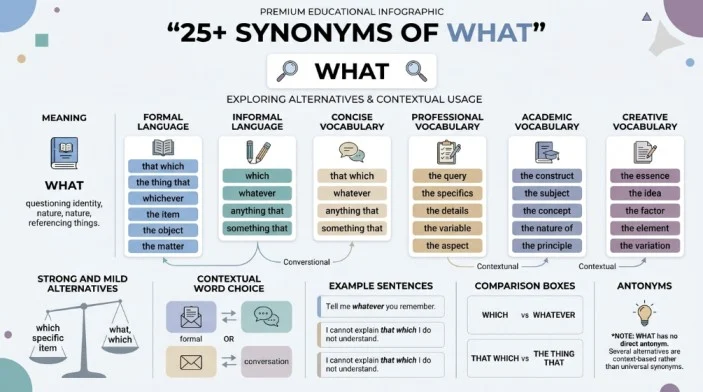
What usually asks about a thing, fact, action, or piece of information. Depending on context, useful alternatives include which, whatever, the thing that, that which, anything that, and the information that. For formal writing, that which or a precise noun phrase may work, while everyday English usually favors what or which.
The best alternative changes according to the sentence:
| Context | Useful Alternative | Why It Works |
|---|---|---|
| Formal writing | that which | More formal and structured |
| Academic writing | which, the specific factor that | Adds precision |
| Professional communication | which, the information that | Clear and direct |
| Casual conversation | which, whatever | Natural and conversational |
| Emotional writing | whatever, the thing that | Can add emphasis |
| Creative writing | that which, whatever | Creates a more expressive tone |
| Resume writing | the skills that, the experience that | Replaces vague wording with precision |
| Business writing | the information that, the issue that | Makes the subject specific |
A key point is worth remembering: what is often the best word already. Replacing it simply to avoid repetition can make a sentence awkward.
Meaning, Tone, and Context
Simple Definition
What is a common English word used to ask about or refer to a thing, fact, information, action, or situation.
For example:
What time does the meeting begin?
Here, what asks for specific information.
It can also introduce a clause:
In this sentence, what refers to the thing that the person means.
Part of Speech
What can perform several grammatical roles.
- It can function as an interrogative pronoun:
What happened?
- It can function as an interrogative determiner:
What book are you reading?
- It can also introduce a noun clause:
She explained what caused the problem.
Because what has several grammatical functions, its replacement must be selected according to the sentence.
Overall Tone
The word what is generally neutral.
It is not inherently positive or negative. Its emotional effect comes from the sentence around it.
Compare:
What a beautiful performance!
with:
What a terrible mistake!
The same word can appear in both positive and negative expressions.
Formality Level
What is neutral and highly versatile.
It works naturally in:
- everyday conversations
- school assignments
- academic writing
- professional emails
- business reports
- presentations
- creative writing
- social media
There is usually no need to replace it merely because the writing is formal.
Common Uses
Native English speakers commonly use what to:
- ask for information
- identify something
- clarify an idea
- introduce a noun clause
- express surprise
- emphasize an opinion
- refer to an unspecified thing
- describe something generally
What do you need?
What caused the delay?
I know what you are saying.
Take what you need.
What a wonderful idea!
Word Forms
What does not have ordinary noun, verb, adjective, and adverb forms because it is a function word rather than a regular lexical word.
Related interrogative words include:
- who
- whom
- which
- whose
- where
- when
- why
- how
These words are related grammatically, but they are not interchangeable synonyms.
When and How to Use “What”
What is usually the best choice when you need a natural way to ask for information or refer to an unspecified thing.
Professional
Please let me know what information you need before the meeting.
This sounds direct and professional.
Academic
The study examines what factors influence student performance.
Here, what introduces the subject of investigation.
Workplace
We need to determine what caused the delay.
The word fits naturally into workplace problem solving.
Personal
I understand what you are trying to say.
This is natural in an everyday conversation.
Could you clarify what documents I should submit?
This is polite and precise.
Resume
A resume usually benefits from replacing vague uses of what with specific nouns.
Instead of:
Responsible for what customers needed.
Write:
Responded to customer requests and resolved service issues.
The second version communicates the actual responsibility.
Social Media
What a beautiful day to start something new.
Here, what contributes to an expressive statement rather than asking a question.
Best Synonyms of “What”
There is no single replacement that works in every sentence. What has several grammatical meanings, so a good alternative must preserve both meaning and sentence structure.
Professional Writing
Which is often useful when the sentence refers to a defined set of choices.
Which option would you recommend?
If the subject is information rather than a choice, a specific noun phrase can be better:
Please provide the information required for the application.
Academic Writing
Academic writing often benefits from replacing vague references with precise nouns.
Instead of:
The paper explains what students need.
Consider:
The paper explains the resources students need.
The second version tells readers exactly what is being discussed.
Business Communication
Which works well when choices are known:
Which proposal should we approve?
For greater clarity, use a specific noun:
Which proposal should the team approve?
Casual Conversation
Which and whatever can sometimes replace what, depending on the meaning.
Which one do you want?
Take whatever you need.
Both are natural in conversation.
Emotional Writing
Whatever can intensify an emotional statement:
Whatever happened changed her completely.
It suggests an unknown event without identifying it.
Creative Writing
That which can create a formal or literary tone:
He searched for that which had been lost.
However, ordinary modern writing would usually sound more natural with:
He searched for what had been lost.
Resume Writing
The strongest strategy is often not to substitute another pronoun. Instead, identify the exact noun.
Instead of:
Improved what the company offered customers.
Write:
Improved customer support services.
This creates stronger and more measurable resume language.
Workplace Communication
Use which, the issue that, the reason that, or another specific noun phrase depending on meaning.
We need to identify which process caused the error.
This is more precise than trying to replace what mechanically.
Stronger Meaning
Whatever can sometimes create broader or stronger emphasis.
Whatever you decide, I will support you.
The word covers any possible choice.
Softer Meaning
In some contexts, something that creates a less direct reference:
I want something that feels more professional.
This is useful when the exact thing has not been identified.
When Not to Use “What”
There are situations where what is grammatically correct but not the clearest stylistic choice.
When the Meaning Is Too General
Consider:
We need to improve what we offer.
The reader may not know what what refers to.
A better version is:
We need to improve our customer support services.
The specific noun gives the reader useful information.
When a Specific Choice Exists
Instead of:
What color do you prefer, blue or green?
A more precise version is:
Which color do you prefer, blue or green?
Which is preferable when the options are limited or already identified.
When a Professional Document Needs Precision
Instead of:
We reviewed what happened during the project.
Write:
We reviewed the causes of the project delay.
The revised sentence communicates more information.
When the Word Sounds Too Vague
Instead of:
She explained what caused the problem.
If the cause is known, write:
She explained the software error that caused the problem.
When You Are Repeating It Too Often
Instead of:
We discussed what customers want, what they expect, and what they need.
You could write:
We discussed customer expectations, preferences, and needs.
This reduces repetition without forcing unnatural synonyms.
When the Sentence Needs a Stronger Noun
Instead of:
The manager discussed what employees experienced.
Try:
The manager discussed employees’ workplace experiences.
The revised sentence is more concise and specific.
Words Commonly Confused With “What”
What vs Which
Difference: What is generally open ended, while which usually refers to a limited or identifiable set.
When to Use It: Use what when the possible answer is broad. Use which when the options are known.
Example:
What do you want for dinner?
Which restaurant should we choose?
What vs Whatever
Difference: What identifies or asks about something. Whatever means any thing or any choice that fits the situation.
When to Use It: Use whatever when the exact item is unrestricted or unknown.
Example:
What do you need?
Take whatever you need.
What vs That
Difference: What can introduce a clause meaning roughly “the thing that.” That often introduces a clause connected to a noun already stated.
When to Use It: Use what when the thing itself has not been named. Use that when referring back to a specific noun or idea.
Example:
I understand what you mean.
I understand the point that you made.
What vs Who
Difference: What normally asks about things or information. Who asks about people.
When to Use It: Choose who when the answer should identify a person.
Example:
What caused the problem?
Who caused the problem?
What vs Where
Difference: What asks about a thing, while where asks about a place.
When to Use It: Use where when location is the information needed.
Example:
What did you find?
Where did you find it?
What vs Why
Difference: What asks about a thing, action, or information. Why asks about a reason or cause.
When to Use It: Use why when you need an explanation.
Example:
What happened?
Why did it happen?
Best Synonyms of “What” by Context
Because what has several grammatical uses, some alternatives are contextual rather than perfect one word replacements.
| Context | Best Synonym or Alternative | Why It Works | Example |
|---|---|---|---|
| Formal writing | that which | Creates a formal tone | He pursued that which mattered most. |
| Academic writing | which | Works well with defined choices | Which variable affected the result? |
| Professional communication | which | Clear for known options | Which proposal should we review? |
| Business emails | the information that | Adds specificity | Please send the information that we requested. |
| Resume writing | the skills that | Replaces vague wording | Highlight the skills that match the role. |
| Workplace communication | the issue that | Identifies the subject | We addressed the issue that caused the delay. |
| Casual conversation | which | Natural for limited options | Which one do you prefer? |
| Everyday speaking | whatever | Natural for unrestricted choices | Choose whatever you like. |
| Creative writing | that which | Adds literary formality | She protected that which she loved. |
| Storytelling | whatever | Creates uncertainty or mystery | Whatever happened next changed everything. |
| Emotional writing | the thing that | Adds personal emphasis | The thing that hurt most was the silence. |
| Strong emphasis | whatever | Broadens the reference | Whatever happens, stay calm. |
| Mild tone | something that | Sounds less specific | Find something that feels comfortable. |
| Social media captions | what | Usually most natural | What a beautiful view. |
| American English | what, which | Both are standard depending on context | Which option works best? |
| British English | what, which | Both are standard here too | What do you think? |
How to Choose the Best Synonym of “What”
Choosing an alternative should begin with meaning, not vocabulary variety.
Step 1: Identify the Function
Ask yourself what what is doing.
Is it:
- asking about an object?
- asking for information?
- referring to an unspecified thing?
- introducing a clause?
- expressing surprise?
- referring to a known set of choices?
The answer determines the best alternative.
Step 2: Check the Audience
A school essay, business email, text message, and novel do not always need the same vocabulary.
A literary phrase such as that which may sound unnecessarily formal in a casual text.
Step 3: Consider Precision
If what hides useful information, replace it with a specific noun.
We need to improve what we provide.
becomes:
We need to improve the training materials we provide.
Step 4: Consider Formality
Use ordinary modern English unless a formal or literary tone is genuinely appropriate.
What you said was helpful.
is perfectly acceptable in professional writing.
There is no advantage in changing it to:
That which you communicated was helpful.
The second version sounds unnecessarily stiff.
Step 5: Check Emotional Strength
Words such as whatever can broaden or intensify a statement, while something that can sound softer and less definite.
Step 6: Read the Sentence Aloud
If the alternative sounds unnatural, keep what.
Good vocabulary is not about replacing common words. It is about choosing the clearest word for the intended meaning.
Real Life Examples of “What”
School
Original:
The teacher explained what the assignment required.
More precise:
The teacher explained the requirements of the assignment.
The second version works well when the specific requirements are known.
College
Original:
The study examines what affects student motivation.
Alternative:
The study examines the factors that affect student motivation.
This sounds more precise in academic writing.
Workplace
Original:
We need to discuss what caused the delay.
Alternative:
We need to discuss the cause of the delay.
The second version is concise and professional.
Business
Original:
The report shows what customers value most.
Alternative:
The report shows the features customers value most.
The revised sentence gives the reader a clearer subject.
Original:
Please confirm what information you need.
Alternative:
Please confirm which information you need.
Which can work when the available information is already understood or limited.
Resume
Original:
Improved what the sales team used to track leads.
Alternative:
Improved the sales team’s lead tracking system.
The revised version is substantially stronger because it names the actual achievement.
Conversation
What do you want to watch tonight?
This is completely natural. Replacing what would usually make the sentence worse.
Storytelling
Nobody knew what had happened that night.
Here, what naturally creates uncertainty and keeps the story moving.
Blogging
Original:
This guide explains what you need to know about better writing.
Alternative:
This guide explains the key principles of effective writing.
The second version can make an article introduction more focused.
Social Media
What a perfect morning for coffee and fresh air.
Here, what is expressive and should not be replaced simply for variety.
25 Best Synonyms of “What”
The following list includes contextual alternatives and related constructions. Since what has multiple grammatical functions, not every item can replace it in every sentence. This distinction matters for accurate vocabulary use.
| Synonym or Alternative | Simple Meaning | Best Used For | Example Sentence |
|---|---|---|---|
| Which | One from a known group | Choices and defined options | Which design should we use? |
| Whatever | Any thing or choice | Open or unrestricted choices | Choose whatever feels right. |
| That which | The thing that | Formal or literary writing | He defended that which he believed. |
| The thing that | The specific thing | Explanatory writing | The thing that surprised me was her honesty. |
| Anything that | Any thing fitting a condition | General possibilities | Choose anything that matches the theme. |
| Something that | An unspecified thing | Soft or general references | Find something that works for everyone. |
| The information that | Specific information | Professional writing | Please review the information that we received. |
| The fact that | A specific fact or circumstance | Formal explanation | The fact that sales increased was encouraging. |
| The reason that | A cause or explanation | Professional and academic writing | We identified the reason that the system failed. |
| The issue that | A particular problem | Workplace communication | We resolved the issue that affected the client. |
| The factor that | A particular influence | Academic writing | Researchers examined the factor that affected growth. |
| The aspect that | A particular part or feature | Analytical writing | The aspect that matters most is reliability. |
| The point that | A particular idea | Discussion and argument | I agree with the point that you raised. |
| The idea that | A particular concept | Essays and discussions | The idea that effort matters remains important. |
| The detail that | A particular piece of information | Reports and storytelling | The detail that stood out was the unusual date. |
| The element that | A specific component | Technical and analytical writing | The element that caused the problem was identified. |
| The feature that | A specific characteristic | Product and business writing | The feature that customers liked most was simplicity. |
| The quality that | A specific characteristic | Descriptive writing | The quality that impressed the judges was originality. |
| The experience that | A specific event or experience | Personal and professional writing | The experience that shaped her career was unforgettable. |
| The result that | A particular outcome | Academic and professional writing | The result that surprised researchers was unexpected. |
| The answer that | A specific response | Education and discussion | The answer that she gave was accurate. |
| The choice that | A specific decision | Personal and professional contexts | The choice that he made changed the project. |
| The subject that | A specific topic | Academic writing | The subject that attracted the most attention was technology. |
| The purpose that | A specific aim | Formal writing | The purpose that guided the project was clearly defined. |
| The matter that | A particular issue or subject | Formal writing | The matter that concerned the board required attention. |
An Important Accuracy Note
Several entries above are contextual alternatives, not universal dictionary synonyms.
For example, which can replace what in some questions, but not all:
What is your name?
does not naturally become:
Which is your name?
Similarly, the factor that can replace what when the sentence discusses a particular influencing factor, but it cannot replace every occurrence of what.
This distinction is essential for good vocabulary guidance.
Synonyms of “What” by Usage
Professional vs Personal Synonyms
Professional writing benefits from specificity. Instead of repeatedly using what, writers can name the actual subject.
We analyzed what customers requested.
can become:
We analyzed customer requests.
In personal communication, what is often better because conversational English values natural phrasing.
I know what you mean.
Trying to replace what here would usually make the sentence less natural.
Formal vs Conversational Synonyms
Formal writing may occasionally use that which, the matter that, or the information that.
Conversational English usually favors what, which, whatever, and something that.
| Setting | Recommended Choice |
|---|---|
| Reports | Specific noun phrase |
| Essays | What, which, or precise noun phrase |
| Business writing | Which, the issue that, the information that |
| Presentations | What, which |
| Emails | What, which |
| Casual conversation | What, which, whatever |
| Texting | What, which, whatever |
Academic Synonyms
Academic writing rewards precision more than complicated vocabulary.
Useful alternatives include:
- which
- the factor that
- the aspect that
- the element that
- the evidence that
- the result that
- the finding that
- the issue that
For example:
The research investigates what influences employee retention.
can become:
The research investigates the factors that influence employee retention.
The revised sentence identifies the type of subject being examined.
Professional and Business Synonyms
For resumes, interviews, meetings, presentations, performance reviews, client communication, and business emails, specificity usually produces stronger writing.
Useful alternatives include:
- the skills that
- the experience that
- the issue that
- the information that
- the process that
- the result that
- the strategy that
- the factor that
Instead of:
I improved what the department used.
write:
I improved the department’s reporting system.
The second sentence communicates an identifiable accomplishment.
Creative and Literary Synonyms
Creative writing gives writers more freedom to choose expressive constructions.
Whatever can create mystery:
Whatever waited beyond the door, she was ready.
That which can create an intentionally formal or old fashioned feeling:
He remembered that which others had forgotten.
The thing that can emphasize a character’s emotional focus:
The thing that frightened him most was the silence.
Slang or Modern Synonyms
There is no widely accepted slang synonym for what that works as a general replacement.
Informal expressions such as whatever can carry a dismissive attitude in conversation:
Whatever. I am done arguing.
This is not a true synonym in every grammatical sense. It expresses a particular attitude and should not be used as a substitute in formal writing.
Strongest to Mildest Synonyms
Because what is generally neutral, it is more useful to compare the emotional force of contextual alternatives.
| Intensity | Alternative | Typical Effect |
|---|---|---|
| Mild | something that | General and soft |
| Mild | the thing that | Personal but relatively neutral |
| Moderate | what | Neutral and direct |
| Moderate | which | Specific and focused |
| Moderate | the issue that | More problem focused |
| Strong | whatever | Broader or more emphatic |
| Strong | that which | Formal and emphatic |
| Very Strong | whatever on earth | Highly emphatic, informal |
The last expression is not appropriate as a standard synonym in formal writing. It is included only to show how context can increase emotional intensity.
Emotional vs Neutral Synonyms
Emotional Synonyms and Alternatives
Some alternatives add feeling rather than simply replacing what.
- whatever
- the thing that
- that which
- anything that
Examples:
Whatever happened changed her perspective.
The thing that hurt most was the betrayal.
These constructions can make the sentence feel more personal or dramatic.
Neutral Synonyms and Alternatives
Neutral choices include:
- what
- which
- something that
- the information that
- the factor that
- the issue that
Use these when your primary goal is clear communication rather than emotional impact.
Antonyms of “What”
What has no direct antonyms.
This is because what is primarily an interrogative and relative function word. It does not describe a quality, action, object, or state that can naturally be reversed.
Words such as nothing, everything, specific, or known may contrast with particular meanings of what in certain sentences, but they are not genuine antonyms of the word itself.
For example:
What do you need?
and:
I need nothing.
show a contrast in meaning, but nothing is not the dictionary opposite of what.
This is an important distinction. Creating a list of 15 supposed antonyms would give readers inaccurate vocabulary information.
Comparison: “What” vs Similar Words
What vs Which
Main Difference
What generally asks about an open range of possibilities. Which usually asks someone to select from an understood or limited group.
Which Is Stronger?
Neither is inherently stronger. The difference is mainly about the range of possible answers.
Which Is More Formal?
Neither is automatically more formal.
When to Use Each
Use what for broad questions. Use which when the available choices are known.
Examples
What:
What do you want to eat?
Which:
Which of these three meals do you want?
What vs Whatever
Main Difference
What identifies or asks about something. Whatever refers to any option that meets the situation.
Which Is Stronger?
Whatever can sound broader or more emphatic.
Which Is More Formal?
What is more neutral. Whatever is also standard but can sound informal depending on context.
When to Use Each
Use whatever when the specific choice does not matter or is unrestricted.
Examples
What:
What do you want?
Whatever:
Choose whatever you want.
What vs That
Main Difference
What can mean roughly “the thing that.” That often connects a noun with additional information.
Which Is Stronger?
Neither is stronger.
Which Is More Formal?
Neither is inherently more formal.
When to Use Each
Choose according to grammar rather than formality.
Examples
What:
I understand what you mean.
That:
I understand the point that you made.
What vs Who
Main Difference
What normally refers to things or information. Who refers to people.
Which Is Stronger?
Neither.
Which Is More Formal?
Neither.
When to Use Each
Use who when asking for a person’s identity.
Examples
What:
What caused the problem?
Who:
Who caused the problem?
What vs Why
Main Difference
What asks about the event, thing, or information. Why asks for a reason.
Which Is Stronger?
Neither.
Which Is More Formal?
Neither.
When to Use Each
Choose why when you want an explanation.
Examples
What:
What happened?
Why:
Why did it happen?
What vs How
Main Difference
What identifies a thing or information. How usually asks about a method, condition, manner, or degree.
Which Is Stronger?
Neither.
Which Is More Formal?
Neither.
When to Use Each
Use how when the manner or method is the main focus.
Examples
What:
What did you change?
How:
How did you change it?
Common Phrases and Expressions with “What”
What If
Meaning: Introduces a possible situation or concern.
Example Sentence:
What if the meeting starts earlier than expected?
What About
Meaning: Introduces another subject, option, or concern.
Example Sentence:
What about the customers who have not received their orders?
What For
Meaning: Asks about purpose or reason, often informally.
Example Sentence:
What did you buy that tool for?
What Else
Meaning: Asks whether there is another item, idea, or possibility.
Example Sentence:
What else should we include in the presentation?
What Kind Of
Meaning: Asks about a category or type.
Example Sentence:
What kind of books do you enjoy?
What Matters
Meaning: Refers to something considered important.
Example Sentence:
What matters most is how we respond to the problem.
What It Takes
Meaning: Refers to the qualities or effort required to accomplish something.
Example Sentence:
She has what it takes to lead the project.
What A
Meaning: Used in exclamations to emphasize a person, thing, or quality.
Example Sentence:
What a remarkable performance!
Common Mistakes to Avoid
Mistake 1: Replacing Every “What” With a Synonym
Incorrect:
That which do you want?
Better:
What do you want?
Why: That which cannot replace what in every grammatical position. Natural English matters more than avoiding repetition.
Mistake 2: Using “Which” for Completely Open Questions
Incorrect:
Which is your favorite movie?
This can sound incomplete if no group of movies has already been established.
Better:
What is your favorite movie?
Why: The question is open ended.
Mistake 3: Using “Whatever” When You Mean “What”
Incorrect:
Whatever is your name?
Better:
What is your name?
Why: Whatever suggests an unrestricted choice or dismissive attitude, not a normal request for identity.
Mistake 4: Making Formal Writing Unnecessarily Stiff
Incorrect:
The researcher analyzed that which participants reported.
Better:
The researcher analyzed what participants reported.
Why: What is already appropriate for academic writing. More formal wording is not automatically better.
Mistake 5: Using Vague Language in a Resume
Incorrect:
Improved what the department used to manage clients.
Better:
Improved the department’s client management system.
Why: The second version tells an employer exactly what was improved.
Mistake 6: Choosing an Overly Dramatic Alternative
Incorrect:
Whatever occurred was an unimaginable catastrophe.
Better:
What happened was unexpected.
Why: Strong emotional language should match the facts and intended tone.
Mistake 7: Replacing Natural Language Just to Avoid Repetition
Incorrect:
I explained that which I wanted.
Better:
I explained what I wanted.
Why: The alternative sounds unnecessarily formal and less natural.
Frequently Asked Questions
1. What are the best synonyms of “what”?
The best contextual alternatives include which, whatever, that which, the thing that, and specific noun phrases. However, what itself is often the most natural choice, especially in everyday and professional English.
2. What are the best formal synonyms of “what”?
Useful formal alternatives include that which, the information that, the matter that, the factor that, and the aspect that. Choose based on meaning rather than replacing what automatically.
3. What are common informal synonyms of “what”?
There is no universal informal synonym for what. Which, whatever, and something that can work in particular contexts, but what remains completely natural in casual conversation.
4. What is another word for “what” in professional writing?
Professional alternatives depend on meaning. Which, the issue that, the information that, the factor that, or a specific noun can improve precision. In many professional sentences, what remains appropriate.
5. What is the difference between “what” and “which”?
What normally introduces an open question, while which usually refers to a limited or identifiable set of choices. For example, “What do you want?” is open, while “Which option do you want?” presents known options.
6. What is the opposite of “what”?
What has no direct antonym because it functions primarily as an interrogative or relative word. Terms such as nothing or everything can contrast with particular sentences, but they are not true antonyms.
Conclusion
What is one of the most flexible words in English, and its best alternative depends heavily on grammar and context. Useful synonyms of what include which, whatever, that which, the thing that, and precise noun phrases, but none can replace what in every sentence.
For professional and academic writing, specificity is often more valuable than a complicated synonym. For conversation, what is usually the most natural choice. Creative writing, alternatives such as whatever or that which can add emphasis when used carefully.
The best vocabulary improvement tip is simple: do not replace a word just because it appears twice. Replace it when another word communicates the intended meaning more clearly, naturally, or precisely.
Read More Related Articles:
- 50+ Synonyms of This | Meanings, Uses, Examples, and Best …
- Synonyms for Empty | Meaning, Examples, and Better Word …
- Synonyms for Creativity | Meaning, Examples, and Better …