A writer may use the word “condone” in an email, essay, workplace message, or social media caption, then realize it does not quite express the intended idea. That is where understanding the synonyms of condone becomes useful. The right alternative can make the message clearer, more natural, and better suited to its audience.
Condone usually describes accepting, allowing, or overlooking behavior that is considered wrong or unacceptable. However, words such as “tolerate,” “overlook,” “excuse,” “approve,” and “endorse” do not all carry the same meaning or strength. Choosing carefully helps readers understand whether you mean simple tolerance, silent acceptance, forgiveness, or actual approval.
What Are the Best Synonyms of “Condone”?
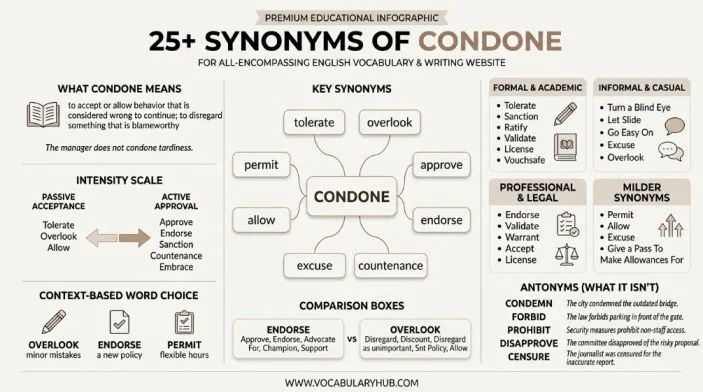
The best synonyms of condone include tolerate, overlook, excuse, permit, allow, accept, sanction, approve, endorse, and countenance. “Tolerate” often suggests allowing something unpleasant, while “overlook” suggests ignoring a fault and “endorse” or “approve” can suggest active support.
For formal writing, countenance, tolerate, permit, sanction, and overlook can work well depending on context. Academic writing often favors tolerate, accept, permit, or overlook. In professional communication, allow, tolerate, overlook, or approve are usually clearer. For emotional or creative writing, phrases such as turn a blind eye to or wink at can create stronger imagery.
Meaning, Tone, and Context
Simple Definition
Condone means to accept, allow, or overlook behavior that is generally regarded as wrong, harmful, inappropriate, or unacceptable.
The important point is that condoning something does not necessarily mean personally liking it. A person can condone an action by choosing not to object to it or by allowing it to continue.
For example:
The company does not condone harassment in the workplace.
This means the company does not accept, tolerate, or permit harassment.
Part of Speech
Condone is a verb.
- The organization does not condone discrimination.
- The manager refused to condone dishonest behavior.
- Silence can sometimes appear to condone misconduct.
Overall Tone
The word is generally neutral in grammatical tone but negative in subject matter because it commonly refers to questionable, harmful, unethical, or unacceptable behavior.
It is especially useful when discussing responsibility, standards, ethics, rules, or behavior.
Formality Level
Condone is generally formal to neutral.
It appears frequently in:
- Professional communication
- Academic writing
- Policies
- News writing
- Legal or ethical discussions
- Public statements
- Workplace guidelines
- Formal speeches
It is less common in casual conversation than alternatives such as “allow,” “let,” “put up with,” or “let it slide.”
Common Uses
Native English speakers commonly use “condone” when discussing whether someone accepts or permits behavior that should normally be challenged.
Common patterns include:
- condone violence
- condone dishonesty
- condone discrimination
- condone unethical behavior
- condone misconduct
- condone abuse
- condone cheating
- condone irresponsible behavior
A common structure is:
subject + do not + condone + behavior
For example:
We do not condone cheating on exams.
Word Forms
The main forms are:
- Verb: condone
- Third person: condones
- Past tense: condoned
- Present participle: condoning
- Related noun: condonation
The word “condonation” is much less common in everyday American English and is generally more specialized or formal.
When and How to Use “Condone”
Choose “condone” when you want to communicate that someone accepts, permits, overlooks, or fails to object to behavior that is considered wrong or unacceptable.
Professional
Our company does not condone discrimination or harassment of any kind.
This works well in workplace policies because “condone” clearly communicates an ethical position.
Academic
The study does not condone unethical treatment of research participants.
The word is appropriate when discussing ethics or standards in academic contexts.
Workplace
A supervisor should never condone repeated violations of safety procedures.
Here, “condone” emphasizes that allowing the behavior to continue could be interpreted as acceptance.
Personal
I cannot condone the way he treated his family.
This expresses strong personal disapproval while focusing on the act of accepting or permitting the behavior.
While we understand the circumstances, we cannot condone the use of offensive language toward customers.
This sounds professional and firm.
Resume
“Condone” is rarely useful as a positive resume verb. It usually describes what someone does not accept rather than what they accomplish.
Instead of writing:
Condoned workplace conflicts.
A better resume statement would normally describe a constructive action, such as:
Resolved workplace conflicts through clear communication and mediation.
Social Media
Calling out harmful behavior does not mean we should condone it.
This works naturally when discussing social issues, ethics, or public behavior.
Best Synonyms of “Condone”
No synonym is identical to “condone” in every situation. The best choice depends on whether you mean simple tolerance, permission, passive acceptance, forgiveness, or active approval.
Best for Professional Writing: Tolerate
“Tolerate” is useful when discussing behavior that an organization allows to continue even though it may dislike or oppose it.
The company will not tolerate discrimination.
This is often more direct than “The company will not condone discrimination.”
Best for Academic Writing: Accept
“Accept” can work when the focus is on recognizing or allowing something rather than actively approving it.
The institution cannot accept unethical research practices.
Best for Business Communication: Permit
“Permit” emphasizes authorization or allowing something to happen.
The policy does not permit employees to share confidential information.
It is especially useful when rules or permissions are involved.
Best for Casual Conversation: Put Up With
“Put up with” is informal and means tolerate something unpleasant.
I will not put up with that kind of behavior.
It sounds natural in conversation but is usually too casual for formal policies.
Best for Emotional Writing: Overlook
“Overlook” can suggest deliberately ignoring a fault or wrongdoing.
She decided to overlook his mistake.
It can sound softer than “condone” because it does not necessarily imply approval.
Best for Creative Writing: Wink At
“Wink at” is figurative and informal. It suggests knowingly allowing questionable behavior.
The old manager would wink at minor rule violations.
This creates a more vivid tone than the formal word “condone.”
Best for Resume Writing: Avoid “Condone”
A resume usually benefits from action verbs that demonstrate positive contributions. “Condone” generally describes an ethical position rather than a professional achievement.
Words such as supported, enforced, prevented, resolved, addressed, maintained, and promoted are usually more useful when they accurately describe the person’s actions.
Best for Workplace Communication: Tolerate
“Tolerate” is often effective when an organization wants to communicate a clear standard.
We do not tolerate harassment.
It is direct, familiar, and easy for employees to understand.
Stronger Meaning: Endorse
“Endorse” can be stronger than “condone” because it may imply active approval or support.
The organization does not endorse the proposal.
Use it when you want to emphasize a clear position of support or approval.
Softer Meaning: Overlook
“Overlook” can be softer when the speaker means that a mistake or fault was intentionally ignored rather than supported.
The teacher chose to overlook the student’s first mistake.
When Not to Use “Condone”
When You Mean Simple Permission
If someone officially gives permission, “permit” may be more precise.
Less precise:
The manager condoned employees leaving early.
Better:
The manager permitted employees to leave early.
“Condone” can imply that the behavior is questionable. “Permit” simply communicates authorization.
When You Mean Active Support
If someone openly supports an idea or action, “endorse” may be stronger.
Less precise:
The organization condones the new policy.
Better:
The organization endorses the new policy.
“Endorse” makes active support clearer.
When You Mean Forgiveness
“Condone” is not always the best substitute for “forgive.”
Less precise:
She condoned his personal mistake.
Better:
She forgave his personal mistake.
Forgiveness focuses on releasing blame or resentment. Condoning focuses on accepting or allowing behavior.
When You Mean Physical or Emotional Endurance
Use “tolerate” or “put up with” when the main idea is enduring something unpleasant.
Less natural:
I cannot condone this loud music.
Better:
I cannot tolerate this loud music.
The second sentence focuses on the speaker’s inability to endure the noise.
When You Mean Ignoring a Minor Fault
“Overlook” may be more appropriate.
Less precise:
The teacher condoned the student’s spelling mistake.
Better:
The teacher overlooked the student’s spelling mistake.
“Overlook” suggests that the error was noticed but not treated as important.
When You Need a Casual Expression
“Condone” may sound unnecessarily formal in an everyday conversation.
Formal:
I do not condone that behavior.
Casual:
I am not okay with that behavior.
The casual version is often more natural in ordinary speech.
Words Commonly Confused With “Condone”
Tolerate
Difference: Tolerate means allowing something unpleasant or unwanted to exist or continue without necessarily approving it.
When to Use It: Use it for behavior, conditions, opinions, or situations that someone is willing to endure.
Example:
The school will not tolerate bullying.
Endorse
Difference: Endorse usually means actively approving, supporting, recommending, or publicly backing something.
When to Use It: Use it when someone clearly supports an idea, product, policy, or position.
Example:
The organization endorsed the proposed reforms.
Permit
Difference: Permit means officially or practically allowing something to happen.
When to Use It: Use it when rules, authority, permission, or authorization are central.
Example:
The building does not permit smoking indoors.
Overlook
Difference: Overlook means failing to notice something or intentionally choosing not to take action over a fault.
When to Use It: Use it when a mistake or minor offense is being ignored.
Example:
The editor overlooked a small formatting error.
Excuse
Difference: Excuse means forgiving or finding a reason that makes a person’s mistake or behavior seem acceptable.
When to Use It: Use it when the focus is on forgiveness or justification.
Example:
A difficult childhood does not excuse cruel behavior.
Approve
Difference: Approve means expressing a favorable opinion or giving official acceptance.
When to Use It: Use it when someone actively agrees with something.
Example:
The board approved the revised budget.
Best Synonyms of “Condone” by Context
| Context | Best Synonym | Why It Works | Example |
|---|---|---|---|
| Formal writing | Countenance | Formal and precise for allowing something questionable | The policy does not countenance discriminatory conduct. |
| Academic writing | Tolerate | Clear when discussing unacceptable practices | The institution should not tolerate academic dishonesty. |
| Professional communication | Tolerate | Direct and widely understood | We do not tolerate workplace harassment. |
| Business emails | Permit | Useful when rules or authorization are involved | The agreement does not permit unauthorized access. |
| Resume writing | Avoid condone | The word rarely describes a professional achievement | Addressed policy violations promptly. |
| Workplace communication | Tolerate | Communicates a firm behavioral standard | Management will not tolerate abusive language. |
| Casual conversation | Put up with | Natural and conversational | I will not put up with that behavior. |
| Everyday speaking | Allow | Simple and easy to understand | We cannot allow this to continue. |
| Creative writing | Wink at | Adds figurative meaning and personality | The mayor quietly winked at minor violations. |
| Storytelling | Overlook | Works naturally for faults and mistakes | She chose to overlook his first offense. |
| Emotional writing | Excuse | Can express disagreement with attempts to justify behavior | Nothing can excuse that cruelty. |
| Strong emphasis | Endorse | Suggests active approval | The group does not endorse violence. |
| Mild tone | Overlook | Can soften the idea of ignoring a minor fault | He decided to overlook the mistake. |
| Social media captions | Support or oppose | Clearer when discussing public positions | We oppose discrimination in every form. |
| American English | Tolerate | Common and natural in American professional usage | The company will not tolerate misconduct. |
| British English | Tolerate | Also natural and widely understood in British English | The school will not tolerate bullying. |
How to Choose the Best Synonym of “Condone”
Start with the exact meaning you want to communicate.
- If you mean allowing something: choose permit or allow.
- If you mean accepting something unpleasant: choose tolerate.
- If you mean ignoring a fault: choose overlook.
- If you mean forgiving a mistake: choose excuse or forgive, depending on the situation.
- If you mean active approval: choose approve or endorse.
- If you mean knowingly allowing questionable behavior: choose countenance, wink at, or turn a blind eye to, depending on formality.
Next, consider your audience. A business policy may benefit from “tolerate” or “permit,” while a casual conversation may sound more natural with “put up with.”
Finally, check emotional strength. “Allow” is relatively neutral, “tolerate” can sound firm, and “endorse” suggests a much stronger form of approval.
Real Life Examples of “Condone”
School
The school does not condone cheating during examinations.
A more direct alternative is:
The school does not tolerate cheating during examinations.
College
The university does not condone plagiarism.
This is appropriate because academic integrity is the central concern.
Workplace
Managers should never condone discriminatory comments.
A stronger workplace version is:
Managers should never tolerate discriminatory comments.
Business
The company does not condone misleading advertising.
“Endorse” would not be appropriate here because the company is not actively supporting the behavior.
We understand the delay, but we cannot condone repeated violations of the agreement.
This gives the message a formal and firm tone.
Resume
Instead of:
Condoned employee conflicts.
A stronger resume statement is:
Resolved employee conflicts through structured communication.
The second version describes a useful professional action.
Conversation
I cannot condone what he did, even if he had a reason.
This sounds natural because “condone” clearly communicates moral or personal disapproval.
Storytelling
The village had learned to overlook his small acts of rebellion.
“Overlook” creates a softer narrative tone than “condone.”
Blogging
Understanding someone’s background does not mean you have to excuse harmful behavior.
“Excuse” is useful here because the sentence focuses on explanations and accountability.
Social Media
Silence should never be mistaken for approval.
This can be more concise and powerful than repeatedly using “condone.”
25 Best Synonyms of “Condone”
| Synonym | Simple Meaning | Best Used For | Example Sentence |
|---|---|---|---|
| Tolerate | Allow something unpleasant to continue | Workplace and formal communication | The company will not tolerate harassment. |
| Permit | Give permission for something | Rules and policies | The facility does not permit unauthorized entry. |
| Allow | Let something happen | Everyday and professional language | We cannot allow this behavior to continue. |
| Overlook | Ignore a fault or offense | Mistakes and minor wrongdoing | The teacher chose to overlook the first mistake. |
| Excuse | Forgive or accept a reason for wrongdoing | Personal and emotional contexts | A stressful day does not excuse rude behavior. |
| Accept | Regard something as allowable or satisfactory | General and academic writing | The committee will not accept unethical practices. |
| Approve | Express agreement or favorable judgment | Business and organizational settings | The board did not approve the proposal. |
| Endorse | Actively support or approve | Public and professional statements | The organization does not endorse discriminatory policies. |
| Sanction | Officially approve or authorize | Formal and institutional contexts | The committee sanctioned the revised procedure. |
| Countenance | Willingly allow or tolerate | Formal writing | The policy does not countenance abusive conduct. |
| Disregard | Treat something as unworthy of attention | Formal and analytical writing | The manager could not simply disregard the complaint. |
| Ignore | Choose not to pay attention to something | Everyday and general writing | We cannot ignore repeated safety violations. |
| Wink at | Knowingly overlook questionable behavior | Informal and creative writing | The supervisor would sometimes wink at minor rule violations. |
| Turn a blind eye to | Deliberately ignore wrongdoing | Informal, figurative writing | Leaders should not turn a blind eye to misconduct. |
| Look the other way | Avoid dealing with wrongdoing | Conversational language | Some employees felt that management looked the other way. |
| Let slide | Decide not to address a fault | Casual conversation | I usually let small mistakes slide. |
| Put up with | Continue accepting something unpleasant | Informal speech | She refused to put up with disrespect. |
| Live with | Accept an unpleasant situation | Informal conversation | We may have to live with the inconvenience for now. |
| Bear with | Tolerate or endure something | Everyday communication | We had to bear with the temporary disruption. |
| Abide | Accept or tolerate something | Formal or literary contexts | The organization will not abide dishonest practices. |
| Acquiesce to | Accept something reluctantly or without protest | Formal writing | The committee acquiesced to the proposed changes. |
| Give way to | Stop resisting and allow something | Formal or narrative contexts | The officials eventually gave way to public pressure. |
| Give tacit approval to | Quietly communicate acceptance | Professional and analytical writing | His silence gave tacit approval to the decision. |
| Let pass | Choose not to challenge something | Formal and literary contexts | The editor decided to let the minor error pass. |
| Look past | Choose to ignore a fault or problem | Personal and conversational contexts | She chose to look past his earlier mistake. |
Synonyms of “Condone” by Usage
Professional vs Personal Synonyms
Professional writing usually benefits from precise terms such as tolerate, permit, authorize, approve, endorse, and countenance.
Personal conversations can use more natural expressions such as put up with, let slide, look past, or look the other way.
For example:
The company does not tolerate harassment.
sounds more professional than:
The company will not put up with harassment.
Both communicate opposition, but the first fits organizational communication better.
Formal vs Conversational Synonyms
Formal choices include:
- Countenance
- Tolerate
- Permit
- Sanction
- Acquiesce to
Conversational choices include:
- Put up with
- Let slide
- Look the other way
- Wink at
- Live with
A formal report should generally avoid slang or highly figurative expressions.
Academic Synonyms
Academic writing often benefits from precise terms such as:
- Tolerate
- Permit
- Accept
- Overlook
- Endorse
- Countenance
For example:
Researchers should not tolerate unethical treatment of participants.
This is clearer and more academically appropriate than:
Researchers should not put up with unethical treatment.
Professional and Business Synonyms
Resumes
Avoid using “condone” unless it is directly relevant to a responsibility.
Better professional verbs include:
- Prevent
- Address
- Resolve
- Enforce
- Maintain
- Promote
- Support
Interviews
When discussing ethics, “tolerate,” “permit,” and “accept” can be useful.
I would not tolerate discriminatory conduct in a team.
Meetings
Use “approve” when discussing formal agreement.
The committee approved the proposal.
Use “endorse” when discussing active support.
The leadership team endorsed the recommendation.
Presentations
Use “tolerate” when discussing standards.
We cannot tolerate repeated security failures.
Performance Reviews
Choose concrete language.
Instead of:
She did not condone poor performance.
write:
She addressed performance concerns promptly.
Client Communication
Use “permit” when rules or permissions are involved.
Our agreement does not permit the requested change.
Business Emails
“Tolerate” and “permit” are usually clearer than figurative phrases.
We cannot permit further unauthorized changes to the account.
Creative and Literary Synonyms
Creative writing gives you more room to choose expressive alternatives.
Wink at suggests knowing cooperation with questionable behavior.
Turn a blind eye to creates a strong image of deliberate avoidance.
Look the other way suggests choosing not to confront something.
Overlook can soften the treatment of a mistake.
For example:
The town had learned to turn a blind eye to the merchant’s secret dealings.
This creates more atmosphere than the straightforward:
The town condoned the merchant’s secret dealings.
Slang or Modern Synonyms
There is no single slang word that perfectly replaces “condone.”
Informal expressions such as let it slide, let it pass, look the other way, and put up with it can work in casual speech.
Avoid these expressions in academic papers, formal policies, legal documents, and important business communication unless the context specifically calls for conversational language.
Strongest to Mildest Synonyms
The intensity of a synonym depends heavily on context, but this general scale can help.
Mild
Allow, overlook, accept, let pass
These can describe noninterference without necessarily suggesting strong approval.
Moderate
Tolerate, permit, disregard, live with
These communicate a more deliberate decision to allow or endure something.
Strong
Countenance, endorse, approve, turn a blind eye to
These can communicate a clearer position, deliberate acceptance, or active support depending on the word.
Very Strong or Highly Expressive
Give tacit approval to, wink at, acquiesce to
These expressions can suggest knowing or deliberate acceptance, especially when the behavior is questionable.
Remember that “endorse” can actually be stronger in a different direction because it suggests active support rather than passive acceptance.
Emotional vs Neutral Synonyms
Emotional Synonyms
These choices can carry more attitude or implied judgment:
- Turn a blind eye to
- Wink at
- Look the other way
- Excuse
- Put up with
- Let slide
They work especially well when the writer wants readers to sense frustration, criticism, or personal involvement.
Neutral Synonyms
These tend to communicate the basic idea more directly:
- Allow
- Permit
- Accept
- Tolerate
- Overlook
- Approve
Use neutral terms in policies, reports, essays, professional emails, and other settings where clarity matters more than emotional effect.
Antonyms of “Condone”
| Antonym | Meaning | Example Sentence |
|---|---|---|
| Condemn | Publicly express strong disapproval | The organization condemned the violent act. |
| Censure | Formally criticize | The committee censured the official for misconduct. |
| Denounce | Publicly criticize something strongly | Leaders denounced the discriminatory policy. |
| Disapprove | Regard something as wrong or unacceptable | Her parents strongly disapproved of the decision. |
| Reject | Refuse to accept or support something | The board rejected the unethical proposal. |
| Oppose | Act against or resist something | The group opposed the new policy. |
| Prohibit | Officially prevent something | The rules prohibit harassment. |
| Forbid | Order someone not to do something | The school forbids cheating. |
| Ban | Officially prevent something from being done or used | The organization banned abusive conduct. |
| Prevent | Stop something from happening | New safeguards helped prevent misconduct. |
| Punish | Impose a penalty for wrongdoing | The school punished students who cheated. |
| Rebuke | Express sharp disapproval | The director rebuked the employee for the inappropriate remark. |
| Reprimand | Officially criticize someone for wrongdoing | The manager reprimanded the employee for violating policy. |
| Object to | Express opposition to something | Several employees objected to the proposed rule. |
| Challenge | Question or oppose an action, idea, or decision | The journalist challenged the official’s explanation. |
Comparison: “Condone” vs Similar Words
Condone vs Tolerate
Main Difference: Condone suggests accepting or allowing behavior that is considered wrong. Tolerate focuses more on allowing something unpleasant or unwanted to continue.
Which Is Stronger? Condone can imply a more direct moral acceptance, while tolerate often emphasizes endurance or noninterference.
Which Is More Formal? Both are suitable for formal writing.
When to Use Each: Use “condone” for ethical or questionable conduct. Use “tolerate” for behavior, conditions, attitudes, or situations that someone refuses to accept indefinitely.
Examples
Condone:
We do not condone discrimination.
Tolerate:
We do not tolerate discrimination.
Condone vs Endorse
Main Difference: Condone means accept or allow questionable behavior. Endorse usually means actively support or approve something.
Which Is Stronger? Endorse often suggests stronger, more positive support.
Which Is More Formal? Both work well in professional writing.
When to Use Each: Use “condone” when discussing unacceptable behavior. Use “endorse” when discussing active support for an idea, policy, candidate, or product.
Examples
Condone:
The organization does not condone violence.
Endorse:
The organization endorsed the proposed reform.
Condone vs Permit
Main Difference: Condone involves accepting or overlooking behavior that may be wrong. Permit simply means allow something to happen.
Which Is Stronger? Condone usually carries more moral or ethical meaning.
Which Is More Formal? Permit is especially useful in rules and policies.
When to Use Each: Use “permit” when authorization is the main issue. Use “condone” when the moral acceptability of the behavior matters.
Examples
Condone:
The school does not condone cheating.
Permit:
The school does not permit students to use phones during exams.
Condone vs Excuse
Main Difference: Condone focuses on accepting or allowing behavior. Excuse focuses on forgiving, overlooking, or offering a reason for that behavior.
Which Is Stronger? Condone can sound more directly connected to acceptance of the behavior.
Which Is More Formal? Both can appear in formal writing.
When to Use Each: Use “excuse” when discussing justification or forgiveness. Use “condone” when discussing acceptance or permission.
Examples
Condone:
I cannot condone his actions.
Excuse:
His difficult circumstances do not excuse his actions.
Condone vs Overlook
Main Difference: Condone means accepting or allowing questionable behavior. Overlook can mean deliberately ignoring a fault or failing to notice it.
Which Is Stronger? Condone often carries a stronger implication of acceptance.
Which Is More Formal? Both are suitable for formal contexts.
When to Use Each: Use “overlook” for mistakes, minor offenses, or faults that someone chooses not to address.
Examples
Condone:
The organization does not condone misconduct.
Overlook:
The supervisor overlooked a minor formatting error.
Condone vs Approve
Main Difference: Condone means accept or allow something, often despite its questionable nature. Approve means regard something favorably or give formal agreement.
Which Is Stronger? Approve can suggest more active support.
Which Is More Formal? Both work well in professional settings.
When to Use Each: Use “approve” for decisions, proposals, plans, and actions that receive positive agreement. Use “condone” for behavior that should normally be questioned.
Examples
Condone:
We cannot condone dishonest reporting.
Approve:
The board approved the revised report.
Common Phrases and Expressions with “Condone”
Condone Violence
Meaning: To accept, permit, or overlook violent behavior.
Example Sentence:
The organization does not condone violence under any circumstances.
Condone Discrimination
Meaning: To accept discriminatory treatment as permissible.
Example Sentence:
The company does not condone discrimination based on personal characteristics.
Condone Misconduct
Meaning: To accept or allow improper behavior.
Example Sentence:
Leaders must avoid actions that appear to condone misconduct.
Condone Cheating
Meaning: To accept dishonest behavior in academic or competitive settings.
Example Sentence:
The school has a strict policy stating that it will not condone cheating.
Condone Abuse
Meaning: To accept or allow abusive behavior.
Example Sentence:
No explanation should be used to condone abuse.
Condone Unethical Behavior
Meaning: To accept conduct that violates ethical standards.
Example Sentence:
A strong professional culture should never condone unethical behavior.
Do Not Condone
Meaning: A formal way to state that something is not accepted or supported.
Example Sentence:
We understand the circumstances, but we do not condone the decision.
Cannot Condone
Meaning: A firm statement that the speaker cannot accept or approve of something.
Example Sentence:
I understand your frustration, but I cannot condone the way you responded.
Common Mistakes to Avoid
Mistake 1: Treating “Condone” as a Simple Synonym for “Approve”
Incorrect:
The committee condoned the new marketing plan.
Better:
The committee approved the new marketing plan.
Why: “Approve” clearly communicates positive agreement. “Condone” often suggests allowing behavior that may be questionable.
Mistake 2: Using “Condone” When You Mean “Permit”
Incorrect:
The rules condone employees to work remotely.
Better:
The rules permit employees to work remotely.
Why: “Permit” is the natural verb when a rule or authority gives permission.
Mistake 3: Using a Casual Synonym in Formal Writing
Incorrect:
The university will not put up with cheating.
Better:
The university will not tolerate cheating.
Why: “Put up with” is conversational. “Tolerate” is more appropriate for institutional communication.
Mistake 4: Choosing an Overly Dramatic Expression
Incorrect:
The editor turned a blind eye to a minor spelling mistake.
Better:
The editor overlooked a minor spelling mistake.
Why: “Turned a blind eye” can suggest deliberate avoidance of serious wrongdoing. “Overlooked” is more proportionate for a minor error.
Mistake 5: Confusing Tolerance With Approval
Incorrect:
I tolerate the decision, so I strongly support it.
Better:
I tolerate the decision, although I do not support it.
Why: Tolerating something does not necessarily mean approving or endorsing it.
Mistake 6: Repeating “Condone” Too Often
Incorrect:
The school does not condone cheating. It also does not condone plagiarism. Teachers do not condone dishonest work.
Better:
The school does not tolerate cheating or plagiarism. Teachers are expected to address dishonest work promptly.
Why: Strategic variation improves readability without changing the underlying meaning.
Mistake 7: Using a Synonym With the Wrong Emotional Tone
Incorrect:
The manager winked at a serious safety violation.
Better:
The manager overlooked a serious safety violation.
Why: “Winked at” is highly figurative and can imply knowing acceptance. A more direct term may be better when precision is important.
Frequently Asked Questions
1. What are the best synonyms of “condone”?
The best synonyms of condone include tolerate, overlook, permit, allow, accept, excuse, approve, endorse, sanction, and countenance. The best choice depends on whether you mean tolerance, permission, forgiveness, or active support.
2. What are the best formal synonyms of “condone”?
Formal synonyms of condone include tolerate, permit, sanction, countenance, accept, and acquiesce to. “Countenance” is especially formal, while “permit” works well when discussing official rules or authorization.
3. What are common informal synonyms of “condone”?
Common informal alternatives include put up with, let slide, look the other way, wink at, look past, and live with. These expressions work better in casual conversation than in formal academic or business writing.
4. What is another word for “condone” in professional writing?
Tolerate is often the most natural professional alternative when discussing unacceptable workplace behavior. Permit is better when authorization matters, while endorse works when the intended meaning is active support.
5. What is the difference between “condone” and “tolerate”?
Condone means accepting or allowing behavior that is generally considered wrong or unacceptable. Tolerate means allowing something unpleasant or unwanted to continue without necessarily approving it. The two overlap, but their emphasis differs.
6. What is the opposite of “condone”?
Common antonyms of condone include condemn, censure, denounce, disapprove, reject, oppose, prohibit, forbid, ban, and prevent. The strongest choice depends on whether you mean criticism, rejection, or actively stopping the behavior.
Conclusion
Condone means to accept, allow, or overlook behavior that is considered wrong or unacceptable. Its best alternatives depend on the intended meaning. Use tolerate for unwanted behavior, permit for authorization, overlook for faults, excuse for forgiveness, and endorse or approve for active support.
There is no perfect substitute in every sentence. The strongest vocabulary choice depends on your audience, tone, purpose, and the exact relationship between acceptance and approval. When selecting from the synonyms of condone, first identify what you really mean, then choose the word that expresses that idea most precisely.
Practical vocabulary tip: Before replacing a word with a synonym, ask whether you mean permission, tolerance, forgiveness, passive acceptance, or active approval. That one distinction can make your writing much more precise.
Read More Related Articles:
- 50+ Synonyms of This | Meanings, Uses, Examples, and Best …
- Synonyms for Empty | Meaning, Examples, and Better Word …
- Synonyms for Creativity | Meaning, Examples, and Better …