A writer may use reluctantly several times while describing a character, explaining a decision, or writing an email. Repeating the same adverb can make otherwise clear writing feel flat. Finding the right synonym of reluctantly can make the sentence more precise by showing hesitation, unwillingness, resistance, or reluctant acceptance.
The best alternative depends on what you want to communicate. Words such as hesitantly, unwillingly, and involuntarily are not interchangeable in every situation. Some describe uncertainty, while others emphasize a lack of desire or action that happens without conscious choice. Understanding these differences helps you choose a word that fits your meaning, tone, and audience.
What Are the Best Synonyms of “Reluctantly”?
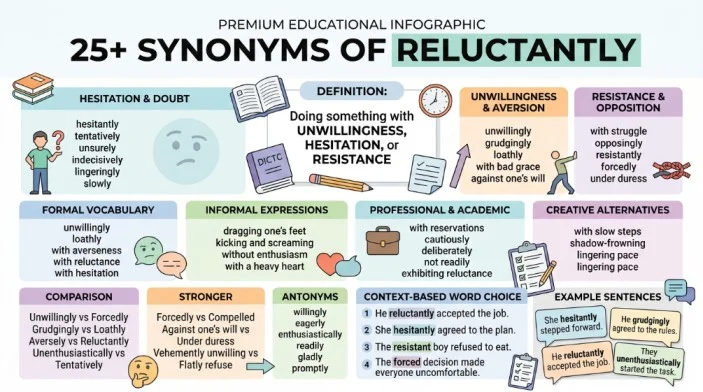
A strong synonym for reluctantly depends on the type of hesitation involved. Hesitantly emphasizes uncertainty, unwillingly stresses a lack of desire, grudgingly suggests reluctant acceptance, and resistantly highlights opposition. For formal writing, use unwillingly or hesitantly when accurate. In creative writing, grudgingly, tentatively, or with hesitation can add more detail.
Meaning, Tone, and Context
Simple Definition
Reluctantly means doing something without wanting to do it, often because you feel uncertain, unwilling, resistant, or pressured to act.
For example:
She reluctantly agreed to attend the meeting.
This sentence tells us that she agreed, but she did not really want to do so.
The important point is that reluctantly describes the manner or attitude behind an action. The person performs the action, but their willingness is limited.
Part of Speech
Reluctantly is an adverb.
It modifies a verb and explains how someone performs an action.
Examples:
- He reluctantly accepted the offer.
- She reluctantly apologized.
- They reluctantly followed the instructions.
- I reluctantly admitted that he was right.
Overall Tone
Reluctantly is generally neutral, although it can carry a negative emotional suggestion because it indicates resistance, hesitation, or unwillingness.
It does not necessarily mean anger. A person can act reluctantly because they are uncertain, uncomfortable, disappointed, or simply unwilling to do something.
Formality Level
Reluctantly is a neutral word that works in both formal and informal English.
It is appropriate for:
- Academic writing
- Professional communication
- Business writing
- Everyday conversation
- Fiction
- Journalism
- Personal writing
For example:
The committee reluctantly approved the proposal.
This sounds natural in a formal report.
In conversation:
I reluctantly agreed to go with them.
This also sounds completely natural.
Common Uses
Native English speakers commonly use reluctantly when someone:
- Accepts something they do not want
- Agrees after resistance
- Takes an action unwillingly
- Gives permission with reservations
- Admits something they would rather avoid
- Changes their position after pressure
- Participates in something reluctantly
- Accepts a difficult decision
Common combinations include:
- reluctantly agree
- reluctantly accept
- reluctantly admit
- reluctantly acknowledge
- reluctantly consent
- reluctantly participate
- reluctantly follow
- reluctantly return
- reluctantly apologize
- reluctantly approve
Word Forms
The main related forms are:
| Form | Word | Example |
|---|---|---|
| Adjective | Reluctant | She was reluctant to speak. |
| Adverb | Reluctantly | She reluctantly spoke. |
| Noun | Reluctance | His reluctance was obvious. |
The adjective reluctant describes a person’s attitude, while reluctantly describes how the action is performed.
Compare:
He was reluctant to accept the offer.
He reluctantly accepted the offer.
When and How to Use “Reluctantly”
Use reluctantly when someone ultimately performs an action despite not wanting to do it.
The word works especially well when there is a contrast between the person’s internal attitude and outward behavior. They may say yes, go somewhere, accept something, or take action, but they do so without enthusiasm.
Professional
The manager reluctantly approved the revised budget after reviewing the financial projections.
This shows that the manager approved the budget but was not fully comfortable with the decision.
Academic
The researcher reluctantly accepted the criticism after examining the additional evidence.
Here, reluctantly shows resistance followed by acceptance.
Workplace
Daniel reluctantly agreed to take on the extra assignment.
The sentence suggests that Daniel did not want the additional responsibility.
Personal
I reluctantly gave away my old guitar because I no longer had space for it.
The word expresses emotional resistance to the action.
I reluctantly agree that postponing the meeting is the most practical option.
This communicates disagreement or hesitation while still accepting the decision.
Resume
The word reluctantly is rarely appropriate on a resume because resumes usually emphasize achievements, initiative, and positive professional behavior.
Instead of:
Reluctantly accepted additional responsibilities.
A stronger resume statement would be:
Took on additional responsibilities during a period of team expansion.
Social Media
I reluctantly tried the new restaurant, but the food completely changed my mind.
This sounds natural in a casual post because it shows initial resistance followed by a positive experience.
Best Synonyms of “Reluctantly”
No alternative has exactly the same meaning as reluctantly in every sentence. The best choice depends on whether the sentence focuses on hesitation, unwillingness, resistance, lack of enthusiasm, or forced action.
Professional Writing: Unwillingly
Unwillingly is useful when the central idea is that someone does not want to perform an action.
The employee unwillingly accepted the new assignment.
However, if the person eventually agrees after some resistance, reluctantly may sound more natural.
Academic Writing: Hesitantly
Hesitantly works when uncertainty is more important than simple unwillingness.
The student hesitantly offered an alternative explanation.
This suggests uncertainty rather than strong opposition.
Business Communication: With Reservations
With reservations is a useful phrase when someone agrees but still has concerns.
The board approved the proposal with reservations.
This is often more precise than reluctantly in formal business writing.
Casual Conversation: Unwillingly
Unwillingly is easy to understand in everyday English when someone does something against their preference.
He unwillingly joined us for dinner.
For natural conversation, however, speakers may also say:
He didn’t really want to go, but he came anyway.
Emotional Writing: Grudgingly
Grudgingly is stronger and more emotionally expressive.
She grudgingly admitted that her sister had been right.
This suggests that the person gives something, accepts something, or admits something with resentment or poor grace.
Creative Writing: Hesitantly
Hesitantly can create a vivid sense of uncertainty in storytelling.
He hesitantly reached for the door handle.
This does not necessarily mean he did not want to open the door. It suggests caution or uncertainty.
Resume Writing: Usually Avoid It
Reluctantly and most direct synonyms are generally poor choices for resumes because they emphasize resistance rather than achievement.
Instead of:
Reluctantly managed a larger team.
Use:
Successfully managed an expanded team during a period of rapid growth.
Workplace Communication: With Reservations
When describing professional disagreement, with reservations can sound measured and diplomatic.
The department agreed to the change with reservations.
It communicates concern without sounding overly emotional.
Stronger Meaning: Grudgingly
Grudgingly is stronger than reluctantly because it can imply resentment or unwilling generosity.
He grudgingly apologized.
Softer Meaning: Hesitantly
Hesitantly can be softer because it often indicates uncertainty rather than unwillingness.
She hesitantly raised her hand.
When Not to Use “Reluctantly”
Although reluctantly is versatile, it is not the right word for every situation involving hesitation or difficulty.
When the Person Is Simply Uncertain
If someone is unsure rather than unwilling, hesitantly is usually better.
Less precise:
She reluctantly answered the question.
Better:
She hesitantly answered the question.
The second sentence suggests uncertainty rather than resistance.
When the Person Acts Without Conscious Choice
If an action happens without deliberate intention, involuntarily is more accurate.
Less precise:
He reluctantly blinked when the light became brighter.
Better:
He involuntarily blinked when the light became brighter.
Blinking is a physical response, not necessarily an unwilling decision.
When the Person Is Forced
If someone has no real choice, under pressure, under compulsion, or against their will may be more accurate.
Less precise:
She reluctantly signed the document.
Better:
She signed the document under pressure.
The second sentence gives a clearer reason for her action.
When the Person Accepts Something With Resentment
Use grudgingly when the emotional element is important.
Less precise:
He reluctantly admitted his mistake.
Stronger:
He grudgingly admitted his mistake.
The second sentence suggests that he did not want to give the other person credit or admit fault.
When the Person Is Cautious
Use tentatively or hesitantly when the action reflects caution.
Less precise:
She reluctantly touched the unfamiliar object.
Better:
She tentatively touched the unfamiliar object.
This emphasizes caution rather than unwillingness.
When the Person Has No Strong Feeling
Do not use reluctantly simply because an action is not enthusiastic.
For example:
She reluctantly chose the blue notebook.
If she simply chose the notebook without much emotion, reluctantly adds a meaning that may not be intended.
Words Commonly Confused With “Reluctantly”
Hesitantly
Difference: Hesitantly focuses on uncertainty, nervousness, or lack of confidence.
When to Use It: Use it when someone pauses or acts cautiously because they are unsure.
Example:
She hesitantly opened the door.
Unwillingly
Difference: Unwillingly emphasizes a lack of desire.
When to Use It: Use it when someone does something despite not wanting to do it.
Example:
He unwillingly accepted the extra work.
Grudgingly
Difference: Grudgingly adds resentment or a feeling that someone is giving in reluctantly.
When to Use It: Use it when acceptance comes with poor grace or irritation.
Example:
She grudgingly admitted that he was correct.
Involuntarily
Difference: Involuntarily means something happens without conscious control or intention.
When to Use It: Use it for automatic physical or emotional responses.
Example:
He involuntarily laughed at the unexpected comment.
Tentatively
Difference: Tentatively emphasizes caution and uncertainty rather than unwillingness.
When to Use It: Use it when someone takes a careful first step.
Example:
She tentatively suggested a different approach.
Against One’s Will
Difference: This phrase means someone does something despite actively not wanting to do it, often because of force or circumstances.
When to Use It: Use it when lack of freedom or choice is important.
Example:
He was taken to the meeting against his will.
Best Synonyms of “Reluctantly” by Context
| Context | Best Synonym | Why It Works | Example |
|---|---|---|---|
| Formal writing | Unwillingly | Clearly expresses lack of desire | The committee unwillingly accepted the proposal. |
| Academic writing | Hesitantly | Emphasizes uncertainty | The student hesitantly presented the alternative theory. |
| Professional communication | With reservations | Sounds diplomatic and measured | The team approved the plan with reservations. |
| Business emails | With reservations | Communicates concern professionally | We accepted the revised terms with reservations. |
| Resume writing | Usually avoid direct synonym | Negative hesitation can weaken a resume | Managed additional duties during team expansion. |
| Workplace communication | Reluctantly | Neutral and widely understood | She reluctantly agreed to the schedule change. |
| Casual conversation | Unwillingly | Simple and familiar | He unwillingly went along with the plan. |
| Everyday speaking | Hesitantly | Natural for uncertainty | She hesitantly asked for help. |
| Creative writing | Hesitantly | Creates a sense of uncertainty | He hesitantly stepped into the dark room. |
| Storytelling | Grudgingly | Adds emotional resistance | She grudgingly accepted his apology. |
| Emotional writing | Grudgingly | Shows resistance and feeling | He grudgingly let go of the relationship. |
| Strong emphasis | Grudgingly | Can suggest resentment | She grudgingly gave him credit. |
| Mild tone | Hesitantly | Softer than unwillingly | He hesitantly agreed to participate. |
| Social media captions | Didn’t really want to | Sounds conversational | I didn’t really want to go, but I had fun. |
| American English | Reluctantly | Natural and widely understood | She reluctantly changed her plans. |
| British English | Reluctantly | Equally natural in standard British usage | He reluctantly agreed to the arrangement. |
How to Choose the Best Synonym of “Reluctantly”
The easiest way to choose an alternative is to identify the reason behind the person’s resistance.
If the Person Does Not Want to Do It
Choose unwillingly.
She unwillingly accepted the assignment.
If the Person Is Unsure
Choose hesitantly.
She hesitantly answered the question.
If the Person Is Cautious
Choose tentatively.
He tentatively reached toward the switch.
If the Person Is Resentful
Choose grudgingly.
He grudgingly apologized.
If the Person Has Concerns
Choose with reservations.
The committee approved the plan with reservations.
If the Action Is Automatic
Choose involuntarily.
She involuntarily stepped backward.
If the Person Has No Choice
Choose against their will or under pressure.
He signed the agreement under pressure.
Consider Your Audience
Academic readers usually benefit from precise vocabulary such as hesitantly or unwillingly. Business readers may respond better to the diplomatic phrase with reservations.
Consider Emotional Strength
- If you want a neutral description, use reluctantly.
- If you want stronger emotional resistance, use grudgingly.
- If you want a softer sense of uncertainty, use hesitantly.
Consider Natural Usage
Do not replace reluctantly simply because another word looks more sophisticated. The best synonym is the one that preserves the original meaning while making the sentence more precise.
Real Life Examples of “Reluctantly”
School
Original:
The student reluctantly joined the group discussion.
More precise:
The student hesitantly joined the group discussion because she was nervous about speaking.
Here, hesitantly is better because nervousness, not unwillingness, explains the behavior.
College
Original:
The student reluctantly changed his research topic.
More precise:
The student reluctantly changed his research topic after discovering that the original approach was not practical.
Here, reluctantly works because the student did not want to make the change.
Workplace
Original:
The employee reluctantly accepted the new schedule.
Alternative:
The employee accepted the new schedule with reservations.
The second version sounds more diplomatic in a professional context.
Business
Original:
The company reluctantly agreed to the revised terms.
Alternative:
The company agreed to the revised terms with reservations.
The alternative is useful when the business wants to communicate concern without sounding emotional.
Original:
I reluctantly agree that postponing the event is necessary.
Alternative:
I agree that postponing the event is necessary, although I have some reservations.
The second version is clearer when the writer wants to communicate a specific concern.
Resume
Instead of:
Reluctantly took on additional responsibilities.
Use:
Took on additional responsibilities during a period of organizational growth.
A resume should focus on capability and results rather than unwillingness.
Conversation
I reluctantly went to the party, but I ended up having a great time.
This is natural because the speaker initially did not want to attend but eventually enjoyed the experience.
Storytelling
She hesitantly pushed open the old wooden door.
Hesitantly works better than reluctantly because the character is cautious and uncertain.
Blogging
I reluctantly tried the new productivity method, but it turned out to be surprisingly useful.
The word creates a relatable contrast between initial resistance and later approval.
Social Media
I reluctantly joined the hiking trip and came home wondering why I had waited so long.
The word works well in casual writing because it communicates an initial lack of enthusiasm.
25 Best Synonyms of “Reluctantly”
| Synonym | Simple Meaning | Best Used For | Example Sentence |
|---|---|---|---|
| Hesitantly | With uncertainty | Cautious actions | She hesitantly answered the question. |
| Unwillingly | Without wanting to | Lack of desire | He unwillingly accepted the assignment. |
| Grudgingly | With resentment or poor grace | Emotional resistance | She grudgingly admitted that he was right. |
| Tentatively | With caution or uncertainty | First attempts | He tentatively suggested another solution. |
| Involuntarily | Without conscious control | Automatic reactions | She involuntarily stepped back. |
| Unenthusiastically | Without enthusiasm | Lack of excitement | He unenthusiastically joined the discussion. |
| Resistantly | In a resistant manner | Opposition | The patient responded resistantly to the proposed change. |
| Warily | With caution or suspicion | Uncertain situations | She warily accepted the unfamiliar offer. |
| Doubtfully | With uncertainty or doubt | Questionable situations | He doubtfully agreed to the proposal. |
| Guardedly | With caution and limited openness | Sensitive situations | She guardedly accepted the explanation. |
| Cautiously | With care to avoid risk | Risky decisions | He cautiously agreed to the experiment. |
| Reluctant | Unwilling or hesitant | Adjectival replacement | She was reluctant to participate. |
| Under Pressure | Because circumstances force action | Professional or personal situations | He accepted the deal under pressure. |
| Against One’s Will | Without wanting to do something | Forced situations | She went along against her will. |
| With Reservations | While still having concerns | Formal communication | The board approved the proposal with reservations. |
| With Hesitation | After pausing or doubting | General writing | He signed the form with hesitation. |
| With Misgivings | While feeling doubtful | Formal or literary writing | She accepted the offer with misgivings. |
| Halfheartedly | Without full enthusiasm or commitment | Weak participation | He halfheartedly supported the proposal. |
| Unenthusiastically | Without eagerness | Everyday and professional contexts | They unenthusiastically agreed to the change. |
| Doubtingly | While questioning something | Literary or descriptive writing | She looked at him doubtingly. |
| Warily | Carefully because of possible danger | Suspicious situations | He warily approached the unfamiliar vehicle. |
| Guardedly | Carefully avoiding openness | Emotional or sensitive contexts | She guardedly discussed the issue. |
| Cautiously | Carefully because of possible consequences | Decisions and actions | They cautiously accepted the offer. |
| Resistantly | Showing opposition | Descriptive contexts | He resistantly responded to the suggestion. |
| Grudgingly | Giving in unwillingly | Strong emotional resistance | She grudgingly offered an apology. |
The list includes several context dependent alternatives. Some are closer synonyms than others. For example, hesitantly, unwillingly, and grudgingly can often replace reluctantly, while involuntarily should only be used when the action occurs without conscious control.
Synonyms of “Reluctantly” by Usage
Professional vs Personal Synonyms
In professional settings, the safest alternatives are usually with reservations, hesitantly, and unwillingly, depending on the exact meaning.
For example:
The committee approved the proposal with reservations.
This sounds more diplomatic than:
The committee grudgingly approved the proposal.
In personal writing, emotional alternatives such as grudgingly may be more appropriate.
She grudgingly admitted that her brother had been right.
The choice depends on whether you want to describe professional disagreement or personal emotion.
Formal vs Conversational Synonyms
Formal writing benefits from precise and restrained vocabulary.
Reports:
The board approved the proposal with reservations.
Essays:
The researcher hesitantly accepted the alternative interpretation.
Business writing:
The organization unwillingly accepted the additional costs.
Presentations:
The team initially expressed reservations about the proposal.
Emails:
I agree with the recommendation, although I have some reservations.
Casual conversation:
I didn’t really want to go, but I went anyway.
Texting:
I wasn’t sure about it, but I agreed.
The casual versions often sound more natural than forcing a formal synonym into everyday speech.
Academic Synonyms
Academic writing requires precision. The best alternative depends on the reason behind the hesitation.
- Use hesitantly when uncertainty is the central idea:
The participant hesitantly proposed an alternative explanation.
- Use unwillingly when the person does not want to participate:
The participant unwillingly accepted the revised conditions.
- Use with reservations when concerns remain:
The researchers accepted the interpretation with reservations.
Avoid using grudgingly in academic writing unless the emotional attitude is genuinely relevant to the subject.
Professional and Business Synonyms
For resumes, interviews, meetings, presentations, performance reviews, client communication, and business emails, choose language carefully.
Resumes: Avoid reluctant language when possible. Focus on actions and achievements.
Interviews: Use hesitant only when discussing a genuine period of uncertainty.
Meetings: With reservations works well for diplomatic disagreement.
Presentations: Initially hesitant can describe a cautious response.
Performance reviews: Use neutral language such as initially uncertain instead of emotionally loaded alternatives.
Client communication: With reservations is often more diplomatic.
Business emails: Explain the concern directly rather than relying on reluctantly.
For example:
We can approve the request with reservations regarding the proposed timeline.
This tells the reader exactly what the concern is.
Creative and Literary Synonyms
Creative writing gives you more freedom to select words based on emotional effect.
Hesitantly can make a character seem uncertain.
He hesitantly stepped into the room.
Grudgingly can suggest resentment.
She grudgingly accepted his apology.
Tentatively can create suspense.
He tentatively touched the strange object.
Warily can suggest suspicion.
She warily followed the stranger down the hallway.
With misgivings can show internal doubt.
He accepted the invitation with misgivings.
These choices help readers understand the character’s emotional state without explaining it directly.
Slang or Modern Synonyms
There is no single slang word that perfectly replaces reluctantly.
In casual American English, people often express the idea with phrases such as:
- I didn’t really want to.
- I wasn’t into it.
- I wasn’t thrilled about it.
- I didn’t want to, but I did.
- I went along with it.
For example:
I wasn’t thrilled about going, but I went anyway.
These expressions work in conversations, texts, and casual social media posts. They should generally be avoided in academic essays, formal reports, and professional documents.
Strongest to Mildest Synonyms
The intensity of a synonym depends on the emotional resistance it communicates.
| Level | Words and Phrases | Main Idea |
|---|---|---|
| Mild | Hesitantly, tentatively, cautiously | Uncertainty or caution |
| Moderate | Reluctantly, unwillingly, unenthusiastically | Limited willingness |
| Strong | Grudgingly, with misgivings, resistantly | Clear emotional resistance |
| Very Strong | Against one’s will, under pressure | Lack of genuine choice |
This is not an absolute ranking because context changes intensity. Against one’s will, for example, describes circumstances rather than simply a stronger emotional version of reluctantly.
Emotional vs Neutral Synonyms
Emotional Synonyms
Use these when the person’s feelings are important to the sentence.
- Grudgingly
- With misgivings
- Unenthusiastically
- Waryingly
- Against one’s will
Example:
He grudgingly accepted the criticism.
The word grudgingly gives the sentence an emotional edge.
Neutral Synonyms
Use these when you want to communicate the situation without adding much emotional judgment.
- Reluctantly
- Hesitantly
- Unwillingly
- Tentatively
- Cautiously
- With reservations
Example:
The committee approved the proposal with reservations.
This sounds measured and professional.
Antonyms of “Reluctantly”
| Antonym | Meaning | Example Sentence |
|---|---|---|
| Willingly | With a desire to do something | She willingly volunteered for the project. |
| Eagerly | With strong enthusiasm | He eagerly accepted the invitation. |
| Enthusiastically | With excitement and energy | They enthusiastically supported the plan. |
| Readily | Without hesitation or difficulty | She readily agreed to help. |
| Happily | With pleasure | He happily joined the celebration. |
| Gladly | With willingness and pleasure | I would gladly assist you. |
| Freely | Without pressure or force | She freely accepted the responsibility. |
| Voluntarily | By personal choice | He voluntarily joined the program. |
| Willingly | Without resistance | They willingly followed the instructions. |
| Enthusiastically | With strong positive interest | The students enthusiastically participated. |
| Eagerly | With eagerness | She eagerly opened the package. |
| Cheerfully | In a happy and positive manner | He cheerfully accepted the task. |
| Readily | Quickly and willingly | The manager readily approved the request. |
| Wholeheartedly | With complete sincerity and commitment | She wholeheartedly supported the cause. |
| Unreservedly | Without hesitation or limitation | He unreservedly accepted responsibility. |
Several of these words overlap in meaning, but each emphasizes a different form of willingness. Willingly is the broadest opposite, while eagerly and enthusiastically add stronger positive emotion.
Comparison: “Reluctantly” vs Similar Words
Reluctantly vs Hesitantly
Main Difference
Reluctantly means someone does not want to do something. Hesitantly means someone is uncertain or nervous about doing it.
Which Is Stronger?
Reluctantly can suggest stronger resistance, while hesitantly may simply indicate uncertainty.
Which Is More Formal?
Both are neutral and suitable for formal writing.
When to Use Each
Use reluctantly when the person does not want to act.
Use hesitantly when the person is unsure.
Examples
Reluctantly:
She reluctantly accepted the assignment.
Hesitantly:
She hesitantly answered the question.
Reluctantly vs Unwillingly
Main Difference
Both describe a lack of desire, but unwillingly focuses more directly on not wanting to act.
Which Is Stronger?
Unwillingly can sound slightly more direct about the person’s lack of desire.
Which Is More Formal?
Both work in formal writing.
When to Use Each
Use reluctantly when resistance accompanies eventual acceptance.
Use unwillingly when lack of desire is the main point.
Examples
Reluctantly:
He reluctantly agreed to the change.
Unwillingly:
He unwillingly accepted the extra responsibility.
Reluctantly vs Grudgingly
Main Difference
Grudgingly suggests resentment or poor grace. Reluctantly does not necessarily imply resentment.
Which Is Stronger?
Grudgingly is stronger and more emotional.
Which Is More Formal?
Reluctantly is more neutral and versatile.
When to Use Each
Use grudgingly when the person’s negative feelings matter.
Examples
Reluctantly:
She reluctantly agreed to apologize.
Grudgingly:
She grudgingly admitted that she had made a mistake.
Reluctantly vs Involuntarily
Main Difference
Reluctantly involves a conscious action performed without much willingness. Involuntarily describes something that happens without conscious control.
Which Is Stronger?
Neither is simply stronger. They describe different situations.
Which Is More Formal?
Both are suitable for formal writing when used accurately.
When to Use Each
Use involuntarily for automatic physical or emotional reactions.
Examples
Reluctantly:
He reluctantly raised his hand.
Involuntarily:
He involuntarily flinched when the door slammed.
Reluctantly vs Tentatively
Main Difference
Tentatively suggests caution or uncertainty. Reluctantly suggests limited willingness.
Which Is Stronger?
Reluctantly generally communicates stronger resistance.
Which Is More Formal?
Both are neutral.
When to Use Each
Use tentatively when someone is testing an idea or taking a cautious step.
Examples
Reluctantly:
She reluctantly joined the committee.
Tentatively:
She tentatively suggested a new approach.
Reluctantly vs Willingly
Main Difference
These words express opposite attitudes. Reluctantly indicates limited willingness, while willingly indicates that someone chooses to act without resistance.
Which Is Stronger?
They are opposites rather than stronger and weaker versions of the same idea.
Which Is More Formal?
Both are appropriate in professional and academic writing.
When to Use Each
Use willingly when someone is cooperative or eager enough to act by choice.
Examples
Reluctantly:
He reluctantly accepted the assignment.
Willingly:
He willingly accepted the assignment.
Common Phrases and Expressions with “Reluctantly”
Reluctantly Agree
Meaning: Accepting an idea or proposal despite not fully wanting to.
Example:
The committee reluctantly agreed to extend the deadline.
Reluctantly Accept
Meaning: Taking or receiving something despite resistance.
Example:
She reluctantly accepted the new position.
Reluctantly Admit
Meaning: Acknowledging something that a person would rather not admit.
Example:
He reluctantly admitted that his original plan had failed.
Reluctantly Acknowledge
Meaning: Recognizing a fact despite some resistance.
Example:
The company reluctantly acknowledged the problems with the product.
Reluctantly Apologize
Meaning: Saying sorry without feeling completely willing or enthusiastic.
Example:
He reluctantly apologized after realizing how his comment had affected her.
Reluctantly Approve
Meaning: Giving approval despite concerns or reservations.
Example:
The board reluctantly approved the proposal.
Reluctantly Participate
Meaning: Taking part without wanting to.
Example:
She reluctantly participated in the group activity.
Reluctantly Follow
Meaning: Obeying or following something despite resistance.
Example:
He reluctantly followed the new procedure.
Common Mistakes to Avoid
1. Confusing Reluctantly With Hesitantly
Incorrect:
She reluctantly answered because she was nervous.
Better:
She hesitantly answered because she was nervous.
Why:
Nervousness suggests uncertainty, so hesitantly communicates the reason more accurately.
2. Using Involuntarily for a Conscious Decision
Incorrect:
He involuntarily accepted the job offer.
Better:
He reluctantly accepted the job offer.
Why:
Accepting a job is generally a conscious decision. Involuntarily is better for automatic reactions.
3. Using Grudgingly When There Is No Resentment
Incorrect:
She grudgingly agreed to help because she was simply unsure.
Better:
She hesitantly agreed to help.
Why:
Grudgingly suggests resentment. If the person is merely uncertain, hesitantly is more accurate.
4. Using Reluctantly When Someone Has No Choice
Incorrect:
He reluctantly signed the document after being physically forced.
Better:
He signed the document against his will.
Why:
The second sentence clearly communicates a lack of free choice.
5. Using Formal Synonyms in Casual Conversation
Incorrect:
I accepted the invitation with reservations because I wasn’t sure about it.
This is grammatically correct, but it may sound unnecessarily formal in casual speech.
Better:
I wasn’t sure about it, but I agreed to go.
Why:
Everyday English often favors simple, direct expressions.
6. Using Reluctantly on a Resume
Incorrect:
Reluctantly accepted additional responsibilities.
Better:
Took on additional responsibilities during a period of rapid growth.
Why:
The second version emphasizes professional contribution instead of resistance.
7. Choosing a Stronger Word Than the Situation Supports
Incorrect:
She grudgingly touched the unfamiliar object because she was nervous.
Better:
She hesitantly touched the unfamiliar object because she was nervous.
Why:
Hesitantly reflects nervous caution. Grudgingly would suggest resentment that is not present.
Frequently Asked Questions
1. What are the best synonyms of “reluctantly”?
The best synonyms of reluctantly include hesitantly, unwillingly, grudgingly, tentatively, and with reservations. The best choice depends on whether the sentence emphasizes uncertainty, resistance, resentment, or concern.
2. What are the best formal synonyms of “reluctantly”?
Formal alternatives include unwillingly, hesitantly, with reservations, and with misgivings. For professional communication, with reservations is often especially useful because it expresses concern without adding unnecessary emotional language.
3. What are common informal synonyms of “reluctantly”?
In informal English, people often say hesitantly, unwillingly, or use phrases such as I didn’t really want to and I wasn’t thrilled about it. The best option depends on the situation.
4. What is another word for “reluctantly” in professional writing?
Unwillingly, hesitantly, and with reservations can work in professional writing. With reservations is particularly useful when someone accepts a proposal while still expressing concerns about it.
5. What is the difference between “reluctantly” and “hesitantly”?
Reluctantly describes doing something without wanting to, while hesitantly describes acting with uncertainty or caution. Someone can be hesitant without being unwilling, so the two words should not always be substituted.
6. What is the opposite of “reluctantly”?
The most direct opposite of reluctantly is willingly. Other positive alternatives include eagerly, readily, gladly, enthusiastically, and wholeheartedly, depending on how much enthusiasm or commitment the sentence needs.
Conclusion
Reluctantly describes an action performed without much willingness, often because someone has reservations, resistance, uncertainty, or limited desire. The best synonym of reluctantly depends on the exact reason behind that attitude.
Use hesitantly for uncertainty, unwillingly for lack of desire, grudgingly for resentment, tentatively for caution, and with reservations for professional or diplomatic disagreement. These distinctions matter because replacing a word with an inaccurate synonym can change the meaning of the entire sentence.
The most useful vocabulary habit is to identify the feeling or circumstance behind an action before choosing a replacement. Instead of searching for the most sophisticated word, choose the alternative that communicates the intended meaning most clearly.
Read More Related Articles:
25+ Synonyms, Meanings, Uses, Examples, and Best …
Meaning, Uses, Examples, and the Best Synonym of Complain
25+ Synonyms of Frequency | Meanings, Uses, Examples …