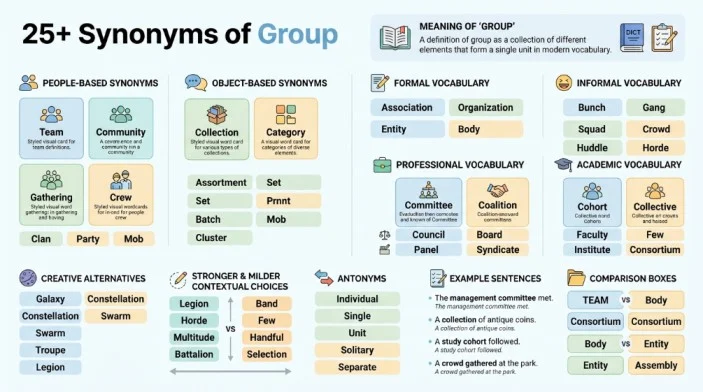
When writing an essay, business report, email, or everyday message, repeating the word group can make your sentences feel flat. Finding the right synonym for group gives your writing more variety and helps you describe people, objects, organizations, or ideas with greater precision. The best word depends on what you mean. A group synonym such as team suggests people working toward a shared goal, while collection works better for objects and category suits ideas or classifications.
Whether you are searching for another word for group, exploring synonyms for group, or comparing other words for group, context matters. This guide also covers groups synonym, group synonyms, another word for groups, and the difference between a synonym group and a simple collection of related words. Understanding these distinctions helps you choose vocabulary that sounds natural, accurate, and appropriate for the situation.
What Are the Best Synonyms of “Group”?
A group is a collection of people or things considered together because they share something or are connected in some way. Common alternatives include team for organized work, community for shared identity, collection for objects, category for classification, audience for people watching or listening, and cohort for people sharing a particular characteristic or experience.
Meaning, Tone, and Context
Simple Definition
Group refers to two or more people or things that are gathered, connected, classified, or considered together.
The exact meaning changes according to context. A group can be organized for a purpose, connected by a shared characteristic, physically gathered in one place, or simply treated as a set of related things.
For example:
“The students worked in a group.”
Here, group refers to several students working together.
In another sentence:
“This group of products is designed for beginners.”
Here, the word describes products placed together because they share a particular feature.
Part of Speech
Group can function as both a noun and a verb.
As a noun:
“Our group meets every Friday.”
As a verb:
“The teacher grouped the students according to their skill levels.”
Overall Tone
Group is generally neutral. It does not normally communicate a positive or negative opinion by itself.
The surrounding words determine the emotional effect.
“A supportive group helped her succeed.”
“A hostile group blocked the entrance.”
The word remains neutral in both sentences.
Formality Level
Group is a highly versatile, neutral word. It works in:
- Academic writing
- Professional communication
- Business documents
- Everyday conversation
- Emails
- Reports
- Social media
- Creative writing
More specific alternatives may sound more appropriate when the relationship between members matters.
Common Uses
Native English speakers use group for many situations, including:
- A group of students
- A group of employees
- A group of friends
- A group of researchers
- A group of customers
- A group of volunteers
- A group of tourists
- A group of musicians
- A group of companies
- A group of objects
- A group of categories
- A group of related ideas
Word Forms
| Form | Example |
|---|---|
| Noun | “The group reached an agreement.” |
| Verb | “The teacher grouped the students.” |
| Noun, plural | “Several groups attended the event.” |
| Related noun | “Grouping can make information easier to understand.” |
When and How to Use “Group”
Use group when you want a broad, natural term for multiple people or things considered together. It is especially useful when the exact relationship between members is not important or when a more specific word would add unnecessary detail.
Professional
“The management group reviewed the proposal before the meeting.”
Academic
“The researchers divided the participants into three groups.”
Workplace
“Our group is responsible for updating the client database.”
Personal
“A group of friends joined us for dinner.”
“I have attached the information for the group to review.”
Resume
“Led a group of five employees during a major process improvement project.”
Social Media
“Our group had an amazing time at the conference.”
Best Synonyms of “Group”
No single alternative works in every situation. The most accurate choice depends on whether group refers to people working together, people sharing an identity, objects collected together, or items classified under one heading.
Professional Writing: Team
Use team when people work together toward a shared goal.
“The project team completed the research ahead of schedule.”
Why it works: It communicates cooperation, purpose, and shared responsibility more clearly than the general word group.
Academic Writing: Cohort
Use cohort for people who share a particular academic, demographic, or research characteristic.
“The study followed a cohort of college students for four years.”
Why it works: It provides more precise academic meaning than group.
Business Communication: Team
Team is usually the strongest choice when employees collaborate on a task or objective.
“The sales team exceeded its quarterly target.”
Casual Conversation: Bunch
Bunch is informal and commonly used when referring casually to several people or things.
“A bunch of us went to the movie.”
Emotional Writing: Community
Community works when people are connected through shared identity, support, location, or values.
“She found a welcoming community after moving to the city.”
Creative Writing: Crowd
Crowd can create a stronger visual image when many people are gathered together.
“A restless crowd filled the narrow street.”
Resume Writing: Team
Team is usually more effective than group when describing collaboration.
“Collaborated with a cross functional team to improve customer service.”
Workplace Communication: Team
When employees share responsibilities and objectives, team gives readers more useful information.
“The product team will present the new strategy tomorrow.”
Stronger Meaning: Coalition
Use coalition when separate people or organizations join together for a particular purpose.
“Several organizations formed a coalition to support the proposal.”
Softer or Broader Meaning: Collection
For objects, collection can be a natural alternative when the items are gathered or considered together.
“The museum displayed a collection of historical photographs.”
When Not to Use “Group”
Although group is flexible, it can sometimes be too general. A more specific word can communicate the relationship between members more effectively.
When “Group” Is Too General
Less precise:
“The group completed the project.”
Better:
“The team completed the project.”
Why: Team tells the reader that the people were working together toward a shared goal.
When “Group” Is Too Vague
Less precise:
“The group studied the issue.”
Better:
“The committee studied the issue.”
Why: Committee suggests an organized body assigned to examine or decide something.
When “Group” Is Too Informal
In highly formal contexts, a more precise organizational term may be better.
Less precise:
“The group approved the proposal.”
Better:
“The committee approved the proposal.”
When “Group” Is Too Weak
If several organizations deliberately join for a shared objective, coalition may communicate the relationship better.
Less precise:
“A group of organizations supported the campaign.”
Better:
“A coalition of organizations supported the campaign.”
When “Group” Is Too Strong
Sometimes a simple word is better than a term suggesting formal organization.
Less natural:
“A committee of friends met for dinner.”
Better:
“A group of friends met for dinner.”
When “Group” Is Not Specific Enough for Objects
Less precise:
“The store sells a group of related products.”
Better:
“The store sells a collection of related products.”
Or:
“The products belong to the same category.”
The best choice depends on whether the items are physically gathered or conceptually classified.
Words Commonly Confused With “Group”
Team
Difference: A team usually consists of people working toward a shared objective.
When to Use It: Use it for sports, workplaces, projects, and collaborative tasks.
Example:
“The marketing team developed a new campaign.”
Crowd
Difference: A crowd emphasizes a large number of people gathered together, often physically.
When to Use It: Use it for public events, streets, concerts, demonstrations, and busy places.
Example:
“A large crowd gathered outside the stadium.”
Community
Difference: A community emphasizes shared identity, location, interests, values, or social connection.
When to Use It: Use it for neighborhoods, online communities, cultural groups, and people with shared interests.
Example:
“The online community shares helpful writing advice.”
Committee
Difference: A committee is an organized group appointed or selected to perform a particular function.
When to Use It: Use it in government, schools, businesses, organizations, and formal decision making.
Example:
“The committee reviewed the new policy.”
Collection
Difference: A collection normally refers to things gathered or considered together, although it can occasionally describe people or works.
When to Use It: Use it for books, art, objects, data, photographs, or related items.
Example:
“She has a large collection of vintage books.”
Category
Difference: A category is a classification rather than necessarily a physical or social gathering.
When to Use It: Use it when similar things are organized according to shared characteristics.
Example:
“The products fall into three main categories.”
Best Synonyms of “Group” by Context
| Context | Best Synonym | Why It Works | Example |
|---|---|---|---|
| Formal writing | Collective | Emphasizes people or things considered together | “The collective responded to the proposal.” |
| Academic writing | Cohort | Identifies people sharing a defined characteristic | “The cohort was monitored throughout the study.” |
| Professional communication | Team | Shows collaboration toward a goal | “The team completed the assignment.” |
| Business emails | Team | Natural for workplace collaboration | “The team will review the document.” |
| Resume writing | Team | Highlights collaboration and professional work | “Led a team of eight specialists.” |
| Workplace communication | Team | Clearly communicates shared responsibility | “The support team resolved the issue.” |
| Casual conversation | Bunch | Informal and conversational | “A bunch of friends came over.” |
| Everyday speaking | Group | Simple and natural | “A group of people was waiting outside.” |
| Creative writing | Crowd | Creates a visual sense of many people | “The crowd moved toward the entrance.” |
| Storytelling | Gathering | Highlights people coming together | “The gathering continued late into the evening.” |
| Emotional writing | Community | Suggests belonging and connection | “The community gave her much needed support.” |
| Strong emphasis | Coalition | Shows purposeful cooperation | “The organizations formed a coalition.” |
| Mild tone | Set | Useful for a small collection of related things | “She bought a set of notebooks.” |
| Social media captions | Crew | Casual term for a close group of people | “Great memories with my favorite crew.” |
| American English | Group | Broad, neutral, and highly common | “The group met after work.” |
How to Choose the Best Synonym of “Group”
The easiest way to choose the right word is to identify what connects the members.
If People Work Together
Choose team.
“The engineering team solved the problem.”
If People Share an Identity or Interest
Choose community.
“The photography community is very active online.”
If People Are Appointed for a Task
Choose committee.
“The committee reviewed the applications.”
If Many People Are Gathered in One Place
Choose crowd.
“A crowd gathered near the stage.”
If People Share a Specific Characteristic
Choose cohort.
“The researchers studied a cohort of first year students.”
If Organizations Join for a Purpose
Choose coalition.
“The coalition launched a public awareness campaign.”
If You Mean Related Objects
Choose collection, set, or category, depending on the relationship.
“A collection of photographs”
“A set of tools”
“A category of products”
Consider Tone
- Use team and community for natural professional or social communication.
- Use cohort, collective, and coalition when the context requires greater precision.
- Use bunch and crew mainly in informal communication.
Consider Your Audience
A business report should usually favor precise terms such as team, committee, or department.
A casual conversation can comfortably use group, bunch, or crew.
Consider Emotional Strength
Community often sounds warmer than group because it can suggest belonging.
Crowd may sound more impersonal because it focuses on many people gathered together.
Coalition can suggest deliberate cooperation and shared purpose.
Real Life Examples of “Group”
School
Basic:
“The students worked in a group.”
More precise:
“The students worked in a team to complete the science project.”
College
Basic:
“The professor divided the class into groups.”
More precise:
“The professor divided the class into small teams for the research activity.”
Workplace
Basic:
“The group discussed the new policy.”
More precise:
“The committee discussed the new policy.”
Business
Basic:
“A group of companies supported the plan.”
More precise:
“A coalition of companies supported the plan.”
Basic:
“Please send this document to the group.”
More precise:
“Please send this document to the project team.”
Resume
Basic:
“Worked with a group of designers.”
More effective:
“Collaborated with a team of designers on multiple client projects.”
Conversation
“A group of us went out for dinner.”
Here, group sounds completely natural because the situation is casual and no more specific relationship is necessary.
Storytelling
Basic:
“A group entered the old building.”
More vivid:
“A small band of travelers entered the old building.”
The alternative adds a stronger storytelling quality.
Blogging
Basic:
“A group of readers responded to the article.”
More specific:
“A community of readers responded to the article.”
Social Media
Basic:
“Great day with my group.”
More natural:
“Great day with my crew.”
The informal alternative works particularly well when referring to close friends.
25 Best Synonyms of “Group”
| Synonym | Simple Meaning | Best Used For | Example Sentence |
|---|---|---|---|
| Team | People working toward a shared goal | Work, sports, projects | “The team completed the project early.” |
| Community | People connected by identity, place, or interests | Social and cultural contexts | “The writing community shared useful advice.” |
| Collection | Things gathered or considered together | Objects, books, art | “The museum displayed a collection of paintings.” |
| Category | Things classified by shared characteristics | Organization and classification | “This product belongs to a different category.” |
| Crowd | Many people gathered together | Public places and events | “A large crowd waited outside.” |
| Committee | People chosen for a specific responsibility | Organizations and institutions | “The committee approved the proposal.” |
| Cohort | People sharing a particular characteristic or period | Academic and research contexts | “The cohort was followed for five years.” |
| Collective | People or things considered as one whole | Formal and social contexts | “The artists worked as a collective.” |
| Gathering | People coming together in one place | Social events | “The family held a small gathering.” |
| Cluster | Things or people positioned close together | Science, data, objects | “A cluster of houses stood near the river.” |
| Set | Related things treated as a unit | Objects and collections | “She bought a set of measuring cups.” |
| Bunch | Several people or things, informal | Casual conversation | “A bunch of friends joined us.” |
| Crew | A group working or spending time together | Informal and occupational contexts | “The film crew arrived early.” |
| Band | A small group with a shared purpose | Music, stories, informal groups | “A band of travelers crossed the valley.” |
| Circle | People connected socially or intellectually | Friends and relationships | “She has a close circle of friends.” |
| Association | People or organizations connected by an interest or purpose | Formal organizations | “The professional association published new guidelines.” |
| Alliance | Parties cooperating toward a shared goal | Politics, business, organizations | “The two companies formed an alliance.” |
| Coalition | Separate groups joining for a particular purpose | Politics and advocacy | “Several organizations formed a coalition.” |
| Party | A group participating in an activity or event | Travel, negotiations, events | “A rescue party searched the area.” |
| Faction | A smaller group within a larger organization with distinct views | Politics and organizations | “A faction opposed the proposed changes.” |
| Division | A distinct section within a larger organization or system | Business and institutions | “The sales division reported strong results.” |
| Segment | A distinct part of a larger population or market | Business and analysis | “The company targets a younger segment.” |
| Class | People or things sharing characteristics or classification | Education and categorization | “The study focused on a particular class of materials.” |
| Category | A class of similar people or things | Classification | “The books belong to the same category.” |
| Network | Connected people or organizations | Professional and social relationships | “She built a strong professional network.” |
Synonyms of “Group” by Usage
Professional vs Personal Synonyms
In professional settings, team, committee, department, cohort, association, and collective can provide more information than the broad word group.
For example:
“The team prepared the presentation.”
sounds more specific than:
“The group prepared the presentation.”
In personal communication, group, circle, crew, and bunch may sound more natural.
“My circle of friends is small.”
“A bunch of us went to the beach.”
Formal vs Conversational Synonyms
Formal writing often favors precise organizational terms.
| Situation | Recommended Word |
|---|---|
| Report | Committee |
| Academic essay | Cohort |
| Business writing | Team |
| Presentation | Team |
| Formal email | Team or committee |
| Casual conversation | Group |
| Texting | Bunch or crew |
| Social media | Crew or community |
Academic Synonyms
Academic writing benefits from terms that describe exactly how people or things are related.
Cohort is useful for research participants who share a defined characteristic or period.
“The cohort consisted of first year students.”
Category works for classification.
“The responses were divided into four categories.”
Cluster is useful when describing naturally occurring concentrations or patterns.
“The analysis identified three distinct clusters.”
Collective can describe artists, researchers, or people operating together.
“The researchers formed a collective to explore the issue.”
Professional and Business Synonyms
- For resumes, interviews, meetings, presentations, performance reviews, client communication, and business emails, team is usually the safest replacement for group when people collaborate.
“Led a team of eight employees.”
- For organizational structures, use department or division when appropriate.
“Worked closely with the sales department.”
- For strategic cooperation between organizations, alliance or coalition may be more accurate.
“The companies formed a strategic alliance.”
Creative and Literary Synonyms
Creative writing gives you more freedom to choose words that create a particular image.
Band can suggest a small group traveling or acting together.
“A band of travelers crossed the desert.”
Crowd emphasizes a large gathering.
“The crowd surged toward the gates.”
Gathering creates a social atmosphere.
“The gathering grew quieter as evening approached.”
Circle can suggest intimacy or friendship.
“Her small circle gathered around the fireplace.”
Slang or Modern Synonyms
There is no single slang word that universally replaces group.
However, crew is common in informal American English when referring to close friends or people who regularly spend time together.
“I’m meeting my crew after work.”
Bunch is also common in casual speech.
“A bunch of us are going to the concert.”
These expressions should generally be avoided in formal academic papers, resumes, official reports, and professional documents where precise language is expected.
Strongest to Mildest Synonyms
Unlike adjectives such as important, synonyms of group are not naturally arranged on a simple emotional intensity scale. Their differences mainly concern size, organization, relationship, and purpose.
A more useful scale is based on specificity and organization.
| Level | Words | Typical Meaning |
|---|---|---|
| Mild or general | Group, set | Broad collection |
| More specific | Collection, circle, community | Shared connection |
| Organized | Team, committee, association | Defined structure |
| Purpose driven | Alliance, coalition | Deliberate cooperation |
| Highly specific | Cohort, faction, division | Defined membership or structure |
The strongest word is therefore not necessarily the most formal one. Team may be better than coalition for employees, while coalition is better when separate organizations unite for a shared objective.
Emotional vs Neutral Synonyms
Emotional Synonyms
Some alternatives create a stronger feeling of belonging, closeness, or shared identity.
Community suggests connection and belonging.
Circle can suggest friendship and intimacy.
Crew can sound friendly and informal.
Band can create a sense of adventure or shared experience in creative writing.
Neutral Synonyms
These words mainly communicate information without adding much emotional meaning.
- Group
- Team
- Category
- Collection
- Set
- Cohort
- Committee
- Division
- Segment
Use neutral words when clarity and precision matter more than emotional effect.
Antonyms of “Group”
Because group has several meanings, there is no single opposite that works in every context. The following terms represent genuine or contextually appropriate opposites depending on whether group refers to people being together, classification, organization, or collective identity.
| Antonym or Opposing Term | Meaning | Example Sentence |
|---|---|---|
| Individual | One person considered separately | “Each individual completed the task alone.” |
| Singleton | A single person or thing rather than a collection | “The software identified the item as a singleton.” |
| Solitary individual | One person acting alone | “The solitary individual walked across the field.” |
| Loner | A person who tends to act alone | “He preferred working as a loner.” |
| Outsider | Someone outside a particular group | “She initially felt like an outsider.” |
| Isolation | Separation from others | “Long periods of isolation can affect social connection.” |
| Solitude | The state of being alone | “He enjoyed the quiet of solitude.” |
| Aloneness | The condition of being alone | “The character struggled with aloneness.” |
| Separation | The state of being apart | “The policy resulted in the separation of the two units.” |
| Division | The act or state of being split | “The disagreement caused division within the organization.” |
| Disunity | Lack of cooperation or unity | “Internal disunity weakened the organization.” |
| Fragmentation | Breaking into separate parts | “The movement suffered from fragmentation.” |
| Dispersal | Spreading people or things apart | “The dispersal of the crowd began after midnight.” |
| Individuality | Distinct identity rather than collective identity | “The program encourages individuality.” |
| Independence | Acting separately rather than collectively | “The workers valued their independence.” |
Comparison: “Group” vs Similar Words
Group vs Team
Main Difference
A group is a broad collection of people or things. A team normally involves people cooperating toward a shared goal.
Which Is Stronger?
Neither is stronger. Team is more specific about cooperation.
Which Is More Formal?
Both are neutral, but team is often more effective in professional communication.
When to Use Each
Use group when the relationship is general. Use team when members collaborate.
Examples
Group:
“A group of employees attended the event.”
Team:
“The customer service team solved the problem.”
Group vs Crowd
Main Difference
A crowd usually refers to many people gathered in the same physical location.
Which Is Stronger?
Crowd emphasizes size and physical gathering.
Which Is More Formal?
Both are neutral.
When to Use Each
Use crowd for concerts, streets, stadiums, demonstrations, and public events.
Examples
Group:
“A group of tourists visited the museum.”
Crowd:
“A crowd gathered outside the museum.”
Group vs Community
Main Difference
A community emphasizes shared identity, interests, location, or social connection.
Which Is Stronger?
Community creates a stronger sense of belonging.
Which Is More Formal?
Both can work in formal writing.
When to Use Each
Use community when relationships or shared identity matter.
Examples
Group:
“The group discussed local issues.”
Community:
“The local community discussed neighborhood issues.”
Group vs Committee
Main Difference
A committee is an organized body given a particular responsibility.
Which Is Stronger?
Committee is more specific about structure and purpose.
Which Is More Formal?
Committee is more organizational and formal.
When to Use Each
Use committee when members are formally selected or assigned a task.
Examples
Group:
“A group reviewed the proposal.”
Committee:
“The committee reviewed the proposal.”
Group vs Collection
Main Difference
A collection generally refers to things gathered together, while group can refer to people or things.
Which Is Stronger?
Neither is stronger.
Which Is More Formal?
Both are neutral.
When to Use Each
Use collection for books, objects, art, photographs, or related materials.
Examples
Group:
“The group of photographs was displayed.”
Collection:
“The museum displayed a collection of photographs.”
Group vs Category
Main Difference
A category is a classification based on shared characteristics. It does not necessarily mean the items are physically together.
Which Is Stronger?
Neither is stronger. They describe different relationships.
Which Is More Formal?
Category is common in academic, technical, and business writing.
When to Use Each
Use category when classifying information.
Examples
Group:
“The books were placed in groups.”
Category:
“The books were divided into categories.”
Common Phrases and Expressions with “Group”
Group of People
Meaning: Several people considered together.
Example:
“A group of people waited near the entrance.”
Group Project
Meaning: An assignment completed collaboratively by several people.
Example:
“Our group project is due next Monday.”
Group Discussion
Meaning: A discussion involving several participants.
Example:
“The class held a group discussion about the reading.”
Group Meeting
Meaning: A meeting involving multiple participants.
Example:
“We have a group meeting at three.”
Group Effort
Meaning: Something achieved through the combined work of several people.
Example:
“The successful event was a group effort.”
Group Activity
Meaning: An activity performed by several people together.
Example:
“The teacher planned a group activity for the students.”
Focus Group
Meaning: A selected group of people whose opinions are studied, often for research or marketing.
Example:
“The company tested the new design with a focus group.”
Support Group
Meaning: A group formed to provide emotional, practical, or social support.
Example:
“She joined a support group for new parents.”
Common Mistakes to Avoid
1. Using “Group” When “Team” Is More Precise
Incorrect:
“The group completed the project together.”
Better:
“The team completed the project together.”
Why: Team clearly communicates collaboration toward a shared objective.
2. Confusing “Group” With “Category”
Incorrect:
“Dogs are a group of animals.”
Better:
“Dogs belong to a category of animals.”
Why: When classifying things according to shared characteristics, category is more precise.
3. Using “Crowd” for a Small Number of People
Incorrect:
“A crowd of three students entered the room.”
Better:
“A group of three students entered the room.”
Why: Crowd normally suggests a larger gathering.
4. Using Informal Vocabulary in Formal Writing
Incorrect:
“A bunch of researchers conducted the study.”
Better:
“A team of researchers conducted the study.”
Why: Bunch is conversational and lacks the professional tone expected in academic writing.
5. Using “Committee” for an Informal Gathering
Incorrect:
“My committee of friends went to dinner.”
Better:
“My group of friends went to dinner.”
Why: Committee suggests a formal organization with a specific responsibility.
6. Using “Community” Without a Shared Connection
Incorrect:
“A community of five tourists visited the museum.”
Better:
“A group of five tourists visited the museum.”
Why: Community normally suggests a deeper shared identity, interest, place, or connection.
7. Repeating “Group” When More Specific Words Are Available
Incorrect:
“The group met with another group to discuss the group project.”
Better:
“The team met with the committee to discuss the project.”
Why: Specific nouns make the sentence easier to understand and less repetitive.
Frequently Asked Questions
What is a synonym for group?
A synonym for group can be collection, set, team, category, cluster, or gathering, depending on the context. The best choice depends on whether you mean people, objects, ideas, or categories.
What is another word for group?
Another word for group is team, collection, gathering, set, bunch, or category. For people working together, “team” is often more precise, while “collection” works well for objects or related things.
What are the most common synonyms for group?
Common synonyms for group include team, set, collection, gathering, cluster, bunch, category, and community. Each word has a slightly different meaning and should match the specific context.
What is the synonym of groups?
The synonym of groups can be teams, sets, collections, categories, gatherings, clusters, or communities. The right alternative depends on what the groups contain and how they are organized.
What are other words for group?
Other words for group include team, collection, set, gathering, category, cluster, bunch, community, association, and class. Some are more suitable for people, while others are better for things or ideas.
What is another word for groups?
Another word for groups can be teams, collections, sets, categories, clusters, communities, or gatherings. Choose the alternative that best describes the relationship between the people, objects, or ideas involved.
1. What is the best synonym of “group”?
The best synonym depends on context. Team works for people collaborating, community for shared identity, collection for objects, category for classification, committee for formal tasks, and cohort for defined research or academic populations.
2. What are the best formal synonyms of “group”?
Useful formal alternatives include collective, cohort, committee, association, category, division, coalition, and consortium when their specific meanings fit. These words provide more precision than the broad term group.
3. What are common informal synonyms of “group”?
Common informal alternatives include bunch, crew, circle, and sometimes band. Their suitability depends on context. Bunch is very casual, while crew often refers to close friends or people regularly working or spending time together.
4. What is another word for “group” in professional writing?
Team is usually the best professional alternative when people collaborate toward a shared objective. Depending on the context, committee, department, division, association, or cohort may be more accurate.
5. What is the difference between “group” and “team”?
A group is any collection of people considered together, while a team usually consists of people working toward a shared objective. Every team is a group, but not every group functions as a team.
6. What is the opposite of “group”?
The most direct opposite depends on context, but individual is usually the clearest choice when contrasting several people considered together with one person considered separately. Other contextual opposites include singleton, solitude, and isolation.
Conclusion
The word group is a broad and useful noun for people or things considered together, but the best alternative depends on the relationship between them. Team emphasizes cooperation, community highlights shared identity, committee suggests formal responsibility, cohort provides academic precision, and collection works well for related objects.
When looking for a synonym of group, do not choose a replacement simply because it sounds more sophisticated. First determine whether you mean collaboration, classification, physical gathering, shared identity, organizational structure, or casual association.
A useful vocabulary habit is to identify the exact relationship before choosing a synonym. The more precisely your word reflects that relationship, the clearer and more natural your writing becomes.
Read More Related Articles:
- Synonyms for Thus | Meaning, Examples, and Better Word …
- 25+ Synonyms of Generic: Meanings, Uses, Examples, and …
- Synonyms for Empty | Meaning, Examples, and Better Word …











6 thoughts on “Synonym of Group | 25+ Powerful Alternatives, Meanings & Usage Tips 2026”