When writing an email, product description, essay, business proposal, or social media caption, repeating the word price can make your language feel limited. The right synonym of price can make your message more precise by showing whether you mean a cost, fee, rate, charge, value, or amount.
These alternatives are not always interchangeable. A hotel has a rate, a taxi has a fare, a professional may charge a fee, and a product has a price. Understanding these distinctions helps you choose vocabulary that sounds natural and communicates exactly what you mean.
What Are the Best Synonyms of “Price”?
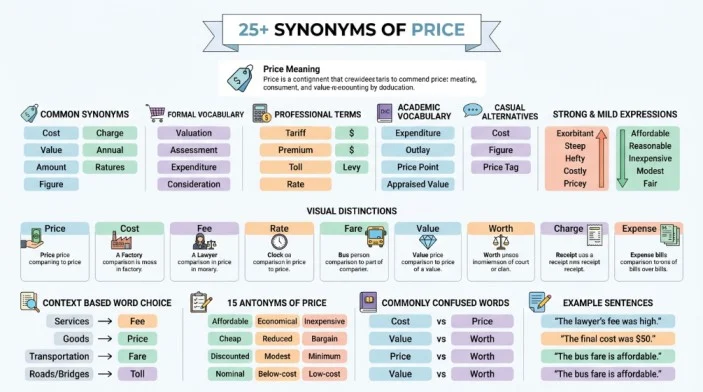
The best synonym for price depends on context. Cost works for the amount paid for something, fee suits professional services, rate fits recurring or measured charges, and charge works for amounts billed. In academic and professional writing, cost, value, and expense are useful, while tag or figure can sound more conversational.
Meaning, Tone, and Context
Simple Definition
Price is the amount of money asked or paid for a product, service, property, or other item. It can also describe the amount someone must give up to obtain a desired result, although this broader meaning is more figurative.
For example:
“The price of the laptop is $900.”
Here, price refers to the amount the seller asks the buyer to pay.
The word can also describe a nonfinancial consequence:
“Success often comes at a price.”
In this sentence, price means a sacrifice or cost rather than a specific amount of money.
Part of Speech
Price can function primarily as a noun and also as a verb.
As a noun:
“The price of the car is reasonable.”
As a verb:
“The store priced the jacket at $80.”
Overall Tone
Price is generally neutral. It does not automatically express approval or disapproval.
The surrounding words determine the feeling:
“The price is affordable.”
This sounds positive.
“The price is outrageous.”
This expresses a negative opinion.
Formality Level
Price is a neutral word that works naturally in formal, professional, academic, and casual communication.
You can use it in:
- Business reports
- Product descriptions
- Emails
- Conversations
- Advertisements
- Academic writing
- News articles
- Resumes when discussing pricing responsibilities
Common Uses
Native English speakers commonly use price when discussing:
- Products
- Services
- Real estate
- Food
- Clothing
- Technology
- Transportation
- Hotels
- Business transactions
- Retail purchases
- Negotiations
- Financial decisions
Common phrases include price range, price increase, price reduction, price tag, price point, asking price, and selling price.
Word Forms
| Form | Example |
|---|---|
| Noun | The price is reasonable. |
| Verb | They priced the product competitively. |
| Plural noun | Prices have increased. |
| Related noun | Pricing affects customer demand. |
| Related adjective | The product is reasonably priced. |
When and How to Use “Price”
Use price when you want to identify the amount of money requested or paid for something. It is often the safest choice when you do not need to specify whether the amount is a fee, rate, fare, expense, or another type of payment.
Professional
“The proposed price includes installation and technical support.”
Here, price clearly communicates the amount associated with the overall offer.
Academic
“Higher food prices can affect household spending patterns.”
In an academic context, prices works well when discussing economic behavior or consumer decisions.
Workplace
“Please confirm the price before placing the order.”
This sentence is direct and natural in workplace communication.
Personal
“I like the sofa, but the price is higher than I expected.”
The word works naturally in everyday conversation.
“Could you please send me the current price for the annual subscription?”
This is a clear and professional way to request pricing information.
Resume
“Negotiated product prices with suppliers to reduce purchasing costs.”
Here, prices refers to amounts negotiated during business transactions.
Social Media
“The quality is impressive, especially for this price.”
This casual use sounds natural in a product review or social media post.
Best Synonyms of “Price”
No single synonym works perfectly in every sentence. The most accurate alternative depends on what kind of monetary amount you mean and what relationship exists between the buyer, seller, service provider, or product.
Professional Writing: Cost
Cost is often the best professional alternative when discussing how much money something requires.
“The cost of implementation will depend on the size of the project.”
Why it works: It focuses on the amount required to obtain or produce something and is especially useful in business and financial contexts.
Academic Writing: Cost
Cost is particularly useful in academic discussions involving economics, resources, production, or consumer behavior.
“The study examined the cost of renewable energy systems.”
Why it works: It sounds objective and precise.
Business Communication: Charge
Charge works well when a business or service provider bills a customer for something.
“The company does not charge an additional fee for setup.”
Why it works: It focuses on the amount imposed by the provider.
Casual Conversation: Cost
“How much did it cost?”
Why it works: Cost is more natural than many alternatives in everyday speech.
Emotional Writing: Value
Sometimes the focus is not the amount paid but what something is worth to a person.
“No price can measure the value of that memory.”
Why it works: Value shifts attention from money to significance or worth.
Creative Writing: Worth
Worth can describe monetary or personal value.
“She wondered whether the opportunity was worth the sacrifice.”
Why it works: It allows a writer to connect financial value with emotional or abstract value.
Resume Writing: Cost
For resumes, cost works especially well when describing savings, budgets, purchasing, or financial efficiency.
“Reduced operating costs by improving supplier negotiations.”
Why it works: It connects directly to measurable business outcomes.
Workplace Communication: Rate
Rate is useful when payment is calculated according to time, quantity, or another unit.
“The contractor’s hourly rate is $75.”
Why it works: It gives more information than the general word price.
Stronger Meaning: Expense
Expense emphasizes money spent rather than simply the amount requested for an item.
“Travel expenses increased significantly this year.”
Why it works: It is useful when discussing spending from the buyer’s or organization’s perspective.
Softer or More Neutral Meaning: Amount
Amount is a broad, neutral alternative when the exact nature of the payment is already understood.
“The amount due is shown on the final page.”
Why it works: It avoids unnecessarily repeating price when discussing a payment.
When Not to Use “Price”
Although price is highly versatile, another word may communicate the intended meaning more precisely.
When You Mean the Cost of Producing Something
Price can refer to what a customer pays, while cost often refers to what something requires financially.
Less precise:
“The price of producing the product is too high.”
Better:
“The cost of producing the product is too high.”
Why: Cost is the natural choice for production expenses.
When You Mean a Professional Service Charge
Less precise:
“The lawyer’s price is $300.”
Better:
“The lawyer’s fee is $300.”
Why: Fee is the conventional term for professional services.
When Payment Is Based on Time
Less precise:
“The consultant’s price is $150 per hour.”
Better:
“The consultant’s rate is $150 per hour.”
Why: Rate communicates that the amount is calculated according to time.
When Discussing Transportation
Less precise:
“The price for the taxi ride was $25.”
Better:
“The taxi fare was $25.”
Why: Fare is the established term for the amount charged for transportation.
When Describing Personal or Nonfinancial Value
Less precise:
“The price of her friendship is enormous.”
Better:
“The value of her friendship is enormous.”
Why: Value can express importance, worth, or significance beyond money.
When Talking About Money Already Spent
Less precise:
“The price of our business trip was higher than expected.”
Better:
“The expense of our business trip was higher than expected.”
Why: Expense focuses on money that was spent.
When Referring to a Seller’s Desired Amount for Property
Less precise:
“The house’s price is $500,000.”
Better:
“The seller’s asking price is $500,000.”
Why: Asking price specifically identifies the amount requested by the seller.
Words Commonly Confused With “Price”
Cost
Difference: Cost focuses on the money required to obtain, produce, or maintain something. Price commonly refers to the amount a seller asks from a buyer.
When to Use It: Use cost when discussing expenses or resources.
Example:
“The price of the phone is $700, but the cost of repairing it could be much higher.”
Fee
Difference: A fee is a charge for a service, professional assistance, membership, or administrative action.
When to Use It: Use fee for lawyers, consultants, memberships, applications, licenses, and similar services.
Example:
“The application fee is $50.”
Rate
Difference: A rate usually expresses a charge according to a unit such as an hour, day, mile, or percentage.
When to Use It: Use rate for wages, services, interest, hotels, and measured charges.
Example:
“The hotel offers a lower nightly rate during the winter.”
Fare
Difference: Fare specifically refers to the money paid for transportation.
When to Use It: Use it for buses, trains, taxis, subways, and other forms of transportation.
Example:
“The train fare increased this month.”
Value
Difference: Value refers to how useful, desirable, or worthwhile something is. It does not always refer to its selling price.
When to Use It: Use value when discussing worth rather than simply the amount charged.
Example:
“The laptop offers excellent value for students.”
Expense
Difference: Expense refers to money spent or required as part of an activity.
When to Use It: Use it for business spending, travel, household spending, and operating costs.
Example:
“The company reimburses approved travel expenses.”
Best Synonyms of “Price” by Context
| Context | Best Synonym | Why It Works | Example |
|---|---|---|---|
| Formal writing | Cost | Clear and objective | “The cost of implementation was substantial.” |
| Academic writing | Cost | Fits economic and analytical discussions | “The study measured the cost of treatment.” |
| Professional communication | Charge | Identifies a billed amount | “The provider will not charge an additional amount.” |
| Business emails | Quote | Refers to a stated price for a job or service | “Please send us a quote for the project.” |
| Resume writing | Cost | Useful for savings and budgeting | “Reduced operating costs through supplier negotiations.” |
| Workplace communication | Rate | Works for hourly or unit based charges | “The contractor’s hourly rate has changed.” |
| Casual conversation | Cost | Natural in everyday speech | “How much did it cost?” |
| Everyday speaking | Amount | Simple and neutral | “The amount seems reasonable.” |
| Creative writing | Worth | Can express financial or personal value | “The opportunity was worth the sacrifice.” |
| Storytelling | Value | Adds broader meaning | “He finally understood the value of the lesson.” |
| Emotional writing | Worth | Connects value with sacrifice | “Some memories are worth more than money.” |
| Strong emphasis | Cost | Can highlight consequences | “The decision came at a significant cost.” |
| Mild tone | Amount | Neutral and nonjudgmental | “The amount due was small.” |
| Social media captions | Deal | Suggests favorable pricing | “This was an incredible deal.” |
| American English | Price | The standard general term | “What’s the price?” |
| British English | Price | Also standard and widely used | “What is the price of the ticket?” |
How to Choose the Best Synonym of “Price”
Choosing the right alternative becomes easier when you identify exactly what the monetary amount represents.
If You Mean What a Customer Pays
Use price.
“The price of the shoes is $90.”
This is the safest general choice.
If You Mean What Something Requires Financially
Use cost.
“The cost of renovating the kitchen was $20,000.”
If You Mean a Professional Service Payment
Use fee.
“The attorney’s fee was clearly explained.”
If You Mean a Time Based or Unit Based Charge
Use rate.
“The designer’s hourly rate is $60.”
If You Mean Transportation
Use fare.
“The bus fare is $2.”
If You Mean What Something Is Worth
Use value or worth.
“The experience was worth the investment.”
If You Mean Money Already Spent
Use expense.
“Travel expenses must be submitted by Friday.”
If You Mean a Seller’s Requested Amount
Use asking price.
“The home’s asking price is $450,000.”
If You Mean a Business’s Stated Offer
Use quote or quotation.
“The contractor sent us a quote for the repairs.”
The best synonym is the one that explains the relationship between the money and the thing being discussed.
Real Life Examples of “Price”
School
Original:
“The price of textbooks has increased.”
More precise:
“The cost of textbooks has increased.”
Why: Cost works well when discussing the financial burden on students.
College
“Students should compare the cost of tuition before choosing a college.”
Here, cost describes the overall financial requirement.
Workplace
“Please check the supplier’s rate before approving the contract.”
Rate is appropriate because the amount is connected to a service arrangement.
Business
“The company lowered its prices to attract new customers.”
Price is correct because the sentence refers to amounts charged to buyers.
“Could you please provide a quote for 500 printed brochures?”
Quote is more specific than price because it refers to a formal statement of how much a particular job or order will cost.
Resume
“Reduced procurement costs by 12 percent through supplier negotiations.”
Cost is more effective than price because the accomplishment concerns company spending.
Conversation
“Do you know how much the tickets cost?”
Cost sounds more natural in ordinary conversation than a formal alternative.
Storytelling
“He learned that success sometimes comes at a cost.”
Here, cost can refer to sacrifice rather than money.
Blogging
“The phone offers impressive value for its price.”
Using both value and price creates a useful distinction. Price tells readers what they pay, while value addresses what they receive in return.
Social Media
“Great quality, reasonable price, and fast delivery.”
The general word price is concise and natural for a product caption.
25 Best Synonyms of “Price”
Some alternatives below are direct substitutes only in specific contexts. That distinction matters because words such as fare, fee, and rate describe particular types of monetary amounts rather than every possible use of price.
| Synonym | Simple Meaning | Best Used For | Example Sentence |
|---|---|---|---|
| Cost | Money required for something | Products, production, services | “The cost of the equipment was higher than expected.” |
| Charge | Amount billed by a provider | Services and billing | “The hotel added a cleaning charge.” |
| Fee | Payment for a service or privilege | Professional services, memberships | “The consultant’s fee was clearly stated.” |
| Rate | Amount charged per unit or period | Time, services, hotels | “The hourly rate is $50.” |
| Fare | Payment for transportation | Taxis, buses, trains | “The train fare was affordable.” |
| Value | Worth or usefulness | Products, investments, experiences | “This laptop provides excellent value.” |
| Worth | Amount something is considered to be worth | Purchases and abstract value | “The painting is worth thousands of dollars.” |
| Amount | A quantity of money | Bills and payments | “The amount due appears on the invoice.” |
| Expense | Money spent | Business, travel, household spending | “Travel was our largest expense.” |
| Expenditure | Money spent for a purpose | Formal financial writing | “Government expenditure increased this year.” |
| Figure | A stated numerical amount | Business discussions | “The final figure was higher than expected.” |
| Sum | A particular quantity of money | Formal or financial contexts | “The buyer paid a large sum for the property.” |
| Quote | A stated amount for a service or order | Business transactions | “We received a quote for the renovation.” |
| Quotation | A formal statement of an amount | Business documents | “The quotation includes labor and materials.” |
| Tariff | Official or listed charge | Trade and certain services | “The new tariff affected imported goods.” |
| Valuation | Estimated monetary worth | Property and assets | “The property’s valuation increased.” |
| Estimate | Approximate expected cost | Projects and repairs | “The contractor provided an estimate.” |
| Assessment | Evaluation of monetary worth | Property and financial contexts | “The assessment placed the property’s value at $400,000.” |
| Appraisal | Professional estimate of value | Real estate and valuable items | “The bank requested an appraisal of the house.” |
| Premium | Extra amount paid for higher value or special features | Insurance and premium products | “Customers pay a premium for faster delivery.” |
| Compensation | Money given in return for work or loss | Employment and legal contexts | “The employee received compensation for the additional work.” |
| Consideration | Something of value exchanged in a transaction | Legal and contractual writing | “The contract specifies the consideration paid by the buyer.” |
| Valuation amount | Monetary estimate assigned to an asset | Financial contexts | “The valuation amount was recorded in the report.” |
| Asking price | Amount a seller requests | Real estate and sales | “The seller reduced the asking price.” |
| Selling price | Amount at which an item is sold | Retail and commerce | “The selling price includes applicable taxes.” |
Synonyms of “Price” by Usage
Professional vs Personal Synonyms
Professional writing benefits from precise terms that identify the nature of a payment.
Use cost for business expenses, rate for measured charges, fee for professional services, quote for proposed work, and expenditure for formal financial discussions.
Personal communication usually needs simpler vocabulary.
“How much does it cost?”
is more natural than:
“What is the monetary expenditure associated with it?”
The second sentence is grammatically possible but unnecessarily formal.
Formal vs Conversational Synonyms
Reports
Use cost, expenditure, expense, or figure.
Essays
Use cost, value, expense, or amount, depending on the subject.
Business Writing
Use cost, rate, fee, charge, quote, or quotation.
Presentations
Use cost, price, rate, or figure for concise communication.
Emails
Use price, cost, quote, or fee.
Casual Conversations
Use price, cost, amount, or deal when appropriate.
Texting
Simple language is usually best:
“How much does it cost?”
Natural communication matters more than using a sophisticated synonym.
Academic Synonyms
Academic writing requires precise distinctions between different financial concepts.
Cost
Use cost when analyzing how much money is required.
“The cost of higher education has increased.”
Expenditure
Use expenditure when discussing organized or institutional spending.
“Public expenditure on education increased during the period.”
Value
Use value when discussing economic worth or usefulness.
“The analysis examined the value of public transportation.”
Rate
Use rate when the amount is calculated according to a unit or period.
“The study compared the interest rates offered by different lenders.”
Price
Keep price when discussing the amount sellers charge consumers.
“The price of essential goods increased.”
The strongest academic vocabulary is not necessarily the most complicated vocabulary. Precision is more valuable than formality.
Professional and Business Synonyms
Resumes
Use cost, savings, rate, and value.
“Reduced annual operating costs by 15 percent.”
This is stronger than:
“Improved important prices.”
Interviews
Use cost, pricing, value, and rate when discussing business decisions.
“I evaluated supplier pricing and negotiated lower costs.”
Meetings
Use price, cost, or figure depending on the discussion.
“The current figure is above our approved budget.”
Presentations
Use specific terms rather than repeatedly saying price.
“Our pricing strategy balances affordability with profitability.”
Performance Reviews
Use cost savings or financial impact.
“Generated substantial cost savings through contract negotiations.”
Client Communication
Use price, fee, rate, quote, or estimate.
“The quoted price includes delivery and installation.”
Business Emails
Use the exact term that matches the transaction.
“Could you confirm the service fee?”
“Please send the updated price list.”
“Would you provide a quote for the requested work?”
Creative and Literary Synonyms
Creative writing often uses price, cost, worth, and value in both literal and figurative ways.
Storytelling
“He finally understood the price of his ambition.”
Here, price means the sacrifice required to achieve something.
Fiction
“Freedom came at a cost.”
Cost creates a sense of consequence without specifying money.
Poetry
“No fortune could measure the worth of her kindness.”
Worth moves the idea away from simple financial measurement.
Descriptive Writing
“The necklace carried a value far beyond its market price.”
This contrast helps distinguish monetary price from personal value.
Speeches
“We must understand the cost of ignoring this problem.”
Cost can make an abstract consequence feel concrete.
Slang or Modern Synonyms
There is no single slang word that universally replaces price. However, casual American English uses several informal expressions in specific situations.
A Steal
Meaning: Something available at an unusually good price.
Acceptable in: Casual conversation, advertising, social media.
Avoid in: Academic and formal business writing.
“This jacket was a steal at $30.”
A Deal
Meaning: A purchase that offers favorable terms or a good price.
Acceptable in: Everyday conversation and marketing.
Avoid in: Highly formal financial writing when precision is required.
“That’s a great deal for a laptop.”
Pricey
Meaning: Relatively expensive.
Acceptable in: Conversation, reviews, lifestyle content.
Avoid in: Formal reports when a more precise term is available.
“The restaurant is a little pricey.”
These are useful expressions, but they are not exact replacements for price in every sentence.
Strongest to Mildest Synonyms
Unlike words describing emotions, monetary vocabulary does not always have a simple intensity scale. The strength often depends on what the word adds to the meaning.
| Level | Word | Main Effect |
|---|---|---|
| Mild | Amount | Neutral reference to money |
| Mild | Figure | Neutral numerical reference |
| Moderate | Price | General amount requested |
| Moderate | Cost | Financial requirement |
| Moderate | Expense | Money spent |
| Strong | Charge | Amount imposed by a provider |
| Strong | Fee | Specific payment for a service |
| Strong | Rate | Specific calculated charge |
| Strong | Premium | Extra amount for added value |
| Very Strong | Cost | Can emphasize financial consequences when used figuratively |
For price, intensity is better understood as specificity rather than emotional strength. A word such as fee is not inherently more expensive than price. It simply identifies a particular kind of payment.
Emotional vs Neutral Synonyms
Emotional Synonyms
These words can add attitude or personal judgment:
- Worth
- Value
- Premium
- Steal
- Deal
- Pricey
- Cost, when used figuratively
Examples:
“The opportunity was worth every sacrifice.”
“This is an incredible deal.”
These expressions can communicate approval, disappointment, sacrifice, or personal judgment.
Neutral Synonyms
These words mainly communicate financial information:
- Price
- Cost
- Amount
- Rate
- Fee
- Charge
- Expense
- Figure
- Sum
- Expenditure
Use neutral terms in reports, invoices, academic writing, and professional communication when you want to minimize emotional language.
Antonyms of “Price”
Because price is a noun describing an amount rather than a quality, it does not have perfect one word antonyms in every context. The following terms represent genuine opposing ideas in specific uses of price, especially when price means financial burden, expense, or monetary demand.
| Antonym | Meaning | Example Sentence |
|---|---|---|
| Free | Available without payment | “The museum offers free admission on Sundays.” |
| Priceless | Too valuable to measure financially | “The family photograph is priceless to her.” |
| Worthless | Having no monetary or practical value | “The damaged coupon became worthless.” |
| Valueless | Having no recognized value | “The obsolete document was considered valueless.” |
| Costless | Requiring no cost | “The basic service is costless for registered users.” |
| Inexpensive | Low in price | “The restaurant offers inexpensive meals.” |
| Cheap | Low in price | “We found a cheap alternative.” |
| Affordable | Reasonably priced for the intended buyer | “The plan is affordable for small businesses.” |
| Free of charge | Provided without payment | “Delivery is free of charge.” |
| Complimentary | Given without payment | “Guests received complimentary breakfast.” |
| Donated | Given without payment | “The equipment was donated to the school.” |
| Gifted | Given as a gift | “The tickets were gifted to the employees.” |
| No cost | Requiring no payment | “The consultation comes at no cost.” |
| Gratis | Given without payment | “The samples were provided gratis.” |
| Waived | Officially canceled or not required | “The application fee was waived.” |
Comparison: “Price” vs Similar Words
Price vs Cost
Main Difference
Price usually refers to what a seller asks a customer to pay. Cost can refer to what the buyer pays, but it also commonly refers to the resources or money required to produce, obtain, or maintain something.
Which Is Stronger?
Neither is inherently stronger.
Which Is More Formal?
Both are neutral and suitable for formal writing.
When to Use Each
Use price for selling amounts. Use cost for broader financial requirements.
Examples
Price:
“The price of the software is $500.”
Cost:
“The cost of developing the software was much higher.”
Price vs Fee
Main Difference
A fee is a specific payment for a service, membership, professional activity, or administrative process.
Which Is Stronger?
Neither.
Which Is More Formal?
Fee is common in both professional and everyday contexts.
When to Use Each
Use price for products and general purchases. Use fee for specific services or charges.
Examples
Price:
“The price of the printer is $250.”
Fee:
“The membership fee is $50.”
Price vs Rate
Main Difference
A rate usually expresses an amount according to a unit of time, quantity, or another measurement.
Which Is Stronger?
Neither.
Which Is More Formal?
Both are standard professional terms.
When to Use Each
Use rate for hourly wages, hotel charges, interest, and similar measured amounts.
Examples
Price:
“The price of the desk is $400.”
Rate:
“The contractor’s hourly rate is $80.”
Price vs Value
Main Difference
Price tells you what something costs. Value tells you what something is worth or how useful it is.
Which Is Stronger?
Neither.
Which Is More Formal?
Both are appropriate in professional writing.
When to Use Each
Use price for the monetary amount requested. Use value for worth, usefulness, or benefit.
Examples
Price:
“The price is $1,000.”
Value:
“The product offers excellent value.”
Price vs Worth
Main Difference
Worth focuses on the amount or significance something deserves, while price focuses on the amount charged or paid.
Which Is Stronger?
Worth can have a broader meaning because it can refer to financial and nonfinancial value.
Which Is More Formal?
Both can work formally, but price is more direct for transactions.
When to Use Each
Use worth when evaluating whether something deserves its cost.
Examples
Price:
“The price is $300.”
Worth:
“The phone is worth $300.”
Price vs Expense
Main Difference
An expense is money spent or required as part of an activity. A price is usually the amount charged for something.
Which Is Stronger?
Neither.
Which Is More Formal?
Expense is especially common in financial and business contexts.
When to Use Each
Use expense for spending. Use price for the amount attached to an item or service.
Examples
Price:
“The price of the equipment is $2,000.”
Expense:
“The equipment was a major business expense.”
Common Phrases and Expressions with “Price”
Price Tag
Meaning: The displayed amount a customer is expected to pay.
Example:
“The designer jacket had a surprisingly high price tag.”
Price Range
Meaning: The lowest and highest prices within a group of products or services.
Example:
“The restaurant has a price range suitable for most families.”
Price Point
Meaning: A particular level at which a product or service is offered.
Example:
“The company chose a competitive price point for its new software.”
Asking Price
Meaning: The amount a seller initially requests.
Example:
“The seller lowered the asking price after several weeks.”
Selling Price
Meaning: The amount for which an item is sold.
Example:
“The selling price includes the retailer’s markup.”
At a Price
Meaning: Available or achievable by paying a particular amount or accepting a particular consequence.
Example:
“He achieved his goal, but at a high price.”
At Any Price
Meaning: Willing to pay or sacrifice almost anything to obtain something.
Example:
“She wanted to protect her reputation at any price.”
Come at a Price
Meaning: To require a sacrifice or undesirable consequence.
Example:
“Rapid growth can come at a price.”
Common Mistakes to Avoid
1. Treating Every Synonym as Identical
Incorrect
“The lawyer’s price is $500.”
Better
“The lawyer’s fee is $500.”
Why: A professional service usually has a fee, making the sentence more precise.
2. Confusing Price With Cost
Incorrect
“The price of manufacturing the product is $10.”
Better
“The cost of manufacturing the product is $10.”
Why: Manufacturing involves an expense or resource requirement, so cost is the more accurate term.
3. Using Rate for a Fixed Product Price
Incorrect
“The rate of this laptop is $900.”
Better
“The price of this laptop is $900.”
Why: Rate generally involves a unit, period, or measurement.
4. Using Fare for Ordinary Products
Incorrect
“The fare of the shoes is $80.”
Better
“The price of the shoes is $80.”
Why: Fare is associated with transportation.
5. Using Informal Language in Formal Writing
Incorrect
“The software is a steal.”
Better
“The software is available at a competitive price.”
Why: A steal is casual and suggests an unusually good bargain.
6. Using Price When You Mean Value
Incorrect
“This product has a high price, so it must be good.”
Better
“This product has a high price, but its value depends on its features and performance.”
Why: Price and value are related but not identical.
7. Choosing a More Complicated Word Without a Reason
Incorrect
“The monetary expenditure associated with the product is $50.”
Better
“The price of the product is $50.”
Why: Sophisticated vocabulary is not automatically better. Clear and natural wording is usually more effective.
Frequently Asked Questions
What are the best synonyms of “price”?
The best alternatives depend on context. Cost is the most versatile, while fee, rate, charge, fare, value, worth, and expense describe specific types of monetary amounts.
What are the best formal synonyms of “price”?
Formal alternatives include cost, expenditure, charge, rate, valuation, figure, and amount. The best choice depends on whether you mean a selling amount, expense, service charge, or estimated worth.
What are common informal synonyms of “price”?
In casual English, people commonly use cost, amount, deal, and expressions such as a steal. However, these alternatives do not all mean exactly the same thing as price.
What is another word for “price” in professional writing?
Cost is often the strongest general alternative in professional writing. Fee, rate, charge, quote, estimate, and expenditure are better when the financial situation requires greater precision.
What is the difference between “price” and “cost”?
Price usually refers to the amount a seller asks or a buyer pays. Cost can describe that amount, but it also refers to the money or resources required to produce, obtain, or maintain something.
What is the opposite of “price”?
There is no perfect universal antonym for price because it describes a monetary amount. In contexts involving payment, words such as free, no cost, complimentary, and waived can express the absence of a required payment.
Conclusion
The word price is a simple and flexible term for the amount asked or paid for something, but its best alternative depends on context. Cost works broadly, fee describes professional services, rate identifies measured charges, fare applies to transportation, and value or worth focuses on what something is actually worth.
The most effective vocabulary choice is not always the most advanced word. Before replacing price, identify whether you are discussing a product amount, service payment, recurring charge, financial expense, estimated value, or personal worth. That small distinction can make your writing much clearer and more natural.
A useful vocabulary habit is to learn synonyms in context rather than memorizing isolated lists. When you understand the difference between price, cost, fee, rate, and value, you can choose the exact word your reader needs.
Read More Related Articles:
- Synonyms for Thus | Meaning, Examples, and Better Word …
- 25+ Synonyms of Generic: Meanings, Uses, Examples, and …
- Synonyms for Empty | Meaning, Examples, and Better Word …