You are writing an email, essay, resume, or social media caption, and suddenly you notice that you have used the word “understand” several times. The sentence may be correct, but repeating the same word can make your writing feel plain. Learning the right synonyms of understand gives you more ways to express comprehension, awareness, recognition, or empathy.
The best alternative depends on what you actually mean. Words such as comprehend, grasp, recognize, realize, appreciate, and perceive do not carry exactly the same meaning. Choosing the right one can make your writing clearer, more precise, and better suited to the audience and situation.
What Are the Best Synonyms of “Understand”?
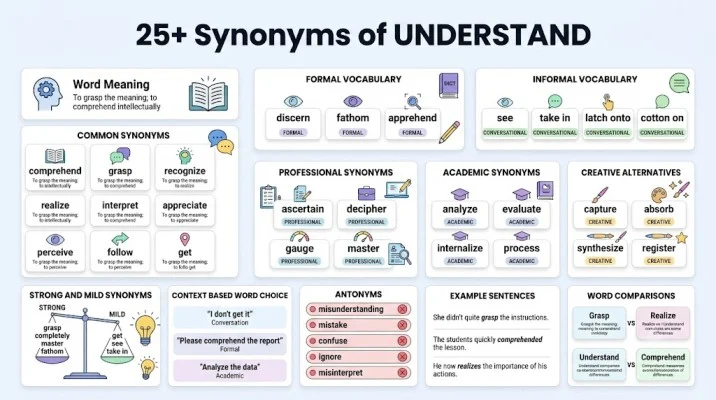
The best synonyms of understand include comprehend, grasp, follow, realize, recognize, appreciate, and interpret. Use comprehend in formal or academic writing, grasp for clear understanding, realize for becoming aware of something, and appreciate when understanding includes emotional or practical awareness.
Meaning, Tone, and Context
Simple Definition
Understand means to know the meaning of something, recognize how something works, become aware of a fact, or recognize another person’s thoughts or feelings.
For example:
“I understand the instructions.”
This means the speaker knows what the instructions mean and can follow them.
The word can also describe emotional awareness:
“I understand how difficult this situation is for you.”
Here, understand means recognizing or appreciating another person’s feelings or circumstances.
Part of Speech
Understand is primarily a verb.
Overall Tone
The word is generally neutral. Its tone can become supportive, sympathetic, formal, or intellectual depending on the sentence.
For example:
“I understand the problem.”
This is neutral.
“I understand how you feel.”
This can sound empathetic.
“I understand the theory.”
This refers to intellectual comprehension.
Formality Level
Understand is a neutral English word. It works naturally in:
• Academic writing
• Professional communication
• Business emails
• Everyday conversation
• Personal messages
• Social media
• Presentations
• Interviews
It is not overly formal or informal, which makes it highly versatile.
Common Uses
Native English speakers commonly use understand when talking about:
• Understanding instructions
• Understanding information
• Understanding a concept
• Understanding a situation
• Understanding someone’s feelings
• Understanding a language
• Understanding a problem
• Understanding a decision
• Understanding a person’s point of view
• Understanding how something works
Word Forms
| Word Form | Example |
|---|---|
| Verb | understand |
| Past tense | understood |
| Present participle | understanding |
| Noun | understanding |
| Adjective | understandable |
| Adjective | understanding |
The noun understanding can refer to knowledge or an agreement.
Example:
“She has a strong understanding of marketing.”
It can also describe mutual agreement:
“We reached an understanding.”
When and How to Use “Understand”
Use understand when you want to communicate that someone has grasped information, recognized an idea, or become aware of a situation. It is often the safest choice when you do not need to emphasize a particular type of understanding.
Professional
“Employees must understand the company’s safety procedures before beginning work.”
Academic
“Students should understand the relationship between these two concepts.”
Workplace
“I understand the concern and will review the issue this afternoon.”
Personal
“I understand why you feel disappointed.”
“Thank you for explaining the situation. I understand your concerns.”
Resume
“Developed an understanding of customer needs through market research.”
Social Media
“Once you understand the process, creating better content becomes much easier.”
Best Synonyms of “Understand”
No alternative is identical to understand in every situation. The best choice depends on whether you mean intellectual comprehension, awareness, recognition, interpretation, or emotional sensitivity.
Professional Writing: Comprehend
Comprehend is a precise alternative when you mean fully understanding information, especially complex information.
Example:
“Employees must comprehend the new compliance requirements.”
It works well in formal contexts, although understand is usually more natural in ordinary workplace communication.
Academic Writing: Comprehend
Comprehend fits academic discussions when the focus is on understanding a concept, argument, text, or theory.
Example:
“Students must comprehend the central argument before evaluating the evidence.”
Business Communication: Grasp
Grasp is useful when you want to show that someone has gained a clear understanding of an idea.
Example:
“The team quickly grasped the main objectives of the project.”
Casual Conversation: Get
Get is a common informal alternative to understand.
Example:
“I get what you’re saying.”
It sounds natural in conversation but should generally be avoided in formal academic or professional writing.
Emotional Writing: Appreciate
Appreciate works when understanding involves recognizing the importance, difficulty, value, or feelings involved in a situation.
Example:
“I appreciate how stressful this change has been for you.”
Creative Writing: Perceive
Perceive can work in creative or descriptive writing when understanding involves noticing or interpreting something through observation.
Example:
“She perceived a change in his voice but said nothing.”
Resume Writing: Recognize
Recognize is useful when describing the ability to identify problems, patterns, opportunities, or needs.
Example:
“Recognized emerging customer trends and adjusted marketing strategies accordingly.”
Workplace Communication: Acknowledge
Acknowledge is useful when you want to show that you have recognized a concern, fact, message, or point.
Example:
“I acknowledge your concerns and will discuss them with the team.”
Stronger Meaning: Comprehend
When you want to emphasize deep intellectual understanding, comprehend can be stronger and more precise than the general word understand.
Example:
“Researchers must comprehend the limitations of the model before applying it.”
Softer Meaning: Follow
Follow can be a natural, less formal way to say that someone is able to understand an explanation, argument, or conversation.
Example:
“I follow your reasoning.”
When Not to Use “Understand”
Although understand is flexible, sometimes another word communicates your meaning more accurately.
When “Understand” Is Too General
The sentence may fail to explain what kind of understanding you mean.
Less precise:
“I understand the issue.”
Better:
“I recognize the risks associated with the issue.”
Here, recognize clearly communicates awareness of a particular problem.
When “Understand” Is Too Vague
If you mean that someone has intellectually mastered difficult material, grasp or comprehend may be more specific.
Less precise:
“She understands the theory.”
Better:
“She grasps the underlying theory.”
When a More Formal Word Is Needed
In a formal academic context, comprehend or interpret may sometimes provide greater precision.
General:
“Students need to understand the data.”
More academic:
“Students need to interpret the data accurately.”
When an Informal Expression Is Better
In casual conversation, understand can sometimes sound more formal than necessary.
Formal:
“I understand what you mean.”
Casual:
“I get what you mean.”
The second version is more conversational.
When “Understand” Is Too Weak
If you mean that someone has become aware of a fact, realize may be better.
Weak or unclear:
“She understood that the deadline had passed.”
More precise:
“She realized that the deadline had passed.”
When Emotional Recognition Is Intended
If you mean that someone recognizes another person’s feelings or situation, appreciate can communicate the emotional meaning more effectively.
General:
“I understand your difficulties.”
More empathetic:
“I appreciate how difficult this situation has been.”
When “Understand” Does Not Show Recognition
If the intended meaning is that someone has accepted or recognized a fact, acknowledge may be more appropriate.
General:
“He understands the problem.”
More specific:
“He acknowledged the problem.”
These sentences are not always interchangeable. Understanding means knowing or comprehending, while acknowledgment means recognizing or admitting something.
Words Commonly Confused With “Understand”
| Word | Difference | When to Use It | Example |
|---|---|---|---|
| Comprehend | Focuses on fully understanding information or ideas. | Formal and academic contexts. | “She comprehended the complex argument.” |
| Realize | Means becoming aware of a fact or truth. | New awareness or discovery. | “He realized that he had made a mistake.” |
| Recognize | Means identifying or accepting something as known or true. | Awareness, identification, or acknowledgment. | “She recognized the warning signs.” |
| Interpret | Means explaining or determining the meaning of something. | Data, language, behavior, or texts. | “Researchers interpreted the results carefully.” |
| Appreciate | Means understanding the value, difficulty, or emotional significance of something. | Empathy and value. | “I appreciate your concerns.” |
| Perceive | Means becoming aware of something through observation or interpretation. | Formal, descriptive, and analytical writing. | “The audience perceived a change in tone.” |
Best Synonyms of “Understand” by Context
| Context | Best Synonym | Why It Works | Example |
|---|---|---|---|
| Formal writing | Comprehend | Precise and formal | “Readers must comprehend the argument.” |
| Academic writing | Comprehend | Fits intellectual understanding | “Students should comprehend the theory.” |
| Professional communication | Grasp | Shows clear understanding | “The team grasped the strategy quickly.” |
| Business emails | Acknowledge | Shows recognition of a concern or message | “I acknowledge your concerns.” |
| Resume writing | Recognize | Highlights professional awareness | “Recognized changing customer needs.” |
| Workplace communication | Follow | Sounds natural and clear | “I follow your reasoning.” |
| Casual conversation | Get | Common informal alternative | “I get what you mean.” |
| Everyday speaking | See | Can mean understanding an idea | “I see what you’re saying.” |
| Creative writing | Perceive | Adds observational depth | “She perceived something unusual.” |
| Storytelling | Realize | Shows a moment of awareness | “He realized the truth too late.” |
| Emotional writing | Appreciate | Highlights empathy or value | “I appreciate what you’re going through.” |
| Strong emphasis | Comprehend | Suggests deep intellectual understanding | “Few people fully comprehend the consequences.” |
| Mild tone | Follow | Soft and conversational | “I follow your point.” |
| Social media captions | Get | Natural and informal | “If you get this feeling, you know.” |
| American English | Understand | Most broadly natural | “I understand your point.” |
| British English | Understand | Equally standard and natural | “I understand what you mean.” |
How to Choose the Best Synonym of “Understand”
Choosing an alternative becomes easier when you first identify the exact type of understanding you want to communicate.
Choose “Comprehend” for Intellectual Understanding
Use comprehend when someone fully understands information, concepts, arguments, or complex material.
Example:
“Researchers must comprehend the limitations of the study.”
Choose “Grasp” for Clear Understanding
Use grasp when someone quickly or clearly understands an idea.
Example:
“She quickly grasped the main point.”
Choose “Realize” for New Awareness
Use realize when someone becomes aware of a fact or situation.
Example:
“He realized that the information was incorrect.”
Choose “Recognize” for Identification
Use recognize when someone identifies something, accepts a fact, or becomes aware of a pattern.
Example:
“The manager recognized the need for additional training.”
Choose “Interpret” for Meaning
Use interpret when someone determines the meaning of information, language, behavior, data, or a text.
Example:
“Scientists interpreted the results carefully.”
Choose “Appreciate” for Empathy or Value
Use appreciate when understanding includes recognizing someone’s feelings, effort, difficulty, or value.
Example:
“I appreciate how challenging this decision has been.”
Choose “Get” for Casual Speech
Use get when speaking informally.
Example:
“I get what you’re trying to say.”
Choose “Acknowledge” for Recognition
Use acknowledge when you want to show that you recognize a fact, concern, or point.
Example:
“The company acknowledged the customer’s complaint.”
Real Life Examples of “Understand”
School
Original:
“Students need to understand the lesson.”
Improved:
“Students need to grasp the main concept before moving to the next lesson.”
College
Original:
“Students must understand the research.”
Improved:
“Students must comprehend the research before evaluating its conclusions.”
Workplace
Original:
“I understand your concern.”
Improved:
“I acknowledge your concern and will discuss it with the team.”
Business
Original:
“We need to understand customer behavior.”
Improved:
“We need to analyze customer behavior to identify changing preferences.”
Original:
“I understand that you need more time.”
Improved:
“I appreciate that you need additional time to complete the project.”
Resume
Original:
“Understood customer needs.”
Improved:
“Recognized customer needs and developed solutions based on market feedback.”
Conversation
Original:
“I understand what you mean.”
Improved:
“I get what you mean.”
Storytelling
Original:
“She understood what had happened.”
Improved:
“She realized what had happened when she saw the empty room.”
Blogging
Original:
“Readers need to understand this concept.”
Improved:
“Readers need to grasp this concept before applying the strategy.”
Social Media
Original:
“People understand how difficult the journey was.”
Improved:
“People appreciate how difficult the journey really was.”
25 Best Synonyms of “Understand”
| Synonym | Simple Meaning | Best Used For | Example Sentence |
|---|---|---|---|
| Comprehend | Fully understand something | Academic and formal writing | “Students must comprehend the central argument.” |
| Grasp | Understand something clearly | Ideas and explanations | “She quickly grasped the main concept.” |
| Follow | Understand an explanation or argument | Conversation and workplace communication | “I follow your reasoning.” |
| Get | Understand something | Casual conversation | “I get what you’re saying.” |
| Realize | Become aware of something | New awareness | “He realized that the deadline had changed.” |
| Recognize | Identify or become aware of something | Professional and analytical contexts | “The team recognized the emerging problem.” |
| Appreciate | Understand the value or difficulty of something | Emotional and professional contexts | “We appreciate the challenges involved.” |
| Interpret | Determine the meaning of something | Data, texts, and behavior | “The analyst interpreted the results carefully.” |
| Perceive | Become aware of something | Formal and descriptive writing | “She perceived a subtle change in his tone.” |
| Acknowledge | Recognize a fact or concern | Professional communication | “The manager acknowledged the employee’s concerns.” |
| Discern | Recognize or understand something with difficulty | Formal and analytical writing | “Experts discerned a pattern in the data.” |
| Infer | Reach an understanding from evidence | Academic and analytical writing | “Researchers inferred the cause from the results.” |
| Figure out | Discover or understand through thought | Informal communication | “I finally figured out how the system works.” |
| See | Understand or recognize an idea | Everyday conversation | “I see what you’re trying to explain.” |
| Know | Have knowledge or awareness | General communication | “I know what you mean.” |
| Learn | Gain knowledge or understanding | Education and development | “She learned how the system operates.” |
| Perceive | Become aware through observation | Formal and descriptive contexts | “The audience perceived a shift in mood.” |
| Decode | Understand something difficult or hidden | Messages and complex information | “The analyst decoded the technical report.” |
| Make sense of | Understand something confusing | Everyday and professional communication | “It took time to make sense of the data.” |
| Get the idea | Understand the basic point | Informal conversation | “I get the idea behind your proposal.” |
| Take in | Absorb or understand information | Conversation and learning | “It was difficult to take in all the information.” |
| Absorb | Take in and understand information | Education and learning | “Students absorbed the new material quickly.” |
| Fathom | Understand something difficult or mysterious | Formal and literary writing | “I could not fathom why the decision was made.” |
| Penetrate | Understand something deeply or beyond the surface | Formal and literary contexts | “The researcher penetrated the deeper meaning of the text.” |
| Make sense of | Reach a clear understanding | Confusing information | “She made sense of the conflicting instructions.” |
Note: Some alternatives above are context based rather than perfect replacements in every sentence. Words such as infer, learn, decode, and acknowledge describe specific forms of understanding rather than being interchangeable with understand in all situations.
Synonyms of “Understand” by Usage
Professional vs Personal Synonyms
Professional writing usually benefits from precise words such as comprehend, recognize, acknowledge, grasp, and interpret.
Personal communication often sounds more natural with understand, get, see, appreciate, or follow.
Compare:
Professional:
“I acknowledge your concerns and will review the proposal.”
Personal:
“I get why you’re upset.”
Both sentences communicate awareness, but their tones are different.
Formal vs Conversational Synonyms
Formal writing often uses:
• Comprehend
• Interpret
• Recognize
• Discern
• Infer
• Acknowledge
Conversational English often uses:
• Get
• See
• Follow
• Figure out
• Make sense of
• Know
For an academic essay, write:
“The participants were able to comprehend the instructions.”
For a casual conversation, say:
“I get what you mean.”
Academic Synonyms
Academic writing needs precise vocabulary because different words can describe different types of understanding.
Comprehend
Best for understanding complex material.
“Students must comprehend the theoretical framework.”
Interpret
Best when determining meaning from information or evidence.
“Researchers interpreted the findings according to the available evidence.”
Infer
Best when reaching a conclusion from evidence rather than directly knowing something.
“The researchers inferred a relationship between the variables.”
Discern
Best when identifying something that may be difficult to recognize.
“The analysis helped researchers discern a clear pattern.”
Grasp
Useful when discussing a student’s or reader’s ability to understand an idea.
“Students gradually grasped the central concept.”
Professional and Business Synonyms
Resumes
Use recognize, identify, analyze, or interpret when describing professional abilities.
Instead of:
“Understood customer needs.”
Use:
“Recognized customer needs and developed targeted solutions.”
Interviews
Use grasp when discussing your ability to learn concepts quickly.
“I quickly grasp new systems and adapt to changing workflows.”
Meetings
Use follow when confirming that you understand someone’s explanation.
“I follow your point and agree with the proposed approach.”
Presentations
Use explain or interpret when describing the communication of information.
“The presentation helped employees interpret the new performance data.”
Performance Reviews
Use recognize or appreciate when discussing awareness of strengths, challenges, or contributions.
“The manager recognized the employee’s contribution to the project.”
Client Communication
Use acknowledge when responding to concerns.
“We acknowledge your concerns and are reviewing the issue.”
Business Emails
Use understand, acknowledge, or appreciate depending on your meaning.
- “I understand your request.”
- “I acknowledge receipt of your message.”
- “I appreciate the urgency of the situation.”
Creative and Literary Synonyms
Creative writing allows more expressive alternatives.
Perceive
Adds an observational quality.
“She perceived a strange silence in the room.”
Realize
Works well for moments of discovery.
“He realized the truth when the letter fell from the book.”
Fathom
Suggests difficulty in understanding something mysterious or complex.
“She could not fathom his sudden decision.”
Discern
Adds a sense of careful observation.
“He discerned a faint expression of fear in her eyes.”
Appreciate
Works when a character recognizes emotional significance.
“Only later did she appreciate what the gesture meant.”
These choices can make a narrative more specific than repeatedly using understand.
Slang or Modern Synonyms
There is no single slang word that perfectly replaces understand in every situation. However, several informal expressions are common in modern American English.
Get
Meaning: Understand.
Acceptable in casual conversations, texting, and informal social media.
“I get what you mean.”
Avoid it in formal academic writing when a more precise alternative is expected.
Figure Out
Meaning: Discover or understand something through thinking or investigation.
“I finally figured out how to fix the problem.”
This is common and natural in everyday American English.
Get It
Meaning: Understand the point or meaning.
“Okay, I get it now.”
This is conversational and should generally be avoided in formal reports.
Strongest to Mildest Synonyms
Understanding does not have a simple intensity scale because these words often differ in meaning rather than strength. Still, they can be grouped according to how deeply or specifically they describe comprehension.
| Level | Suitable Words | Typical Meaning |
|---|---|---|
| Mild | See, Follow, Get | Basic understanding |
| Moderate | Understand, Recognize, Grasp | Clear awareness or comprehension |
| Strong | Comprehend, Discern, Appreciate | Deeper or more deliberate understanding |
| Very Strong | Fathom, Fully comprehend | Deep understanding of something difficult |
A word such as critical should not be treated as a synonym for understanding simply because it sounds strong. Accuracy matters more than intensity.
Emotional vs Neutral Synonyms
Emotional Synonyms
These words can communicate personal or emotional awareness:
• Appreciate
• Understand
• Recognize
• Feel
• Relate to
Example:
“I appreciate how difficult this decision must be.”
The word appreciate adds emotional sensitivity that understand does not always express.
Neutral Synonyms
These words focus more directly on knowledge or comprehension:
• Comprehend
• Grasp
• Interpret
• Follow
• Recognize
• Infer
• Discern
Example:
“The students comprehended the main argument.”
The sentence communicates intellectual understanding without adding strong emotion.
Antonyms of “Understand”
| Antonym | Meaning | Example Sentence |
|---|---|---|
| Misunderstand | Understand something incorrectly | “I misunderstood your original message.” |
| Misinterpret | Give the wrong meaning to something | “She misinterpreted his comment.” |
| Confuse | Fail to distinguish or understand clearly | “The instructions confused the new employees.” |
| Ignore | Fail to give attention to something | “He ignored the warning.” |
| Overlook | Fail to notice something | “The reviewer overlooked an important detail.” |
| Miss | Fail to notice or grasp something | “She missed the main point of the discussion.” |
| Forget | Fail to retain something in memory | “He forgot the instructions.” |
| Disregard | Deliberately pay no attention to something | “The manager disregarded the team’s advice.” |
| Deny | Refuse to accept something as true | “He denied the evidence presented to him.” |
| Reject | Refuse to accept an idea or explanation | “She rejected the proposed explanation.” |
| Doubt | Feel uncertain about something | “They doubted the accuracy of the report.” |
| Misread | Understand written information incorrectly | “I misread the instructions.” |
| Neglect | Fail to give proper attention | “The team neglected several warning signs.” |
| Obscure | Make something difficult to understand | “Technical language obscured the main idea.” |
| Conceal | Hide information so it cannot be understood or known | “The report concealed important details.” |
Comparison: “Understand” vs Similar Words
Understand vs Comprehend
Main Difference
Understand is a broad, everyday word. Comprehend emphasizes successfully grasping the meaning of information, especially when the material is complex.
Which Is Stronger?
Comprehend can suggest deeper intellectual understanding, but the difference is often about formality rather than simple strength.
Which Is More Formal?
Comprehend is more formal.
When to Use Each
Use understand in everyday communication. Use comprehend for academic, technical, or formal contexts.
Examples
Understand:
“I understand the instructions.”
Comprehend:
“Students must comprehend the underlying theory.”
Understand vs Realize
Main Difference
Understand means knowing or grasping something. Realize means becoming aware of something, often at a particular moment.
Which Is Stronger?
Neither is simply stronger. Realize emphasizes a change from not knowing to knowing.
Which Is More Formal?
Both are neutral.
When to Use Each
Use realize when describing discovery or sudden awareness.
Examples
Understand:
“I understand the problem.”
Realize:
“I realized that I had misunderstood the problem.”
Understand vs Recognize
Main Difference
Recognize means identifying or acknowledging something. Understand means knowing what something means or how it works.
Which Is Stronger?
Neither. They describe different mental processes.
Which Is More Formal?
Recognize can sound slightly more professional in analytical contexts.
When to Use Each
Use recognize for patterns, problems, opportunities, facts, or familiar things.
Examples
Understand:
“I understand the problem.”
Recognize:
“I recognize the risks involved.”
Understand vs Interpret
Main Difference
Interpret means determining or explaining the meaning of something. Understand is broader.
Which Is Stronger?
Interpret is more specific.
Which Is More Formal?
Interpret is particularly common in academic and analytical writing.
When to Use Each
Use interpret for data, language, behavior, texts, and evidence.
Examples
Understand:
“I understand the report.”
Interpret:
“I interpreted the data differently.”
Understand vs Appreciate
Main Difference
Appreciate can mean recognizing the value, importance, difficulty, or emotional significance of something.
Which Is Stronger?
Neither is universally stronger. Appreciate adds a sense of recognition or empathy.
Which Is More Formal?
Both are suitable for professional communication.
When to Use Each
Use appreciate when discussing value, effort, or emotional circumstances.
Examples
Understand:
“I understand your concern.”
Appreciate:
“I appreciate your concern.”
Understand vs Perceive
Main Difference
Perceive focuses on becoming aware of something through observation or interpretation. Understand focuses more broadly on comprehension.
Which Is Stronger?
Perceive is more specific, not necessarily stronger.
Which Is More Formal?
Perceive is more formal and common in analytical or literary writing.
When to Use Each
Use perceive when describing how someone notices or interprets subtle information.
Examples
Understand:
“She understood his concern.”
Perceive:
“She perceived a change in his attitude.”
Common Phrases and Expressions with “Understand”
Phrase: Understand the Point
Meaning: Recognize the main idea someone is communicating.
Example:
“I understand the point you’re making.”
Phrase: Understand the Difference
Meaning: Know how two things are different.
Example:
“Students should understand the difference between facts and opinions.”
Phrase: Understand the Situation
Meaning: Know what is happening and why.
Example:
“Before making a decision, we need to understand the situation.”
Phrase: Understand the Importance
Meaning: Recognize why something matters.
Example:
“Employees need to understand the importance of protecting customer data.”
Phrase: Understand the Problem
Meaning: Know what is causing a difficulty or issue.
Example:
“The engineer needs more information to understand the problem.”
Phrase: Understand How Something Works
Meaning: Know the process or mechanism behind something.
Example:
“Once you understand how the system works, it becomes easier to use.”
Phrase: Understand What Someone Means
Meaning: Grasp another person’s intended message.
Example:
“I understand what you mean, even though I see the situation differently.”
Phrase: Come to Understand
Meaning: Gradually develop awareness or knowledge.
Example:
“Over time, she came to understand why the decision had been necessary.”
Common Mistakes to Avoid
Mistake 1: Using “Understand” When You Mean “Realize”
Incorrect:
“I understood that I had left my keys at home.”
Better:
“I realized that I had left my keys at home.”
Why:
Realize focuses on becoming aware of a fact. Understand focuses more on comprehension.
Mistake 2: Using “Comprehend” in Casual Conversation
Incorrect:
“I comprehend what you’re saying.”
Better:
“I understand what you’re saying.”
Why:
Comprehend is correct, but it can sound unnecessarily formal in ordinary conversation.
Mistake 3: Using “Get” in Formal Academic Writing
Incorrect:
“The students got the main idea.”
Better:
“The students understood the main idea.”
Why:
Get is conversational. Academic writing generally benefits from more neutral vocabulary.
Mistake 4: Confusing “Understand” With “Acknowledge”
Incorrect:
“The manager understood the complaint by sending a reply.”
Better:
“The manager acknowledged the complaint by sending a reply.”
Why:
Acknowledging means recognizing something. It does not necessarily prove that the person fully understood it.
Mistake 5: Using “Interpret” as a Universal Replacement
Incorrect:
“I interpreted the instructions.”
Better:
“I understood the instructions.”
Why:
Interpret suggests determining meaning, while understand can simply mean knowing what the instructions require.
Mistake 6: Choosing an Overly Strong Word
Incorrect:
“I finally fathomed how to use the coffee machine.”
Better:
“I finally figured out how to use the coffee machine.”
Why:
Fathom often suggests difficulty, depth, or something mysterious. It is unnecessary for an ordinary task.
Mistake 7: Repeating “Understand” Too Often
Incorrect:
“I understand the problem, understand the customer, and understand what the team needs.”
Better:
“I recognize the problem, appreciate the customer’s concerns, and grasp what the team needs.”
Why:
Using context appropriate alternatives reduces repetition and gives each idea a more precise meaning.
Frequently Asked Questions
What are the best synonyms of “understand”?
The best synonyms of understand include comprehend, grasp, realize, recognize, interpret, appreciate, and follow. Each works differently depending on whether you mean knowledge, awareness, interpretation, or empathy.
What are the best formal synonyms of “understand”?
The strongest formal alternatives include comprehend, interpret, discern, infer, and perceive. For academic writing, comprehend and interpret are especially useful when discussing concepts, evidence, texts, or complex information.
What are common informal synonyms of “understand”?
Common informal alternatives include get, see, follow, figure out, and make sense of. These expressions work naturally in conversations, texts, and informal social media, but some are less suitable for formal writing.
What is another word for “understand” in professional writing?
In professional writing, useful alternatives include comprehend, grasp, recognize, acknowledge, interpret, and appreciate. Choose the word based on whether you mean understanding information, recognizing a concern, or appreciating a situation.
What is the difference between “understand” and “comprehend”?
Understand is the broader and more common word, while comprehend often emphasizes complete intellectual understanding. Both can describe knowing the meaning of information, but comprehend sounds more formal.
What is the opposite of “understand”?
The most direct opposite of understand is misunderstand, which means interpreting something incorrectly. Other context based opposites include misinterpret, confuse, ignore, overlook, and miss.
Conclusion
Understand is a versatile English verb that can describe knowing the meaning of something, becoming aware of a fact, recognizing a situation, or showing empathy toward another person. Because its meaning changes slightly with context, choosing a more specific alternative can make your writing much clearer.
For academic and formal writing, comprehend, interpret, and discern can provide greater precision. In professional communication, grasp, recognize, and acknowledge are useful choices. For casual conversations, get, see, and follow sound natural, while appreciate can express emotional awareness.
There is no single synonym that works perfectly in every sentence. When choosing among the synonyms of understand, identify what you actually mean first, then select the word that best matches your audience, tone, and purpose. A simple vocabulary habit is to replace repeated words only when the alternative adds a clearer meaning.
Read More Related Articles:
50+ Best List of Synonyms | for Better Writing and …
50+ Synonyms of Love | Powerful Words to Express Every …
Synonyms for Thus | Meaning, Examples, and Better Word …