When writing an essay, caption, story, review, or personal message, using the same word for beauty repeatedly can make your writing feel predictable. If you have come across synonyms of pulchritudinous, you are likely looking for a more precise or natural way to describe someone or something exceptionally beautiful.
Pulchritudinous is an unusual and highly formal adjective that means physically beautiful or attractive. Its alternatives range from everyday words such as beautiful and pretty to expressive choices such as stunning, ravishing, alluring, and exquisite. Choosing carefully helps you control the tone, emotional intensity, and style of your writing without making the description sound unnatural.
What Are the Best Synonyms of “Pulchritudinous”?
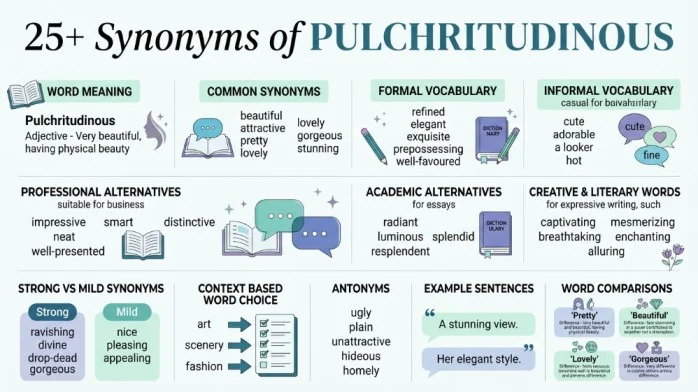
Pulchritudinous means physically beautiful or attractive, usually describing a person’s appearance. The best synonyms include beautiful, gorgeous, stunning, attractive, lovely, and handsome. Use everyday alternatives in conversation, beautiful or attractive in neutral writing, and more expressive words such as ravishing or exquisite in creative writing.
Meaning, Tone, and Context
Simple Definition
Pulchritudinous means physically beautiful or attractive.
It is normally used to describe someone’s appearance, although the broader idea of beauty can sometimes be applied creatively to other subjects.
The word carries a strong focus on physical attractiveness rather than personality, character, usefulness, or moral qualities.
Part of Speech
Pulchritudinous is an adjective.
Example:
“She was known for her pulchritudinous appearance.”
The noun related to the word is pulchritude, which means physical beauty.
Overall Tone
The word has a positive meaning because it expresses admiration for physical beauty.
However, its tone is noticeably more formal and unusual than words such as beautiful, pretty, or attractive.
Formality Level
Pulchritudinous is highly formal, literary, and uncommon in ordinary American English.
It can sound sophisticated in essays, literary descriptions, vocabulary discussions, or deliberately playful writing. In a normal conversation, however, beautiful, gorgeous, or attractive will usually sound more natural.
Common Uses
Pulchritudinous is most commonly useful when discussing:
- Physical beauty
- A person’s appearance
- Literary descriptions
- Advanced vocabulary
- Formal or playful writing
- Discussions about unusual English words
- Descriptive prose
It is not normally the first choice for ordinary workplace communication, casual conversation, or everyday emails.
Word Forms
| Word | Part of Speech | Meaning |
|---|---|---|
| Pulchritudinous | Adjective | Physically beautiful |
| Pulchritude | Noun | Physical beauty |
| Beautiful | Adjective | Pleasing in appearance or qualities |
| Beautifully | Adverb | In a beautiful manner |
The word pulchritude is useful when you need a noun rather than an adjective.
Example:
“Her pulchritude was obvious to everyone in the room.”
When and How to Use “Pulchritudinous”
Use pulchritudinous when you intentionally want an elevated, uncommon, or literary way to describe physical beauty. It is most effective when the unusual vocabulary itself contributes to the style.
In ordinary communication, a simpler synonym will usually be clearer.
Professional
“Although the campaign featured a pulchritudinous model, its main focus was the product.”
This is grammatically possible, but striking or elegant would usually sound more natural in professional writing.
Academic
“The novel repeatedly presents its protagonist as pulchritudinous, linking physical beauty with social status.”
Here, the word works because the sentence is analyzing language or literary characterization.
Workplace
“The company selected a pulchritudinous spokesperson for the campaign.”
The sentence is understandable, but attractive or striking would normally be more appropriate for professional communication.
Personal
“She was undeniably pulchritudinous, but her kindness made an even stronger impression.”
This works in personal or reflective writing because the unusual word creates emphasis.
“The photographs show a pulchritudinous setting along the coast.”
This sounds unusually literary for a normal email. Beautiful would be the more natural choice.
Resume
Avoid using pulchritudinous to describe yourself or another person’s appearance on a resume.
A resume should focus on skills, qualifications, achievements, and professional qualities rather than physical beauty.
Social Media
“The sunset over the mountains was absolutely pulchritudinous.”
This can work as a playful vocabulary choice on social media, especially when the unusual word is part of the post’s personality.
Best Synonyms of “Pulchritudinous”
No synonym is identical to pulchritudinous in every context. Some alternatives focus specifically on physical attractiveness, while others add ideas such as elegance, charm, emotional appeal, visual impact, or glamour.
Professional Writing: Attractive
Attractive is a safer professional alternative because it clearly communicates physical appeal without sounding unnecessarily literary.
Example:
“The campaign featured an attractive and confident spokesperson.”
Academic Writing: Beautiful
Beautiful is usually clearer than pulchritudinous in academic writing unless the paper is specifically discussing unusual vocabulary or literary style.
Example:
“The poem presents the natural world as beautiful and harmonious.”
Business Communication: Striking
Striking works well when describing a visually impressive person, design, image, or presentation.
Example:
“The advertisement uses a striking visual style.”
Casual Conversation: Gorgeous
Gorgeous is a natural informal choice when you want to express strong admiration.
Example:
“That dress looks gorgeous on you.”
Emotional Writing: Lovely
Lovely can communicate beauty with a warmer, softer emotional quality.
Example:
“She had a lovely smile that made everyone feel welcome.”
Creative Writing: Ravishing
Ravishing is a highly expressive word that conveys exceptional physical beauty.
Example:
“The portrait captured her in a ravishing evening gown.”
Resume Writing: Do Not Use a Beauty Synonym
Beauty related vocabulary generally does not belong on a resume unless appearance is directly relevant to the role.
For example, a modeling portfolio may discuss appearance, but a standard business resume should emphasize qualifications instead.
Workplace Communication: Attractive or Striking
Use attractive when referring directly to appearance and striking when describing something visually noticeable.
Example:
“The new packaging has a striking appearance.”
Stronger Meaning: Stunning
Stunning conveys a powerful reaction to beauty and often sounds stronger than the neutral word beautiful.
Example:
“The photographer captured a stunning portrait.”
Softer Meaning: Pleasant
When you want to describe appearance positively without making a strong statement about beauty, pleasant can provide a softer tone.
Example:
“The room had a pleasant, welcoming appearance.”
When Not to Use “Pulchritudinous”
When the Word Sounds Too General
This is less about the meaning itself and more about the purpose of the description. If you want to explain exactly what makes someone attractive, pulchritudinous is too broad.
Less precise:
“She had a pulchritudinous appearance.”
Better:
“She had striking green eyes and an elegant smile.”
The second sentence gives readers actual visual information.
When the Word Sounds Too Vague
Pulchritudinous tells readers that someone is beautiful but does not explain the specific quality of that beauty.
Less descriptive:
“He was pulchritudinous.”
More descriptive:
“He had a handsome face and an effortlessly confident presence.”
When the Word Sounds Too Formal
In casual conversation, pulchritudinous can sound unnatural.
Less natural:
“Your new haircut is quite pulchritudinous.”
Better:
“Your new haircut looks great.”
When the Word Sounds Too Unusual
The problem is not grammatical accuracy. The problem is familiarity.
Less natural:
“That actress is extraordinarily pulchritudinous.”
More natural:
“That actress is stunning.”
When a Stronger Word Is Needed
If you want to show a powerful emotional reaction, beautiful or pulchritudinous may not provide enough intensity.
Less expressive:
“The view was beautiful.”
Stronger:
“The view was breathtaking.”
When a Softer Word Is Better
Sometimes you want to compliment appearance without sounding intense.
Less suitable:
“She was ravishing.”
Softer:
“She looked lovely.”
When Writing About Professional Qualifications
Physical beauty should not replace relevant professional descriptions.
Less effective:
“She is a pulchritudinous manager.”
Better:
“She is a confident and highly effective manager.”
When Writing for a General Audience
If readers may not know advanced vocabulary, beautiful, attractive, or lovely will communicate the idea more efficiently.
Words Commonly Confused With “Pulchritudinous”
Beautiful
Difference: Beautiful is the broadest and most familiar word for describing pleasing appearance or qualities.
When to Use It: Use it in almost any context where you want a natural expression of beauty.
Example:
“She looked beautiful in the photograph.”
Attractive
Difference: Attractive specifically describes someone or something that creates visual appeal, although it can also describe qualities that draw interest.
When to Use It: Use it for neutral descriptions of physical appearance.
Example:
“The design is attractive and easy to understand.”
Handsome
Difference: Handsome traditionally describes a good looking man, although it can also describe people, objects, or features in broader modern usage.
When to Use It: It is especially natural when describing a man’s appearance.
Example:
“He looked handsome in his new suit.”
Pretty
Difference: Pretty usually describes attractive appearance in a softer or more delicate way.
When to Use It: It is common in everyday speech and is often used for women, children, objects, and places.
Example:
“She wore a pretty blue dress.”
Gorgeous
Difference: Gorgeous is more expressive and enthusiastic than neutral words such as attractive or beautiful.
When to Use It: Use it in casual conversation, compliments, social media, and expressive writing.
Example:
“The garden looks gorgeous in spring.”
Stunning
Difference: Stunning emphasizes the powerful visual effect something has on the observer.
When to Use It: Use it when ordinary words such as beautiful do not fully express the impact.
Example:
“The photographer took a stunning portrait.”
Best Synonyms of “Pulchritudinous” by Context
| Context | Best Synonym | Why It Works | Example |
|---|---|---|---|
| Formal writing | Beautiful | Clear and broadly accepted | “The author describes the landscape as beautiful.” |
| Academic writing | Attractive | Neutral and precise | “The study examined perceptions of attractive faces.” |
| Professional communication | Striking | Focuses on noticeable visual appeal | “The campaign uses a striking visual design.” |
| Business emails | Beautiful | Natural and easy to understand | “The presentation included beautiful photographs.” |
| Resume writing | Not generally recommended | Appearance words are usually irrelevant | Focus on skills and achievements instead. |
| Workplace communication | Attractive | Neutral when appearance must be discussed | “The new design is attractive and practical.” |
| Casual conversation | Gorgeous | Natural and enthusiastic | “You look gorgeous tonight.” |
| Everyday speaking | Beautiful | Familiar and versatile | “That’s a beautiful painting.” |
| Creative writing | Ravishing | Adds strong expressive detail | “She appeared ravishing beneath the chandeliers.” |
| Storytelling | Striking | Creates a vivid impression | “A striking figure stood at the doorway.” |
| Emotional writing | Lovely | Warm and affectionate | “She had a lovely smile.” |
| Strong emphasis | Stunning | Expresses powerful visual impact | “The final scene was stunning.” |
| Mild tone | Attractive | Positive without excessive emotion | “The apartment has an attractive interior.” |
| Social media captions | Gorgeous | Familiar and expressive | “What a gorgeous sunset.” |
| American English | Beautiful | Most natural general choice | “The bride looked beautiful.” |
| British English | Lovely | Very natural for warm compliments | “She looked lovely at the ceremony.” |
How to Choose the Best Synonym of “Pulchritudinous”
Choosing an alternative becomes easier when you identify exactly what kind of beauty you want to communicate.
Choose Based on Meaning
- If you simply mean visually beautiful, choose beautiful.
- If you mean physically attractive in a neutral way, choose attractive.
- If you mean exceptionally beautiful, choose gorgeous, stunning, or ravishing.
- If you mean elegant rather than intensely beautiful, choose elegant or graceful.
- If you mean visually noticeable, choose striking.
If you mean warm and charming, choose lovely or charming.
Choose Based on Tone
| Tone | Recommended Word |
|---|---|
| Neutral | Beautiful |
| Professional | Attractive |
| Academic | Beautiful, attractive |
| Casual | Gorgeous |
| Warm | Lovely |
| Elegant | Elegant |
| Dramatic | Stunning |
| Literary | Ravishing |
| Visually powerful | Striking |
| Romantic | Alluring |
Choose Based on Audience
For children and English learners, beautiful is easiest.
- For professional readers, attractive, elegant, and striking are usually more natural.
- For readers of fiction, words such as ravishing, alluring, and exquisite can create stronger imagery.
Choose Based on Emotional Strength
A simple progression might look like this:
Attractive → Beautiful → Lovely → Gorgeous → Stunning → Ravishing
This is not an absolute ranking because context changes how each word feels. A word can become stronger or softer depending on the sentence, speaker, and subject.
Choose Based on Writing Purpose
- For an essay, prioritize beautiful, attractive, striking, or significant when the appearance has analytical relevance.
- For a story, consider radiant, alluring, ravishing, or exquisite when the description needs more atmosphere.
- For a social media caption, gorgeous, stunning, and beautiful are usually more natural.
- For professional writing, use attractive, elegant, or striking when appearance is genuinely relevant.
Real Life Examples of “Pulchritudinous”
School
Instead of:
“The character was pulchritudinous.”
Try:
“The character was remarkably beautiful.”
This is easier for a general classroom audience.
College
“Although the novel repeatedly describes the heroine as pulchritudinous, the author gives greater attention to her intelligence and independence.”
Here, the word is appropriate because the sentence is analyzing literary language.
Workplace
Instead of describing an employee as pulchritudinous, focus on professional qualities:
“She is a confident communicator with excellent leadership skills.”
This is more appropriate for workplace writing.
Business
“The company chose a striking visual style for its new campaign.”
Striking works better than pulchritudinous because business writing usually values clarity and relevance.
“The venue was beautiful, and the photographs turned out wonderfully.”
This sounds much more natural than using pulchritudinous in an ordinary email.
Resume
Avoid:
“Pulchritudinous marketing representative.”
Use:
“Experienced marketing representative with strong communication and client relationship skills.”
Physical appearance is generally not a professional qualification.
Conversation
“She looked gorgeous at the wedding.”
This is much more natural in everyday American English than:
“She looked pulchritudinous at the wedding.”
Storytelling
“Under the soft evening light, the actress appeared almost ethereal.”
This gives readers a more specific visual impression than simply calling her pulchritudinous.
Blogging
“From its elegant architecture to its beautiful gardens, the estate offers plenty to admire.”
The varied vocabulary keeps the description from sounding repetitive.
Social Media
“Absolutely stunning sunset tonight.”
For a caption, stunning is short, familiar, and expressive.
25 Best Synonyms of “Pulchritudinous”
| Synonym | Simple Meaning | Best Used For | Example Sentence |
|---|---|---|---|
| Beautiful | Pleasing in appearance | General writing | “The painting is beautiful.” |
| Attractive | Visually appealing | Neutral descriptions | “She has an attractive smile.” |
| Gorgeous | Extremely beautiful | Casual compliments | “You look gorgeous tonight.” |
| Stunning | Extremely impressive in appearance | Strong descriptions | “The dress was stunning.” |
| Lovely | Beautiful in a warm, pleasant way | Personal writing | “She has a lovely personality and smile.” |
| Pretty | Attractive in a delicate or pleasing way | Everyday speech | “She wore a pretty dress.” |
| Handsome | Good looking, especially for men | Personal descriptions | “He is a handsome young man.” |
| Alluring | Highly attractive and tempting | Creative writing | “The mysterious character had an alluring presence.” |
| Ravishing | Exceptionally beautiful | Literary or expressive writing | “She looked ravishing at the ceremony.” |
| Exquisite | Extremely beautiful and refined | Art, fashion, description | “The gown had an exquisite design.” |
| Striking | Very noticeable and attractive | Professional and creative writing | “She has striking blue eyes.” |
| Elegant | Beautiful because of refined style | Fashion and design | “Her elegant appearance suited the occasion.” |
| Graceful | Beautiful through smooth movement or manner | People, movement, writing | “The dancer made a graceful entrance.” |
| Charming | Pleasantly attractive or appealing | People and personality | “He has a charming smile.” |
| Glamorous | Attractive in a stylish, exciting way | Fashion and entertainment | “The actress looked glamorous on the red carpet.” |
| Radiant | Beautiful in a bright, glowing way | People and creative writing | “She looked radiant on her wedding day.” |
| Beauteous | Beautiful in a poetic or old fashioned style | Poetry and literary writing | “The poet praised the beauteous landscape.” |
| Fair | Beautiful or pleasing in appearance, often literary | Literary descriptions | “The tale begins with a fair maiden.” |
| Comely | Pleasantly attractive, especially in literary usage | Literary writing | “The novel describes her as comely and kind.” |
| Memorable | Attractive or impressive enough to be remembered | Creative descriptions | “Her memorable appearance suited the character.” |
| Appealing | Pleasant or attractive | General and professional writing | “The website has an appealing design.” |
| Captivating | So attractive that it holds attention | Creative writing | “Her captivating performance held the audience.” |
| Enchanting | Delightfully attractive or charming | Stories and descriptions | “The village had an enchanting atmosphere.” |
| Picturesque | Visually attractive and suitable for a picture | Places and scenery | “The town has a picturesque setting.” |
| Pulchral | Relating to beauty, especially physical beauty | Rare, technical, or literary contexts | “The poem contains several pulchral descriptions.” |
Synonyms of “Pulchritudinous” by Usage
Professional vs Personal Synonyms
Professional writing generally benefits from restrained and familiar vocabulary.
Use attractive, elegant, striking, or appealing when physical appearance genuinely matters.
Personal communication can be more expressive. Words such as gorgeous, lovely, beautiful, and stunning sound more natural when complimenting someone.
Formal vs Conversational Synonyms
- For reports and essays, choose beautiful, attractive, striking, or elegant.
- For presentations, striking and appealing can describe visual features effectively.
- For emails, beautiful is usually preferable because it is simple and natural.
- For casual conversation and texting, gorgeous, pretty, lovely, and stunning are more common.
Academic Synonyms
Academic writing should favor clarity over unnecessarily complicated vocabulary.
Beautiful
Useful when analyzing literary descriptions, art, nature, or aesthetics.
Attractive
Useful for discussions involving physical appearance or visual appeal.
Striking
Useful when a feature is especially noticeable.
Elegant
Useful when discussing refined design, style, mathematical presentation, or sophisticated structure.
Exquisite
Useful when analyzing art, craftsmanship, literature, or highly refined visual details.
The unusual word pulchritudinous can itself be appropriate in a vocabulary, linguistics, or literary analysis paper because the unusual form may be part of the topic.
Professional and Business Synonyms
Resumes
Beauty synonyms are generally inappropriate for standard resumes.
Instead of describing someone as beautiful or attractive, focus on measurable professional strengths.
Interviews
If appearance is relevant to a role, professional, polished, presentable, or well groomed may be more appropriate than beauty focused vocabulary.
Meetings
When describing a design or presentation, use striking, elegant, appealing, or visually impressive.
Presentations
“Striking” is useful when a slide, graphic, photograph, or design immediately attracts attention.
Performance Reviews
Avoid judging employees based on physical beauty. Use words describing communication, leadership, professionalism, reliability, or performance.
Client Communication
Use clear descriptive language such as elegant, attractive, or visually appealing when discussing products, designs, or branding.
Business Emails
Prefer familiar vocabulary. Beautiful, elegant, and attractive are generally better than pulchritudinous.
Creative and Literary Synonyms
Creative writing gives you more freedom to choose expressive alternatives.
Storytelling
Striking, radiant, and captivating can help create memorable character descriptions.
Fiction
Alluring, ravishing, and enchanting can suggest attraction while adding atmosphere.
Poetry
Beauteous, fair, and exquisite can work when the style is intentionally elevated or lyrical.
Descriptive Writing
Picturesque, radiant, elegant, and enchanting can add imagery without repeating beautiful.
Speeches
Beautiful, remarkable, and inspiring are generally easier for audiences to understand than highly obscure vocabulary.
Slang or Modern Synonyms
There is no single modern slang word that functions as a direct equivalent of pulchritudinous.
Informal expressions such as gorgeous, stunning, hot, and a knockout can describe strong physical attraction, but they differ in tone and appropriateness.
Gorgeous is broadly acceptable in casual compliments.
Stunning is expressive but still relatively neutral.
Hot is much more focused on sexual or physical attractiveness and should be used carefully.
A knockout is an informal expression for a very attractive person and is best reserved for casual contexts.
These expressions should generally be avoided in academic writing, professional communication, resumes, and formal correspondence.
Strongest to Mildest Synonyms
There is no universal intensity ranking for beauty words because context strongly affects emotional force. Still, the following guide can help.
| Level | Words | General Effect |
|---|---|---|
| Mild | Appealing, attractive, pretty | Positive but restrained |
| Moderate | Beautiful, lovely, charming, elegant | Clearly positive |
| Strong | Gorgeous, radiant, exquisite, striking | Strong admiration |
| Very Strong | Stunning, ravishing, captivating | Powerful visual or emotional effect |
A word such as captivating is different from beautiful because it suggests that the person’s appearance or presence holds someone’s attention.
Similarly, elegant does not necessarily mean more beautiful. It describes a particular style of beauty based on refinement and grace.
Emotional vs Neutral Synonyms
Emotional Synonyms
These words tend to communicate stronger personal reactions:
- Gorgeous
- Stunning
- Ravishing
- Captivating
- Enchanting
- Radiant
- Lovely
Use these in personal messages, creative writing, compliments, stories, and expressive social media posts.
Neutral Synonyms
These alternatives communicate physical attractiveness more objectively:
- Beautiful
- Attractive
- Appealing
- Striking
- Elegant
- Pretty
- Handsome
These are better choices for educational, professional, descriptive, and informational writing.
Antonyms of “Pulchritudinous”
Because pulchritudinous specifically describes physical beauty, its opposites generally describe a lack of physical attractiveness. Some are neutral, while others are considerably harsher.
| Antonym | Meaning | Example Sentence |
|---|---|---|
| Ugly | Unpleasant or unattractive in appearance | “The damaged building looked ugly after the storm.” |
| Unattractive | Not pleasing in appearance | “The old design was functional but unattractive.” |
| Plain | Lacking striking physical beauty | “She had a plain appearance but a warm personality.” |
| Homely | Unattractive in appearance in American usage | “The character was described as homely rather than glamorous.” |
| Hideous | Extremely unpleasant to look at | “The creature had a hideous appearance.” |
| Unsightly | Visually unpleasant | “The construction site left an unsightly area.” |
| Grotesque | Distorted or unpleasantly strange in appearance | “The sculpture had a grotesque face.” |
| Repulsive | Extremely unpleasant and causing strong dislike | “The creature’s appearance was repulsive.” |
| Unappealing | Not attractive or inviting | “The website had an unappealing design.” |
| Unlovely | Not beautiful or pleasant | “The poet describes the landscape as bleak and unlovely.” |
| Plain looking | Having an ordinary, not especially attractive appearance | “He was described as plain looking but friendly.” |
| Ill favored | Unattractive in appearance, usually literary or old fashioned | “The tale features an ill favored stranger.” |
| Misshapen | Having an abnormal or irregular shape | “The artist rejected the misshapen figure.” |
| Deformed | Having an unusual or abnormal physical form | “The character was portrayed as physically deformed.” |
| Unhandsome | Not handsome or attractive | “The character is intentionally presented as unhandsome.” |
Some of these words are much harsher than others. Plain and unappealing can be relatively mild, while hideous, repulsive, and grotesque can sound insulting or emotionally severe.
Comparison: “Pulchritudinous” vs Similar Words
Pulchritudinous vs Beautiful
Main Difference
Both describe physical beauty, but beautiful is familiar and broadly natural, while pulchritudinous is rare and highly formal.
Which Is Stronger?
Neither necessarily describes greater beauty. Pulchritudinous mainly adds an unusual and elevated tone.
Which Is More Formal?
Pulchritudinous is considerably more formal and literary.
When to Use Each
Use beautiful in normal communication. Use pulchritudinous when discussing advanced vocabulary, literary style, or intentionally unusual language.
Examples
Pulchritudinous:
“The novelist described the heroine as pulchritudinous.”
Beautiful:
“The novelist described the heroine as beautiful.”
Pulchritudinous vs Attractive
Main Difference
Attractive is a neutral term for physical appeal. Pulchritudinous emphasizes beauty with a much more unusual style.
Which Is Stronger?
Pulchritudinous can sound more emphatic, although it does not necessarily mean more beautiful.
Which Is More Formal?
Pulchritudinous is more formal, while attractive is more versatile.
When to Use Each
Use attractive for professional or neutral descriptions. Use pulchritudinous when the unusual vocabulary is intentional.
Examples
Pulchritudinous:
“The character was described as pulchritudinous.”
Attractive:
“The character was described as attractive.”
Pulchritudinous vs Gorgeous
Main Difference
Gorgeous is a familiar informal word that expresses strong admiration. Pulchritudinous is unusual and formal.
Which Is Stronger?
Gorgeous often sounds more emotionally enthusiastic in everyday speech.
Which Is More Formal?
Pulchritudinous is more formal.
When to Use Each
Use gorgeous for compliments and casual writing. Use pulchritudinous for literary or vocabulary focused contexts.
Examples
Pulchritudinous:
“She was considered pulchritudinous by the narrator.”
Gorgeous:
“She looked gorgeous in the photographs.”
Pulchritudinous vs Stunning
Main Difference
Stunning emphasizes the strong visual effect something creates. Pulchritudinous simply identifies physical beauty.
Which Is Stronger?
Stunning often creates a stronger immediate reaction.
Which Is More Formal?
Pulchritudinous is more formal, although stunning works comfortably in both conversation and writing.
When to Use Each
Use stunning for powerful visual descriptions. Use pulchritudinous for an intentionally elevated vocabulary choice.
Examples
Pulchritudinous:
“The portrait depicted a pulchritudinous young woman.”
Stunning:
“The portrait was absolutely stunning.”
Pulchritudinous vs Lovely
Main Difference
Lovely is warmer and softer. Pulchritudinous focuses directly on physical beauty.
Which Is Stronger?
Pulchritudinous sounds more formal, while lovely may feel more emotionally affectionate.
Which Is More Formal?
Pulchritudinous is more formal.
When to Use Each
Use lovely for warm compliments and personal communication.
Examples
Pulchritudinous:
“The character was described as pulchritudinous.”
Lovely:
“She had a lovely smile.”
Pulchritudinous vs Handsome
Main Difference
Handsome is traditionally used for an attractive man, while pulchritudinous can describe physical beauty more generally.
Which Is Stronger?
Neither is inherently stronger.
Which Is More Formal?
Pulchritudinous is more unusual and formal.
When to Use Each
Use handsome when naturally describing a good looking man. Use pulchritudinous when the focus is on an elevated description of physical beauty.
Examples
Pulchritudinous:
“The narrator portrays the hero as pulchritudinous.”
Handsome:
“The hero is described as handsome.”
Common Phrases and Expressions with “Pulchritudinous”
Because pulchritudinous is an uncommon word, it does not have many established idioms or fixed expressions in everyday American English. It is more useful to think of its natural collocations.
Pulchritudinous Appearance
Meaning: A physically beautiful appearance.
Example:
“The novel emphasizes the character’s pulchritudinous appearance.”
Pulchritudinous Woman
Meaning: A woman described as physically beautiful.
Example:
“The story introduces a pulchritudinous woman at the beginning of the chapter.”
Pulchritudinous Man
Meaning: A man described as physically attractive.
Example:
“The narrator portrays the hero as a pulchritudinous man.”
Pulchritudinous Character
Meaning: A fictional character whose physical beauty is emphasized.
Example:
“The author creates a pulchritudinous character whose appearance influences the plot.”
Pulchritudinous Figure
Meaning: A person described as physically beautiful.
Example:
“The painting depicts a pulchritudinous figure surrounded by flowers.”
Pulchritudinous Beauty
Meaning: A highly redundant but stylistically possible expression emphasizing beauty.
Example:
“The poem celebrates the pulchritudinous beauty of the heroine.”
This phrase is usually less effective than simply saying beauty, because the adjective already expresses the idea.
Pulchritudinous Features
Meaning: Attractive physical characteristics.
Example:
“The portrait highlights her pulchritudinous features.”
These combinations are understandable, but they remain much less common than ordinary expressions using beautiful, attractive, or gorgeous.
Common Mistakes to Avoid
1. Assuming Pulchritudinous Is the Best Choice Everywhere
Incorrect:
“Your new profile picture is pulchritudinous.”
Better:
“Your new profile picture looks gorgeous.”
Why:
The second sentence sounds more natural in casual communication.
2. Using It as a Noun
Incorrect:
“Her pulchritudinous was obvious.”
Better:
“Her pulchritude was obvious.”
Why:
Pulchritudinous is an adjective. The noun form is pulchritude.
3. Using It to Describe Personality
Incorrect:
“His pulchritudinous personality made him a great leader.”
Better:
“His charismatic personality made him a great leader.”
Why:
Pulchritudinous describes physical beauty, not personality or character.
4. Using It in a Resume
Incorrect:
“Pulchritudinous sales professional with five years of experience.”
Better:
“Experienced sales professional with five years of experience.”
Why:
A resume should emphasize professional qualifications rather than physical appearance.
5. Assuming It Means “Excellent”
Incorrect:
“The company’s pulchritudinous strategy increased sales.”
Better:
“The company’s effective strategy increased sales.”
Why:
Pulchritudinous is connected to physical beauty, not general quality or effectiveness.
6. Using It When a Specific Description Would Be Better
Incorrect:
“She had a pulchritudinous face.”
Better:
“She had expressive eyes, a graceful smile, and delicate features.”
Why:
Specific details help readers visualize the subject instead of receiving only a general judgment.
7. Overusing Advanced Vocabulary
Incorrect:
“Her pulchritudinous dress complemented her pulchritudinous hair and pulchritudinous jewelry.”
Better:
“Her elegant dress complemented her radiant appearance and delicate jewelry.”
Why:
Varied vocabulary produces smoother and more natural prose.
Frequently Asked Questions
What are the best synonyms of “pulchritudinous”?
The best synonyms of pulchritudinous include beautiful, attractive, gorgeous, stunning, lovely, handsome, alluring, ravishing, and exquisite. The best choice depends on tone, audience, and writing context.
What are the best formal synonyms of “pulchritudinous”?
Formal synonyms include beautiful, attractive, elegant, exquisite, striking, and beauteous. For most formal writing, beautiful, attractive, or elegant is clearer and more natural than the original word.
What are common informal synonyms of “pulchritudinous”?
Common informal alternatives include gorgeous, beautiful, pretty, lovely, and stunning. These words are much more familiar in everyday American English and work naturally in conversations, texts, and social media.
What is another word for “pulchritudinous” in professional writing?
Attractive, elegant, striking, or visually appealing are better professional alternatives. They communicate visual appeal without the unusually formal and potentially distracting tone of pulchritudinous.
What is the difference between “pulchritudinous” and “beautiful”?
Both words describe physical beauty, but beautiful is common, versatile, and natural in everyday English. Pulchritudinous is rare, highly formal, and often chosen because of its unusual vocabulary rather than because it expresses a different type of beauty.
What is the opposite of “pulchritudinous”?
Common opposites include ugly, unattractive, plain, unappealing, unsightly, and hideous. The best antonym depends on how strongly you want to express a lack of physical beauty.
Conclusion
Pulchritudinous means physically beautiful or attractive, but its unusual and highly formal character makes it less natural than many everyday alternatives. Words such as beautiful, attractive, gorgeous, stunning, lovely, and striking are usually better choices for modern communication.
The best synonym depends on your purpose. Choose attractive for neutral descriptions, gorgeous for casual compliments, stunning for strong visual impact, lovely for warmth, and ravishing or exquisite when a creative or literary style calls for greater expression.
No synonym works perfectly in every situation. When choosing among the synonyms of pulchritudinous, consider your audience, tone, intended meaning, and level of formality. A useful vocabulary habit is to replace a general beauty word only when the new word adds a clear and relevant shade of meaning.
Read More Related Articles:
50+ Best List of Synonyms | for Better Writing and …
50+ Synonyms of Love | Powerful Words to Express Every …
Synonyms for Thus | Meaning, Examples, and Better Word …